Embracing the Melodrama Part II #30: The Sweet Ride (dir by Harvey Hart)


The_Sweet_Ride_FilmPosterThe 1968 film The Sweet Ride takes the audience on a ride through Malibu and reminds us all that, in many ways, the 1960s sucked.

The Sweet Ride opens with actress Vicki Cartwright (Jacqueline Bisset) losing her top while swimming in the ocean.  While Vicki panics and tries to figure out how to get back to the beach without anyone seeing her breasts, she’s spotted by a surfer named Denny McGuire (Michael Sarrazin).  Denny hands her a towel and then leads her back to the beach house that he shares with aging tennis player Collie (Anthony Franciosa) and stoned musician Choo-Choo (Bob Denver).

The rest of the film is a 90 minute tour of California beach life in the late 60s.  Despite Collie’s cynical warning against falling in love, Denny does just that, despite the fact that Vicki refuses to tell him anything about her past or even where she lives.  Meanwhile, Collie spends his time hustling on the tennis court and the married Choo-Choo pretends to be gay in an attempt to get out of being drafted.  (Choo-Choo probably could have gotten out of the draft by pointing out that he appears to be 40 years old but the filmmakers decided to have him walk around with a poodle and speak in falsetto.  Just in case you had any doubt that this film was made in 1968…)  It’s a mix of comedy, romance, and drama and it’s features footage of some real bands performing in actual Malibu nightclubs and that’s a good thing for all of us history nerds.

And, since The Sweet Ride was made in 1968, the whole film gets progressively darker as it reaches its conclusion.  Choo-Choo does get drafted and it’s hard to believe he’ll survive a day in Viet Nam.  Collie’s perfect life is revealed to be an empty facade.  Denny realizes that his friends are all immature losers.  And Vicki ends up getting assaulted by a high-power studio executive (Warren Stevens).  It all leads to more violence, disillusionment, and general ennui.

For some reason, The Sweet Ride shows up on FXM fairly regularly.  It’s a strange film because it doesn’t really work and yet it’s also compulsively watchable.  It tries to be about everything and, as a result, it often feels like it’s about absolutely nothing.  And yet, somehow, it remains compelling…

Why is the film compelling despite itself?  It’s not because of the main characters, that’s for sure.  The boys in the beach house are probably some of the least likable film protagonists in cinematic history.  Anthony Franciosa gave some great performances in his career (check him out in A Face in the Crowd and Tenebrae) but Collie is such a smug jerk that you find yourself hoping that someone will just punch him in the face.  Meanwhile, Denny tends to come across like a weak-willed and obsessive stalker and Choo-Choo — well, Choo-Choo often seems to be a character in a totally different movie.  As for Vicki, her character pretty much exclusively exists to be victimized.

Ultimately, I think The Sweet Ride is watchable because it is such an imperfect time capsule.  If I wanted to know what it was like to be alive in the 60s, The Sweet Ride is one of the films that I would watch.  It’s not the best film ever made but it is a chance to look into the past.

(Incidentally, The Sweet Ride was directed by Harvey Hart, who also directed the underrated Shoot.)


“It Follows” That I Should Have Liked This Movie, But —


It-Follows-poster

A funny thing happened on the way to writer/director David Robert Mitchell’s 2014-lensed indie horror It Follows finding its way into the VOD dump-off land most contemporary scare flicks have reluctantly learned to call home : it got noticed. In fact, it got noticed a lot, and evidently by at least some of the right people, because on the basis of positive “buzz” alone, the aforementioned relegation to so-called “home viewing platforms” was quickly scuttled in favor of a limited theatrical release — which just as quickly became a wide theatrical release — which finally ended with this being one of the most-talked- about “supernatural thrillers” in years.

What I can’t figure out is, I’m sorry to say, is why.

it-follows-341

Don’t get me wrong — It Follows certainly isn’t bad by any stretch of the imagination, and I’m naturally disposed towards rooting for any sort of original horror film that tries to navigate its way through the contemporary morass of remakes and might-as-well-be-remakes because they’re based on concepts that were played out three or four decades ago, but by the time I got around to seeing this flick yesterday, the hype surrounding it was so all-consuming that my expectations were sky high. Maybe it’s not fair to expect any movie to live up to all that, much less a modest production out of Detroit like this one, but I like to think that I’m honest enough with myself (and, hopefully, with the rest of you) to recognize that my belief that this is just a more-stylishly-done-than-usual presentation of a rather poorly-thought-through, and in many cases bog-standard, story would be unchanged even without the profound sense of “well, that was a bit of a letdown” I left the theater with. I’m not holding Mitchell’s rave reviews against him by any stretch, nor is it fair to judge his work against a yardstick fashioned from others’ praise, but hey — I’m only human, and when I come out of a movie that most everyone else has gushed one superlative after another about feeling decidedly unimpressed, I’ve gotta wonder where the disconnect comes from. Am I really that hard to please, or is everyone else just that wrong?

I mentioned my feelings about the film in a horror and exploitation group I belong to on facebook, and a friend on there made an interesting observation — most of the more glowing reviews for It Follows have come from “establishment” critics (as in, those who routinely guffaw at the horror genre in general, when they even bother to pay attention to it at all), while hard-core “horror hounds” have been decidedly less enthusiastic. A quick bit of research on my part found this to be pretty true — sure, most of the “big” horror sites and publications have been effusive in their praise, but by and large the die-hards out there have been a lot more cool towards it.

My theory is pretty simple — they (as in, your major newspaper and magazine critics) haven’t seen this done a hundred times before, while we (as in, Mr. and Ms. horror aficionado) have. And therein lies the entire difference in perception.

1

To be sure, Michell has concocted a very stylish little number here — the cinematography and shot composition, the performances, and particularly the sound design are all top-notch. If you don’t watch a lot of horror flicks and are inclined to write the ones you haven’t seen off completely, you could be forgiven for being surprised that some of them are this well done. But when you do watch a lot of horror, and you see vastly superior fare like Starry Eyes garnering far less attention, well — you’re bound to wonder what all the fuss is about in this case.

Likewise, the central premise involving a young woman named Jay Height (played my Maika Monroe, who does a fantastic job) contracting the attention of some sort of malevolent entity after a casual sexual encounter “transmits” it to her might feel reasonably original to somebody who doesn’t “speak fluent horror,” but if you do, you’ll recognize it as a slapdash combination of Shivers-era Cronenbergian body horror and dime-a-dozen, regulation-issue “possession movie” tropes. Furthermore, the idea that sexual “promiscuity” (as in, being female and actually enjoying sex) equals death is the oldest card in the “slasher” movie hand, Mitchell just has the nerve to obfuscate it under a thick enough  layer of pretense that you can be swindled into believing he’s “deconstructing” the whole notion rather than reinforcing it. Trust me when I say he’s clearly doing the latter.

it-follows-movie

Another thing that bugged the shit out of me about It Follows is how flat-out pleased with its own supposed “cleverness” it is. Jay and her sister, Kelly (Lili Sepe) live in a house that’s pure 1970s throwback, and most of their friends drive cars that date to that era, but one member of their slacker clique has a flip-open plastic toy seashell that doubles as a Kindle-type device, while their mom has a fancy-ass modern refrigerator to go along with her Curtis Mathes console TVs and outdated brown shag carpeting. The streets and driveways of their suburban neighborhood seem to be populated with decidedly modern cars and SUVs and mini-vans, as well. This dichotomy of past and future might feel right at home in, say, a David Lynch film, or some other equally-channeled-from-the-subconscious story, but in a narrative as by-the-numbers as this one, it just feels like weirdness for its own sake, and a rather naked plea for attention that the filmmakers don’t trust you enough to get on the first pass, so they keep hammering the point home. Think of the scene in the thoroughly risible Juno where she takes a call in her bedroom on one of those old plastic hamburger-shaped phones and, afraid that you’ll miss how cool and “shabby-chic” the whole thing is, they actually have her say into the receiver “sorry, I can’t hear you so well — I’m talking to you on my hamburger phone,” and you”ll get what I’m driving at here.

The final major flaw in Mitchell’s little opus I feel the need to call attention to  is the fact  that he apparently hasn’t taken the time to think through how the whole “STD possession” thing works. The guy who gave Jay the “curse” admits he’s still being pursued by the ultra-slow-motion killer(s) after even after playing hide the salami with her, and in due course Jay herself can’t seem to shake it either after screwing some loser friend of hers in the hospital — even after it kills him. She finally seems to manage to lose her pursuers-from-beyond-the-grave when — spoiler alert! — she has sex with her long-suffering male friend/lap dog Paul (Keir Gilchrist, the second of the film’s pitch-perfect leads), but if this is supposed to be some heavy-handed metaphor for the idea that it’s true love that finally sends the spirits packing, I have to say it falls pretty flat, because when Jay finally relents to allowing Paul’s dream of getting his schlong inside her to come true, it feels more like a combination of pity fuck and resignation to pass it on to him just because she’s tired of being — you know — followed. Yeah, sure, he’s clearly over the moon about her, but she seems to have just finally “settled” for a guy who was convenient and cared about her. Talk about playing into the old “you can’t have everything you want, ladies” and “don’t aim for higher than your station in life” pieces of received “wisdom.”

The big denoument here comes when Paul concocts a totally lame-brained scheme to kill the “stalker force” in a public swimming pool — a plan that has disaster written all over it from the outset (disaster that’s only averted due to the fact that every single one  of the literally dozens of electrical appliances they toss into the drink doesn’t start shooting sparks; go figure that one out), but I’ll gave that a pass because stupid teenagers do a lot of stupid shit. I find it rather useful to mention,  though,  simply because it’s such a handy representation in microcosm for why the movie itself doesn’t work, much less live up to all those hyper-congratulatory blurbs we’ve been reading : it all sounds good on paper for about a minute, but ultimately can’t stand up to any sort of even semi-rigorous examination.


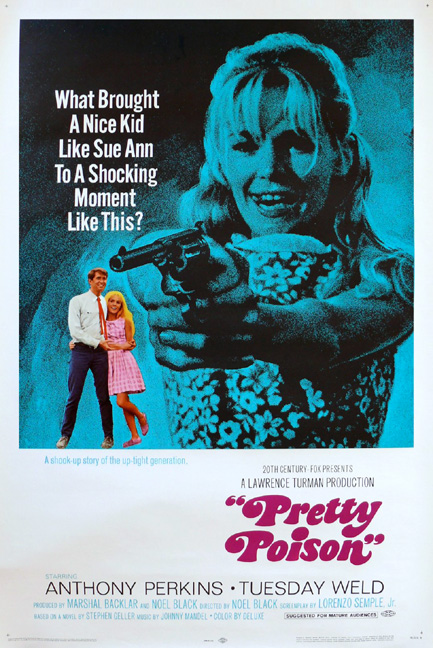
Embracing the Melodrama Part II #29: Pretty Poison (dir by Noel Black)


Prettypoison1

“I don’t care if critics like it; I hated it.  I can’t like or be objective about films I had a terrible time doing.”

— Tuesday Weld on Pretty Poison (1968)

It’s actually rather depressing to read that Tuesday Weld hates Pretty Poison because it really is an underrated gem, a nifty little thriller that acts as sly satire on youth, conformity, and small town life.  The main reason that the film works is because of the performances delivered by both Weld and her co-star, Anthony Perkins.

But then again, when we the viewers think back on a movie, we remember what we saw as a member of the audience and sometimes, we forget that just because a film is fun to watch, that doesn’t necessarily mean that it was enjoyable to make.  When actors and other technicians think back on a film they were involved with, they remember the experience of actually making it.  Reportedly, Weld did not get along with the director of Pretty Poison and couldn’t wait to get away from him.

Interestingly enough, in Pretty Poison, Tuesday Weld plays a teenage girl who doesn’t get along with her mother and who can’t wait to get away from her.  Perhaps being miserable while making Pretty Poison helped Weld to bring a miserable character to life.

Pretty Poison opens with a nervous-looking man named Dennis Pitt (Anthony Perkins) watching a group of high school cheerleaders practicing on a field.  His attention is focused on one cheerleader in particular, the blonde Sue Ann Stepanek (Tuesday Weld).  Even before the opening credits have ended, the film has established a familiar dynamic.  Sue Ann is the fresh-faced example of small town American innocence.  Dennis is the type of creepy older guy that every girl has had to deal with at some point in her life.  (When I was in high school, there were always guys like Dennis hanging out around the mall.  When I was in college, the Dennis Pitts of the world were the guy who still hung out around the dorms even though they hadn’t been a student in a decade.)

Having established this dynamic early on, Pretty Poison spends the rest of its running time turning that dynamic upside down.

Dennis has recently been released from a mental hospital.  Under the watchful eye of his parole officer (John Randolph), Dennis gets a mind-numbingly dull job at a local mill and tries to live a normal life.  When Dennis finally does get a chance to talk to Sue Anne, he lies to her and tells her that he’s a secret agent and that he’s in town on a mission.  Sue Anne responds to Dennis’s awkward flirting and soon, she’s accompanying him on his “missions.”  During one such mission near the mill, they’re spotted by a security guard.  Sue Anne responds by enthusiastically murdering him.

Yes, the cheerleader’s a sociopath.

Sue Anne’s tyrannical mother (Beverly Garland) does not approve of her relationship with Dennis.  Sue Anne wants her mother out of the way and she expects her secret agent boyfriend to help her out…

Pretty Poison is a sharp mix of dark comedy and heightened drama, one that gets progressively darker as it progresses.  From the minute the film first shows Sue Anne intensely practicing on that field while Dennis watches her, it’s pretty obvious that the film was meant to be an allegory for American society in 1968.  Sue Anne is the perfect, all-American cheerleader who kills people because she can.  Dennis is the neurotic outsider who knows that he’ll never be able to get anyone to believe the truth.

And it all works, largely because both Anthony Perkins and Tuesday Weld are so well-cast.  It is, of course, impossible to watch Perkins without first thinking about Psycho but he actually manages to make Dennis into a very different character from Norman Bates.  If Norman was a psycho who, at first sight, looked like an innocent, Dennis is an innocent who, at first sight, looks like a psycho.  Tuesday Weld, meanwhile, turns Sue Anne into a disturbingly plausible killer, the type who, within minutes, can alternate between moodiness and giddiness, all the while squealing with orgasmic joy while bashing in someone’s head.

Tuesday Weld may hate Pretty Poison but it’s still a pretty good movie.

What Lisa Watched Last Night #122: Deadly Revenge (dir by Michael Feifer)


Last night, I watched Deadly Revenge on Lifetime!

Deadly_Revenge_TV-243376740-large

Why Was I Watching It?

Not only was it on Lifetime but it had one of the most perfectly generic Lifetime titles ever.  Deadly Revenge sounds like one of the results that you’d get from a random Create-A-Lifetime-Movie-Title Generator.

What Was It About?

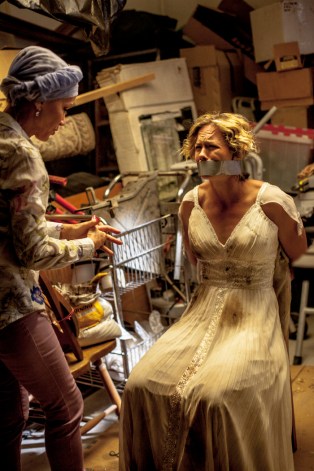
Harrison (Mark Hapka) appears to be the perfect guy.  He’s got a good job, a great apartment, and he’s a good cook!  However, he also has some secrets in his part, as his fiancee, Cate (Alicia Ziegler), discovers when she agrees to take care of Evelyn (Donna Mills), his sick mother.

What Worked?

Actually, this movie really wasn’t that bad.  Alicia Ziegler and Donna Mills did the best that they could possibly do.  If their characters occasionally didn’t make sense, that had more to do with the script than the performances.  As well, I enjoyed seeing where everyone lived.  Harrison had a really kickass apartment and Evelyn — oh my God, she practically lived in a freaking castle!

Plus, towards the end of the film, Cate got to wear this white dress that would look great on me.  So, there’s always that.

What Did Not Work?

Oh my God, this is such a frustrating movie to try to review!  Under the no spoiler rule, I’m not allowed to talk about the solution to the film’s mystery but, at the same time, it’s sooooooo obvious!  Seriously, you will figure it out within the first 30 minutes of the film.  (You would have figured it out earlier except for the fact that the mystery doesn’t start until about 30 minutes into the film.)  I mean, you’re supposed to be shocked when the big secret is revealed but the only shocking thing is that Cate didn’t figure it out for herself.  IT WAS SO OBVIOUS!

Like seriously.

“Oh my God!  Just like me!” Moments

I’ve actually recently had a dizzy spell/panic attack while driving so when Cate had the same thing happen to her, I was like, “Oh my God, I know exactly how scary that is!”

I do think I handled it better than Cate though.  Cate reacted by calling up her best friend and talking to her on the phone while driving!  In my case, however, I quickly pulled over to the side of the road, turned off the engine, and did my breathing exercises for panic attacks.

Lessons Learned

If it seems painfully obvious that someone is trying to kill you, they probably are.

Deadly Revenge_13

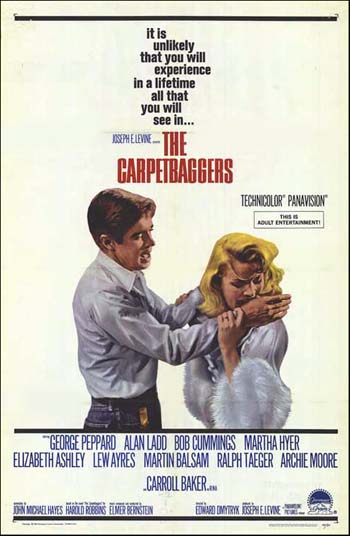
Embracing the Melodrama Part II #28: The Carpetbaggers (dir by Edward Dmytryk)


The_Carpetbaggers_1964_poster

The 1960s was apparently a bad time for talented old school Hollywood filmmakers getting sucked into making big budget, excessively lengthy films.  Joseph L. Mankiewicz spent most of his career making movies like All About Eve and then, in 1963, he ended up directing Cleopatra.  Elia Kazan went from A Face In The Crowd to The Arrangement.  John Huston went from Treasure of the Sierra Madre and The African Queen to directing not only The Bible but Reflections in a Golden Eye as well.

And then there’s Edward Dmytryk.  Dmytryk may not be as highly regarded by modern critics as Mankiewicz and Huston but he still directed some of the best film noirs of the 1940s.  His 1947 film Crossfire was nominated for best picture and probably should have won.  In 1952, he directed one of the first true crime procedural films, The Sniper.  His 1954 best picture nominee, The Caine Mutiny, featured one of Humphrey Bogart’s best and most unusual performances.

And yet, in 1964, he somehow found himself directing The Carpetbaggers.

The Carpetbaggers tells the story of Jonas Cord (George Peppard).  Jonas is the son of the fabulously wealthy Jonas Cord, Sr. (Leif Erickson).  At the start of the film, father and son do not get along.  Senior resents that Junior is more interested in piloting airplanes than in learning the family business.  Junior is angry that Senior has married Jonas’s ex-girlfriend, actress Rina Marlowe (Carroll Baker).  In fact, as far as Jonas, Jr. is concerned, Nevada Smith (Alan Ladd) is more of a father to him than his actual father.

Nevada Smith is Jonas, Sr.’s best friend and occasional business partner.  He’s a former cowboy who, we are told in a lengthy bit of exposition, is legendary for tracking down and killing the three men who killed his parents.  (As we listen to Jonas, Jr. tell the entire lengthy story, we find ourselves thinking, “Okay, so why not make a movie out of that story?”  Well, they did.  Two years after the release of The Carpetbaggers, Steve McQueen starred in Nevada Smith.)  Nevada’s also a film star whose career is in deep decline.

Speaking of deep decline, Jonas, Sr. ends up having a heart attack and dramatically dropping dead before he can get a chance to disinherit his son.  Jonas, Jr. inherits the Cord fortune and the Cord business and proceed to spend the next two and a half hours abusing everyone who gets close to him.  He even mistreats his loving and neurotic wife, Monica (Elizabeth Ashley, giving the only really memorable performance in the entire film).

Yes, there’s really no reason to have any sympathy at all for Jonas Cord, Jr. but the film insists that we should because he’s the main character and he’s played by the top-billed star.  We’re also told that he’s a brilliant aviation engineer and I guess we’re supposed to admire him for being good at what does.  We also discover that Jonas believes that his mother was insane and that she passed down her insanity to him.  He fears that he’ll pass the crazy gene to any of children that he might have so that’s why he pushes everyone away.  Just in case we don’t understand how big a deal this is to him, the camera zooms in for a closeup whenever Jonas is reminded of his mother.

(In the 60s, all mental instability was represented via zoom lens.)

However, Jonas isn’t just into airplanes!  He also buys a movie studio, specifically because Rina Marlowe is under contract.  Soon, Jonas is directing movies his way.  Jonas also finds himself falling in love with another actress (Martha Hyer) so, of course, he starts treating her badly in an effort to push her away.

What can be done to save the tortured soul of Jonas Cord?  Maybe he just need to get beaten up by Nevada Smith…

The Carpetbaggers was based on a novel by Harold Robbins.  The novel was apparently quite a scandal when it was originally published.  People read it and they wondered, “Who was based on who?”  Well, if you’ve ever seen The Aviator, it’s not that difficult to figure out.  Jonas Cord, eccentric movie mogul and obsessive pilot, was obviously meant to be Howard Hughes.  Rina Marlowe was meant to be Jean Harlow, a fact that can be guessed just by looking at the last names.  And I’m guessing that Nevada Smith was probably based on former President Warren G. Harding because … well, why not?

I suppose that, by the standards of 1964, the film version of The Carpetbaggers would have been considered risqué.  For a modern audience, the main appeal of something like The Carpetbaggers is to see what was once considered to be shocking.  The film is overlong, George Peppard doesn’t exactly figure out how to make Jonas into the compelling  rogue that he needs to be, the clothes and the sets are a lot more interesting than any of the dialogue (but not interesting enough to carry a nearly 3 hour movie), and the film’s pacing is so off that some scenes seem to go on forever while others are way too short.  But, as a cultural and historical artifact, The Carpetbaggers does hold some interest.

The Carpetbaggers was made at a time when Hollywood felt it was under attack from both television and European cinema.  With a film like The Carpetbaggers, the studios were saying, “See!?  Television will never be able to make a film this long and big!  And those Europeans aren’t the only ones who can make a movie about sex!”  Of course, as so often happened during this time, the studios failed to take into account that size and length don’t always equal quality (and ain’t that the truth?).  As for the sex — well, we hear a lot more than we actually see.  The Carpetbaggers is one of those films where everyone talks about sex, largely because showing sex wasn’t really an option.  (And it should be noted that most of the sex talk is delivered in the language of euphemism.)  As a result, The Carpetbaggers feels incredibly tame by today’s standards.  As a result, your main reaction to The Carpetbaggers will probably be to marvel at what was considered daring and shocking 50 years ago.

(And before we get too cocky and quick to dismiss those who came before us, let’s consider how our current films will look to movie audiences five decades from now…)

As far as biopics of Howard Hughes are concerned, The Carpetbaggers in no Aviator.  However, it is an occasionally interesting historical artifact.

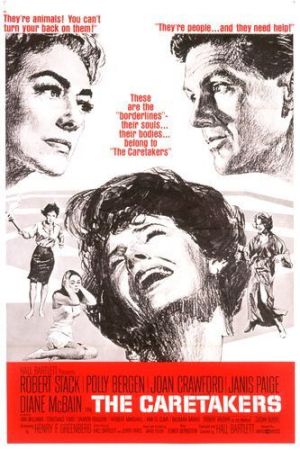
Embracing the Melodrama Part II #27: The Caretakers (dir by Hall Bartlett)


The_Caretakers_(1963_movie_poster)Whenever I go to Half-Price Books, I always seem to end up spending most of my time browsing the “nostalgia” section.  This is where they keep all of the old paperbacks that were published long before I was born.  This is where you can find old romance novels, “for adults only” novels, detective novels, and occasionally you’ll even find mainstream novels that were apparently considered to be quite daring when they were originally released.  These novels usually carry cover blurbs that brag about how controversial they are and how they deal with the “real issues of today.”

Usually, these novels are pretty silly and over-the-top which is why I always seem to end up buying a lot of them.  About a year ago, I bought a novel from 1959.  It was by Dariel Telfer and it was called The Caretakers.  The cover features a naked woman standing in front of several nurses and doctors.  The cover blurb announces that The Caretakers is “A shattering novel about nurses, doctors, and patients in a state hospital where emotions readily explode!”  The back cover features a pull quote from Time: “Will shock as well as arouse compassion.”

Now, I have to admit that I have yet to get around to actually reading The Caretakers.  However, thanks to TCM, I recently saw the 1963 film version and it’s a film that definitely embraces the melodrama.

How melodramatic is The Caretakers?  It’s melodramatic enough that it opens with Lorna Medford (Polly Bergen) stumbling into a movie theater and having a nervous breakdown.  Since this film was made in 1963, her mental breakdown is represented by spinning the camera around and getting hyperactive with the zoom lens, all while Bergen shrieks and tears at her hair.

Lorna is sent to a mental hospital, where she meets several other patients and is treated by Dr. MacLeod (Robert Stack), who is a rebel.  We know that he’s a rebel because everyone else at the hospital keeps telling him that he’s a rebel and complaining about his use of radical use of group therapy.  Under Dr. MacLeod’s guidance, Lorna reveals that she hasn’t gotten over the tragic death of her child.

As the film progresses, Lorna gets to know the rest of the patients.  They’re a mixed bunch, all played by actresses who clearly saw this as their chance to pick up an Oscar for Best Supporting Actress and were determined to make as big an impression as possible.  For instance, Barbara Barrie plays Edna, who never speaks but who does enjoy setting fires and who, whenever she’s feeling persecuted, poses as if she’s hanging from a cross.  And then there’s grandmotherly Irene (Ellen Corby), who is supposed to be the nice one but always looks like she’s on the verge of very sweetly shoving a pair of knitting needles into someone’s eyes.

However, my favorite patient was the cynical Marion (Janis Paige), precisely because she was so cynical and, as a result, she got all the best lines.  Marion is a former prostitute who now hates all men and Paige has a lot of fun playing the role.  Whenever Paige is giving one of her long, angry monologues, she practically grabs the film and refuses to let it go.

And then, of course, there’s Joan Crawford.  Crawford doesn’t play a patient.  Instead, she’s the head nurse and she doesn’t approve of Dr. MacLeod’s methods.  Crawford announces early on that she’s been attacked by a patient in the past and her main concern is protecting her staff.  She teaches a self-defense class.  If you’ve ever wanted to see a middle-aged Joan Crawford flip someone over, The Caretakers is a film to watch.

And that’s The Caretakers for you.  It’s one of those films that takes itself so seriously that it becomes humorous despite itself.  As a result, the film is a lot of unintentional fun.

And who knows?

Maybe someday, I’ll get around to reading the book!


Embracing the Melodrama Part II #26: Cleopatra (dir by Joseph L. Mankiewicz)


Cleopatra_posterWhile watching the 1963 best picture nominee, Cleopatra, I had many thoughts.  The film lasts over 4 hours so I had a lot of time to think.

For instance, I often found myself impressed by the sheer size of the production.  I marveled at the recreation of ancient Greece and Rome.  I loved looking at the ornate costumes.  I loved feeling as if I was taking a look back at what Rome may have actually looked like at the height of the Roman Empire.  Making it all the more impressive was that this film was made in the days before CGI.  When the film’s Romans walked through the streets of Rome, they weren’t just actors standing in front of a green screen.  They were walking down real streets and surrounded by real buildings.  It reminded me of the awe and wonder that I felt when I was in Italy and I was visiting the ruins of ancient Rome.

(I don’t know if any of the cast accidentally flashed everyone like I did when I visited during Pompeii on a windy day but considering how short some of the skirts on the men were, it wouldn’t surprise me if they did!)

And, as I marveled at the recreation of Rome, I also thought to myself, “How long is this freaking movie?”  Because, seriously, Cleopatra is an amazingly long movie.  It’s not just the film is over four hours long.  It’s that the film feels even longer.  Gone With The Wind, The Godfathers Part One and Part Two, Once Upon A Time In America; these are all long films but, because they’re so great, you never find yourself checking the time while watching.  Cleopatra is the opposite of that.  Cleopatra is a film that, at its slowest, will make you very much aware of how many seconds are in a minute.

I found myself marveling at the lack of chemistry between Elizabeth Taylor and Richard Burton.  If anything, this is the most shocking thing about Cleopatra.  If Cleopatra is famous for anything, it’s famous for being the film where Elizabeth Taylor (cast in the role of Cleopatra) first met Richard Burton (who was playing Mark Antony).  Their affair dominated the gossip headlines.  (If TMZ and YouTube had been around back then, there would be daily videos of Richard Burton punching out paparazzi.)  Cleopatra was the first of many big-budgeted, overproduced films that Taylor and Burton co-starred in.

(Then again, they also starred in Who’s Afraid of Virginia Woolf, a film that is almost the exact opposite of Cleopatra.)

In the role of Mark Antony, Burton spends most of the film looking absolutely miserable.  Elizabeth Taylor, meanwhile, seems to be having a lot more fun.  It’s almost as if she understood what Cleopatra was going to become so she went out of her way to give the type of over-the-top performance that the film deserved.  The same can also be said about Rex Harrison, who plays Julius Caesar and who, perhaps because he appears to have shared her attitude, actually does have some chemistry with Taylor.

Actually, if anyone gives a truly great performance in Cleopatra, it’s Roddy McDowall.  McDowall plays the future Emperor Augustus with a mesmerizing intensity.  Again, McDowall’s performance is not exactly subtle but Cleopatra is not a film that demands subtlety.

As the film finally neared its end, I found myself wondering how Joseph L. Mankiewicz went from directing two close to perfect films, A Letter To Three Wives and All About Eve, to directing this.  Even more amazing, Mankiewicz had previously directed one of the best Roman Empire films ever, 1953’s Julius Caesar.  (When compared to Cleopatra, the low-key and thoughtful Julius Caesar appears to have been filmed on an entirely different planet.)  Well, in Mankiewicz’s defense, he was not the original director.  He was brought in to replace Rouben Mamoulian, who had previously attempted to make the film with Joan Collins, Ben-Hur‘s Stephen Boyd, and Peter Finch.  When Mankiewicz was brought in, the cast was replaced with Taylor, Burton, and Harrison.  Between the expensive stars, the troubled production, and all of the offscreen romantic melodrama, Mankiewicz probably did the best that he could.

Today, Cleopatra is mostly interesting as an example of a film from the “Only Gigantic Productions Will Save Us From Television!” era of Hollywood filmmaking.  Cleopatra started out as a $2,000,000 production and ended up costing $31,000,000.  It was the number one film at the 1963 box office and it still nearly bankrupted 20th Century Fox.  While the film does have some kitsch appeal, the critics hated it and it’s easy to see why.

And yes, it was nominated for best picture of the year, a tribute to the size of the production and the determination of 20th Century Fox to get something — anything — in return for their money.

Cleopatra is a bit of a chore to sit through but it can be fun if you’re in a snarky mood.  It’ll do until the inevitable Angelina Jolie remake comes along.

Embracing the Melodrama Part II #25: West Side Story (dir by Robert Wise and Jerome Robbins)


West_Side_Story_poster

Nearly two weeks ago, I started on something that I call Embracing the Melodrama, Part II.  For the next month or so, I will be reviewing, in chronological order, 126 examples of cinematic melodrama.  I started things off by reviewing the 1927 classic Sunrise and now, 24 reviews later, we’re ready to start in on one of my favorite decades, the 1960s!

And what better way to start the 60s than be taking a look at the 1961 best picture winner, West Side Story?

Being a lifelong dancer, I have to admit that I’ve lost track of how many times I’ve seen West Side Story.  If you love to dance, this is one of those films that you simply have to see.  Of the various musicals that have won best picture, West Side Story is arguably the best.  Based on a hit Broadway show (which was itself rather famously based on William Shakespeare’s Romeo and Juliet), West Side Story was co-directed by the great choreographer Jerome Robbins and it features some of the greatest dance numbers ever filmed.  If you don’t get excited while watching the Sharks and the Shark Girls arguing about America, then there’s really no hope for you.  Tonight Quintet, Somewhere, A Boy Like That, Maria … even Gee, Officer Krupke, has there ever been another musical score that just leaves you wanting to sing as much as West Side Story does?

(I mean, I’ll be the first admit that I absolutely love the theme song from Santa Claus Conquers The Martians but it can’t even compare to West Side Story!)

What’s funny is that, in between viewings of the film, I always seem to forget just how good West Side Story actually is.  (Fortunately, this also means that I’m pleasantly surprised every time I watch the movie.)  In theory, this is an easy film to joke about.  It tells the story of street gangs who are apparently just as good at dancing as they are at fighting.  The all-white Jets snap their fingers and tell us that when you’re a jet, you’re the best.  The Puerto Rican Sharks are moving in on the Jets’s territory.  The two leaders of the gangs — Riff (Russ Tamblyn) and Bernardo (George Chakiris) — want to settle thing with a “rumble.”  And it’s easy for contemporary audiences to laugh because “rumble” is such an old-fashioned way of saying things that it’s now one of those terms that’s only used when one is trying to be ironic or snarky.

(For instance, I was with some friends at the movies and the people sitting behind us kept talking.  One of my friends told them to shut up.  One of the loud people replied that we were the ones who need to shut up.  As the insults escalated, I finally said, “Y’all — do we really have to have a rumble right now?”  Unfortunately, everyone was too busy arguing to appreciate my pitch perfect delivery.)

Riff’s best friend is Tony (Richard Beymer).  Tony was a co-founder of the Jets but now, he wants to move on from the gang.  He meets a girl named Maria (Natalie Wood) and the two of them fall in love.  However, Maria is Bernardo’s younger sister.  Her best friend, Anita (Rita Moreno), is Bernardo’s girlfriend.  Loving Tony, in other words, is prohibido.

And, since West Side Story is based on Romeo and Juliet, you can probably guess to what type of tragedy all of this leads.

Now, before I heap too much praise of West Side Story, I do need to admit that, in the role of Tony, Richard Beymer does not exactly radiate charisma.  He’s handsome enough but you never quite buy that he was former member of the Jets.  Since Tony’s singing voice was dubbed by Jimmy Bryant, you do believe everything that he sings.  But otherwise, Richard Beymer comes across as being stiff and rather awkward.

And it doesn’t help, of course, that he’s acting opposite Russ Tamblyn who, in the role of Riff, is a whirlwind of unstoppable energy.  Tamblyn is the one who you remember at the end of the film, followed by George Chakiris.  Compared to those two, Richard Beymer’s performance is just dull.

Fortunately, there’s Maria (played by Natalie Wood with Marni Nixon doing the singing).  Natalie Wood is one of my favorite of the classic Hollywood actresses.  She’s certainly one of the actresses with whom I most idenitfy.  With Richard Beymer sleepwalking through the role of Tony, it falls on Natalie to provide some true emotion to the film’s love story and that’s exactly what she does.  Every time I see West Side Story, I want to be Natalie Wood and I want to have a best friend like Rita Moreno and I want to meet someone like Riff…

Sorry, Tony.

West Side Story is one of the best musicals ever made.  If you’re not dancing and then crying and then dancing while crying as you watch West Side Story, then you’re doing it wrong.

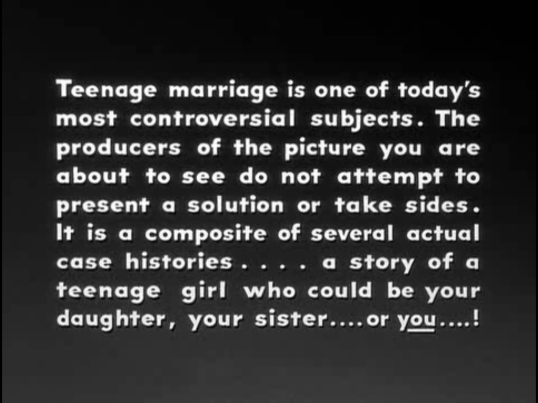
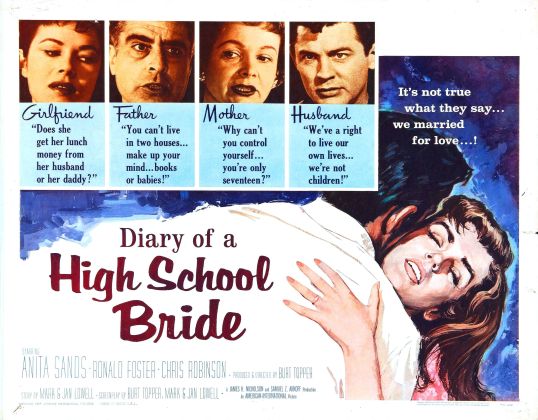
Embracing the Melodrama Part II #24: The Diary of a High School Bride (dir by Burt Topper)


teen01

I always enjoy it when a film opens with a message statement that announces that it was made to shine the light on one of “today’s most controversial subjects.”  Even better is when that message statement states that the film could be my story or that it could serve as a warning to people like me about what might happen.

Of course, it’s too late for me to be warned.  I’m not in high school anymore.  I’ve already made my decisions and had to deal with the consequences of my mistakes and all the other melodrama that makes life interesting.  But I can watch a film like 1959’s The Diary Of A High School Bride and I can read the message statement at the beginning and I can think to myself, “If only I had seen this movie before I decided to sneak out that night and drink alcohol or smoke weed or let my boyfriend take pictures of me naked or have sex with a married man or rob a convenience store or read that forbidden book or become a bride of Cthulhu or agree to spy for the communists or whatever the Hell it was that I did that night!”  If only…

Actually, it probably wouldn’t have made much of a difference.  Life doesn’t come with a message statement and whenever I see one at the beginning of a film, it usually makes me less likely to take that film seriously.  In fact, I tend to seek out films the open with message statements because they’re usually a lot of fun.

Take The Diary of a High School Bride, which is silly in a way that only an American International Pictures youth film could be.  The film opens with 25 year-old law student Steve (Ron Foster) driving home from Las Vegas with his new wife, 17 year-old Judy (Anita Sands).  When Steve gets pulled over by a police officer, Judy starts to tremble in terror.  When the cops asks Judy how old she is, she lies that she’s 21 and then starts to cry.  When the police officer asks if she’s really married to Steve, she wails, “Yes, and this record proves it!”  At this point, she holds up a vinyl record.

However, a vinyl record is not the only thing that Judy has.  She also has a teddy bear and oh my God, she literally carries that teddy bear with her everywhere!  When she and Steve tell her parents, she has the teddy bear.  When she wails at them, “AND NO — I’M NOT PREGNANT!,” she has the teddy bear.  When she and Steve go out to a coffeehouse and listen to some pretty good flamenco music, Judy has that teddy bear.  When they get back to Steve’s apartment and Judy finally see Steve with his shirt unbuttoned, Judy drops the teddy bear on the floor.

Why are Steve and Judy married?  That’s never really made clear.  They have absolutely nothing in common and Judy is so naive and so innocent that she spends most of the movie struggling to speak in coherent sentences.  (And, of course, she also won’t let go of her teddy bear.)  Steve, meanwhile — well, listen, when you’re 17, any man in his 20s is automatically attractive.  But still, there’s something undeniably (and, judging from the film’s script, unintentionally) creepy about Steve’s marriage to Judy.

Anyway, when Judy goes back to school, she has to deal with people singing Here Comes The Bride at her.  She also has to deal with her ex-boyfriend, Chuck (Chris Robinson).  Chuck wants her back and soon, he’s harassing the newly married couple and making such a menace out of himself that the whole “She’s only 17!” thing gets forgotten about…

So, that’s Diary of a High School Bride.  It’s a film that, if I had seen it when I was an out-of-control teenager, would have made absolutely no difference whatsoever.  But, if you’re a fan of 1950s B-movies (and who isn’t!) and if you have a group of friends who like to be snarky while watching old movies (and who doesn’t!), you’ll probably enjoy The Diary of a High School Bride.  At the very least, it features a fun little theme song from someone named Tony Casanova.

The Diary of a High School Bride was directed by Burt Topper and written by the poet Robert Lowell.  (Okay, it was probably a different Robert Lowell…)  It’s currently available on Netflix and it’s a lot of fun if you’re in the right snarky mood.

Diary

Embracing the Melodrama Part II #23: The Defiant Ones (dir by Stanley Kramer)


Defiant_Ones_poster

Stanley Kramer is one of those old school filmmakers who directed several films that were acclaimed when they were originally released but who tends to be dismissed by contemporary film critics.  Kramer specialized in making films about social issues and he deserves to be applauded for attempting to look at issues that Hollywood, at that time, would have preferred to ignore.  However, as Mark Harris points out in his excellent book Pictures At A Revolution, Kramer started out as a producer and, even after he started directing, he never lost his producer sensibility.  As a result, a Kramer film would typically address issues that were guaranteed to generate a lot of free publicity but, at the same time, Kramer would never run the risk of truly alienating his audience by digging too deeply into those issues.  As a result, Kramer’s films have come to represent a very safe and middlebrow version of 50s and early 60s style liberalism.

Now, I have previously reviewed 4 Stanley Kramer films on this site and I have to admit that I was somewhat dismissive of most of them.  I felt that Ship of Fools was shallow.  I thought that Guess Who’s Coming To Dinner collapsed under the combined weight of a self-satisfied script and Kramer’s refusal to let Sidney Poitier’s character be anything other than idealized perfection.  R.P.M. is a guilty pleasure, specifically because Kramer was so out-of-touch with the film’s subject matter.  I did give Judgment at Nuremberg a good review, describing it as one of Kramer’s rare films that still holds up today.

And now, I’m going to give another Kramer film a good review.

Kramer’s 1958 film The Defiant Ones features a classic Kramer situation.  White Joker (Tony Curtis) and black Noah (Sidney Poitier) are both prisoners in the deep south.  Joker is an unrepentant and violent racist while Noah … well, Noah is Sidney Poitier.  He’s determined, he’s not afraid to speak his mind, and most of all, he’s dignified.  That’s not meant to be a complaint about Poitier’s performance in The Defiant Ones.  In the role of Noah, Poitier has a great screen presence and it’s impossible not to root for him.  Whereas Curtis tends to chew up every piece of scenery that he gets nears (and, again, that’s not really a complaint because Curtis’s overacting is totally appropriate for his character), Poitier keeps the film grounded.

When the prison bus that is transporting them crashes, Joker and Noah are able to escape.  Fleeing on foot, they make their way through the wilderness and attempt to hide from the police.  As quickly becomes obvious, Joker and Noah hate each other but, because the sheriff had a sense of humor, they have also been chained together.  In other words, they’re stuck with each other and, in order to survive, they’re going to have to learn to coexist.

No, it’s not exactly subtle but it works.

As a filmmaker, Kramer was never known for being visually inventive and, as a result, his films often had to resort to heavy-handed monologues to make their point.  But, in The Defiant Ones, the chains act as a great visual symbol for race relations in America.  Joker and Noah literally can’t escape from each other and they have to work together if they’re going to survive.  The chains make that obvious and, as a result, this is the rare Kramer film where nobody has to give a big speech to get across Kramer’s message.  As a result, The Defiant Ones preaches without ever getting preachy.

Though the film is dominated by Poitier and Curtis, it also features some excellent supporting work.  Lon Chaney, Jr, for instance, has a great cameo as world-weary man who helps the two convicts in their flight.  Cara Williams is surprisingly poignant as a lonely, unnamed woman who tries to both protect Joker and get rid of Noah.  And finally, there’s Theodore Bikel, playing the role of Sheriff Max Muller.  Max is the most surprising character in the film, the head of a posse that’s set out to recapture Noah and Joker.  As opposed to most of his men, Max is a humane and caring man who struggles to control the more bloodthirsty men who are serving under him.

Message films tend to get dated rather quickly but The Defiant Ones holds up surprisingly well.