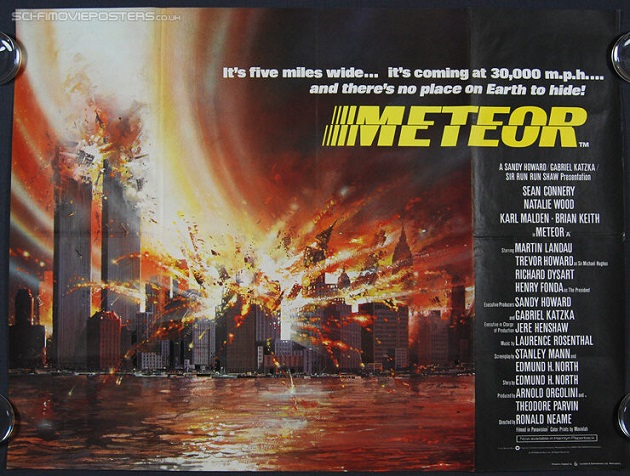
METEOR is a Crashing Bore (AIP 1979)


gary loggins's avatarcracked rear viewer

meteor1

American-International Pictures had gotten pretty fancy-schmancy by the late 70’s. The studio was leaving their exploitation roots behind and branching out to bigger budgeted films like FORCE TEN FROM NAVARONE, LOVE AT FIRST BITE, and THE AMITYVILLE HORROR, with bigger name stars for marquee allure. Toward the end of 1979 they released METEOR, a $16 million dollar, star-studded, special-effects laden, sci-fi/ disaster film spectacle that bombed at the box-office and contributed to the company’s demise.

meteor2

Coming at the tail end of the disaster cycle, METEOR is formulaic as hell. Take a group of well-known stars (Sean Connery, Natalie Wood , Karl Malden , Brian Keith , Martin Landau, Henry Fonda ), give them a disastrous menace to combat (in this case a five-mile wide meteor hurtling toward Earth), add some conflict (US/USSR Cold War relations), and some scenes of destruction, and voila! instant disaster movie! Unfortunately, by 1979 audiences had already grown tired…

View original post 403 more words

Quick Review – La La Land (Dir. by Damien Chazelle)


la-la-land-full-poster-image-691x1024Hype is a dangerous thing.

Too little of it will leave a movie’s showing with tons of empty seats. Too much, and you raise skepticism in the masses. The movie never lives up to the growing expectations and tanks before you know it.  Tonight (as of this writing), preview audiences are going to be packed with fans waiting to catch the latest Star Wars film. While I hope it works out for them, there’s another film moving into a wider release this weekend that deserves just as much love. Right now, La La Land is heavily hyped, and hopefully will be part of every major awards run. I still want to try to catch some of the other soon to be nominated films for the Awards season, but I’m good for right now. I’m that kid in the corner, totally content with that one little Transformer he always wanted while other presents still need to be opened. Unless I run into another film that captures my eye (and ears) like this one, La La Land is easily my go to pick for everything this year. It’s a fun little love story wrapped up in musical dance numbers, my feel good movie.

lalalandtickets

I really, truly loved La La Land. 

For me, that’s saying a lot. Outside of the usual Disney film, I don’t see too many musicals. I can count on one hand a few favorites – Frank Oz’s movie version of Little Shop of Horrors, Baz Luhrman’s Moulin Rouge, both Muppet films and of course West Side Story. However, I’ve never watched Singing in the Rain, or any of the Astaire/Rogers numbers. The opening dance sequence in Ted 2 might be the closest I’ve come to all that, or maybe the French Mistake in Blazing Saddles. However, I walked out of La La Land with a huge smile on my face, one that prompted me to run right back in for the next showing. This isn’t meant to convince you to see the film or not. If you do, cool. If you don’t, that’s fine. I just know that I’ll be scooping this up come the Blu-Ray release. This review is me, geeking out.

La La Land is a very simple story. In Los Angeles, Mia (Emma Stone) is an aspiring actress who meets Sebastian (Ryan Gosling), a lover of Jazz who’s fighting to keep it alive. Both individuals are fighting to fulfill their dreams, and it’s hard not to root for them. This leads to a friendship that grows, surrounded by great music. For the story, that’s all you really need to know, and to go into more detail risks going into spoiler territory. It’s a classic Boy Meets Girl in the Big City situation.

Having worked together in Gangster Land and Crazy Stupid Love, Stone and Gosling already have some great chemistry. The dialogue pops between them and is very reminiscent of some of the Tom Hanks/Meg Ryan films. With the conversation style, coupled with Damien Chazelle’s writing, it all feels very natural. Both of their characters come across as passionate individuals when it comes to the talent of their choice. The cast also includes singer John Legend, Callie Hernandez (Blair Witch), Jessica Rothe (Better Off Single), and Sonoya Mizuno (Ex Machina). If I have one problem with La La Land, it would just be that I wanted to see more of the co-stars, but the film truly belongs to the leads. At least in a film like Grease, you were at least aware of the supporting cast and their stories. It’s a tiny nitpick, but it doesn’t get in the way of the story’s progression.

Visually, La La Land is full of rich colors and deep shadows. When there’s a change in lighting or a focus made, it’s a beautiful thing to behold. Linus Sandgren (American Hustle, Joy) does a great job here and I’m adding him to my list of Cinematographers to keep an eye on. The movie feels like a classic film from start to finish. The editing deserves some kudos as well. Every scene feels like it grew naturally from the one before it, and there’s rarely a moment where you ask yourself if one scene needed to be there if there were any holes to be found. If there was an editing mistake in La La Land, I couldn’t find it.

As with Guy and Madeline On a Park Bench & Whiplash, it wouldn’t be a Chazelle film without music. Justin Hurwitz is on music duty here and La La Land’s music is in some places snappy. I picked up the soundtrack after the movie, and there’s a good chance that some of that music is going to get stuck in your head. Emma Stone may get some recognition come awards season with one song in particular, but overall it’s difficult not to listen to some of these and not want to nod your head with the crowd. On my exit after the second showing, there were people humming and/or whistling the tunes.

Overall, La La Land is a wonderful film that reminds one of the beauty of the Cinema Experience, with a pair of characters that make you want to cheer them on. Really, if you have a chance to see this in the theatre, do so. Who knows, maybe you’ll find yourself with a spring in your step too on the way out.

Cleaning Out The DVR Yet Again #41: Lady Snowblood (dir by Toshiya Fujita)


(Lisa recently discovered that she only had about 8 hours of space left on her DVR!  It turns out that she’s been recording movies from July and she just hasn’t gotten around to watching and reviewing them yet.  So, once again, Lisa is cleaning out her DVR!  She is going to try to watch and review 52 movies by the end of 2017!  Will she make it?  Keep checking the site to find out!)

snowblood-press9.tif

On Oct. 23rd, I recorded the classic martial arts/revenge film, Lady Snowblood!

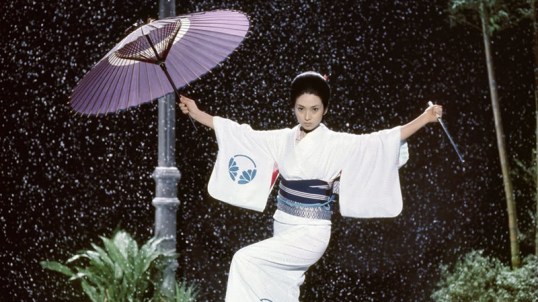
There’s a scene, in Lady Snowblood, in which a drunk gambler sobs as he begs the white-clad Yuki Kashima (Meiko Kaji) to spare his life.  He says that he’s sorry that he raped her mother.  He’s sorry that he took part in the murders of both Yuki’s half-brother and her mother’s husband.  He points out that years have passed and he has changed.  He now has a daughter of his own.  It wasn’t even his idea to attack Yuki’s mother.  He was forced to take part.

And while the gambler begs, Yuki stares down at him without a hint of emotion.  Though the audience may feel conflicted because the gambler sounds sincere in his remorse and it’s obvious that his life, in the years after his crimes, has been difficult, Yuki shows no compassion.  There are no tears from her.  Instead, she tells him, “An eye for an eye,” before slashing him to death.

There’s another scene in which Yuki discovers that another one of her targets has attempted to escape her vengeance by committing suicide.  As Yuki stares at the hanging body, she realizes that her target’s heart is still beating.  With one quick slice of her sword, Yuki chops the body in half.  The blood pouring onto the floor sounds like rain drops tapping on a tin roof.

And finally, when Yuki discovers that another target has died before she got a chance to track him down, she goes to a cemetery and destroy his tombstone.

In short, Yuki is a killing machine, one who dispenses vengeance with style and flair.  She was literally born, bred, and trained solely for the purpose of dispensing violent justice.  After her mother was raped and watched as her husband and son were brutally murdered, she was sent to prison.  It was there that she had an affair with a prison guard, specifically out of the hope that she would conceive and give birth to a child of vengeance.

First released in 1973, Lady Snowblood is perhaps best known for being a major influence on the Kill Bill films but it’s also one of the best revenge films ever made.  Stylishly directed and relentlessly paced, Lady Snowblood is almost a ballet of violence, with the grace of Yuki’s movements emphasized almost as much as their bloody results.  Though Yuki’s grim determination is often frightening, it’s also impossible not to admire her.  Her only job is to dispense vengeance and she’s the best at what she does.  And since she’s a woman who, for the most part, is killing evil men in an oppressively patriarchal society, her actions soon become about more than mere revenge.  With each slice of her sword and drop of blood spilled, Yuki is taking vengeance for not just her mother but for every other woman as well.

If anyone ever hurt me or anyone I loved, I would want Yuki on my side.

If I could be any revenge-seeking movie character, I would want to be Yuki.

I would want to be Lady Snowblood.

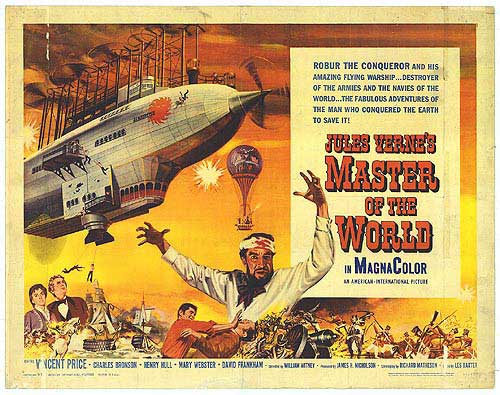
Flight of Fancy: Vincent Price in MASTER OF THE WORLD (AIP 1961)


gary loggins's avatarcracked rear viewer

motw1

MATSER OF THE WORLD is AIP’s answer to Disney’s 20,000 LEAGUES UNDER THE SEA . Both are based on the works of Jules Verne, and involve fanatical protagonists commanding futuristic ships (an airship in this case). The difference is in budget, as studio honchos Samuel Z. Arkoff and James Nicholson didn’t have the financial means to compete with the mighty Walt Disney. They did have Vincent Price though, and within their monetary constraints came up with an entertaining mini-epic enhanced by another solid Richard Matheson script.

motw2

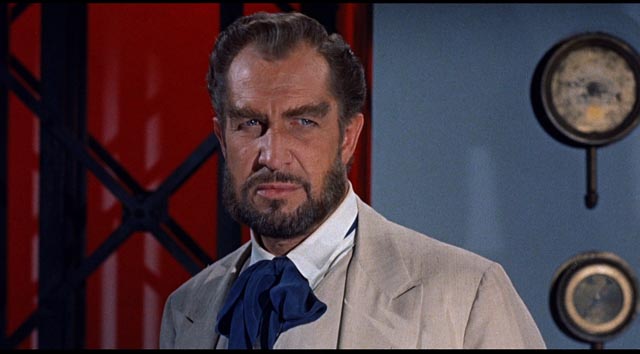
Price stars as Captain Robur, who’s fantastic flying airship Albatross rules the skies of 1868. When his amplified voice bellows some scripture from a mountain (does this make Vinnie the Voice of God?), balloon enthusiasts Mr. Prudent, daughter Dorothy, and her fiancé Phillip Evans, along with government agent John Strock, investigate, only to be shot down by Robur’s rockets and taken prisons aboard his flying fortress.

View original post 419 more words

Hillbilly Deluxe: MURDER, HE SAYS (Paramount 1945)


gary loggins's avatarcracked rear viewer

murderhe1

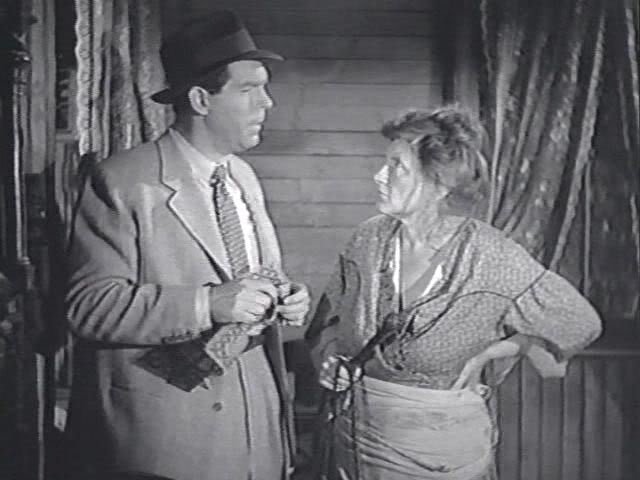
George Marshall has long been a favorite director of mine. Though he excelled in all genres (particularly Westerns), it’s his comedies that first caught my attention. Marshall guided W.C. Fields through his first for Universal, YOU CAN’T CHEAT AN HONEST MAN (with radio foils Edgar Bergen and Charlie McCarthy), did some of Bob Hope’s best films (THE GHOST BREAKERS, MONSIER BEAUCAIRE, FANCY PANTS), and directed MY FRIEND IRMA, the debut of Dean Martin & Jerry Lewis, later teaming with the pair for SCARED STIFF. He’s also responsible for the classic comic Western DESTRY RIDES AGAIN with James Stewart and Marlene Dietrich, and the remake with Audie Murphy. But his wackiest comedy is undoubtably the off-the-wall MURDER, HE SAYS.

murderhe4

This black comedy gem stars the underrated Fred MacMurray as Pete Marshall, pollster for the Trotter company (“Like the Gallup Poll, but not as fast”), sent to tiny rural Potowanamie to find missing coworker Hector P…

View original post 472 more words

Cleaning Out The DVR Yet Again #40: Melinda (dir by Hugh A. Robertson)


(Lisa recently discovered that she only had about 8 hours of space left on her DVR!  It turns out that she’s been recording movies from July and she just hasn’t gotten around to watching and reviewing them yet.  So, once again, Lisa is cleaning out her DVR!  She is going to try to watch and review 52 movies by the end of 2017!  Will she make it?  Keep checking the site to find out!)

melinda

I recorded Melinda off of TCM on November 13th.

First released in 1972, Melinda is technically a murder mystery.  Frankie J. Parker (Calvin Lockhart, giving a brilliant performance) is a popular radio DJ in Los Angeles.  When we first see Frankie, he’s driving his expensive sportscar through a poor neighborhood.  It’s a neighborhood that he knows well but, as opposed to those around him, he’s made it out.  He’s handsome, slick, and more than a little arrogant.  When he arrives at a local gym, he looks at himself in a mirror and says, “I shouldn’t say it … but I am a pretty motherfucker.”  Frankie’s a student in a taekwondo class taught by Charles Atkins (Jim Kelly).  Charles gives Frankie a hard time about not giving back to the community.  Frankie blows off his concerns.  To be honest, we really should dislike Frankie but he’s so damn charming.  As played by Calvin Lockhart, Frankie has one of those irresistible smirks, the type of the lights up the screen.

One night, Frankie meets the mysterious Melinda (Vonetta McGee) and spends the night with her.  He thinks that it’s just going to be another one night stand but Melinda tells Frankie that he has the potential to be more than he realizes.  Touched, Frankie goes to work and resolves to be a better person.  Then he returns home and discovers that Melinda has been murdered!

The rest of the film deals with Frankie’s attempts to discover who murdered Melinda.  It turns out that Melinda had underworld connections and mob boss Mitch (Paul Stevens) is desperate to recover something that Melinda had in her possession when she died.  But honestly, the whole murder subplot is a MacGuffin (if you want to get all Hitchcockian about it).  Ultimately, Melinda is a character study of Frankie Parker and how, over the course of solving Melinda’s murder, he learns that there’s more to life than just looking out for himself.

Though Melinda was obviously made to capitalize on the blaxploitation craze of the early 70s, it’s actually far more low-key than most of the better known films in the genre.  (Or, at least it is until the karate-filled finale.)  Perhaps because it was directed by a black man and written by noted black playwright Lonne Elder III, Melinda is far more interested in exploring what makes its characters who they are, as opposed to just putting a gun in their hand and having them shoot up the screen.  Frankie Parker emerges as a fascinating character.

Mention should also be made of the performance of Rosalind Cash, who plays Terry, Frankie’s ex.  Cash gets an absolutely amazing scene where, while attempting to convince a bank employee that she’s Melinda so that she can get into Melinda’s safe deposit box, she tells off a rude teller.  It’s such a good scene and Cash delivers her lines with such fury that you find yourself forgetting that the teller was actually correct in her suspicion that Terry wasn’t actually who she said she was.

Melinda is probably one of the best films that hardly anyone has ever heard of.  Keep an eye out for it.

Happy 100th Birthday Kirk Douglas: THE BAD AND THE BEAUTIFUL (MGM 1952)


gary loggins's avatarcracked rear viewer

badand1

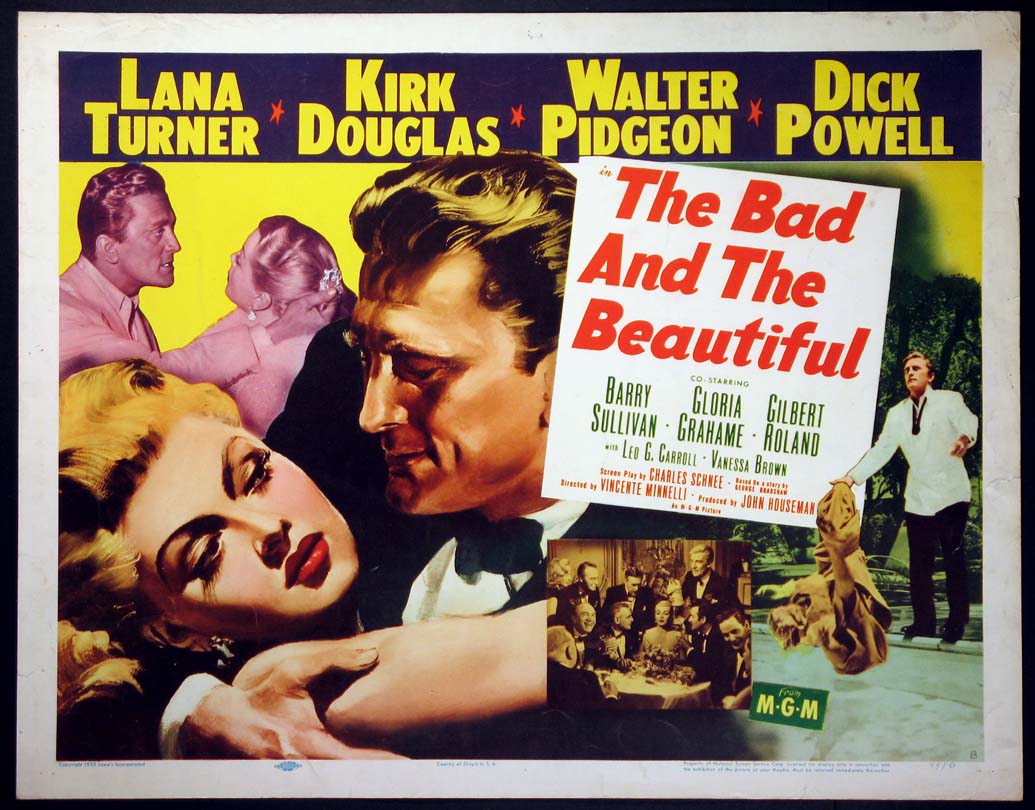
Today is the 100th birthday of movie legend Kirk Douglas! Like Olivia de Havilland earlier this year, Kirk is one of the last living Golden Age greats. Bursting onto the screen in film noir classics like THE STRANGE LOVES OF MARTHA IVERS and OUT OF THE PAST , he first received top billing in the 1949 boxing noir CHAMPION, earning an Oscar nomination for his performance. Later, Kirk starred in some of the best films Hollywood has to offer: ACE IN THE HOLE, 20,000 LEAGUES UNDER THE SEA , LUST FOR LIFE (his second Oscar nom, though he never won the statue), PATHS OF GLORY, SPARTACUS, LONELY ARE THE BRAVE. One of my personal favorites is 1952’s THE BAD AND THE BEAUTIFUL.

One of those Hollywood movies about making Hollywood movies, THE BAD AND THE BEAUTIFUL is expertly directed by insider Vincent Minnelli, who knew this material like the back of his hand. Aided…

View original post 851 more words

Cleaning Out The DVR Yet Again #39: Where The Boys Are (dir by Henry Levin)


(Lisa recently discovered that she only has about 8 hours of space left on her DVR!  It turns out that she’s been recording movies from July and she just hasn’t gotten around to watching and reviewing them yet.  So, once again, Lisa is cleaning out her DVR!  She is going to try to watch and review 52 movies by the end of 2017!  Will she make it?  Keep checking the site to find out!)

wheretheboysare

Before I talk about the 1960 film Where The Boys Are, I’m going to admit something.  Nearly a month ago, I started this mission to clean out my DVR.  I had 52 films to review and I said that I’d have it all done by Thanksgiving.  Of course, I failed to take into account that Thanksgiving is a holiday and, when you’re celebrating a holiday, that doesn’t always leave time to write 52 reviews.  So, I gave myself until the end of the first week of December.  And that’s when I realized that 52 reviews is not a small amount of work.  Especially if you want to make them decent reviews, as opposed to just posting a few sentences.  So, I’m abandoning all of my arbitrary deadlines.  I’ve got 14 more movies to review and I really hope that I’ll be done by the end of the year.  Maybe I will be, maybe I won’t…

But, seriously, I really hope that I am!

Anyway, now that I’ve cleared that up, let’s go to Where The Boys Are!

Released in 1960, Where The Boys Are was one of the first spring break films and it set the template for many films that would follow.  Because it is a piece of history, it’s one of those films that seems to regularly pop up on TCM.  It last aired on TCM on November 13th.  That’s when I recorded it.

Where The Boys Are tells the story of four girls who go to college in Maryland.  When we first see them, they are trudging across a snowed-in campus and there’s a distinct lack of handsome men around.  We listen as Merritt Andrews (Delores Hart) debates her far older professor about whether or not a girl should be “experienced” before getting married.  The professor thinks that all girls should wait for marriage.  Merritt disagrees.  What makes this scene interesting is that it’s almost totally done in euphemism.  Merritt never says sex.  Instead, she says making out and the professor has to ask her to explain what that means.

I mean …. 1960, amirite?

Anyway, it’s spring break so Merritt and her friends go down to Ft. Lauderdale.  After all … that’s where the boys are!  All of the girls have their own defining characteristic.  Merritt is the leader of the group, an intellectual with an I.Q. of 138.  Tuggle (Paula Prentiss) is smart and no-nonsense.  She’s a self-described “good girl” and her hope is to be a “baby-making machine.”  She intimidates some men because she stands 5’10.  Angie (Connie Francis) is athletic and naive.  And then there’s Melanie (Yvette Mimieux), who overcomes her insecurity and loses her virginity as soon as they arrive in Florida (though, of course, this is all handled via euphemism).

Over the course of spring break, all four of the girls meet a man or two.  Merritt meets Ryder (George Hamilton), who is not only an Ivy League student but has a tan to die for.  Ryder it turns out is very experienced (the film doesn’t seem to have the same issue with men being experienced as it does with women) and Merritt is forced to consider whether she’s really as ready for sex as she claims.  Melanie also hooks up with an Ivy Leaguer but it quickly becomes obvious that, despite going to Yale, Franklin (Rory Harrity) is a total heel.  (Oh, how you will hate Franklin.)  Tuggle finds herself competing for the attention of TV (Jim Hutton).  And Angie falls for a myopic jazz musician, Basil (Frank Gorshin).

Watching Where The Boys Are was an odd experience.  It’s an extremely dated film and it’s hard to believe that its euphemistic sex talk and extremely modest swimsuits were ever considered to be controversial.  There’s a hilarious scene where the girls are getting ready for their dates by changing into dresses that look more appropriate for cotillion than a night in Ft Lauderdale.  Needless to say, nobody is seen smoking weed or skinny dipping or doing any of the other stuff that we’ve come to take for granted as far as spring break films are concerned.  (That said, I get the feeling that both TV and Basil may have been stoned.  But definitely not Ryder.  From the minute Ryder shows up, you know he’s going to end up running a successful business and probably serving as an advisor in the Trump White House.)

There are a lot of jokes about people getting drunk, however.  It’s nice to see that, even in 1960, college students on Spring Break couldn’t hold their liquor.  I also found it interesting that not only did almost everyone in Where The Boys Are smoked but most of them looked really cool doing it.  In fact, I’d say that this film was probably the best advertising for cigarettes that I’ve ever seen.

For the most part, Where The Boys Are is a hit-or-miss comedy that’s distinguished by perfect casting.  Even though the film itself was dated, I felt that I could relate, in one way or another, to all of the girls.  Hart, Prentiss, Mimeux, and even Francis captured universal emotions and feelings in their performances and their friendship felt very true.

About 70 minutes into the film, Where The Boys Are takes a very serious turn and the film actually ends on a rather melancholy note, a reminder that not even a somewhat light weight comedy could escape the harshly judgmental morality of the time.  The sudden shift in tone took me by surprise but the film actually handled it well.  I just wish that it didn’t feel as if the filmmakers were punishing our characters for questioning the dictates of society.

On a final note, it’s interesting to note that Delores Hart, who played the sexually free thinking Merritt, later gave up her film career and became a nun.

So much for where the boys are.

Danger Is Their Business: STUNTS (New Line Cinema 1977)


gary loggins's avatarcracked rear viewer

stunts1

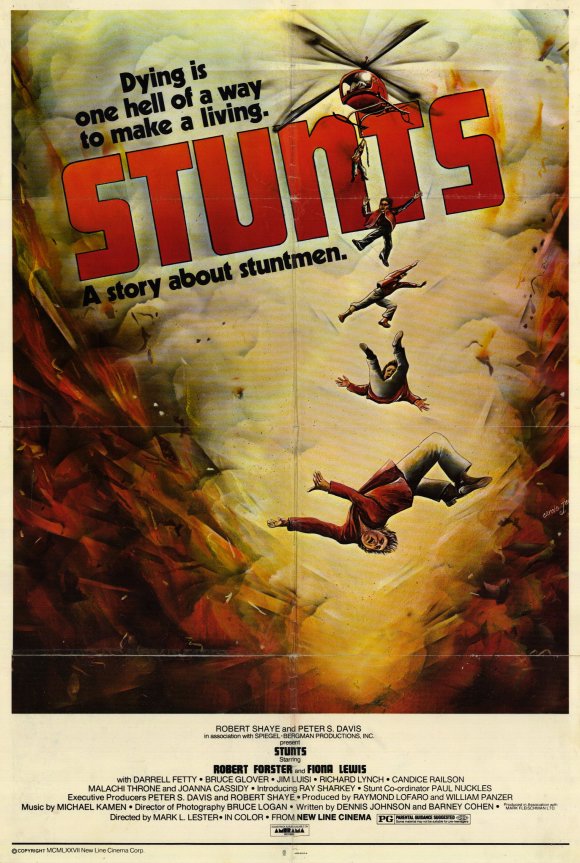
With the success of films like WHITE LIGHTING, CANNONBALL, DEATH RACE 2000, and SMOKEY AND THE BANDIT (not to mention the continuing fascination with Evel Knenevel), movies revolving around stunts and stuntmen were big box office in the 1970’s. New Line Cinema took note and produced STUNTS, a murder mystery about stuntmen being killed off that gives us a behind-the-scenes look at low-budget filmmaking in addition to a good cast and well-staged action.

stunts2

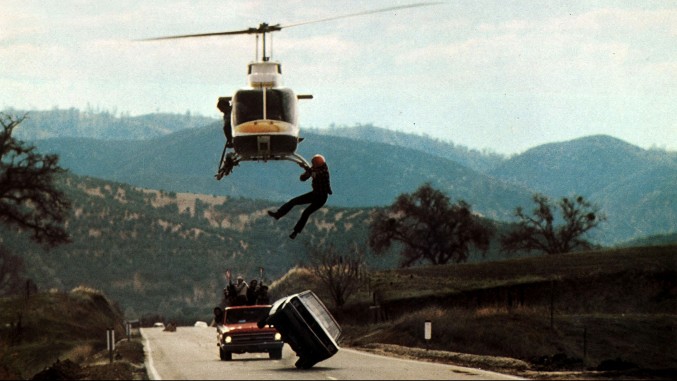
When stuntman Greg Wilson’s hanging from a helicopter gag goes horribly awry, resulting in him plummeting to his death, his brother Glen arrives on the set determined to do the stunt himself and investigate Greg’s demise. Along the way he picks up B.J. Parswell, an attractive reporter doing a story on stuntmen. Glen’s fellow stuntmen start getting picked off one by one in gruesome “accidents”, and he must find the killer before he becomes next.

stunts3

This basic variation on “Ten…

View original post 338 more words

Cleaning Out The DVR Yet Again #38: The Baby (dir by Ted Post)


(Lisa recently discovered that she only has about 8 hours of space left on her DVR!  It turns out that she’s been recording movies from July and she just hasn’t gotten around to watching and reviewing them yet.  So, once again, Lisa is cleaning out her DVR!  She is going to try to watch and review 52 movies by the end of Thursday, December 8th!  Will she make it?  Keep checking the site to find out!)

poster_of_the_movie_the_baby

On October 30th, I recorded The Baby off of TCM.

First released back in 1973, The Baby is a seriously strange little movie.  It’s about a 21 year-old man named Baby (played by David Manzy).  Why is he called Baby?  Because he lives in a crib.  And he wears a diaper that occasionally needs changing.  And he sounds exactly like a baby.  (Whenever he opens his mouth, the sound of an actual baby is dubbed in.)  When he’s alone with his babysitter, he eagerly sucks on her breast, half-nursing and half-perving.

Baby is the only son of Mrs. Wadsworth (Ruth Roman, giving a chillingly evil performance).  Mrs. Wadsworth was abandoned by her husband shortly after Baby was born and the film implies that she’s taken a lot of her hatred towards her ex out on her son.  Despite not liking her son, Mrs. Wadsworth is determined to hold onto him.  She gets a weekly welfare check from the state.  The money is supposed to be used to take care of Baby but Mrs. Wadsworth uses it to take care of herself and her two daughters.

Who are her daughters?  Alba Wadsworth (Suzanne Zenor) is an implied nymphomaniac who has a way with a cattle prod.   Germaine Wadsworth (Marianna Hill) is an actress and model who, it’s suggested, has incestuous designs on her brother.

That’s right — they’re a messed up family!  However, they do throw great parties, the type that are full of all the typical characters who you would expect to appear in a low-budget film from 1973.  Hippies, hipsters, aspiring disco dancers, they all show up.  Michael Pataki shows up as well!  You my not know the name but if you’re a fan of 70s exploitation films like me, you’ll immediately recognize Michael Pataki.

In order to continue receiving money from the government, the Wadsworths have to impress their case worker.  They’ve moved through several social workers and, for the most part, they’ve survived by being so strange that no one wants to spend too much time dealing with them.  However, their case has just been assigned to Ann Gentry (Anjanette Comer) and she actually takes an interest in Baby and his life with the Wasdworths.

Ann says that she thinks Baby could benefit from going to a special school.  The Wadsworths suggest that she mind her own business.  Ann, however, has no intention of doing that.  Ann refuses the give up on giving Baby a chance at a better life.

Sounds heart-warming, right?

Well, no.

At first, Ann seems like just another concerned do-gooder.  But, at the film progresses, we start to suspect that Ann might have some secrets of her own.  We’re told that she lost her husband in a car accident but the details are left intentionally vague.  What we do know is that Ann lives in a huge house with her mother-in-law (Beatrice Manley Blau) and we find ourselves wondering why, if her husband is gone, are the two of them still living together.

We also fin ourselves wondering: Does Ann have Baby’s best interests in mind?  For that matter, does anyone?

Being a 70s movie, it all ends with a violent home invasion that’s followed by a surprise twist.  The twist caught me totally off-guard and forced me to reconsider everything that I had previously seen.  It was shocking, it was borderline offensive, it was just a little bit ludicrous, and it was rather brilliant in its odd way.

The same can be said for The Baby as a whole.  This is one weird movie and you’ll never see another like it.  For that reason alone, The Baby is worth seeing at least once.