In 1989’s Out of the Dark, a man dressed in a clown costume is killing phone sex operators. He lurks in the darkness and jumps out of the shadows to commit his dastardly crimes. Especially during the first hour or so, the film has its share of both suspense and gruesome moments. In the style of Italian giallo and pre-Halloween American slasher pics, the film actually tries to create some mystery about who the killer could be. Lt. Frank Meyers (Tracey Walter) suspects that the killer might photographer Kevin Silvers (Cameron Dye). Kevin and his girlfriend, Kristi (Lynn Danielson-Rosenthal), think that the police should be taking a closer look at David Stringer (Bud Cort), an accountant who has an office in the same building as the phone sex company. Meanwhile, Detective Langella (Divine) thinks that the murders might be linked to a serial killer who is targeting prostitutes.
The main problem with Out of the Dark is that it’s pretty obvious from the start who the killer is and it’s hard not to judge the people who can’t figure it out for themselves. The movie doesn’t really offer up enough viable suspects to keep you guessing and than it spends so much time trying to make it look like one of the suspects is guilty that any experienced film watcher will automatically know that he isn’t. The viewers are supposed to be shocked by the killer’s identity but there’s nothing shocking about it. It’s pretty obvious.
On the plus side, OutoftheDark does have a one-of-a-kind cast. Divine and Tracy Walter play detectives. Bud Cort is intense and nerdy as the bitter accountant. Cameron Dye is vacuously handsome as the photographer. Geoffrey Lewis shows up as an alcoholic. Lainie Kazan plays an aging prostitute. Tab Hunter drives a car. Paul Bartel manages a motel and gets upset when he sees the blood pooling in one of his rooms. And finally, Karen Black plays the owner of the phone sex company and gives a far better performance than the material actually deserves. Black brings some much needed emotional reality to the film.
As I said at the start of this review, OutoftheDark has its moments. The clown costume is truly creepy and the opening murder is all the more disturbing because it happen outside and in a public park. (You do have to wonder how no one noticed a weirdo dressed like a clown wandering around.) A scene in which the clown attacks a phone sex operator who has agreed to serve as bait is also well-done and genuinely frightening. The story moves at a quick and steady pace and it deserves some credit for ending on a definitive note as opposed to trying to copy the ambiguity that was so popular with other slasher films of the era.
If only the identity of the killer had actually been a surprise, Out of the Dark would probably be considered a classic. As it is, it’s just another well-made slasher film.
High atop Mt. Olympus, Zeus (Laurence Olivier) and his fellow Gods look down on Earth and jealously manipulate its citizens. When Zeus impregnates Danae (Vida Taylor), the daughter of the King of Argos, she and her son Perseus (Harry Hamlin) are banished to sea. Zeus responds by ordering Poseidon (Jack Gwillim) to release the Kraken.
Years later, when Callibos (Neil McCarthy), the son of the Goddess Thetis (Maggie Smith), destroys all but one of Zeus’s flying horses, Zeus transformer Callibos into a tailed monster. Thetis tries to get her revenge by having Callibos kill Perseus but instead, Perseus chops off Callibos’s hand, comes to possess Pegasus, the last of the flying horses, and also wins the right to marry Andromeda (Judi Bowker).
At the wedding, Cassiopeia (Sian Phillips) declares Andromeda to be even more beautiful than Aphrodite (Ursula Andress). Big mistake. Aphrodite demands that Andromeda by sacrificed to the Kraken. Along with Pegasus, Ammon (Burgess Meredith), Thallo (Tom Pigott-Smith), and robot owl, Perseus goes on a quest to get the snake-haired head of Medusa so he can turn the Kraken into stone.
There’s a lot that I love about Clash of the Titans, from the Ray Harryhausen’s stop-motion special effects to the blind witches who pass one eyepiece among them to Burgess Meredith’s performance as Ammon. I even like the robot owl. But the thing that has always made the biggest impression on me is that Mt. Olympus is portrayed as having a shelf that holds a figurine for every human in the world. The Gods casually move the pieces around and transform them on whims. Of all the films that have been based on Greek mythology, ClashoftheTitans is one of the few that really captures the idea of the Gods essentially being a bunch of petty and jealous libertines who view humans are just being their playthings.
Let’s not overthink Clash of the Titans, though. The main appeal of Clash of the Titans is that it’s just a good, old-fashioned adventure movie. In this age of CGI and humorless heroes, it’s hard not love the film’s mix of old-fashion stop-motion animation, strong characters, and occasional moments of humor. (I like the owl and I won’t apologize for it.) Also, Medusa has appeared in a lot of movie but she’s never been scarier than in this movie. Who can forget the yellow glow of her eyes, followed by men turning to stone? Who can forget the hiss of her tail or the moment when Perseus waits to strike while trying not to look into her eyes? Beyond Medusa, who can forget the Kraken rising from the sea or the blood of Callibos giving birth to giant scorpions? Without CGI, Clash of the Titans still captures the feel of living in a different time and a different land. Clash of the Titans brings mythology to life in a way that few other films have been able to,
I loved the original Clash of Titans when I was a kid. I rewatched it last month and I happy to say that I love it still.
This 1991 made-for-TV movie opens with a murder in a Brooklyn park. The year is 1979 and a group of teenagers are accosted by two men carrying guns. The men rob the teenagers of their drugs and guns. One person is killed. When the police arrive, almost everyone says that it was too dark to see anything. However, a 15 year-old named Jimmy O’Neill (Tristan Tait) says that he saw the faces of the men.
At the police station, the detective (Mark Metcalf) shows him a picture of a man named Billy Ferro (Zachary Mott) and Jimmy identifies him as one of the gunmen. The detective then produces a picture of a 19 year-old named Bobby McLaughlin (Brendan Fraser) and asks if Bobby was the other man. When Jimmy hesitates, the detective says that McLaughlin has been arrested with Billy in the past.
Of course, the truth of the matter is that, while Bobby has been arrested in the past, he’s never been arrested for anything as serious as murder and he’s never met Billy Ferro. The man who had been arrested in the past with Ferro was named Harold McLaughlin. The detective accidentally grabbed the wrong picture.
Bobby, a high school drop-out who lives with his foster parents (played by Martin Sheen and Caroline Kava), is arrested and charged with second degree murder. It doesn’t matter that Bobby passes a polygraph because the results are not admissible in court. It doesn’t matter what Bobby has an alibi because the prosecutor portrays all of his friends as being a collection of stoners and losers. It doesn’t matter what Bobby has never even met Billy Ferro because Ferro isn’t going to help anyone out, even someone who he knows is being falsely convicted. Bobby is convicted of second degree murder and sent to prison.
For the next seven years, while Bobby tries to survive prison, his foster father attempts to prove his son’s innocence. With the police refusing to help, Bobby’s father is forced to launch his own investigation but it seems like no matter what he discovers, it’s not enough to get Bobby out of prison. Still, neither he nor Bobby gives up. Neither one will accept a system in which you’re guilty until proven innocent….
For most people who choose to watch this film, I imagine it will be because of that “Introducing Brendan Fraser” credit. Fraser gives a very good performance in this film, playing Bobby as basically well-meaning but directionless teenager who finds himself trapped in a nightmare. Of course, the majority of this film is Martin Sheen yelling about the injustice of it all. This is the type of crusader role that Sheen has played often. As was often the case when he was cast in films like this, there’s nothing subtle about Sheen’s performance but it’s not really a role that needs or demands subtlety.
Though this was made-for-television and, as such, is never quite as critical of the system as perhaps it should be (if anything, the film argues that one should trust the system to eventually do the right thing, even if it does so seven years too late), it still shows how one cop’s mistake can ruin an innocent’s man life. It’s all the more effective because it’s based on a true story. Of course, I immediately knew the cop shouldn’t be trusted because he was played by Mark Metcalf. Niedermeyer as a cop? That’s definitely not going to end well.
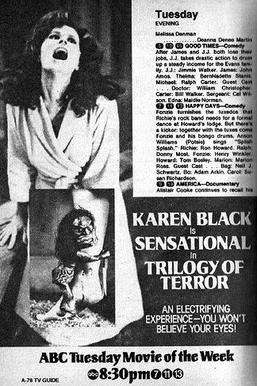
1975’s Trilogy of Terror is a true classic, a rare made-for-television horror film that could have just as easily and effectively been released in theaters.
As one can surmise from the title, it features three stories. Each story is directed by Dan Curtis and written by Richard Matheson. Each story also features Karen Black in the lead role, giving Black a chance to play not just one but four very different characters over the course of one film. One of the things that makes this film work so well is Karen Black’s totally committed performance. Sadly, Karen Black later expressed some regret about having appeared in the film because it led to her being typecast as a horror actress, which she definitely hadn’t been before. (One need only watch Karen Black in Five Easy Pieces, Nashville, or Family Plot to see what a good actress she was. Even in something like Easy Rider, where she had only a small role and very few lines, her talent is obvious.) As a result, Black was no longer considered for the big studio films that she had appeared in previously and instead, she spent the remained of her career appearing in low-budget horror films. That’s a shame because Trilogy of Terror really does show what a strong actress Black was.
The first segment features Black as Julie, a seemingly uptight teacher who somewhat surprisingly agrees to go out on a date with Chad (Robert Burton), a sleazy college student. Chad drugs Julie’s drink during their date and later undresses her and takes pictures which he then uses in an attempt to blackmail Julie into basically being his sex slave. Julie, however, turns out to have a big secret of her own and Chad discovers too late that he was the one who was being manipulated. This segment was the least interesting of the three stories but the ending was very satisfying. Anyone who has ever dated a “nice guy” who turned out to actually be a jerk will enjoy Julie’s revenge.
The second segment is enjoyably sordid, an over-the-top soap opera that I can’t talk too much about without spoiling the plot. Black plays Millicent, a repressed brunette, who is hatefully obsessed with her twin sister, blonde Theresa (Black again). Millicent fears that Therese is planning to corrupt and destroy her boyfriend, Thomas (John Karlen). Millicent explains to her therapist (George Gaynes) all of the terrible things that Therese has done. Of course, the truth turns out to be much more complicated. This story was entertaining and featured a surprisingly effective twist.
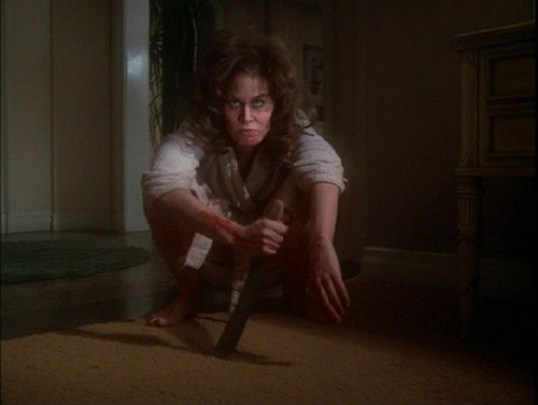
The third segment is the one that everyone remembers. Amelia (Karen Black) lives alone in a high-rise apartment and has recently purchased, as a present for her anthropologist boyfriend, a wooden fetish doll in the form of a misshapen aboriginal warrior with pointed teeth and a spear. The doll comes with a scroll that explains that the doll is inhabited by the spirit of a Zuni hunter and that the only thing keeping the doll from coming to life is the gold chain adorning the doll. Of course, the chain eventually falls off and Amelia finds herself being pursued through her apartment by a viscous doll that is obsessed with killing her. This is the simplest and the scariest of the Trilogy of Terror’s three stories. It’s easy to say that it’s just a doll until it pops out of nowhere and stabs Amelia in the ankle. This story ends on a properly dark note and that final image of Karen Black is haunting.
For a fifty year-old film, Trilogy of Terror holds up remarkably well. Watch it and witness just how good an actress Karen Black truly was.
Trilogy of Terror (1975, dir by Dan Curtis. DP: Paul Lohmann)
The Creation of the Humanoids takes place in the 23rd Century. A nuclear war has wiped out 92% of the human population. The radiation has caused many of the survivors to become sterile. The birth rate has plummeted to 1.4% and humanity is at risk of slowly dying out. The majority of the remaining humans have dealt with this news by becoming lazy and decadent. They live in luxurious apartments and they basically refuse to do anything themselves. Instead, all of the work is done by blue-skinned androids, the Humanoids that some dismissively refer to as being “clickers.” The Humanoids were not designed to have human emotions or thoughts but some appear to be developing them. The Order of Flesh and Blood want to destroy the Humanoids, especially when they hear rumors that a Humanoid has been created who is indistinguishable from an actual human. The Order of Flesh and Blood fears that the Humanoids are plotting to take over the world and replace humanity and …. they’re right!
Of course, the film suggests that might not be such a bad thing. The majority of the humans that we meet in The Creation of the Humanoids don’t seem to have much interest in continuing on with their lives. Having destroyed most of their civilization with a pointless nuclear war and now being unable to conceive, they seem to be content to laze about and wait for the end to come. Ironically, the only humans that seem to care about the future of their race are a bunch of fanatics. The Humanoids may move and speak stiffly but at least they’re making plans for the future and seem to actually care about the world in which they exist.
The Creation of the Humanoids was made for a very low-budget and with only the most rudimentary of sets. The luxury apartments all look very similar and very simple and yet that adds to the sense of ennui that runs through the entire film. The same can be said of the costumes, which are largely made up of jumpsuits and Confederate army caps that were reportedly rented from a local costume store. The drab costumes capture the feel of a society where being creative or imaginative is no longer rewarded and any sign of free thought is considered to be a threat. It’s the type of society that always seems to follow as a result of the empty promises of Marx and Coca-Cola. Fortunately, the film’s producers did pay extra so that the film could be shot in color, the better to highlight the blue tint of the Humanoids and the darkness outside of the city. They also wisely hired veteran cinematography Hal Mohr, who brings some visual flair to the project. Realizing that the film was extremely talky and that it featured characters who didn’t move around a lot, Mohr used creative camera angles and old-fashioned “glamour” lighting to give the film an interesting look. The film ultimately becomes a work of pop art and it’s not a surprise that Andy Warhol described Creation of the Humanoids as being his favorite film.
I like the film too. The stilted but philosophical dialogue, the atmosphere of ennui, the casting of Plane Nine From OuterSpace’s Dudley Manlove as a Humanoid, and the moment when Dr. Raven (Don Doolittle) breaks the fourth wall to speak directly the audience, it all adds up to something that is wonderfully bizarre and thoroughly unforgettable.
The Creation of the Humanoids (1962, dir by Wesley Barry)
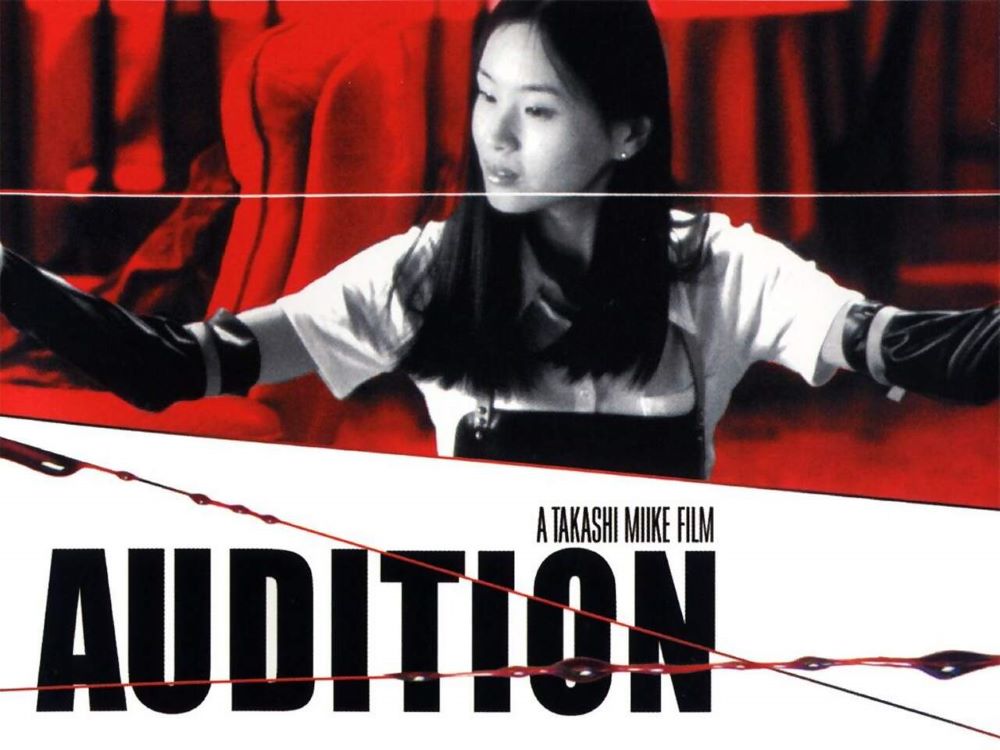
Takashi Miike’s Audition premiered in 1999 at various international film festivals before receiving a limited theatrical release in Japan in 2000. Before this film, Miike was largely known in Japan as a director of gritty, often hyper-violent yakuza cinema, with films like the Black Society Trilogy defining his reputation. However, Audition introduced him to the world stage in a way that shocked and captivated audiences beyond Asia. It was a major step in bringing Japanese horror, or J-horror, into the international spotlight, specifically to Western viewers who had limited exposure to this distinct style of horror. While filmmakers and cinephiles such as Quentin Tarantino and Eli Roth had been fans of Miike’s earlier works, Audition was a revelation that displayed a more complex, restrained, and deeply unsettling side of Japanese horror cinema that was largely unknown to general audiences in the West.
At first glance, Audition presents itself as a simple, quiet domestic drama. The film opens with Shigeharu Aoyama, played with a gentle dignity by Ryo Ishibashi, visiting his terminally ill wife in the hospital. This opening scene is tender and somber, establishing the emotional core of the film: a man grappling with loss. The narrative then leaps seven years forward, showing Aoyama as a widower still mired in grief, living a lonely life with his teenage son, Shigehiko. Shigehiko, sensing his father’s emotional paralysis, urges him to begin moving on with his life, encouraging him to date again and escape the depression that has enveloped him since his wife’s death.
The inciting moment comes when Aoyama’s friend Yasuhisa Yoshikawa, a film producer played by Jun Kunimura, proposes a peculiar solution: to hold an audition for a fictional TV drama, the real purpose being to discreetly find a woman who could be compatible with Aoyama as a partner. The auditions, while framed as a casting call, are frankly a thinly veiled matchmaking scheme. Although initially awkward and even comical in its premise, the auditions soon reveal a darker subtext—the women are not treated as individuals with their own hopes and desires, but rather as pieces in a man’s recovery process. This treatment subtly exposes lingering misogyny entrenched within the social fabric, where the women’s autonomy is overlooked and they are reduced to roles to be performed and judged purely on superficial criteria.
Among the candidates, one young woman stands out: Asami Yamazaki, portrayed with chilling serenity by Eihi Shiina. Asami, with her soft-spoken voice and seemingly delicate demeanor, instantly captures Aoyama’s attention. She shares a tragic backstory about her abandoned dreams of becoming a ballerina, cut short by a debilitating injury. This combination of fragility and mystery pulls Aoyama in, despite the warnings from Yoshikawa, who finds suspicious gaps in her background and troubling connections to violent incidents. What makes Asami particularly intriguing is the way Miike shapes her character with a complex duality. Outwardly, she embodies calmness and grace, which is visually reinforced through her wardrobe choices. She is often dressed in white—a color traditionally associated with purity and innocence—but she also frequently dons black latex over her white clothing. This contrast of white and black on her outfit manifests her dual nature: the peaceful façade masking a darker, far more dangerous interior.
This juxtaposition of colors is a subtle yet powerful artistic choice. It visually hints at her character’s concealed capacity for violence and control beneath a serene exterior. The black latex signals strength, mystery, and something potentially sinister, while the white suggests vulnerability and fragility. Asami doesn’t scream threat or menace; instead, she radiates an almost hypnotic calm that belies the storm hidden underneath. This visual storytelling complements the slow-building tension of the film, where the audience is continuously reminded to question appearances and expect unsettling surprises beneath the surface.
For much of the film’s first hour, Audition presents itself as a slow-burning romance between two emotionally damaged people. The pacing is unhurried, and the tone is understated and reserved, encouraging viewers to settle into the seemingly bittersweet story of a man tentatively trying to open his heart again. Yet throughout, subtle details apply pressure on this comfortable façade: Asami’s unblinking stares, her quiet stillness, and the unsettling sight of the large burlap sack sitting ominously in her sparsely furnished apartment speak volumes in silence. Miike shows a masterful ability to create an overwhelming sense of horror and dread from this sparse setting—just Asami, a burlap sack, and a phone lying on the floor become enough to chill the viewer deeply by their sheer mysteriousness and the ominous possibilities they evoke. The emptiness of the room forces attention on the few elements present, making the audience fill in unseen horrors with imagination, intensifying the tension without a single loud noise or burst of action.
The horror emerges gradually, not as a sudden rupture but as an inevitable revelation. As the film progresses, Asami’s cracks in the façade deepen, and the audience is led to an increasingly dark place where it becomes clear that almost nothing is as it seems. When the violence finally explodes, the tone shifts entirely. Miike keeps the camera steady and calm while the terror unfolds with surgical precision—a terrifying contrast to most horror films’ usual frantic editing in moments of violence. The infamous climactic scene is a masterclass in controlled horror: every movement, every sound, every visual detail is deliberate. It unfolds with a quiet, ritualistic menace that makes it impossible to look away, yet deeply uncomfortable to watch.
Asami’s violent acts are disturbing not only for their nature but for the serenity with which she carries them out. Her cold, calm demeanor during these moments reinforces her duality. The woman who once seemed so fragile now becomes merciless, completely in control, almost as if performing a deeply personal ritual. Her chilling voice remains soft, almost tender, as she methodically inflicts unimaginable pain on Aoyama, turning the hunting of the predator into a careful orchestration of revenge and self-assertion.
This transformation invites apt comparison to Annie Wilkes from Rob Reiner’s film adaptation of Stephen King’s Misery. Both characters are women whose broken pasts have twisted them into forces of violent control. Annie Wilkes, played iconically by Kathy Bates, is a former nurse whose love turns obsessive and horrifying when she imprisons her favorite author. Like Asami, Annie’s violence is not born from random cruelty but from deep emotional scars and isolation that have warped her understanding of love and power. Both women are trapped by their traumas and express that trauma through calculated violence—a grim reclaiming of agency in worlds that had silenced or harmed them. While Asami channels her rage through a cold, almost ritualistic cruelty hidden beneath an outer calm, Annie’s madness is an explosive, volatile cyclone of passion and psychosis. Both, however, show how a woman shaped by pain and repression might lash back in terrifying ways.
What made Audition stand out at the time—and still does today—is its slow-building dread and emotional complexity. Western horror in the late 1990s was dominated by slasher flicks, supernatural hauntings, and a new generation of self-referential genre films that played with tropes for laughs and jumpscares. Audition offered something completely different: a quiet, emotionally resonant story where the horror grows from the cracks in human relationships and societal expectations. Aoyama’s loneliness, his idealization of women, and his emotional blindness all play into the film’s horrifying climax, making the violence feel almost inevitable—a dark extension of the story’s psychological and social subtext.
However, Audition has often been unfairly associated by Western critics and media with the so-called “torture porn” wave of horror films that emerged in the early 2000s. This grouping overlooks the important distinction that the brutal, graphic, and extended depictions of physical and sexual torture characteristic of torture porn owe much more to the French New Extremity movement. Filmmakers like Alexandre Aja, Pascal Laugier, Xavier Gens, and Alexandre Bustillo pushed horror into territories of relentless physical torment, prolonged scenes of sexual violence—including rape—and vivid, lingering gore with films such as High Tension (2003), Martyrs (2008), and Inside (2007). These films are marked by their explicit, often shocking depiction of suffering and are designed to push the audience’s limits through sustained, graphic realism.
In contrast, Audition relies heavily on psychological tension, careful pacing, and emotional weight rather than overt gore or relentless brutality. Its moments of violence, while shocking, are part of a carefully constructed narrative about loneliness, denial, and control, creating horror through gradual revelation rather than relentless spectacle. Miike’s film helped broaden the landscape of horror by introducing a more atmospheric, character-driven terror that challenged viewers to engage deeply with the emotional and social undercurrents of fear.
When Audition reached Western film festivals and arthouse theaters, it caused a stir. Many audiences were unprepared for its unsettling mix of quiet domestic drama and savage horror. Accounts of fainting and walkouts spread quickly, but beyond the shock factor, the film earned critical praise for its artistry and unique voice. Directors like Quentin Tarantino championed Miike’s work, drawing attention not only to him but to the broader wave of Japanese horror arriving on the global stage. Audition helped open the door for landmark films like Ringu (1998) and Ju-on: The Grudge (2002), sparking widespread interest in J-horror’s more subtle, psychological approach to fear.
At its core, Audition is about appearances and the dangerous fictions people build around longing and loss. Asami embodies this perfectly—her serene outward demeanor conceals a deeply disturbed interior. The interplay of light and shadow in her wardrobe, the gentle cadence of her speech compared with her violent deeds, all speak to the duality of her character. She is both victim and predator, delicate and deadly, calm and terrifying.
In this way, Miike invites viewers not just to witness horror but to feel it as an inevitable expression of human vulnerability and social repression. Violence here is less an escape than a dark reflection of isolation and a desperate reclaiming of power when all other avenues are closed.
Looking back, Audition stands as the film that propelled Takashi Miike beyond obscurity and established him as a singular voice in global cinema. It was one of the earliest J-horror films to find a meaningful audience in the West, breaking new ground in how horror could be crafted—fear born from loneliness and cultural repression, told with unsettling subtlety. It remains a haunting, unforgettable film that changed horror’s shape and opened many eyes to the frightening potential lurking beneath calm surfaces.
1963’s Dementia13 is a significant film for another reasons.
For one, it’s the mainstream feature film debut of Francis Ford Coppola. (Coppola has said that he directed two softcore films before Dementia13 but they’ve been lost to history.) Both Coppola’s screenplay and his direction were heavily influenced by the early giallo films that were coming out of Italy. One could argue that this is the first American film to pay homage to Mario Bava.
Dementia13 is also the first film on which Coppola ever went overbudget. This film is literally the start of an era.
Coppola himself has been critical of Dementia13. Producer Roger Corman was not happy with the first cut of the film and added a few scenes that took away from Coppola’s pacing. That said, it’s still an atmospheric and creepy forerunner to the American slasher film. The scene in which Launa Anders goes for a swim has been duplicated in numerous other films and it’s still effective in the way that it chops away at the audience’s sense of security. It certainly freaks me out. Of course, I’m not much of a swimmer. I’m a good drowner, though.
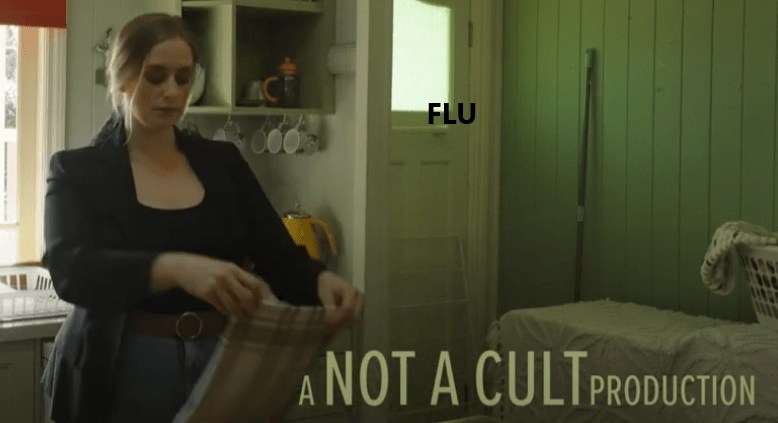
This film was not in IMDB. I could not find the actresses or director on imdb. Unless it’s just a series of slurs, I’m going to pretty lenient and hopeful. The filmmaker has no subscribers and is doing this for the love of the art. My fingers are crossed! A single mom and her friend are unlucky in love and have a budding romance. During their mundane conversation, the mother’s daughter is screaming like a demon. There are a number of signs of evil presence. Since there was not a conclusion, I believe that this short was a pitch for funding for a feature length film. When Hulu makes a faux short film, it’s very annoying, but Stacey Ellis is trying hard to get her art off of the ground and I wish her the best. Yes, I’ve gone soft.
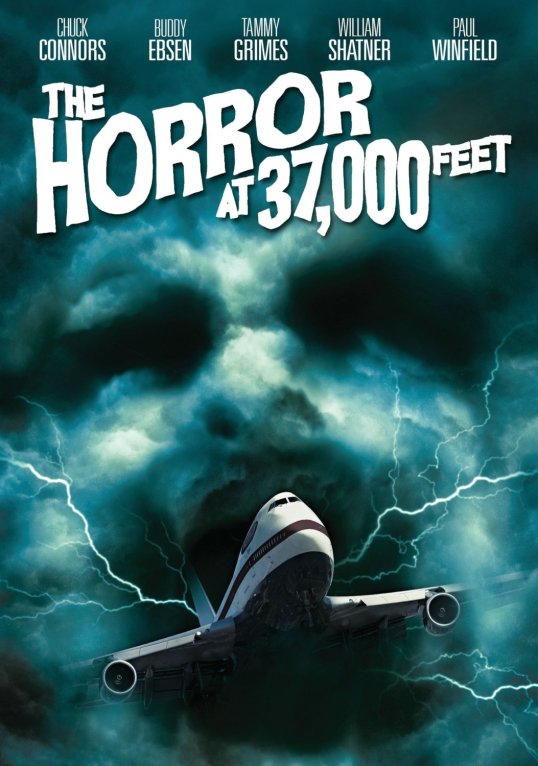
I imagine that it should go without saying that, if you’re on an airplane and you’re flying high above the ground, the last thing that you want to deal with is a bunch of angry ghost druids.
And yet, that’s exactly what happens in this made-for-TV horror film from 1973.
The ghost druids are upset because two architects (played by Roy Thinnes and Jane Merrow) have traveled to England, specifically so that they can supervise the deconstruction of ancient druid altar. Now, they’re flying the pieces of the altar back over the ocean so that the altar can be reconstructed in the United States. The spirits of the ancient druids aren’t happy about being moved so they start doing everything they can to make the journey difficult.
First, they attempt to freeze the plane. When that doesn’t work, they decide to rip it in half. One of the passengers, Mrs. Pinder (Tammy Grimes), suggests that maybe the druids will settle down if they’re offered a sacrifice. When the druids reject an offer of a doll, the passengers start to wonder if maybe the spirits would be happier with a human sacrifice.
Although some of the passengers are reluctant to buy into the whole sacrifice thing, a few of them do start to come around. For instance, there’s a perpetually angry businessman who is played by Buddy Ebsen. Once he realizes that the druids aren’t going anywhere, he has no problem with the idea of a human sacrifice. There’s also a cowboy played by Will Hutchins. If sacrificing a human is what he has to do to have another chance to ride the range, that’s what he’s going to do. Paul Winfield plays a distinguished doctor who tries to keep everyone calm while Chuck Connors is stuck in the cockpit, trying to keep the plane in the air while his passengers and crew debate the ethics of human sacrifice.
And then there’s William Shatner.
Shatner plays a former priest who has lost his faith. From the minute he gets on the plane, he starts drinking and he doesn’t stop for almost the entire movie. It doesn’t matter what’s happening on the plane, Shatner always has a glass in his hand. Playing a character who never has anything positive to say, Shatner smirks through the entire film. Shatner delivers all of his lines in his standard halfting and overdramatic fashion and it’s something of a wonder to behold. Shatner has said that The Horror At 37,000 Feet may be the worst movie in which he ever appeared and just one look at his filmography will show why this is such a bold statement.
The Horror at 37,000 Feet is definitely a film of its time. The plane comes complete with a swinging cocktail lounge, William Shatner wears a turtle neck, and all of the flight attendants wear boots and miniskirts. Everything about this film screams 1973. It’s an incredibly silly but undeniably fun movie. With a running time of only 73 minutes, the pace is fast and the druids don’t waste any time getting down to business. The film’s on YouTube so check it out the next time you’ve an hour and 13 minutes to kill.
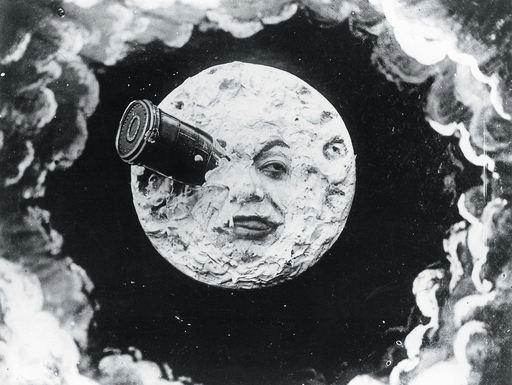
Let’s celebrate October by taking a trip to the moon with classic film that came out 123 years ago?
Directed and written by Georges Melies, A Trip to The Moon is often cited as the first sci-fi film and the image of the capsule crashing into the eye of the man in the moon is one of the most iconic in film history. Seen today, the film seems both charmingly innocent and remarkably ahead of its time.
For me, it always takes a minute or two to adjust to the aesthetic of early films. We’ve grown so used to all the editing tricks that modern filmmakers use to tell their stories that these old silent films, with their lack of dramatic camera movement and obvious theatrical origins, often take some effort to get used to. Still, the effort is often worth it.
Here then is Georges Melies’s 1902 science fiction epic, A Trip To The Moon.




 Through the Shattered Lens