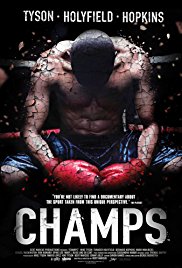
Bernard Hopkins. Evander Holyfield. Mike Tyson. Three men who came from similar backgrounds and who eventually became three very different heavyweight champions. Bernard Hopkins was the ex-con who transformed himself through boxing. Mike Tyson was the ferocious and self-destructive fighter whose legendary career eventually became a cautionary tale. Evander Holyfield was the underrated fighter, whose discipline and self-control made him a champ but also ensured that he would never get as much attention as the other boxers of the era.
Featuring extensive interviews with these three fighters, Champs is a documentary that not only follows their careers but also tries to place boxing within a greater sociological framework. As several people in the film state, rich kids do not grow up to become professional boxers. Instead, they are the ones who grow up to charge people $100 to watch Mayweather vs McGregor on Pay-Per-View. Boxing has always been a sport that has been dominated by men who grew up poor and marginalized. That was certainly true for Hopkins, Tyson, and Holyfield. For all three of them, boxing provided an escape but it also provided temptation. Unlike players in other sports, boxers rarely have anyone looking out for their best interests. Tyson’s career was derailed by a prison sentence and he has struggled with both financial and mental issues. Holyfield made millions for promoters but still ended up declaring bankruptcy. Champs does not shy away from examining the physical and metal toll of boxing.
As a documentary, Champs is sometimes too slick. There are too many interview with celebrity boxing fans. Ron Howard may be a good director but he does not have much to add to a discussion about the correlation between poverty and boxing. Champs works best when it allow Hopkins, Holyfield, and Tyson to tell their own stories. Hopkins speaks movingly about how the experience of being in prison not only changed him but ultimately made him a better person. Mike Tyson is candid about his own demons. Meanwhile, Holyfield talks about what it was like to always be underestimated and underrated by the boxing world. All three of them are compelling in their own different way. For fight fans, Champs has much to offer.
Way back in January, when I first heard about To The Bone, I had high hopes for it.
After all, To The Bone was the directorial debut of Marti Noxon, who is well-known both for her work on Buffy the Vampire Slayer and for co-creating Unreal. To The Bone was reportedly based on Noxon’s own struggle with an eating disorder and it was said to feature an outstanding lead performance from Lily Collins as an artist struggling with anorexia. Even the casting of Keanu Reeves as a doctor sounded intriguing.
And, to me, it didn’t matter that To The Bone got mixed reviews at Sundance. Who would seriously expect critics, especially male critics, to understand a movie about body issues and eating disorders? When I heard that To The Bone had been purchased by Netflix, I did sigh a little. Far too often, Netflix is where good films end up getting lost in a sea of mediocre offering. But then again, perhaps To The Bone was exactly the type of intimate character study that would actually benefit from being viewed on a small screen. After all, it’s not a film about a bunch of space lizard attacking the great wall of China. It’s a film about a young woman struggling with an eating disorder.
When Netflix finally released To The Bone back in July, I was excited.
Then I actually watched the movie.
To The Bone actually gets off to a pretty good start. The first 20 minutes or so are dedicated to establishing who Ellie (Lily Collins) is. She’s 20 years old. She’s smart. She’s sarcastic. She’s an artist. She’s a college dropout who apparently used to have a very popular tumblr that dealt with being thin. She’s also anorexic and, from the first minute that we see her, Ellie looks like she’s on the verge of death. (To the film’s credit, it makes clear that there is a huge difference between being naturally thin and being anorexic. That’s a distinction that is far too often overlooked.) We meet Ellie’s dysfunctional family: her frustrated stepmother (Carrie Preston), the father who often can’t be bothered, and the half-sister (Liana Liberato) who both loves and resents her. The relationship between the two sisters is especially well-handled. Even if it takes a while to get used to Keanu Reeves playing a compassionate but tough-talking doctor, the film still works during his first few scenes.
Then, Ellie joins Reeves’s inpatient program and moved into a house with six other patients and this is where the film started to annoy me. Ellie is such a well-drawn and well-acted character that it makes it all the more obvious that the rest of the patients are not. Instead, the rest of the patients are all easily identifiable types. As soon as they show up on screen, you know everything about them and you know exactly what is going to happen to each and every one of them. From the minute that Ellie reluctantly steps into that house, To The Bone starts to feel less like an honest look at anorexia and more like a well-meaning and predictable PSA. One of the patients is pregnant and always talk about how worried she is that her eating disorder is going to lead to her losing the baby. Can you guess what happens?
And then there’s Luke (Alex Sharp). Luke is the ballet dancer who is recovering from a knee injury. As soon as I saw that Luke was the only male in the house, I knew that he was destined to eventually declare his love for Ellie. But my problem with Luke has less to do with his predictable character arc and more to do with just how annoying a character he is. Luke is relentlessly upbeat. Luke constantly tells corny jokes. Luke just will not stop talking! When Luke leaves a room, he starts singing a song called Sugar Blues. When Luke reenters a room, he is still singing Sugar Blues. SHUT UP, LUKE!
(Whenever Ellie would visit Luke in his room, I would find myself distracted by the posters on his wall. The majority of them said “Jazz Festival” and featured some saxophone clipart. As strange as it may sound, it really started to annoy me that there was no date or location listed. Why would you go through all the trouble of making — or buying, for that matter — a poster for a jazz festival and then not bother to include a date or a location? That may sound like a minor thing but, as I watched the film, that inauthentic poster came to represent everything that felt inauthentic about Luke as a character.)
I guess the main problem with To The Bone is that it never succeeds in convincing us that the inpatient program is actually going to do any good for Ellie. It’s not for lack of trying. However, the scenes in the house are too overwrought and predictably scripted. There’s a scene where Reeves takes the patients on a field trip and it’s supposed to be inspiring but it doesn’t work because, as a first-time director, Noxon doesn’t trust her material enough to allow us to draw our own conclusions. Instead, she beats us over the head with her message. For To The Bone to work, it needed a director like Andrea Arnold, someone who specializes in a naturalistic performances and who is willing to embrace ambiguity and take the time to let a scene play out. Noxon makes the mistake of not trusting her audience to draw the right conclusion and, as a result, To The Bone goes from being an intriguing character study to being the cinematic equivalent of the last 15 minutes of an episode of Intervention.
Though it all, Lily Collins continues to give a good performance. Even when she’s forced to deliver some unfortunate dialogue, she’s the best thing about To The Bone. Unfortunately, the rest of this movie just collapses around her.
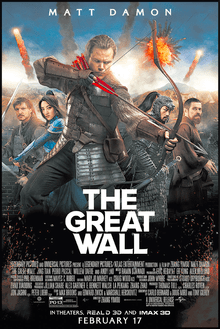
The Great Wall came out in February. Before it was released, I saw the trailer and I thought, “Well, that looks like it might be fun.” However, I never actually saw the film when it was in theaters. I think I was still recovering from Fifty Shades Darkerwhen The Great Wall was released so I put off going to see it. I thought to myself, “That’ll be around for a while.” Of course, I was wrong. The Great Wall played for two weeks and then it was gone.
That may not sound like a big deal when you consider the reviews that The Great Wall received. If not for the fact that Fifty Shades Darker was released a week earlier, The Great Wall would have been the first critical disaster of 2017. Seriously, the critics hated The Great Wall with a passion that took even me by surprise. The comments went beyond the usual snarkiness to outright hatred. Suddenly, The Great Wall — which, to judge from the trailer, looked like a harmless little monster movie — was being held up as an example of everything wrong with modern filmmaking.
The film was even attacked for starring Matt Damon. As I said before, I thought the trailer looked like fun but, apparently, other critics watched that trailer and found themselves asking, “How dare Matt Damon appear in a movie that’s set in eleventh century China!?” And you know what? I get it. Whenever I’m watching a movie about aliens invading the 11th Century, my immediate concern is whether or not the film is historically accurate. It’s bad enough that Americans are being taught that Matt Damon could survive on Mars. Do they also have to be told that Matt Damon saved China from the space lizards!?
Even though I missed The Great Wall when it was playing in theaters, I knew that it was a film that I would see eventually. Whenever a film gets totally slaughtered by the critics, I feel like I have almost a duty to watch the film and judge for myself. Some of that’s because I don’t trust the majority of critics. And some of it’s because, as a natural born contrarian, I’m always hopeful for any chance to go against the consensus. Last month, I finally watched The Great Wall and you know what?
It’s not that bad.
Now, it should be understood that being not that bad doesn’t necessarily mean that The Great Wall is a good movie. It’s a deeply silly movie and, occasionally, it’s also a profoundly dumb one. Matt Damon plays a European mercenary who is sneaking around China, searching for gunpowder. After he is captured by the Chinese and brought to the Great Wall, he is enlisted to help battle a bunch of space lizards. Apparently, the space lizards attack the wall every 60 years but, this year, they’re arriving early. Or something like that. I really couldn’t follow the mythology of the space lizards and that’s probably for the best. The Great Wall is not a film that demands or benefits from a good deal of deep thought. This is one of those films where the best plan is to not ask too many questions because the answers probably won’t make any sense anyway.
As dumb as The Great Wall may be, it’s an undeniably entertaining movie. Under the direction of Zhang Yimou, The Great Wall is a visual feast, full of epic landscapes and swooping cameras. When a seemingly limitless number of space lizards appear out of nowhere and suddenly charge the wall, it’s impossible not to get caught up in the exciting silliness of it all. When the Chinese army takes their positions on the Great Wall and prepare to repel the invasion, it doesn’t matter that none of the characters are particularly fleshed out. Instead, you’re just overwhelmed by the vibrant colors of their armor and the determined fierceness of their expressions. The Great Wall is shamelessly over the top and nicely self-aware. This a movie that knows that it is ludicrous and occasionally incoherent and you know what? The Great Wall is perfectly fine with that.
For all the criticism that he received for appearing in the movie, Matt Damon is ideally cast. Whenever Damon is on screen, it’s as if he’s entered into a conspiracy with the viewer. Matt Damon is one of the few actors who can maintain his balance while walking that thin line between drama and parody. With every arched eyebrow and slightly sarcastic line reading, Damon is saying, “Sure, this is all kind of stupid. But aren’t we having fun?”
When The Great Wall eventually shows up on the SyFy channel, it’s going to be fun movie to live tweet. Some films were just meant to be watched and appreciated with a group of your snarkiest friends. The Great Wall is one such film.
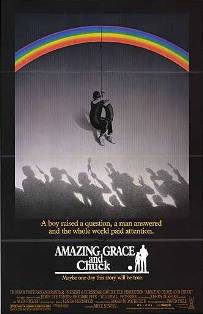
Amazing Grace and Chuck has a heartfelt message but it ultimately trips over its own good intentions.
Chuck (Joshua Zuelkhe) is a 12 year-old boy who lives in Montana and who is the best little league pitcher in the state. Because a field trip to a missile silo causes him to have nightmares, Chuck announces that he will not play baseball until the world agrees to nuclear disarmament. Chuck’s team ends up having to forfeit a game because Chuck refuses to play. In the real world, this would lead to Chuck enduring 6 years of ridicule and bullying until he was finally old enough to change his name and go to college in a different state. In the world of the movies, it leads to Chuck becoming a hero.
A basketball player named Amazing Grace (Alex English) reads a news story about Chuck’s protest and he decides to protest as well. He announces that he will not play basketball until there are no more nuclear missiles. Before you can say “Colin Kaepernick,” hundreds of other sports stars are following Amazing Grace’s lead. Of course, if any group of people is well known for their willingness to give up a huge payday for a quixotic and largely symbolic protest, it’s America’s professional athletes. Amazing Grace and the athletes even move out to Montana, so that they can be closer to Chuck.
Because they do not appreciate his efforts to put all sporting events (and all betting on sporting events) on hold, the Mafia makes plans to assassinate Amazing Grace. Chuck protests this by taking a vow of silence. By now, it is hard to keep track of what Chuck is protesting and how. Is he still trying for world disarmament or has he moved on to getting the Mob out of professional sports? All the other children of the world follow Chuck’s example, refusing to speak. In the real world, children taking a vow of silence would lead to parents celebrating in the street but, in the movie, it leads to panic and causes the Soviets to assume they have the upper hand over the west. The President (Gregory Peck) ruins it all by inviting Chuck to the White House. When President Peck explains that people are not allowed to shout fire in a crowded movie theater, Chuck breaks his vow of silence to ask, “But what if there’s a fire?”
There are many problems with Amazing Grace and Chuck, including the dumb Mafia subplot that seems like it should be in a different movie and Chuck coming across as being a smug little creep. Joshua Zuehlke made his film debut as Chuck and, on the basis of his performance, it is not surprising that he has never appeared in another film since. By the end of the movie, even Gregory Peck is sick of Chuck and his demands. It’s obviously a heartfelt film, which is probably why actors like Peck, Jamie Lee Curtis, and William L. Petersen all appeared in it despite presumably having a hundred better things to do, but a nuanced look at détente and the arms race, Amazing Grace and Chuck is not.
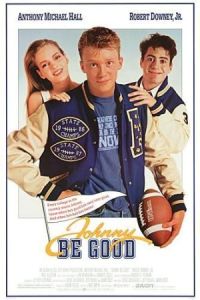
Johnny Walker (Anthony Michael Hall) may be the best high school quarterback in the country but he has a difficult choice to make. He promised his girlfriend, Georgia (Uma Thurman), that he would go to the local state college with her but every other university in the country wants him. (Even legendary sportscaster Howard Cosell calls Johnny and advises him to go to an Ivy League college.) As Johnny tours universities across the country, he faces every temptation. By the time he makes his decision, will Johnny still be good?
The main problem with Johnny Be Good can be found in the first sentence of the above synopsis. Anthony Michael Hall plays the best high school quarterback in the country. By taking on the role of Johnny Walker, Hall was obviously attempting to prove that he was capable of more than just playing nerds for John Hughes. But Hall is never convincing as a quarterback, much less the best in the country. Though he bulked up for the role, it is impossible to imagine Hall in a huddle, coming up with the big play that wins the game. It’s easier to imagine Johnny getting shoved in a locker and left there until the school year ends. Hall seems to be lost in the role and the movie never seems to be sure who Johnny Walker is supposed to be. (Two years later, Hall would again play a jock and give a far better performance in Edward Scissorhands.)
As for the rest of the cast, Robert Downey, Jr., who plays Johnny’s teammate and best friend, is even less convincing as a football player than Hall. In the 1980s, Downey could play a quirky sidekick in his sleep but not a wide receiver. Paul Gleason also shows up in the movie, basically playing the same role that he played in The Breakfast Club. Uma Thurman is sweet and pretty in her film debut but it’s a nothing role. Fans of Cannon Picture will want to keep an eye out for Steve James, in a small role as a coach.
Poorly written and slackly directed with few laughs, Johnny Be Good fails to take its own advice.
Actress Alex Ramsey (Deborah Shelton) may have become a star as a result of playing the lead role in a cop show but she still worries that her show is not realistic enough. When a fight with her director (Gilbert Gottfried) leads to her walking off the set for the hundredth time, Alex stumbles across a real-life murder. Now being chased by terrorists and gun smugglers, Alex is forced to go into hiding. FBI agent Baker (Marc Singer) is assigned to protect her but how can he hide one of the most famous women in America, especially one who does not appreciate being told what to do? Making things even worse, there is a traitor in the bureau. Shelton is going to have to use all of her tv crime-fighting skills to survive.
Though it featured enough Deborah Shelton nudity to win it a place in the regular Skinemax rotation, Silk Degrees is basically a standard 90s direct-to-video action film but it has a cast that will be appreciated by any B-move fan. Along with Body Double‘s Shelton, Beastmaster’s Marc Singer, and everything’s Gilbert Gottfried, Silk Degrees also features Charles Napier as Singer’s boss, Mark Hamill as Singer’s partner, and Katherine Armstong as a duplicitous femme fatale. The main villain is played by singer Michael Des Barres. Even Adrienne Barbeau shows up in a tiny role! Silk Degrees is not a great movie but with a cast like this, it does not have to be.
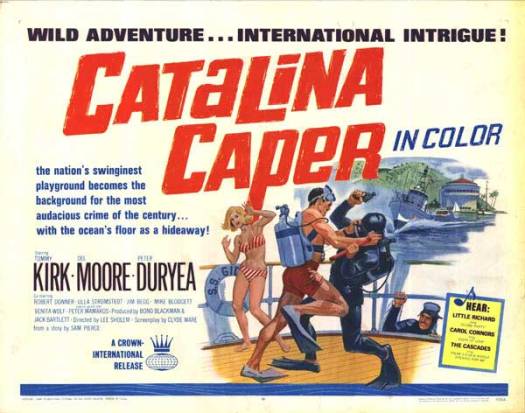
Beach Party movies had run their course by 1967, as AIP released their final entry in the surf cycle, THE GHOST IN THE INVISIBLE BIKINI, with Tommy Kirk and Deborah Walley replacing Frankie and Annette , and nary a beach in sight. Crown International Pictures, AIP ‘s impoverished cousin (if one can imagine!), produced what is considered the last of the genre, CATALINA CAPER, also starring Kirk and a cast of dozens.
CATALINA CAPER is basically an lame excuse to get a bunch of young hardbodies on the beach and let ’em dance around to some dated rock music. Believe it or not, there’s a plot (though not a very good one) involving the theft of an ancient Chinese scroll masterminded by one of the teen’s con artist parents (Del Moore, Sue Casey) and a gangster trying to get ahold of it. There’s also a subplot (imagine that!) about Kirk torn between his bud’s sister (Venita Wolf) and a…
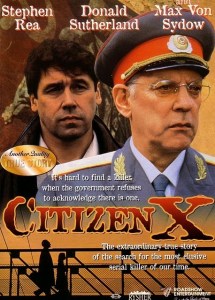
How do you solve a crime in a society that refuses to admit that crime exists?
That is the dilemma faced by Viktor Burakov (Stephen Rea) in the fact-based film, Citizen X. Burakov is a forensic expert in the Soviet Union. In 1982, when a dead body is found on a collective farm, Burakov is assigned to investigate. When seven more bodies are discovered, Burakov is convinced that he is dealing with a serial killer. The problem is that the official Soviet position is that crime and, especially, serial murder are a product of western decadence. With his superiors refusing to accept that a serial killer could be active in the USSR, Burakov is driven to the point of insanity as he both tries to stop the murders and keep his job. Fortunately, he has the Machiavellian Col. Fetisov (Donald Sutherland) on his side but, even with Fetisov’s protection, Burakov is no closer to tracking down the murderer.
Citizen X is based on the crimes of Andrei Chikatilo. From 1978 to 1990, Chikatilo committed at least 57 murders, with several of his victims being young children. Though many were suspicious of him, Chikatilo was protected by both his membership in the Communist party and the government’s refusal to allow most of his crimes to be publicly reported. It was only during the reforms of Perestroika that authorities were allowed to thoroughly investigate Chikatilo’s crimes. Chikatilo was arrested in 1992 and executed, via a gunshot to the back of his head, in 1994. In Citizen X, Chikatilo is played by Jeffrey DeMunn, who gives a very good and disturbingly plausible performance as the monstrous killer.
Made for HBO, Citizen X is a low-key but thought-provoking recreations of not just Chikatilo’s crimes but the atmosphere that allowed him to go undetected, Along with DeMunn, both Rea and Sutherland give great performances. (Sutherland won an Emmy.) Max Von Sydow also appears, playing a psychologist who is given the unenviable task of trying to enter Chikatilo’s mind.
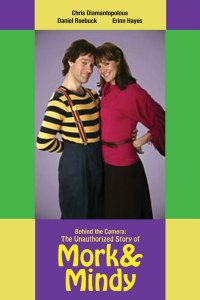
The year is 1978. A television producer named Garry Marshall (Daniel Roebuck) teaches America how to laugh again by casting Pam Dawber (Erinn Hayes) and a hyperactive stand-up comedian named Robin Williams (Chris Diamantopoulos) in a sitcom about an alien struggling to understand humanity. Despite constant network interference, the show makes Robin a star but, with stardom, comes all the usual temptations: lust, gluttony, greed, pride, envy, wrath, and John Belushi.
The Behind The Camera films, which all dramatized the behind the scenes drama of old television shows, were briefly a big thing in the mid-aughts. Because they were lousy, they never got good reviews but they did get good ratings from nostalgia-starved baby boomers and gen xers. I think The Unauthorized Mork & Mindy Story was the last one produced. It probably would have been better if there had been any sort of drama going on behind-the-scenes of Mork & Mindy but, according to this movie, everyone got along swimmingly. Williams may get hooked on cocaine but the film squarely puts the blame for that on John Belushi. The script, which was obviously written with one eye on avoiding getting sued, is sanitized of anything that could have reflected badly on anyone who was still alive when the movie aired.
Stuck with unenviable task of having to play one of the most famous people in the world, Chris Diamantopoulos was not terrible as Robin Williams. Considering how sanitized the script was, not terrible is probably the best that could be hoped for. There was not much of a physical resemblance but Diamantopoulos nailed the voice and some of the mannerisms. Erinn Hayes looks like Pam Dawber but, just as in the actual show, the movie gives her the short end of the stick and focuses on Williams.
For aficionados of bad television, this is mostly memorable for Daniel Roebuck’s absolutely terrible performance as Garry Marshall and a scene in which Williams is heckled in a comedy club but an overweight man who steps out of the shadows and announces that he’s John Belushi! Roebuck’s performance as Garry Marshall begins and end with his attempt to impersonate Marshall’s familiar voice. He was much better cast as Jay Leno in The Night Shift. As for Belushi , since he was not around to sue or otherwise defend himself, the movie goes all out to portray Belushi (who was played by Tyler Labine) as being an almost demonic influence on Williams. The film’s portrayal of Belushi is even worse and probably more inaccurate than Wiredand that’s saying something!
To quote Mork himself: Shazbot! This movie is full of it.
Producer/director Roger Corman finally cut ties with American-International Pictures after they butchered his apocalyptic satire GAS-S-S! Striking out on his own, Corman’s next movie was VON RICHTOFEN AND BROWN, a World War I epic about famed German aerial ace The Red Baron and the Canadian pilot who shoots his down Roy Brown. There are grand themes, as Corman sought to make a statement on the futility of war, the end of chivalry, and the mechanized savagery of what was to be “the last war”. The film looks good, shot in Ireland, with exciting aerial footage, but despite all the outer trappings VON RICHTOFEN AND BROWN is still a Corman drive-in movie.
John Philip Law also looks good as Baron Manfred von Richtofen, the aristocrat/warrior who became the feared Red Baron. Law was always great to watch, whether as the blind angel in BARBARELLA, the black-clad supervillain in DANGER: DIABOLIK, sexy Robin Stone in…
 Bernard Hopkins. Evander Holyfield. Mike Tyson. Three men who came from similar backgrounds and who eventually became three very different heavyweight champions. Bernard Hopkins was the ex-con who transformed himself through boxing. Mike Tyson was the ferocious and self-destructive fighter whose legendary career eventually became a cautionary tale. Evander Holyfield was the underrated fighter, whose discipline and self-control made him a champ but also ensured that he would never get as much attention as the other boxers of the era.
 Johnny Walker (Anthony Michael Hall) may be the best high school quarterback in the country but he has a difficult choice to make. He promised his girlfriend, Georgia (Uma Thurman), that he would go to the local state college with her but every other university in the country wants him. (Even legendary sportscaster Howard Cosell calls Johnny and advises him to go to an Ivy League college.) As Johnny tours universities across the country, he faces every temptation. By the time he makes his decision, will Johnny still be good?
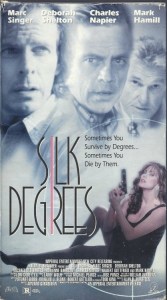 Actress Alex Ramsey (Deborah Shelton) may have become a star as a result of playing the lead role in a cop show but she still worries that her show is not realistic enough. When a fight with her director (Gilbert Gottfried) leads to her walking off the set for the hundredth time, Alex stumbles across a real-life murder. Now being chased by terrorists and gun smugglers, Alex is forced to go into hiding. FBI agent Baker (Marc Singer) is assigned to protect her but how can he hide one of the most famous women in America, especially one who does not appreciate being told what to do? Making things even worse, there is a traitor in the bureau. Shelton is going to have to use all of her tv crime-fighting skills to survive.

 How do you solve a crime in a society that refuses to admit that crime exists?
 The year is 1978. A television producer named Garry Marshall (Daniel Roebuck) teaches America how to laugh again by casting Pam Dawber (Erinn Hayes) and a hyperactive stand-up comedian named Robin Williams (Chris Diamantopoulos) in a sitcom about an alien struggling to understand humanity. Despite constant network interference, the show makes Robin a star but, with stardom, comes all the usual temptations: lust, gluttony, greed, pride, envy, wrath, and John Belushi.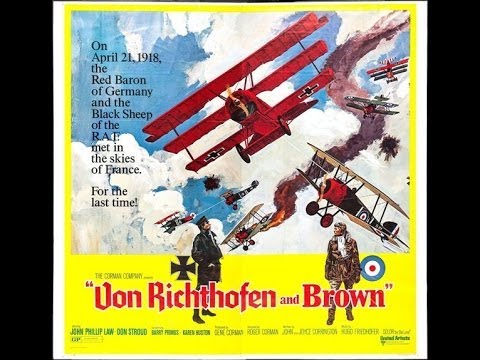

 Through the Shattered Lens