And then there’s Lars Von Trier’s Melancholia. Von Trier is always going to be controversial filmmaker but no one has ever matched his brilliance when it came to capturing the end of existence. In Melancholia, a depressed woman (played in a revelatory performance by Kristen Dunst) finds unexpected strength in the end of the world. As can be seen in the scene below, it’s a beautifully sad film, one that ends on a note of triumphant apocalypse:
John Candy and Eugene Levy make a great team in the underrated comedy, Armed and Dangerous.
John Candy plays Frank Dooley, a member of the LAPD. One of the first scenes of the movie is Frank climbing up a tree to save a little boy’s kitten and then getting stuck in the tree himself. When Frank discovers two corrupt detectives stealing televisions, Frank is framed for the theft and kicked off the force.
Eugene Levy plays Norman Kane, a lawyer whose latest client is a Charles Manson-style cult leader who has a swastika carved into his head. After being repeatedly threatened with murder, Norman asks for a sidebar and requests that the judge sentence his client to life in prison. The judge agrees on the condition that Norman, whom he describes as being “the worst attorney to ever appear before me,” find a new line of work.
Frank and Norman end up taking a one day training course to act as security guards and are assigned to work together by their tough by sympathetic supervisor (Meg Ryan!). Assigned to guard a pharmaceutical warehouse, Frank and Norman stumble across a robbery. The robbery leads them to corruption inside their own union and, before you can say 80s cop movie, Frank and Norman are ignoring the orders of their supervisors and investigating a crime that nobody wants solved.
Armed and Dangerous was one of the many comedy/cop hybrid films of the 1980s. Like Beverly Hills Cop, it features Jonathan Banks as a bad guy. Like the recruits in Police Academy, all of Frank and Norman’s fellow security guards are societal misfits who are distinguished by one or two eccentricities. There is nothing ground-breaking about Armed and Dangerous but Mark Lester did a good job directing the movie and the team of Candy and Levy (who has previously worked together on SCTV) made me laugh more than a few times.
Armed and Dangerous was originally written to be a vehicle for John Belushi and Dan Aykroyd. It’s easy to imagine Belushi and Aykroyd in the lead roles but I think the movie actually works better with Candy and Levy, whose comedic style was similar to but far less aggressive than that of Belushi and Aykroyd. One of the reasons that Armed and Dangerous works is because John Candy and Eugene Levy seem like the two last people to ever find themselves in a shootout or a car chase. With Belushi and Aykroyd, it would have been expected. After all, everyone’s seen The Blues Brothers.
Sam (Lloyd Nolan), Jim (Fred MacMurray), and Wahoo (Jack Oakie) are three outlaws in the old west. Wahoo works as a stagecoach driver and always lets Sam and Jim know which coaches will be worth holding up. It’s a pretty good scam until the authorities get wise to their scheme and set out after the three of them. Sam abandons his two partners while Jim and Wahoo eventually end up in Texas. At first, Jim and Wahoo are planning to keep on robbing stagecoaches but then they realize that they can make even more money as Texas Rangers.
At first, Jim and Wahoo are just planning on sticking around long enough to make some cash and then split. However, both of them discover that they prefer to be on the right side of the law. After they save a boy named David from Indians, Jim and Wahoo decide to stay in Texas and protect its settlers.
The only problem is that their old friend Sam has returned and his still on the wrong side of the law.
Made to commemorate the Texas centenary (though it was filmed in New Mexico), The Texas Rangers is a good example of what’s known as an oater, a low-budget but entertaining portrayal of life on the frontier. King Vidor does a good job with the action scenes and Fred MacMuarry and Jack Oakie are a likable onscreen team. The best performance comes from Lloyd Nolan, as the ruthless and calculating Sam. Sam can be funny and even likable but when he’s bad, he’s really bad.
Jack Oakie was better known as a comedian and The Texas Rangers provides him with a rare dramatic role. Four years after appearing in The Texas Rangers, Oakie would appear in his most famous role, playing a parody of Benito Mussolini in Charlie Chaplin’s The Great Dictator.
THE CHEAP DETECTIVE could easily be subtitled “Neil Simon Meets MAD Magazine”. The playwright and director Robert Moore had scored a hit with 1976’s MURDER BY DEATH, spoofing screen PI’s Charlie Chan, Sam Spade, and Nick & Nora Charles, and now went full throttle in sending up Humphrey Bogart movies. Subtle it ain’t, but film buffs will get a kick out of the all-star cast parodying THE MALTESE FALCON, CASABLANCA , TO HAVE AND HAVE NOT, and THE BIG SLEEP .
Peter Falk does his best Bogie imitation as Lou Peckinpaugh, as he did in the previous film. When Lou’s partner Floyd Merkle is killed, Lou finds himself in a FALCON-esque plot involving some rare Albanian Eggs worth a fortune. Madeline Kahn , John Houseman, Dom De Luise , and Paul Williams stand in for Mary Astor, Sydney Greenstreet, Peter Lorre, and Elisha Cook Jr, respectively, and they milk it for every…
When a secret service agent’s investigation into a supposed counterfeiting ring instead leads to him discovering a plot to smuggle illegal aliens into the United States via airplanes, the agent ends up plummeting several hundred miles to his death. Realizing that they need someone who can go undercover and infiltrate the smuggling ring, the Secret Service recruits Lt. Brass Bancroft (Ronald Reagan). Bancroft is a war hero who is now a commercial airline pilot. He is also good with his fists, has an innate sense of right and wrong, and a sidekick named Gabby (Eddie Foy Jr., giving a very broad performance as the movie’s comic relief). But before Brass can win the trust of the smugglers, he will have to establish a firm cover story and that means allowing himself to be arrested on fake charges. In order to save the day, Brass will have to first survive prison.
If Secret Service of the Air is remembered today, it is because it featured future President Ronald Reagan in an early starring role. In the role of Brass Bancroft, Reagan gives a performance that can be best described as being amiable. He may not be anyone’s idea of a good actor but he is likable, a trait that served him well when, 26 years later, he ran for governor of California. As for the rest of the movie, it was obviously cheaply made but it is also only an hour long, which means that there is rarely time for a dull moment. It plays out like as serial, with a new cliffhanger ever few minutes. Though Reagan was dismissive in the film in his autobiography, Secret Service of the Air was enough of an unexpected success that he would play Brass Bancroft is two sequels.
“In an hour, I promise, you’ll be able to beg in two languages.” — Patricia (Shannon Tweed) in Scorned
If anyone could pull that line off, it would be Shannon Tweed at the height of her Skinemax stardom!
In Scorned, Shannon plays Patricia, the beautiful wife of executive Truman Langley (Daniel McVicar). Truman is desperate to land the Wainwright account, thinking it could be the key to getting a huge promotion. To help him out, Patricia sleeps with Mason Wainwright (Stephen Young). Truman gets the account but Alex Weston (Andrew Stevens, who also directed) gets the promotion. After Truman kills himself, Patricia shows up at the Weston house, disguised as a tutor for their son, Robey (Michael D. Arenz). Like clockwork, Patricia seduces not just Alex and Robey but Marina Weston (Kim Morgan Greene) as well.
Of the many direct-to-video films that Andrew Stevens and Shannon Tweed made together in the 90s, Scorned is one of the best. Of course, Shannon Tweed looks good. Of all the regular 90s direct-to-video vixens, Shannon was the sexiest. What is often forgotten is that Shannon could also actually act and she shows that here with her ferocious performance. Andrew Stevens does a good job too, giving an above average performance and, as a director, staying out of Shannon’s way. He knows that everyone watching the movie is watching to see Shannon and this film does not disappoint.
It does stretch credibility that no one in the household realizes that Shannon is trying to destroy them but, then again, what parents would actually hire their hormonal, teenage son a live-in tutor who looks like this?
It is all about maintaining a healthy suspension of disbelief.
There has been a car crash in Paris and now, David (Judd Nelson) is in the hospital, slowly recovering. In flashbacks, it is revealed that David is an American writer who came to France after his first novel flopped. He came to see his best friend, a womanizing photographer (Roy Dupuis), and ended up meeting and falling in love with the beautiful model, Annabelle (Laurence Treil). Even as he worked on his second novel, he was consumed with jealousy over Annabelle. Why was she sneaking off to a château owned by a mysterious and decadent businessman named Garavan (Piece Brosnan)? Any why, while he is in the hospital, is his second novel published and credited to someone else?
Entangled is yet another 90s neo-noir starring Judd Nelson. Laurence Treil was beautiful and often naked, which made it perfect for showings on Skinemax but the movie fails because, like so many others, it requires the audience to believe that Judd Nelson could not only write a book but get a model girlfriend as well. That takes much more work than is portrayed in Entangled. Early on in Entangled, Judd Nelson gropes a cardboard cut-out of George H.W. Bush and it is pretty much all downhill from there. Not even Brosnan doing a good job as a sinister character can do much to save Entangled.
What could have saved Entangled? Like so many of Judd Nelson’s direct-to-video movies, Entangled needed the calming hand of Judd’s co-star from Shattered If Your Kid’s On Drugs, Burt Reynolds!
Am I saying that Entangled would have been a better movie if Burt Reynolds had been given a role?
Alistair MacLean’s adventure novels, filled with muscular action and suspenseful plot twists, thrilled moviegoers of the 60’s and 70’s in such big budget hits as THE GUNS OF NAVARONE and ICE STATION ZEBRA. In his first foray into screenwriting, 1969’s WHERE EAGLES DARE, he adapted his own work to the silver screen, resulting in one of the year’s biggest hits, aided by the box office clout of Richard Burton and Clint Eastwood . The film’s a bit long, running over two and a half hours, but action fans won’t mind. There’s enough derring-do, ace stunt work, explosions, and cliffhanging (literally!) to keep you riveted to the screen!
A lot of the credit goes to veteran stunt coordinator Yakima Canutt, in charge of all the action scenes as second unit director. Canutt staged some of the most exciting scenes in film history, from John Ford’s STAGECOACH to William Wyler’s BEN HUR, and certainly keeps things busy…
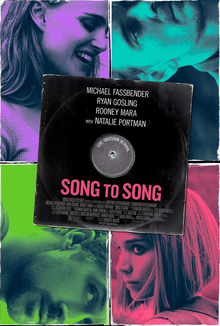
You’re watching a movie called Song to Song. It’s about beautiful people in a beautiful city.
In this case, the city is Austin, Texas. The people are all involved in the Austin music scene and they’re played by actors like Ryan Gosling, Rooney Mara, Natalie Portman, Michael Fassbender, and Cate Blanchett. A good deal of Song to Song was filmed at the Austin City Limits festival and several real-life musicians appear as themselves, though only Patti Smith is on screen long enough to make much of an impression. To be honest, both the music and Austin are almost incidental to the film. Though the movie was sold as an Austin film and it premiered at SXSW, it could have just as easily taken place in Ft. Worth.
The film is made up of short, deliberately obscure shots. The camera never stops moving, floating over images of sunsets, sunrises, and oddly empty streets. Because the film was shot with a wide-angle lens, you’re never not aware of the expanse around the characters. At times, all of those beautiful film stars run the risk of become specks on the landscape, as if the film itself is taunting the characters for thinking that they are more important than nature.
Who are the characters? It’s not always easy to say. There are plenty of voice overs but it’s rare that anyone directly states what they’re thinking or who they are. When the characters speak to each other, they mumble. The dialogue is a mix of the banal and the portentous, a sure sign of a film that was largely shot without a script. Eventually, you turn on the captioning so that you can at least understand what everyone’s muttering.
Michael Fassbender plays Cook. Cook appears to be a music producer but he could just as easily be a businessman who enjoys hanging out with and manipulating aspiring stars. People seem to know him but nobody seems to be particularly impressed by him. Cook spends a lot of time standing in front of a pool. Is it his pool? Is it his house? It’s hard to say. Cook is obsessed with control or maybe he isn’t. Halfway through the film, Fassbender appears to turn into his character from Shame.
Ryan Gosling is BV. BV appears to be a lyricist, though it’s never made clear what type of songs that he writes. At one point, you think someone said that he had written a country song but you may have misheard. BV appears to have an estranged relationship with his dying father. BV may be a romantic or he may not. He seems to fall in love easily but he spends just as much time staring at the sky soulfully and suggesting that he has a hard time with commitment. BV appears to be Cook’s best friend but sometimes, he isn’t. There’s a random scene where BV accuses Cook of cheating him. It’s never brought up again.
Rooney Mara is Faye. Faye contributes most of the voice overs and yet, oddly, you’re never sure who exactly she is. She appears to be BV’s girlfriend and sometimes, she appears to be Cook’s girlfriend. Sometimes, she’s in love and then, just as abruptly, she’s not. She may be a singer or she may be a songwriter. At one point, she appears to be interviewing Patty Smith so maybe she’s a music journalist. The film is centered around her but it never makes clear who she is.
Natalie Portman is Rhonda. Rhonda was a teacher but now she’s a waitress. She might be religious or she might not. She might be married to Cook or she might not. Her mother (Holly Hunter) might be dying or she might not.
And there are other beautful people as well. Cate Blanchett plays a character named Amanda. Amanda has a relationship with one of the characters and then vanishes after four scenes. There’s an intriguing sadness to Blanchett’s performance. Since the first cut of Song to Song was 8 hours long, you can assume her backstory was left on the cutting room floor. (And yet strangely, it works that we never know much about who Amanda is.) Lykke Li shows up, presumably playing herself but maybe not. Berenice Marlohe and Val Kilmer also have small roles, wandering in and out of the character’s lives.
There’s a lot of wandering in this movie. The characters wander through their life, stopping only to kiss each other, caress each other, and occasionally stare soulfully into the distance. The camera seems to wander from scene to scene, stopping to occasionally focus on random details. Even the film’s timeline seems to wander, as you find yourself looking at Rooney Mara’s forever changing hair and using it as a roadmap in your attempt to understand the film’s story.
“I went through a period when I thought sex had to be violent,” Rooney Mara’s voice over breathlessly explains, “We thought we could just roll and tumble, live from song to song, kiss to kiss.”
As you watch Song to Song, you find yourself both intrigued and annoyed. This is a Terrence Malick film, after all. You love movies so, of course, you love Malick. Even if his recent films have been flawed and self-indulgent, he is a true original. You want to support him because he’s an artist but, as you watch Song to Song, the emphasis really does seem to be on self-indulgence. The images are beautiful but the characters are so empty and the voice overs are so incredibly pretentious. Should you be mad or should you be thankful that, in this time of cinematic blandness, there’s a director still willing to follow his own vision?
At times, Song to Song is brilliant. There are images in Song to Song that are as beautiful as any that Malick has ever captured. Sometimes, both the images and the characters are almost too beautiful. The music business is tough and dirty but all of the images in Song to Song are clean and vibrant.
At times, Song to Song is incredibly annoying. It’s hard not to suspect that the film would have worked better if Natalie Portman and Rooney Mara had switched roles. Mara can be an outstanding actress with the right director (just check out her performance in Carol) but, in Song to Song, her natural blandness makes it difficult to take her seriously as whoever she’s supposed to be. Portman has much less screen time and yet creates an unforgettable character. Mara is in 75% of the film and yet never seems like an active participant.
At times, the film is annoyingly brilliant. Malick’s self-indulgence can drive you mad while still leaving you impressed by his commitment to his vision.
And then, other times, the film is brilliantly annoying. Many directors have mixed overly pretty images with pretentious voice overs but few do so with the panache of Terrence Malick.
Even fans of Terrence Malick, of which I certainly am one, will probably find Song to Song to be his weakest film. Even compared to films like To The Wonder and Knight of Cups, Song to Song is a slow movie and there are moments that come dangerously close to self-parody. Unlike Tree of Life, where everything eventually came together in enigmatic poignance, Song to Song often feels like less than the sum of its parts. And yet, I can’t totally dismiss anything made by Terrence Malick. Song to Song may be empty but it’s oh so pretty.
The year is 1876 and the legendary Wild Bill Hickok (Jeff Bridges) sits in a saloon in Deadwood and thinks about his life (most of which is seen in high-resolution, black-and-white flashbacks). Hickok was a renowned lawman and a sure shot, a man whose exploits made him famous across the west. Thanks to his friend, Buffalo Bill Cody (Keith Carradine), he even appeared on the New York stage and reenacted some of his greatest gun battles. Now, Hickok is aging. He is 39 years old, an old man by the standards of his profession. Though men like Charlie Prince (John Hurt) and California Joe (James Gammon) continue to spread his legend, Hickok is going blind and spends most of his time in a haze of opium and regret.
Hickok only has one true friend in Deadwood, Calamity Jane (Ellen Barkin). He also has one true enemy, an aspiring gunslinger named Jack McCall (David Arquette). McCall approaches Hickok and announces that he is going to kill him because of the way that Hickok treated his mother (played, in flashback, by Diane Lane). Hickok does not do much to dissuade him.
Based on both a book and a play, Wild Bill is a talky and idiosyncratic Western from Walter Hill. Hill is less interested in Hickok as a gunfighter than Hickok as an early celebrity. There are gunfights but they only happen because, much like John Wayne in The Shootist, Hickok has become so famous that he cannot go anywhere without someone taking a shot at him. Almost the entire final half of Wild Bill is set in that saloon, with Hickok and a gallery of character actors talking about the past and wondering about the future.
At times, Wild Bill gets bogged down with all the dialogue and philosophizing. (To quote The Good, The Bad, and the Ugly: “When you have to shoot, shoot. Don’t talk.”) Luckily, the film is saved by an intriguing cast, led by Jeff Bridges. In many ways, his performance was Wild Bill feels like an audition for his later performance in True Grit. David Arquette is intensely weird as the jumpy Jack McCall and Ellen Barkin brings the film’s only underwritten role, Calamity Jane, to life. Smaller roles are played by everyone from Bruce Dern to James Remar to Marjoe Gortner.
United Artist made the mistake of trying to sell Wild Bill as being a straight western, which led to confused audiences and a resounding flop at the box office. Ironically, years after the release of Wild Bill, Walter Hill won an Emmy for directing the first episode of HBO’s Deadwood, an episode the featured Wild Bill cast member Keith Carradine in the role of Hickok.
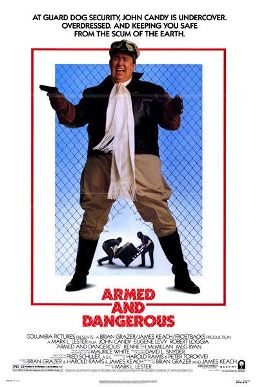 John Candy and Eugene Levy make a great team in the underrated comedy, Armed and Dangerous.
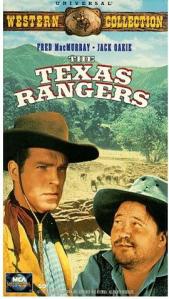 Sam (Lloyd Nolan), Jim (Fred MacMurray), and Wahoo (Jack Oakie) are three outlaws in the old west. Wahoo works as a stagecoach driver and always lets Sam and Jim know which coaches will be worth holding up. It’s a pretty good scam until the authorities get wise to their scheme and set out after the three of them. Sam abandons his two partners while Jim and Wahoo eventually end up in Texas. At first, Jim and Wahoo are planning to keep on robbing stagecoaches but then they realize that they can make even more money as Texas Rangers.


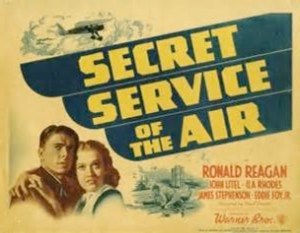 When a secret service agent’s investigation into a supposed counterfeiting ring instead leads to him discovering a plot to smuggle illegal aliens into the United States via airplanes, the agent ends up plummeting several hundred miles to his death. Realizing that they need someone who can go undercover and infiltrate the smuggling ring, the Secret Service recruits Lt. Brass Bancroft (Ronald Reagan). Bancroft is a war hero who is now a commercial airline pilot. He is also good with his fists, has an innate sense of right and wrong, and a sidekick named Gabby (Eddie Foy Jr., giving a very broad performance as the movie’s comic relief). But before Brass can win the trust of the smugglers, he will have to establish a firm cover story and that means allowing himself to be arrested on fake charges. In order to save the day, Brass will have to first survive prison.
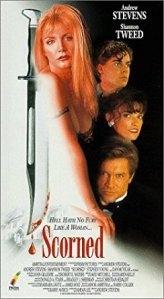 “In an hour, I promise, you’ll be able to beg in two languages.” — Patricia (Shannon Tweed) in Scorned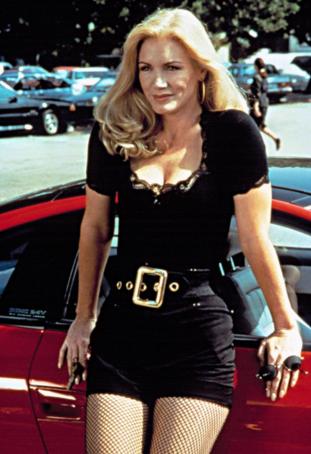
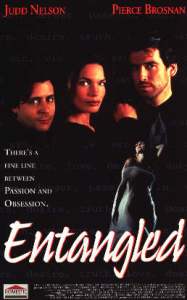 There has been a car crash in Paris and now, David (Judd Nelson) is in the hospital, slowly recovering. In flashbacks, it is revealed that David is an American writer who came to France after his first novel flopped. He came to see his best friend, a womanizing photographer (Roy Dupuis), and ended up meeting and falling in love with the beautiful model, Annabelle (Laurence Treil). Even as he worked on his second novel, he was consumed with jealousy over Annabelle. Why was she sneaking off to a château owned by a mysterious and decadent businessman named Garavan (Piece Brosnan)? Any why, while he is in the hospital, is his second novel published and credited to someone else?


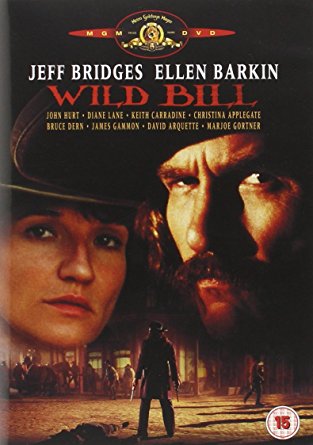 The year is 1876 and the legendary Wild Bill Hickok (Jeff Bridges) sits in a saloon in Deadwood and thinks about his life (most of which is seen in high-resolution, black-and-white flashbacks). Hickok was a renowned lawman and a sure shot, a man whose exploits made him famous across the west. Thanks to his friend, Buffalo Bill Cody (Keith Carradine), he even appeared on the New York stage and reenacted some of his greatest gun battles. Now, Hickok is aging. He is 39 years old, an old man by the standards of his profession. Though men like Charlie Prince (John Hurt) and California Joe (James Gammon) continue to spread his legend, Hickok is going blind and spends most of his time in a haze of opium and regret.
 Through the Shattered Lens