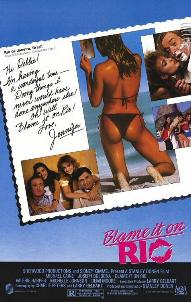
A Movie A Day #299: Blame It On Rio (1984, directed by Stanley Donen)


When I was growing up in Baltimore, I used to go down to this independent video story every weekend and check out movies.  Every time that I stepped into the store, the first thing I saw was the poster for Blame It On Rio hanging over the front register.  The store did not actually have any copies of Blame It On Rio in stock and I don’t think anyone working there had ever seen it but it only takes one look at the poster to guess what they were thinking when they hung it at the front of the store.

Blame It On Rio is one of the films that Michael Caine made during that period when he was willing to accept any paycheck.  (The Jaws 4 years.)  Caine plays Matthew, who goes on a vacation to Rio with his 17 year-old daughter, Nikki (Demi Moore), his best friend Victor (Joseph Bologna), and Victor’s daughter, Jennifer (Michelle Johnson).  Both Matthew and Victor’s marriages are falling apart and Victor encourages Matthew to hit on every topless woman they see.  Instead, Matthew ends up fooling around with Jennifer.  When Victor discovers that his daughter to having an affair with an older, married man, he recruits Matthew to help him discover the man’s identity.  In between the scenes of all the action in Brazil, Matthew and Jennifer appear in interview segments that do no add up to much.

It may be hard to believe but this forgettable movie was co-written by Larry Gelbart and directed by the same director responsible for Singin’ In The Rain, Charade, and Two For The Road, Stanley Donen.  For a film about a 43 year-old man having a sexual relationship with a 17 year-old, Blame It On Rio is a hopelessly square movie.  Caine and Bologna walking along a topless beach and accidentally leering at their own daughters is about as funny as things get.  Michael Caine’s a trooper and does the best that he can but Michelle Johnson is bland as Jennifer.  She and Demi Moore should have switched roles.
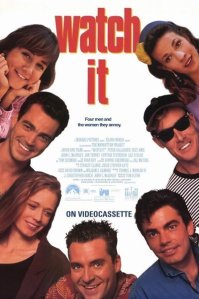
 

A Movie A Day #298: Watch It (1993, directed by Tom Flynn)


In Chicago, three men all live in the same house and try to avoid growing up.  Rick (John C. McGinley) and Mike (Jon C. Tenney) are old friends while Danny (Tom Sizemore) works on stolen cars.  When Mike’s estranged cousin, John (Peter Gallagher), moves in with them, John is drawn into a steadily escalating game of pranks.  The game is called “Watch It” and the rules are simple.  No one can take anything personally and each prank must be followed by another, bigger prank.  While the four men takes turns trying to one up each other, they also deal with women who wish that they would all just grow up.  When John starts to date Mike’s ex-girlfriend, Anne (Suzy Amis), the men are forced to come to terms with their extended adolescence.
Watch It is an awkward combination of two stories.  One half of the film deals with the pranks, which get so outlandish that it is impossible to believe that a group of blue collar roommates in Chicago could pull them off.  One of John’s pranks involves imitating a police detective on a local news broadcast and saying that Danny has had a warrant issues for his arrest.  Even if John could pull that off, it seems like he would get in so much trouble that it would not be worth the effort.  (Never mind that the city of Chicago now thinks that Danny is wanted by the police.)  At the same time, Watch It also wants to be a fairly realistic relationship dramedy, with Suzy Amis and Cynthia Stevenson trying to get Gallgher and McGinley to grow up.  Despite some very good performances, Watch It is too uneven to work.  The best thing about Watch It is that it offers a chance to see actors like McGinley, Tenney, Sizemore, and Gallagher all playing quasi-normal, relatable people for once.

Horror Film Review: The Stepfather (dir by Joseph Ruben)


Who is Jerry Blake?

That is the question at the heart of the classic 1987 horror thriller, The Stepfather.

Most of the people who know Jerry (brilliantly played by Terry O’Quinn) would say that he’s just a really nice guy.  He’s responsible.  He’s a good employee.  He can be trusted.  He works in real estate and spends his days selling perfect homes to perfect families.  Jerry always has a friendly smile and hearty manner.  He’s the perfect neighbor, precisely because he’s so boring.  You don’t have to worry about Jerry not taking care of his yard or throwing a loud party or … well, doing anything anyone else would do.  Sure, Jerry seems to be a little bit old-fashioned and sure, sometimes he’s a little bit too good to be believed.  But what’s wrong with that?  I mean, the man makes birdhouses!  Jerry is so dedicated to creating perfect families that he even tries to make the perfect home for the birds in his back yard!

In fact, the only person who seems to have any doubts about Jerry is his new stepdaughter, Stephanie (Jill Schoelen).  Stephanie is a teenager so, occasionally, she’s less than perfect.  Sometimes, she gets into a fight at school.  Sometimes, she talks back.  To be honest, to me, nothing she does seems like it’s really that big of a deal.  But Jerry simply cannot handle the fact that Stephanie is making his new family just a little less than perfect.  When Jerry catches Stephanie and her boyfriend sharing a very chaste kiss, he freaks out.  KISSING!?  Why that could only lead to one thing…

But it’s not just that Jerry is kind of controlling and seems to be living in a 1950s sitcom.  There’s also the fact that sometimes, Jerry goes down in the basement and just starts yelling and throwing stuff.  That’s what Jerry does when he gets angry.  He hides in the basement and he totally loses control.  When Stephanie overhears him, Jerry just gives her a bland smile and says that he was blowing off some steam.

Stephanie suspects that something’s wrong with Jerry but, of course, no one believes her.  However, we know that Stephanie’s right to be suspicious.  At the start of the film, we saw Jerry walking out of his old house, leaving behind the dead bodies of his wife and children.  At that time, of course, Jerry’s name was Henry Morrison.  Henry’s previous family disappointed him so he killed them and then vanished, changing his identity and marrying Stephanie’s mother, Susan (Shelley Hack).

Jerry wants everything to be perfect.  He’s an old-fashioned guy with old-fashioned values and, whenever anyone disappoints him, he kills them and changes his identity once again.  He’s the type who will kill you but then make sure that your seat belt is fastened when he puts you back in your car.  “Buckle up for safety,” Jerry says.

There’s a 2009 remake of The Stepfather.  For some reason, it regularly shows up on Lifetime.  Ignore the remake and track down the original.  Long before he played John Locke on Lost, Terry O’Quinn gave a simply amazing performance in the role of Jerry Blake.  Jerry is so friendly and likable that, even though we know he’s a murderer, it’s still hard not to fall under his spell.

Why, we wonder, can’t the world be as perfect as Jerry wants it to be?

Because Jerry’s world is not the real world.  In the real world, family are never perfect but they love each other anyway.  In Jerry’s world, it’s more important that things appear to be perfect than that anyone actually be honest or, for that matter, happy.

The Stepfather is a chillingly effective thriller, featuring a brilliant performance from Terry O’Quinn.  If you haven’t seen it, see it!

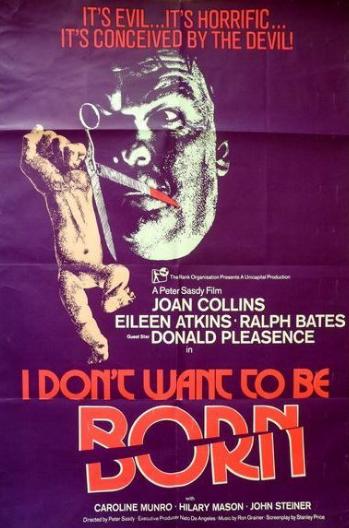
The TSL’s Horror Grindhouse: I Don’t Want To Be Born (dir by Peter Sasdy)


“I don’t want to be born!”

“That’s too bad, kid!  YOU’RE COMING OUT!”

Now, admittedly, that dialogue is never heard in the 1975 British horror film, I Don’t Want To Be Born.  However, if I had heard that particularly exchange in this film, I would not have been surprised.  That’s just the type of movie that I Don’t Want To Be Born is.  It’s a thoroughly ludicrous, totally ridiculous movie and what makes it all the more memorable is that it doesn’t seem to realize how silly it all is.  This is a batshit crazy movie that tells its story in the most serious way possible.  This damn film is almost somber, it’s so serious.

Lucy (played by Joan Collins) is a stripper who performs her act with a perverted dwarf named Hercules (George Claydon).  When Hercules tries to force himself on Lucy, he is tossed out of the club by Tommy (who is played by John Steiner, a good actor who somehow always turned up in movies like this one.)  After she and Tommy make love, Lucy is confronted by Hercules who curses her, telling her that she will have a baby “as big as I am small and possessed by the devil himself!”

Oh, Hercules, you weirdo.

9 months later, Lucy’s life has somehow completely changed.  She’s no longer a dancer.  Now, she’s married to a rich Italian named Gino (played by Ralph Bates, speaking in a bizarre accent).  When Lucy has her baby, it’s a long and difficult delivery.  The baby is huge!  Not only is he huge, but he also has a bad temper and unnaturally sharp nails.  The first time that Lucy holds him, he attacks her.  Whenever the baby is introduced to anyone new, he responds by biting them.  When Tommy drops by to take a look at the baby that might be his son, he ends up with a bloody nose!

But that’s not all this baby can do!  Anytime he’s left alone in a room, the room ends up getting destroyed.  Eventually, he apparently figures out how to climb trees and how efficiently slip a noose around the neck of anyone who walks underneath him.  And don’t think that you can escape this baby simply because you’re taller and faster.  One unfortunate person is decapitated, even though he’s standing at the time.  How did the baby reach his neck?  Who knows?

Does this baby need an exorcism?  Lucy’s sister-in-law, Sister Albana (Eileen Atkins), certainly believes that it does!  As Lucy thinks about whether the baby’s behavior is in any way odd, she glances over at the baby and — OH MY GOD!  The baby has Hercules’s face!

And it just keeps going from there.  Again, I feel the need to repeat that this film is meant to be taken very seriously.  The script may be full of awkward and clichéd dialogue but most of the cast attempts to act the Hell out of it.  Speaking of the cast, there’s a lot of familiar horror people in this one.  Along with John Steiner, there’s also Caroline Munro and Donald Pleasence.  Those three give performances that somehow manage to remain credible, perhaps because they had the experience necessary to understand what type of movie they were in.  But the rest of the cast … you feel bad for them because they’re just trying  so hard.

It’s a terrible movie but it’s so weird that I have to recommend that everyone see it once.  If for nothing else, see it for the scene where Hercules responds to an attempt to exorcise the baby by swaying drunkenly on the stage.  It’s weird and it’s hard for mere words to do it justice.

“No wonder this baby didn’t want to be born!”

That line is also nowhere to be found in this movie.  It’d be nice if it was, though.

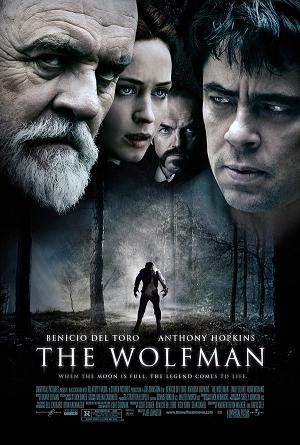
Horror Film Review: The Wolfman (dir by Joe Johnston)


I have to admit that I’m always a little bit surprised to discover how many people really don’t like the 2010 film, The Wolfman.

I mean, I’ll be the first to admit that it may not have been the greatest film ever made but the amount of negative feelings that this film has managed to generate over the years seems, to me, to be a bit out of proportion.  Essentially, it’s just a silly film about a werewolf.

Yes, it is a remake of The Wolf Man and we’re all honor-bound to dislike remakes but, if we’re going to be absolutely honest, the original Wolf Man was sometimes pretty silly too.  If anything, the original’s success is largely due to the heartfelt work of Claude Rains in the role of the Wolf Man’s father.  Yes, the original Wolf Man is a classic but remaking it is not exactly sacrilege.

In the remake, Benicio Del Toro takes over the role of Larry Talbot, who is reimagined as a Shakespearean actor who has a history of mental instability.  Del Toro is not exactly convincing as an Englishman, though the same could be said of Lon Chaney, Jr.  However, nobody broods with quite the panache of Benicio Del Toro and that’s what was needed for the remake’s version of Larry Talbot.  If Lon Chaney, Jr. played Larry as being a dumb lug, Del Toro plays Larry as being a tortured artist.

Anthony Hopkins takes over the old Claude Rains role.  Just as it’s difficult to imagine Del Toro as being English, it’s next to impossible to imagine him sharing any DNA with Anthony Hopkins.  And yet, I’m really glad that Hopkins was cast in the role.  Of course, in the remake, the character of John Talbot has been totally reimagined.  He’s now something of a bitter and sarcastic alcoholic, a negligent father who always seem to be amused at some mean-spirited joke that only he can understand.  I imagine that if I asked Hopkins, he’d say that he did this role for the money but there’s nothing wrong with that.  Some of Hopkins’s best performances have been the ones that he subsequently claimed to have done only for the money.  Freed from any obligation to give a nuanced or subtle performance, Hopkins goes totally over-the-top and it’s actually a lot of fun to watch.  In The Wolfman, Hopkins turns the delivery of bitter bon mots and erduite insults into an art form.

Watching the film’s first half, we all know what’s going to happen.  Gypsies are going to show up in the woods near Talbot Hall and paranoid villagers are going to blame them for everything that happens.  Larry is going to get bitten by a werewolf and transform every night when the moon is full.  Larry is going to fall in love with Gwen (Emily Blunt) but, for her own protection, will try to send her away.  An arrogant but clever inspector, Francis Abberline (Hugo Weaving, playing a version of the real-life detective who inspired the role played by Johnny Depp in From Hell), is going to arrive from London to investigate all the recent deaths…

About halfway through, The Wolfman takes a totally unexpected turn.  I won’t spoil it here, just in case you haven’t seen the movie.  I know a lot of people don’t care much for the big twist but I happened to love it.  Yes, it doesn’t necessarily make a lot of sense and it’s all a bit overdone but so what?  It’s exactly the type of weird twist that a movie like this needs.  It all leads to a final confrontation, one that is as exuberantly silly as the original’s conclusion was somber and tragic.

The key to enjoying The Wolfman is to accept it for what it is, an occasionally dumb and definitely not-to-be-taken-seriously movie that features some appropriately atmospheric cinematography, gorgeously gothic production design, and some very talented actors.  (I especially enjoyed Weaving’s performance as Abberline.)  A classic it may not be, but it’s still a fun little movie if you’re in the right mood for it.

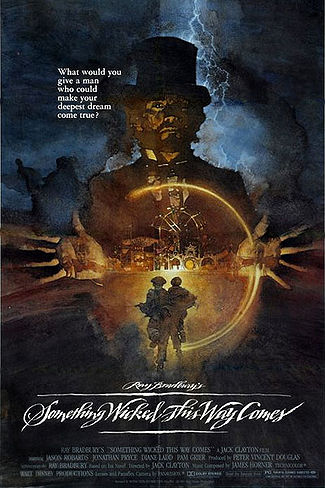
A Movie A Day #296: Something Wicked This Way Comes (1983, directed by Jack Clayton)


Something Wicked This Way Comes is one of my favorite films.

The place is Green Town, Illinois.  The time is the 1920s.  The carnival has come to town but this is no normal carnival.  Led by the sinister, Mr. Dark (Jonathan Pryce), this carnival promises to fulfill everyone’s dreams but at what cost?  Double amputee Ed (James Stacy) gets his arm and his leg back.  The lonely teacher, Miss Foley (Mary Grace Canfield), is young and beautiful once again.  Mr. Dark may bring people what they want but he gives nothing away for free.  Only two young boys, Will (Vidal Peterson) and Jim (Shawn Carson), realize the truth about the carnival but no one in town will listen to them.  Mr. Dark wants Jim to be his successor and Will’s only ally is his elderly father, the town librarian (Jason Robards).

As much a coming of age story as a horror film, Something Wicked This Way Comes takes the time to establish Green Town and to make it feel like a real place and its inhabitants seem like real people.  When Mr. Dark shows up, he is not just a supernatural trickster.  He is not just stealing the souls of Green Town.  He is also destroying the innocence of childhood.  Jonathan Pryce is both charismatic and menacing as Mr. Dark while Jason Robards matches him as the infirm librarian who must find the strength to save his son.  The confrontation between Pryce and Robards, where Pryce tears flaming pages out of a book, is the best part of the movie.  Along with Robards and Pryce, the entire cast is excellent.  Be sure to keep an eye out for familiar faces like Royal Dano, Jack Dodson, Angelo Rossitto, and especially Pam Grier, playing the “Dust Witch,” the most beautiful woman in the world.

Based on a classic novel by Ray Bradbury, Something Wicked This Way Comes is one of the only Bradbury adaptations to do justice to its source material.

The TSL’s Horror Grindhouse: Hard To Die (dir by Jim Wynorski)


Do you remember how, a few days ago, I reviewed a silly little movie called Sorority House Massacre II?

Well, it turns out that there’s a sequel and it’s on YouTube!  Both films were directed by Jim Wynorski and featured pretty much the same cast, despite the fact that a few of them were playing new characters.  It was released under several different titles.  Hard To Die is the one that I’m going with for this review.  However, the film was also known as Tower of Terror, which makes sense when you consider that the majority of the film takes place in a hi-rise office building.  It was also apparently released in some places as Sorority House Massacre III, despite the fact that there’s no sorority house in the movie.

Actually, it’s debatable whether or not Hard To Die is actually a sequel.  It’s true that Orville Ketchum (Peter Spellos) does make another appearance.  In the first movie, Orville was the creepy neighbor.  In Hard To Die, he’s the janitor at the office building.  Orville tells the exact same story, with the exact same flashbacks, that he told in Sorority House Massacre II.  (Those flashbacks, of course, were lifted from a totally unrelated movie called Slumber Party Massacre.  There were apparently a lot of massacres in the 80s and 90s.)  The evil spirit of Hockstadder returns as well, though this time he comes flying out of a box that was accidentally delivered to the office building as opposed to a Ouija board.  And, of course, there’s an abundance of lingerie, awkward dialogue, and cheap gore effects.  (At one point, a bucket of fake blood is literally splashed on a wall.)  However, Hard To Die also tells almost exactly the same story of Sorority House Massacre II.  There are so few differences that I’m actually more tempted to say that Hard To Die is a remake of Sorority House Massacre II than a sequel.  The only problem with that theory is whether or not a second movie can be considered remake when the first movie literally came out the exact same year.

(One of the reasons that I love my work here at the TSL is that it allows me to obsess over minutia like this.)

Anyway, the main difference between Hard To Die and Sorority House Massacre III is that there’s no sorority house in Hard To Die.  Instead, Hard To Die takes place in a lingerie shop that just happens to be located on the 7th floor of a skyscraper.  The hard-working employees are spending the weekend doing inventory but it’s not going to well.  For one thing, the sprinklers accidentally go off so everyone decides to take off their wet clothes, put on skimpy lingerie, and order pizza.  Personally, I probably would have waited for the pizza to arrive before getting naked but then again, I’ve never worked retail or dated a pizza deliveryman.

The pizza does eventually arrive but no one gets to eat it because the deliveryperson gets set on fire and ends up falling several floors to her death.  That’s a waste of good pizza, which is kind of depressing.  Meanwhile, Orville keeps trying to warn everyone about Hockstadder but, instead, he keeps getting beaten up.  The end credits of Hard To Die promised that the next film would be called Orville In Orbit.  Apparently, it was never made but I do hope that Orville got a vacation after all of this.

Anyway, Hard To Die is an extremely silly movie but it’s just so sincere in its silliness that it feels somewhat churlish to be too critical of it.  If I had to choose whether to be in Sorority House Massacre II or Hard To Die, I would probably pick Hard To Die because, at least in that movie, I’d get to shoot a machine gun.  Hard To Die is so blatantly and unapologetically over the top that you can’t help but be amused by it all.

Horror Film Review: The Vampire (dir by Paul Landres)


Headaches are a bitch!

And if you didn’t already know that, you will know it after watching the 1957 film, The Vampire.

Like many films of this kind, The Vampire starts with death.

Actually, I take that back.  Technically, it’s true but it’s also little bit too melodramatic.  And, to be honest, The Vampire starts with a 14 year-old boy, who is very much alive, riding his bicycle down the street of Anytown USA.  He has a box with him, one that has air holes.  On the back of his bike, a cardboard sign reads: “Bobs Pet Zoo!  If Its Alive We Got It!”  Apparently, the kid is smart enough to run his own zoo but not smart enough to know when to use an apostrophe.

Anyway, the kid comes up to a creepy old house, one that looks somewhat out of place in the otherwise pristine suburban neighborhood.  Originally, I thought that maybe Pennywise lived in the house but then I reminded myself that The Vampire was made decades before It.  Instead, the house belongs to Dr. Campbell, a scientist who is doing experiments with blood and who needs a never-ending supply of animal test subjects.  (Boooooo!  Animal testing!  Hiss!)  Apparently, the kid keeps Dr. Campbell supplied with animals.  When the kid enters the house, Dr. Campbell is nowhere to be seen.  It’s not until the kid enters the laboratory that he discovers Campbell, dead and slumped over his desk.

As news spreads of Campbell’s death, his friend, Dr. Paul Beecher (John Beal), searches through Campbell’s belongings and he comes across a mysterious bottle of pills, which he promptly takes home with him.  Dr. Beecher is kindly doctor, the type that we all wish we could deal with whenever we had to go in for a check up.  However, he suffers from terrible migraines.  That night, when he’s literally blinded with a headache, he asks his daughter to get him his pills.  She retrieves a bottle of pills but guess what?  They’re the wrong pills!  They’re not headache pills!  Instead, they’re Dr. Campbell’s vampirism pills!

The pills cause Beecher to blaxk out.  Whenever he comes to, he never has any memory of what he may or may not have done while he was out.  However, strange things are happening to his friends and his patients.  One of his longtime patients dies of fright when he comes by her house.  On her neck, he finds two puncture wounds…

So, it’s not a spoiler for me to tell you that Dr. Beecher has been transformed into a vampire.  And I know what you’re thinking.  Why doesn’t he just stop taking the pills?  The simplest answer is that the pills are addictive.  The more complex answer is that he doesn’t want to.  The pills have brought out his dark side and, now that it’s free, it’s not planning on going anywhere.

In a strange way, The Vampire reminded me of Nicholas Ray’s Bigger Than Life.  In Bigger Than Life, James Mason plays a gentle and good-hearted professor who, after taking steroids, turns into a monster who dreams of creating a master race.  Bigger Than Life was unsettling for the exact same reason that The Vampire is unsettling.  Both suggest that the pills didn’t turn their user into a monster.  Instead, the pills just allowed his true self to come out.

The Vampire was a low-budget film, a B-movie as many would probably call it.  The musical score is overly melodramatic and so are some of the actors.  But I would say that The Vampire is actually a bit of a subversive masterpiece.  This 1957 film suggests that behind the pristine facade of suburbia, there lurked monsters.  Even an outwardly successful and respected man like Dr. Beecher can turn into something totally different behind closed doors, this film is saying.  That’s a message that it as relevant today as it was when this film was first released.  In its own way, The Vampire is a brilliant and important movie.

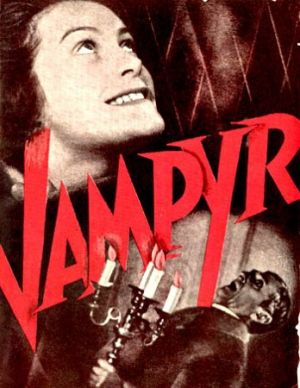
Horror Film Review: Vampyr (dir by Carl Thedor Dryer)


A dream of dark and disturbing things….

Allan Gray (Nicolas de Gunzburg, performing under the name Julian West) might be a student of the occult or he might just be a man having a dream within a dream.  He’s handsome with just enough of an aristocratic bearing to be intriguing.  His face is strangely blank.  Whenever we see him, we wonder if he’s awake or if he’s asleep.  We’re reminded of Werner Herzog’s film Heart of Glass, in which the entire cast recited their lines while hypnotized.

Allan’s come to a small village in France.  It’s a quaint little place, probably the type that most tourist would consider to be quite beautiful.  But from the minute that we see it, the entire landscape seems to be off.  The inhabitants of the village seem almost as blank-faced as Allan.  When we see the trees sway in the wind, we’re reminded of  Victor Sjöström’s The Wind and how the nonstop wind drove Lillian Gish mad.

Allan stays in an inn.  He goes to sleep.  When he wakes up, an old man stands in his room.  The old man gives him a package.  The package is not to be opened until the man’s death.  Allan goes outside.  The village is full of shadows.  He watches an old woman and the town’s doctor.  Allan meets with one of the old man’s daughters and learns that her sister is deathly ill.  She needs a blood transfusion.  When Allan reads a book about vampyres, he suspects that both the town and the sisters are being held prisoner.  At times, the events feel almost random but the film has such a hypnotic power that we automatically know that nothing happens by mere chance.

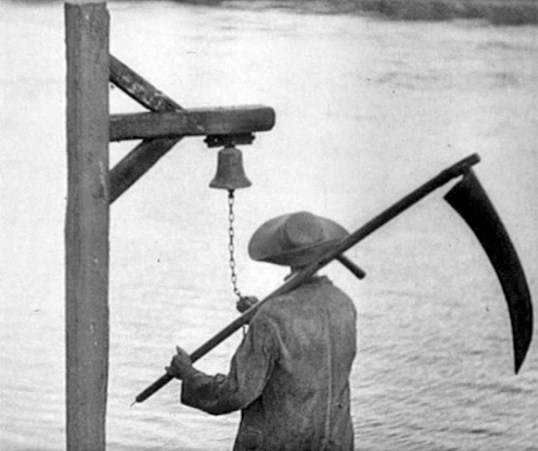
Directed by Carl Theodor Dryer, Vampyr was filmed in 1931 and released in 1932.  This was Dreyer’s first sound film but Vampyr almost seems like a silent film.  It certainly has more in common with Dreyer’s hallucinogenic silent masterpiece, The Passion of Joan of Arc, than it does with Universal’s version of Dracula.  Vampyr feels like a cinematic dream, full of surrealistic images and odd performances.  As a collection of images, Vampyr is one of the most intensely atmospheric film that I’ve ever seen.  Allan, who may be having a dream within a dream, discovers a coffin and is shocked to discover who is inside.  A character is buried alive in flour.  Fogs rolls across the river and a figure with a scythe brings to mind Charon, the ferryman who took the dead to the underworld.  Shadows dance across the screen.  Much like Lucio Fulci’s Beyond trilogy, Vampyr succeeds by creating its own cinematic world, one where reality is solely defined by the images on the screen.  The plot of Vampyr might not always make sense in the real world but it’s perfectly logical in the world created by the film.

Vampyr’s a surreal classic, one that reportedly came close to being a lost film.  Several of the video releases have been technically inferior, though the flickering picture and inconsistent soundtrack of those releases can actually add to the film’s dreamlike power.  It’s been released by the Criterion Collection and that is the ideal version to watch.


Horror on the Lens: Night of the Living Dead (dir by George Romero)


Happy Halloween everyone!

Well, as another horrorthon draws to a close, it’s time for another Shattered Lens tradition!  Every Halloween, we share one of the greatest and most iconic horror films ever made.  For your Halloween enjoyment, here is George Romero’s Night of the Living Dead!

(Be sure to read Arleigh’s equally iconic review!)

ENJOY!