Lisa Reviews An Oscar Nominee: Test Pilot (dir by Victor Fleming)


(With the Oscars scheduled to be awarded on March 4th, I have decided to review at least one Oscar-nominated film a day.  These films could be nominees or they could be winners.  They could be from this year’s Oscars or or they could be a previous year’s nominee!  We’ll see how things play out.  Today, I take a look at the 1938 best picture nominee, Test Pilot!)
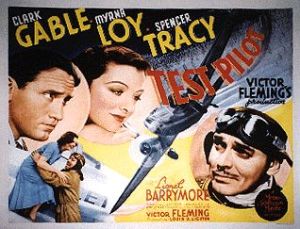
Test Pilot is all about charisma.

It tells a fairly simple story.  I imagine that the plot seemed just as familiar in 1938 as it does in 2018.  Jim Lane (Clark Gable) is a test pilot.  In the early days of aviation, long before people took the idea of flight for granted, Jim Lane is a hero and celebrity.  Whenever a new aviation technique is developed, Jim is the one who tests it.  He’s the one who makes sure that it’s safe.  Every day, when Jim goes to work for Mr. Drake (Lionel Barrymore), there’s a chance that he might not make it home.  Not surprisingly, he’s cocky, reckless, and not prone to commitment.  He’s also handsome, charming, manly, and quick with a quip.  In short, he’s Clark Gable.

When the movie starts, Jim has only one real friend.  Gunner (Spencer Tracy) is his mechanic.  Gunner is a by-the-book, no-nonsense professional.  He might enjoy a drink every now and then but Gunner knows his job and he knows his planes and, even more importantly, he knows Jim.  Gunner’s a man of unimpeachable integrity, the type who will always call things as he sees them.  In short, he’s Spencer Tracy.

One day, while on a test flight, Jim is forced to make an emergency landing on a farm in Kansas.  That’s where he meets Ann Barton (Myrna Loy).  Ann is beautiful and outspoken.  She quickly proves that she can keep up with Jim, quip-for-quip.  In short, she’s Myrna Loy and, before you know it, she and Jim are in love.  Just as quickly, Jim and Ann are married.

The movie starts out as a bit of domestic comedy.  Jim may know how to fly a plane but it quickly becomes obvious that he doesn’t know much about commitment or being a husband.  When Jim attempts to buy his wife a nightgown, he doesn’t even know how to pronounce the word lingerie.  (He asks a store clerk for help in finding the “lonjur department.”)  However, Jim soon starts to find that married life agrees with him.

Of course, that’s a problem when your job requires you to defy death on a daily basis.  Ann worries that Jim is going to go to work and never come home, fears that are intensified after a race with another airplane ends in a terrible and (for the other pilot) fatal crash.  Gunner, meanwhile, starts to fear that there’s only so many times that Jim can cheat fate.  Both Ann and Gunner promise that they will never leave Jim’s side.

Well, you can probably already guess everything that’s going to happen.  Test Pilot is not exactly the most narratively adventurous movie ever made but, when you’ve got Gable, Tracy, Loy, and Barrymore all in the same film, you don’t really need to break any new ground, storywise.  Test Pilot is an example of the power of pure movie star charisma.  It’s watchable because the performances are just as entertaining today as they were in 1938.  The film features Gable doing what he did best and Tracy doing what he did best and Loy and Barrymore all doing what they did best.  In this case, that’s more than enough.

When it comes to the film’s numerous flight sequences, it’s perhaps best to try to put yourself in the shoes of someone seeing the film in 1938.  Today, of course, we’ve been spoiled by CGI.  We tend to assume that literally anything can happen in a movie.  In the 30s, however, people couldn’t take special effects for granted.  When they watched the flight footage in Test Pilot, they did it with the knowledge that it was filmed by people who actually were putting their lives at risk to get it.  At a time when commercial aviation was considered to be a luxury, Test Pilot provided audiences with a view of the world in the sky and of the world below, a view that they probably wouldn’t have gotten a chance to see otherwise.

A huge box office success, Test Pilot was nominated for best picture but lost to another film featuring Lionel Barrymore, Frank Capra’s You Can’t Take It With You.


Oriental Pearl: LADY SNOWBLOOD (Toho 1973)


gary loggins's avatarcracked rear viewer

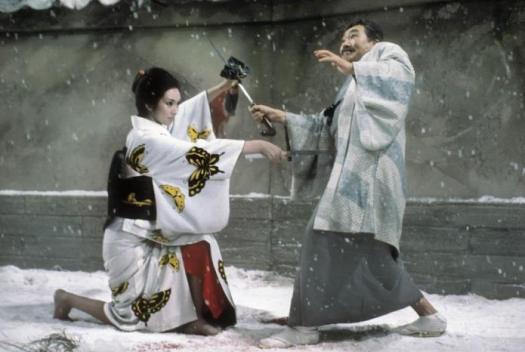
I’ll be the first to admit I don’t know a whole hell of a lot about Japanese manga. But I do know a little something about movies, and 1973’s LADY SNOWBLOOD was a revelation for me, a game changer that has me yearning for more! As I sat watching, enthralled by the imagery, I couldn’t help but feel I’d seen LADY SNOWBLOOD before, and I had: Quentin Tarantino “borrowed” (some would say stole!) much of the plotline for his KILL BILL films, with some scenes practically lifted verbatim!

Much as I loved KILL BILL VOLS. 1 and 2, I found LADY SNOWBLOOD to be even more entertaining. It’s non-linear plot is structured into chapters (sound familiar, Tarantino buffs?), and the dazzling camerawork and bold, vivid color schemes kept me glued to the screen. A prisoner named Sayo gives birth to a child on a cold winter’s night. The child, Yuki…

View original post 344 more words

Silk Purse: MY NAME IS JULIA ROSS (Columbia 1945)


gary loggins's avatarcracked rear viewer

Columbia Pictures cranked out 52 films in the year 1945, mostly ‘B’ movies with titles like LET’S GO STEADY, I LOVE A MYSTERY, EVE KNEW HER APPLES, ROCKIN’ IN THE ROCKIES, TEN CENTS A DANCE, and THE ADVENTURES OF RUSTY, along with their continuing series featuring Blondie, Boston Blackie, The Crime Doctor, The Durango Kid, and The Whistler. They were programmers, budget jobs, designed to fill a double bill  and a theater’s seats, bread-and-butter movies with no pretenses to reach any artistic heights.

MY NAME IS JULIA ROSS was one of those programmers, a quickie cashing in on the success of the previous year’s hit GASLIGHT. Whereas MGM’S psychological thriller boasted stars Ingrid Bergman and Charles Boyer directed by George Cukor, Columbia headlined their contract players Nina Foch and George Macready , good, competent actors but hardly box office draws. And in place of Cukor, Joseph H. Lewis sat in…

View original post 485 more words

4 Film Reviews: Bridge To Silence, The Chocolate War, Kiss The Bride, Wedding Daze


Last week, I watched six films on This TV.

Which TV?  No, This TV!  It’s one of my favorite channels.  It’s not just that they show a lot of movies.  It’s also that they frequently show movies that are new to me.  For instance, last week, This TV introduced me to both Prison Planet and Cherry 2000.

Here are four other films, two good and two not so good, that This TV introduced to me last week.

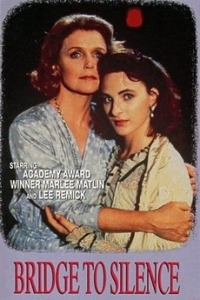
First up, we have 1989’s Bridge to Silence.

Directed by Karen Arthur, Bridge To Silence was a made-for-TV movie.  Lee Remick plays Marge Duffield, who has a strained relationship with her deaf daughter, Peggy (Marlee Matlin).  After Peggy’s husband is killed in a traffic accident, Peggy has a nervous breakdown.  Marge and her husband, Al (Josef Sommer) take care of Peggy’s daughter, Lisa, while Peggy is recovering.  However, even as Peggy gets better, Marge still doesn’t feel that she can raise her daughter so Marge files a lawsuit to be named Lisa’s legal guardian.  While all of this is going on, Peggy is starring in a college production of The Glass Menagerie and pursuing a tentative romance with the play’s director (Michael O’Keefe).

Bridge to Silence is one of those overwritten but heartfelt melodramas that just doesn’t work.  With the exception of Marlee Matlin, the cast struggles with the overwrought script.  (Michael O’Keefe, in particular, appears to be miserable.)  The film’s biggest mistake is that it relies too much on that production of The Glass Menagerie, which is Tennessee Williams’s worst play and tends to be annoying even when it’s merely used as a plot device.  There’s only so many times that you can hear the play’s director refer to Peggy as being “Blue Roses” before you just want rip your hair out.

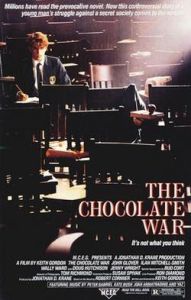
Far more enjoyable was 1988’s The Chocolate War.

Directed by Keith Gordon, The Chocolate War is a satirical look at conformity, popularity, rebellion, and chocolate at a Catholic boys school.  After the manipulative Brother Leon accidentally purchases too much chocolate for the school’s annual sale, he appeals to one of his students, Archie Costello (Wallace Langham), to help him make the money back.  Archie, who is just as manipulative as Leon, is the leader of a secret society known as the Vigils.  However, Archie and Leon’s attempt to manipulate the students runs into a roadblack when a new student, Jerry Renault (Illan Mitchell-Smith) refuses to sell any chocolates at all.  From there, things get progressively more complicated as Archie tries to break Jerry, Jerry continues to stand up for his freedom, and Leon … well, who knows what Leon is thinking?

The Chocolate War was an enjoyable and stylish film, one that featured a great soundtrack and a subtext about rebellion and conformity that still feels relevant.  John Glover and Wallace Langham both gave great performances as two master manipulators.

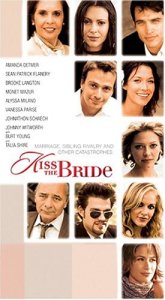
I also enjoyed the 2002 film, Kiss The Bride.

Kiss The Bride tells the story of a big Italian family, four sisters, and a wedding.  Everyone brings their own personal drama to the big day but ultimately, what matters is that family sticks together.  Directed by Vanessa Parise, Kiss The Bride featured believable and naturalistic performances from Amanda Detmer, Talia Shire, Burt Young, Brooke Langton, Monet Mazur, and Parise herself.

I have to admit that one reason why I liked this film is because it was about a big Italian family and it featured four sisters.  I’m the youngest of four sisters and, watching the film, I was reminded of my own big Irish-Italian family.  The movie just got everything right.

And then finally, there was 2006’s Wedding Daze.

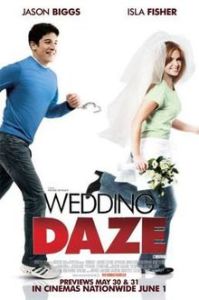
Wedding Daze is a romantic “comedy.”  Anderson (Jason Biggs) asks his girlfriend to marry him, just to have her drop dead from shock.  Anderson’s best friend is afraid that Anderson will never get over his dead girlfriend and begs Anderson to not give up on love.  Anderson attempts to humor his friend by asking a complete stranger, a waitress named Katie (Isla Fisher), to marry him.  To everyone’s shock, Katie says yes.

From the get go, there are some obvious problems with this film’s problem.  Even if you accept that idea that Katie would say yes to Anderson, you also have to be willing to accept the idea that Anderson wouldn’t just say, “No, I was just joking.”  That said, the idea does have some comic potential.  You could imagine an actor like Cary Grant doing wonders with this premise in the 30s.  Unfortunately, Jason Biggs is no Cary Grant and the film’s director, comedian Michael Ian Black, is no Leo McCarey.  In the end, the entire film is such a misjudged failure that you can’t help but feel that Anderson’s ex was lucky to die before getting too involved in any of it.

Catching Up With The Films of 2017: The Little Hours (dir by Jeff Baena)


You don’t necessarily have to be from a Catholic background to find The Little Hours to be hilarious but it probably helps.  You also don’t have to be an expert in satirical Italian literature from the Medieval era but, again, it probably helps.  Of course, what helps the most is to have a good sense of humor.

Technically, The Little Hours is based on The Decameron, though not even that famously bawdy  book featured dialogue like, “Don’t fucking talk to us!” and “Stop fucking looking at us!”  Both of those lines are delivered by Aubrey Plaza, who plays a nun in a medieval convent.  The fact that Plaza is playing a nun tells you a lot about the humor in The Little Hours.  The sets and the costumes are meticulously accurate. It’s easy to imagine that, if you got your hands on a time machine and traveled back to the Fourteenth Century, what you would see would look a lot like The Little Hours.  But the dialogue and the attitudes are all straight from the 21st century.

The Little Hours tells the story of three nuns and the people who get in their way.  Aubrey Plaza plays Sister Fernanda, the sarcastic nun who is willing to beat up anyone who looks at her for too long.  Ginerva (Kate Micucci) is the repressed nun who can’t wait to get everyone else in trouble.  Alessandra (Alison Brie) is the nun who is only a nun because her father (Paul Reiser) is making her.

When you’re bored and stuck in a convent, you find interesting ways to keep yourself amused.  For instance, gossip is always a fun way to pass the time.  Or you can get drunk on communion wine.  If you get really bored, you can always join the local coven and dance around a fire.  Or you can lust after the new handyman, a handsome deaf-mute named Massetto (Dave Franco).  Of course, Massetto isn’t really a deaf-mute.  He’s just pretending because he doesn’t want to be executed for having sex with his former master’s wife.  Life was never easy in medieval Italy.

The film may be based on The Decameron but all of the dialogue was improved.  Whenever I hear that anything’s been improvised, I always know that the end result is either going to be hilarious or it’s simply going to be unbearable.  Fortunately, the cast of The Little Hours is full of comedic pros.  They all play off of each other well.  Each line of dialogue seems like a challenge being delivered by both the character and the performer.  Behind every joke is a subtext of “Try to top this.”  Supporting roles are played by everyone from Molly Shannon to Nick Offerman to John C. Reilly.  Fred Armisen plays the Bishop who has the unenviable task of trying to keep straight everything that’s happened and his display of exasperation is absolutely brilliant.

As you can probably guess, I enjoyed The Little Hours.  It’s probably not a film for everyone.  As I said, it helps to not only have a Catholic background but to also have a sense of humor about it.  But, for those in the right mood, it’s a hilarious film.

Playing Catch-Up With The Films of 2017: Marshall (dir by Reginald Hudlin)


So, here I am.  January is nearly over.  The Oscar nominations have already been announced.  2018 is well under way and yet, I still have 158 films on the DVR that I need to watch and a few 2017 releases that I still need to catch up on.  At this point, I’ve accepted that I’ll probably never truly be “caught up” when it comes to watching movies.  But, that’s okay.  I love movies too much to ever regret having an excuse to watch more.

On Wednesday night, I watched Marshall, which came out last October.  A film about the early life of civil rights activist and future Supreme Court justice Thurgood Marshall, Marshall seemed like a movie that would perfectly capitalize on the current political atmosphere.  The film starred Josh Gad and Chadwick Boseman and a lot of people — including me — assumed that the excitement over Boseman as Black Panther would also translate into excitement over a chance to see him in this film.  (For that matter, Josh Gad has also recently been proving himself to be a far better actor than I originally believed him to be.  Never again will I refer to Gad as being the poor man’s Jonah Hill.)  The film’s reviews were respectable.  Quite a few sites, including this one, listed Marshall as being a potential Oscar nominee.

And yet, when the movie was released, it fell flat at the box office.  On the week of its release, it finished in 11th place.  I guess there’s a lot of reasons for that.  Personally, I think it would have done better if the film had been released in November or December.  In a month that is traditionally dominated by horror movies and the last gasps of a few summer blockbusters, Marshall seemed somewhat out-of-place.  Perhaps Marshall would have stood a better chance if it had been given a limited release in December, with a big awards push for Chadwick Boseman.  Who knows?  As it is, it ended up losing money and it only received one Oscar nomination, for best original song.

Having now watched Marshall, I can say it’s a good movie, though perhaps never quite as good as you want it to be.  It takes place in 1940.  After making a name for himself defending blacks in the South, attorney Thurgood Marshall travels to Connecticut to defend a black chauffeur (Sterling K. Brown) who has been accused of raping a white woman (Kate Hudson).  It soon becomes obvious that Northern justice is just as corrupted by bigotry as Southern justice.  A racist judge (James Cromwell) rules that Marshall will not be allowed to even speak in court.  Marshall ends up advising the chauffeur’s attorney, an insurance lawyer named Sam Friedman (Josh Gad).  All of Sam’s friends expect him to just make a deal with the smug prosecutor (Dan Stevens) and move on.  However, Sam believe his client to be not guilty and, with Marshall’s help, is determined to win an acquittal.

Director Reginald Hudlin never seems to be quite what type of movie he’s trying to make.  Sometimes, the film feels like a reverent biopic.  Other time, it’s an old-fashioned courtroom drama, complete with different flashbacks depending on who is doing the testifying.  And then other times, Marshall is an extremely stylish film that almost turns Thurgood Marshall into a comic book super hero.  Fortunately, Chadwick Boseman is such a talented and charismatic actor that he holds all of the disparate elements of the film together.  Not only does Boseman bring intelligence and righteous anger to the role, he also brings a sense of fun.  As played by Boseman, Marshall isn’t just outsmarting a prejudiced system and putting racists in their place.  He’s also having a good time while he’s doing it.  Boseman is a lot of fun to watch and he gets good support from Josh Gad and Sterling K. Brown.

Marshall may not be a perfect film but Chadwick Boseman is always watchable.  The excitement over Black Panther has proven that Boseman is a star but Marshall shows that he’s a pretty good actor as well.

Film Review: Maze Runner: The Death Cure (dir by Wes Ball)


Here are a few good things about Maze Runner: The Death Cure.

First off, and most importantly, Dylan O’Brien is still alive.  When The Death Cure first went into production way back in 2016, O’Brien was seriously injured on the set.  While it’s never really been disclosed just how serious the injuries were, they were bad enough that it took O’Brien several months to recover.  There was even some speculation that his career might be over.  Fortunately, that wasn’t the case.  Last year, O’Brien returned to the screen and gave a superior performance as the lead in American Assassin.  In The Death Cure, O’Brien returns as Thomas and even if the character is still a bit of cipher, O’Brien does a good job playing him.

Secondly, Gally lives!  In the first Maze Runner, Gally was a villain but, because he was played by Will Poulter, he was also strangely likable.  Maze Runner was the first film in which I ever noticed Will Poulter and I have to admit that I’ve always felt that both the actor and the character deserved better than to be casually killed off at the end of the first movie.  Since Maze Runner, Poulter has given great performances in both The Revenant and Detroit.  (He was also briefly cast as Pennywise in It, though the role was ultimately played by Bill Skarsgard.)  In The Death Cure, it is not only revealed that Gally is still alive but he also finally gets to be one of the good guys.

Third, the Death Cure confirms what I felt when I first saw The Maze Runner.  Wes Ball is a talented director.  Despite whatever narrative flaws that the Maze Runner films may have, they’re always watchable.  Death Cure opens with a genuinely exciting action sequence and there are more than a few visually striking shots.

Fourth, Death Cure actually ends the Maze Runner saga.  That may sound like a strange or back-handed compliment but it’s not.  Death Cure resists the temptation to try to milk more money out of the franchise by unnecessarily splitting the finale in two.  I’ve always felt that The Hunger Games made a huge mistake with its two-part finale.  (The first part was good but the second part dragged.)  Divergent appears to be destined to be forever unfinished because the first part of it’s two-part finale bombed at the box office.  Death Cure refuses to indulge in any of that nonsense.  Unfortunately, this also means that Death Cure ends up lasting an unwieldy 142 minutes but still, that’s better than forcing the film into two parts.  With the current YA dysptopia cycle winding down, now is the right time to end things.

Finally, I appreciated the fact that the bad guys in Death Cure were named WCKD.  There’s nothing subtle about that but this isn’t a movie the demands subtlety.  As opposed to many other films based on dystopian YA fiction, The Maze Runner films have always been aware of just how ludicrous they often are.  Unlike the Divergent films or The Fifth Wave, the Maze Runner films have always been smart enough not to take themselves too seriously.

Anyway, as for Death Cure itself, it’s big and noisy and your enjoyment will largely depend on how much you remember about the first two films.  It’s been nearly three years since The Scorch Trials came out, which is an eternity when it comes to a franchise like Maze Runner.  Death Cure pretty much jumps right into the action and if you don’t remember all of the details from the first two films … well, good luck getting caught up!  (Unfortunately, it doesn’t help that, while the first movie was fun, Scorch Trials was a lot easier to forget.)  It’s pretty much a typical tale of YA dystopia, complete with tragic deaths, shocking betrayal, and a chosen one.  If you’re a fan of the previous two films or the books, you’ll probably enjoy Death Cure.  For the rest of us, it’s a bit of a confusing ride but at least there’s a lot of up-and-coming talent on display.

Film Review: Pride and Prejudice (dir by Robert Z. Leonard)


On this date, in 1813, Jane Austen’s Pride and Prejudice was first published.  The book was published Thomas Egerton, who bought the rights for £110.  Apparently, Austen didn’t expect the book to become the success that it did.  As a result, she ultimately only made  £140 off of the book.  (Egerton made considerably more.)  When the book was originally published, Austen’s name was nowhere to be found on the manuscript.  Instead, it was credited to “the author of Sense and Sensibility.”

(When Sense and Sensibility was originally released, it was simply credited to “A Lady.”)

The rest, of course, is history.  205 years after it was first published, Pride and Prejudice remains one of the most popular and influential novels ever written.  Every year, new readers discover and fall in love with the story of outspoken Elizabeth Bennet, the proud Mr. Darcy, the pompous Mr. Collins, and the rather sleazy George Wickham.  There have been countless film and television adaptations.  My personal favorite is Joe Wright’s 2005 version, with Keira Knightley as Elizabeth.  My least favorite would have to be Pride and Prejudice and Zombies.

The very first film adaptation of Pride and Prejudice was released in 1940.  Originally, the movie was envisioned as being a George Cukor film that would star Norma Shearer and Clark Gable.  However, the film’s production was put on hold after the death of Shearer’s husband, the legendary Irving Thalberg.  When the film finally resumed pre-production in 1939, Gable was now busy with Gone With The Wind.  Cast in his place was Robert Donat (who, interestingly enough, would have played Rhett Butler if Gable had refused the role).  With the film originally meant to be filmed in Europe, the outbreak of World War II led to yet another delay.  By the time production resumed, Cukor had been replaced by Robert Z. Leonard and Norma Shearer had also left the project.  With Gone With The Wind breaking box office records, MGM came up with the idea of once again casting Vivien Leigh opposite of Clark Gable.  However, Gable eventually left the film and Laurence Olivier, looking for a chance to act opposite Leigh, agreed to play Darcy.  However, the studio worried that casting Olivier and Leigh opposite each other would lead to negative stories about the two of them having an affair despite both being married to other people.  So, Leigh was removed from the project and Greer Garson was cast.  Olivier was so annoyed with the decision that, after Pride and Prejudice, it would be eleven years before he would work with another American studio.

Despite all of the drama behind-the-scenes, MGM’s version of Pride and Prejudice is a thoroughly delightful film, one full of charming performances and witty lines.  Though she was 36 when she made Pride and Prejudice, Garson is still the perfect Elizabeth, giving a lively and intelligent performance that stands in stark contrast to the somewhat staid films that she was making at the same time with Walter Pidgeon.  As for Olivier, from the first minute he appears, he simply is Darcy.  That said, my favorite performance in the film was Edmund Gwenn’s.  Cast as Mr. Bennet,  Gwenn brought the same warmth and gentle humor to the role that he would later bring to Kris Kringle in Miracle on 34th Street.  I also liked the performances of Maureen O’Sullivan as Jane and Edward Ashley as disreputable Mr. Wickham.

Pride and Prejudice is not an exact adaptation.  For one thing, the movie takes place in the early Victoria era, supposedly because MGM wanted to cut costs by reusing some of the same costumes that were previously used in Gone With The Wind.  As well, Lady Catherine (Edna May Oliver) is no longer as evil as she was in the novel.  Finally, because the production code forbid ridicule of religion, the theological career of Mr. Collins (Melville Cooper) was considerably downplayed.  Not even Jane Austen (or, more specifically, the film’s screenwriter, Aldous Huxley) could defy the Code.

Seventy-eight years after it was first released, the 1940 version of Pride and Prejudice holds up surprisingly well.  It’s an enjoyable film and one that, despite a few plot changes, remains true to the spirit of Austen.

A Blast From The Past: You Are The One (dir by Andy Warhol)


Pop artist Andy Warhol wasn’t just a painter and a celebrity.  He was also a filmmaker.

Below, you’ll find Warhol’s final film.  In 1985, using a type of early computer known as an Amiga, Warhol made a 2 and a half-minute movies called You Are The One.  It’s a strange little movie, one that features Marilyn Monroe and a disembodied voice repeating, “You are the one.”  It’s atmospheric and, when viewed under the right circumstances, kind of creepy.

This movie was believed to be lost until 2007, when it was found hidden away in Warhol’s studio.

Here is Andy Warhol’s final film:

Film Review: Empire (dir by Andy Warhol and John Palmer)


“The Empire State Building is a star!” 

— Andy Warhol, reportedly on the night of filming Empire (1964)

On the night of July 24th, 1964, Andy Warhol, John Palmer, Jonas Mekas, Gerald Malanga, Marie Desert, and Henry Romeny gathered in an office on the 41st floor of the Time-Life Building in New York City.

As the sun went down, they pointed a camera out a window and at the Empire State Building, which was the tallest building in the world at that time.  As they filmed, the upper 30 floors of the building were lit up in honor of the opening of the 1964 World’s Fair.  Behind the Empire State Building, the beacon atop the Metropolitan Life Insurance Company tower blinked on and off.  Otherwise, the entire skyline was invisible in the night.

They started filming at 8:06 pm and stopped at 2:42 am.  Projected in slow motion (which was either per Warhol’s specifications or the result of an error on the part of the projectionist, depending on which source you read), the final film — entitled Empire — lasted for 8 hours and five minutes.  Originally, Warhol planned to have voices in the background but ultimately, Empire would be a silent film.  Three times you can very briefly spot the faces of Warhol and the crew reflected in the window of the office.  When the tower’s skylights were eventually switched off, Warhol filmed darkness.

Believe it or not, Empire is available, in its entirety, on YouTube.  I watched about two and a half uninterrupted hours of it, along with skipping to the brief glimpses of Warhol and to the film’s end.  Believe it or not, Empire does have a definite hypnotic power.  When you spend hours staring at the same image, you do start to become fascinated by things like a blinking beacon or the occasional bird flying by the Empire State Building.  (The film was so grainy that I assumed it was a bird.  It could have just as easily been a speck of dust.)  You find yourself thinking about what it would have been like to be in New York in 1964 and to see that one brilliantly lit tower rising high above the city.  The tower does take on a life of its own.

On that night in 1964, there was no bigger star in New York City than the Empire State Building.