Horror Film Review: Happy Death Day (dir by Christopher B. Landon)


So, imagine this.

You’re a college student.  You’re a member of a sorority.  You start your day by waking up in a stranger’s bed, with a hangover.  When you walk across campus, you blow off the girl trying to get you to sign her anti-climate change petition.  When you get back to your sorority house, you’re rude to her roommate and refuse to eat the birthday cupcake that she made for you.  You body shame a girl at lunch.  You’re sleeping with one of your professors.  You’re rude to your father.  You’re going to a party.

Oh!  And did I mention that you’re in a slasher film and that there’s a really creepy figure wearing a baby mask who is following you around?

Seriously, you are so dead.

That’s the situation that Theresa “Tree” Gelbman (Jessica Rothe) finds herself in 2017’s Happy Death Day.  It’s her birthday and, unfortunately, she’s murdered at the end of it.  Of course, if you’ve ever seen in a slasher film, it’s not a shock when Tree dies.  She’s the quintessential self-centered girl who always gets killed in these type of movies.

(For the record, I would probably die within the first ten minutes of any slasher film.)

However, in Tree’s case, she gets another chance.  And then another one after that.  And then, another one after that… every night, Tree dies.  Every morning, Tree wakes up in the dorm room of Carter Davis (Israel Broussard) and she has to relive the last day of her life all over again.

To the film’s credit, it doesn’t take long for Tree to realize that she’s in a time loop.  (Also, to the film’s credit, Carter specifically points out that Tree’s story sounds exactly like the plot of Groundhog Day.  “What’s that?” Tree asks.  Carter explains that it’s a film with Bill Murray.  “Who’s Bill Murray?” Tree replies.)  Once Tree figures out that she’s going to have to keep living the same day over and over again, she sets out trying not to die.  She doesn’t go to the party but that just means that the killer comes to her.  She tries to spend a day barricaded in her dorm room, just to find that the killer is hiding in a corner.  She follows the various suspects around as they go about their day.  It seems like no matter what she does, she can’t keep the killer from catching her.

On the plus side, as a result of having to deal with the same crap over and over again, she does become a better person.  She’s less rude and condescending.  She grows more confident in herself and stops worrying so much about what everyone else is going to think about her.  Of course, becoming a better person isn’t going to do her much good if she keeps dying every night….

Happy Death Day is a clever combination of horror and comedy.  It’s a movie that’s smart enough not take itself too seriously.  Even when Tree becomes a nicer person, both the character and the film retain their sarcastic edge.  Even when she learns to face the world with positivity and happiness, the film seems to be gently mocking the ease by which film characters can go from being self-centered to thoroughly altruistic.  Meanwhile, the killer may be frightening but again, the film mines plenty of dark humor from the character’s pure determination.  No matter Tree does, that killer eventually shows up.

It’s a precarious balancing act, trying to be scary and funny at the same time.  Fortunately, Happy Death Day benefits from a clever script and a good lead performance from Jessica Rothe.  Rothe gives an intelligent and empathetic performance as Tree.  It’s impossible not to sympathize with her frustration as she wakes up to discover that she has to go through the exact same day yet again.  It’s a sign of the strength of Rothe’s performance that you sympathize with Tree even before she becomes a nicer person.

Happy Death Day is a clever film and one that I’m surprised to say I missed when it was originally released.  If you also missed it, now’s a great time to catch it!

Horror on the Lens: The Four Skulls of Jonathan Drake (dir by Edward L. Cahn)


It’s the voodoo!

Today’s horror on the lens in 1959’s The Four Skulls of Jonathan Drake.  It’s a film about a family, a zombie, decapitation, and a family curse.  Someone is murdering all of the descendants of the legendary Captain Drake.  Can Jonathan Drake be saved or is he destined to become just another skull?

The Four Skulls of Jonathan Drake is an atmospheric little movie, one that treats its potentially campy plot with the utmost seriousness.

Enjoy!

We All Float Down Here: Graveyard Shift (1990, directed by Ralph S. Singleton)


The old textile mill has a problem.  The people who work there keep dying, especially the ones who work the night shift.  The mill has another problem.  It’s become infested with rats.  Just stepping into the mill means you’re running the risk of having a rat fall through the ceiling and land on your head.  The evil mill foreman, Warwick (Stephen Macht), puts together a cleanup crew to work overnight and take care of the infestation.  Idealistic drifter John Hall (David Andrews) is hired to help and soon discovers that there’s something even bigger than a rat living underneath the mill.  Unfortunately, by the time that John makes his discovery, almost everyone else is dead and Warwick, having had an Apocalypse Now-style breakdown, is painting his face with muck and trying to kill whoever’s left.

This is a weak film adaptation of a throw-away Stephen King short story.  That the film itself is clearly not meant to taken seriously doesn’t make it any better.  The only thing that this film has to recommend it is Brad Dourif, who has an extended cameo as a crazy exterminator named Tucker Cleveland.  Cleveland knows everything about how rats have been weaponized over the years and he will be more than happy to explain every detail.  It’s too bad that Dourif does not have a bigger role because the movie is lot less entertaining when he’s not around.  If you do watch Graveyard Shift, stick around for the end credits so you can hear the theme song that is made up of samples of dialogue from the movie.

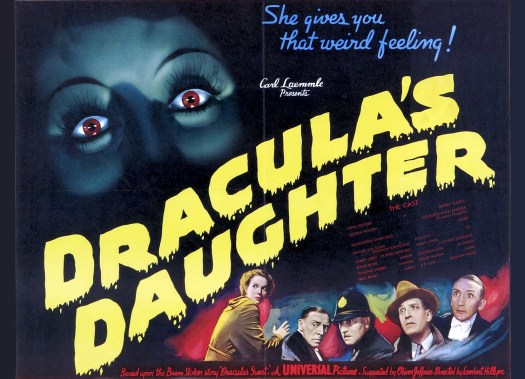
Halloween Havoc!: DRACULA’S DAUGHTER (Universal 1936)


gary loggins's avatarcracked rear viewer

After the success of BRIDE OF FRANKENSTEIN , Universal decided it was time for a sequel to everybody’s favorite vampire, Dracula , with James Whale scheduled to direct. Whale opted out, putting DRACULA’S DAUGHTER in the hands of Lambert Hillyer , an old pro who dated back to silent William S. Hart Westerns, and was more comfortable with sagebrush sagas than Gothic horror. The result was an uneven film saved by Gloria Holden’s performance as the title character, Countess Marya Zaleska.

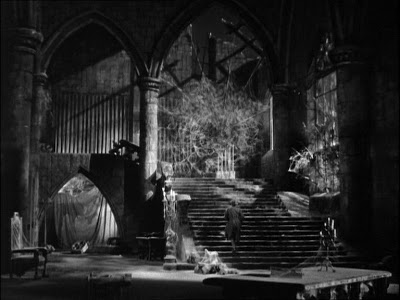
I’ll give Hillyer credit for some atmospheric scenes scattered throughout the movie. The opening scene at Carfax Abbey, cobwebbed as ever, picks up where DRACULA left off, with Edward Van Sloan’s Van Helsing (inexplicably renamed Von Helsing here) caught by constables shortly after staking the undead Count. The Countess burning the body of her vampiric father, hoping to free herself of her curse, is spooky, as is the return…

View original post 360 more words

Horror Film Review: Near Dark (dir by Kathryn Bigelow)


The 1987 film Near Dark is the story of two American families.

The Coltons are a family of ranchers living Oklahoma.  Loy Colton (Tim Thomerson) is the patriarch, keeping a watchful eye on his children, Caleb (Adrian Pasdar) and Sarah (Marcie Leeds).  Caleb is a cowboy and a nice guy, even if he does seem to be a little bit too naive for his own good.  After Caleb disappears one night, Loy and Sarah start their own search, traveling across the back roads of the Southwest.

The other family may not share any biological relation to one another but they definitely share blood.  They’re a group of outcasts who have found each other and now spend their nights searching for people who can satisfy their hunger.  They’re vampires, even though that’s not a word that they tend to use.  (In fact, for all the blood-sucking that goes on throughout the film, the term “vampire” is never actually heard.)  At night, they’re all-powerful but during the day, even the slightly exposure to the sun can set them on fire.

The patriarch of this family is Jesse Hooker (Lance Henriksen), a scarred war veteran.  Jesse will do anything to protect the members of his family but he expects each of them to pull their weight.  At one point, when Jesse is asked how old he is, he says that he fought for the South and that the South lost.

Jesse’s girlfriend is Diamondback (Jenette Goldstein), who is just as ruthless as Jesse.  Filling the role of oldest son is Severen (Bill Paxton), a cocky gunslinger with a quick smile and cruel sense of humor.  Homer (Joshua Miller) appears to be a 12 year-old boy but he’s actually one of the older and more violent members of the family.  And then there’s Mae (Jenny Wright), the rebellious daughter.

Mae is the one who first met and bit Caleb.  She’s the one who turned Caleb into one of them, though it takes Caleb a while to not only discover but also understand what he’s become.  When Caleb tries to escape from Mae and his new family, he becomes violently ill.  He can no longer eat human food but, at the same time, he can’t bring himself to hunt.  Instead, he’s forced to drink whatever blood Mae can provide for him.  Even when Jesse’s group attacks a redneck bar, one cowboy manages to escape, specifically because Caleb cannot bring himself to kill him.

What is Caleb to do?  He can’t return to his old family, as much as he may want to.  (It doesn’t help that Homer has developed an obsession with Caleb’s sister, Sarah.)  At the same time, his new family says that they’re going to kill him unless he starts hunting for blood.  They only thing keeping Caleb alive is the fact that Mae likes him and even she’s telling him that he’s going to have to hunt.

Meanwhile, Loy continues his own hunt, the hunt for his son….

Long before she became the first female director to win an Oscar for The Hurt Locker, Kathryn Bigelow directed this stylish vampire film.  Visually, Bigelow emphasizes the emptiness of the Southwestern plains.  Looking at the desolate landscape, it’s easy to believe that Jesse and his family could use them to successfully hide from the rest of the world.  It’s also just as easy to believe that a well-meaning but not particularly bright young man like Caleb could get lost and not be able to find his way home.  Bigelow turns the vampire family into a group of modern-day outlaws, crossing the land in their sun-proofed vehicles and trying to stay one step ahead of modern-day posses made up by concerned families and law enforcement officers who don’t know what they’re getting into.

Even if not for Bigelow’s stylish direction, the film would be a classic for just the cast alone.  Henriksen, Paxton, and Goldstein all previously appeared in James Cameron’s Aliens and they have a camaraderie that feels real.  In fact, the vampires work so well together that it’s impossible not to kind of admire them.  They’ve got it together and, even when faced with an army of police officers determined to make them step out into the sunlight, they don’t lose their sardonic sense of humor.  The much missed Bill Paxton’s performance is a hyperactive marvel, both menacing and sexy at the same time.  Meanwhile, Jenny Wright and Adrian Pasdar have a likable chemistry as Mae and Caleb while Tim Thomerson makes Loy’s love and concern for his son feel so real that adds an unexpected emotional depth to the overall movie.  The script, written by Eric Red and Bigelow, is full of quotable dialogue and the cast takes full advantage of it.

Near Dark is vampire classic and definitely one to watch this Halloween season.

Horror on the Lens: Night Slaves (dir by Ted Post)


For today’s horror on the lens, we have the 1970 made-for-TV movie, Night Slaves!

In this atmospheric film, an estranged married couple (James Franciscus and Lee Grant) find themselves in a small town.  It seems like a friendly enough place.  I mean, Leslie Nielsen is the sheriff!  How could anything go wrong in a town protected by Leslie Nielsen?

However, at night, the town changes.  Only Franciscus seems to notice all of the townspeople wandering about like zombies.  Is he going crazy or has he stumbled across something sinister?

You’ll have to watch find out!

Enjoy!

The TSL’s Horror Grindhouse: Raiders of the Living Dead (dir by Samuel M. Sherman and Brett Piper)


Wow, were to even begin?

The 1986 film Raiders Of The Living Dead is not an easy movie to describe.  It’s a film that somehow manages mix terrorists, zombies, journalists, movie theaters, a sociopathic kid who somehow invents a death ray, and the Three Stooges.  If that makes it sound like something you want to see …. well, good.  You should see this movie, just so you can say that you’ve had the experience.

On the plus side, Raiders of the Living Dead opens with one of the most brilliant songs that I’ve ever heard.  Seriously, take a listen and then ask yourself why Olivia Cooke was covering Bob Dylan in Life Itself instead of this song:

So, I know what you’re asking.  “What’s this movie about?”

I’m not really sure.  Here’s what I can tell you.

The movie opens with a truck apparently being hijacked.  At least, I think it was a hijacking.  A guy jumped in a truck and drove off with it and then some police cars started following him down a country road so I’m going to assume that some sort of law was broken.  Anyway, the truck gets away because a dump truck pulls in front of the police cars.  The dump truck driver isn’t an accomplice or anything.  He’s just having engine trouble.  I guess the cops just decided they had wasted enough time chasing the other truck so they decided to just sit around and watch the dump truck driver work on his engine.

Suddenly, we’re in a nuclear power plant!  Oh my God, a terrorist is trying to blow the place up!  That will lead to an environmental catastrophe and …. oh never mind.  Two SWAT guys just showed up and shot the terrorist with a taser and then the terrorist stumbled into a circuit box and got electrocuted so I guess that’s a god thing.

Now, I’m not sure how either of these scenes are connected to the rest of the film.  In fact, we soon abandon the nuclear power plant so that we can send time with Jonathan (Scott Schwartz, the same kind who got his tongue stuck to the flag pole in A Christmas Story) and his grandfather, Dr. Corstairs (Robert Allen).  Dr Corstairs is having trouble with whatever the 80s equivalent of a DVD player is and he gives it Jonathan to see if he can fix it.  Somehow, Jonathan turns it into a death ray and accidentally atomizes his pet hamster.  Jonathan never seems to be too upset over killing his pet, which leads me to suspect that Jonathan is a sociopath.

Meanwhile, there’s a reporter named Morgan (Robert Deveau), who drags his girlfriend with him to an old farmhouse in the middle of the night.  He says that he’s investigating something for a story but I think he just has a thing for farmhouses.  Anyway, they get attacked by zombies.  Morgan escapes.  His girlfriend doesn’t.  Morgan never seems to be too upset about it, proving that Morgan is as much of a sociopath as Jonathan.

Anyway, Morgan goes into hiding, which in this case means getting a room in a nearby boarding house and looking for clues at the library.  He also gets a new girlfriend named Shelley (Donna Asali).  They go to a Three Stooges film festival together.  They watch a Three Stooges short which means that viewers of Raiders of the Living Dead also have to watch it.  This actually happens more than once.

Anyway, it’s all somehow connected to a mad scientist who is creating zombies out in a deserted prison somewhere.  I’m not really sure how it all connects and neither is the film.  Jonathan’s death ray does kind of play a role in resolving the whole zombie subplot but to be honest, I was so curious about why no one was freaking out about a kid having a death ray that it was sometimes hard to focus on just what exactly was going on at the prison.

So, this is a very strange film.  Apparently, it was shot over a lengthy period of time, with footage being shot until the production ran out of money and then filming resuming whenever some more money came in.  That probably explains why Raiders of the Living Dead seems to actually be five or six films in one.  As bad as the film is, I am going to give it a cautious recommendation just because it’s so damn weird that I think everyone should experience it at least once.

Plus, I love that theme song!

Faust Goes Metal: Shock ‘Em Dead (1991, directed by Mark Freed)


Spastic Colon, an up-and-coming metal band, desperately needs a new guitarist, so much so that they allow a nerdy pizza boy named Martin (Stephen Quadros) to come in off the street and audition.  Martin, with his thick glasses and his total lack of talent, blows the audition and is told to leave and never return.  Not only does Martin lose his chance to be a rock star but he also loses his job when his boss (Aldo Ray) fires him for leaving work to audition.  While wandering around dejected, Martin runs into the local voodoo priestess (Tyger Sodipe), who offers to make him a rock star in exchange for his soul.

Martin agrees and after a ceremony involving a double neck guitar, Martin wakes up to discover that he is now an extremely talented guitarist who lives in a gigantic mansion with three outrageously hot groupies.  Martin now has big, heavy metal hair and no longer needs to wear his glasses.  Renaming himself Angel Martin, he not only becomes Spastic Colon’s new guitarist but he also pulls the band’s manager (Traci Lords) away from her boyfriend.  The only problem is that Martin cannot eat normal food and has to regularly feast on the souls of his groupies in order to stay alive.

Shock “Em Dead is the 1000th retelling of the old Faust legend, about the man who gets everything that he desires but loses his soul in the process.  A real product of its time, it’s impossible to watch Shock “Em Dead without thinking about how Martin sold his soul to become the type of musician that, in just a few months, would be made obsolete by Kurt Cobain and Nirvana.  I have fond memories of Shock “Em Dead because it always used to air on HBO back when I was growing up but, for the most part, this is a really crummy movie, with a bad script, bad acting, and bad special effects.  Shock “Em Dead does prove that Traci Lords had enough talent that, if not for her background as an underage porn star, she probably could have had a mainstream film career.  The film also provided small roles for Aldo Ray and Troy Donahue while the legendary Michael Angelo Batio served as Angel’s “guitar double.”

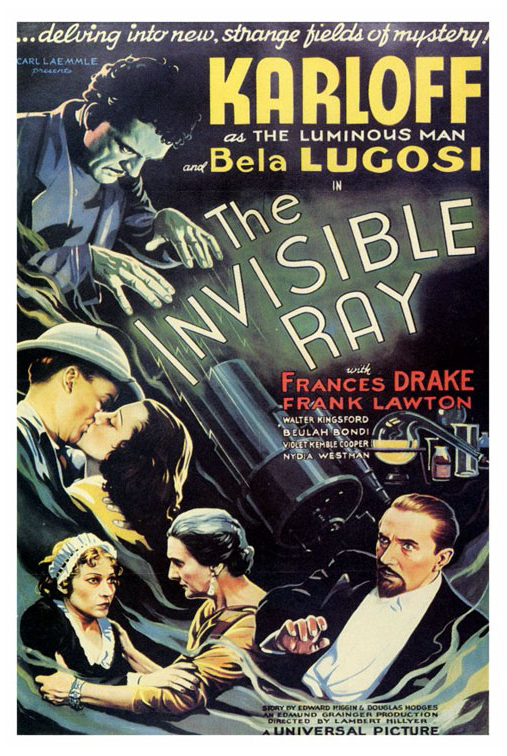
Halloween Havoc!: THE INVISIBLE RAY (Universal 1936)


gary loggins's avatarcracked rear viewer


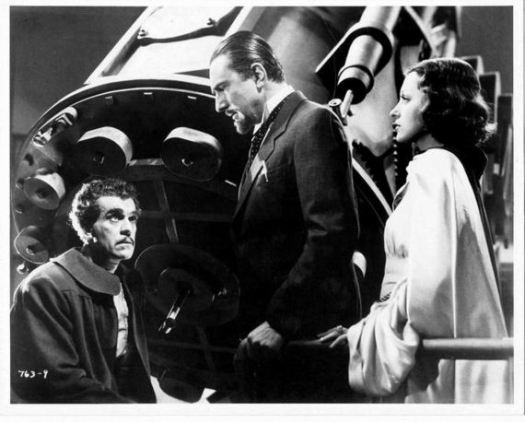
THE INVISIBLE RAY, the third Universal teaming of Boris Karloff and Bela Lugosi , is probably the least discussed of their seven films together. And I don’t quite know why, because I find it an entertaining meld of horror and science fiction that holds my interest for its 80 minute running time. The two stars are well spotlighted, with Bela as one of the good guys (for a change!) and Boris giving a hammy but well crafted performance as a scientist unhinged by his newest discovery.

A curly-haired Karloff stars as Dr. Janos Rukh, awaiting the arrival of a group of his fellow scientists for a demonstration of his Invisible Ray as a storm rages outside. Rukh’s wife Diana and blind Mother Rukh greet them: Sir Francis Stevens and his wife Lady Arabella, French astro-chemist Dr. Felix Benet, and Lady Arabella’s nephew Ronald Drake, who’s along for the ride. Rukh…

View original post 426 more words

Italian Horror Showcase: A Lizard In A Woman’s Skin (dir by Lucio Fulci)


The 1971 film A Lizard In A Woman’s Skin is a story of greed, love, lust, repressed desires, bloody murder, and two rather hateful hippies.  It’s a surreal tale that manages to combine LSD, politics, therapy, and a good old-fashioned whodunit.  It’s a film that clearly a product of the late 60s and the early 70s and yet, it’s also a film that is so shamelessly sordid and wonderfully strange that it feels timeless.

And not surprisingly, it was directed by Lucio Fulci.

Over the course of his career, Lucio Fulci was credited with directing 56 films and one television miniseries.  Though we tend to primarily think of Fulci as being a horror director, he actually worked in every genre.  He directed peplums.  He was responsible for some of the best and most violent spaghetti westerns ever made.  He even directed comedies and an adaptation of Jack London’s White Fang!

Still, it is for his horror films that Fulci is best-remembered and his non-compromising and frequently surreal style was perfect for the genre.  Though 1979’s Zombi 2 is frequently cited as Fulci’s first excursion into the horror genre, he had actually dabbled in it before with a set of stylish and violent giallo films that he directed in the early 70s.

For example, A Lizard In A Woman’s Skin deals with a horrific crime and features some of Fulci’s most striking and disturbing images.  The film deals with Carol Hammond (Florida Bolkan), who is the daughter of a politician (Leo Genn) and the wife of a wealthy attorney (Jean Sorel).  Carol is haunted by bizarre dreams involving her decadent neighbor, Julia Durer (Anita Strindberg).  In her latest dream, Carol not only has a sexual encounter with Julia but also stabs her to death immediately afterward!  It’s only after Julia’s dead that Carol realizes that she’s being watched by two hippies, who appear to be amused by the whole thing.

After telling her therapist about the dream, Carol learns that Julia Durer has indeed been murdered.  In fact, she was stabbed in exactly the same way that Carol saw in her dream!  Was it just a dream or did Carol really murder of Julia?  Or did someone find out about her dream (which she recorded in her journal) and then murder Julia in order to frame her?  But who would want to do that?  Could it be maybe her weaselly husband, who is having an affair with his secretary?  Or maybe someone looking to embarrass her father?

And what about the two hippies?  It turns out that they’re real and they have a story of their own tell….

The mystery at the heart of A Lizard In A Woman’s Skin is a convoluted one and while the film’s plot did hold my interest, this film is less about the story and more about the way that Fulci tells it.  Dealing with hippies, visions, LSD, and a potentially unstable protagonist gave Fulci whatever excuse he needed to turn Lizard In A Woman’s Skin into a surrealistic carnival ride of psychedelic images and sexually-charged dream sequences.  From Carol’s nightmares to the scene where an intruder chases Carol through a sanitarium, A Lizard In A Woman’s Skin is full of strange images that are designed to keep the viewer just as off-balance as Carol.  The film’s most shocking scene — which involves Carol coming across four dogs being used in a medical experiment — actually led to Fulci and special effects artist Carlo Rambaldi being taken to court and forced to prove that the dogs in the scene weren’t real.  (Fortunately, Rambaldi brought his dog props to court with him.)  It’s a shamelessly sordid film, one from which you will not be able to divert your eyes.

Florinda Bolkan gives a great and sympathetic performance was Carol while Antia Strindberg is properly decadent as Julia.  Penny Brown and Mike Kennedy plays perhaps the most hateful and callous hippies of all time and Kennedy especially makes a strong impression.  Trust Lucio Fulci to make a film where the hippies are just as frightening as the zombies who populated his later work!

A Lizard in A Woman’s Skin is a classic giallo and one of Fulci’s best.