Horror Film Review: Psycho II (dir by Richard Franklin)


Norman Bates is back!

No, I don’t mean Freddie Highmore from Bates Motel or Vince Vaughn from the odd Psycho remake that I keep seeing on Showtime.  No, I’m talking about the original Norman Bates, Anthony Perkins!

First released in 1983, Psycho II is a direct sequel to the classic shocker from Alfred Hitchcock.  The film opens with a replay of the original film’s famous shower scene and then immediately jumps forward 22 years.  Having been found not guilty by reason of insanity, Norman Bates has been in a mental institution ever since he was arrested for the murders of Marion Crane and Milton Arborgast.  However, Norman’s psychiatrist, Dr. Raymond (Robert Loggia, who was considered for the role of Sam Loomis in the original film), now feels that Norman has been cured and is no longer a danger to himself or others.  A judge agrees.  Marion Crane’s sister, Lila Loomis (Vera Miles, reprising her role from the original) does not.  She presents the judge with a petition demanding that Norman not be released.  When the judge ignores her, Lila yells that Norman will murder again!

Now free, Norman returns to the Bates Motel and discovers that it’s now being run by the sleazy Warren Toomey (Dennis Franz).  When Norman finds various party favors in the motel rooms and asks Warren what they are, Warren laughs and says, “They’re drugs, Norman.”  Norman’s not too happy about that.  As Dr. Raymond tells him, the world has changed considerably over the past two decades.

However, Norman has other issues to deal with.  For the most part, most of the people in town are not happy that their most famous resident has returned.  Emma Spool (Claudia Bryar) gets Norman a job at a local diner because, in her words, she believes in forgiveness and second chances.  Norman gets to know the new waitress, Mary Samuels (Meg Tilly) and, when Mary tells him that she’s had a fight with her boyfriend, he invites her to stay at the hotel until she can get things together.

From the minute that he returns home, Norman is struggling to keep it together.  When he first reenters his former house, he hears his mother’s voice but he tells himself that she’s not really there.  But if his mother isn’t there, then who keeps calling him on the phone and yelling at him about the state of the motel?  Who keeps taunting him about his awkward (yet rather sweet) relationship with Mary?  And when two teenagers are attacked after breaking into the house, who else could it possibly be but Norman’s mother?

I was really surprised by Psycho II, which turned out to be a really entertaining little movie, an effective thriller with a healthy dash of dark humor.  It’s a very plot-heavy film, with almost every scene introducing a new twist to the story.  With the exception of the sleazy Warren Toomey, no one in this film turns out to be who you initially expected them to be, including Norman.  Meg Tilly does a good job in the somewhat oddly written role of Mary Samuels and even manages to make an awkward line like “Norman, you’re as mad as a hatter” sound natural.  Not surprisingly, the film is dominated by Perkins’s performance as Norman Bates and what a great performance it is.  The best moments are the ones where Norman awkwardly tries to fit back in with society, nervously laughing at his own jokes and struggling to maintain eye contact with whoever he’s talking to.  You really can’t help but feel sorry for him, especially as the film progresses.

Wisely, Psycho II set out to establish it own identity as a film, as opposed to just trying to duplicate the shocks of Psycho.  (There is a shower scene that’s filmed similarly to the one from the first scene, with a key difference that I won’t spoil.)  It’s what a sequel should be, not a remake but a continuation of the original’s story.  This is definitely a film that’s far better than you may expect.


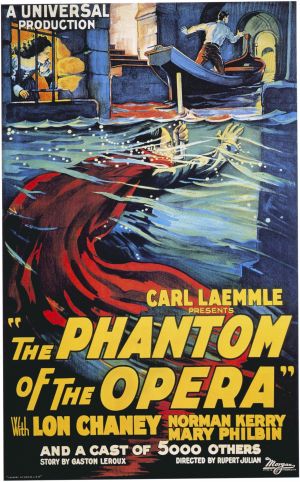
Horror On The Lens: The Phantom of the Opera (dir by Rupert Julian)


Today’s horror movie on the Shattered Lens is both a classic of silent era and one of the most influential horror films ever made.  It’s one that I previously shared in 2013, 2015, 2016, and 2108 but it’s such a classic that I feel that it is worth sharing a second (or fifth) time.

First released in 1925, The Phantom of the Opera is today best known for both Lon Chaney’s theatrical but empathetic performance as the Phantom and the iconic scene where Mary Philbin unmasks him. However, the film is also a perfect example of early screen spectacle. The Phantom of the Opera was released during that period of time, between Birth of the Nation and the introduction of sound, when audiences expected films to provide a visual feast and Phantom of the Opera certainly accomplishes that. Indeed, after watching this film and reading Gaston Leroux’s original novel, it’s obvious that the musical was inspired more by the opulence of this film than by the book.

This film is also historically significant in that it was one of the first films to be massively reworked as the result of a poor test screening. The film’s ending was originally faithful to the end of the novel. However, audiences demanded something a little more dramatic and that’s what they got.

Home Invasion: Twice Dead (1988, directed by Bert Dragin)


Twice Dead is twice dumb but also twice the fun.

The fine and upstanding Cates family have recently inherited a mansion and are eager to move in.  The only problem is that the mansion is already inhabited!  Not only has a gang of street punks declared that the mansion belongs to them but the house is also home to the ghost of Tyler Walker (Jonathan Chapin).  A great actor, Tyler committed suicide after being swindled out of his possessions by the love of his life, Myrna.  After the Cates family plays an elaborate practical joke on the street gang (and the joke simply has to be seen to believed), the gang declares that they will take revenge.  Because the Cates’s daughter, Robin (Jill Whitlow), is dead ringer for Myrna, Tyler’s ghost decides to help take out the street punks.  Death by shotgun, dirt bike, and dumb waiter follows.

The two Cates children are played by Jill Whitlow and Tom Bresnahan.  Whitlow and Bresnahan ended up dating after they finished shooting the film and their obvious chemistry brings an apparently unintended subtext to all of their sibling interactions in Twice Dead.  Jill Whitlow also appeared in Night of the Creeps and, with her ability to be both sexy and wholesome at the same time, was one of the first crushes of many an 80s and 90s child.

A mix between The Amityville Horror and Death Wish 3, Twice Dead was one of the many horror films to come out of Roger Corman’s Concorde Pictures in the 80s.  It’s dumb but it has both Jill Whitlow and enough of a sense of humor to be entertaining.  The street punks, who all have names like Crip, Silk, Stony, and Candy, are all annoying so you don’t mind seeing them get killed in various ways.  Todd Bridges proves that the world don’t move to the beat of just one drum by playing a Petie, a friendly guy who likes to hang out at the library, while the amazing Charlie Spradling, who appeared in several films like this back in the day, plays a member of the gang.  Sadly, neither one of them comes to a good end.


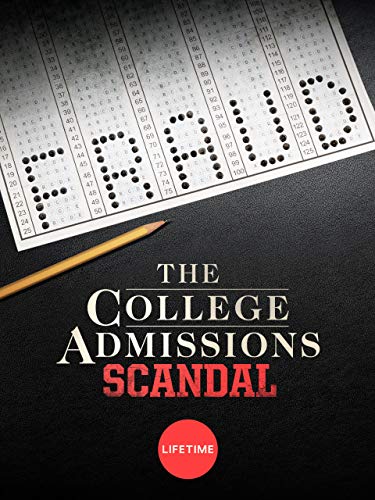
What Lisa Watched Last Night #200: The College Admissions Scandal (dir by Adam Salky)


Last night, like all good Americans, I watched The College Admissions Scandal on Lifetime!

Why Was I Watching It?

How could I not watch it!?

Seriously, Lifetime has been advertising the Hell out of this thing for the past few months.  I haven’t been able to turn on the channel without seeing a few hundred commercials for The College Admissions Scandal.

Add to that, I have to admit that this is the rare national scandal that I’ve actually been following.  When the news first broke that certain rich people had cheated and broken the rules to get their child into a good college, my initial reaction was, “Well, isn’t that what a parent’s supposed to do?”  Of course, I made the mistake of saying that on twitter and I immediately ended up with a bunch of finger-wagging nags screaming at me about how it wasn’t something to make a joke about and how it wasn’t fair and blah blah blah.  They sure told me!  Of course, it didn’t really change my mind or anything but at least everyone else got to feel like they had stuck up for truth and justice.  That said, I think my point remains valid.  Don’t get mad at the parents for taking advantage of the system.  They’re just trying to look after their kids.  Instead, get mad at the colleges that were willing to be bribed.  Get mad at a system that’s been specifically set up to be corrupted.  The solution is reform, not necessarily imprisonment.

Perhaps not surprisingly, I kinda love the fact that, while Felicity Huffman basically begged everyone to forgive her, Lori Loughlin pretty much said, “Fuck you, I’m not apologizing for anything.” That’s the spirit!

What Was It About?

Penelope Ann Miller plays a character who is definitely not Felicity Huffman, just as Mia Kirshner is playing someone who is definitely not Lori Loughlin.  That said, like Miller and Loughlin, they’re two wealthy mothers who are concerned about getting their children into the right school.  Fortunately, Rick Singer (Michael Shanks) is willing to sell his services as an admissions consultant.  Pay him enough money and he’ll fix your child’s grades, improve their test scores, and even make them look like athletes!

It sounds like a great plan!  Of course, it’s also illegal and, even as the parents are looking forward to sending their kids to Stanford and Harvard, the FBI is looking forward to sending the parents to prison!

What Worked?

Miller and Kirshner were both well-cast and Kirshner was especially good as the mother who definitely was not Lori Loughlin.  Michael Shanks was also wonderfully repellent in the role of Rick Singer.

It was fascinating to watch the lengths that Singer and the families went to remaking their children.  My main memory of this film will probably always be Sarah Dugdale standing in front of a blue screen and kicking a soccer ball so that she can later be photoshopped into a picture of an actual soccer game.

What Did Not Work?

Where were the real people!?  Yes, Rick Singer is a real person but why were all the parents fictional?  I assume for legal reasons.  For instance, Lori Loughlin has yet to be convicted of anything and I imagine that Lifetime didn’t want to get on the bad side of either Felicity Huffman or William H. Macy by portraying them in the movie.  But seriously, it was hard not to be disappointed by the lack of real world gossip.

“Oh my God!  Just like me!” Moments

Hmmmm …. I got into college legally but then again, I also didn’t go to an Ivy League school, nor did I ever particularly want to.  To be honest, it didn’t really occur to me that college was actually that important until my senior year.  That’s when I was like, “Oh, I’m actually supposed to do something with this art history degree….”

Lessons Learned

If you want to send your child to a good college, get them interested in soccer early.

Horror on the Lens: Hotline (dir by Jerry Jameson)


Yay!  Brianne O’Neill (Lynda Carter) has a got a new job, working at a crisis hotline!

Boooo!  The serial called known as the Barber is now obsessed with calling her!

The Barber is known as the Barber because he cuts his victims’s hair before killing them, which as far as I’m concerned, make him even worse than a normal serial killer.  You have to wonder if he resents being known as the Barber as opposed to The Stylist.

Anyway, it’s up to Brianne to figure out why The Barber keeps calling her and to hopefully discover his identity.  For whatever reason, no one else seems to be that concerned about it.

That’s the plot of Hotline, a 1982 made-for-TV movie that is today’s horror on the lens.  It’s not a bad film, though it does inspire a certain amount of snarkiness while you’re watching it.  For the most part, though, it’s well-acted and effectively directed.  If you’ve got 95 minutes to kill, why not kill them with Lynda Carter, The Barber, and Frank Stallone?

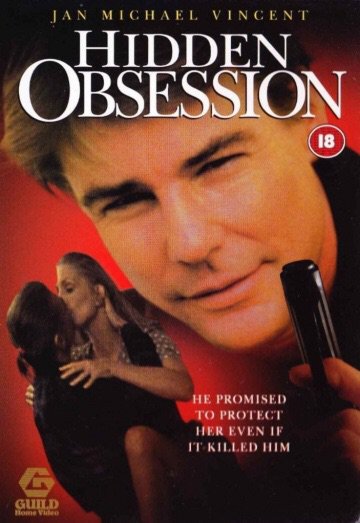
From The Cinemax Vault: Hidden Obsession (1993, directed by John Stewart)


Hidden Obsession comes to us from the glorious days of late night 90s Cinemax. 

Ellen Carlyle (Heather Thomas) is a TV anchorwoman who is looking forward to taking some time off.  The only problem is that everyone — from a crazed homeless man to an escaped convict that she helped put behind bars — wants to kill her.  She assumes that she’ll be safe if she just spends her vacation in a remote cabin in the mountains.  Fortunately, she’s got Deputy Ben Scanlon to look after her and keep her company in bed.  Unfortunately, Deputy Scanlon is played by Jan-Michael Vincent and Jan-Michael Vincent in a 90s direct-to-video flick is always bad news.  Ellen’s cameraman (Nick Celozzi) discovers that Scanlon is not really who he says he is but will he be able to warn Ellen in time?

By the standards of late night Cinemax, Hidden Obsession is tame.  Ellen Carlye is a role that Shannon Tweed could have worked wonders with but instead, television actress Heather Thomas gives a flat, listless, and usually clothed performance in the starring role.  Fortunately, this movie was made just before Jan-Michael Vincent started his final decline so, even though it is obvious that he had seen better days by the time he got around to playing Ben Scanlon, Vincent is still capable of giving a halfway decent performance.  Vincent throws himself into playing the psycho and he shows that, if not for the liquor and the drugs, he could have had a long and decent career as a B-movie villain.  Imagine if Vincent had been sober enough for Quentin Tarantino to give him the opportunities that he gave to Robert Forster and Michael Parks.  Unfortunately, it was not to be.

“Love hurts!” Ellen says.  It would be easy to say that this film hurts too but it’s really not memorable enough to be so bad that it’s good.  Like Witchtrap and Deadly Compansion, this film’s main appeal is to nostalgia.  These are the type of films that not only used to show up on late night Cinemax but which also lined the walls of your local Blockbuster.  These are movies of a bygone era.  Watch while you still can.

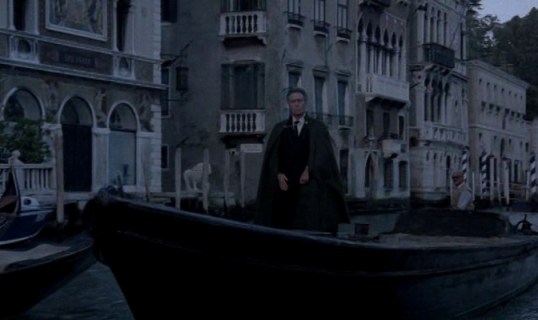
International Horror Film Review: Nosferatu in Venice (dir by Augusto Caminito, Klaus Kinski, Luigi Cozzi, Mario Ciaino, and possibly others)


Nosferatu the vampyre is back!  Well, maybe.  It’s complicated,

This Italian production from 1988 was originally envisioned as being a semi-official sequel to Werner Herzog’s Nosferatu, which was itself a remake of F.W. Murnau’s silent classic.  The idea was that Klaus Kinski would reprise his role and this time, his feral version of Dracula would haunt Venice.  Kinski agreed, initially, to reprise his role.  However, after arriving on the set, Kinski lived up to his infamous reputation for being difficult.  He announced that he would, under no circumstances, don the famous make-up that he wore in Nosferatu.  And while Kinski was undoubtedly a good actor who was capable of giving performances that kept him employed despite reportedly being insane, Nosferatu without the makeup is not really Nosferatu.  He’s just another vampire.

Still, Kinski was a big enough star that he got his way about the makeup.  He also attempted to get his way during the first day of filming, when he refused to take any direction from director Mario Ciaino.  When Ciaino attempted to figure out why Kinski was being so difficult, Kinski declared that he had been promised, by producer Augusto Caminito, that he would be allowed to direct the film.  This led to Mario Ciaino quitting during the first day of production.  Producer Caminito took over as a director, though apparently Kinski did end up directing several of his own scenes.  Reportedly, other scenes were directed by Luigi Cozzi.

However, Kinski didn’t stop with getting the director replaced.  He also demanded that nearly the entire cast be replaced as well.  Kinski, in fact, was such a terror on the set that it was common for members of the crew to refuse to work with him, which perhaps explains why Kinski seems to spend so much of this film wandering around Venice by himself.

As for the film itself — well, yes, it’s exactly as big of a mess as it sounds like it would be.  Kinski plays a vampire who may or may not be Dracula.  Actually, very few of the traditional vampire rules seem to apply to him.  He wanders around in the daylight.  He looks at his reflection in a mirror.  He does, however, drink a lot of blood so I guess some things never change.  Because he refused to wear the vampire makeup or shave his head, Kinski spends the entire film looking like the aging lead singer of a 70s prog rock band.  At the same time, it must be said that Kinski actually does give a fairly good performance.  He’s a vampire who is desperate to find someone pure of heart who can end his ennui-stricken life.  Kinski’s screen presence is undeniably powerful and he looks appropriately miserable.

Christopher Plummer has the Van Helsing role and Donald Pleasence plays a priest who always seems to be somewhat nervous.  (In other words, a typical role for Donald Pleasence.)  Plummer is in Venice because, back in the 18th century, it was the last place that Kinski’s vampire was seen.  This leads to several confusing flashbacks, all of which are somewhat randomly sprinkled throughout the film.

There’s not really any story beyond Kinski walking around with a stricken-look on his face but, oddly, the film kind of works. Despite all of the directors who worked on it, the film is often visually stunning.  I think it’s the power of Venice.  No other city has quite the same atmosphere as Venice and it turns out to be the perfect location for a film about an ennui-stricken vampire.

(I know that when I visited Venice the summer after I graduated high school, I often found myself thinking about vampires.  That’s just the type of city it is.)

Anyway, the film will be best appreciated by Italian horror enthusiasts and Kinski completists.  Others will probably be bored out of their mind.  If you just want to see a good horror film set in Venice, I recommend Don’t Look Now.

Horror Film Review: Butcher, Baker, Nightmare Maker (by William Asher)


This is an unexpectedly odd psychological thriller from 1981.

Okay, well, actually, I guess the technical term for this film would be “slasher” because it does feature a dark secret from the past and a series of gruesome murders and some 20-something teenagers getting naked.  That said, calling this movie a slasher brings to mind thoughts of Friday the 13th and Halloween and, as much as I’ve defended those films in the past, it’s hard to compare them to a film like Butcher, Baker, Nightmare Maker.  Nor is the film comparable to more giallo-influenced slashers that came out in the late 70s and the early 80s.  The identity of the murderer is revealed too early for that.

The murderer is Cheryl Roberts (Susan Tyrrell), who may seem like a perfectly normal suburban widow but who has some bad habits.  For instance, when she’s sexually rejected by television repairman Phil Brody (Caskey Swaim), she reacts by grabbing a knife and stabbing him to death in the kitchen.  When the police arrive, she says that he attempted to rape her.  When it’s later revealed to her that Phil was gay and in a committed relationship with the local high school basketball coach, she snaps that “Homosexuals are very sick people!”  Cheryl goes on to murder several more people, all because she views them as a threat to her relationship with her nephew, Billy (Jimmy McNichol).

Billy is a senior in high school.  His parents died in a mysterious car crash when he was an infant and he’s been raised by his aunt Cheryl.  Billy has an opportunity to go away to college on a basketball scholarship but Cheryl isn’t happy about that.  Cheryl never wants Billy to leave and she’s not above drugging his milk to make sure that he has a bad game while the college scouts are watching.  Cheryl is also not happy that Billy has a girlfriend, Julia (Julia Duffy).  When she finds out that Billy and Julie are sexually active, Cheryl’s response is to trap Julia in the basement.

Aunt Cheryl is not Billy’s only problem.  There’s also Detective Joe Carlson (Bo Svenson).  Carlson has been assigned to investigate the murder of Phil and he quickly becomes fixated on the fact that Phil was gay and that he was in a relationship with Billy’s coach, Tom Landers (Steve Eastin).  Despite all of the evidence that Cheryl’s killing people left and right, Carlson becomes obsessed with proving that Billy’s gay and that he murdered Phil as the result of a love triangle.  It quickly becomes clear that Carlson, who brags about his own military service, is incapable of going for more than five minutes without accusing someone of being gay.  (Of course, Carlson never says “gay.” Instead, he uses a slur that begins with the letter F and he uses it a lot.)

What sets this film apart from other horror films of the era is that the rampant homophobia is not played for laughs or for shock value.  Traditionally, being gay in a 1980s horror film meant that the character was either going to be held up as an object of ridicule or, in many cases, turn out to be the murderer.  Instead, in Butcher, Baker, Nightmare Maker, the gay characters are literally the only fully sympathetic people in the entire film.  Instead, the film’s villains are homophobes like Carlson, Cheryl, and Eddie (Bill Paxton!), a bully who gives Billy a hard time over his friendship with the coach.  As many people as Cheryl kills over the course of the film, the bigger monster is Carlson, who is so determined to indulge his prejudices that he’s blind to everything that’s happening in front of him.

It makes for an unexpectedly thoughtful slasher film.  Butcher, Baker, Nightmare Maker has its flaws, to be sure.  I wish, for instance, that Julia and Billy weren’t such bland characters.  (They’re well-acted but neither is written with much depth.)  There’s some pacing issues as well.  But overall, this is an unexpectedly good thriller which features two horrifyingly plausible performances from Susan Tyrrell and Bo Svenson.


Horror on the Lens: The Screaming Woman (dir by Jack Smight)


Today’s horror on the lens is The Screaming Woman, a 1972 made-for-TV movie that’s based on a Ray Bradbury short story.

Olivia de Havilland plays Laura Wynant, who has just returned home from a stay at a mental institution.  Soon after her arrival, Laura starts to hear a woman crying for help.  Laura becomes convinced that the woman has been buried alive on her property but, because of her debilitating arthritis, she can’t dig the woman up on her own.  And, because of her own mental history, no one believes her when she tries to tell them about what she’s hearing!

The Screaming Woman features screen legend Olivia De Havilland giving a sympathetic performance as Laura.  It also features two other luminaries of the golden age of Hollywood — Joseph Cotten and Walter Pidgeon — in supporting roles.  It’s a good little thriller so watch and enjoy!

(And of course, I should mention that the great Olivia De Havilland is still with us, 103 years old and living in France.)

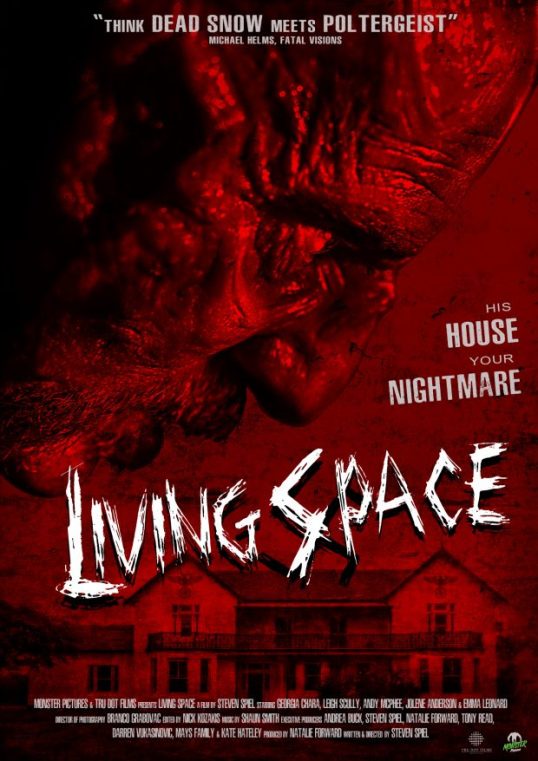
The TSL’s Horror Grindhouse: Living Space (dir by Steven Spiel)


So, before I talk about this movie, I want to talk about the title.  This is an independent Australian film from 2018 and, when it was originally released, its title was Living Space.  That’s not a particularly exciting title but it’s a title that goes along with the plot of the film and, in context of the story, it makes sense.

The film has since been retitled Nazi Undead.  That’s the title that’s used on the imdb.  That’s the title that’s used when it airs on Showtime and Starz.  When I recorded the film, I specifically set the DVR to record Nazi Undead.  I’m going to assume that it was felt that Nazi Undead was a more “commercial” title and I suppose it is.  For me, I saw the title and I immediately thought of the great 70s zombie flick, Shock Waves.  That said, it’s not a title that I plan on using in this review.  Living Space may not carry the punch of Nazi Undead but it’s still a far more appropriate title for this film, which involves a very evil spirit but no actual zombies.

As for the film itself, it opens with two Americans tourists driving through Germany.  Ashley (Georgia Chara) and Brad (Leigh Scully) should be having the time of their lives but they just can’t stop arguing.  At one point, Brad even calls Ashley a “whore” and it’s shortly afterwards that a house appears in the distance.  They’re having car trouble.  Brad wants to go in the house and get help.  Ashley is haunted by a horrific sense of deja vu and doesn’t want to.  Brad orders her to enter the house.

It turns out that Ashley was right.  The house is not a place you want to enter.  The house was once owned by a Nazi officer (Andy McPhee) who, one night, murdered his entire family.  His spirit is there and it’s still filled with the hatred and the sadism that fueled the Third Reich.  Brad is killed.  Ashley is next….

Suddenly, Ashley and Brad are sitting in the car again.  The house is sitting in front of them.  Ashley again has a horrific feeling of deja vu.  Brad again orders her to go into the house.  It’s a time loop, always starting with them at the car and always ending with a night of torture and death inside the house.  Each time, Ashley’s sense of deja vu grows stronger.  And each time, Brad is insistent that she enter the house….

It’s an interesting idea, really.  The evil of the Nazis, the film seems to be saying, cannot just be forgotten and, due to stubbornness  or willful blindness, we’re destined to suffer through their evil again and again unless people are willing to listen to and heed the warning signs.  The film opens with a title card that explains the idea behind Hitler’s concept of a “living space,” that room had to be made for the Aryan people and, in order to make that room, all undesirables would have to be moved somewhere else.  The house is a living space, one that is dominated not just by the evil ideology of its former inhabitant but also by the officer’s overwhelming hatred of women.  (Both the ghost and Brad use the word “whore,” which suggests that the whole reason the house appeared was because of Brad’s uttering of that word.  Brad and the ghost are in league, whether Brad realizes it or not.)  Every time, it’s Ashley who know what waits inside the house and Brad who insists that she enter it….

If only the execution was as assured as the idea behind it!  Georgia Chara does a good job in the role of Ashley but the rest of the cast is less impressive and, once they enter the house, the film sometimes seems to get so caught up in trying to duplicate other recent “torture” films that it runs the risk of trivializing exactly what it’s meant to condemn.  The film has a lot of ambition and, flaws and all, I do look forward to seeing what Steven Spiel does next.  Hopefully, whatever it is, it won’t get saddled with a name like Nazi Undead.