Axel McGregor (Donald Pleasence) is a world-famous author and big game hunter who, while on a hunt in the steamy jungles of Thailand, is maimed by a ferocious panther. With both his body and pride wounded, Axel posts a reward for the panther, demanding that it be captured and brought to his private island estate. When the panther is delivered, Axel plans to set it free so that he can hunt and kill it and regain his lost virility. Unfortunately, as soon as McGregor sets the panther free, unexpected guests show up at the island, Axel’s two daughters (Nancy Kwan and Jennifer Rhodes), his granddaughter (Lesly Fine), and an obnoxious tour guide named Ross (Ross Hagen). The panther proves to be harder to hunt than Axel was expecting and soon, one daughter has been killed and another daughter suffers a fate worse than death when she becomes Ross’s default love interest.
Night Creature is a strange film. It was obviously made as a part of the nature-gone-wild cycle that started in the wake of Jaws but, once the daughters arrive at the island, there are several lengthy stretches where the movie concentrates more on the love triangle between Ross and the daughters than on the panther. When the panther does show up, the attack scenes are so confusingly shot that it is difficult to be sure what has really happened. Director Lee Madden goes overboard with slow motion shots of the panther stalking its prey and an attempt to introduce some psychic bond between Axel and the panther largely falls flat.
At least we get Donald Pleasence, playing one of his twitchy roles and suffering another extended nervous breakdown. Night Creature may not offer much but it does have one of the best Pleasence freakouts ever captured on film. It’s always a pleasure to watch Pleasence chew the scenery, especially when he’s joined by panther.
The 1958 short film, What About School Spirit?, introduces us to the greatest high school in all of Kansas. The entire state is envious of Lawrence High. Not only are they champions in basketball but they’re champions in academics as well! What is it that makes Lawrence High so special?
Well, as one student explains, Lawrence High was’t always the wonderful institution that it is today. It’s not that the school didn’t have school spirit. In fact, it had too much school spirit! The students were driving fast and painting the school’s initials “where they had no business to be!” Everyone was so crazy about the school that they didn’t stop to think about how their rambunctious behavior was making life annoying for everyone else!
Then, luckily, the basketball team captain, Bob Corby, spoke at a student assembly and what Corby said changed the entire direction of the school. I’m not sure how that happened exactly because, judging from what we see of his speech, it’s nothing that special. In fact, I think Bob Corby’s kind of overrated. That’s right, I said it. Of course, after giving the speech, Bob Corby got sick and died. The students, of course, continued to display properly controlled school spirit in his memory.
I guess the message here is that teenagers should be proud of their school without being too loud about it. To be honest, though, Bob Corby and all of his followers kind of come across as being little fascists who are determined to quash any hint of nonconformity or rebellion. The next time that they say, “It couldn’t happen here,” you tell them that it already happened at Lawrence High.
This film was directed by Herk Harvey, who made a career out of doing educational films like this one. However, horror fans will always know Harvey best for directing the massively influential Carnival of Souls. That’s a film that we’ll watch later this month. For now, enjoy the legend of Bob Corby!
Now, admittedly, a female vampire emerging from a grandfather clock is an image to which filmmaker Jean Rollin would frequently return. It was one of his most iconic images and, in many ways, a perfect visual for his uniquely dream-like aesthetic. Seeing as how Rollin’s films always seemed to be, at least somewhat, concerned with how the past bleeds over into the present, it only makes sense that every grandfather clock — that ultimate symbol of the past — would have a vampire lurking somewhere within it.
As far as I know, though, 1971’s The Shiver of the Vampires was the first time that Rollin ever featured a vampire emerging from a clock. Rollin often cited The Shiver of the Vampires are being one of his personal favorites from his filmography so it makes sense that he would continually return to that film’s best-known moment.
Though I prefer later films like Living Dead Girl, Two Orphan Vampires, and Night of the Hunted, The Shiver of the Vampires is definitely one of Rollin’s best films. It’s certainly the first of his films in which Rollin feels like a truly mature filmmaker. This was his third film and, like both Le Viol du Vampire and The Nude Vampire, it plays out like a cinematic dream. At the same time, it’s more coherent than either of those earlier films, without the occasional moments of pretension that sometimes threatened to make those two films feel like elaborate student exercises.
The Shiver of the Vampires takes place in all of the usual Rollin locations. There’s an isolated castle and decrepit castle, a symbol of the past which still features very modern graffiti on some of the walls. There’s the chapel, which seems to be specifically designed to accommodate human sacrifice. And, of course, there’s the beach. As with so many Rollin films, all paths lead to the beach, a location that Rollin presents as being both comforting and menacing.
The Shiver of the Vampires tells the story of a honeymooning newlywed couple, Isle (Sandra Julien) and Antoine (Jean-Marie Durand). Isle is looking forward to visiting her two cousins at their castle but, upon arriving, Isle and Antoine discover that the castle is now the home to two young women and that Isle’s cousins died just the day before. Upset at both the news and a strange meeting with another woman named Isabelle (Nicole Nancel), Isle decides to spend the night sleeping alone. However, while Isle is getting ready for bed, Isolde (played by the singularly-named Dominique) emerges from the grandfather clock.
Isolde is the vampire who not only killed the cousin but who, along with her two servants, has taken over the castle. While Isolde leads Isle to the cemetery, Antoine wanders around the castle and just happens to run into the two dead cousins…
At its heart, The Shiver of the Vampires is an old Universal haunted castle movie with a bit more nudity and the sexuality move to the forefront as opposed to just being subtext. It’s a horror film with plenty of blood and one rather nasty death via piercing by pointed nipple covers. At the same time, it’s also a rather sentimental film. Ultimately, Isle is vulnerable not because she has any secret desire to be a vampire but instead because her cousins, regardless of what they’ve become, are the only family that she has left. Married or not, Antoine is just an interloper.
As with all of Rollin’s films, The Shiver of the Vampires plays out at its own dream-like pace, with the camera loving examining every inch of the old castle. On the one hand, the film may be a dream of dark and disturbing things but, at the same time, it’s also a sad-eyed look at family and the impossibility of escaping the past.
And, of course, you’ll never forget that grandfather clock.
No, no. You’re thinking of the wrong Guardian, my imaginary friend. This Guardian is from 1990 and it’s the killer tree film that was directed by William Friedkin.
“William Friedkin directed a killer tree film?”
Apparently so.
“What’s it about?”
It’s kind of hard to say. Camilla (Jenny Seagrove) is hired as a nanny and proceeds to not only claim the baby as her own but also tries to seduce the baby’s father away from his wife.
“I think it’s cute the way that you always mention the actor’s name is parenthesis….”
Well, that’s what we’re taught to do. But back to The Guardian. The Guardian could also be a movie about a druid who steals babies so that she can sacrifice them to a tree God.
“You mean like that big talking tree from the from Lord of the Rings?”
I guess. Or maybe Camilla is a reincarnation of Lillith, the demon who kidnaps babies in the night.
“Poor Lillith, so misunderstood.”
Or maybe Camilla is a witch who can make wolves and tress do her bidding!
I try to keep my actual cursing to minimum. That way, it means something.
“That’s sweet.”
Whatever. Back to The Guardian! It’s also possible that Camilla actually is a tree that’s come to life and is now doing evil tree stuff!
“So, what you’re saying is that the film is unclear about just what exactly Camilla’s deal is?”
That’s it, exactly! The Guardian is a notorious mess and it’s probably significant that this is one of two films that William Friedkin doesn’t even acknowledge in his otherwise tell-all autobiography, Friedkin Confidential. Reportedly, there were problems on the set. From what little I’ve found online, it would appear that Friedkin originally wanted the movie to be about a mentally deranged woman who thought she was a druid. But the producers wanted a horror film about a woman who actually was a druid. Somehow, this eventually led to The Guardian becoming a movie about a woman who is actually a tree. What’s funny is that the film itself feels like a typical crazy nanny Lifetime film, up until the moment that one of Camilla’s employers attempts to take a chainsaw to that tree.
“Trees don’t like chainsaws.”
Yeah, no joke. Anyway, before all that happens, Camilla is killing people left and right but yet no one seems to notice. She doesn’t make any secret of the fact that she’s trying to seduce Phil (Dwier Brown) but Phil’s wife, Kate (Carey Lowell), doesn’t seem to care. Instead, Phil and Kate attempt to set Camilla up with their friend, goofy Ned (Brad Hall). It doesn’t take long for Ned to get devoured by a bunch of wolves. That’s what happens when you walk in on a druid nanny turning into a tree, I guess.
“Isn’t Brad Hall married to Julia Louis-Dreyfus?”
Indeed, he is! And you don’t see him in any movies nowadays so I guess getting eaten by wolves was kind of the last straw. But the movie gets even weirder! There’s also an odd scene in which three gang members just happen to be walking through the woods when they come across Camilla and the baby. They kind of pop up out of nowhere and they immediately turn out to be some pretty bad guys. Luckily, a tree pops up and kills the all. Is the tree Camilla or is the tree someone else? Who knows?
“Gang members in the woods? You mean like in Friday the 13th Part 3?”
Strangely enough, yes. Even stranger is the fact that no one notices anything strange about Camilla. To be honest, there are times that Camilla might as well be wearing a sign that reads, “Druid” but no one seems to notice. Then again, it’s debatable whether or not she was actually a druid. She might actually be a tree and I guess it’s understandable that something like that wouldn’t naturally occur to anyone. I mean, I think we’ve all probably met a druid or two but someone who is actually a tree? Well, that’s unusual.
“Very unusual!”
Anyway, The Guardian is a messy film and I’m afraid that I’m probably making it sound more fun than it actually is. If you do watch it, please be sure to chime in with your thoughts on whether or not Camilla is actually a tree. I look forward to hearing your opinion!
After concert pianist Vernon Paris (James Stapleton) loses his hands in an auto accident, he is the recipient of a double hand transplant. Unfortunately, Vernon isn’t happy with having a stranger’s hands and he fears that he’ll never be able to play the piano again. Even worse, he soon becomes convinced that the hands are evil and are trying to force him to commit murders.
But is it the hands or Vernon’s own unstable mind that’s responsible his actions?
This 1962 horror film was the fourth adaptation of the Maurice Renard’s The Hands of Orlac. As opposed to other film adaptations of Renard’s novel, Hands of Stranger plays up the ambiguity of whether the recipient of the hands is truly possessed or if he’s just using the hands as an excuse to indulge in his dark side.
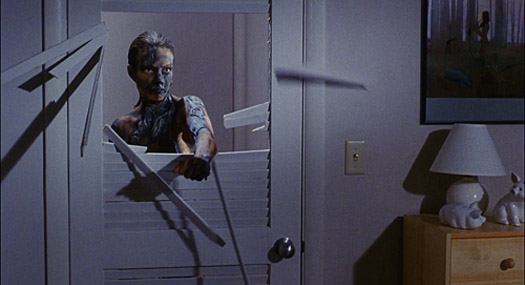
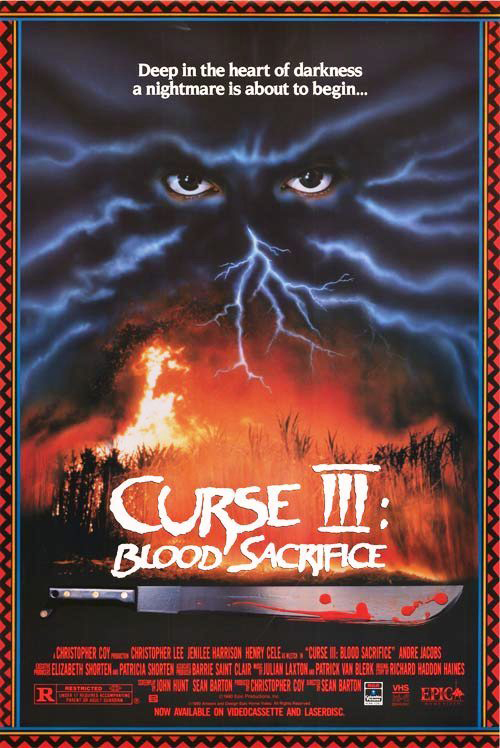
Having absolutely nothing to do with either of the Curse films that preceded it, Curse III: Blood Sacrifice takes place in South Africa during the 1950s. American Elizabeth (Jenilee Harrison) has just married plantation owner Geoff Armstong (Andre Jacobs) and is still struggling to adjust to living in Africa. When her sister, Cindy (Jennifer Steyn), comes over for a visit, she and Elizabeth stumble across what appears to be a native ceremony. When they realize that the local witch doctor is about to sacrifice a goat, Cindy steps on and grabs the goat. Not happy at being interrupted and needing to make a sacriice to atone for an earlier murder, the witch doctor places a curse on Elizabeth and her entire family. Later, a rubbery fishman stalks the plantation, using a machete to kill every colonialist it comes across.
Curse III is the best of the Curse films, though that may not be saying much. The film is largely a standard slasher with a super natural twist, right down to the first victims being horny teens. However, both the setting and the 1950s time period make the film slightly more interesting than the usual 90s, direct-to-video horror fare, with the curse being the result of a cultural misunderstanding and many of the victims too blinded by their own prejudices to realize how much trouble they are in. Making what would turn out to be both his first and last film as a director, acclaimed editor Sean Barton showed that he knows how to put together an effective “stalking” scene, wringing out all the atmosphere that he could from that plantation. Best known for co-starring in the later seasons of Three’s Company, Jenilee Harrison is adequate if not particularly memorable in the lead role but the film is, not surprisingly, stolen by Christopher Lee, who plays a local doctor and who lends Curse III whatever gravitas it may have.
Today’s horror on the lens is 1966’s Curse of the Swamp Creature!
Probably the best thing about Curse of the Swamp Creature is that it was filmed in the town of Uncertain, Texas, which is right near the Texas/Louisiana border. Uncertain, which sits on the shores of Caddo Lake, was incorporated in 1961. Reportedly, when filling out the paperwork, the town’s founders wrote “Uncertain” in the blank for the name because they genuinely hadn’t come up with a name. And …. well, you know what happens when you try to make a joke on an official document.
Anyway, this film was directed by Larry Buchanan and that’s really all you need to know about it. Buchanan specialized in making low-budget remakes of other films, though he always claimed that Curse of the Swamp Creature was a totally original idea on his part. The film is about a mad scientist who lives in the swamp and is trying to reverse evolution. Things don’t always work out the way that they should and occasionally, the mad scientist has to feed his alligators. John Agar’s in the movie, of course.
I had a few reasons for watching the 1972 slasher film, The Flesh and Blood Show.
First off, the film was directed by Pete Walker. Though Pete Walker may not be as well-known as some of his contemporaries and his overall cinematic output is dreadfully uneven, he was still responsible for enough memorable films that I will always give him a chance.
Secondly, it’s a British film and the British were responsible for some of the best horror films of the late 60s and early 70s.
Third, speaking as a horror fan, that title is just irresistible. The Flesh and Blood Show? Well, there’s nothing subtle about that! Looking at that title, you find yourself wondering, “How much flesh and how much blood is actually in this film?”
Well, having watched the film, I can tell you that there’s very little blood and a good deal of flesh. The Flesh and Blood Show was Walker’s first horror film. Before moving into the horror genre, Walker specialized in making sexploitation movies and it’s kind of obvious that, when he directed this film, he was still more comfortable asking people to undress than asking them to play dead. As opposed to other slasher films, the majority of the young cast survives and the almost all of the murders occur off-screen. Every couple of minutes or so, someone else is getting undressed. The constant nudity actually starts to get pretty funny after a while. One could very easily use The Flesh and Blood Show to construct a drinking game.
As for the film’s plot, it deals with a group of actors who receive invitations to an abandoned theater. An unseen producer apparently wants them all to perform an infamous play, perhaps the same play that is rumored to have led to tragedy back in 1945. If it seems rather odd that the film’s characters would willingly go to an abandoned theater in the middle of nowhere and perform a possibly cursed play, no one is ever going to accuse anyone in this film of being smart. Why ask why when there’s so much dancing and undressing to do?
There’s also an elderly major (Patrick Barr) hanging out around the theater. He was actually one of my favorite characters in the movie because he approached everything with this very British, very stiff upper lip attitude. Of course, the major himself has a secret. That said, the secret isn’t that surprising. I figured it out as soon as he showed up.
Naturally, all the murders at the theater are linked back to a tragedy in the past. The final 15 minutes of the movie are made up of an extensive flashback to that tragedy and I will say this: it’s the best part of the film. The flashback was originally filmed in 3-D and Walker uses this as an excuse to indulge in some surreal flourishes.
There are a few positive things to be said about The Flesh and Blood Show. Pete Walker was a talented director and that talent comes through in even his weaker films. There are a few scenes where Walker manages to maintain a properly ominous atmosphere and the movie’s score is so melodramatic and over the top that it’s kind of hard not to love it.
But, for the most part, The Flesh and Blood Show is a rather forgettable film. If you want to see a good Pete Walker film, track down Frightmare.
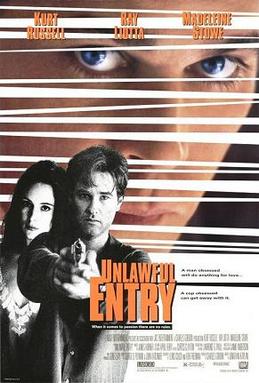
The upscale and complacent life of Michael and Karen Carr (Kurt Russell and Madeleine Stowe) is interrupted one night when a burglar breaks into their home via their skylight. The intruder briefly holds a knife to Karen’s throat before taking off. Shaken by the encounter, the Carrs are very happy when a seemingly friendly cop, Officer Pete Davis (Ray Liotta). offers to help them cut through all the red tape and get a security system installed in their house.
At first glance, Pete seems like the perfect cop but actually, he’s a mentally unstable fascist who quickly becomes obsessed with Karen. When Pete offers Michael his nightstick so that Michael can use it on the man who earlier broke into his house, Michael refuses. That’s all that Pete needs to see to decide that Michael’s not a real man and that Karen would be better off with him. Even after Michael orders Pete to stay away from his home, Pete continues to drop by so that he can spy on the couple. When Michael complains, Pete frames him by planting cocaine at his house. When Michael says that he’s innocent, no one believes him. Why would they? Pete’s a decorated cop who is keeping the streets safe. Michael is just a homeowner. While Michael sits in jail, the increasingly violent and unhinged Pete makes plans to make Karen his own.
“Who watches the watchmen?” as the old saying goes. Unlawful Entry is an efficient and no-nonsense thriller that was ahead of its time as far as its portrayal of a policeman abusing his authority is concerned. Jonathan Kaplan was trained in the Roger Corman school of filmmaking so he doesn’t waste any time getting to the story and he even finds a role for Dick Miller. Ray Liotta, fresh off of his performance in Goodfellas, is perfectly cast as the manipulative and misogynistic Pete while Kurt Russell is once again the ideal everyman. Madeleine Stowe, who was one of the best actresses of the 90s, does not get to do much beyond be menaced but she does it well. Whatever happened to Madeleine Stowe? Kurt Russell’s career is still going strong and Ray Liotta still appears regularly in gangster movies and Chantix commercials. Isn’t it about time for a Madeleine Stowe comeback?
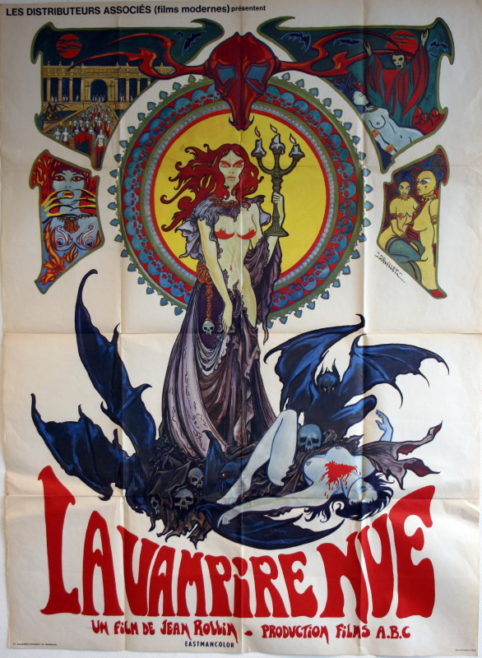
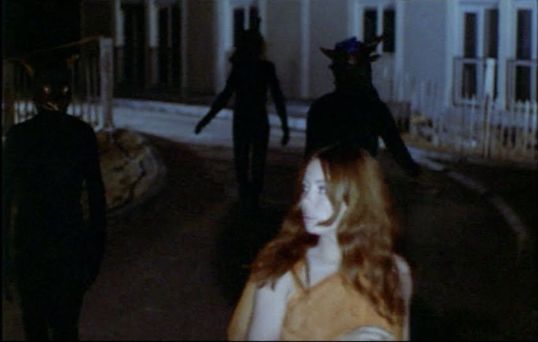
In the middle of the night, a woman (Christine François), wearing an orange nightgown walks down a dark, Paris street.
She is followed by three men, all of whom are wearing strange, bird-like masks.
The woman turns a corner and runs into Pierre (Olivier Rollin). Pierre and the woman stare at each other, without saying a word. Though it may be their first time to meet each other, both their attraction and their bond is instantaneous.
Both Pierre and the woman run down the street. The men in the marks follow them.
Finally, in a deserted alley, the men corner the woman and Pierre. Though Pierre escapes, the woman is shot by one of the men and promptly collapses.
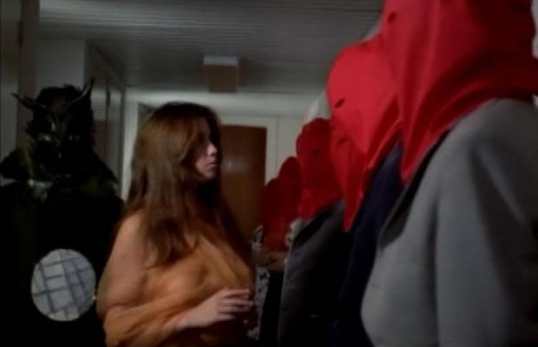
The men pick up the woman’s body and carry her to a nearby, gated building. A bearded doorman lets them through. Several other people, all wearing tuxedos and fancy gowns, come to the gate and, after showing the doorman their invitation, are allowed to pass through. Pierre tries to follow but is told that he cannot enter because he has not been invited.
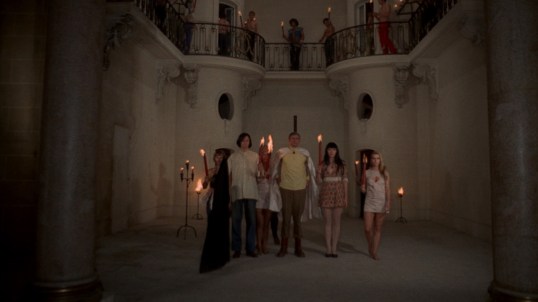
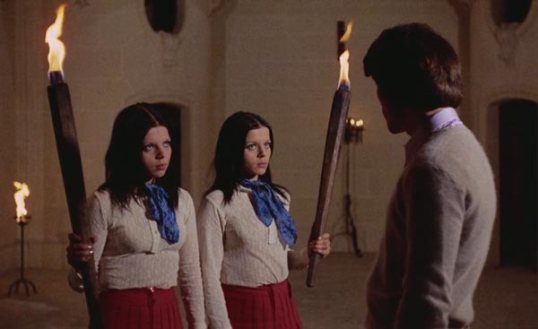
And so begins Jean Rollin’s 1970 film, The Nude Vampire. This was Rollin’s second film, following the controversial Le Viol du Vampire. The Nude Vampire, while once again featuring all of Rollin’s pet obsessions, is still a far more assured piece of filmmaking than Rollin’s first film. It’s interesting to watch The Nude Vampire directly after Le Viol du Vampire because you can can truly see Rollin developing as a director. Once again, Rollin is telling an odd story about a frequently disrobed vampire and once again, all of the action leads to the beach. However, the plot is far easier to follow in The Nude Vampire than in Le Viol du Vampire. If the first film often seemed to be too indulgent for its own good, The Nude Vampire is just indulgent enough to work. Of course, as with any Rollin film, your mileage may vary. What seems rather coherent and almost tame to a Rollin fan may seem like the exact opposite to someone who has never seen a Rollin film before.
As for Pierre, he is determined to figure out what happened to the woman, even though his own father says that it is sometimes best to just leave well enough alone. After punching out a partygoer and stealing his invitation, Pierre gets into the building and discovers that, despite having been shot in front of him, the woman in the orange nightgown is not dead. In fact, she doesn’t even appear to be injured. Instead, she drinks the blood of a party guest who has just committed suicide. It turns out that the party is actually a cult and they worship the woman.
As if that’s not shocking enough, Pierre discovers that his own father is in charge of the cult! His father explains that the woman is actually a vampire but that there might be a cure for her condition. But, in order to cure her, she must be kept safe from the vampires who are trying to capture her….
And that’s not all! But I won’t share any more of the plot. I only have limited space here, after all. The film plays out like a serial, with twists and turns and a lot of scenes involving people being chased from one location to another. As I mentioned before, it all leads to the beach because this is a Rollin film and Rollin’s vampiric visions always ended with the beach.
As one should always expect from a Jean Rollin film, The Nude Vampire plays out at its own deliberate, dream-like pace. As a director, Rollin was such a strong visualist that somehow even his film’s lapses in coherence seemed to make a strange sort of sense. If every movie is a dream then who are we to complain when they employ dream logic? As with any Rollin film, The Nude Vampire is not for everyone but fans of Rollin’s unique aesthetic will definitely find much to enjoy.
 Axel McGregor (Donald Pleasence) is a world-famous author and big game hunter who, while on a hunt in the steamy jungles of Thailand, is maimed by a ferocious panther. With both his body and pride wounded, Axel posts a reward for the panther, demanding that it be captured and brought to his private island estate. When the panther is delivered, Axel plans to set it free so that he can hunt and kill it and regain his lost virility. Unfortunately, as soon as McGregor sets the panther free, unexpected guests show up at the island, Axel’s two daughters (Nancy Kwan and Jennifer Rhodes), his granddaughter (Lesly Fine), and an obnoxious tour guide named Ross (Ross Hagen). The panther proves to be harder to hunt than Axel was expecting and soon, one daughter has been killed and another daughter suffers a fate worse than death when she becomes Ross’s default love interest.



 Through the Shattered Lens