A Real American Hero (1978, directed by Lou Antonio)


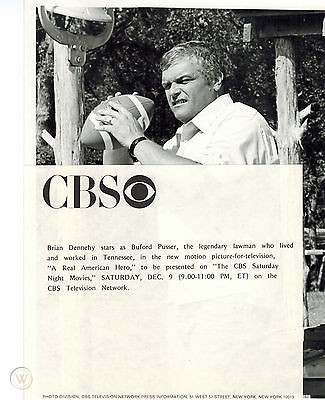
Based on the title, you might think this made-for-TV movie is about G.I. Joe but instead it’s about Buford Pusser, the club-wielding sheriff who battled bootleggers in Tennessee and who might have been murdered by them.  While he was still alive, Pusser was played by Joe Don Baker in the original Walking Tall.  After Pusser’s mysterious death, Bo Svenson took over the role for two sequels and a Walking Tall television series in 1981.  Meanwhile, in A Real American Hero, the role is played by Brian Dennehy.

Though Pusser may be played by a different actor than in the original movies, A Real American Hero finds him still dealing with same threats.  As a result of getting some bad moonshine at the Dixie Disco, two teenagers are dead and two are blind.  Buford is determined to take down the owner of the Disco, Danny Boy Mitchell (Ken Howard).  Unfortunately for Buford, Danny Boy has a mole in the sheriff’s department and always manages to clean up his club before Buford arrives.  When Buford does arrest Danny, the case is thrown out of court because Buford didn’t have probable cause or any real evidence beyond hearsay.

Buford’s solution is to start enforcing every single law on the books, even the ones that haven’t been relevant for over a century.  Buford knows that stopping Danny Boy for a misdemeanor would give him probable cause to search him for any evidence of smuggling moonshine.  For instance, Buford pulls Danny Boy over because he’s driving a vehicle but, in violation of a law written in 1908, he doesn’t have a man walking in front of the car and waving a red flag.  Another time, he gives Danny Boy a ticket because, in violation of a law from 1888, he never ties his carriage to a hitching post and a law written in 1910 legally defines all cars as being carriages.

The problem is that, if Buford only enforces the law against Danny Boy, he could be accused of police harassment.  So, everyone in the country has to be held to the same standard, which means that everyone in town is soon getting ticketed and jailed for the minor offenses as Danny Boy and his associates.  Everyone gets angry with Buford but, after Danny Boy tries to assassinate the sheriff while he’s got his kids in the car, they change their minds and support being overpoliced.

A Real American Hero was obviously an early attempt at a pilot for a Buford Pusser TV series.  Bulky Brian Dennehy is physically right for Buford but he’s never as convincing a redneck as Joe Don Baker was in the role.  Plus, it’s impossible to watch Dennehy hauling people into court for not hitching their “horseless carriages” without being reminded of Dennehy harassing Sylvester Stallone at the start of First Blood.  Despite a subplot where Pusser tries to help a former prostitute re-enter society, Buford comes across more like a jerk than a real American hero.  Meanwhile, Ken Howard does his best but Danny Boy is still just a generic television bad guy.  If he wasn’t selling moonshine in Buford’s county, he’d probably be further down south, trying to frame the Duke boys for a bank robbery.

This one is for Walking Tall completists only.
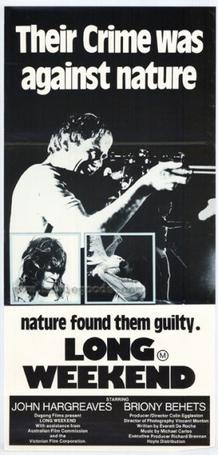
Spring Breakdown: Long Weekend (dir by Colin Eggleston)


The 1978 Australian film, Long Weekend, is about what happens when two unlikable humans decide to spend the weekend with nature.  Nature, it turns out, doesn’t really like the company and decides to kill them.

Or does it?  From what I’ve read, the screenwriter for Long Weekend, Everett De Roche, did intend this to be a nature’s revenge type of film.  The idea behind the film is that these two city dwellers aren’t respectful of nature when they go camping and, as a result, all of the plants and the animals decide to get revenge.  But the film is shot in such a way that your interpretation may vary.  Are the humans really being targeted by nature?  Or are the humans themselves just so paranoid and craven that they don’t even realize that they’re destroying themselves?  For instance, when one of them gets attacked by a possum, is it because the possum has been sent on a search-and-destroy mission or was it just because someone was stupid enough to stick their hand in a possum’s face?  I mean, you can really only expect any animal to put up with so much, regardless of whether they’re a member of an organized army or not.  Whether or not it was intentional on the part of the filmmakers or just the result of having to adjust to working with a low budget, Long Weekend is actually a rather ambiguous film and it’s all the more effective for it.

Long Weekend opens with Peter (John Hargreaves) and Marcia (Briony Behets) driving through the rain.  They’re heading off to an isolated beach camping spot that Peter has discovered.  Peter considers himself to be a great outdoorsman and is very proud of the hunting rifle that he’s bringing with him.  Marcia is a self-described “city girl” and is considerably less enthused about the prospect about spending the weekend in the rough.  (I immediately identified with Marcia because I have always hated the idea of camping.)  Marcia and Peter spend half of their time talking about how much they love each other and the other half talking about how much they hate each other.  Marcia’s also having an affair and Peter might know about it.  (When Peter first brings his new rifle home, he points it directly at Marcia.  Is he just testing the sight or is he fantasizing about murdering his wife?  The film leaves it up to us to decide.)  Along the way, Peter runs over a kangaroo while driving to the campsite but neither he nor Marcia seem to notice.

Once they’re camping, Peter and Marcia only get more obnoxious. Marcia complains about nature. Peter litters the ground with cigarette butts and he kills a manatee.  He also shoots a tree with a spear gun.  He claims it was an accident, though it’s hard not to notice how close the spear comes to hitting Marcia.

The surroundings start to grow more ominous.  The wind howls.  The skies grow dark.  Eagles attack.  Possums attack.  A dog attacks.  Marcia wants to leave and eventually, even stubborn old Peter agrees but it turns out that leaving is not going to be as easy as they think….

Long Weekend takes a while to really get going but, if you stick with it, your patience will be rewarded.  The time taken to reveal who Peter and Marcia are and to show us how their relationship works definitely pays off in the end.  Shot on location in the Australian bush, this is one of those horror films that creates a perfectly ominous atmosphere and then doesn’t let up until the end credits roll.  Peter and Marcia are so unlikable that you don’t really mind seeing them being tormented but, by the end of the film, it’s impossible not to share their desperation as they try to figure out how to escape the wrath of a seriously pissed off planet.  The film ends on a rather abrupt yet totally perfect note.

As I mentioned at the start of this review, one of the things that makes Long Weekend so effective is that it does maintain a certain ambiguity as to what’s happening.  There are hints throughout that whats happening might not just be isolated to that campsite and that Peter and Marcia aren’t the only ones who have gotten on the bad side of nature this weekend.  At the same time, it’s also possible to interpret the film as being less about nature’s revenge and more about an unhappy couple who lets their own paranoia get the better of them.  Are they really victims of nature or are they just two people being driven mad by their own dysfunctional relationship?  While the filmmakers are on record as saying that they meant for it to be the former, the film itself leaves it up to you decide.

Long Weekend is an intense and effective horror film.  If you’re tempted to go camping this Spring Break, be sure to watch this film first.

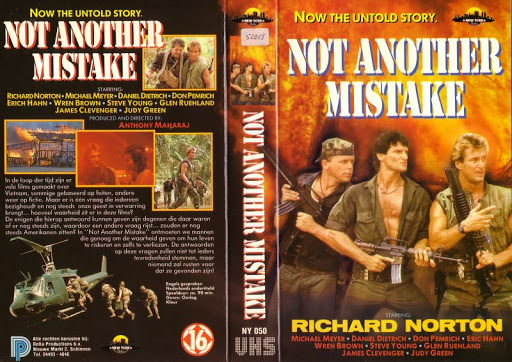
Not Another Mistake (1989, directed by Anthony Maharaj)


Not

Another

Mistake

As the title indicates, this is another Nam film, where a veteran reenters the jungle and finally rescues the POWs who were left behind when the United States fled Saigon.  With Sylvester Stallone, Chuck Norris, and even Gene Hackman leading the way, these films were all the rage during the 80s.  They provided American audiences with a chance to go back and win the only war that, up to that point, America had lost.  Not only did they provide wish-fulfillment for audiences but they also confirmed what several suspected, that the only reason the U.S. lost in Vietnam was because our soldiers’s hands were tied by generals and Washington pencil pushers.  If we had just let our men go in and fight the VC guerrilla-style, these films say, Saigon never would have fallen.

Not Another Mistake came out towards the end of the cycle and you know what type of film you’re about to get into as soon as the “A Troma Team Release” skyline appears at the start of it.

Don’t let that skyline scare you off.  Not Another Mistake is slightly better than the average Troma film.  Admittedly, that’s not exactly a high bar to clear.

Richard Norton plays Richard Straker, who served in a special ops unit during Vietnam and who was a key part of Operation Black Thunder.  In other words, he’s a badass.  After the war ended, Straker raised a family and found success as a businessman.  One night, he returns home and interrupts a home invasion.  He kills the thugs but not before his wife and daughter each suffer a slow motion death.  (Straker has Vietnam flashbacks while shooting the thugs.)  Straker spends a year drinking and then goes to Vietnam to lead a raid on a POW camp.  What’s interesting is that Straker’s family being murdered doesn’t really figure into the rest of the plot.  He never brings up his tragic past nor does it appear to have made him more willing to take crazy risks or anything else you’d expect it to do.  Instead, his family is gunned down because I guess the movie had to start in some way.

Once Straker is sent to Vietnam, he’s given a ragtag group of soldiers to command.  None of the soldiers have any personality but then again, neither do any of the POWs or the camp guards or anyone else in the movie, other than Straker.  Richard Norton has appeared in a lot of movies like this and his appeal has always been that he seems like he could probably do everything that he does on film in real life.  Norton is convincing in the action scenes and he does okay in the big dramatic scenes, like when he rescues an old friend, just to discover that, after years in a POW camp, the man is nearly dead.

It takes a while for Not Another Mistake to really get going.  There’s a lot of extremely dark jungle scenes where you can’t really see what’s going on.  Things pick up once they get to the POW camp and the rescue operation leads to some exciting action scenes.  There’s a good chase scene on a train and this film features some of my favorite example of one man being able to blow up gigantic buildings with just one grenade launcher.  One thing that I appreciated about the film is that it attempted to be honest about what type of state a person would be in after spending 20 years in a POW camp.  This isn’t one of those films where the POWs can pick up a discarded machine gun and immediately follow Chuck Norris into battle.  Also, as easy as it is compare Not Another Mistake to the other POW rescue films of the 80s, it has a surprisingly dark and abrupt ending, which suggests that maybe the film was meant to be more than just an exercise in jingoistic wish fulfillment.  It’s the type of sober ending that you never would have seen happen to Norris or Sylvester Stallone but Richard Norton handles it like a champ.

Too long by at least 30 minutes and severely hampered by a low budget, Not Another Mistake still has enough surprises and enough Richard Norton to stand out from the rest of the POW rescue genre.  If you’re a fan of the genre, watching this won’t be another mistake.

Spring Breakdown: Super Shark (dir by Fred Olen Ray)


So, here’s the thing: when I was making out my list of films to review for Spring Breakdown, I was under the impression that the 2011 film, Super Shark, was a Spring Break film.  I was convinced that it was a film about a giant shark that ate a bunch of people over the course of Spring Break.

Fortunately, right before posting this review, I decided to rewatch Super Shark.  Normally, I probably wouldn’t have because I’m currently on vacation but it’s also currently raining and it’s also about 7 degrees outside.  (That’s 7 degrees Celsius but it’s still pretty cold.)  It’s like God was reading through my drafts folder last night and said, “Uh-oh.  Lisa needs to rewatch the movie before she posts the review.”

Anyway, upon rewatching Super Shark, I discovered that 1) the film is still awesome as Hell and 2) it’s not actually a Spring Break film.  Instead, it’s a summer film.  There’s even a scene where two lifeguards talk about what a great time they’re going to have working on the beach during the summer.  So, technically, I probably shouldn’t be reviewing this film as part of a Spring Break series but …. well, I’m going to do it anyways.  I mean, it may be a summer film but it plays out like a Spring Break film.  Plus, it’s got a giant shark.

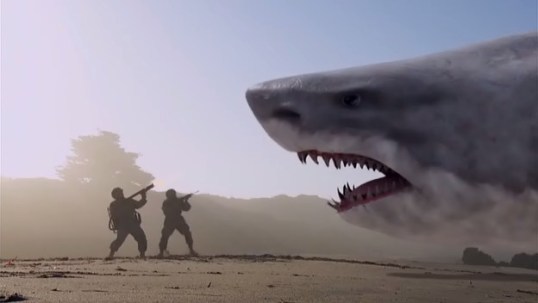
Not surprisingly, for a film called Super Shark, the giant shark is the main attraction.  The CGI’s a bit dodgy and the shark does look a bit cartoonish but that actually adds to the film’s charm.  Whereas Steven Spielberg dealt with the reality of a fake-looking shark by keeping the shark off-screen as much as possible, directed Fred Olen Ray takes the opposite approach and seriously, more power to him.  Ray puts the shark in as many scenes as possible, as if he’s saying, “Yes, this is a low-budget B-movie and why should we pretend that it’s anything other than that?”  There’s an honesty to this approach that’s impossible not to respect.

The shark is prehistoric in origin.  It was safely separated from society until the big bad oil company did some bad corporate stuff and, as a result, the shark is now free to ruin everyone’s summer.  You know that whole thing about how sharks have to stay in the water or they’ll die?  That’s not a problem for Super Shark.  Super Shark will jump on the beach and eat you, he doesn’t care.  In fact, Super Shark is such a rebel that he’ll even take on a tank and win!  WE LOVE YOU, SUPER SHARK!

As always, there’s a group of humans around who don’t love Super Shark as much as the viewers.  There’s the evil corporate guy played by John Schneider.  He’s into money and drilling.  And then there’s the scientist played by Sarah Lieving.  She hates corporations and she doesn’t like sharks.  There’s a DJ played by Jimmie “JJ” Walker.  And then there’s the lifeguards and the beachgoers and the people who just want to participate in a wholesome bikini contest.  Sorry, everyone, Super Shark has other plans.

Anyway, I have a weakness for films about giant sharks attacking oil wells and eating people on the beach.  It’s a silly film but it’s obviously been designed to be silly.  This isn’t Jaws nor is this a serious film about the issues surrounding underwater drilling.   This is a B-movie about a giant shark and if you can’t enjoy something like this, I worry about you.  This is a film that you watch with your friends and you have a lot of fun talking back to the screen.  Don’t take it seriously and just enjoy the giant shark action.  Who could ask for a better summer?  Or a better Spring Break for that matter?


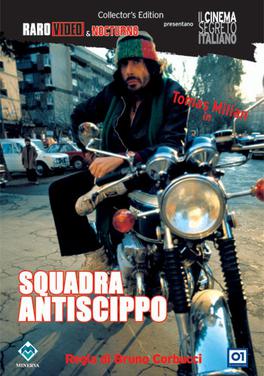
The Cop in Blue Jeans (1976, directed by Bruno Corbucci)


Nico Giraldi (Tomas Milian) was once one of Rome’s top thieves.  He stole handbags and briefcases and he sold them through a network of underground sellers.  Now that Nico has grown up, he’s turned over a new leaf.  Though he still bristles at authority and is just as quick to break the rules, Nico is now a member of the Rome police, assigned to the anti-mugging squad.  He’s a tough cop who has no problem beating the Hell out of a mugger after he captures him.  However, Nico knows that arresting the muggers is only half the job.  To Nico, the real enemies are the sellers who employ the muggers.  Nico wants the men at the top of the criminal food chain, men like the mysterious Baron (Guido Mannari) and the sadistic American crime boss, Richard Russo (Jack Palance).

It’s not just his background that’s unconventional.  Dressing like a slob and sporting an unkempt beard, Nico is a strong contrast to his more conventional co-workers.  Nico even carries a mouse named Captain Spaulding in his front shirt pocket.  The ladies, of course, love Nico.  His girlfriend (played by the beautiful Maria Rosaria Omaggio) is a literary agent who is hoping the publish a manuscript that is being smuggled out of Russia.  The Russians try to sabotage her efforts by switching a briefcase.  It’s a pretty good thing that Nico still remembers how to pull off the perfect mugging.

Though Nico is obviously based on Al Pacino’s performance in Serpico, The Cop in Blue Jeans has little in common with Sidney Lumet’s classic.  Instead, The Cop in Blue Jeans is a mix of action and comedy.  The action comes from Nico’s attempts to capture the members of Russo’s gangs and Russo killing anyone who displeases him.  (A scene in which Russo has a man suffocated in a car is far stronger than anything you would ever see in an American comedy.)  The comedy comes from Nico being such a slob that even his fellow police officers often attempt to arrest him.  Nico insults everyone and everyone insults Nico.  It’s actually not that funny but I liked how every fight turned into an elaborate brawl and Tomas Milian, who was always well-cast as scruffy iconoclasts, gives a good performance as Nico.  Add to that, it’s always entertaining to see Jack Palance play the bad guy, even if this was clearly just a film that he did to pick up a paycheck.

The Cop in Blue Jeans was a big hit in Italy and, coming out a time when Milian’s career was struggling after his early Spaghetti Western successes, it helped to revive his career.  Milian went on to play Nico in ten sequels before then establishing himself as a character actor.  (The role that most modern audiences know him from is as the corrupt Mexican general in Traffic.)  Milian died in 2017 and today would have been his 87th birthday.  The Cop in Blue Jeans features him at his best and shows why he was a star for such a long time.

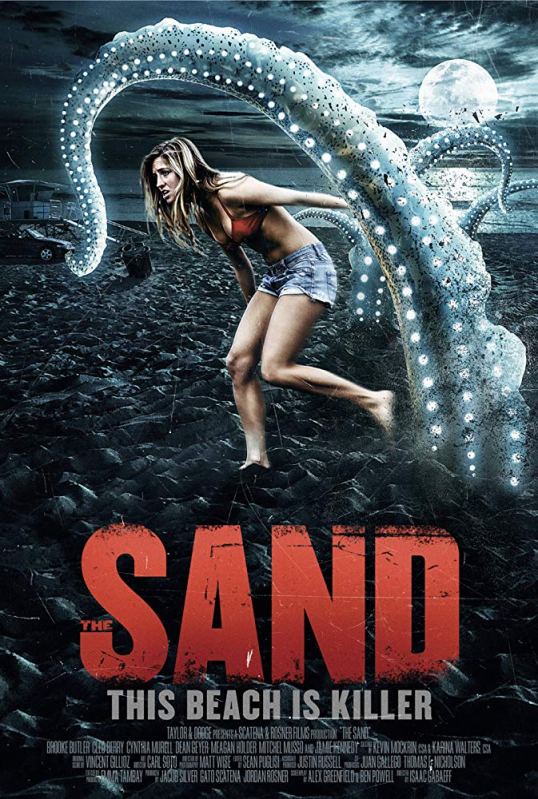
Spring Breakdown: The Sand (dir by Isaac Gabaef)


The 2015 horror film, The Sand, is the movie that asks, “What would you do if the beach was literally eating you?”

The answer, to judge from this film, is “Die.”

I mean, seriously, think about it.  If you’re on the beach and you’re still hungover from the night before and your friend is like literally trapped inside of a trash can (and yes, that does happen in this movie), then you’re pretty much screwed if the sand suddenly decides to start ripping apart your body.  I mean, that’s one thing about the beach.  There’s a lot of sand.  The sand has the advantage.

Of course, despite the title of this movie, it’s not really the beach that’s eating people.  Instead, it turns out that some sort of previously unknown sea serpent hatched out of an egg in the middle of the night and burrowed under the sand.  We don’t learn much about the serpent, other than it has tentacles and it apparently injects a numbing poison into your body before killing you.  That leads to a lot of scenes of people sinking into the sand while screaming, “I’ve gone numb!  I can’t feel anything!”  I can’t remember if anyone in the film actually yells, “The sand’s got me!”  It seems like a missed opportunity if they didn’t.

This is one of those movies that opens with a big spring break party, which means booze, lost bikini tops, and drunken hook-ups in the lifeguard tower.  As I mentioned before, it also means that one unfortunate fellow ends up getting tossed into a trash can, where he promptly gets stuck.  Making things even worse is that his friends use a felt tip marker to draw a penis on his face.  He’s definitely not going to die a dignified death.  That’s just the way things go when the beach turns on you.

The next morning, a few people wake up and discover that almost everyone else from the party has disappeared.  That probably has something do with the fact that only a few people were smart enough to fall asleep somewhere other than on the sand.  So, you’ve got one couple in a lifeguard station.  And then you’ve got four people in a car.  And then you’ve got the poor guy in the trashcan.  They’ve got to figure out how to get to safety without getting eaten by the beach.

They also have to work out their own personal issues.  For instance, one of the girls in the car cheated with the girl in the station’s boyfriend and the boyfriend happens to be in the car so there’s a lot of scenes of people apparently forgetting that they’re on the verge of dying so that they can argue about who cheated first.  It gets kind of annoying.  I would put all that personal stuff to the side if I was trying to figure out how not to get eaten on the beach.

(Actually, I probably wouldn’t.  Sometimes, personal drama just can’t wait.  But then again, I’d never survive a horror film….)

On the plus side, The Sand doesn’t take itself seriously at all.  It knows that it’s a ludicrous, low-budget horror film and it doesn’t pretend to be anything other than what it is.  Jamie Kennedy shows up as a fascist beach patrol guy.  When he’s told that his shoes are the only thing that’s dissuading the beach from eating him, he promptly takes his shoes off.  He’s an idiot.  Everyone in the movie is an idiot.  But the movie understand that they’re all idiots and it plays up the fact because it understands that everyone watching is going to be on the side of the monster under the sand.  GO, MONSTER, GO!

So, I guess my point is that The Sand is what it is.  It knows its audience and it goes out of its way fulfill their expectations and you always have to give credit to a film that understands both its strengths and its limitations.  If you want to watch a bunch of unlikable college students get eaten by the beach, have had it.  This film has what you’re looking for.

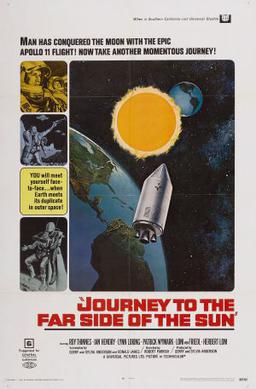
Journey to the Far Side of the Sun (1969, directed by Robert Parrish)


In the year 2069, the European Space Exploration Council discovers that there is a planet on the other side of the Sun, one that orbits the same path as the Earth.  Unfortunately, a spy transmits this information to the communists so America and Europe team up to make sure that they reach the planet before the Russians!

(Remember, production started on this movie in 1967, when America and Soviet Union were still competing to see who would be the first to land on the moon.  Of course, by the time Journey to the Far Side of the Sun was released in 1969, America had already landed on the moon and the Russian space program was no longer taken seriously.)

Two astronauts are assigned to a manned mission to explore the new planet.  Glenn Ross (Roy Thinnes) is American.  John Kane (Ian Hendry) is British.  After spending three weeks in suspended animation, Ross and Kane awaken to discover themselves orbiting a planet that appears to have much the same atmosphere as Earth.  When their ship crashes into the planet, Kane is fatally injured and Ross is retrieved by a human rescue team!  He’s told that the ship crashed in Mongolia.  Kane and Ross were orbiting Earth all along!

Or were they?  Even though Ross is reunited with his wife and debriefed by Jason Webb (Patrick Wymark), the head of the mission, he soon discovers that things are different.  People who were once right-handed are now left-handed and text is now written from right-to-left instead of left-to-right.  People drive on the wrong side of the road and, after Ross makes love to his wife, she feels like something was different about him.  Ross realizes that he’s on a counter-Earth!

It’s an intriguing premise but, unfortunately, Journey to the Far Side of the Sun doesn’t do much with it.  It’s not as if Ross has landed on the Bizarro world, where people say, “Bad Bye” and root for the bad guys at the movies.  Instead, it’s just a world where right-handed people are now left-handed and everyone drives on the opposite side of the road.  Ross theorizes that everything that happens on Earth also happens on Counter-Earth, which means that the other Ross is on Earth, realizing the exact same thing that the first Ross is realizing but who cares because there’s not really any major differences between the two Earths.  Maybe if Counter-Earth had an alternate history where Rome never fell or the Germans won World War II, the movie would be more interesting or at least more like an old episode of Star Trek.  Instead, the movie is all about Ross trying to convince the people on Counter-Earth that he didn’t intentionally abort the mission and that he should be given a chance to return to his Earth.   It’s the driest possible way to approach an interesting premise.

I will say that Journey to the Far Side of the Sun also has one of the strangest endings that I’ve ever seen.  I won’t spoil it here, other than to say that I wonder if the ending was written before or after 2001 made confusing conclusions cool again.

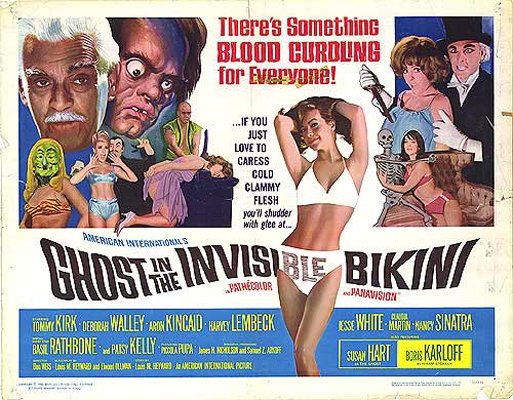
Spring Breakdown: The Ghost In the Invisible Bikini (dir by Don Weis)


The 1966 film, The Ghost In The Invisible Bikini, asks the question, “What can you do if you want to have a beach party but you don’t have a beach?”

The answer: “Find a pool!”

Seriously, a pool is just as good as a beach and fortunately, Chuck (Tommy Kirk) has a pool where his friends can hang out and listen as Vicki (Nancy Sinatra) sings a song.  It’s in a big old mansion and hey, it might be haunted.  It used to belong to Hiram Stokeley (Boris Karloff) and he’s dead now so he certainly won’t mind, right?

Well, what if he’s not dead!?

Oh wait, actually, he is dead.  But he’s still hanging around.  It turns out that he needs to do at least one good deed in order to get into Heaven.  (Isn’t starring in Frankenstein enough?  I mean, c’mon…..)  It also turns that Hiram only has 24 hours to do that good deed or it’s off to Hell for him.  Maybe he could figure out a way to help Chuck and his family win his fortune!  Hiram enlists the help of his long-dead girlfriend, Cecily (Susan Hart).  Cecily, we are told, is wearing an invisible bikini but we just have to take the film’s word on that because it’s invisible and, seeing as how Cecily’s a ghost, it’s always possible that only reason she’s transparent is because she’s a spirit.  I mean, seriously, who knows how ghosts work?

Anyway, it’s not going to be easy for Hiram and Cecily to ensure that Chuck inherits that fortune, largely because Chuck and all of his friends are idiots.  The other problem is that Reginald Ripper (Basil Rathbone), Hiram’s lawyer, is determined to win that money for himself and, if you have any doubt that he’s a bad dude, just check out his name.  GOOD PEOPLE ARE NOT NAMED REGINALD RIPPER!  Fortunately, even though Reginald graduated from law school and is played by Basil freaking Rathbone, he’s still an idiot and he comes up with the stupidest plan possible to get Chuck and friends out of the house.

He’s going to make them think that it’s haunted!

(But it is haunted….)

Reginald’s plan is to have his evil associates, J. Sinister Hulk (Jesse White), Chicken Feather (Benny Rubin), and Princess Yolanda (Bobbi Shaw), pretend to be monsters and ghosts in order to scare all of the teens out of the house.  He also enlists his daughter, Sinistra (Quinn O’Hara), to help but Sinistra isn’t really bad.  She’s just extremely near-sighted and someone thought it would be a good idea to name her Sinistra.

And then the bikers show up!  This is one of AIP’s beach party films so, of course, there are bikers.  Eric von Zipper (Harvey Lembeck) shows up and pretends to be Marlon Brando in The Wild One.  Of course, at the time this film was made, the real Marlon Brando was filming Arthur Penn’s The Chase so I’m going to guess that Harvey Lembeck probably had more fun pretending to be Brando than Brando was having being himself….

Anyway, this is a stupid movie even by the standards of the AIP beach party films.  It’s also notably disjointed.  That probably has something to do with the fact that Karloff and Susan Hart weren’t actually added to the film until after the movie had already been shot.  Apparently, AIP felt that the first cut of the movie was missing something so they said, “Let’s toss in a little Karloff!”  Of course, Boris Karloff was such an old charmer that it doesn’t matter that he doesn’t ever really interact with anyone other than Susan Hart over the course of the film.  You’re just happy to see him.

So yeah, technically, this is not a good film but, at the same time, you kind of know what you’re getting into when you watch a movie called The Ghost In The Invisible Bikini.  The jokes fall flat.  The songs are forgettable.  But the whole thing is such a product of its time that it’s always watchable from an anthropological perspective.  Add to that, you get Boris Karloff and Basil Rathbone, doing what they had to do to pay the bills and somehow surviving with their dignity intact.  Good for them.

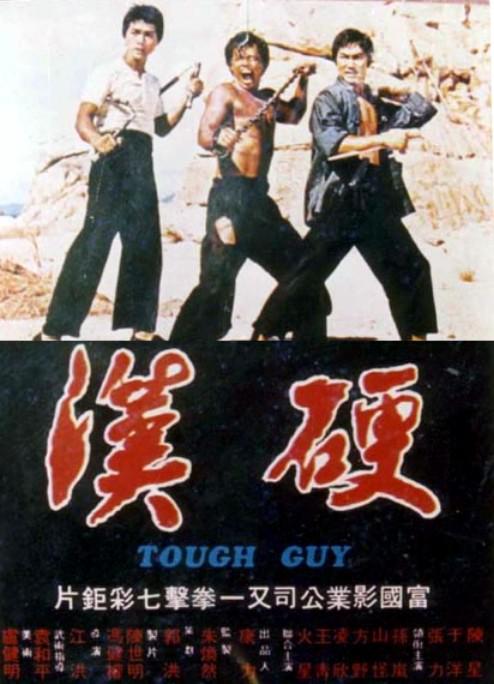
Tough Guy (1972, directed by Joseph Kong Hung)


Chen Xing and Cheung Lik are two cops who have been assigned to take down a drug lord.  In order to infiltrate the criminal gang, Chen Xing goes undercover as a prisoner.  When he escapes from the prison, he does so with another member of the gang.  While Cheung Lik pretends to be a simple villager so that he can keep an eye on his partner, Chen joins the gang and immediately shocks everyone with his fighting abilities.  What sets Chen apart from other martial artists is his ability to kill his opponents just by grabbing their foreheads and smashing their skulls.  That impresses everyone who sees it.  However, when the drug lord finds out that Chen is actually an undercover cop, he captures and tortures him.  Will Chen be able to escape in time to have a climatic fight in a mud pit with the drug lord’s main enforcer?

One of my favorite martial arts films, Tough Guy is known by several titles.  When it was released in the West, it was apparently retitled — and I am not kidding — Kung Fu The Head Crusher.  When it was subsequently released on video, it was called Revenge of the Dragon, probably to try to fool people into thinking that it was a Bruce Lee film or, at the very least, that it starred Bruce Li or some other Bruceploitation star.

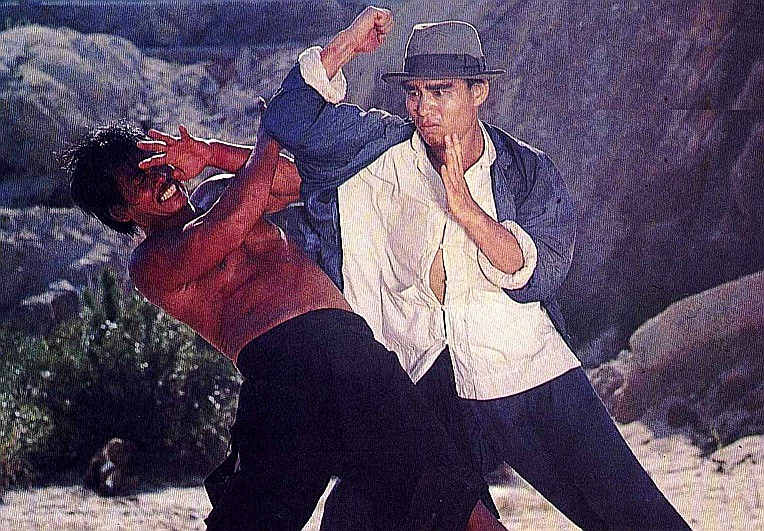
Whatever it’s title, Tough Guy is an often brutal film, featuring some of the most exciting fight scenes that I’ve ever seen.  What Chen Xing and Cheung Lik lacked in screen charisma, they made up for in skill and relentlessness.  When Chen Xing gets in the middle of things and starts trading blows with his adversaries, it’s like watching a wild animal suddenly go on the attack.  He doesn’t stop moving until no one’s left standing and he even manages to make the whole skull crushing thing look credible.  He’s matched by Cheung Lik, who may not have as big a role as Chen Xing but who still proves himself to be a formidable fighter.  The fights themselves are expertly choreographed and largely filmed in close-up.  There’s no cheating the camera or anything else that martial arts films sometimes did to make their stars look more skilled than they actually were.  Another thing that I appreciated is that, when Chen and Cheung have to fight multiple opponents, the bad guys usually attack all at once, as a group, instead of everyone standing around waiting for their turn to get in their punches.

There’s little intentional humor to be found in Tough Guy and there’s even less discussion of the philosophy behind the martial arts.  Instead, this is a tough and violent crime movie that wastes no time in getting down to business.

One final note: While watching Tough Guy, be sure to pay attention to the film’s score.  If it sounds familiar, that’s because it was lifted nearly note-for-note from Ennio Morricone’s score for Once Upon A Time In The West.

Spring Breakdown: The Beach Bum (dir by Harmony Korine)


February is over!  Welcome to March!

Now, the first two weeks of March is, traditionally, when most schools give their students a week off for Spring Break.  I have a lot of good Spring Break memories and, to be honest, I’ve always kind of resented the fact that Spring Break is something that only schools do.  To me, it should be like a national holiday where everything stops for a week and everyone hangs out at the beach for a few days.

Of course, this year’s Spring Break may be a bit of a disappointment, what with everyone freaking out about …. well, everything.  That’s a shame but fear not!  You may not be able to leave behind your fears long enough to go down to the beach but at least you can still watch movies about the beach, right?  So, with that in mind, over the next two weeks, I will be reviewing some films for Spring Break!

It’s time for Spring Breakdown!

Let’s get things started with the 2019 film, The Beach Bum.

The beach bum of the title is an always stoned, alcoholic poet named Moondog (Matthew McConaughey), who spends his time wandering around the Florida Keys.  Moondog has been working on a book for several years and he’s a bit of a local celebrity.  Everyone that he meets tends to like him, or at least they do until he ruins their lives.  Moondog is irresponsible, immature, and apparently some sort of genius as well.  Moondog is also extremely laid back.  Even when he finds out that his wife, Minnie (Isla Fisher), cheated on him with his best friend, a singer named Lingerie (Snoop Dogg), Moondog is okay with it.  He’s always loved Minnie but he’s never had a problem cheating on her so why shouldn’t she do the same to him?

After Moondog shows up late for his daughter’s wedding and goes out of his way to make a scene, he goes for a drive with Minnie.  Of course, since Moondog is drunk off his ass, he ends up crashing the car and killing his wife.  In her will, Minnie leaves half of her fortune to their daughter, Heather (Stefania LaVie Owen).  She leaves the other half to Moondog, with the stipulation that Moondog will only get the money after he finishes his book.

The rest of the film follows, in an episodic fashion, Moondog as he tries to finish his book and get his money.  Along the way, he commits crimes, dabbles with various jobs, and spends time in jail and drug rehab.  He meets a host of eccentric and destructive characters, almost all of who are the type of outsiders who seem as if they’re destined to eventually be the subject of a “Florida man” headline.  For instance, Flicker (Zac Efron) is a pyromaniac.  And Captain Wack (Martin Lawrence) hosts dolphin tours but, unfortunately, cannot tell the difference between a dolphin and a shark.

When The Beach Bum was first released in March of last year, it was eagerly anticipated because it was Harmony Korine’s first film since 2012’s Spring Breakers.  Despite the fact that Spring Breakers and The Beach Bum both take place in Florida and feature a lot of beach action, the two films might as well be taking place in separate universes.  The Beach Bum is as laid back as Spring Breakers was violent.  If Spring Breakers was a film that seemed to be fueled by ecstasy and cocaine, The Beach Bum is a celebration of getting high and enjoying life.  If Spring Breakers was all about being young, The Beach Bum is about growing old without giving up your individuality.

In many ways, The Beach Bum is the ultimate Matthew McConaughey film and how you react to the film will depend on how much tolerance you have for Matthew McConaughey at his most McConaugheyest.  Indeed, if you like Moondog, it’ll probably be because you like Matthew McConaughey.  As a character, Moondog is a jerk.  He nearly ruins his daughter’s wedding.  He drives drunk and kills his wife.  He refuses to take responsibility for being a general fuck-up and, from what little we hear of his work, he appears to be a subpar poet as well.  And yet, Matthew McConaughey brings enough of his own natural charm to the role that it’s tempting to forgive Moondog.  You can understand why some people in the film are willing to tolerate him, even though he’s basically a pain in the ass to have around.

The Beach Bum is not a film for everyone.  I appreciated Matthew McConaughey’s performance and I also appreciated the fact that Harmony Korine didn’t try to remake Spring Breakers.  At the same time, the film was a bit too loosely constructed to really hold my interest and a little bit of Moondog goes a long way.  I saw this film last year and I’ve really had no desire to rewatch it.  That said, the cinematography frequently makes Florida looks like the most beautiful place on Earth and, regardless of what you may think about his poetry, at least Moondog just keeps on L-I-V-I-N, livin’.

Add to that, Moondog’s going to enjoy Spring Break, no doubt about it.