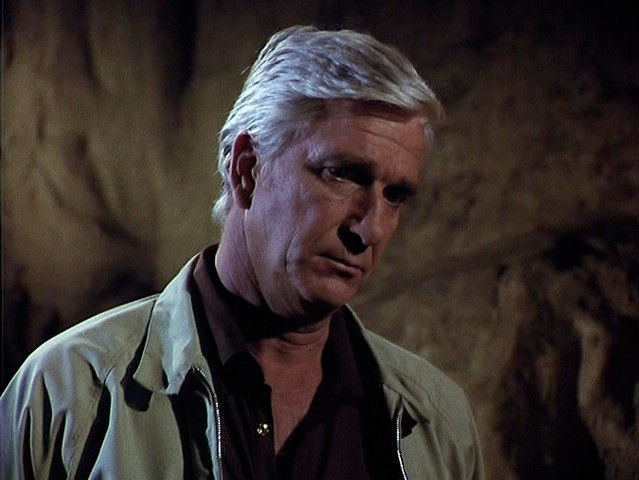
Sen. Kate Lassiter (Susan Sullivan) is visiting a cave in order to determine whether it’s safe to leave it open to the public. Giving the senator and her group the grand tour is Gene Pearson (Dennis Cole), who is not only a park ranger but who is also Kate’s ex-boyfriend. The question as to whether or not the cave is safe for the general public is answered by a sudden cave-in, which leaves Kate, Gene, and the others trapped. Now, Gene has to lead the group across often dangerous terrain to safety.
Along with Kate, the group includes a bitter cop named Joe Johnson (Leslie Nielsen!), his wife Liz (Julie Sommars), arrogant Prof. Harrison Soames (Ray Milland), and the professor’s shy daughter, Ann (Sheila Larkin). Joe and Liz are struggling to keep their marriage together. Prof. Soames refuses to allow his daughter to have a life of her own. The six of them are going to have to somehow work together if they’re going to survive this cave-in! Of course, they’re not alone. There’s a seventh person in the cave. Tom Arlen (James Olson) is a dangerous convict who was in the cave hiding out from the police. Now, he’s trapped along with everyone else.
Cave-In is a pretty standard disaster movie. Produced by Irwin Allen, it was originally filmed in 1979 but it didn’t air on NBC until 1983. By that time, Airplane! had pretty much reduced the disaster genre to a joke. Ironically, Leslie Nielsen himself has a starring role in Cave-In, playing exactly the type of character that he parodied in both Airplane! and Police Squad. At the time he filmed Cave-In, Neilsen was still a dramatic actor but by the time the movie aired, his deadpan style was firmly associated with comedy. Even when his dialogue is serious, the natural instinct is to laugh.
Cave-In gets bogged down by flashbacks. Even though everyone should be concentrating on making their way to safety, it instead seems that they’re too busy obsessing on their backstory. Since no one’s backstory is that interesting, the flashbacks don’t do much to liven up the film and, unfortunately, a cave-in just isn’t as compelling as a fire in skyscraper or an upside down boat.
On the plus side, every disaster movie needs an arrogant bastard who makes escape unnecessarily difficult and, in the 70s, no one played a better arrogant bastard Ray Milland. Otherwise, Cave-In is a forgettable entry from the final days of the disaster genre.
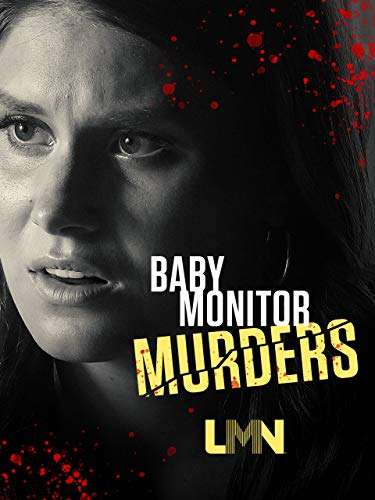
Apple Springs, Washington might seem like a nice little town but appearances can be deceiving. Mallory Raymond has gone missing and no one can find her. The local sheriff seems to suspect that her husband, Glenn (Dustin Lloyd). may have had something to do with it. Meanwhile, Glenn is spending all of his time in the park where Mallory was last seen. Is he searching for his wife or is he searching for another victim?
While Mallory is busy disappearing, Cassie (Natalie Sharp) is busy returning. Cassie grew up in Apple Springs and she’s just returned from college. She thought she was going to get an internship with a music label but that fell through. Now, it looks like like Cassie is going to have to spend the entire summer stuck at her parent’s house. That’s fine with her parents, of course. They’re heading to Paris and they need someone to housesit.
Not wanting to spend another summer working at the local diner, Cassie is very happy when she just happens to run into Chloe Paine (Nicole LaPlaca), a lawyer who is planning on returning to work but who desperately needs someone to look after her daughter, Becca. Chloe asks Cassie if she wants the job and Cassie accepts.
Soon, Cassie is spending hours a day over at the Paine house, taking care of Becca. She gets to know Chloe’s husband, the seemingly friendly Tom Paine (Jon Cor). She also gets to know Glenn, who it turns out just happens to work with Tom. Cassie can’t help but notice that Tom and Glenn seem to always be arguing about something.
Strange things start to happen. One night, Cassie is sure that she’s being watched. Another night, she hears a menacing voice come over the baby monitor but, when she checks out Becca’s room, she doesn’t find anyone there. And then, much like Mallory before her, Chloe disappears!
Where has Chloe gone? Has she been kidnapped? Has she been murdered? And if that’s the case, who’s responsible? Is it Tom, the seemingly perfect husband who seems to have a few secrets hiding underneath the friendly surface? Or is it Glenn, who appears to be obviously unstable but who swears that the only thing he cares about is discovering what happened to his wife? Even though almost everyone tells Cassie that she should just quit her job and stay away from the Paines, Cassie knows that would mean abandoning Beeca and that’s not something that she’s willing to do….
The Baby Monitor Murders, which initially aired way back in January, was originally entitled The Babysitter and really, that’s a better title for the film. While the scene with the voice coming over the baby monitor is an undeniably creepy one, it’s also a rather minor one. The film’s focus is much more on Cassie and her growing realization that she’s found herself in a dangerous and potentially deadly situation. Natalie Sharp gives a good and sympathetic performance as Cassie, making her devotion to Becca feel believable and, as a result, giving this film a bit more emotional depth than the typical Lifetime film. The mystery itself is frequently intriguing and you’ll find yourself going back and forth on whether Glenn or Tom is the one who Cassie should be weary of. All in all, The Baby Monitor Murders is a good Lifetime film that will keep you guessing.
After dating for a very long time, Deanna (Anna Hutchison) and Karl (Jason-Shane Scott) are finally getting married!
Yay! Everyone loves a big wedding!
And, even before Karl asks Deanna to marry him, he’s purchased a large house for them to live in!
Yay! Everyone loves a big house!
But first, Deanna needs to meet Karl’s family and that means going to an even bigger house!
YAY! EVERYONE LOVES AN EVEN BIGGER HOU….
Wait a minute …. Deanna hasn’t met Karl’s family, yet?
Seriously, everyone, that should be a big red flag. I don’t care how rich your boyfriend is, you don’t accept his marriage proposal before you’ve met his family. After all, his family could be …. well, the could be crazy. Or they might meet you and then decide that they don’t like you or maybe they like you but they still think that their son (or brother or stepbrother) could do better. Or — and this especially happens in Lifetime movie — someone might start murdering all the members of your wedding party.
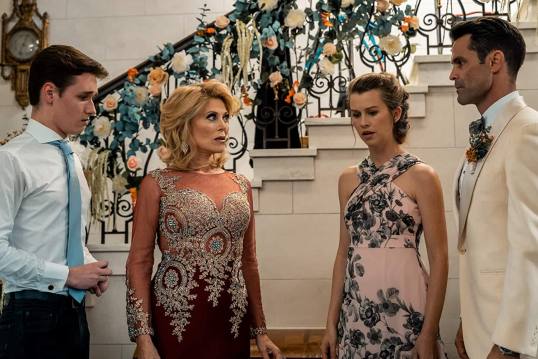
All of that happens in Engaged To A Psycho. Engaged To A Psycho premiered on the Lifetime Movie Network back in May but, according to the imdb, the film was actually around a while before making it’s official LMN premiere. It played in Canada back in 2018 and then, in 2019, it showed up on television in the UK, Spain, and France. At the time, it was known as Murder at the Mansion. By the time it premiered here in the States, the name had been changed to Engaged To A Psycho. (Lifetime was going through a Psycho cycle. Try saying that six times fast.)
Anyway, regardless of the title, Engaged To A Psycho is a fun little movie. As soon as Deanna shows up at, she meets Karl’s mother, Ivy (Audrey Landers) and his adopted sister, Ruby (Melissa Bolona). Ivy makes it clear that she thinks her son could have done better than Deanna. Ruby, meanwhile, is almost too friendly and seems to be trying way too hard to convince Deanna that Deanna is welcome in the family. It soon becomes obvious, than even though the family is living in a gigantic mansion, the rooms and the hallways are full of secrets, lies, and murder. Soon people are dying all over the place.
One thing I liked about Engaged To A Psycho is that there were plenty of POV shots from the killer’s point of view. It gave the whole a film a sort of giallo feel while also hiding the killer’s identity. It also led to a lot of scenes of people looking straight at the camera and saying stuff like, “I knew it was you! Wait here while I go tell everyone!” Well, needless to say, the killer isn’t big on waiting.
The other thing I liked about Engaged To A Psycho is that it had a sense of humor about itself. Ivy is so extremely unimpressed by Deanna that it actually becomes rather hilarious how dismissive she is. It doesn’t matter how many times Deanna nearly gets killed, Ivy refuses to accept her word that there’s something strange going on.
I liked Engaged to a Psycho. There were a lot of murders, a lot of archly delivered dialogue, and a lot of big houses. What more can you ask for?
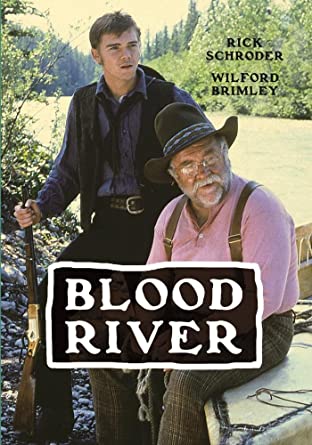
In the old west, Jimmy Pearls (Ricky Schroder), a seemingly dissolute young man, kills the three men who he hold responsible for the murder of his parents. Unfortunately for Jimmy, one of those men was the son of powerful rancher Henry Logan (John P. Ryan) and Logan is now determined to track down Jimmy and get some revenge of his own.
Jimmy only his one ally in his attempt to make it to safety and that’s Winston Culler (Wilford Brimley). In his younger days, Culler was a legend. He tamed the frontier and he lived with the Indians and everyone knew better than to get in his way. Now, Winston is older and no one give him the respect that he deserves. Winston allows Jimmy to stay with him but Winston has more than just Jimmy’s safety in mind. Winston has his own reasons for wanting to get revenge on Logan and, despite their constant bickering, he and Jimmy are soon working as a team.
Adrienne Barbeau has a cameo as a madam and, while she’s always a welcome sight in any film, I imagine her casting has to do with the fact that this film was actually written by John Carpenter. Yes, that John Carpenter! Carpenter actually wrote the script for what would become Blood River in 1971. When he wrote it, he pictured John Wayne as Winston and either Elvis Presley or Ron Howard as Jimmy. (The Duke and Elvis in the same film? That would have been something, regardless of how the film itself turned out.) Carpenter sent copies of the script to both John Wayne and director Howard Hawks but neither one responded. It would be 19 years before the script was finally filmed.
Blood River is an amiable western. It was ultimately produced for television and it first aired on CBS. Despite the fact that the film was originally written to be a theatrical film, it plays more like a pilot than a film. You could imagine a weekly series featuring Winston and Jimmy riding from town to town and getting into adventures. The plot is nothing special but Ricky Schroder and Wilford Brimley make for a good team. Brimley is especially ornery, even for him. Blood River may be a simple film but it will be appreciated by those looking for a likable and old-fashioned western.
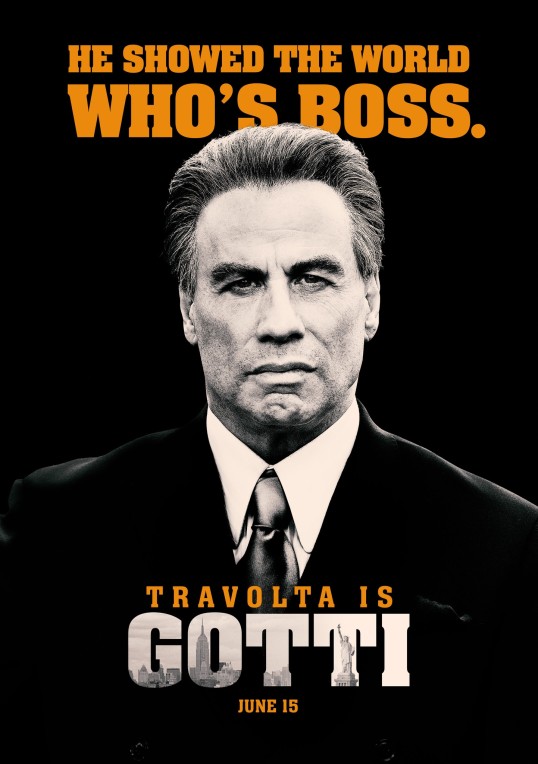
Few recent films have been as misunderstood as Gotti.
When this film was first released in 2018, it was slammed by critics and it flopped at the box office. On Rotten Tomatoes, it managed a score of 0% from the critics. At the same time, the opening day audience score was 80%. (Over subsequent days, the audience score would drop to 46%.) This disparity was blamed on studio employees inflating the audience score, though I think it’s more likely that, after months of negative press about the film’s troubled productions, critics were already looking forward to slamming the film before they even had a chance to see it. At the same time, the buzz on Gotti was so bad that the opening day audience was made up of a combination of John Travolta die-hards (whoever they may be) and people who were expecting such a trainwreck that all Gotti had to do to surpass their expectations was to occasionally be in focus.
Then again, it could be that some members of the audience understood what I instinctively understood when I first watched Gotti. Gotti is not really a film about John Gotti, the flamboyant New York mob boss who ruled the streets with an iron fist and who eventually ended up dying of cancer in prison. Instead, whether it was the filmmaker’s actual intention or not, Gotti is a film about the audience’s fascination with not only gangsters but also the movies that have been made about them.
It’s true that John Travolta may be playing someone namned John Gotti but the film goes out of its way to remind you that he’s not the real John Gotti. The film is full of archival news footage of the real John Gotti, either laughing it up with reporters or smirking while sitting in a courtroom. Every time that we’re shown footage of the real John Gotti, we’re reminded of the fact that, at not point during the film, does Travolta look anything like John Gotti. Add to that, the real Gotti is always smirking whereas Travolta always looks somewhat grim. At the time this film came out, many claimed that this was evidence of lazy filmmaking but I viewed it as being a Brechtian distancing device. Whenever the real Gotti makes an appearance, we’re reminded that we’re just watching a movie and then we’re encouraged to ask ourselves why we would want to watch a movie about such a disreputable figure.
The movie opens with John Travolta standing next to the Brooklyn Bridge and speaking directly to the camera. Though Travolta is meant to be speaking to us as John Gotti, the sight of him standing near a bridge in New York will automatically remind some viewers of a previous Travolta film, Saturday Night Fever. The character that Travolta played in Saturday Night Fever, Tony Manero, has come to epitomize New York in the 70s. The film suggests that, in much the same way, Gotti epitomized New York in the 80s and 90s. Gotti, the film is saying, is as much of an icon of the popular imagination as Tony Manero dancing in a white suit.
Why is Gotti speaking directly to us in that scene? It may seem like a framing device until, a few minutes later, we see a bald and sickly Gotti in a prison meeting room, telling his life story to his son, John, Jr. (Spencer LoFranco). Gotti talking in prison is then established as the narrative’s other framing device. So, why was Gotti speaking to us on the bridge and why did he look so healthy and have a full of head of hair when the film has made it clear that the newly bald Gotti is going to die in prison? When I first saw the film, my initial thought was that the Gotti who speaks directly to the audience was meant to be a ghost. But then it occurred to me that he’s actually not meant to be John Gotti at all. Instead, the Gotti who talks to us on the bridge is meant to be our popular conception of what gangsters like John Gotti as like. He’s what we imagine gangsters to be — i.e., tough-talking, well-dressed, and played by an iconic actor. As such, the film’s narration is not being provided by John Gotti. Instead, it’s being provided by the person that we imagine someone like Gotti to have been.
Is the imprisoned Gotti meant to be the real Gotti? Perhaps. However, it’s hard not to notice that, over the course of the film, Gotti’s son never ages. Though several decades pass, Gotti’s son always looks like he’s in his mid-twenties. When he visits his father in prison and talks about having teenage children of his own, it feels odd because he barely looks old enough to be out of high school. That may seem like lazy filmmaking but again, I would argue that this is a distancing device. It’s a reminder that we’re not watching reality. Instead, we’re choosing to watch actors pretending to be gangsters.
Once you accept that Gotti is a film not about John Gotti but instead about those of us in the audience who are watching, the film makes a lot more sense. The film’s cliches about life in the Mafia are revealed to be not so much the result of an uninspired script as they’re an homage to American folklore. Of course, there’s going to be a scene where Gotti tells his children never to rat on their friends. Of course, there’s going to be random shootings and burly men demanding respect. This is a gangster movie, after all. By populating the cast with people who you normally wouldn’t expect to see playing members of the Mafia — Stacy Keach, Chris Mulkey, Pruitt Taylor Vince — Gotti continually reminds you that you’re watching a movie. The real mafia isn’t like this, Gotti is saying, but the mafia of the popular imagination is. Why are we horrified by real-life crime and yet we flock to movies that claim to recreate it for our entertainment? This is the issue at the heart of Gotti.
Gotti’s flaws are there to remind us that we’re just watching a movie. They’re also there to make us wonder why we’re watching that particular movie. Gotti asks us why audience idolize killers like John Gotti. Why do we turn them into folk heroes? Is it because we imagine them to be characters in films as opposed to actual human beings? Whether or not one feels that the film succeeded in its goal, this is an offer that you cannot refuse.
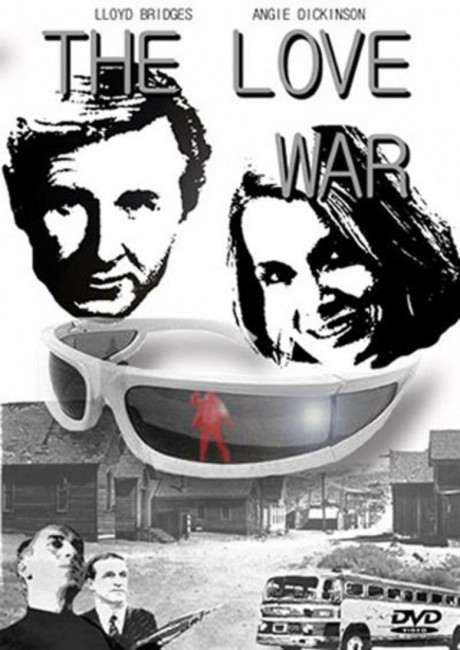
Two warring alien races are settling their conflict in California. Two teams of three have been sent down to Earth. Though they may appear to be human, their true form is revealed whenever anyone looks at them while wearing a special pair of glasses. (Yes, just like in They Live.) Kyle (Lloyd Bridges) is the last surviving member of his team but, even if his side has lost two battles, Kyle is still determined to win the war.
After killing one of his opponents in Los Angeles, Kyle hops on a bus and heads to a small town. While he’s on the bus, he’s approached by Sandy (Angie Dickinson). Though Kyle tries to avoid talking to her, Sandy manages to break down his defenses because she’s Angie Dickinson. If 70s era Angie Dickinson started talking to you on a bus, would you be able to ignore her? When Kyle reaches his destination and gets off the bus, Sandy decides to follow him. Even after Kyle explains that he’s an alien and allows her to see his true form, Sandy says that she’s in love with him. Kyle starts to fall in love with her too but what will he do when the other aliens show up in the town, looking to kill him?
Even though this made-for-TV movie’s 70 minute runtime makes it feel more like an extended episode of The Outer Limits than an actual movie, The Love War makes good use of both its intriguing premise and its two lead actors. Lloyd Bridges and Angie Dickinson might not be the first two actors who come to mind you think about who could credibly play an alien and the woman in love with him but they both pull it off. The Love War works because it takes its premise seriously. I can only imagine how audiences in 1970 reacted the film’s ending, which is hardly typical of the type of feel-good stuff that we usually associate with 70s television.
The Love War has never officially been released on DVD but it can be viewed on YouTube.
Does it never occur to anyone in a Lifetime movie to not let a stranger move into their house?
That was my main thought as, earlier today, I watched Deadly Daughter Switch. Deadly Daughter Switch, which I DVR’d off of the Lifetime Movie Network back in April, tells the story of two families. One family is rich and lives in a really nice house and sends their daughter to a really nice school. The other family is not rich, which means that they live in a slightly smaller house and the mother has to work at a coffee shop.
When Brooke (Lindsay Hartley) and Carter Jenkins (Matthew Pohlkamp) discover that their teenage daughter, Hailey (Tu Morrow), is not actually their daughter, they take their story to the media. They ask that anyone who was born on the same night and at the same hospital as Hailey take a DNA test. It turns out that Hailey is actually the daughter of Alexis (Hannah Barefoot) and that Alexis has been raising Brooke’s biological daughter, Breanne (Jane Widdop)!
If that’s not complicated enough, a counselor at the hospital comes up with the bright idea that Hailey should spend time with Alexis while Breanne should spend time with Brooke and then the girls can decide by whom they ultimately want to be raised. Alexis points out, quite reasonably in my honest opinion, that Brooke obviously has more money than her and that she probably lives in a better school district and that the end result of this experiment will probably be Brooke having two daughters and Alexis having no one. Still, they all agree to take the counselor’s advice because I guess the counselor is the voice of God or something and you have to do what she says even if it doesn’t make any sense.
Anyway, it turns out that Alexis was right about Breanne wanting to get away from her. However, it’s not just that Alexis has less money than Brooke and Carter. It’s also that Alexis is a little bit insane. Alexis loses her job at the coffee shop after she kills her boss. Then Alexis kills the volleyball coach who she claims is Breanne’s biological father. Then Alexis kills her alcoholic, white trash boyfriend. Alexis, of course, manages to make all of these deaths look like accidents because Alexis may be poor-ish and she may be dangerously unstable but she’s not stupid.
Anyway, seeing as how everyone in her life is dead, the Carters invite Alexis to come stay with them. “Do you think we trust Alexis too much?” Brooke asks Carter. Gee, Brooke, why would you ask that? Is it because Alexis is obviously plotting to murder you?
Anyway, if it sounds like I’m being critical of Deadly Daughter Switch, I’m not. I actually rather enjoyed it. A part of loving Lifetime films is that you come to accept all of the strange premises and the melodramatic plot twists. You don’t ask why. You don’t question logic. You just accept it and follow it to its conclusion. These films are meant to be the cinematic equivalent of a paperback novel that read over the course of an afternoon. Hence, the more melodramatic the better. Hannah Barefoot was an energetic killer and the Carter house was really big and nice and it looked like it would be a fun place to live. And really, isn’t that all you need?
Seriously, though, don’t invite just anyone to come live with you. You never know what they might be secretly plotting.
Kinkaid (Clint Walker) is a bounty hunter in the old west who doesn’t have time for sentiment or friendship. All he cares about is the money that his next bounty is going to bring in. When he captures outlaw Billy Riddle (John Ericson), it should be a cool $5,000 payday. The only problem is that Billy’s girlfriend, a prostitute named Mae (Margot Kidder), insists on accompanying Kinkaid while he takes Billy to jail. Though she initially conspires to help Billy escape, Mae soon starts to fall for the outwardly unemotional Kinkaid, especially when she discovers the details of his tragic backstory. (Every bounty hunter has one!)
However, the three of them soon run into another problem. Angus Keogh (Richard Basehart) and his gang have decided that they want to collect the bounty for themselves. Kinkaid, Billy, and Mae find themselves trapped in a canyon, under siege and with no food or water. The three of them will have to work together to survive but can they trust one another?
The Bounty Man was a made-for-TV western and it feels like it was originally mean to be a pilot. There’s not really much to the story, beyond establishing Kinkaid and Mae as characters who could potentially have a new adventure every week. I did like the performance of Richard Basehart, especially in the scene where he taunts the trapped Kinkaid by demonstrating that he has so much water that he can pour it out of his canteen without having to worry about running out. Basehart was a good villain and Walker was a believable hero, even if the character wasn’t very interesting. Margot Kidder, not surprisingly, is the best thing about the film. Mae is stock role, the prostitute with a heart of gold, but Kidder brings a lot of life to the part.
The Bounty Man was one of many TV movies directed by John Llewelleyn Moxey. He does a good job moving the action along. The Bounty Man is a quick, 70-minute diversion for undemanding western fans.
Last night, I turned over to Lifetime and I watched Her Deadly Groom!
Why Was I Watching It?
How couldn’t I watch it? It was on Lifetime.
Last night, I realized that it had bee forever since I last watched and live tweeted a Lifetime film. Some of that was due to some changes in my schedule. On Saturday night, I now co-host the Scary Social live tweet, which means that I usually have to DVR and watch Saturday’s Lifetime movie at a later date. And, admittedly, some of my absence from the Lifetime front just had to do with just pure exhaustion at the state of the world. When you spend 7 days straight hearing about how the world is going to end, you often just want to spend Sunday meditating or sleeping or, at the very least, dancing.
But, regardless of what else may be happening, I love Lifetime movies and I always have. Last night, I was determined to watch Her Deadly Groom and I’m glad that I did.
What Was It About?
Allison (Kate Watson) is divorced from George (Eric Roberts), an alcoholic and a serial philanderer. She now lives with her daughter Nicky (Elyse Cantor) and Nicky’s boyfriend, Jake (Jacob Michael) and she has a nice specialty peanut butter business going with her friend Brenna (Kelly Erin Decker). One thing that Allison says she doesn’t need in her life right now is another man. Brenna, however, disagrees and creates an account for Allison on a dating site.
Soon, Allison has met Vincent Black (Michael DeVorzon), who is handsome, charming, and psychotic. Fear not, that’s not a spoiler. You know that Vincent is dangerous from the minute you first see him because 1) he pushes his previous girlfriend off a cliff and 2) this is a Lifetime movie. Anyway, Vincent is soon dating Allison and it looks like they’ll soon be married. What Allison doesn’t know is that Vincent has taken out a huge life insurance policy on her….
What Worked?
Eric Roberts was in this film! Admittedly, he had a small role but still, he’s Eric Roberts and he’s always a lot of fun to watch. Plus, in this film, there was a neat little twist involving his character and Roberts did a great job playing it.
One thing I liked about this film is that Vincent may have been charming and lucky but he wasn’t always the most clever con artist around. He wasn’t one of those super villains who you occasionally come across in a film like this. Instead, he was just a con man who knew how to manipulate people but who also understood that he would only be able to successfully fool people for a limited amount of time. As a result, he didn’t waste any time when it came to putting his plans into action and that created some suspense. We knew he wasn’t going to wait forever to make his move. Vincent was a wonderfully hissable villain.
The mother-daughter relationship between Nicky and Allison felt real and both Kate Watson and Elyse Cantor did a good job of bringing their characters to life. I appreciated the fact that, even though Allison may have been naive when it came to Vincent, she wasn’t stupid. She was just someone who got legitimately conned by a sociopath.
Finally, this was a Lifetime film so all of the house were to die for. Seriously, never underestimate the importance of a big house in a Lifetime film.
What Did Not Work?
It all worked. This was a fun Lifetime movie.
“Oh my God! Just Like Me” Moments
I related to Brenna, mostly because we’ve both fallen down a flight of stairs. Of course, nobody had to push me. I’m just a klutz when it comes to stairs.
Lessons Learned
If something seems too good to be true, it probably is. Oh! And always check to see if your man has taken out a life insurance policy on you.
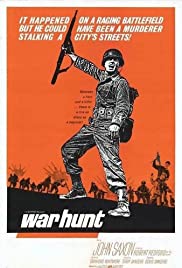
In the last days of the Korean War, Pvt. Roy Loomis (Robert Redford) is assigned to an infantry unit that’s serving on the front lines. Loomis is an idealist who believes in always doing the right thing and who believes that he’s truly fighting for the American way of life in Korea. The company’s commander (Charles Aidman) is more cynical. As he explains it, the job of the soldiers is not to win the war. Their job is to stall the advance of the enemy long enough to let the politicians and the diplomats get what they want out of a peace settlement. The soldiers are merely there to be sacrificed.
Loomis soon finds himself in conflict with Pvt. Endore (John Saxon). Endore spends his night sneaking around behind enemy lines, killing soldiers, and gathering intelligence. No one goes with Endore on these missions and Endore makes it clear that he doesn’t want to have anything to do with the other solders in the unit. Because Endore usually returns with valuable intelligence, he’s allowed to do what he wants but it becomes clear that gathering intelligence is not what motivates Endore. Endore loves war and killing. In the United States, he would probably be on death row. In Korea, at the height of the war, he’s a valuable asset.
Charlie (Tommy Matsuda) is an orphan boy who has been adopted as the company’s mascot. Both Loomis and Endore have a bond with Charlie. Loomis wants Charlie to go to an orphanage after the war so that he can hopefully be adopted and maybe brought over the United States. Endore, however, plans to stay in Korea even after the war ends and he wants to keep Charlie with him. He wants to turn Charlie into as efficient a killing machine as he is.
This low-budget but effective anti-war film may be best known for featuring Robert Redford in his first starring role but the film is stolen by John Saxon, who is frighteningly intense as Endore. Endore is so in love with war that he continues to fight it even after the Armistice is declared. Saxon plays him like a cool and calculating predator, a natural born killer. He’s an introvert who rarely speaks to the other members of the company. Even though he helps them by killing the enemy before the enemy can kill them, it’s clear that Endore doesn’t really care about the other members of the unit. He just cares about killing. He’s close to Charlie because Charlie is too young to realize just how dangerous Endore actually is.
Along with Saxon and Redford, War Hunt also features early performances from Tom Skerritt, Sydney Pollack, and Francis Ford Coppola. (Coppola, who goes uncredited, plays an ambulance driver.) Pollack and Redford met while they were both acting in this film and Pollack would go on to direct Redford in several more films. One of those films, The Electric Horseman, would reunite Redford and Saxon. Again, they would play adversaries.
Last night, when I heard John Saxon had died, I tried to pick his best performance. I know that most people know him from his horror work and his role in Enter the Dragon. Those are all good performances but, for me, Saxon was at his absolute best in War Hunt.

 Through the Shattered Lens