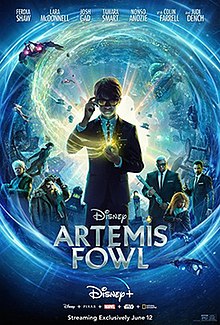
Basically, it opens with news reports about the home of millionaire businessman Artemis Fowl (Colin Farrell) being raided by the police and the discovery that Fowl has apparently been stealing ancient artifacts from across the world. A bearded man named Mulch Diggums (Josh Gad) is arrested at the house and is interrogated by …. someone. I guess he’s being interrogated by an intelligence agency, I don’t know. Mulch explains that he’s a dwarf and that he’s about to tell a story that will prove that magic exists which …. okay, I guess.
The story is about Artemis Fowl’s 12 year-old son, who is also named Artemis Fowl (Ferdia Shaw). The younger Artemis Foul is a criminal mastermind, just like his father, and he wears a suit and dark glasses and basically, he looks like a 12 year-old who dressed up like one of the Men In Black for Halloween. Artemis Fowl the younger is investigating the disappearance of Artemis Fowl the older which leads to a search for a missing magical object. Somehow, it all involves faeries and other magical figures. Judi Dench pops up a few times, looking stern. There’s a lot of chase scenes and a few fight scenes, none of which really make much of an impression.
The plot of Artemis Fowl is pretty much impossible to follow, especially if you haven’t read (or, in my case, recently reread) the books on which the film is based. A huge part of the problem is that the film itself doesn’t really develop any sort of individual personality. For a film about a 12 year-old wearing a suit and concocting criminal schemes, Artemis Fowl is surprisingly bland. It feels like a collection of scenes from other YA adaptations. We get the slow motion fight scenes. We get the magical scenes that feel as if they were lifted from a lesser entry from the Harry Potter series. Indeed, a huge chunk of the film seems to be made up of discarded scenes from director Kenneth Branagh’s previous excursion into the world of fantasy and vaguely defined magic, Thor. The film moves quickly but since nothing interesting or unusual is happening, you find yourself wishing that maybe the film would slow down for a just a minute or two and spend a bit of time exploring the world in which the two Artemis Fowls live. It’s a remarkably undetailed fantasy world that Artemis Fowl presents us with. I spent the majority of the movie wondering whether Judi Dench was supposed to be an elf or a faerie. One of the great actress, Dench spends the entire film wearing pointed ears and looking rather annoyed.
Much like Dolittle, Artemis Fowl ends with the promise of more cinematic adventures, though it’s doubtful that promise will actually be fulfilled. Also — and again like Dolittle — it’s hard not to feel that Artemis Fowl would have worked much better as an animated film than as a live action spectacular. Unfortunately, Artemis Fowl is just too bland and borderline incoherent to really make much of a lasting impression.
Dolittle tells the story of Dr. Dolittle (Robert Downey, Jr.), the eccentric doctor who can talk to the animals and who hasn’t had much use for humans ever since the tragic death of his wife, Lily (Kasia Smutniak). Dolittle would be happy to just spend his entire life locked away in his estate, talking to Poly the Parrot (voice of Emma Thompson) and Chee-Chee the Gorilla (voice of Rami Malek) and all of the other animals but Dolitle has to eventually leave his home because otherwise, there wouldn’t be a movie.
When Queen Victoria (Jessie Buckley) is mysteriously taken ill, only Dolittle can save her. Dolittle quickly realizes that the Queen has been poisoned and that the only cure for the poison is to be found on a tree that’s located on an island that no one has ever seen before. Soon, Dolittle and the animals are sailing in search of the island. Accompanying them is Tommy Stubbins (Harry Collett), a sensitive teen who hates to hunt and who hopes to become Dolittle’s apprentice. Pursuing Dolittle is the evil Dr. Blair Mudfly (Michael Sheen), who went to college with Dolittle and who is in cahoots with the conspirators who are trying to do away with Queen Victoria.
Got all of that? I hope so because we haven’t even gotten to the dragon with a set of bagpipes crammed up her ass. Yes, you read that correctly.
Last year, Dolittle was one of the few major studio productions to actually get a wide release before COVID-19 closed down all the theaters. It was released in January, which is traditionally the time when studios release the films that they hope everyone will have forgotten about by the time April rolls around. January is traditionally the month when studios release the films that they know aren’t any good. And, indeed, the reviews of Dolittle were overwhelmingly negative. Not only did the critics hate Dolittle but audiences were also rather unenthusiastic and the film bombed at the box office. Indeed, under normal circumstances, the reaction to Dolittle and its subsequent box office failure would be considered one of the year’s biggest disasters. However, 2020 was a year of disasters. Compared to everything else that ended up happening over the past 12 months, Dolittle’s lukewarm reception seems almost quaint now.
Earlier today, I finally watched Dolittle on HBOMax. I was expecting the film to be terrible but it’s actually not quite as bad as I had been led to believe. I mean, don’t get me wrong. Dolittle has a ton of problems. The tone is all over the place as the film tries to mix cartoonish humor with thrilling adventure in a style that owes more to the Pirates of the Caribbean franchise than it does to Dr. Dolittle. Despite a few self-consciously manic moments, Robert Downey, Jr. seems remarkably bored in the lead role. Many of the jokes fall flat and the awkward attempts to shoehorn the usual message of “be true to yourself” into the film just felt awkward. That said, the CGI animals were cute enough to hold my interest and that’s really the most important thing when it comes to a film like Dolittle. Cute animals — even computer generated ones — help to make up for a lot of flaws.
Dolittle’s final scene hints at a sequel or even a franchise. Considering the reaction to the first film, I doubt we’ll get a second. I do think Dr. Dolittle could make for an enjoyable PIXAR film but it might be time to give the live action adaptations a rest.
Let Them All Talk is the latest film from Steven Soderbergh. Meryl Streep plays Alice Hughes, a novelist who is traveling to London on the Queen Mary so that she can accept a literary prize. Accompanying her are two friends from college, Roberta (Candice Bergen) and Susan (Dianne Wiest), both of whom have far less glamorous lives than Alice’s. Roberta is also still angry because she feels that Alice used details from Roberta’s life in one of her novels.
Also on board the Queen Mary are Alice’s nephew, Tyler (Lucas Hedges, who overacts to such an extent that it’s almost as if he’s daring the Academy to take back that nomination for Manchester By The Sea) and Karen (Gemma Chan), who is Alice’s new agent and who is trying to figure out what Alice’s next book is going to be about. (Karen hopes that it’ll be a sequel to her first novel, the one that was full of details stolen from Roberta’s life.) Though Alice keeps insisting that she wants Tyler to keep Roberta and Susan entertained while she works on her latest book, Tyler is far more interested in getting to know Karen.
The film was shot on the Queen Mary, while the ship was actually making the voyage across the Atlantic. Though the actors had a story outline, the majority of the dialogue was improvised and Soderbergh essentially just sat in a wheelchair with his camera and followed the actors around. In short, this is a film that you probably could have shot, the only difference being that you probably wouldn’t have been able to get Meryl Streep to agree to appear in it. I’m tempted to say that the story of the production is actually more interesting than the film itself but, to be honest, Steven Soderbergh shooting an improvised film isn’t that interesting. Soderbergh’s always had a weakness for gimmicks like improv. You may remember that, decades ago, he and George Clooney insisted on trying to produce largely improvised television shows for HBO. Though the shows got a lot of hype before they premiered, both K Street and Unscripted mostly served to prove that improv is often more interesting in theory than in practice.
That’s certainly the case with Let Them All Talk, which is one of the most mind-numbingly dull films that I’ve ever sat through. I think the assumption was that Meryl Streep, Candice Bergen, and Dianne Wiest would automatically be interesting to watch no matter what they said but it doesn’t work out that way. Meryl Streep, in particular, is so excessively mannered that she comes across like a retired drama teacher playing the lead in the community theater production of Mame. Candice Bergen does a bit better but Dianne Wiest is stranded with a role and subplot that seems almost like an afterthought. In the end, the film just isn’t that interesting. The “just start filming and see what happens” approach has its limits.
To be honest, as I watched Let Them All Talk, I found myself wondering if maybe Steven Soderbergh was deliberately trolling everyone by seeing how bad of a film he can make before critics stop reflexively praising everything that he does. Let Them All Talk currently has a score of 89% at Rotten Tomatoes so Soderbergh still has a ways to go.
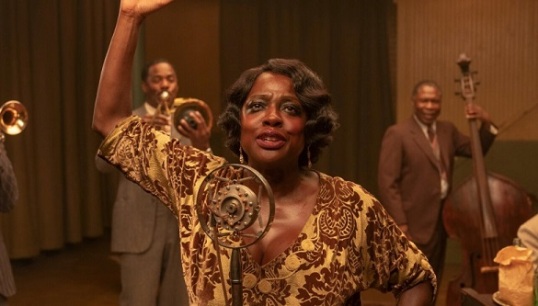
The year is 1927 and the place is Chicago. 6 men are in a claustrophobic recording studio, waiting for the arrival of blues singer Ma Rainey (Viola Davis). While Ma’s agent, Irv (Jeremy Shamos) and studio owner Mel Sturdyvant (Johnny Coyne) wait upstairs, the members of Ma’s band gather in the rehearsal room. They’ve been given a list of songs to rehearse. As is quickly made clear, the band doesn’t have much say about which songs they’re going to perform and record. In fact, Irv and Mel pretty much go out of their way to have as little contact with the black musicians as possible.
The band is made up of Cutler (Colman Domingo), Slow Drag (Michael Potts), Toledo (Glynn Turman), and a trumpet player named Levee (Chadwick Boseman). Cutler may be their unofficial leader but Levee is the most outspoken. Levee is sick of playing what he calls “jug band music.” He’s written his own songs and he’s shown them to Sturdyvant. He’s convinced that he’s going to start his own band and that he’s going to become a bigger star than Ma Rainey ever was. The rest of the band views Levee with a mix of humor and distrust.
As for Ma, she arrives an hour late, accompanied by her girlfriend Dussie (Taylor Paige) and her nephew, Sylvester (Dusan Brown). She doesn’t apologize for being late and, as soon as she arrives, she starts to make her voice heard. She wants Sylvester to perform a spoken word intro on the record, despite the fact that Sylvester stutters. When Irv and Sturdyvant fail to bring her a coke, she brings recording to a halt until she gets one. She argues about which songs she wants to record and she reprimands Levee for trying to change the arrangement of one of her songs. Ma’s difficult but, as she explains it, she has to be difficult. Irv and Sturdyvant don’t care about her, they don’t care about what her music is actually about, and they certainly don’t care about paying her what she deserves. Irv may claim to care about her but, as Ma tells Cutler, he’s only invited her to his home once and that was so she could sing for his white friends. When they’re in the recording studio, Ma has all of the power and she’s not going to let anyone forget it.
Meanwhile, the members of the band continue to talk among themselves with the conversation always coming back to what it takes to survive in a society run by white people. The three older men seem to have accepted that the world is what it is and that’s it’s never going to change but Levee believes that he has a future. When the other members of the band poke fun at him for the obsequious way that he talks to Sturdyvant, Levee discusses the horrifying trauma of his past. As the recording sessions continues, tempers start to flare until finally, the film climaxes in an act of sudden violence.
Ma Rainey’s Black Bottom is based on a play by August Wilson and, despite a few efforts to open up the story by including a few scenes on the streets of Chicago, it’s an undeniably stagey film. You never forget that you’re essentially watching a film version of a theatrical experience. Fortunately, the performances are so powerful and the dialogue is so sharp that it’s easy to forgive both the film’s staginess and the occasional lapses in pace.
In his final performance before his tragic passing, Chadwick Boseman transforms Levee into a character who manages to be frustrating, sympathetic, and occasionally frightening. From his powerful monologue about what he and his family experienced during his youth to the film’s final anguished moments, Boseman holds your attention every second that he’s on screen. Boseman captures not only Levee’s anger and his ambition but also Levee’s fragile confidence. At the start of the film, he may be bitter about having to play Ma’s music but he’s also perhaps the most hopeful musician in that recording studio and there’s something undeniably tragic about watching him come to realize the truth of his situation. He’s a character about whom many viewers will have mixed feelings but Boseman is never less than compelling. Viola Davis, as well, gives a powerful performance as Ma Rainey, playing her as someone who knows that she can’t afford to show a single moment of weakness. Ma knows that the white men who are in charge of the studio need her more than she needs them and she’s not going to let them forget it. Of the rest of the cast, Glynn Turman is a stand-out as a piano player who knows and understands history in a way that his bandmates don’t.
Ma Rainey’s Black Bottom is currently streaming on Netflix.
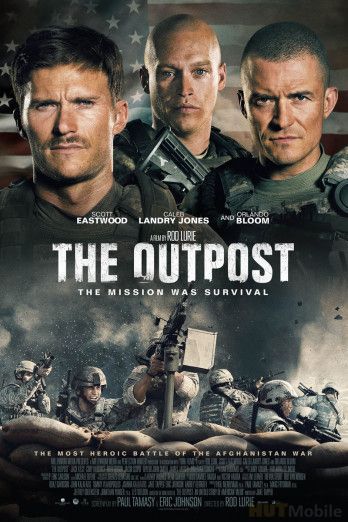
The Outpost, which is currently streaming on Netflix and which deserves far more attention than it’s been given, is a film that left me breathless. Seriously, as the film came to its conclusion, I realized that I was so emotionally overwhelmed by what I had just seen that I actually had to stop for a few minutes and catch my breath. Once I was breathing again, I started to cry. I cried all the way through the end credits. That’s the sign of a powerful film.
Based on a true story, The Outpost takes place in 2009. PRT Kamdesh is an American military outpost in Northern Afghanistan. The post is located in a valley. The mountains, which rise high up into the sky, are not only beautiful but they also provide the perfect cover for the Taliban. The outpost is attacked on a nearly daily basis. At the start of the film, we’re told that one military strategist said that the base should have been named after George Custer because it was impossible to defend and that, should a big attack ever truly come, all 53 of the man on the base would essentially be sitting ducks.
The Outpost follows those 53 men as they go about their daily lives on the base. Commanders die and are replaced. The soldiers try to hold onto their sanity, even though they know that the “big attack” is inevitable. Though more than a few of the men have families back home, they try not to think about them. They can’t risk the distractions. Even the act of adopting a dog is seen as being a potentially dangerous move. The humor is dark, to the extent that the base’s theme song is “Everybody Dies.” While dealing with daily attacks, the base’s commanders try to win the support of the local villagers. One of the local elders asks if the Americans are the same invaders who have been in Afghanistan for the last 40 years. “No,” the flummoxed commander tries to explain, “those were the Russians.” It quickly becomes apparent that the soldiers and the villagers have at least one thing in common: no one is quite sure why the Americans are there or if they’ll ever able to leave. Orders are sent down by faceless generals and the men of PRT Kamdesh wait for the attacks that they all know are coming,
When the attack does come, it leads to one of the most visceral battle scenes that I’ve ever seen. There’s nothing glamorous about the way that The Outpost portrays war. Instead, it’s a confusing, loud, and terrifying nightmare. The Outpost establishes early on that anyone can die, an important lesson when you consider how many action movies have been made about heroes who are mythically impervious to even the slightest of injuries.
For roughly the final hour of the film, The Outpost puts us into the middle of the Battle of Kamdesh. The film pays tribute to the soldiers who fought in the battle, showcasing their bravery and the quick thinking that kept the battle from being even more of a disaster than it was. At the same time, it also reminds us that war is not fun and that the scars of combat are not just physical. When a soldier breaks down into tears while trying to talk about the battle, the film treats his feelings with the respect that they deserve. It’s been said that few people are as anti-war as the people who have actually experienced combat and The Outpost shows us why that is.
The Outpost is an important film. It’s especially important now that we have a new president and the national media is probably going to go back to ignoring whatever happens in Afghanistan for at least the next four years. For far too many people, it’s become the forgotten war, even though it’s still ongoing. The Outpost is a film that reminds us that no war and no soldier should ever be forgotten.
Though they’re not quite as ever-present as people up north seem to assume, rodeos are still a pretty big deal down here in the Southwest. Now, I have to admit that I have mixed feelings about the rodeo, largely due to the fact that I spent the early part of my life constantly moving from the city to the country to the city and then back to the country again. The city girl side of me looks at the rodeo and says, “That’s a silly tradition that’s dangerous to both the animals and the participants and there’s no way that I would ever let any future child of mine have anything to do with it.” However, the country girl side of me hears the words “rodeo,” and shouts, “Hell yeah!” Seriously, there’s nothing more exciting than watching a handsome cowboy try to ride a bull without getting killed.
And believe me, rodeos can be dangerous. There’s an episode of King of the Hill in which Hank and Peggy take Bobby to the rodeo and Peggy mentions that one of her relatives was sent home from Vietnam because he was having rodeo nightmares. I could believe it. Rodeos are not petting zoos, despite what some people may think. Bulls and broncos can be dangerous when they’re angry and a rodeo clown can only provide so much protection. In fact, there’s some towns that have actually considered baning the rodeo.
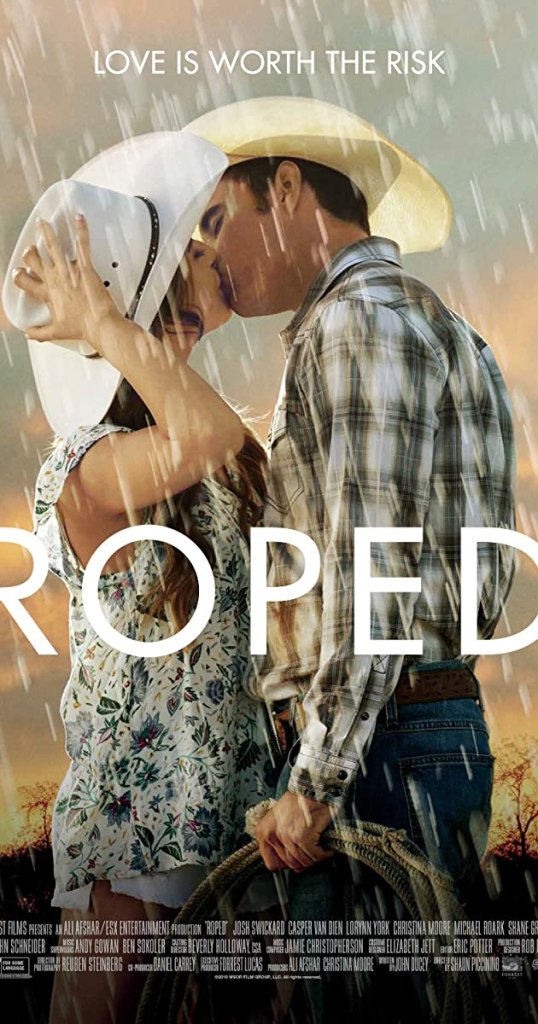
Roped takes place in one such town. City councilman Robert Peterson (Casper Van Dien) doesn’t want the rodeo coming anywhere near his home. He argues that the rodeo is unfair to animals and that it corrupts the youth. It’s kind of like Footloose, except instead of banning dancing, the councilman wants to ban a rather foul-smelling carnival in which people are occasionally killed.
Of course, what the councilman doesn’t know is that his own teenage daughter, Tracy (played by Lorynn York) is falling in love with a rodeo cowboy! Colton Burtenshaw (Josh Swickard) is a up-and-coming star on the rodeo circuit and it’s pretty much love at first sight as soon as he and Tracy meet. Of course, this means that Tracy is going to have to defy her father and Colton’s going to have to prove that the rodeo isn’t as bad as everyone thinks that it is. It’s time for laughs, tragedy, love, and sheep. Yes, you read that right.
Anyway, you can probably guess everything that happens in Roped. This is a low-budget movie that’s designed for the “I wish they still made movies like they used to do” crowd and, for what it is, it’s not that bad. It’s hardly a great or even a memorable film but it gets the job done and it’ll appeal to people who have nostalgic memories of the rodeo. There’s not an edgy moment to be found in the film but people looking for edgy movies probably won’t be watching Roped in the first place. It’s a nice-looking film and Lorynn York and Josh Swickard make for a cute couple, in both the film and real life. (York and Scwickard married shortly after making this movie.) Plus — hey, Casper Van Dien’s in the movie! Van Dien’s always fun to watch, especially when he’s playing a well-meaning but misguided authority figure.
As I wrap up this review, one final word about the rodeo: it’s pronounced “roe-dee-oh.” Don’t come down here and say you want to see a “ro-day-oh.” Those clowns can turn on you quickly.
The Trial of the Chicago 7, the latest film from Aaron Sorkin, is a fairly mediocre and rather forgettable film. Because of that mediocrity, it stands a pretty good chance of doing very well at the Oscars later this year.
Aaron Sorkin specializes in political fan fiction. He writes plays, movies and television shows that address big and controversial issues in the most safely liberal way possible. Whenever Sorkin writes about politics, there’s not a single debate that can’t be won by one long, overdramatic speech, preferably delivered in an office or a conference room while everyone who disagrees nervously stares at the ground, aware that they’ll never be able to match the rhetorical brilliance of their opponents. It’s a rather dishonest way to portray the ideological divide but it’s one that’s beloved by people who want to be political without actually having to do much thinking. Sorkin is the poet laureate of the keyboard activists, the people who brag about how their cleverly-worded tweets “totally owned the MyPillow guy.” (One sure sign of a keyboard activist is the excessive pride over rhetorically owning people who are ludicrously easy to own. These are the people who think that Tom Arnold arguing about the electoral college with Kirstie Alley is the modern-day equivalent of the Lincoln/Douglas debates.)
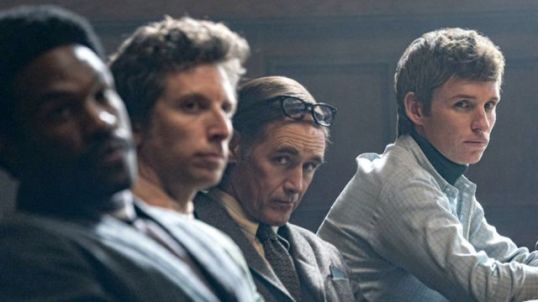
The Trial of the Chicago 7, which Sorkin not only wrote but also directed, deals with a real-life event, the 1969 trial of eight political activists who were charged with conspiracy and crossing state lines with the intention of inciting riots at the 1968 Democratic National Convention in Chicago. (Black Panther Bobby Seale was ultimately tried separately from the other defendants, leading to the Chicago 8 becoming the Chicago 7.) Sacha Baron Cohen plays Abbie Hoffman, the fun-loving activist who delights in upsetting the establishment. Eddie Redmayne played Tom Hayden, who takes himself and his activism very seriously and who worries that Hoffman’s antics in the courtroom are going to discredit progressives for generations to come. Hoffman ridicules Hayden for being a rich boy who is rebelling against his father. Hayden attacks Hoffman for not thinking about how his actions are going to be perceived by the rest of America. Sorkin the screenwriter is clearly on Hayden’s side while Sorkin the director keeps finding himself drawn to Hoffman, if just because Hoffman is the more entertaining character. Hoffman gets to make jokes while Hayden has to spend the entire film with a somewhat constipated expression on his face.
As is typical of Sorkin’s political work, the film raises issues without really exploring them. We learn that the defendants were all arrested during anti-war protests but the film never really explores why they’re against the war. It’s mentioned that David Dellinger (John Carroll Lynch) is a pacifist who even refused to fight in World War II but at no point do we learn what led to him becoming a pacifist. When Hoffman and Jerry Rubin (Jeremy Strong) talk about how they feel that the government holds people like them in contempt and that they shouldn’t have to fight in a war that they don’t believe in, Sorkin’s script has them speak in the type of simplistic platitudes that could just as easily have been uttered by a MAGA supporter talking about the war in Afghanistan. If all you knew about these men was what you learned in this film, you would never know that Hayden, Hoffman, and the rest of the Chicago 7 were activists both before and after the Vietnam War. You’d never know that there was more to their ideology than just opposition to the Vietnam War. The film never really digs into anyone’s beliefs and motivations. Instead, everyone might as well just have “Good” or “Evil” stamped on their forehead.
Sorkin’s simplistic approach is most obvious when it comes to Bobby Seale (Yahya Abdul-Mateen II). With Seale, the film is more interested in how other react to him than in the man himself or his activism. The film’s most shocking moment — when Judge Hoffman (Frank Langella) orders Seale to be literally bound and gagged in the courtroom — actually did happen but the film mostly seems to use it as an opportunity to show that even the lead prosecutor (played by Joseph Gordon-Levitt) is disgusted by the government’s heavy-handedness. Seale and the Black Panthers are used more as symbols than as actual characters.
Since this is an Aaron Sorkin film, the action is male-dominated. It’s justified as the Chicago 7 and their lawyers were all men. Still, it’s hard not to notice that the only prominent female characters are an undercover cop who betrays the protestors and a receptionist who is frequently reprimanded by the men in the film. One black woman in a maid’s uniform does get a chance to reprimand Hayden for not speaking out when Bobby Seale was gagged but she’s never even given a name. As often happens with women of color in films like this, she’s only there to remind the white heroes to do the right thing.
Watching The Trial of the Chicago 7, I found myself thinking about how lucky Aaron Sorkin was to get David Fincher as the director of The Social Network. A smart director with a strong and unique style, Fincher was able to temper Sorkin’s tendency toward pompousness. Unfortunately, as a director, Aaron Sorkin is no David Fincher. While Sorkin has definitely established his own style as a writer, he directs like someone who learned how to stage a crowd-pleasing moment from watching Spielberg but who, at the same time, never noticed the sense of playfulness that Spielberg, especially early in his career, infused within the best of those scenes. It’s all soaring rhetoric and dramatic reaction shots and cues to let us know when we’re supposed to applaud. As a director, Sorkin never challenges the audience or lets the film truly come to any sort of spontaneous life. Instead, he adopts a somewhat cumbersome flashback-laden approach. The story never quite comes alive in the way that the similar courtroom drama Mangrove did. It’s all very safe, which is one reason why I imagine The Trial of the Chicago 7 is as popular as it is. It’s a film that allows the viewers to celebrate the fantasy of activism without having to deal with the messy reality of all the complications that come along with taking an actual stand. It’s a film that encourages you to pat yourself on the back for simply having watched and agreeing that people have the right to protest.
I will say that Sorkin made some good casting choices. Langella is memorably nasty of the judge and Joseph Gordon-Levitt does a good job as the prosecutor. Eddie Redmaye is a bit of a drag as Tom Hayden but Alex Sharp is likable as Hayden’s friend, Rennie Davis. Michael Keaton has an effective cameo as Ramsey Clark. The film presents Clark as being a bit of a wise liberal and the film’s epilogue doesn’t mention that Clark went on to a lucrative career of providing legal aide to murderous dictators and anti-Semites. (Lyndon LaRouche was one prominent Ramsey Clark client.)
The Trial of the Chicago 7 will probably do well come Oscar-time. In many ways, it almost feels like a generic Oscar movie. It’s about a historical event, it’s political without being radical, and it presents itself as being far more thoughtful than it actually is. That’s been a winning combo for many films over the years.
This is a film that I think a lot of people expected to be an Oscar contender because it was directed by industry favorite Ron Howard, it was based on a genuinely moving best seller, and the cast included Amy Adams and Glenn Close, two actresses who are more than overdue for their first Academy Award. I don’t think anyone expected it to win much, largely because Ron Howard isn’t exactly the most groundbreaking director working in Hollywood, but it was still expected to be contender.
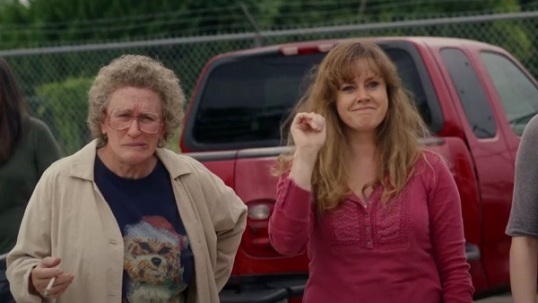
Even before it was released, there were a few signs that Hillbilly Elegy might not be the award-winning film that some were expecting. The first images from the film featured Glenn Close and Amy Adams looking like characters from some sort of ill-conceived SNL sketch. Then the trailer came out and it was so obviously Oscar bait-y and heavy handed that it was hard not to suspect that the film was trying just a bit too hard. By the time the film itself finally premiered in November, I think a lot of people were specifically waiting for their chance to skewer it.
Make no mistake about it, Hillbilly Elegy deserves a certain amount of skewering. Its a bit of a tonal mess and, far too often, it feels as if Ron Howard is inviting us to gawk at the film’s characters as opposed to showing them any sort of real empathy. Those critics who have claimed that the film occasionally feels like “poverty porn” have a point.
And yet, despite all of those legitimate complaints, I would argue that the film is partially redeemed by the performance of Glenn Close. Close plays Meemaw, who always seems to be carrying a lit cigarette and who has no hesitation about threating to beat the Hell out of her children and her grandchildren. Meemaw lives in a cluttered house that probably reeks of smoke. The TV is almost always on. Meemaw is a fan of Arnold Schwarzenegger. If you’ve ever wanted to hear Glenn Close say, “Hasta la vista, baby,” this is the film for you. Meemaw is a somewhat frightening character (during one flashback, she sets her drunk husband on fire) but she’s also the most caring character in the film. When it becomes obvious that her drug addict daughter, Bev (Amy Adams), is incapable of taking care of J.D. (played by Owen Aszatlos as a teen and Gabriel Basso as an adult), Meemaw essentially kidnaps J.D. and take him home with her. Close’s performance is undeniably theatrical but it works. She communicates that underneath all the bluster and the profanity and the anger and the cigarette smoke, Meemaw truly does love her family. Glenn Close transcends the film’s flaws and brings some real heart to the story.
Hillbilly Elegy opens with J.D. as a student at Yale Law School, hoping to get accepted for a prestigious summer internship. Meanwhile, all the other Ivy Leaguers treat J.D. like some sort of alien on display because he’s originally from Kentucky, he served in the army, and he went to a state school. Though ambitious and intelligent, J.D. still feels likes an outsider. When he goes to a banquet and discovers that he’ll be required to use different forks throughout the meal, he calls his girlfriend (Frieda Pinto) and gets a quick lesson on which fork to use when.
Unfortunately, before the meal even starts, J.D. gets a call from his sister, Lindsay (Haley Bennett), telling him that Bev has overdosed on heroin and is at the hospital. J.D. has to drive all the way to Ohio so that he can try to get his mother into a drug rehab. Because Bev doesn’t have medical insurance and would rather just stay with her good-for-nothing boyfriend, that turns out to be a bit more difficult than J.D. was anticipating. The film becomes a race against time to see if J.D. can get his mom taken care of and still make it back to Connecticut so that he can interview for a prestigious internship. Along the way, there are frequent flashbacks to Meemaw telling the young J.D. that he can be something better than just a hillbilly. All he has to do is try and not give up.
By structuring his film as a series of flashbacks, Ron Howard ensures that there’s really not any suspense about whether or not J.D. is going to be able to escape from Appalachia. Since we’ve already seen that the adult J.D. is going to be end up going to Yale, it’s hard to get worried when we see the teen J.D. smoking weed and hanging out with a bunch of losers. We know that J.D. is going to get over his adolescent rebellion and get his life straightened out. The film tries to create some tension about whether or not J.D. is going to be able to make his internship interview but, again, J.D. is going to Yale and living with Frieda Pinto. From the minute we see J.D., we know that he’s going to be just fine regardless of whether he gets that internship or not. In fact, his constant worrying about missing his interview starts to feel a bit icky. While Bev is dealing with her heroin addiction, Ron Howard is focusing on J.D. driving back to Connecticut as if the audience is supposed to be saying, “Oh my God, has he at least reached New Jersey yet!?” This is the type of storytelling choice that could only have been made by a very wealthy and very comfortable director. It reminded me a bit of The Post and Steve Spielberg’s conviction that, when it came to the decision to publish the Pentagon Papers, audiences would naturally be more interested in the owner of the newspaper than the people who actually did the work breaking the story. Here, Howard seems to be saying, “Yes, Bev might overdose and die having never reconciled with her son but the real tragedy is that J.D. might have to settle for his second choice as far as prestigious summer internships are concerned.”
Along with the story’s structural issues, the film also suffers because the usually wonderful Amy Adams is miscast as Bev. Adams acts up a storm as Bev but the performance itself a bit too obvious and on-the-surface. While Glenn Close disappears into the role of Meemaw, you never forget that you’re watching Amy Adams playing a character who is a bit more troubled than the usual Amy Adams role. You don’t think to yourself, “Oh my God, Bev is losing it.” Instead, you think, “Amy Adams sure is yelling a lot in this movie.” Somehow, Hillbilly Elegy makes Amy Adams feel inauthentic, which is something that, before I watched this film, I wouldn’t have believed to be be possible.
Aside from Glenn Close’s performance, Hillbilly Elegy doesn’t quite work and that’s a shame because I do think that a good film could have been made from Vance’s book. Unfortunately, Ron Howard doesn’t bring any sort of grittiness to the film’s depiction of what it’s like to be poor and forgotten in America. Instead, the film feels just a bit too slick. It attempts to be both a film about poverty and a crowd pleaser. When the movie should be showing empathy for its characters, it puts them on display. When it should be challenging the audience, it pats us on the back as if we should feel proud of ourselves merely because we spent two hours watching J.D. and his family. The film just doesn’t work. No wonder Meemaw prefers watching The Terminator.
As I watched David Fincher’s latest film, Mank, my main feeling was one of wanting to like the film more than I actually did.
I mean, really, the film sounds like it was specifically made to appeal to me. It’s a film about the Golden Age of Hollywood, which is an era that has always fascinated me as both a film lover and history nerd. Even more specifically, it’s a film about the writing of Citizen Kane, which is one of my favorite movies. (On one of our first dates, Jeff and I snuck into a showing of Citizen Kane at the Magnolia. The crime was fun and finally getting to see the movie on the big screen was even better.) It’s a film that features a host of historical figures, everyone from Louis B. Mayer to Irving Thalberg to Orson Welles to William Randolph Hearst to Marion Davies to the title character himself, the self-destructive screenwriter Herman J. Mankiewicz.
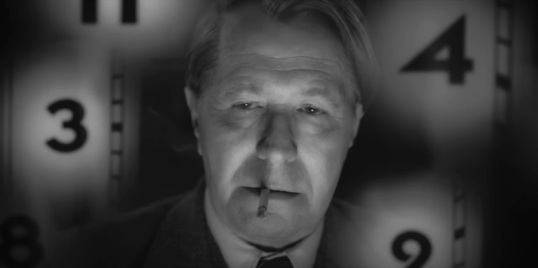
Those historical figures are played by a truly impressive collection of actors, almost all of whom give memorable performances. Gary Oldman plays Mankiewicz, lurching about Hollywood in a drunken haze and calling out the system while, somewhat hypocritically, also attempting to profit from it. Charles Dance is compellingly arrogant as William Randolph Hearst. Tom Burke captures Orson Welles’s trademark voice and charisma, making an impression despite having surprisingly little screen time. Ferdinand Kingsley plays Irving Thalberg and steals nearly every scene in which he appears. Arliss Howard is a marvel as the manipulate Mayer while Amanda Seyfried gives the best performance of her career so far as Marion Davies. The film portrays Davies as being intelligent, witty, and perhaps the only truly honest person in Hollywood. If it can be argued that Citizen Kane robbed Davies of her dignity, it can also be argued that Mank makes a sincere attempt to give it back to her. With the exception of a distracting cameo from Bill Nye (yes, the science guy), Mank is perfectly cast.
And yet, despite all of that, the film never really engaged me on either an emotional or an intellectual level. The black-and-white cinematography is gorgeous but the film plods from one incident to another, skipping back and forth in time and trying to convince us that Herman J. Mankiewicz was a more fascinating figure than he comes across as being. For the most part, Mankiewicz comes across as being a bit of a bore and the film makes the classic mistake of assuming that we’ll naturally like him just because he’s the main character. Gary Oldman is as charismatic as ever but the film doesn’t give him much of character to play. Mankiewicz stumbles from scene to scene, searching for a drink and always complaining about one thing or another. A little bit of Herman J. Mankiewicz goes a long way and, once it becomes apparent that he’s going to spend the entire film perpetually annoyed, Mankiewicz becomes a rather uninteresting character. Long before this film even reached the halfway mark, I was on the side of everyone who wanted Mankiewicz to stop talking and just finish writing the damn script.
If you’re one of the ten or so people who is still outraged over the failure of Upton Sinclair’s 1934 gubernatorial campaign, you’ll probably enjoy this film. For those of you haven’t read Greg Mitchell’s The Campaign of the Century: Upton Sinclair’s Race for Governor of California and the Birth of Media Politics, Upton Sinclair was a writer and longtime socialist activist who won the 1934 Democratic nomination to run for governor of California. Despite garnering a lot of national attention with his End Poverty In California (EPIC) platform, Sincliar was overwhelmingly defeated by Republican Frank Merriam. Mank argues that Sinclair’s defeat was largely due to dirty tricks and negative campaigning, most of it masterminded by Mayer and Hearst. Mankiewicz is a Sinclair supporter who is angered by the underhanded efforts of Mayer and Hearst. The script for Citizen Kane is, at least partially, Mankiewicz’s revenge on Hearst and Mayer for working against Sinclair and it’s something that Mankiewicz feels so strongly about that he’s willing to demand that Orson Welles give him credit for his work on the screenplay. It’s a legitimate theory, but the film’s exploration of it feels rather shallow and intellectually lazy. Just as it did with the character of Mankiewicz, the film makes the mistake of assuming the audiences will automatically find the candidacy of Upton Sinclair to be as inspiring as the film does. The film continually insists that we should care but, when it finally has a chance to show us why Upton Sinclair’s campaign was important, all it can provide is Bill Nye The Science Guy, standing on a platform and complaining about religious hypocrisy. It’s the cinematic equivalent of a casual acquaintance demanding to know why his twitter feed didn’t convince you to vote for Bernie Sanders.
From a historical point of view, the film does itself no favors by creating a fictional friend of Mankiewicz’s, one who is so consumed with guilt over his part in defeating Upton Sinclair that he ends up committing suicide. It feels rather cheap and predictable, an easy way to give Mankiewicz some sort of motivation beyond being infatuated with Marion Davies. Historically, the truth of the matter is that Frank Merriam turned to the left as soon as he was elected and Upton Sinclair went on to win the Pulitzer Prize for writing a series of now-unreadable books about an international do-gooder named Lanny Budd. Meanwhile, director Felix E. Feist (who was responsible for shooting many of the anti-Sinclair newsreels that MGM released into cinemas) went on to have a very long career and never indicated that he felt any guilty for playing a part in Sinclair’s defeat.
Like many of David Fincher’s film, Mank works best as an exercise in style. The black-and-white cinematography is to die for. Some of the shots — especially early in the film — are breathtaking. Mankiewicz may spend the majority of the film railing against the excesses of Hollywood but, visually, Fincher can’t get enough of them. Indeed, much as with The Social Network, Fincher seems to be spend the majority of the film at odds with the the film’s overwritten and rather pompous script. (Of course, Mank was written by Fincher’s late father while The Social Network was written by Aaron Sorkin. While there’s a lot to criticize about Jack Fincher’s script, one can still be thankful that he wrote the script instead of Sorkin. One can only imagine how Marion Davies would have been portrayed if Aaron Sorkin had been involved.) Mank is narratively deficient but visually stunning. The film’s script rather snarkily dismisses Orson Welles as being a mere “showman” but, as film, Mank proves that sometimes a showman is exactly what’s needed.
You have to feel a little bit bad for The Social Dilemma, a well-intentioned documentary that makes several good points but which runs into one huge problem. The documentary takes a look at social media and, more specifically, how society’s addiction to social media has led to a world where people are more divided, more angry, more anxious, and more volatile. Featuring interviews with the people worked for the companies and who created the social media sites that currently dominate our culture, The Social Dilemma shows how the algorithms that were initially designed to keep people clicking have now led to a world where everyone is living in their own separate reality. The film makes the case that this is not a good thing and that the heads of Twitter and Facebook are potentially more powerful than any world leader. Considering that the film was released months before the social media-directed riot at the capitol and Big Tech’s subsequent decision to ban President Trump (while, of course, continuing to allow both Chinese propaganda and the Ayatollah’s calls for the destruction of Israel), it’s hard not to feel that The Social Dilemma‘s case has been proven. It’s a prophetic film.
The problem, however, is that most people already know that social media is addictive and that it’s potentially harmful and that Google has way too much data on file about its users. Everyone already knows this. It’s just that most people don’t care. That’s the nature of addiction. Even though you know it’s probably going to kill you, you also know that there’s a good chance that you’re next fix might be the best feeling you’ve ever experienced.
I know that it’s not a coincidence that YouTube is always trying to get me to watch videos about kittens. I also know that it’s not a coincidence that, for several months last year, every internet ad that I saw was for lingerie. And yes, I guess it’s a little bit creepy that both YouTube and Facebook managed to figure out my political leanings, despite the fact that I hardly ever post anything political online. I would be outraged if I wasn’t so busy clicking on stuff. What’s that YouTube? There’s a video of two kittens at a meeting of libertarian Catholics and it ends with a La Perla ad? I’ll be right over. Just let me finish writing this review….
The Social Dilemma is full of interviews with people who once worked for companies and services like Google, Facebook, Twitter, and Instagram. Most of them wear the shell-shocked expressions of people who are still grappling with feelings of “My God, what have I done?” They discuss not only how the algorithms behind social media work but also how those algorithms eventually turned out to be more powerful and more destructive than any of their creators imagined. One former Facebook engineer discusses how “likes’ were originally viewed as being a way to encourage people to be positive but, instead, they quickly turned Facebook into a competition. One particularly sobering segment discusses how the social media boom also brought with it a surge of teenage girls going to the emergency room as a result harming themselves as their self-worth became linked to getting likes, retweets, hearts, shares, and all the rest. It’s a sobering film, though its impact is lessened by the decision to include some dramatizations involving a fictional family. The message of the film come through well enough via interviews without the film including scenes of Vincent Kartheiser literally playing a character named Artificial Intelligence. (That said, it’s always good to see Vincent Kartheiser in a film. He’s an actor who deserves to work more.)
To the film’s benefit, it acknowledges that giving up social media is not a realistic solution for most people. At this point, asking people to totally give up social media is the equivalent of asking someone to voluntarily cut themselves off from the world. (As one interviewee points out, social media manages to be both a utopia and a dystopia at the same time.) The documentary makes the argument that the Big Tech monopoly needs to be better regulated and perhaps broken up. (The film’s right but, considering how many former Silicon Valley executives and Big Tech lobbyists are going to be involved with the Biden administration, none of that’s not going to happen any time soon.) The film ends with a series of suggestions about how to use social media without allowing it to control or destroy your life. Most of them are common sense stuff — seek out opposing view points, don’t click on clickbait, don’t blindly retweet or share, do not give devices to children, turn off notifications, etc., etc. — and I’m happy to say that I do most of them.
That said, social media is addictive. I’ve tried to take breaks from twitter but it’s rare that I can ever go more than a day without checking. Seeing those mentions, seeing those likes, seeing those retweets; even after all these years, it’s still a rush. When I first started watching The Social Dilemma, I hopped on twitter just to let people know that I was watching the movie. When the movie ended, I checked to see if anyone had commented on the fact that I was watching it. That’s the world that we all live in right now.
And, as one interviewee says during The Social Dilemma, it could very well be the end of the world. What’s sad, though, is that most people are too busy looking at their phones and devices to even enjoy the ride.


 Through the Shattered Lens