Film Review: Atlas Shrugged Part Three (dir by J. James Manera)


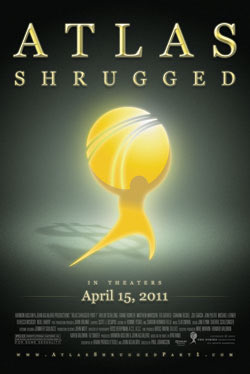
In 2014, the Atlas Shrugged trilogy came to a close with Atlas Shrugged Part III: Who Is John Galt?  As you can probably guess from the title, this is the movie that finally revealed the elusive character of John Galt.

Unfortunately, after all the time spent discussing the character over the past two movies, there’s really no way that the actual John Galt could possibly live up to all the hype.  John Galt, the man who stopped the motor of the world and who is the world’s greatest living engineer, turns out to be a sensitive lumberjack type who has founded his own scenic village in Galt’s Gulch.  He’s manly and handsome and chivalrous and he’s a bit dull.  Kristoffer Polaha, who plays the character, is a perfectly pleasant and likable actor but there’s nothing about his screen presence or his performance that suggests that he’s the man who has figured out how to save civilization from the regulatory state.  As a character, Galt works best as a literary creation, someone who the reader can imagine for themselves.  When seen on screen, he’s a bit of a letdown.

Taking over the role from Taylor Schilling and Samantha Mathis, Laura Regan plays Dagny Taggart as an overworked businesswoman who really needs a vacation.  (Of the three actresses who played the character, only Mathis was credible as the dynamic Dagny of Ayn Rand’s original novel.)  Having crashed her plane in the mountains at the end of the second film, Dagny is nursed back to health by John Galt and the inhabitants of Galt’s Gulch.  Dagny is shocked to discover that most of her old friends are now living in Galt’s Gulch.  As they explain, they’re on strike and they’re no longer going to serve a government that is looking to control and ultimately destroy them.  Unfortunately, the film presents Galt’s Gulch as being a bit of a dull place, one that is not even livened up the presence of pirate Ragnar Danneskold (Eric Allan Kramer).  It’s the type of place where Dagny can visit the local farmer’s market and recuperate in a taste-fully decorated bed and breakfast, all while falling in love with her hunky host.  If the first two Atlas Shrugged films now feel somewhat prophetic, the third one feels like a Libertarian-themed Hallmark movie.

Atlas Shrugged: Part III feels a bit rushed.  Apparently, no one from the cast and crew of either the first or the second film returned to work on Atlas Shrugged: Part III and it feels quite a bit different from the previous two films.  Whatever one may think of the way the first two films presented the effects of government regulation, they were effective because they specifically showed the consequences.  The audience actually saw two trains collide due to incompetent management.  The audience saw the government showing up and forcefully taking over Rearden Metal.  The third film relies on a narrator, one who tells us what happened instead of letting us see it with our own eyes.  We hear about a bridge collapsing but we don’t see it.  We hear about union thugs forcefully taking over a factory but we don’t see them.  We hear about out-of-control government bureaucrats but, as opposed to the first two films, we don’t really get to spend much time with them and, when we do, they’re far more cartoonish in their villainy than they were in the first two films.  John Galt does get to deliver his speech to the world but it’s in a truncated form and the film’s decision to then cut to Sean Hannity, Glenn Beck, and Ron Paul all praising the speech on television not only goes against the film’s depiction of a country where public dissent is suppressed but it also reminds the audience that the film’s outlook has more in common with Fox News than Ayn Rand.

As previously mentioned, the third film has a totally different cast from the first two films.  Greg Germann is enjoyably over-the-top as the unhinged James Taggart but, otherwise, the new cast fails to make much of an impression, with some of them only showing up for a few brief seconds before disappearing from the story.  Rob Morrow plays Hank Rearden but is only seen for less than a minute.  By sidelining one of the book’s most important characters, Atlas Shrugged: Part III also drops the whole storyline about Hank’s affair with Dagny.  While I guess that makes it easier for the film to then have Dagny and John Galt hook up, it still feels a bit unfair to the people who actually watched the entire trilogy.

Considering that both Parts I and II have improved with the passage of time, Part III is a rather disappointing ending for the trilogy.  Upon watching, John Galt would probably be disappointed but not surprised.

Film Review: Atlas Shrugged, Part II (dir by John Putch)


2012’s Atlas Shrugged: Part II picks up where Part I left off.

The time is still the near future.  (Part I specifically set the story as taking place five years into the future.  Part II declines to use a specific date but it does feature some news personalities playing themselves so it’s still clearly only meant to be a few years from 2012.)  The economy has gotten even worse.  The poor are only getting poorer while the rich are getting richer.  Under the direction of Head of State Thompson (Ray Wise) and his main economic advisor, Wesley Mouch (Paul McCrane), the government has nationalized nearly every business.  Halfway through the film, Thompson declares a national emergency and uses the Fair Share Law to invoke Directive 10-289.  All inventors, businessmen, and other creative people are required to sign their patents over to the government and to stop trying to develop now techniques.  Wages are frozen.  No one can be fired and no one can be hired.  Creative thinking is discouraged.  Asking questions or expressing doubt is forbidden.  People are encouraged to snitch on anyone not following the Directive.  Thompson and Mouch insist that it’s for the “good of the people,” and anyone who disagrees runs the risk of being dragged into court and sent to prison for ten years.  Meanwhile, gas now costs $42.00 a gallon.  One of the funnier moments of the film features someone paying $865.72 to fill up a truck.

Dagny Taggart (Samantha Mathis), the Vice President of Taggart Transcontinental Railways, is still trying to discover who invented an experimental motor that she found hidden away in a mine.  The motor could potentially change the way that goods are transported but it appears to be missing one component.  Unfortunately, all of the great scientists and inventors have been vanishing, with many of them leaving behind notes that ask, “Who is John Galt?”  Meanwhile, Dagny’s lover, Hank Rearden (Jason Beghe), fights to protect Rearden Metal from being taken over by the government and Dagny’s brother, James (Patrick Fabian), sells out to Wesley Mouch with the end result being that there’s no one left at Taggart Transcontinental with the intelligence or the experience necessary to keep two trains from colliding in a tunnel.

Given that Ayn Rand herself was an atheist who wrote very critically of religion, it’s interesting how much of Atlas Shrugged: Part II feels like one of those evangelical films where the Rapture comes and the entire world falls apart because all of the believers have suddenly vanished.  In the case of Atlas Shrugged, the world falls apart because all of the creatives and all of the leaders of industry and all of the innovative thinkers have abandoned it so that they can create a new community with John Galt.  (They’ve “stopped the motor of the world.”)  In many ways, this is the ultimate in wish fulfillment, a way of declaring, “They’ll miss me when I’m gone!”  Indeed, the majority of people who keep a copy of Rand’s novel displayed on their bookcase do so because they believe that they would be one of the lucky ones who was approached by Galt.  No one expects that they’ll be the person left behind to try to run the railroad.  It’s a bit like how like the most strident Marxist activists always assume they’ll be the ones organizing the workers as opposed to being a worker themselves.

Not surprisingly, the same critics who attacked Part I didn’t care much for Atlas Shrugged Part II.  When I first saw it, I thought the film was a bit too long and I was annoyed that, with the exception of a few minutes at the end, the film didn’t really seem to move the story forward.  At the same time, just as with the first film, I appreciated the fact that the second film was proudly contrarian in its portrayal of the government as being inherently incompetent.  After all, this was 2012, back in the “good government” era, when a lot of people still reflexively assumed that the government was staffed only by hyper-competent policy wonks who knew what they were doing and who were only concerned with making sure that “the trains ran on time,” to borrow an old expression.

Rewatching the film this weekend, I have to say that I actually appreciated Atlas Shrugged Part II a bit more than the first time I watched it.  Yes, Part II was still a bit too long and the domestic drama between Hank and his wife fell flat but Part II is still a marked improvement on the first film.  Some of that is because Part II had a higher budget than Part I and, as a result, it didn’t look as cheap as the first film.  The corporate offices looked like actual corporate offices and the factories looked like real factories.  Secondly, the second film had an entirely different cast from the first film.  Samantha Mathis, Jason Beghe, and especially Patrick Fabian were clear improvements on the actors who previously played their roles.  That’s especially important when it comes to Mathis and Beghe because, as opposed to the first film, Part II convinces the viewer that  Dagny and Hank actually are as important as they think they are.  When the trains collide in the tunnel, the viewer never doubts that Mathis’s Dagny could have prevented the disaster if not for the government’s attempts to force her out of her own company.  As well, the viewer never doubts that Beghe’s Hank would fight to the end to protect his business, even if it means prison.  One wouldn’t have necessarily believed that while watching the first film.

Finally, having lived through the COVID era, the film’s portrait of government overreach and incompetence feels a lot more plausible when watched today.  One doesn’t have to be a fan of Rand’s philosophy or agree with her solutions to see the parallels between Directive 10-289 and the policies that led to children being kept out of schools and numerous small business having to shut their doors.  In an era when most people’s faith in governmental institutions has been broken to such an extent that it might never be fixed in our lifetime, Atlas Shrugged Part II resonates.  Whereas the film once felt subversive, now it feels downright prophetic.

Film Review: Atlas Shrugged, Part One (dir by Paul Johansson)


The year is 2016.  A global depression has crippled the world’s economy.  While the middle class struggles to exist from day to day, the poor are getting poorer and the rich are getting richer.  Across the world, countries are nationalizing their industries, instituting price controls, and passing burdensome regulations.  Though the government officials and the academics claim that all of this is being done “in the name of the people”, it’s hard not to notice that the people are the one who are suffering as a result.  It’s also hard not to notice that most of the regulations seem to result in the bureaucrats getting not only more powerful but also wealthier.  Throughout the world, people who have started businesses or who have otherwise stood up to the government are vanishing without a trace.  In the shadows people ask, “Who is John Galt?”

Because gasoline now costs $37.00 a gallon, railroads have made a big comeback.  But the government, which claims to know what’s best and to be infallible, has done a terrible job maintaining the nation’s railways.  Dagny Taggart (Taylor Schilling), the vice president of Taggart Transcontinental Railways, is determined to rebuild the aging tracks with Rearden Metal, a new type of metal that is somehow both stronger and lighter than steel.  The inventor of the new metal is Hank Rearden (Grant Bowler).  And while that may sound like a good plan that will preserve the the nation’s supply chain, the government is angry that Rearden will not hand Rearden Metal over to them.  When Dagny’s weaselly brother, James (Matthew Marsden), announces that Taggart Railways will continue to use an inferior metal, Dagny goes into business for herself.  Despite the attempts of the government to stop them with bad publicity and excessive regulation, Dagny and Hank construct the John Galt Line.  Unfortunately, the success of the John Galt Line does not matter to Wesley Mouch (Michael Lerner, giving the film’s best performance), the former corporate lobbyist-turned-economics czar.  Mouch only sees the success of others as being a threat to his own power.

Meanwhile, people like oil tycoon Ellis Wyatt (Graham Beckel, giving the film’s second-best performance) continue to ask, “Who is John Galt?”

The first part of a trilogy of films based on the Ayn Rand novel of the same name, Atlas Shrugged Part One was released in 2011.  At that time, it received overwhelmingly negative reviews.  That, in itself, wasn’t really a shock.  There was no way that a Libertarian-themed film released at the height of the “good government” era was going to get positive reviews.  To some, it was a bigger shock that the film itself didn’t do particularly well at the box office but, again, it should have been expected.  I think Libertarians always tend to overestimate the amount of people who have 1) read Ayn Rand and 2) liked what they read.

Myself, I thought the film suffered due to its low-budget and the bland performances of Taylor Schilling and Grant Bowler in the lead roles.  At the same time, I felt that the film accomplished what it set out to do, in that it entertained the anti-government folks while annoying the MSNBC crowd.  (That said, I doubt anyone from the latter group voluntarily watched the film.)  With everything that has happened over the past seven years, it can be easy to forget just how idealized the government was in 2011.  In 2011, we were continually told that the solution to every problem could be found in a government agency populated by wonky bureaucrats.  It was like being trapped in a never-ending Aaron Sorkin fanfic.  Whatever flaws Atlas Shrugged Part One had, there was something enjoyably subversive about the film’s suggestion that the government was staffed by fools and aspiring authoritarians.  The film may have been heavy-handed when it came to portraying the greed and the stupidity of its villains but one could argue that it was no more heavy-handed than the typical Hollywood film.  It’s just, in this case, the villains of Atlas Shrugged Part One were the people who would have been the heroes of any other film.

Of course, when viewed today, Atlas Shrugged lands a bit differently.  Now that we’ve lived through the COVID era, the film’s portrayal of arrogant bureaucrats and politicians barking out orders and claiming that anyone who questions them is an enemy of the people no longer feels quite as over-the-top.  As well, it’s no longer easy to laugh off the idea of corporations working hand-in-hand with the government or the supply chain being disrupted.  The film itself still comes across as being a bit silly with its attempts to recreate the world of the rich and powerful on a very limited budget but it’s definitely more relatable today than it was in 2011.  Much of what originally felt subversive about this film now feels a bit prophetic.  If the film were released today, it would probably appeal to a mix of anti-government activist and transcontinental rail enthusiasts.  The critic wouldn’t be any nicer but it would definitely do better at the box office.

A Blast From The Past: Face to Face With Communism


In this short film from 1951, a young American airman goes to a small town while on furlough.  He goes to sleep in a freedom-loving American town but, when he wakes up, things have changed.  The people are no longer friendly.  The streets are patrolled by sinister soldiers.  A man gives a speech in the town square, announcing that no one is allowed to defy the state.  When a woman tries to speak up, she’s grabbed by soldiers.  When the airman tries to defend her, he’s grabbed as well.  A judge listens as the airman defends America and the first amendment.  The judge says that the airman would make a good propagandist.  The airman would rather be executed.

What’s happened!?

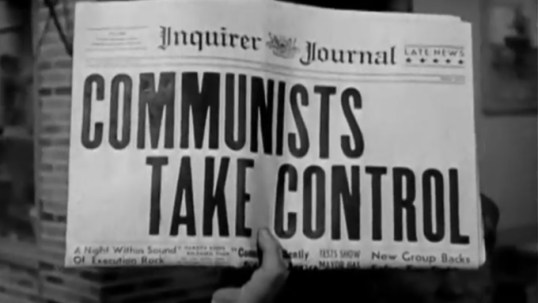
Well, here’s what the newspaper says:

That’s right!  The communists have taken control and apparently, it only took them a few hours to do it.  The airman somehow slept through the whole thing.  It really does make me wonder whether he’s someone who I really want in an important position when it comes to defending this country.  Sleeping through a communist coup takes a lot of effort.

Fear not, though.  There’s a twist ending.  I won’t spoil it, other than to say that it makes about as much sense as a member of the Air Force sleeping through a communist coup.  You can watch it for yourself:

On the one hand, this film is pure propaganda.  On the other hand, authoritarianism has become very popular lately and not just among communists.   This short film may be heavy-handed but it probably seems a bit less heavy-handed today than it did just a few years ago.  In the film, the enemy is communism.  In real life, the enemy is anyone who would say that freedom of speech and thought should be curtailed.  It’s true that they always have what sounds like a good reason for sacrificing freedom, whether it be to protect the workers or to protect the children or to make the world a safer place.  But, in the end, the main goal is to make sure that only one voice can be heard.

Watch this short film on a double bill with the original Red Dawn.  What a great way to celebrate May Day.

Film Review: Detective Knight: Redemption (dir by Edward Drake)


2022’s Detective Knight: Redemption picks up where Detective Knight: Rogue ended.

After having been arrested in front of his wife and daughter, football player-turned-criminal Casey Rhodes (Beau Mirchoff) has been sent to prison.  In the same prison is Rhodes’s nemesis, former Detective James Knight (Bruce Willis).  Knight has been imprisoned for murdering the two villains from Detective Knight: Rogue, finally answering the age-old question of what happens to an action hero after the end credits roll.  In prison, both men meet Ricky Conlan (Paul Johansson), a former convict who is now a chaplain.  Conlan is big on encouraging everyone in prison to set aside their differences and come together as one big community of sinners seeking redemption.

Meanwhile, as Christmas approaches, New York City finds itself under siege.  Terrorists are dressing up like Santa Claus and robbing banks, chanting “Ho!  Ho!  Ho!” as they do so.  Their leader alternates between handing out candy canes and tossing live grenades at people.  He becomes known as The Christmas Bomber and he announces that he’s only robbing the banks to get back at the 1%.  He’s a revolutionary, you see.

He’s also a prison chaplain.  That’s right, Ricky Conlan is the Christmas Bomber and he’s decided that Casey is going to be newest member of his operation!  He even stages a jailbreak, releasing the entire population of Riker’s onto the streets of New York.  The only prisoner who voluntarily chooses not to escape is Detective Knight.  Impressed by his refusal to escape when he had the chance, NYPD Capt. Anna Shea (Miranda Edwards) arranges for Detective Knight to be released from prison so that he can head up the search for Conlan and the commie Santas.

Meanwhile, Knight’s partner, Eric Fitzgerald (Lochlyn Munro), has traveled to New York to help out with the investigation.  In the previous movie, when we last saw Detective Fitzgerald, he was in the hospital after having been shot by Casey Rhodes.  Fitzgerald may be in a wheelchair now but he’s still good with a gun and he also mentions that the doctors think that he should be able to walk again by Memorial Day.  Fitzgerald doesn’t let being in a wheelchair prevent him from investigating and confronting New York’s power brokers, including the oily mayor (John Cassini).

Detective Knight: Redemption was one of the films that Bruce Willis filmed shortly before the announcement that he would be retiring from acting.  Though he’s definitely the main attraction here and he still looks convincing firing a gun during the film’s finale, Willis’s screen time is limited and it’s also obvious that a stand-in was used for a few of the scenes that involved his character.  There are a handful of fleeting moments where we get to see some hints of the wiseguy charisma that was Willis’s trademark but, for the most part, Detective Knight is written to be a man of few words.  When he made this film, Willis still had his screen presence but it’s still difficult to watch with the knowledge that he was struggling with his health during filming.

With Willis largely sidelined, it falls to Munro, Johansson, and Mirchoff to keep the action moving and all three of them prove themselves to be up to the challenge.  Johansson, in particular, is so wonderfully over-the-top in his villainy that it’s impossible not to be entertained whenever he’s onscreen.  The film’s plot does have a few interesting twists.  Conlan presents himself as being a revolutionary who is dedicated to bringing down the 1% but Casey eventually realizes that, much like Die Hard‘s Hans Gruber, he’s ultimately just a greedy thief.  Conlan’s gang is a mix of hardened escaped prisoners who are looking for revenge on the system and confused kids who quickly discover that the revolution is a lot scarier than they thought it would be.  The story may sometimes be too quick to ask the viewer to suspend their disbelief but the plot moves quickly and, just as he did with Gasoline Alley, director Edward Drake doesn’t allow the film’s low budget to prevent him from choreographing a few impressive action scenes.

Ultimately, of course, the main reason to see Detective Knight: Redemption is that it features a bunch of Santa Clauses chanting “Ho!  Ho!  Ho!” while robbing banks.  Who can resist that?

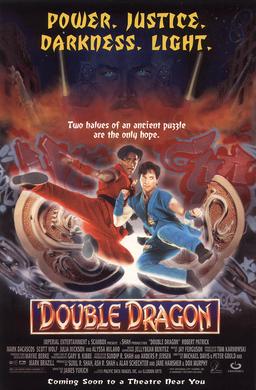
Guilty Pleasure No. 61: Double Dragon (dir by James Yukich)


The time is …. the future!

The future looks a lot like a cheap music video.  Due to repeated earthquakes, California is now an island and Los Angeles has been left in ruins.  The city has been renamed New Angeles, even though the correct name would have been Nuevos Angeles but whatever.  The important thing is that city is now a mess.  The police allow the gangs to run rampant at night in return for not running rampant during the day.  The nightly news, which is anchored by George Hamilton and Vanna White, is full of stories about the federal government refusing to send any more aid to California, despite the fact that Jerry Brown is the Vice President.  For some reason, Andy Dick plays the weatherman and gives continual updates on the smog and rain.

Despite the fact that the city is the most dangerous place on Earth, Satori Imada (Julia Nickson) still makes the time to drive her teenage sons, Billy (Scott Wolf) and and Jimmy Lee (Mark Dacascos, who was clearly not a teenager when this film was shot) to and from their karate tournaments.  However, that might all end because Sartori possesses half of a magic medallion and the evil Koga Shuko (Robert Patrick, looking oddly like Sugar Ray’s Mark McGrath) has the other half.  Satori gives her half of the medallion to Billy and tells him that he and his brother must keep it out of the hands of Shuko.

That’s not going to be easy because Shuko not only has control of the local gangs but also the police.  Fortunately, rebel leader Marian Delario (Alyssa Milano) is willing to help out the Lee brothers.  It all leads to a lot of fights, a lot of running, some campy humor, and stiffly delivered dialogue.  For whatever reason, the filmmakers decided that the way to make this marital arts film a success would be to push accomplished martial artist Mark Dacascos into the background and instead focus on Scott Wolf, who spends most of the movie looking like he’s either confused by the plot or terrified as to what Double Dragon might do to his career.

Yeah, this movie is pretty stupid and the plot is pretty much impossible to follow.  And yet, it is oddly entertaining in its own weird way.  If you ignore the story and just focus on the visuals, it can actually be kind of fun.  Look at all the bright colors.  Look at Robert Patrick, with his goat-tee and his 90s pop star hair.  Look at Alyssa Milano, who, surprisingly, seems to actually be in on the joke.  Look at all of the Mad Max-inspired fashion choices.  From a purely visual point of view, New Angeles is a huge improvement on Los Angeles.  Along with the film visuals, the film is also worth watching just so one can witness just how over-the-top Robert Patrick goes in his performance.  I don’t normally think of Patrick as being someone who chews the scenery but, in this film, he gives into every cartoonish impulse that he has and it’s actually a lot of fun to watch.  There’s not a moment of subtlety to be found in either his performance or Alyssa Milano’s and thank the Angels for that.  Finally, I have to appreciate the fact that the film’s main message appears to be that the government and all other forms of civil authority are basically useless.  Not even Vice President Jerry Brown can be bothered to help out the people of New Angeles.  That pretty much tells you all that you need to know.

In the end, Double Dragon is not a particularly good film but it’s fun in its own deeply dumb way.

Previous Guilty Pleasures

  1. Half-Baked
  2. Save The Last Dance
  3. Every Rose Has Its Thorns
  4. The Jeremy Kyle Show
  5. Invasion USA
  6. The Golden Child
  7. Final Destination 2
  8. Paparazzi
  9. The Principal
  10. The Substitute
  11. Terror In The Family
  12. Pandorum
  13. Lambada
  14. Fear
  15. Cocktail
  16. Keep Off The Grass
  17. Girls, Girls, Girls
  18. Class
  19. Tart
  20. King Kong vs. Godzilla
  21. Hawk the Slayer
  22. Battle Beyond the Stars
  23. Meridian
  24. Walk of Shame
  25. From Justin To Kelly
  26. Project Greenlight
  27. Sex Decoy: Love Stings
  28. Swimfan
  29. On the Line
  30. Wolfen
  31. Hail Caesar!
  32. It’s So Cold In The D
  33. In the Mix
  34. Healed By Grace
  35. Valley of the Dolls
  36. The Legend of Billie Jean
  37. Death Wish
  38. Shipping Wars
  39. Ghost Whisperer
  40. Parking Wars
  41. The Dead Are After Me
  42. Harper’s Island
  43. The Resurrection of Gavin Stone
  44. Paranormal State
  45. Utopia
  46. Bar Rescue
  47. The Powers of Matthew Star
  48. Spiker
  49. Heavenly Bodies
  50. Maid in Manhattan
  51. Rage and Honor
  52. Saved By The Bell 3. 21 “No Hope With Dope”
  53. Happy Gilmore
  54. Solarbabies
  55. The Dawn of Correction
  56. Once You Understand
  57. The Voyeurs 
  58. Robot Jox
  59. Teen Wolf
  60. The Running Man

Retro Television Reviews: See The Man Run (dir by Corey Allen)


Welcome to Retro Television Reviews, a feature where we review some of our favorite and least favorite shows of the past!  On Sundays, I will be reviewing the made-for-television movies that used to be a primetime mainstay.  Today’s film is 1971’s See The Man Run!  It  can be viewed on YouTube!

Two criminals have kidnapped the 18 year-old daughter of Dr. Thomas Spencer (Eddie Albert).  They call the number that they have for Dr. Spencer and they tell the man that answers that they are going to kill his daughter unless he pays them a large amount of money.

What the criminals don’t know is that Dr. Spencer has recently changed his phone number and his old number was given to a struggling actor named Ben Taylor (Robert Culp).  When the kidnappers call, Ben has just gotten out of bed and he’s still a bit too groggy to explain to them that they have the wrong number.  Though he suspects that the whole thing might be an elaborate prank, he decides to call the real Dr. Spencer and tell him about the phone call.  However, when the doctor answers, Ben does such a bad job of explaining the situation that Dr. Spencer thinks that Ben is the kidnapper.  Begging Ben not to hurt his daughter, Dr. Spencer says that he’ll pay anything and that he won’t even call the police.

This gives Ben and his wife, Joanne (Angie Dickinson), an idea.  When the kidnappers call back, Ben pretends to be Dr. Spencer.  After the kidnappers tell Ben the amount of money that they want, Ben then calls Dr. Spencer and, pretending to be the kidnapper, relays the message but he also adds an extra $50,000 to the ransom demand.  Ben and Joanne’s plan is to collect the ransom from Dr. Spencer, take their cut, and then deliver the ransom to the kidnappers.

It’s a complicated plan and, throughout the course of the day, both Ben and Joanne have their moments of doubt.  But they stick with it, because Joanne wants the money and Ben wants the chance to not only prove himself as an actor but to also show Joanne that he’s not the loser that she insists that he is.  Complicating matters, though, is that Dr. Spencer’s wife (June Allyson) has called the police without telling Dr. Spencer.  Though Dr. Spencer doesn’t know it, the cops are determined to be there when he hands off the ransom to the man who claims to have his daughter.

Clocking in at a briskly-paced 73 minutes, See The Man Run is an enjoyable thriller, one that is full of unexpected twists and which features a fierce performance from Angie Dickinson and a rather poignant one from Robert Culp.  Culp is convincing rather he’s playing a kidnapper, a doctor, or just an out of work actor who doesn’t realize that he’s gotten in over his head.  As smart as he may be, Ben cannot escape from his own insecurities and his fear of being betrayed.  It all leads to a diabolically clever surprise ending, one that proves that you can run only so far before you stumble.

Retro Television Reviews: The Feminist and the Fuzz (dir by Jerry Paris)


Welcome to Retro Television Reviews, a feature where we review some of our favorite and least favorite shows of the past!  On Sundays, I will be reviewing the made-for-television movies that used to be a primetime mainstay.  Today’s film is 1971’s The Feminist and The Fuzz!  It  can be viewed on YouTube!

At first glance, Jane Bowers (Barbara Eden) and Jerry Frazer (David Hartman) don’t have much in common.

Jerry is a cop, though he’s attending night school with the hope of someday becoming a lawyer.  Jerry is an old-fashioned law and order man.  He expects the law to be followed.  He’s also the type who definitely believes that there are clear differences between men and women.  As he explains it, there are some thing that men are just better at.  Jerry is dating Kitty (Farrah Fawcett), who works as a waitress at the local Playboy Club.

Dr. Jane Bowers is a pediatrician and a proud feminist, one who takes it personally when a cop like Jerry refuses to give her a parking ticket just because she’s a woman.  She wants to be treated as an equal in all matters.  She’s dating Wyatt Foley (Herb Edelman), an attorney who still lives with his mother and who constantly goes out of his way to let everyone know that he’s an ally.  Jane’s best friend is Dr. Debby Inglefinger (Jo Anne Worley), who has decided that it’s time to lead a protest at the Playboy Club.

The only thing that Jerry and Jane have in common is that they both desperately need an apartment but apparently, apartments were not easy to find in San Francisco in the early 70s.  Fortunately, a hippie (Howard Hesseman) has just been evicted from his apartment because the landlord (John McGiver) didn’t like the fact that he was constantly having overnight guests.  Jane and Jerry both end up at the apartment at the same time, with Jane getting offended by Jerry’s refusal to give her a traffic ticket.  (Jerry makes the mistake of saying that he’s going to let her off “with a warning.”  He wouldn’t give a warning to a man!  Seriously, though, who in their right mind would actually demand a ticket?  Those things cost money.)  Even though they take an instant dislike to each other, Jane and Jerry still decide to pretend to be husband and wife so that they can rent the apartment together.  With their busy schedules, they figure that they’ll never have to see each other.  They won’t even know the other is around.

Of course, it doesn’t work out like that.  Jane allows Debby to hold a consciousness raising meeting at the apartment.  (Future director Penny Marshall appears as a participant.)  Meanwhile, Jerry lets a prostitute (Julie Newmar) stay at the apartment, just to keep her off of the streets for the night.  The landlord is getting suspicious.  So, for that matter, is Jane’s father (Harry Morgan).  And, as you probably already guessed, Jerry and Jane are falling in love.

With its hippies and its militant feminists and its jokes about the Playboy Club, The Feminist and the Fuzz is a film that practically yells, “1971!”  Unfortunately, script’s attempt to turn the film’s rather predictable plot into a Neil Simon-style jokefest never quite works.  The “humorous” dialogue feels forced and the film’s 75-minute run time doesn’t do it any favors, as we never really have the time to get to know Jerry or Jane as human beings.  Instead, they just remain “The Fuzz” and “The Feminist.”  As a result, it’s not that easy to care about whether or not they actually get together.  Some of the supporting performances are amusing.  Barbara Eden manages to avoid turning Jane into a caricature of a humorless activist but poor David Hartman is stiff as a board and in no way convincing as a veteran cop.

The main thing I took away from this movie is that the Playboy Clubs were exceptionally tacky.  Way back in 2011, NBC actually tried to air a drama series that took place at a Playboy Club in the 60s.  (This was when every network was trying to come up with the next Mad Men.)  The pilot started with creepy old Hugh Hefner assuring the viewers that, “Everybody who was anybody wanted to be a member of the club.”  I mean, seriously?  What a strange world.

The TSL Grindhouse: Beyond Desire (dir by Dominique Othin-Girard)


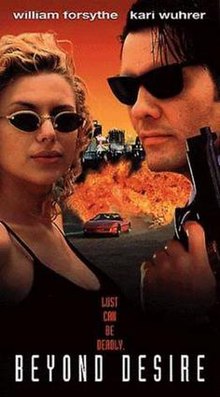
1995’s Beyond Desire tells the story of Ray Patterson (William Forsythe).  He’s spent the last 14 years in jail, convicted of a murder that he says he didn’t commit.  He likes to sing.  He’s obsessed with Elvis.  He claims that he doesn’t know how to drive because he’s been in prison for the last 14 years but he appears to be in his mid-40s so you have to kind of wonder if maybe Ray just wants other people to drive him around.  After all, Elvis never drove himself.

Perhaps because everyone is sick of listening to him as he sings Amazing Grace in his cell, Ray is released from prison.  Since he was serving his time in Nevada, this means that Ray now has to walk down a desert road and hope that someone gives him a ride.  Fortunately, for Ray, a woman named Rita (Kari Wuhrer) pulls up in fancy red car and asks him where he’s going.  Rita explains that she’s always had a fantasy about picking up someone who has just been released from prison.  Ray accepts her offer of a ride and soon, they’re at a desert motel, engaging in saxophone-scored, Vaseline-on-the-lens softcore sex.  Ray may have forgotten how to drive but apparently, he didn’t forget everything during those 14 years he spent in prison.  If nothing else, this film reveals more of William Forsythe than most viewers probably ever thought they’d see.

Soon, Ray and Rita are head to Vegas.  Of course, it turns out that Rita wasn’t quite honest about why she picked up Ray.  Rita is a high-priced escort and she works for a local crime boss named Frank (Leo Rossi).  Frank wants Ray to reveal the location of some stolen money.  Ray, meanwhile, feels that Frank is the key to clearing his name and catching the real murderer.  At first, it seems like everyone is just manipulating everyone else but Rita and Frank do eventually end up falling in love.  Can their love survive bullets and hints of betrayal?

Like many 90s crime films, Beyond Desire is one of those films that was obviously made to capitalize on the success of Quentin Tarantino.  The characters of Ray and Rita are such obvious copies of True Romance‘s Clarence and Alabama that the film comes close to turning into a self-parody.  Ray is a big Elvis fan and occasionally quotes lyrics at inopportune times.  The soundtrack itself is full of Elvis songs, though the budget apparently wasn’t big enough to actually get the rights to any of Elvis’s recordings.  Instead, we get cover versions, the majority of which feel rather wan.  The film emphasizes the garish glitz of the Vegas Strip but none of the quirky beauty of it.  Las Vegas, an adult playground sitting in the desert, is pure Americana.  That was something that was captured by Francis Ford Coppola in The Godfather, Martin Scorsese in Casino and David Lynch in Twin Peaks: The Return.  The film uses Vegas as a convenient backdrop but it has nothing to say about the location itself.

Like the majority of road movies, the film tends to meander a bit.  Ultimately, the road leads to nowhere.  That, in itself, is not necessarily a problem.  The same could be said of Tony Scott’s True Romance or any number of films directed by Wim Wenders.  Unfortunately, this film wasn’t directed by Tony Scott or Wim Wenders.  Instead, it was directed by the guy who did Halloween 5 and the end result is a film that, even when taken as a purely stylistic exercise, still feels rather empty.  It’s a shame because William Forsythe shows off a lot of quirky, bad boy charm in the role of Ray and Kari Wuhrer make Rita into a far more complex and conflicted character than one might expect.  But, unfortunately, the film itself just doesn’t live up to their performances.

Retro Television Reviews: The Secret Night Caller (dir by Jerry Jameson)


Welcome to Retro Television Reviews, a feature where we review some of our favorite and least favorite shows of the past!  On Sundays, I will be reviewing the made-for-television movies that used to be a primetime mainstay.  Today’s film is 1975’s The Secret Night Caller!  It  can be viewed on YouTube!

Though the show pretty much guaranteed that he would forever be a part of the American pop cultural landscape, Robert Reed was not a fan of The Brady Bunch.  Onscreen, Reed played Mike Brady, the stern patriarch who always knew the right thing to do and who, as a result, was named father of the year by the local chamber of commerce.  (Of course, even though she was responsible for him getting the reward, Mike still grounded Marcia for sneaking out to mail in his nomination forms.)  Offscreen, Reed was notoriously difficult, complaining that the scripts for the show were juvenile and shallow.  Reed was correct and it should be noted that all of the actors who played the Brady kids have said that Reed never took out his frustration on the cast and actually became a bit of a surrogate father to all of them.  Still, you have to wonder what Reed was expecting when he signed up for a show that was created by the man responsible for Gilligan’s Island.

The Brady Bunch was cancelled in 1974, temporarily setting Robert Reed free from the burden of playing Mike Brady.  (Of course, he would later return to the role in The Brady Bunch Hour and we all know how that turned out.)  One of the first post-Brady movies that Reed starred in was The Secret Night Caller.   

In this film, Reed plays a seemingly mild-mannered IRS (booo!) agent named Freddy Durant.  Freddy has a good career and a nice home but he’s deeply unsatisfied.  He barely communicates with his wife, Pat (Hope Lange).  He freaks out over his teenage daughter, Jan (Robin Mattson), wearing a bikini.  He fantasies about hitting on almost every woman that he sees.  He hangs out at a strip club and, when he’s really feeling unsatisfied, he makes obscene phone calls!  Because this is a made-for-TV movie from the 70s, we never actually get to hear what Freddy says on the phone but he manages to disgust and/or horrify everyone who has the misfortune to answer his call.  He even calls a woman who works in his office, scaring Charlotte (Arlene Golonka) so much that she subsequently has an auto accident.  Unfortunately, for Freddy, one of his victims, a stripper named Chloe (Elaine Giftos), recognizes his voice and tries to blackmail him.  Freddy’s life is falling apart.  Can his psychiatrist (played by Michael Constantine) help him put it all back together again?

Freddy Durant is obviously meant to come across as being the exact opposite of Mike Brady.  (Of course, many of us who have seen The Brady Bunch have our suspicions about what Mike was actually doing in his office….)  Whereas Mike Brady was the perfect father, Freddy is cold, distant, and repressed.  Reed is convincingly uptight as Freddy and he’s surrounded by a fine supporting cast, including Sylvia Sidney as his disapproving mother-in-law.  That said, it’s still impossible to watch this show without thinking to yourself, “There’s Mike Brady making an obscene phone call.”  That’s the difficulty of typecasting unfortunately.  For all of his efforts to escape the shadow of the Brady Bunch, it’s impossible not to associate Robert Reed with the show, even when he’s talking dirty on the phone.