In 2009, the crusading newspaper publisher, J. Jonah Jameson, was elected Mayor of New York City. At least, that’s what happened in Amazing Spider-Man #591.
It didn’t turn out well, of course. Mayor Jameson spent too much time obsession on Spider-Man and not enough time fixing the subways. He was bombastic, stubborn, and refused to admit when he was wrong. That shouldn’t have taken anyone by surprise. New Yorkers knew what they were getting when they voted for him but they elected him anyway. Of course, in 2009, the idea of a buffoon like J. Jonah Jameson ever holding a major political office seemed like a fantasy. Today, Jonah would fit right in with the majority of the people in Washington.
As mayor, Jameson ended up getting manipulated by both Doctor Octopus and the Green Goblin. It’s no wonder that Mayor Jameson failed to even finish his first term before having to resign.
I was sorry to hear that Neal Adams, the great comic book artist who revitalized Batman and who was a tireless advocate for creator’s rights, passed away yesterday at the age of 80.
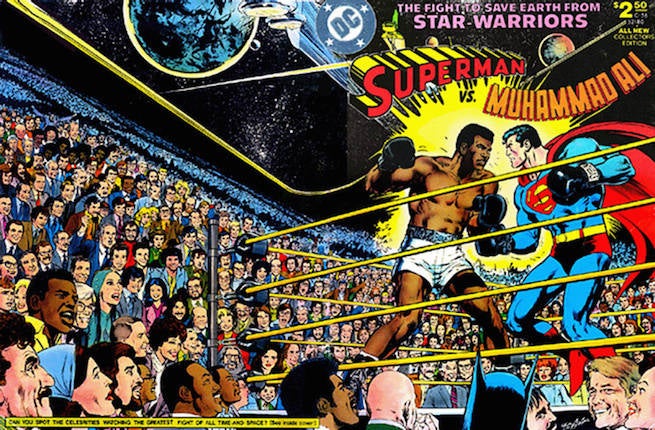
This is my favorite Neal Adams cover and I know I’m not alone. From 1978, here is Superman vs. Muhammad Ali.
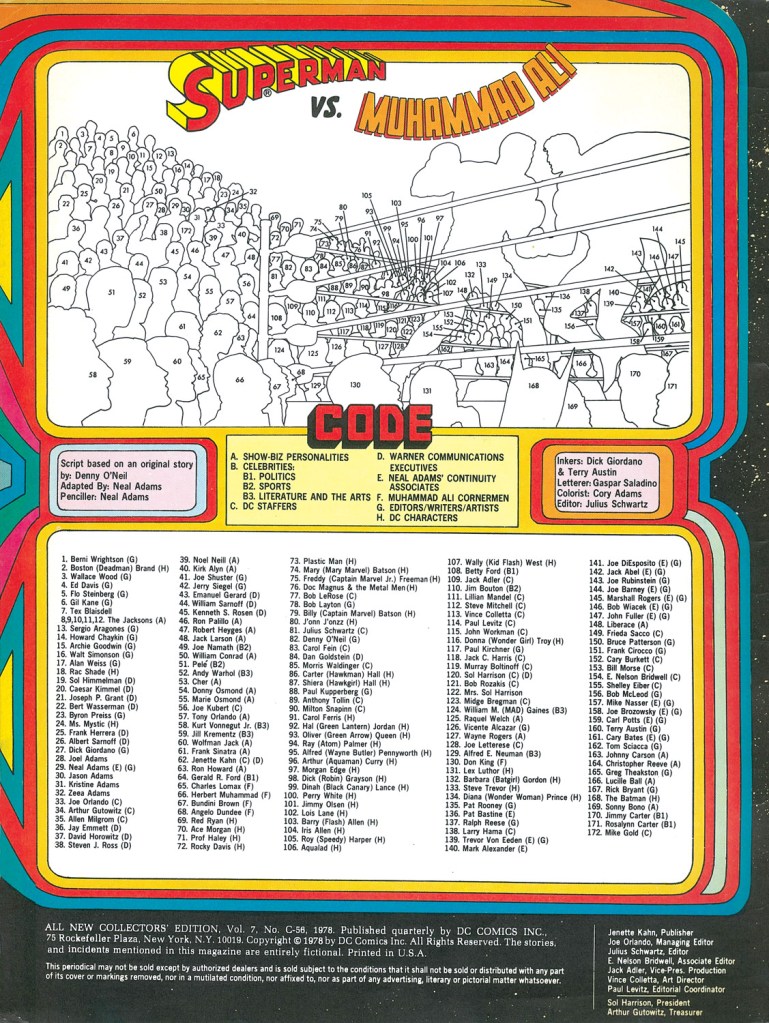
Though Superman vs Ali is the main attraction, the cover features everyone from Batman to Telly Savalas to Sonny Bono to Jackie Onassis to just about everyone else was somebody in the 1970s.
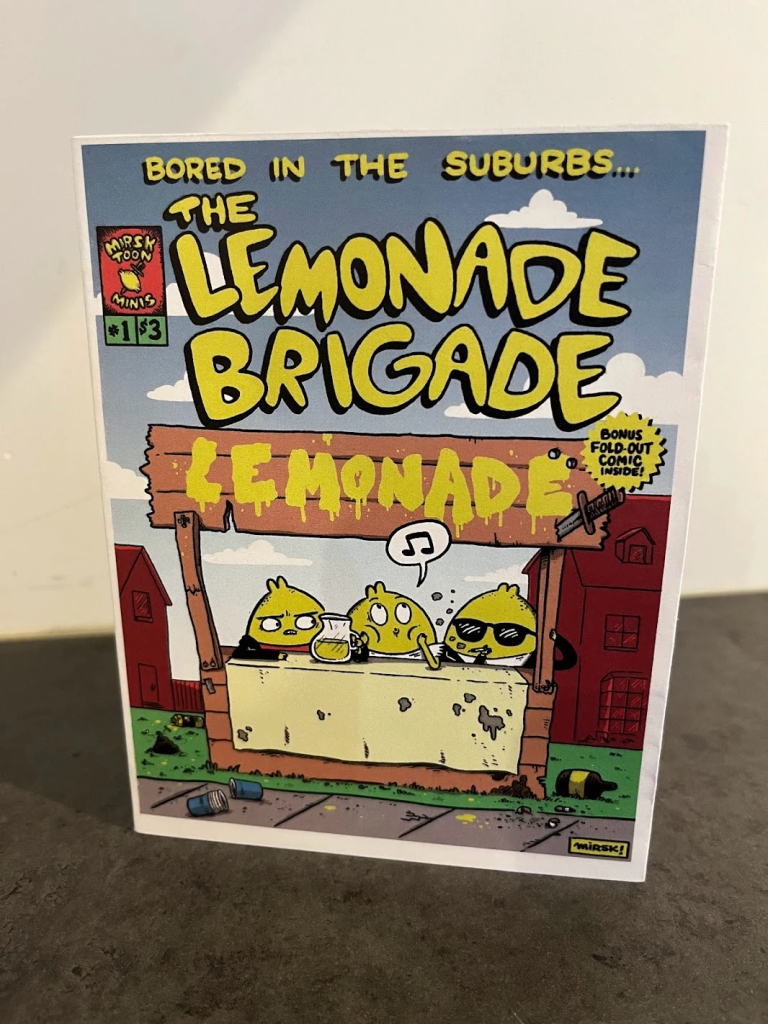
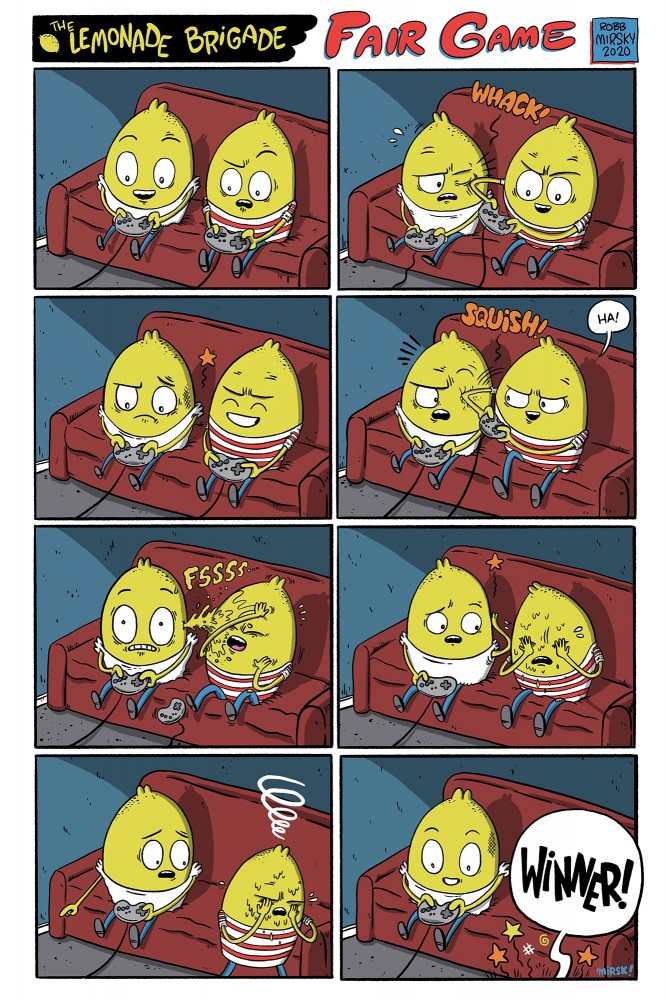
The “tag line” above the title of Robb Mirsky’s new self-published mini The Lemonade Brigade tells you right away that he gets it : why do kids in the suburbs tend to get themselves into any kind of trouble they can find? Because they’re bored — and they damn well should be! When you’re surrounded by people (or, in this case, lemons) who have traded in happiness for the single-dullest approximation of security one can imagine, people who are literally running out the clock on their own lives, you’ll do anything to relieve the tedium. Especially, I suppose, if those people are your own parents.
To that end, most of the juvenile delinquency on offer in these pages is as utterly pointless as such acts of quasi-rebellion tend to be in real life : nobody’s got the brains or ambition to really throw a spanner in the works of the system, so they just “tag” the same walls with graffiti over and over again (among other ultimately pointless endeavors), not so much actively hoping to get caught as they are not really giving a fuck either way. After all, the question of “Why did you do it, son?” is one that only has one answer in suburbia : “Because it was something to do.”
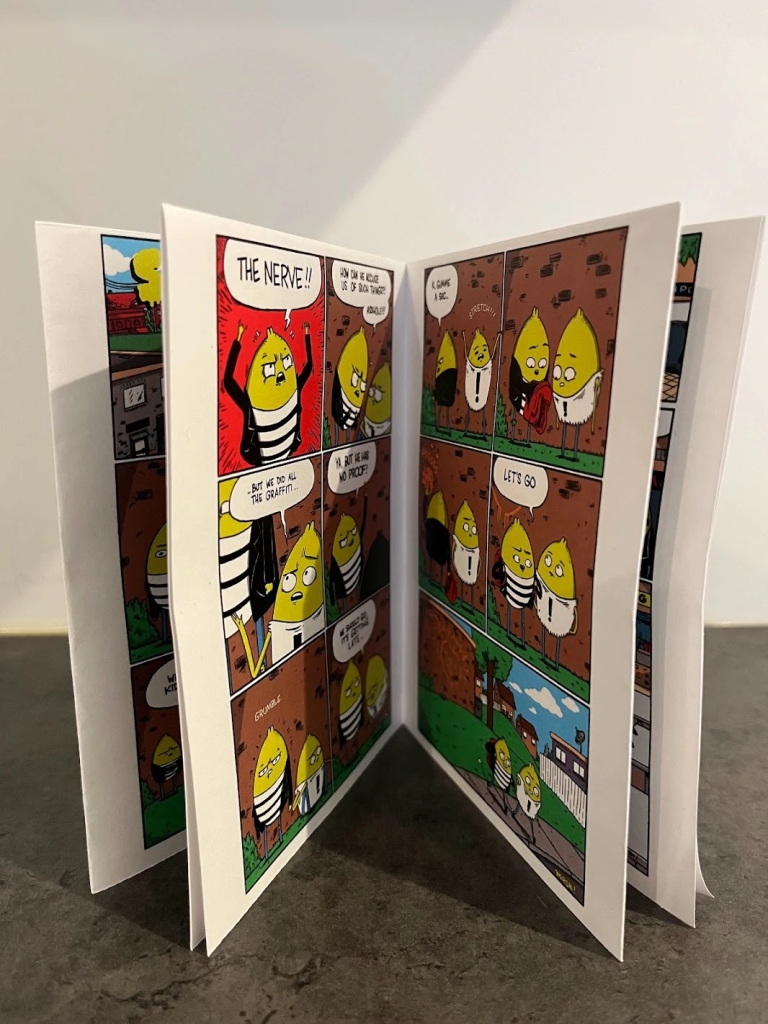
So, yeah, apart from the fact that these comics feature citrus-based life forms, they’re eminently relatable to anyone who either had or is having a standardized, routine upbringing in a consumer-driven community centered around the principle of protracted soul-death on the installment plan. I laughed at something on every page, and that’s basically a Mirsky staple — even if this comic, for entirely practical (yet no less innovative for that fact) reasons actually has no staples. Ya see, what it has instead is something much better : a “B”-side comic of the following strip presented in fold-out form :
Okay, fair enough, it’s a gimmicky idea — but that doesn’t preclude it from being a cool one. Which is also a feature common to all things Mirsky : he has a habit of reminding you why you like certain things simply because he does them so damn well. “Old hat” ideas like muck monsters and anthropomorphic stands-ins for human beings seem fresh, new, and fun again when he’s doing them because he has an uncanny knack both for zeroing in on why these sorts of gimmicks (there’s that word again) were both fun and effective in the first place , and for tossing aside the extraneous baggage that they’ve been saddled with over the years that’s sapped all that fun and effectiveness out of them. They say that everything old is new again, and I suppose that’s true or they wouldn’t keep saying it, but it takes a special talent to make a reader glad that it’s new again. I humbly submit that Mirsky is, indeed, a special talent of precisely that sort.
Looking at things more broadly, it’s fair to say that slapstick gets a bad rap in these pseudo-sophisticated and painfully self-aware times we live in, but when it’s done smartly, and has a point? It’s not only still funny and salient in equal measure, it’s also fiendishly clever, especially when it’s of the painfully obvious “I wish I’d thought of that — in fact, why didn’t I?” variety. All of which is to say that the observations at the beating heart of these gag strips well and truly don’t require any sort of special level of insight — but they most certainly do require skilled comedic timing and a mastery of “Comics 101” visual storytelling basics in order to land properly. If, then, you’re the sort of person who values and appreciates sheer old-school cartooning skill, you’ll find this charmingly unassuming mini to be one that you derive a fair amount of honest-to-goodness joy from.
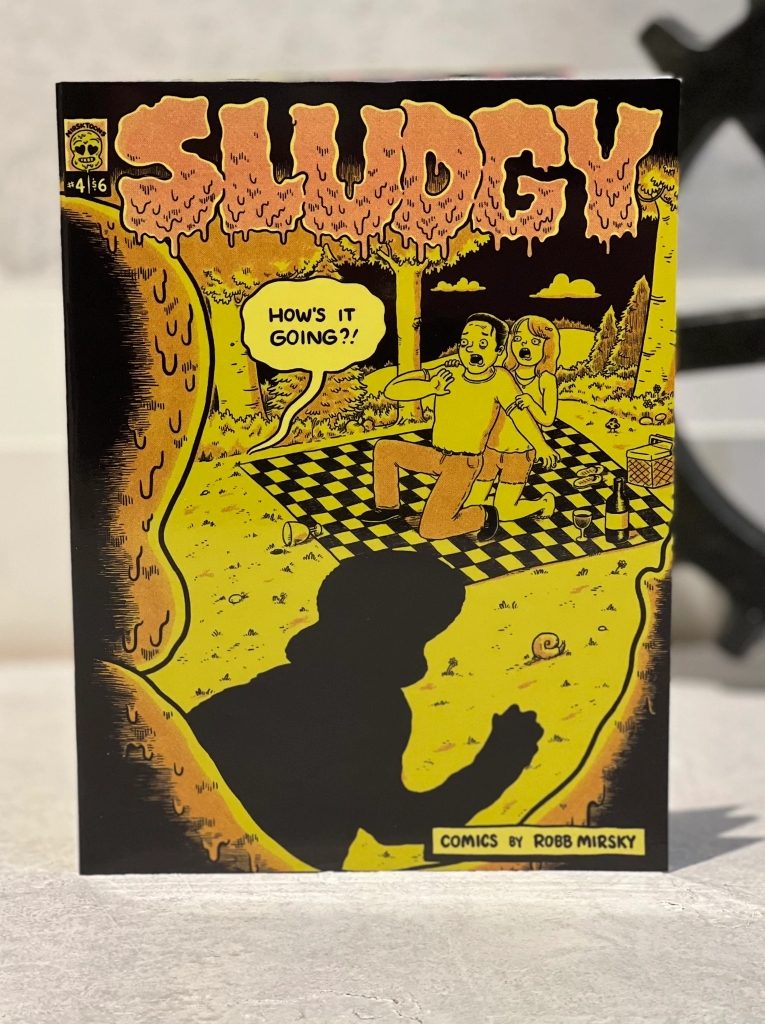
And speaking (again) of muck monsters, Mirsky has also just released the latest and greatest issue of his infectiously likable series Sludgy, which is #4 to be precise, and you don’t want to pass on that, either. I have, however, talked about that title plenty in the past, so I made it my goal this time out to demonstrate to you, dear reader, that this guy is much more than some one-trick pony. He’s the real deal, and he’s making some real good comics.
Also, this review is “brought to you” by my Patreon site, where I serve up exclusive thrice-weekly rants and ramblings on the worlds of comics, films, television, literature, and politics for as little as a dollar a month. Subscribing is the best way to support my continuing work, so I’d be very appreciative if you’d take a moment to give it a look by directing your kind attention to https://www.patreon.com/fourcolorapocalypse
Modestly billing itself as a “12-page three color risograph scifi comic,” Brooklyn-based cartoonist Austin MacDonald’s self-published mini The Emperor’s Chamber certainly is all of those things, but it sells itself short by not, at the very least, calling itself “charming” or “trippy” or “charmingly trippy” or something along those lines. It’s also more than a tad innovative in its transition from traditional line artwork to Claymation-styled digital (I’m assuming, at any rate) stuff and back again. But I suppose I’m getting a bit ahead of myself.
Still, that’s a good sign that I have a fair degree of enthusiasm for this gorgeously-produced little comic (all rich riso tones that absolutely sing on the parchment-style paper stock MacDonald uses), and so I do : it’s simple, sure, but agreeably so, and utilizes what I’ll call for lack of a better term “Peow Studio-style art” much more effectively than many a publication from Peow Studio itself, so yeah — I was impressed. Certainly MacDonald demonstrates a slid grasp of visual storytelling principles and is making real progress from one project to the next — Finger Flip! was fun, his contribution to the Weird Futures anthology was even better, and with this he continues to up the ante, as well as find his footing and a unique authorial voice.
Which isn’t to say this story about an understandably disgruntled member of the palace guard who follows our titular emperor behind a curtain into his equally-titular chamber and discovers a mystical realm beyond his imaginings (as well as the reason the kingdom’s ruler appears so utterly zonked-out half the time) is in any way original, but that’s okay — MacDonald’s approach to the material is, and more often than not that’s plenty sufficient when one is plying their trade in a shop-worn genre such as fantasy.
In a pinch, then, what I’m saying — or at least attempting to — is that MacDonald’s eye-catchingly cool multi-media art really does imbue these proceedings with a sense of the fantastic and that his wry, understated wit grounds them in relatability. It’s the best of both worlds in a tidy, concise, carefully-crafted little package that literally doesn’t waste a line — of art or dialogue.
One could be forgiven, I suppose, for thinking this all sounds a bit “old wine in new bottles,” and maybe it is, but shit — it’s still wine, and that stuff’s pretty good. The same can be said for a well-constructed genre story, and if I’m being completely honest here (hell, it’s my blog, so there’s no reason not to be), I’m actually more than a bit tempted to call this an impeccably-constructed genre story. Or perhaps I just did. What matters even more, though, is that I think you, dear reader, are likely to feel the same once you’ve read it.
So read it you should, and I earnestly hope that you will. MacDonald is an interesting and exciting emerging talent well worth keeping an eye on, as well as somebody who knows how to make a comic that is both marvelous to look at and fun to read. If there’s a long-form epic of some sort percolating away in his mind, that’s terrific and I’ll be more than game to check it out, but if he wants to continue honing and developing his skills with more short-form works, there’s certainly no shame in that. The world needs more comics like this one, and I think this cartoonist has more of them in him.
Also, this review is “brought to you” by my Patreon site, where I serve up exclusive thrice-weekly rants and ramblings on the worlds of comics, films, television, literature, and politics for as little as a dollar a month. Subscribing is the best way to support my continuing work, so I’d be very appreciative if you’d take a moment to give it a look by directing your kind attention to https://www.patreon.com/fourcolorapocalypse
Like a bolt out of the blue, multimedia artist Henry Crane’s first (and, to his credit, first self-published) comic, the generously and gorgeously oversized Late In The Years, hit toward the tail end of 2021 — and proceeded to sit on my monstrously-proportioned “to be read” pile until just a couple of weeks ago. Which is my loss, really, because this isn’t just a good comic, or a great comic — it’s a fucking tour de force, which is not a term I invoke lightly or, for that matter, particularly often. To my (admittedly dubious) credit, however, I’ve since made up for my tardiness by reading the thing six times.
All of which, I suppose, is my way of saying don’t be like me — when you get this comic, read it right away. But then, uhhm, go ahead and be like me and read it a whole lot, over and over (and over) again.
What Crane has created here is, at its core, essentially a Lovecraftian horror tale about a couple that becomes understandably (at first) obsessed with a dark plume of smoke that appears overhead in the sky, but it diverges significantly from HPL in that explores relationship dynamics to a significant degree as things go from plenty goddamn bad to a whole lot worse. Curiosity is one thing, after all, but there’s more than one way to lose your life to it, and as this cautionary fable amply demonstrates, a quick and accidental kill is probably preferable to the slow-burn process of becoming subsumed by one’s own unhealthy fixation.
Still, that’s only the barest of bare-bones synopses, but given that this comic only clocks in at 16 pages it’s entirely fair to say that saying more would, by definition, be saying too much. What I will give away, though, is the general character of the story, which is one of intense foreboding narratively and visually, with Crane succeeding wildly at creating a hermetically-sealed and woodcut-styled world where perils both seen and less so aren’t just lurking around every corner, but literally surrounding our protagonists in all ways at all times. The near-painfully intricate detail he brings to every panel is something to behold and then some, and reflects perfectly the tonal atmosphere of seductively dark immersion that permeates all we see, read and, most crucially, feel in these pages. Which would give the book plenty of reason to recommend it if Crane stopped right there, but then he pulls a maneuver that is just downright gutsy — and absolutely makes his “make or break” moment.
Again, I’m loathe to say too much — or even to say much of anything — but insofar as a short-form (but, again, physically huge) comic can be said to have “acts,” Crane’s third rips things right open as he transitions into color artwork and delivers and accompanying narrative shift that not only complements, but magnifies, the visual one. By the time you’re done, you’ll be in an entirely different mental space than you were when you started out, and your first instinct will probably be to go right back to the beginning just to make sure you really did experience what you just experienced.
You did, of course. But you can be forgiven for needing confirmation simply because this, while echoing the work of others to a certain degree (I’m thinking not only of HPL here but of Charles Burns, Jess Johnson, Penny Moran Van Horn, and certainly Thomas Ott), is quite unlike anything you’ve experienced before. A powerful new voice in cartooning has arrived, fully-formed, at 25 years old. Where Crane goes next is anyone’s guess, but you can bet your bottom dollar that I’ll be along for the ride.
Also, this review is “brought to you” by my Patreon site, where I serve up exclusive thrice-weekly rants and ramblings on the worlds of comics, films, television, literature, and politics for as little as a dollar a month. Subscribing is the best way to support my continuing work, so I’d be very appreciative if you’d take a moment to give it a look by directing your kind attention to https://www.patreon.com/fourcolorapocalypse
It’s not too terribly often that I come across a comic that I don’t necessarily feel all that qualified to opine on, but I may have found one here — or, rather, one my have found me, given that cartoonist Vickie Smalls submitted the new nightmarish (a term I use with precision) horror mini Queen Of Knives, released under the auspices of his own Nowhere Comix imprint, himself, probably knowing full well that it falls well outside my usual stylistic wheelhouse. Points, then, for bravery on Smalls’ part on the one hand, and for giving this critic a good, solid nudge outside the old comfort zone on the other. They do say, don’t they, that steps outside the nest are good for a person from time to time? With that in mind, then, let’s get down to brass tacks as I attempt to define what’s different about this book —
If forced to put my finger on it, I’d say it all boils down to methodology : I’m a bit of a relic, stuck in the old pencil/brush/pen way of doing things, while Smalls is very much an artist of the here and the now, utilizing things like computerized lettering fonts and digitally-inserted background patterning that, if I’m being honest, tend to take me out of a comic to one degree or another. Which doesn’t mean this is a poorly-done example of the type of comic it is by any means, only that the type of comic it is really doesn’t conform to my individual sensibilities as a reader. Not that it’s obligated to, mind you — it’s not art’s job to meet you on your level, but to sufficiently light a fire under your ass so that you feel compelled to meet it on its level. And in that respect, this is a work that makes some of the necessary moves in that direction.
Transcribed both narratively and visually from one of Smalls’ recurring nightmares, which sees him assume the role of a little girl stuck in a haunted castle whose heart is about to be eaten by a Cruella De Ville-esque wicked queen (of knives), the requisite otherworldly quality necessary to pull something such as this off is certainly present and accounted for — events proceed in vaguely linear fashion, and are “easy” (if that’s the term we want to use) enough to follow, but nothing on offer is at all logical, despite the fact that it makes plenty of internally-coherent “sense.” It seems to me that this is a pretty fair approximation of how dreams — both good and bad — operate, and certainly no one would argue that this is a “dull” comic. Hell, it’s downright interesting in the way that being exposed to the flotsam and jetsam of another person’s subconscious frequently is : far-out place to visit, wouldn’t want to stay and all that. Throw in a pleasing middle-finger-to-conformity vibe that runs throughout, and all in all I can’t you you won’t have a pleasant enough time being exposed to all this unrepentant unpleasantness.
But it does look and feel more than a bit inorganic, mechanical, and for me that’s just a hump I have a tough time getting over/beyond/past/whatever. Again, this really isn’t a reflection on the work itself, which for all I know could be a top-notch representation of this particular type of comics creation — it’s just a matter of personal preference and, since this is my blog, a point of personal privilege. What I do feel confident enough to say is that if this kind of “new school” approach is to your liking, then this is a comic that you’ll probably like quite a bit.
And the story, in case I’m not being clear enough about this, grabbed me just fine. The bones I have to pick (maybe not the best choice of words when it comes to a comic that flirts with cannibalistic themes and imagery?) here are purely aesthetic and, of course, entirely subjective. The art samples included with this review should be more than enough to let you form an opinion as to whether or not this looks like your kind of thing, and if it is, then I really can’t think of any reason why you shouldn’t buy it. A fair amount of heart went into making it, that much is obvious, even if our erstwhile heroine is without one by the time all is said and done.
Anyway, what the hell do I know? I guess the answer to that depends on who you ask. I’m glad Smalls asked me for my opinion — I just wish that I had a firmer grasp on what that opinion was after I finished reading this comic.
Also, this review is “brought to you” by my Patreon site, where I serve up exclusive thrice-weekly rants and ramblings on the worlds of comics, films, television, literature, and politics for as little as a dollar a month. Subscribing is the best way to support my continuing work, so I’d be very appreciative indeed if you’d take a moment to give it a look by directing your kind attention to https://www.patreon.com/fourcolorapocalypse
There’s a very certain thing that Charles Glaubitz does that’s utterly unique to his work, which is to say : he picks up the “New Seed” or “Children Of The Monolith” concept introduced by Jack Kirby in the pages of his 2001 : A Space Odyssey series, filters it through a decidedly Mexican cultural lens, adds in plenty of inspired touches of his own creation, then goes all-out to make sure it’s printed and presented in the highest quality manner possible. The end result? Comics that are — quite literally — out of this world.
If there’s one potential “knock” against Glaubitz, though, I suppose it could be that his work tends to tread fairly similar thematic and conceptual ground, but sheesh — who are we kidding? The cosmos is this guy’s playground, and last I checked, that’s a pretty big place that contains within it any number of stories to be told, and one of those stories — perhaps the most remarkable in Glaubitz’ ouevre to date — is currently playing out in the pages of his self-published series Once Upon A Time In Tijuana. And it’s my distinct pleasure to report to you that this is both a more personal take on the artist’s well-established concerns/concepts and the culmination of everything he’s been working toward these past several years all in one go.
Admittedly, I’ve only read the first issue, and apparently three of them are now available, so I don’t have a full “sample size” to base my review/reaction upon, but holy shit if #1 didn’t blow me away sufficiently to sit down and write about it just on its own merits. Needless to say it’s gorgeous, with each generously-proportioned page filled to bursting and beyond with art that is by turns hyper-realistic, intuitively literate, and altogether visionary in both approach and execution — calling it “neo-psychedelic” seems fair enough in a pinch, but at the same time still far too limited. This is a Cinco De Mayo celebration splashed out across the heavens as seen and recorded by somebody who’s ingested a downright heroic quantity of hallucinogens before doing their best to commemorate their impressions on paper. Birth, death, rebirth — even absent words, the art in this comic alone would be enough to tell you that we’re grappling with the entire spectrum of all of existence (and non-existence) here.
So, like, what’s it really about — as in, specifically? Well, again we have to start with the “New Seed” or “Star Seed” premise, only this one’s time may have come and gone — or could very well be in the process of starting over. As a child falls from the sky ( keep in mind, please, that up and down are more metaphorical than physical in this comic) he reflects back on his life, even his embryonic pre-life, in somewhat linear fashion, but given that linearity is out the window (I mean, how do you explain a kid who’s apparently led a lengthy existence?), I’m probably just equating the idea of a reasonably straight line with the concept of chronological “order” because I’m a simple, three-dimensional being and Glaubitz’ imagination extends at least into the fourth dimension, but anyway — yeah, this is a reminiscence, rooted in visual metaphor borrowed from the animal kingdom, the end result being “realistic” text and “surrealistic” imagery working in juxtaposition to create something both undeniably true and altogether fantastic. And it’s a journey that takes us, by issue’s end, to Tijuana. Almost.
Don’t anchor yourself too firmly to dull consensus “reality” if you want to get the most from this book, obviously, but hey — that’s just good advice in general, is it not? In the same way that “don’t pass on a Charles Glaubitz” comic is, I suppose. After all, where else are you really gonna find stuff like this? Scale and scope usually go hand in hand, to the point that the intellectually lazy use the terms interchangeably, but here we have an individual story that’s small in scale with a scope that’s nearly infinite — and, at the risk of sounding too grandiose for my own good, that strikes me as a pretty accurate representation of human life in general. I mean, each of us does contain universes within ourselves, right?
Wiser minds than I have certainly said that for ages now, so who am I to argue? I don’t know a ton about matters metaphysical, anyway — but I like to think that I do know comics. And this is an inarguably inspired one indeed.
Also, this review is “brought to you” by my Patreon site, where I serve up exclusive thrice-weekly rants and ramblings on the worlds of comics, films, television, literature, and politics for as little as a dollar a month. Subscribing is the best way to support my continuing work, so I’d be very appreciative if you’d take a moment to give it a look by directing your kind attention to https://www.patreon.com/fourcolorapocalypse
And so, dear friends, I return — and what a ‘zine to end the my little hiatus with! Brooklyn-based cartoonist Andrew Alexander has been impressing your host/critic with his self-published diary comics for the last couple/few years, but as unlikely-at-first-glance as it may seem, his latest Cram Books-published collection of charcoal drawings depicting scenes from various movies and TV shows on heavy construction-type paper, Screened In Exile, is, if anything, even more personal in nature than his memoir-oriented work. That’s because these aren’t “just” drawings — they’re drawings with a story behind them and a purpose to them.
Which, I suppose, is my cue to elaborate a bit more, but why listen to me blather on when the artist himself explains things far better than I ever could? And so we now, unbeknownst to him, turn the floor over to Mr. Alexander —
What’s equally remarkable to the compelling backstory that informs this collection, though, is the degree to which Alexander captures not only the essential character of, but his own emotive responses to, memorable instances from Jackie Brown, Cool Hand Luke, The Long Goodbye, Mean Streets — hell, even such generally-more-middling fare as Justified and Mad Men. Alexander’s perspective, and the circumstances behind it, result in a truly immersive experience for readers, one informed by factors both within and without the content being delineated and communicating something very much like what it means to watch a film or TV program from someone else’s vantage point. Simply put, you’ll recognize most of what’s in here, but you’ve never seen it like this before.
Which brings us, in a very real sense, to a language barrier of sorts — not that this ‘zine is printed in French or Spanish or something, mind you, no : this barrier is both more subtle and more impenetrable. I guess what’s I’m struggling to say is that Alexander’s drawings don’t evoke feelings that are easily translated into words so much as they just evoke, well, feelings themselves — sensory memories that are sifted through the prism of someone else entirely and reflected back in ways as utterly new as they are utterly familiar. Again, the best method of demonstration is probably for me to just shut up for a second and provide a sample page —
Droll details can’t capture the sheer intent that literally seethes from these pages, as anyone who’s ever spent time looking at strictly photo-referenced illustrations can tell you. I’d be curious, in fact, to know how many of these were drawn from sheer memory alone and how many relied on the aid of a remote control “pause” button, but maybe it doesn’t matter all that much in the final analysis : after all, honesty and exactitude are hardly one and the same thing. Alexander’s representations of media occupy a space all their own, his space, and in that space, artistic methodologies and artistic outcomes are intertwined in ways that transcend the simple equation of “well, I did this in order to produce that.” Am eloquent explication of what those ways are again leads me to a linguistic impasse, but I’m okay with that : after all, a good magician never reveals his or her tricks, and I’d be lying through my teeth if I said there wasn’t something very akin to magic going on in this book.
As a critic, then, am I inadequate to the task of telling you why this is such a special collection — one that I freely admit to having spent several hours poring over? Well, perhaps, but I guess we all meet our match at some point. And while closing this review by paraphrasing Jack Kirby’s famous “Don’t Ask — Just Buy It!” tag line is arguably less than a work this wholly remarkable deserves, it also seems oddly appropriate, because asking too many questions ruins the spell Alexander casts here, and you really do need to buy it.
Also, this review is “brought to you” by my Patreon site, where I serve up exclusive thrice-weekly rants and ramblings on the worlds of comics, films, television, literature, and politics for as little as a dollar a month. And yes, I always keep it updated, even when I’m taking a break from this site. Subscribing is the best way to support my continuing work, so I’d be very appreciative indeed if you’d take a moment to check it out by directing your kind attention to https://www.patreon.com/fourcolorapocalypse
This is from the 4th issue of 1994’s Marvels, in which Kurt Busiek reimagined the early history of the Marvel Universe through the eyes of photographer, Phil Sheldon. The artwork is by the amazing Alex Ross.
On this page, Spider-Man is climbing up the Daily Bugle. That’s something that happened frequently in Spider-Man’s own comics but Marvels was the first comic to capture what it would be like for the ordinary people inside the building to suddenly look over and see Spider-Man, complete with a wrinkled suit, climbing up the outside windows. Long before any of the movies were released or the PS4 game meticulously recreated New York, this page from Marvels made Spider-Man seem real.
In the immortal (at least by my admittedly inexpert estimation) words of the just-recently-reemerged Roland Orzabal, “Don’t you just love a happy ending? Yeah, well so do I.” And if I may add a caveat of my own to that lyric : I especially love them when they’re earned.
And if there’s anyone who has earned one, it’s our titular Acid Nun herself, Annie, who’s travelled through every level of cosmic hell and then some in her search for reunification with cohorts/lovers Elinore and (yes, that) Baphomet, and in many ways the worst is yet to come in the pages of the newly-self-published Acid Nun #3 — but so, thankfully, is delicious comeuppance and joyous homecoming. I know, I know — sic the spoiler police on me.
Still, in my defense, I’ll say that I’m deliberately treading lightly here in terms of specific plot details, and really the plot’s never been a complex affair in Halbert’s now-concluded trilogy anyway — its themes, however, certainly are, given that they revolve around abuse, alienation, longing, self-acceptance and self-love, and even (to the consternation of some, I’m sure) the “big two” of sex and death. Primarily, though, I think Halbet’s principal concern — one filtered through her own utterly unique view of various pagan and pagan-adjacent magickal traditions (most especially, this time out, the tarot) and genuinely decadent blend of the sexual and the psychedelic — is exploring what it really means to be your own, authentic self, and to make your metaphorical home within that inviolable sphere that you create.
Talking of home — they do say that’s where the heart is, and in Halbert’s case that means it’s right here in these pages. She mentions in her afterword (by the way, the “bonus” material here also includes stunning pin-up artwork by Haleigh Buck, Katie Skelly, and Dead Meat Design) that she put her all into this project, but with all due respect, there was no need to say so : the proof was there in every layout, ever line, every design, and certainly in every color choice. This has been one of the most visually arresting comics in recent memory from the outset, and the degree to which Halbert has seen each sumptuously-rendered page as a challenge to herself to keeping upping the creative ante is equal parts obvious and awe-inspiring. Flipping back through the first two issues in preparation for reading this finale was literally a process of charting and mapping one artist’s growth (both in terms of technique and, more importantly, confidence) right in plain sight.
I know, I know, I’m gushing like a fanboy, but my goodness, just look at the pages included with this review that I lazily (but legally) purloined from Halbert’s own website — is there any reason why I shouldn’t be? The care and craft that went into creating these images, these characters, this universe is really something to behold, as well as something to treasure. Sure, there is plenty on offer both in this issue specifically and in this series as a whole that will challenge and perhaps upset (before ultimately rewarding, I promise) survivors of awful shit and send the prudish and uptight to the medicine cabinet for a suppository, but most worthwhile art prods, protests, and provokes as a matter of course. Halbert has plenty to say about patriarchy, repression, subjugation, intolerance, and other oppressive forces — but in the end, she beats them all with love. For her story, for her characters, for her art, for her readers (yes, that means you) and, above all, for herself.
“And all your love will shine for everyone” seems the apropos thing to say at this juncture, just to bring things back to where we started this review. Halbert’s love is shining for everyone in this comic, so go on and be good to yourself. Buy it, read it, and love it right back.
Also, this review is “brought to you” by my Patreon site, where I serve up exclusive thrice-weekly rants and ramblings on the worlds of comics, films, television, literature, and politics for as little as a dollar a month. Subscribing is the best way to support my continuing work, so I’d be very appreciative if you’d take a moment to give it a look by directing your kind attention to https://www.patreon.com/fourcolorapocalypse