I’ve been hyped and itching to get my hands on Battlefield 3 for months now, but still have a little over 2 months to go before I get that chance. Until then EA and DICE (Digital Illusions CE) have come up with another way to tease it’s fans by using Gamescom 2011 over at Germany a new video footage of actual gameplay (using an earlier alpha build of the game). This time around it’s not in-game footage of the single-player campaign. What we get instead is two whole minutes of wargasmic in-game footage showing the game’s multiplayer mode (64-players playing at once over on the PC while the Xbox 360 and the PS3 get 24-player limit for ground fighting).
The footage is of the mulitplayer map simply called “Caspian Border” and it’s a multiplayer game being fought not just between players as foot-soldiers, but also driving armored vehicles, jeeps, tanks and helicopter gunships. But what got me really going is the fact that air-to-air combat with jets. I don’t mean those white-and-green wearing, following the fat, blowhard who has no rings to kiss Jets, but jet fighters performing deadly aerial ballet with their opposing number.
I think if there is ever one reason to pick up Battlefield 3 over Activision’s upcoming title to their juggernaut of a FPS franchise, Call of Duty: Modern Warfare 3, then this gameplay footage with the jets will be one major reason. I may just practice flying those jets for multiplayer and shout “Tally Ho!” over the mike when ambushing another player in their jet.
Battlefield 3 is still set for an October 25, 2011 release date in North America with Europe and the rest of the world getting it the following days.
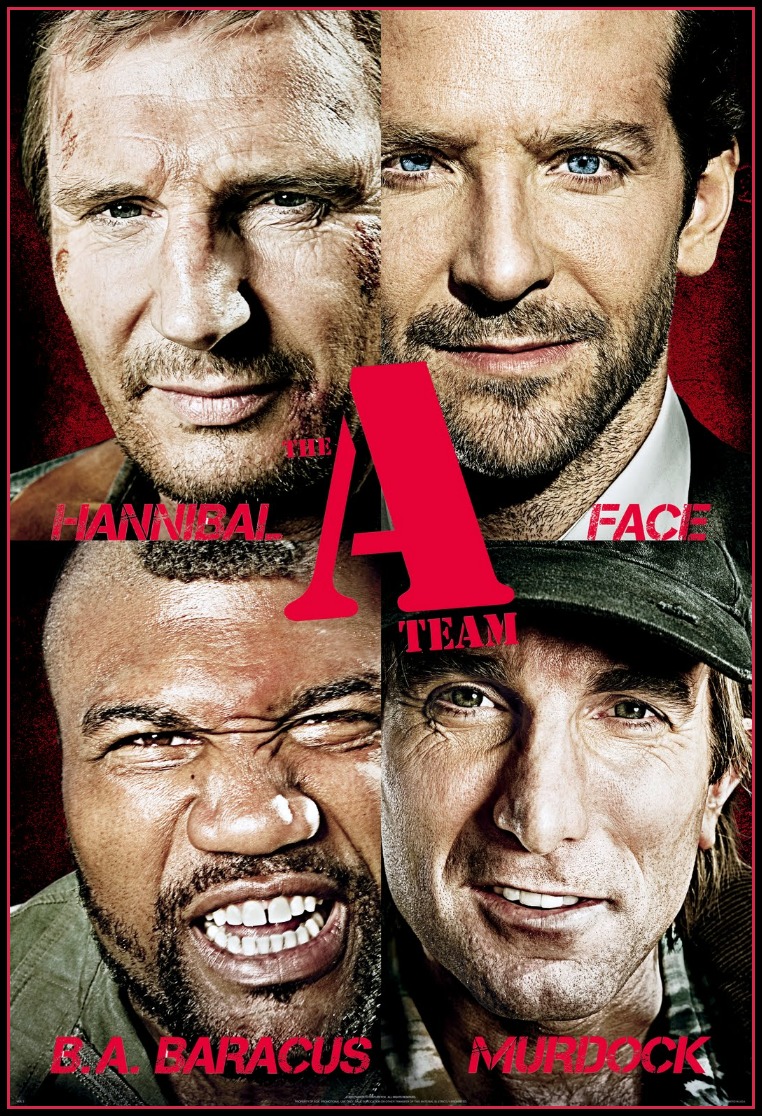
If my memory serves me correctly the year of 2010 ended up becoming the year of the Action Team Flicks. Arriving first was the comic book film adaptation, The Losers, which didn’t do so well. Coming out last was the Stallone testosterone action vehicle, The Expendables, which did much better though it lacked somewhat in the grindhouse it was promising. Smack dab in the middle of these two was the film adaptation of the classic 80’s action tv series of the same name, The A-Team, which in the end I thought was the best of the three Action Team Flicks of 2010.
The A-Team was a film project that once had Mel Gibson attached to it right up to Bruce Willis, but delays upon delays pared back what would’ve been a mega-budgeted action blockbuster into something in the bargain basement (for a summer film). It starred Liam Neeson in the iconic role of Col. John “Hannibal” Smith made famous in the 80’s by George Peppard. Surrounding him would be Bradley Cooper as Templeton “Face” Peck, Sharlto Copley as H.M. “Howlin’ Mad” Murdock and veteran MMA fighter Quinton “Rampage” Jackson as B.A. Baracus. Holding court over this A-Team was filmmaker Joe Carnahan working with a script he, Skip Woods and Brian Bloom (who also had a role as the amoral, sociopathic mercenary Pike).
The film took what was great and fun about the original tv series and gives it a 21st-century upgrade. To say that the film’s plot was secondary to watching the cast having fun on the screen would be an understatement. The story dealt with Smith and his team being accused of a crime they didn’t commit and must now escape from a military prison to find out who set them up and clear their name. It’s straight out of the tv series’ basic premise which managed to last a full on four seasons. Fortunately, Carnahan and his writers only had to make this premise last just a little over two hours. While some may think that two hours would be too long for this film it actually moved quite fast for something that went beyond the two hour mark.
Right from the beginning the cast looked to have been having the time of their lives. Neeson was Hannibal through and through while the other actors making up the rest of the team managed to imbue these well-known characters with their own brand of craziness, absurdity and panache. Just like the other two Action Team flicks of 2010 this film also had it’s share of scene-chewing villains in the form of Patrick Wilson as a duplicitous CIA agent and Brian Bloom as the sociopathic leader of a private military company at odds with Smith and his team. It’s these two groups who end up trying to outguess and outmanuever each other to get that final upper hand. Each encounter between these two groups just got more ridiculous with each passing event.
If one ever wondered if one could fly a tank while it was in freefall then this film answers that question. The climactic showdown at the LA shipyard at night has some of the most over-the-top action of the last couple years that wasn’t a scifi-actioner. Laws of physics doesn’t apply in The A-Team and the film revels in that notion as if telling the audience to either get onboard and enjoy the ride or get off and go on the Toad ride instead.
It’s a shame that The A-Team didn’t do as well in the box-office as some would’ve hoped because the film does set things up for further adventures for Neeson and his crew. What Carnahan ended up making won’t be breaking down the doors to the awards committee, but he did deliver on paying homage to the original tv series while adding his own brand of crazy to a film that had just the right amount of fun, ludicrous action to make it the best of 2010’s Action Team Flicks.
During the weekend it looks like several people saw Final Destination 5 to the tune of over $18million dollars. From what has been said about this fifth entry in the on-going series of Death playing with his food this one was actually quite good and enjoyable. I’ll probably end up seeing it this week, but until then I re-watched my favorite in the series to date: Final Destination 2.
It’s from this second entry in the series that I pick the latest “Scenes I Love” and this scene I still consider the best opening disaster-kill sequence in the series. It’s the opening highway car crash and pile-up which sees one of the best car crash sequence ever put on film since the days of George Miller and his Mad Max post-apocalyptic series. This scene had everything.
tree log vaporizes highway cop
motorcycle crushes it’s rider
stoner’s car get rammed and dies in explosion
mother and son crashes headlong into wreck and explodes
fratboy looking guy being burned alive before huge semi finishes him off
SUV full of spring break college kids rolls over before getting the smi truck treatment
This opening disaster-kill sequence beats out the plane crash from the first, the rollercoaster in the third and the NASCAR disaster in the fourth. I may change my mind once I see the bridge sequence in the 5th but it’ll take a lot for that to happen.
While I find my thoughts on how to continue my review on one of my favorite films of all-time I began to listen to it’s soundtrack for inspiration. So, while listening to the Vangelis composed score for Blade Runner I came across what has to be my favorite track from the many different editions of this film’s soundtrack. This track I picked to be my latest “Song of the Day”.
The track I chose is simply the “End Titles” which plays during the film’s end credits sequence. This version of the Vangelis ambient score comes directly from the Esper Edition of the soundtrack which was a bootleg edition that made the rounds in 2002. More specifically, this version of the “End Titles” track is a demo version of what would finally end up in the film.
Vangelis was one of my favorite film composers growing up and it’s saddening that he hasn’t done as much work in the last decade or so. But then his work on Ridley Scott’s Blade Runner was his best and it’s been difficult to top since. Everything about the “End Titles” track was able to convey each and every genre influence the film would mash together to make it into the masterpiece it has become. It’s ambient and electronic synthesizer melody has hints of film noir and, of course, the very science-fiction the film’s foundation has it’s origins in. This was a soundtrack that was one-of-a-kind and as much as others have tried to copy and emulate it they’ve never succeeded.
I came across this particular AMV (anime music video) while trying to find something else. There really hasn’t been many good AMV’s done with 2010’s hit anime series, Highschool of the Dead, which I find very peculiar. Maybe it’s the extreme ecchi nature paired with zombies which makes some people uncomfortable. I, for one, is not one of those people so I was really surprised when someone made a great AMV from this anime. The latest AMV of the Day is simply titled: “Highschool of the Dead Game”.
The title may be simple, but the video itself ended up looking quite complex in it’s execution. From the mind of AMV creator linnepin007, the video takes the many awesome scenes and sequences from Highschool of the Dead and made it to look like a sizzle reel for an upcoming roleplaying game. The game looks to make each character in the series as a playable one in the game right down to individual stats, character classes and even personal anthems and rally cries.
I know that for some the amount of fan-service in this series ruins it for them and how the series should’ve stuck to just the horror, but this AMV’s creator has realized one thing which has attracted legions of anime fans to this series: it’s fun. This is what this AMV has done to further help sell the series. It highlighted the fun aspect of the anime to ludicrous levels. It helps that the creator used an audio clip from Shaun of the Dead in the very start of the video.
The AMV did well enough that it garnered two awards at this year’s AnimeCon: Editor’s Choice and Audience Choice Awards.
Anime: Highschool of the Dead (Gakuen Mokushiroku)
We’ve now reached the halfway point of the latest season of Torchwood. While the previous four episodes in this season has been quality work there’s been a small, but growing number of the show’s fans who saw the series as not as good season 3, Torchwood: Children of Earth, and that the addition of more American characters and transplanting the team to the US had lessened the show to some degree. I can’t say if these fans are right or not, but this midway point episode goes a long way to really giving Torchwood: Miracle Day the punch it really needed to put the season from just very good to something on the level of season 3.
The team has now split up into three working groups with Gwen headed back to Wales to try and get her ailing father from becoming just another statistic in the so-called “Outflow Camps” being set up by world governments with the help of the pharma-transnational PhiCorp. Her brief reunion with Rhys and her baby girl makes for some fun moments, but it doesn’t last long as Gwen gets right down to the business of “rescuing” her father from the very people tasked to help him. Their plan seemed like something that would never succeed, but seeing the chaos at the newly created “Outflow Camps” really helped in believing that Gwen and Rhys could actually pull off their rescue of her father. It’s not the danger of being discovered which puts her father in greater danger but the “Miracle Day” situation itself which does it and from that development in this episode’s story thread do we get a clue as to the darker nature of the hidden modules being built in these camps.
It’s during the plot thread involving Rex, Esther and Dr. Vera (who had decided earlier in the episode that she had a better chance to help people if she helped Rex with his plans) in California which was the strongest thread in the episode. We get to see first-hand through the eyes of Vera and Rex just how unprepared the government really was even in setting up these PhiCorp “Outflow Camps”. Camps which have been designed to house those who have been given new categories to describe their “Miracle Day” status. Category 1 being those who were braindead but still alive for some reason (including those who have been horrifically mangled in some fashion). Category 2 being people who have survived a fatal event and still alive and conscious (Rex for example) with Category 3 being everyone else who are healthy and no need for extensive care.
It’s during Vera’s tour with an unctuous, inept camp administrator that the true nature of the camps come to light. It serves less as a place to help ease the overcrowding in hospitals, but more of a concentration camp to segregate those labeled Cat 1 and 2 from the general population who make up Cat 3. It’s also in this plot thread that we see for the first time the horrific nature of the secret camp modules that Rhys had heard being called “burn units”. I wasn’t surprised that the writers decided to go all the way with demonstrating the nature of the modules with one of the season’s lead characters with still half a season to go, but it was a major gut-punch and should change how the Torchwood team goes about exposing not just PhiCorp, but those behind it and the true nature and agenda of “Miracle Day”.
The third plot thread in this episode was the weakest of the three as we see Capt. Jack continue in his attempt to understand Oswald Danes and his role in whats going on, but also use him to try and expose PhiCorp. I’ll be the first to admit that I was wrong in thinking Pullman’s performance as Danes would smooth itself out, but with five episodes in the season already in the can his character (as interesting as this character still remains to be) just looks and behaves like a bad caricature of an unhinged villain. Maybe Pullman will pull back on the scenery-chewing long enough to actually appear as the dangerous, albeit tortured, foil for the team, but I’m losing hope. This thread does show that whatever sympathy Jack may have had for Danes just went out the window as the very person he’s trying to use has just set himself up to be the face of “Miracle Day” and the cult growing around his personality.
“The Categories of Life” was still the best episode to date for this new season of Torchwood despite the weakness that is Oswald Danes. It explored the subject matter that’s dear to many (health care in the country or lack thereof) and themes of how in times of crisis people will flock to whoever is speaking the loudest (even if the message is one that is not for the benefit of people) and give those in power the blank check to do whatever needs to be done to keep the masses a false sense of hope and security.
Torchwood: Miracle Day still hasn’t reached the epic greatness that was season 3’s Torchwood: Children of Earth, but with five more episodes to go it’s making a strong push to try and equal it. Whether it does or spectacularly fail in the attempt should make the second half of the season worth watching.
In 2001, Tim Burton released his highly-anticipated remake of the classic 1968 film adaptation of Pierre Boulle’s sci-fi novel which would ultimately be called, Planet of the Apes. Fans of the series were excited to see what idiosyncrasies Burton would add to the series which had petered out decades before. What people were hoping for and what they ended up getting were polar opposites. The film in of itself wasn’t an awful film, but it wasn’t a good one and many saw it as average at best and bad at it’s worst. Any plans to sequelize this remake fell by the wayside. It took almost a decade until a decision was made to continue the series in a different direction.
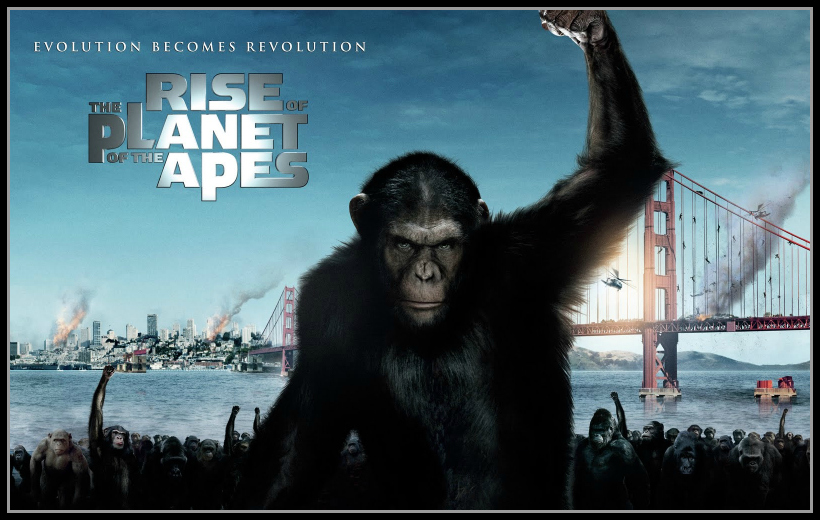
British filmmaker and writer Rupert Wyatt would be given the task to rejuvenate for a second time the Planet of the Apes franchise. He would be working with a screenplay written by Rick Jaffa and Amanda Silver which would take the 4th film in the series, Conquest of the Planet of the Apes, and rework it for a much more current setting. The film was to be called Rise of the Apes and would star James Franco, John Lithgow and Frieda Pinto. As time went by the film would be renamed Rise of the Planet of the Apes. Despite having such an awkward sounding titles the film would end up to be one of the best films of the summer of 2011, if not one of the best of the year.
The film begins with a harrowing sequence in the jungles of Central Africa as poachers capture several chimpanzees to be sold as medical test subjects. Some of these chimps end up at a genetics research lab outside of San Francisco where one Will Rodman (James Franco) is working to find a cure to Alzheimer. He sees the encouraging result in one chimp he has named “Bright Eyes” (due to the side-effect to the test subject’s eyes taking on green flecks to their irises) and pushes for the next step and that’s human testing. The ensuing pitch to the company’s board of directors doesn’t go as planned as Bright Eyes goes on a violent rampage leading to her being put down and the project shelved. Her reaction they soon find out has less to do with the breakthrough treatment and more of a maternal instinct to protect her baby she secretly gave birth to. Will takes the baby chimp home in secret temporarily, but soon becomes attached to it as does his Alzheimer stricken father (John Lithgow) who names it Caesar.
The first third of the film sees Caesar showing an inherited hyper-intelligence from his genetically-treated mother. Caesar becomes an integral part of the Rodman household even to the point that Will has taught Caesar to call him father. It’s a family dynamic which would help mold Caesar into something more than just a wild animal. He begins to show signs of humanity which would become bedrock of his decision later in the film to turn become the revolutionary that the film has been leading up to the moment Caesar gets sent to a primate sanctuary after a violent encounter with a boorish neighbor to end the first reel of the film.
It’s during the second reel which sees Caesar realize that while he may as smart (maybe even smarter) than the humans he would never be a part of that world. In the sanctuary he learns that his very uniqueness has set him apart from the other primates. He sees the abuse inflicted on his fellow primates and longing to be back to his “home” with Will turns to a focus need to free himself and his people. He does this in the only fashion he knows would succeed. With the help from a couple canisters containing the aerosol-based treatment which increased his mother’s intelligence, Caesar frees everyone from the sanctuary and takes the fight to the humans as they make for the wilds of the Muir Redwood Forest north of San Francisco.
Rise of the Planet of the Apes might look to be an action-packed film from how the trailers and tv spots has been pushing the film, but it actually only has three major action sequences and they’re integral to each third of the film in helping advance the story. These were not action for the sake of having action on the screen. Writers Jaffa and Silver do a great job in figuring out that the real strength of the film would be Caesar’s journey from precocious ape child, rebellious teen and then his final unveiling as the leader of a people who have shaken off the shackles of medical research and their forced sacrifice for the greater good.
The film was never about the humans played by Franco, Pinto and Lithgow. It was always about Caesar and the film hinged on the audience believing Caesar as a character. In that regard, the work by WETA Digital should be commended as should Andy Serkis’ performance as Caesar. Serkis’ motion capture performance goes beyond just mimicking the movement of an ape. His own acting as Caesar comes through in even in the digital form of Caesar. In fact, the film never had a real ape used during filming. From Caesar right up to the scarred ape Koba every ape in the film was the work of WETA Digital’s furthering the motion capture work they had done in Peter Jackson’s Lord of the Rings trilogy and James Cameron’s Avatar. Never once during the two hour running time of the film did I ever not believe I was watching apes on the screen. Every emotion Caesar goes through during the film was able to show through facial expressions and body language.
It’s the strength of Serkis’ mo-cap work and the overall execution of Caesar’s character by WETA which also highlighted the one major weakness of the film through it’s underdeveloped human characters. Whether it was Franco’s benevolent Dr. Frankenstein-like Will Rodman right up to his greedy, amoral boss in the company (played by David Oyelowo), all the human’s in the film were very one-note and mostly served to propel Caesar’s story forward. At times, Franco actually seemed to be just as he was during his hosting gig during the Academy Awards earlier in the year. These were not bad performances by the actors involved. They were just there and part of it was due to how underwritten their characters were.
To help balance out this flaw in the film’s non-ape character would be the beautiful work by the film’s cinematographer in Andrew Lesnie. He has always been well-known for beautiful, majestic panoramic shot of the world as he had demonstrated in Jackson’s Lord of the Rings trilogy. He does the same for this film as we see some beautiful shots of the Muir Redwood forest, of San Francisco’s skyline and in the climactic battle on the Golden Gate Bridge. The city of San Francisco and it’s iconic red-hued bridge and the surrounding area has never been shot as gorgeous as Lesnie has done with his DP work on this film.
Even with some of the characters in the film being underwritten the film succeeds through Rupert Wyatt’s direction which keeps the film moving efficiently, but also bringing out the emotional content of the film’s script in an organic way. Film has always been about manipulating the audience’s emotions. It’s when a director does so and make it seem normal is when such manipulation doesn’t come through for those watching to feel. Then add to this Serkis’ exceptional work as Caesar with some major digital artistry from the folks over at WETA Digital and Rise of the Planet of the Apes does rise above it’s B-movie foundation into something that should live beyond the summer and for years to come.
Rise of the Planet of the Apes does a great job and a long way towards wiping off the bad taste left behind by Tim Burton’s failed attempt to remake the franchise. We didn’t need something exotic and idiosyncratic to give the franchise a fresh breath of life. It seems all it needed was a very good story, some exceptional work from Andy Serkis and WETA Digital and a filmmaker knowing how to tell the story in a natural fashion and not fall into the temptation to go into shock and awe to tell it. Rise of the Planet of the Apes is a film that could stand-alone, but it does something that many trying to create film franchises never seem to do right: it makes people want to see what happens next in the lives of Caesar and his apes.
To say that I’m not a big Jonah Hill fan would be an understatement. The characters he has played on film have ranged from annoyingly nebbish to downright obnoxious. An almost irrational rage builds up in me whenever I see a trailer with him in it either as a supporting cast member or one of the leads. To my surprise when I saw the red band trailer of his upcoming R-rated comedy, The Sitter, the rage I was feeling petered out the more I watched the trailer.
The Sitter stars Jonah Hill and is directed by one David Gordon Green who also made the hilarious Pineapple Express and also one of the creators of the HBO comedy series, Eastbound & Down. Unfortunately, Green also directed the very unfunny comedy earlier in 2011 called Your Highness. Here’s to hoping that The Sitter is more of the very hilarious kind and not the unfunny that was his latest comedy film this year.
From what I could tell in the trailer this film looks almost like a remake of the 80’s comedy, Adventures in Babysitting starring Elisabeth Shue. That was a funny film and if Jonah Hill and Green can deliver the raunchiness and laughs then I have a feeling The Sitter may just be worth a look-see.
The first 20-30 years of the 20th century was an ever-changing time for the burgeoning film industry not just in North America but in Europe. Many filmmakers in Europe began to take the motion picture camera and began to use them in ways which went beyond just capturing motion and sound then selling them to the masses as a new form of entertainment.
In Germany, we had the rise of German Expressionist movement with such luminaries as F.W. Murnau, Robert Weine, Fritz Lang and Paul Wegener. Over in France the 20’s saw the rise of a new movement in cinema that would quickly become the Surrealist movement which would include such filmmakers as Jean Cocteau, Germaine Dulac and René Clair. There is one filmmaker who made a major impact on French Surrealist cinema during the 20’s and he was actually a Spaniard whose first film became a major sensation then and continues to be one to this day: Luis Buñuel.
Buñuel’s first film was actually a short film he had made with the help of Spanish surrealist painter Salvador Dalí. Un Chien Andalou (An Andalusian Dog) is a 16-minute film well-known for Buñuel’s use of disjointed chronology to give the film that very surreal quality we tend to attribute to our dreams. The film has Dalí’s influence in almost every scene and one of which would go down in film history as one of the more shocking visual sequences ever put on film. I would describe it but it’s better to just see it for yourself below.
Un Chien Andalou doesn’t really make much sense when one tries to watch it in a purely structured narrative. The film’s inherent genius comes from the fact that it’s chaotic in how it unfolds with scenes chronologically moving back and forth with no impact on the characters within them. Some have called this film a perfect example of dream logic in that while the scenes in themselves do not make any sense when looked at individually they do seem to share particular traits when seen as a whole.
It’s difficult to say whether this film was entertaining. For someone looking to learn more about the craft of filmmaking, especially the part on storytelling, then Un Chien Andalou is quite an eye-opener. But In the end, Luis Buñuel’s first film has less to do with trying to entertaining and more of one filmmaker’s attempt to put into film the very intangible quality and nature of one’s dreams.
Un Chien Andalou is what I’d call the anti-Inception. Where Nolan’s film about dreams still retained a surreal quality to them they were still very much structured with order in mind. Buñuel’s short film is all about the chaos nature of dreams and no one has done it better since the day he released this classic in 1929.
Stephen King’s novels and short stories were mined relentlessly during the late 70’s and through the 80’s and the early 90’s. For the most part the film and tv adaptations of his work were adequate and passable. Some were downright awful and made one wonder if King was just trying to cash as many of his work for licensing paychecks or if he really thought the studios who purchased the rights would actually do a good job adapting them. One such studio which seemed to have done a very good job adapting one of King’s greatest works, Salem’s Lot, was Warner Brothers who adapted the classic vampire novel to become a mini-series for CBS.
I never saw the mini-series when it first aired in 1979, but I did see it a few years later when it re-aired on TV and then many more times on VHS and then on DVD. Tobe Hooper directed the hell out of this mini-series and turned what was a very complex modern retelling of Bram Stoker’s Dracula into a 3-hour mini-series that was both gothic and downright terrifying despite the restraints of TV.
While the mini-series does seem dated now it still retains that creepiness, foreboding atmosphere and scares which made Hooper’s Salem’s Lot one of the better King adaptations. The scene which will always stick with me and still gives me the chills whenever I watch it is when Danny Glick’s younger brother visits him in the hospital. This scene is just downright scary whether watching it as a 9 year-old or one in their 30’s.

 Through the Shattered Lens