First Impressions: Dying Light (Techland / Warner Bros.)


Dying_Light_coverThe short of it:

Dying Light is an impressive Co-Op game that allows you and 3 other friends to take down Zombies in a spectacular fashion, while clambering up and over obstacles. Working together, it’s a lot of fun. You may find the game’s mechanics are a little too familiar, played a million times before in different renditions. If you can get by that, it’s a great experience. Even better, if you love those mechanics, it’s like Oreo’s and Ice Cream. The lighting effects – particularly the day and night cycles – may have you pausing your game to take in the sights, while of course keeping one eye on your watch or the horizon. Those expecting something entirely new may be a little disappointed, because the final product isn’t quite the same as what was first advertised. It’s very close, though.

The long of it:

“Okay, where to next?”, my Xbox Live friend, “Souless” asks me. We’re standing on the top of a large radio tower. With every passing second, the world around is growing darker. This is the city of Harran, devastated by a zombie infection. It’s also Techland and Warner Bros. new game, Dying Light.

“Well, we have that last area to check out to the North…”, I say, glancing over at the horizon. The sun is gone, the only lights around us coming from the city. A message appears, alerting us that Night is Coming, and strange screeching sounds can be heard in the distance.

“Or we can just go home.” I say. “Drop this stuff off.”

Suddenly, there’s a rumble sound, causing our controllers to shake.

“Airdrop!” Souless calls out. “Where?”

I catch sight of the plane as it banks and a box falls from it’s rear. The plane goes along its merry way and the box lands not too far from a zipline connected to our tower. A light blue flare shoots up into the sky from it’s location, and I mark a waypoint on our map that we both can see.

“Not too far from us, on my side. Waypoint set, let’s go!” I say, and ride the zipline down. Souless arrives near me a few seconds later, and we start running towards the package. On our radar, two blips appear near the drop site, complete with vision cones, pointed in the opposite direction of where we’re coming from.

“I’ve got two Night Hunters. One to our left, and another at our 2’o clock.” I say, our characters climbing up and over sheds, houses and finally arriving at the site. Before us are two large orange crates, illuminated in a blue light.

“Sweet! We got here first.” I say, opening one chest. Souless opens the other. If you take too much time getting to these drops, chances are you’ll have to fight others for their contents or come up empty-handed when you reach the packages. We’ve got medical supplies to fight the infection. The folks at our home base will pay us well to bring this back.

“Got a survival kit and some meds. I’m heading out.” Souless says, coming over to me and checking my crate. In Co-Op, Dying Light lets up to 4 players jump into the game. Whenever any chest is opened, it’s contents are available to everyone – meaning that I snatch some Coffee, I’m not taking it from any one player. They’ll all have their Coffee or item available in the box as well. I move to Souless’ crate and pick up some more goodies. I do notice his blip on the map move away from mine, and one of the vision cones turn toward me. A sharp scream cuts through the night.

“They’re on me, go, go, go!!” I say and I’m off. While running at full speed, I tap the “Y” button to look behind me, and there’s this weird muscle-bound creature sprinting on my tail, its appearance similar to Guillermo Del Toro’s vampires in Blade II and The Strain. A quick flash from my UV light disturbs the creature, giving me a few seconds to duck down an alley and break the line the sight. Thankfully, we’ve set up this online session so that we don’t have Zombie Invasions. With that feature enabled, other players can actually jump into Co-Op games as Night Hunters, chasing the rest of the crew with better mobility. We’re hustling up and over walls and eventually make it back home to the safety of our home base and it’s UV spotlights.

We decide to call it a night.

If you merged together the movement style of EA’s Mirror’s Edge, the Zombie Onslaught of Techland’s Dead Island, added the Outpost game mechanic of Ubisoft’s Farcry 3 & 4 and the randomization of weapons from Gearbox’s Borderlands series, you’d probably end up with Dying Light. All of it feels very familiar once you start playing it (though this isn’t entirely a bad thing).  I’ll admit that at the first gameplay session, I was worried by the control system, especially having come from years of Mirror Edge. Additionally, the game picked up some controversy by not lifting the embargo for reviews until the last-minute, even though both companies stated that they’d avoid doing so. I’ve adjusted to it, and I’m really enjoying the game so far.

In the game, you play Kyle Crane, voiced by Roger Craig Smith (Resident Evil’s Chris Redfield and Assassin’s Creed’s Ezio Auditore), an agent dropped into the city of Harran to locate a missing official, requiring him to go undercover. The moment he parachutes into the city, he’s attacked both by an enemy raiders and is bit by a Zombie. Though infected, he and others have been able to keep the change at bay by the use of a medicine called Antizen. The Antizen is delivered to the town daily via airdrops. During the day, it’s a safe as an episode of the Walking Dead. You travel from place to place, scavenging parts from places and money from Zombies. When the sun sets, the Night Hunters rise. You’re given fair warning of the sunset by way of a Purge-like announcement. The game’s menu also comes with a clock to let you keep track (though this is only revealed after the tutorial missions).  suppose they’ve studied Parkour as well, because when they chase you, it takes every skill you know to evade them and break the line of sight. It’s not as terrifying as I thought it would be, but you’ll die a lot if you’re not careful. The fear in Dying Light’s Nighttime sequences isn’t whether a Night Hunter will find you, but getting swarmed by them. Once one pursues you, they all pursue you. If you’re not ready for the night, you can sleep it off at any safe zone and handle your tasks in the daytime. The game does reward you for nighttime runs by automatically doubling the amount of experience you gain for your Agility and Power, letting you easily level up if you’ve the courage to do so.

The default controls in Dying Light are surprisingly simple. The right bumper is your best friend, allowing you to jump and vault. Where Mirror’s Edge had you flipping between your left and right fingers like a pinball machine, the single jump button of Dying Light lets you move with ease. As long as you hold the jump button and are looking at where you want to go, you’re guaranteed to grab a ledge. This is particularly important when descending ledges. What should be a drop and grab becomes a free fall if you don’t hold that button. More advanced moves, like sliding, tackling, drop kicking need to be unlocked as you gain experience. This was the element that bothered me in my first levels of the game. Part of me was under the impression that I’d be fully mobile, wall running doing all those crazy parkour moves right from the start.

The attack button is right below that, allowing you to swing  such as pipes, sticks and knives with ease. The weapons you pick up do get damaged over time, so you’ll need to repair them (usually while running). Swinging on Zombies takes its toll on your player, and you only have so much stamina to work with before rushing back into the fray. Weapons can also be upgraded with electrical or fire damage, which the game seems to borrow from Borderlands. Eventually, you move up to guns, but I can’t say how well that factors into a game like where some of your enemies are rushing at you as the same speed you move.

Once the sun sets, the Night Hunters come out, and they're hungry.

Once the sun sets, the Night Hunters come out, and they’re hungry.

The skill tree system is wonderful. You’re given 3 types of skill trees – Survival (points awarded for crafting items and helping others), Agility (points awarded for climbing, vaulting and using other abilities), and Power ( points awarded through creatively kicking some zombie butt). These are really fun, and I can’t wait to unlock some of these features. For example, the Survival tree has the camouflage ability that allows one to rub dead guts all over themselves and walk among the infected without drawing attention, though attacking will kill the cloak. Other abilities include being able to slide and break an un-expecting zombie’s leg, or rig a car to explode a bunch of Zeds in one shot while you stand on a rooftop and laugh.

From a graphics standpoint, Dying Light is sweet. Harran (or what I’ve seen of it anyway), is more or less a  favela (think of that first chase in The Incredible Hulk or Fast Five). I get the notion that the map may expand. I hope it does, because it’s rather small right now. Still, the city’s transition from Night to Day, along with the weather effects just add to the atmosphere of a place gone sour. Blood sprays are the norm, rendered at near 1080p on the Xbox One and at 1080p on the PS4. I’ve yet to run into any slowdown issues with all of the running that’s being done. Another standout is the loading time. Coming off Mirror’s Edge, which gave you these incredible load times while you stood in an elevator, Dying Light’s transitions between stages are a jaw dropping delight. Then again, I’ve only moved up to Next Gen recently, and that sense of power’s new to me. Others may disagree.
Dying Light will have you facing against hordes of zombies, but so far, I haven't seen any that are this big.

Dying Light will have you facing against hordes of zombies, but so far, I haven’t seen any that are this big.

Another feature I like is the “New Game” system. If you’ve played through part the game with a friend, but don’t wan’t to break that connection where you both left off, you can choose to make a brand new game that starts you at the end of the tutorial and lets you keep your skills progression. So, if your player is a level 9 in everything (the top is 25 in everything) in your original game, you can keep that. Your weapons, however, don’t come with you.

In terms of problems, the only thing I can tell with Dying Light is the connection for playing a Co-op game, and how it doesn’t exactly feel extremely innovative. In trying to join games, I’ve had a number of connection issues, even when both Xbox Live and Techland’s servers are running. Invites sent to me, or mine sent to others fail when the invited party try to join. The only way we’ve been able to successfully connect is by using the join feature within Live itself, and once it holds, it ties together very fast. Each player is given their own color mark so that they can be tracked on the map. Players can also separate and check whatever part of the map they choose. If they stumble upon a story marker, they won’t be able to play it until everyone joins them – easily done with the Quick Travel feature. Additionally, the tutorial for the game is long. You’re shown how to move, and are given some missions to how you the move from day to night. It’s like having to deal with that first mission in GTA Online when the game’s servers were first glitched.

If you’ve watched the early Alpha Footage, you kind of get the feeling that a bit of it was left out of the main game. This is normal though. Games change drastically between the Alpha and final versions. I’ve fought tons of zombies, but the game has yet to reach Dead Rising levels. Maybe this is because of the processing power, or because I’m still early on. I can’t say it’s bad, but I would like a moment where I look down off a roof and go…”Nope. Not landing in the middle of that.” There always seems to be good exit around.

So there you have it. Dying Light. If you like Freerunning, it’s worth a try. If you love zombies, take a look. If you love both, it might be just what you’re looking for. Just be sure to keep your eye on the clock.

Quick Review: Paddington (dir. by Paul King)


paddington_character-poster-4Hello there, and Happy New Year!

When I was little, I owned a stuffed Paddington Bear. When I found out Heyday Films was working on a movie for the character, I immediately added it to my watch list. From the audience’s reaction, made up mostly of families and a few dates, it seemed to be well received. American audiences may not be familiar with Paddington, even though the Orange Marmalade eating bear has had tons of books, toys and cartoons in the UK over the last 50 years. He even has his own float in the Holiday parades we have here in New York City.

The movie, directed by Paul King, finds young Paddington (Ben Wishaw – Layer Cake, Skyfall) traveling to London after an Earthquake destroys his home in Darkest Peru. His Aunt and Uncle (played by Imelda Staunton and Michael Gambon, respectively) have told him of how wonderful London is, but he finds it’s not exactly as kind as he was led to believe. While Wishaw wouldn’t be my first through to voice Paddington, he fits the role quite well, giving the character a sense of polite innocence that’s spot on to how I recalled him.

The Brown family discovers Paddington and takes him in, in the hopes that they can locate the individual who discovered Paddington’s Aunt and Uncle during an expedition many years ago. When an evil taxidermist (played by Nicole Kidman in a turn that feels eerily similar to what she did in The Golden Compass) discovers Paddington, she makes it her goal to have him added to her collection.

Paddington’s supporting cast seems to either have former Harry Potter or Layer Cake stars. Downton Abbey’s Hugh Bonneville plays the overprotective Brown father. Sally Hawkins (Layer Cake, Godzilla) plays Mary, who helps Paddington along his trip. Weasley mom Julie Walters has a fun role as the house nanny, and finally, Doctor Who’s Peter Capaldi is the nosy next door neighbor that doesn’t take too kindly to having furry neighbors around town. It looks like everyone enjoyed themselves on the production, and seeing Capaldi play someone so odd was a little weird.

For young viewers, Paddington is a treat, with a focus on acceptance, family and the notion that sometimes one can hold on too tight to children in an effort to keep them safe. It might a gross out in some ways, depending on some of the scenes that include earwax licking and passing gas. Some may find the notion of a taxidermist a little scary, but my audience seemed to be okay with it. There are very few elements of violence – most of it the playful type found in films like Home Alone. Nicole Kidman may appear scary to some, but at it’s heart, Paddington tries to keep everything as accessible as it can for everyone.

Musically, Sigur Ros provides some great music that flows with the scenes, and the production itself moves almost in the same fashion as Alfonso Cuaron’s Harry Potter and the Prisoner of Azkaban, via the use of screen wipes and subtle season changes. The CGI for the film is done well, though I can’t say it’s very subtle. A casual view could probably spot what’s CGI and what isn’t, but since it’s for kids, they won’t really care.

Overall, it was fun to revisit Paddington. I didn’t have much in the way of expectations, but was a little amazed at how well it actually held up. I found myself smiling more often than I thought I would, honestly.

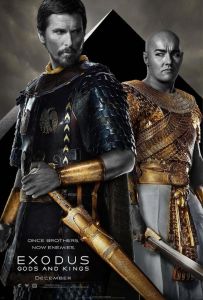
Quick Review: Exodus: Gods & Kings (dir. by Ridley Scott)


Exodus-Gods-and-Kings-Poster-Bale-and-EdgertonOkay, let’s face it.

After Cecil B. DeMille’s 1956 epic “The Ten Commandments”, it’s pretty hard to come up with another story about Moses that comes as close to it. I’ll admit I have a personal love for 1998’s The Prince of Egypt.  Ridley Scott makes a great attempt in his new film “Exodus: Gods and Kings”, but it comes off feeling like the result of having one person relay a story to you through 3 other individuals. By the time the story reaches you, it’s no longer the same tale.

This is a hard review to write with regards to avoid spilling details.

Exodus follows the story of brothers Moses (Christian Bale – The Dark Knight Trilogy) and Ramses (Joel Edgerton – The Thing, The Great Gatsby), sons to the great Pharaoh of Egypt (John Turturro). Both brothers are seasoned warriors, but with the passing of Pharaoh, a truth is brought to light that forces Moses into exile. During his time away, he finds God and makes it his mission to free his people. Ramses refuses to listen to reason, and some drastic measures are taken to help convince him.

That sounds great on the surface, but it’s the execution that’s flawed. And this is Ridley Scott of all people. I loved Kingdom of Heaven and moderately enjoyed Robin Hood, but I just didn’t completely feel like I was invested in this film.

Biblical tales are tricky. Stick too close to the source material and you can have a heavy-handed story that says what it should, but could bore some audiences. Take too many liberties, and you can have audiences excited, but leave some upset or shocked at what’s presented (like with Scorsese’s The Last Temptation of Christ). Here, the liberties are taken to a place where most of the movie doesn’t even require Moses to be in it. The argument could be made that the other films did this too – that the acts occurred with Moses as a harbinger of what was to come. Exodus makes it more of a difference of opinion on how to handle Ramses. Moses elects for a more battle hardened strategy – let the people fight for themselves. This left me wondering where they found the time and freedom away from the Egyptian Soldiers to learn what they did.

On the flip side of the coin, God decides to handle it Their own way. This leaves our Moses in a position where he’s at odds with the Almighty, a sharp contrast to the Moses that followed the Word to the letter. To an audience that can’t help but make comparisons, it’s way off, though it’s supported by the theme that one shouldn’t say things just to placate others and that they should follow what they believe. What came before basically said..”Okay, I don’t know what your plan is, but you’ve shown me your wonders, I believe in you and you’ll guide me right.” Exodus says..”Okay, you’ve got a plan I’m not too cool with, so…uh…just give me a chance to save / warn the people before your wrath comes down.”

There were four writers on board for Exodus. Both Adam Cooper and Bill Collage worked together on Brett Ratner’s “Tower Heist” and Jeffrey Caine is known for “The Constant Gardner” and “Goldeneye”. Steven Zallian (Moneyball, The Girl With the Dragon Tattoo, American Gangster) was the fourth. I’m thinking with all those fingers in the pie, the movie was bound to go in a different direction. Again, it’s not terrible, just different.

The casting for Exodus is okay. The strongest performances go to both Bale and Edgerton, and I’ll state here that I had more fun watching Edgerton on screen than I did with Bale. I haven’t seen him play the villain like this since The Guardians of Ga’Hoole and he does a decent job here. Bale does well, but it’s like watching Batman again. Not saying he’s typecast because of it, but seeing Christian Bale yell is almost expected in a movie these days. Reunited with her Aliens director, Sigourney Weaver has about 10 to 15 minutes total of screen time in the film, and Ben Kingsley might have the same amount. Aaron Paul spends most of his time making that stare he does when he see something incredible. There’s not a lot for any of these actors to chew on, but they try their best with it.  Both Indira Varma (Game of Thrones) and Ewan Bremer (Jack the Giant Slayer, Trainspotting) are on hand as Ramses’ advisors. They don’t really count too much in all this.

Visually, the effects for the Plagues are very good. I honestly think those segments were the best in the entire film. The rest, I’m not so sure. The Red Sea sequence, when it happens, it done in such a way that the mysticism is just about sucked out of it. I’m sitting there hoping for a big reveal and found myself asking if that was it. Perhaps it was the angle where I was sitting or the theatre I saw it in, but it wasn’t as clear as it could be. It seemed like I was watching a 3D version of the film (I went for the regular one). The fight sequences were also done very well, many of which were similar to Ridley’s Robin Hood or Gladiator. Also note that at 154 minutes, it’s a long film. I pulled my iPod Nano out of my pocket twice to check the time.

As for the kid factor, I would say that teens and older can see this. There’s quite a bit of violence early on, along with some bloodshed, but nothing too extreme. In terms of sexual situations, there really aren’t any.

I think overall, my expectations for what this could be were larger than the final product. Had I never known of any film prior to this, Exodus would have more of an impact for me. As it stands, I’d watch it again, but probably when it hits Cable.

Bond 24 Officially Named “Spectre” in Announcement.


If you’re a long time reader of Through the Shattered Lens, you’re probably aware that we’re all fans of the Bond franchise in some way. Around the release of Skyfall, we collectively reviewed every single Bond film. The project – spearheaded by our own Lisa Marie Bowman – was quite the success with each writer taking a film and showcasing their love (or displeasure for it). To date, I consider that our best  “Avengers” moment.

Today, the Announcement for the next film in the series was made at the legendary Pinewood Studios. Director Sam Mendes introduced audiences to the 24th film, “Spectre”, which already seems interesting given the history of the evil group in Bond canon. I guess this means Quantum is no more, was a small piece of a larger puzzle, or perhaps it’s grown into something bigger? We’ll have to wait and see, but it’s up to speculation. Lee and I were actually talking about that yesterday. We do know that the production will take 007 from London to Mexico City, among other locations.

All of the actors were on hand, including new members Christoph Waltz (Django Unchained, Inglorious Basterds), Monica Bellucci (Malena, The Matrix Reloaded), and Lea Seydoux (Mission: Impossible -Ghost Protocol, Blue is the Warmest Color). Returning are Daniel Craig as James Bond, Ralph Finnes as M, Penny Dreadful’s Rory  Kinnear as Tanner, Ben Whishaw (Layer Cake, Cloud Atlas) and Naomie Harris (Ninja Assassin, Mandela: Long Walk to Freedom) as Moneypenny.

Although Roger Deakins won’t be on hand for the Cinematography, its okay (though he’ll be missed). Hoyt Van Hoytema is taking over the reigns. Between Spike Jonze “Her”,  “Interstellar” and “Birdman”, Hoytema knows what he’s doing.

Even Aston Martin threw their keys into the ring with the new DB10, to celebrate their 50 year relationship with Bond. 10 copies were made exclusively for the film and we hope Mendes leaves them in better condition than 007 usually does.

Production starts next Monday and the film is on track for release next November.

Star Wars: The Force Awakens Official Teaser is out!


Greetings, Ladies and Gents. Hope everyone’s faring well after the Thanksgiving Holiday here in the States and a week that’s winding down. Disney, J.J. Abrams and the powers that be have not only made the teaser for Star Wars: The Force Awakens available in select theatre locations, but have also made it available online.

Like the trailer that premiered for The Phantom Menace, we’re seeing a lot of surprises here. New droid types, unconventional lightsaber designs and the Millenium Falcon in all it’s glory. It’s a small taste of what’s to come, but enough to pique the interests of anyone in love with the franchise. If nothing else, it serves as a good conversation starter.

Enjoy!

Quick Review: Birdman (dir. by Alejandro González Iñárritu)


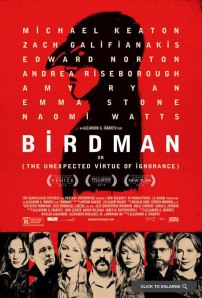
birdman-clickTo help you understand how little I knew going into this film, there was a time where I seriously thought Birdman or (The Unexpected Virtue of Ignorance) was a film adaptation of the old Hanna Barbarra cartoon character. I later found out it wasn’t (to my disappointment), but that it was a Michael Keaton movie helped to keep my interest. If Harvey Birdman is what you’re expecting, stop right there. You’re looking for the wrong film.

Here’s the short of it:

If you enjoy the Theatre, Birdman may be right up your alley. With a focus on a play, it takes the view through the nuances of getting the play into action. There are terrific, funny performances throughout (particularly from Keaton and Edward Norton) and it just flows so incredibly well. Birdman explores what it means to be into your craft (in this case, acting), the nature of what Fame actually is these days, and how much a person is willing to get/keep it. You could basically watch this back to back with Black Swan.

From a script by Iñárritu, along with 3 others, Birdman is the tale of a once famous actor dancing a fine line between total irrelevance and greatness. Hoping to reclaim that fame, he attempts to produce, direct and star in a Broadway play, but not everything is going to plan.

Forget any promos and just see it. I skipped a lot of the advertising for this and after watching the movie last night, I saw a commercial for the film that already feels like it gives too much of the film away. If you’ve followed them all, you’ve seen most of Birdman. Had I not already watched Richard Linkater’s “Boyhood”, I might consider Birdman one of the best films I’ve seen this year, especially in terms of the way it was made.

The Long Haul:

Let’s start with the Cinematography, but this will the element that stands out more than anything with this film. Emmanuel Lubezki (Gravity, Children of Men) is at the top of his game here with the use of a seemingly single tracking shot that lasts almost the entire movie. The camera moves from scene with such fluidity that I wonder if it’s entirely CGI. Most of those shots have to be.

Remember that part in Goodfellas where the camera stayed with Karen and Henry Hill on their first date, moving with them through the back of a restaurant all the way to when they took their seats? Or more recently, True Detective’s fantastic shot of an escape/arrest that had McConaghey moving behind houses and over fences? Or the opening “unpacking” tour of the haunted house in The Conjuring? Those are tracking shots. It’s one long take from Point A to Z, instead of cuts at B, C, and so on. If anyone makes a mistake during filming, the crew has to move back to the start of the take and try again if they want the entire shot to be seamless. I have no idea how it was pulled off in Birdman, but it’s beautiful to behold. If the movie gets nothing else come Awards season, Cinematography should be theirs, right now. One could argue it moves like a found footage film sans the shakiness, but you’d have a hard time selling me on that one.

My only nitpick about Birdman, the only problem I had with it was the representation of Critics. Not that what’s said about them is entirely incorrect, but I kind of hunkered down in my seat at some of the commentary. While I wouldn’t consider myself a Critic, I do share my opinions on films. That doesn’t necessarily mean we’re all out to gut the next release on Friday.

It seems almost too appropriate that Michael Keaton – once a Dark Knight himself – has this role. He’s had his ups (Batman, Beetlejuice, and my personal favorite, Johnny Dangerously), his downs (That horrid Robocop remake, blech) and his in-betweens with Need for Speed earlier this year. He carries the character with a depth that rivals Joaquin Phoenix’s performance in The Master. It’s strange, but it works.

At one time, Riggin Thompson (Keaton) was famous in Hollywood as the superhero Birdman, but after passing on a second sequel (much like Keaton leaving Batman behind and passing the baton to Kilmer and Schumacher), he hasn’t found much fame since then. The story starts with Riggin hoping to reclaim his former glories with a revival of “The Things We Talk About When We Talk About Love” on Broadway. When one of his theatre cast members are injured on set, they recruit a popular actor (played with a slightly over the top Edward Norton) that may prove too much to handle. Add to this Riggin’s shaky relationship with his daughter Sam (Emma Stone), an off again / on again love interest (Oblivion’s Andrea Riseborough) a lawyer trying to keep him afloat (Zack Galifinakis), and a voice in his head reminding him of the problems he faces…well, he’s just a mess. Then again, everyone here is a mess in their own way and maybe because of it, they all kind this good sense of chemistry.

The film is backed by a percussion score from Antonio Sanchez, which doesn’t get in the way at all. I’m not sure I’d call it a soundtrack, though. The music sounds great outside of the scope of the film, but you probably won’t recall the music afterward in the way you would for a soundtrack with a full on orchestra.

Birdman is the first film I’ve watched by Alejandro González Iñárritu. I remember that he was nominated for an Oscar with either Babel or 21 Grams. I feel like I’ve missed out on something grand because Birdman is good. Not that “good” you say when when someone puts a broken bone back into place (“Yeah, I’m good.”, he cried), but that “good” that comes from your first taste of creamy Tiramisu. (“Omigod, that is goood!”, he purred). It’s definitely one I can consider catching one more time before it ends it’s run in the cinema.


Horror on the Lens: Alien Isolation (Dev. by Creative Assembly, Published by Sega)


Alien-IsolationThere’s a quote from one of my old White Wolf books – I think Richard Dansky wrote it in Wraith:The Oblivion – that goes like this:

“The other aspect of horror is its sense of finality and the inability of a character to change it. If terror is the moment when the monster charges down the hall, horror is the instant you discover your feet are rooted to the spot.” 

Everyone who’s seen Ridley Scott’s Alien remembers the scene where Lambert is cornered by the Alien. Yaphet Kotto’s Parker is yelling at her to get out of the way so that he could use his Flamethrower, but she replies, crying..”I can’t!” I always thought that all she had to do was just kind of jump down and crawl or roll and then Parker could blast the damn thing. The movie would end. There’d be a gaping hole of acid in the Nostromo, but our heroes would get in the lifeboat and leave.

And yet, in playing Sega and Creative Assembly’s “Alien Isolation”, I found myself in almost the exact same position, huddled inside of a locker minutes after being introduced in the Alien and utterly terrified to move. Even worse, I’ve had situations where it appeared and I’m frozen in place, completely drawing a blank on my next move. I owe both Brett and Lambert an apology, rest their characters souls.

In the game you play Amanda Ripley, daughter of Ellen Ripley in the Alien films. In the special edition of James Cameron’s Aliens, there’s a brief scene between Burke and Ellen Ripley mentioning her daughter. For you trivia fans, the image used in that film was actually Sigourney Weaver’s actual mother. Anyway, It’s been 15 years since the disappearance of the Nostromo and Amanda is searching for any kind of clue that will help her find her mother or find out what happened to her. Supposedly, the flight recorder for the Nostromo was recovered and taken to Sevastopol station, a ship of roughly the same size. Basically, it’s a starship the size of Hogwarts. After finding herself separated from her crew, she has to both get her answers and find her way out of the station.

Easier said than done, of course. This game knows no mercy, even on it’s easiest setting.

The lighting effects are wonderful in next gen (especially PC). That molotov will only make the Alien mad.

The lighting effects are wonderful in next gen (especially PC). That molotov will only make the Alien mad.

The first rule of Alien Isolation is knowing that there are no safe places. Where most games have mechanics that allow you to take a breather to gear up and plan ahead or pause to get out the right weapon, Isolation will keep flowing as you take action. In Metal Gear, your game pauses when you use your backpack to look through your weapons. In Resident Evil (at least the earlier renditions), you had areas that were designated Save Rooms, places where the monsters couldn’t get at you. Alien Isolation does just the opposite.  Unless you’re checking your map for your next location, the game doesn’t pause. I’ve died while reading information on a workstation. I’ve died while rewiring a door. I’ve even died while putting myself in a locker and walking away from the console for food. It’s a strange kind of game design that forces you to keep one eye on what you’re doing and the other scouting around you to make sure you’re not being stalked. You essentially become a meerkat, poking its head up and going..”Did you hear something?”

And the sound is downright fantastic, especially where the Alien is involved. This is where the true horror lies. Anyone who is familiar with the Alien franchise knows what a Xenomorph looks like. We’ve seen so many of them over the years that they’ve lost that fear factor. The horror doesn’t come from having it charge you, but knowing how close it can be before everything gets to that point. There are tons of playthrough videos out there, and it’s great to see the reactions of players as they navigate this. If I worked at Creative Assembly, I’d chuckle at some of them with pride.

Case in Point: In one area, I open a door to a hallway. It’s clear, but I hear something behind me, causing me to duck behind some boxes. Taking out a noisemaker, I figure I can throw the noisemaker out the way I came (before the door closes) and quickly make my way towards my objective. As I slowly step backwards and to my left ready to pull a Romo-like pass, I just happen to turn to look at the direction I need to go.

The Alien is right there in that entraceway, standing at full height and is peering into the room behind me. There’s a collective “Holy shit!” from everyone in the room I’m in, and I freeze. It must have shot up a vent and came down a vent behind me somewhere. The Xenomorph doesn’t see me, and goes into the room it was looking at. This frees me to make my way down the hallway I need to travel, leaving a trail of fresh urine in my wake.

Heavy footsteps echo in the dark, and when it moves from the ground to the vents, there’s a distinct difference. The game begs to be played either on an extreme surround sound system or noise canceling headphones. If you even more courageous, you can enable your Xbox’s Kinect or PS3/4’s Camera – the microphone in both will pick up the sounds of your room. So, if you’re hiding in a locker with the Xenomorph outside and a friend yells out…”Are we ordering Chinese tonight?!”, the Alien will assume you’re a tender morsel dipped in duck sauce and take you out.

From a control standpoint, Alien Isolation is simple enough that you might not forget what to do when in a panic. For the more complex acts, like lighting a flare and throwing it, you’re given on screen instructions to help you follow through. This becomes a hit or miss at first. While you’re learning that action, there’s always a chance you’ll find yourself under attack by the Xenomorph. A training room feature would be nice here, but at the same time, you’re figuring out what to do with these items just as Ripley does. You’ll find yourself scouting safe areas (and by this, I mean under a table somewhere for a minute) ahead of time to craft different items out of the spare parts you find. At your disposal are flares, medkits, EMP’s, Noisemakers, Smoke Bombs, and more. Of course, before these items can be made, you’ll have to search around for the actual blueprints (which can be anywhere). The game will thankfully teach you how to use items as you get them (if you pay attention). Eventually, you’ll get Molotovs and Flamethrowers, but the Alien understands the nature of fire. To quote Newt, “It won’t make any difference.”

As Ripley turned the corner for a bite to eat from the lunchroom, she suddenly lost her appetite.

As Ripley turned the corner for a bite to eat from the lunchroom, she suddenly lost her appetite.

Saving the game can also be a nuisance at times. Rather than having an autosave, the system incorporates the added task of having to find Save Stations disguised as phone booths to save your progress. Just as with everything else, you have the ability to die if any enemy happens to be near. It can become annoying if you’re in an area where you have a large task and find yourself all the way back at previous place once you die. It’s a drawback, indeed, but it also inspires the player (or it did for me anyway) to treat these stations like an oasis in the middle of a long stretch of desert. You’d think you were playing Ninja Gaiden sometimes, without all the flipping.

Navigating Sevestopol is done in a Metroid / Metal Gear like fashion. Basically, some areas will be locked to you without the right tool. Once you find it (be a blowtorch or a wrench), you can come back to that area. I’m not exactly sure how I feel about this just yet. It’s not exactly linear in that sense, but at the same time, I stopped playing Metroid Prime for almost the same reason. If it works for you, you’ll love it. If not, you might find yourself groaning in agony. If you’re lost, your handy Motion Tracker will help you find your nearest objective by way of a marker on the outside of your display.

4

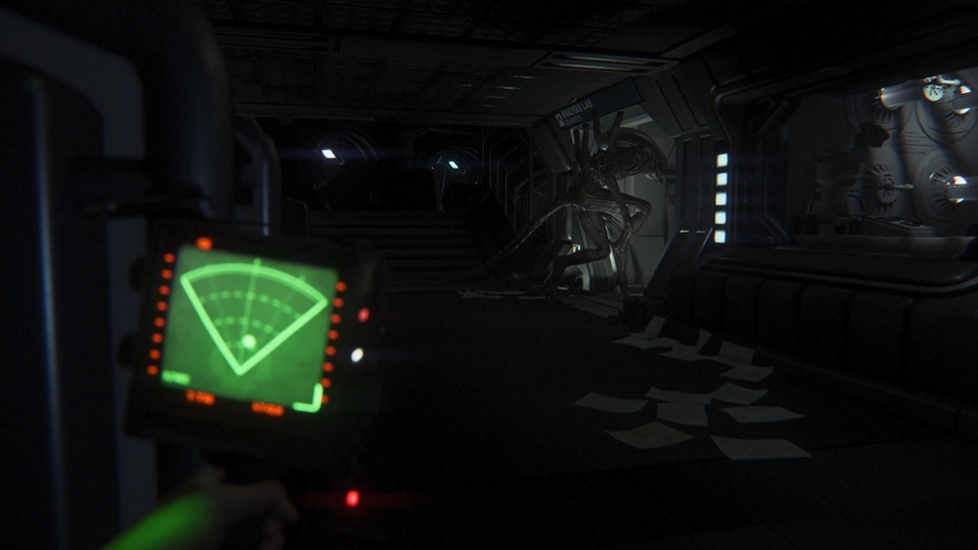
Even in Space, the Alien can hear that beep. Put that Motion Tracker away if you have it in your line of sight. Note the marker on the outer edge telling you where to go.

Alien Isolation is slow. I mean………slow. Not in the story so much, but in the movement. You’ll want to run from point A to Point B, but with the enemies around, you’ll will sneak around for nearly the entire duration of the game (from what I’ve played so far). Don’t even bother sprinting, especially on the hardest difficulty. If you feel you’ve enough patience to play the game in this fashion, it’s a treat. If you’re hoping for something more Splinter Cell / Metal Gear like in that you’re stalking prey, it’s not happening here. Alien Isolation may have On Site Procurement of weapons, but you’ll find these are to be used sparingly, either due to the lack of ammunition / fuel, or from the echoing boom from firing the weapons. In using them you’re indirectly screaming “Hey! I’m right here on the southwest corner of the 3rd floor, kill me now! Do it!! I’m Here!!”

There are other threats on Sevastopol. You have the remaining humans on board who are just trying to survive, synthetics that can swarm you (like Bishop or Ash but not as technologically advanced), but these are enemies that can be defeated depending on what you have on you, and even then, they’re formidable. The Xenomorph, however is an 8 foot beast who delivers a one hit kill to you every time. Its presence will have you hiding in a locker frantically checking your motion tracker – but note that even enemies can sometimes hear the beep coming from it. You may even contemplate how long it’ll take for you to adjust to living in said locker for the rest of your days. According to Creative Assembly, the Alien was built with an adaptable AI that changes on the fly. I’ve had strange interactions in my experiences:

The Alien has no set patrol patterns as far as I can tell. You can watch it walk into a side room from a hiding point at the other end of the room, only to find it double back to the next room you enter. Despite how slow or silent you can be, the doors you move through still make noise, so as you progress, you never really “lose” the Alien so much as you throw it off for a minute or two.

The senses on this thing are creepy. If you are walking fast enough to hear your own feet on the floor, I absolutely guarantee you the Alien knows, too. Again, the Motion Tracker is your friend when it’s at a distance, but it’s also a problem if you’re close. My rule of thumb is that if I have a visual on it, the Motion Tracker isn’t necessary. Even then, use it sparingly to find where you need to go.

Vents. I can’t even tell you how many times I’ve had a chance to escape via a vent and chose a closet or death over it. I’m told you can use these to move around and escape even, but I haven’t even bothered.

Visually, I’ve played this on both the PS3 and the PS4. There’s nothing wrong with the PS3’s version of the game graphically (which is amazing), but if you have access to one, the lighting engines are just better on the next gen consoles. Shadow affects are nice between the two, but there’s a better gradient on the PS4’s newer hardware and smoke / fire effects are that much stronger on that system. Also note that the PS3 runs the game at about 720p, while the PS4 easily handles a 1080p playthrough. I am told that there can occasionally be some glitches where in crawling, you can fall through a room, but I have yet to run into these.

Renderings of the Sevastopol feel like they’re taken right from the first Alien film, as Creative Assembly was pretty much given as much access as they could get to 20th Century Fox’s archives. If you ever wondered what it would feel like to walk those dark halls of the Nostromo with a giant man sized Bone Dragon at your heels, this is the game for you. From the title sequence alone, you get an idea that CA were fans of the first film, and tried to design a game that does its best to immerse you into that universe. It doesn’t get everything right, but it does present the player with a sense of fear and stress unlike anything I’ve played before. Perhaps it’s just me.

In terms of drawbacks, one of the problems comes in the renderings of humans. They don’t seem to have the same sense of care that the Alien gets, most of them walking around with “dead eye” syndrome (like in Final Fantasy: The Spirits Within). The voice acting is okay, but isn’t particularly memorable. It’s like watching a Friday the 13th film. Do you really remember Kevin Bacon’s last lines before he was killed? Maybe, maybe not, but you do remember how he died.

ps4_online_preview_screen001_copy

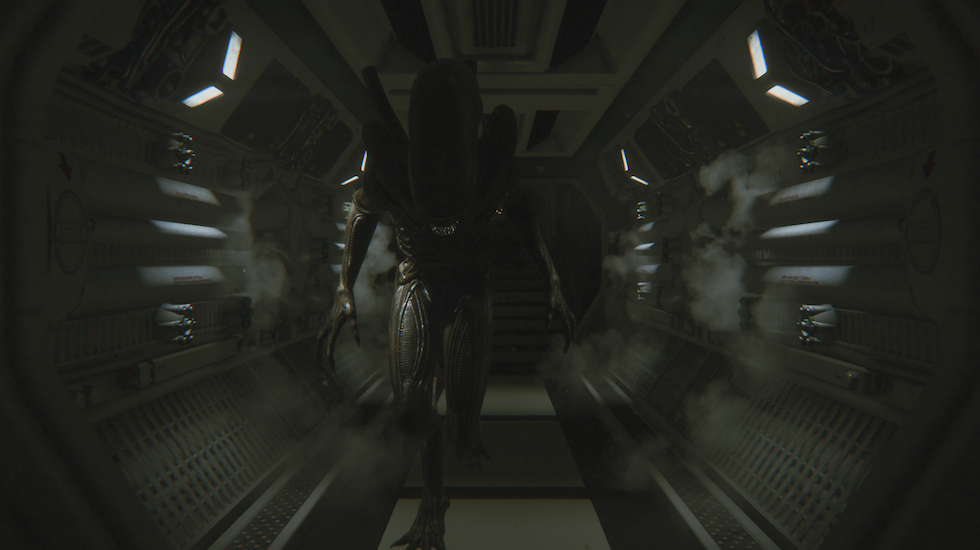
If this is what you see from your Point of View, you’re probably already dead.

 Part of the soundtrack is built off of Jerry Goldsmith’s original score, and the same also features that weird “space wind” sound occasionally, which is so damn eerie. This may actually be (despite it’s flaws) the best movie tie-in/adaptation I’ve ever played. Most movie related games are either rushed projects (I’m looking at you Gearbox. I love Borderlands, but I remember the bad taste of Aliens: Colonial Marines) or fail to completely capture the feel of the movie. I’m very eager to see what Creative Assembly does next, Alien related or not. I’ve truly had fun with this game, despite it being as frustrating as Dark Souls.

Overall, Alien Isolation is a solid game for any fan of the original film. It’s the closest you’ll get to experiencing that universe (or at least playing the ultimate version of Cat & Mouse), even though the slow pace, saving mechanic and unforgiving AI may prove frustrating / unexciting to some.

Quick Review: Gone Girl (dir. by David Fincher)


gone-girl-posterI stumbled onto the novel for Gillian Flynn’s Gone Girl in a mall. It sat near the front of the store with the rest of her books, emblazoned with one of those “soon to be a major motion picture” stickers and a “#1 New York Times Bestseller” label on top. I figured I try it, unaware that David Fincher was involved on the project. During that read, I ran to the Barnes & Noble in Union Square to pick up Flynn’s other books, Sharp Objects and Dark Places. After a co-worker and I finished these (I haven’t read Sharp Objects yet), we agreed that we enjoyed them, overall.

Of Gone Girl the Motion Picture, Flynn herself handles the screenwriting duties and she presents an adaptation so close to her novel that I wouldn’t be shocked if the film receives the same response as the first Harry Potter film. I only spotted 2 distinct changes, and these don’t damage the film in any way. They just may make you say..”Oh, crap, she didn’t keep that.”, If anything.

“But Lenny..” You might say, after hearing me tell you this over pizza and soda. “You’re losing me again, you’re talking too much. I never read Gone Girl. I could care less about the book, I just want to know about the movie because tickets are expensive, dammit! Wrap it up. Is it worth seeing or not?”

In a word, yes. Flynn’s story and Fincher’s direction are like Wine and Cheese here. Flynn’s machine gun writing and Fincher’s pacing method could make them as hot a duo as True Detective’s Nic Pizzolatto and Cary Joji Fukunaga. If actress / producer Reese Witherspoon was involved in getting these two together, she may have another gem under her belt to put next to her film Penelope.

Gone Girl is the story of Nick and Amy Dunne, a happily married Missouri couple on the verge of their 5th Anniversary. When Nick suddenly discovers his wife is missing, the investigation into her disappearance seems to lead back to him, presenting the question of whether our hero may or may not be involved. Just as with the novel, the audience is given glimpses into Amy’s story through flashbacks of their life together. The movie dances from chapter to chapter (or scene to scene, I should say) in this fashion and does so pretty well. You’ve a love story wrapped in a mystery.

The casting is spot on. There’s not a single person in this film that seemed like they didn’t fit their part. Both Ben Affleck (Argo) and Rosamund Pike (Jack Reacher, The World’s End) are magnetic when theyre not dealing with each other and if the movie manages to stumble into Awards season, their names could get thrown into the hat.

The supporting cast in Gone Girl is somewhat strong. Carrie Coon does a fine job as Nick’s sister Margo, which was definitely a good choice. It’s Kim Dickens (Hollow Man, Treme), Neil Patrick Harris and Tyler Perry who have the best screen time of any one outside of the leads. Every one of them help to pick up the story when you think it might waver a bit.

“Great!” you may say, getting up to leave. “I’ll check it out. Thanks for letting me know.”, To which I’d ask..”Don’t you want to know about the direction? Cinematography?” You might sit back down, sigh and roll your eyes, as if to say…”Sure, not like you’d let me leave without telling me anyway, right?”

At this point, everything is technical.

Fincher’s direction is straightforward. Working with Jeff Chernoweth, his cinematographer from Fight Club & The Girl With the Dragon Tattoo, the lighting is what you come to expect from the two. Colors in the present are muted, muddied and almost clinical. By contrast, Amy’s flashbacks appear bright and colorful, but the audience may notice this changing as the story progresses. You could almost say it’s the Zodiac color scheme layered on a different story. Gone Girl doesn’t feel like a “Fincher” movie in the way The Shining was Kubrick’s. It’s more of a Flynn story that would look really good if Fincher put it on screen. I’m not sure if there’s a better way to describe it, actually.

Gone Girl falters in the dialog at times. I had a few moments where scenes that felt fine in the novel fell flat in the film, particularly in some of the flashbacks. Have you ever had a moment where you watch a film, see two people talk to one another and say to yourself (or the person next to you), “Who says that, really?” The relationship of Nick and Amy was a hard, abbreviated sell for me, probably because of the time constraints. You know they’re together, and love is implied (and sexually displayed, I might add), but I can’t say that I recognized a big chemistry between Pike and Affleck. When acting around everyone else they’re great, but between each other, they lost me a little in the beginning. If it were a Blu Ray, I’d be tempted to tap that Chapter Forward button. Mind you, this is coming from a book to movie comparison, so a viewer that hasn’t read the book may respond differently to what’s on screen.

I will say that separately, Rosamund Pike and Ben Affleck are wonderful in this as Nick & Amy. I hope that this gets Pike some more lead dramatic roles, as she was more than memorable here.

Both Trent Reznor and Atticus Ross handled the scoring duties for Gone Girl. In their 3rd go around with Fincher, the sounds are similar to The Social Network, though a bit more subdued. They have a few standout tracks, and their music blends well in Gone Girl, though.

Overall, Gone Girl makes for a interesting night at the cinema, but it’s best viewed if you can manage to avoid the hype and catch it just to sate a curious mind.

Movie Review: Teenage Mutant Ninja Turtles {2014} (dir. by Jonathan Liebesman)


teenage_mutant_ninja_turtles_ver15_xxlg-720x1066Before I start, I’d like everyone in advance to understand I’m aware this is a kid’s movie. So, when I complain, feel free to throw it out there like the hula hoop in The Hudsucker Proxy (“You know…for kids”). I may be nitpicking about this movie, looking at it with eyes that are older than the intended audience. It may also be somewhat spoiler filled, so a little warning beforehand.

When it comes to Kevin Eastman and Peter Laird’s Teenage Mutant Ninja Turtles, I grew up on the 90’s Era cartoon. Truth be told, though, the Turtles started way back in the early 80s and the new movie may be closer to that in some ways. I can’t really say for sure due to my unfamiliarity with the comics.

I can say that while Jonathan Liebesman’s Teenage Mutant Ninja Turtles may not be my Ninja Turtles, but they may end up being someone’s Ninja Turtles. That’s really the kindest thing I can say about it. A number of kids in my audience seemed to really enjoy it, though the adults who came for the nostalgia factor (myself included) looked a little disappointed. It’s not a horrid movie. I had moments – particularly the snow sequence – that I truly enjoyed, but at best this Turtles feels like an action demo reel sliced together.

The beginning of the movie explains the Turtles, the Foot Clan, and The Shredder in the space of five minutes. This is helped along with some drawings down by Kevin Eastman himself. Everyone in the city is aware of the Foot Clan, and reporter April O’Neil (Megan Fox) is trying to crack her first big story with anything she can find about the Ninja groups criminal acts. This leads her to discovering the Turtles, Splinter and together they try to stop the Shredder’s master plan – one that involves poisoning all of New York City with a deadly mist from the top of a tower. This involves the Turtles because their blood still contains remnants of the Mutagen used to change them, which assists in their amazing healing factors. The Mutagen also acts as an antidote to the poison. It’s almost the same premise used in The Amazing Spider-Man and Batman Begins. Would it hurt to have a little creativity? Didn’t anyone in the writing department say “wait, we’ve seen this trend in movies about as much as we’ve seen the ‘Captured-Villian-taken-to-Hero’s-Base-who-Springs-Trap-that-Disables-Hero’s-Ability-to-do-Good’. Maybe we should try something different here?” Nope. Let’s simply take a tired plot line and do it again. Teenage Mutant Ninja Turtles deserves to be the final film that uses the Toxic Mist angle for a while.

A moment of silence, if you will:

R.I.P. “Toxic Mist, a.k.a. Mutagen Mist, a.k.a. Scarecrow Dust” – Born 2005 (Batman Begins) – Died 2014 (Teenage Mutant Ninja Turtles)

Here’s what I had a problem with:

Exposition by way of Explanation –
The rule of “Show, don’t Tell” states that it’s better to reveal information on screen – to the characters and the audience – than it would be to have someone just tell you what’s up. Most of Turtles moves in this fashion. When April witnesses a crime thwarted by Raphael, she runs to her boss, her room mate and pieces it all together, telling everyone exactly what we just saw – that a vigilante is fighting back against the Foot Clan. The argument could be made that the explanation is done to help kids understand what’s going on, but the scene before that already covered it.

Plot holes within plot holes-
Turtles also suffers from giving the audience information that the writers completely ignore later on. At one point, one of the members is wounded and the remaining Turtles have to get Mutagen to save them. Wait. The story already mentioned that they all had Mutagen in them – the “Mutant” part that accelerates their healing – so why would you need to administer more when what they have can already save them? It’s face palm moments like these that show how much focus was done on making the movie look good, compared to writing a solid plot. Some things don’t make sense here.

What did work:

Brian Tyler’s score for the film may be the best element of the entire movie. It may sound similar to Thor: The Dark World in some ways, but it’s a good theme for the heroes overall. I’ve had some of it on repeat on Spotify, truth be told.

The action is actually pretty good, though it takes some time to get there. Some of the fight scenes suffer from the Bourne Identity and Batman Begins blur effects, but overall, it works out. Again, I wouldn’t mind seeing that snow sequence again if I didn’t have to sit through the entire film. From that point forward, the action picks up. Each turtle (and Splinter) has their own moment in the spotlight and when it happens, it can cause a smile or two, however brief that may be. The Turtles themselves are huge and highly mobile, which make the fights look like Power Rangers battles before the enemy grows to a huge size. There aren’t as many Bay like explosions in this as you’d find in Transformers, but you can feel his influence on this. That could be considered a problem when you compare Turtles with Battle: L.A. (which I enjoyed).

The In Between:

The casting on this movie is a mixed bag. Megan Fox isn’t a bad April O’Neil by any means (she’s good), but April herself in this version isn’t the sharpest tool in the shed. By that, I mean she is as abbreviated in this as Lois Lane was in Man of Steel. In an age where we’re trying to see more well rounded female leads on screen, O’Neil becomes just another Lara Croft / Carol Marcus / Sydney Bristow with issues circulating around her father. Not saying it’s unlikely, but they could have found something else to work with as background. Again, it’s a kid’s movie. Maybe it doesn’t need to be that complex. Will Arnett felt like a sidekick in this, and I found it a little difficult to not hear his Lego Batman when he spoke, but that’s just me. The Turtles themselves could be voiced by anyone, really. I didn’t feel too much of a difference between them, save that they played to their archetypes. Raphael always seemed angry, Mike is playful and so on.

Overall, Teenage Mutant Ninja Turtles is a kid’s film and maybe only young kids will really enjoy it. There’s action for both old and new fans of the Heroes in a Halfshell, but it’s wrapped up in stories we’ve heard before. This probably one you’ll want to wait for video, at best.

Gone Girl – The 2nd Trailer


The 2nd trailer for Gone Girl was released recently. David Fincher’s and Gillian Flynn’s film adaptation of Flynn’s popular novel focuses on a writer dealing with the disappearance of his wife. While the trailer expands things a bit compared to the teaser (as any trailer would), there’s the strangest set of casting choices for this film. What I’m most excited about is Flynn handling her own screenplay. Movies are always different from books, but I’m hoping it works out. One fills in the blanks as they go through the story, and I read this before finding out anything concrete about the film. Additionally, I’m also curious about what Trent Reznor  and Atticus Ross are doing for the soundtrack, which also comes out around the same time.

Gone Girl premieres in cinemas on October 3rd.