Film Review: The Initiation (dir by Larry Stewart)


In 1984’s The Initiation, Daphne Zuniga plays Kelly Fairchild, a college student who is haunted by a recurring nightmare in which she, as a child, watches a man get burned alive in her childhood home.  Kelly, who can’t remember anything about her life before the age of ten, signs up for sleep study but her mother, Francesca (Vera Miles), strictly forbids it.  Kelly is far too busy and far too rich to have her dreams analyzed.

And really, Kelly does have a lot going on in her life at the moment.  She’s a student at SMU.  She’s pledging to a sorority.  Her father (Clu Gulager) owns one of Dallas’s biggest department stores and Kelly has the key so that the sorority pledges can spend the night inside the “deserted” building.  Sure, a patient with extensive burn scars has recently escaped from a mental hospital but what could that possibly have to do with Kelly and her disturbing dreams?

The Initiation is a film that takes a while to really get going.  The film spends a lot of time on just Kelly walking around the SMU campus and visiting her parents in Highland Park.  Eventually, though, Kelly, Marcia (Marilyn Kagan), and Alison (Hunter Tylo) spend the night in that store, which is not quite as deserted as they were told.  Not only is the president of the sorority there to play pranks but she’s invited along three goofy guys to add to the fun.  Of course, there’s also the mysterious killer who proceeds to start picking everyone off, one-by-one.

The Initiation is a film that I like for a couple of reasons.  One of them is that, whenever I watch this movie, I find myself shouting, “I’ve been there!”  This film was set and filmed in Dallas and it accomplishes the near-impossible task of actually making the SMU campus look vaguely interesting.  (SMU may be a top college but the campus has always been a bit on the dull side.)  SMU is a college that I once wanted to go to, at least until I saw how much it would cost and my guidance counselor saw how unimpressive my grades were in high school.  Instead, I went to UNT but I still spent a lot of time around the SMU campus because it was right next do to my favorite movie theater, the Dallas Angelika.

Meanwhile, the department store is played by Dallas Market Center.  I can only imagine that trouble that the production went through to get permission to shoot there.  That said, I have to admit that I found the “Vendors only” signs that appeared on several doors to be distracting.  (The Dallas Market Center is largely used for trade shows.)  Still, it was a good and atmospheric location for the slasher mayhem.

While it does take a while for that mayhem to start, the kills are all memorably nasty and bloody and actually rather frightening.  I’ve always felt that, if you’re going to make a movie like this, you should go all out.  There should just be blood and guts everywhere and The Initiation doesn’t shy away from that.  The fact that the victims are largely played by likable actors only makes the deaths more effective.

Finally, The Initiation ends with one of those totally out-there twists that a viewer like me just can’t help but love.  It’s a totally ludicrous twist but it’s just so weird and random that it was impossible not to enjoy.

Now, to be clear, The Initiation is not a lost classic.  As I mentioned earlier, it takes a while for the action to really get started and there are a few early scenes that definitely drag.  The film’s original director was fired after shooting began and, as a result, the film itself feels a bit disjointed.  It’s obvious that the original director had a much different vision than the director who replaced him.  But, even with all that taken into account, The Initiation is still a hundred times more effective than it probably has any right to be.  It’s ultimately an effective and memorable slasher film.

And it was filmed in my home town!
Film Review: Silent Madness (dir by Simon Nuchtern)


1984’s Silent Madness opens in a mental hospital in New Jersey.  In order to cut down on costs, the hospital’s administrators have been giving early release to some of their patients.  Dr. Joan Gilmore (Belinda Montgomery) has only been on staff for a few months but even she knows that there’s a risk that a truly dangerous patient could be released.  Dr. Gilmore’s worries come true when a homicidal patient named Howard Johns (Solly Marx) disappears from the hospital.  Apparently, a computer errors led to Howard being released instead of a patient with a similar name.

Oh, someone screwed up big time!

Or, at least, that’s what Joan believes.  In a scene that has to be seen to be believed, the arrogant Dr. Kruger (Roderick Cook) attempts to convince Joan that Howard Johns actually died a while ago and that’s why he’s not in the hospital anymore.  Joan demands to see a death certificate.  Dr. Kruger is like, “Oh, I don’t know where it is.  We’ll have to look for it.”  Yeah, that’s the same thing I used to say in college whenever I was running behind on my paying my credit card.  “Really?  I never received that bill.  Can you send it again?”

Knowing that Howard was imprisoned after committing several murders at a sorority house in upstate New York, Joan theorizes that he’s heading back to the college so that he can pick up where he left off.  Pretending to be a former member of the sorority, Joan meets the aging house mother, Mrs. Collins (Viveca Lindfors).  Mrs. Collins — who often refers to younger women as being “whores” — tells a story of how a hazing ritual gone wrong led to handyman Howard grabbing a nail gun and wiping out a pledge class.  When Joan actually spots Howard on campus, she tries to get the sheriff (Sydney Lassick) to do something about it.  The sheriff replies that Joan must be seeing things because the hospital called and reported that Howard is deceased.  The sheriff than has a beer because he’s the best character in the entire film.

Howard, needless to say, is not dead.  He’s hiding out in the sorority house and he’s continuing in his murderous ways.  We don’t really learn much about Howard.  As the title suggests, he’s a silent killer.  That works to the film’s advantage.  A silent killer is far more intimidating than one who spends all of his time coming up with bad puns.  Because Silent Madness was originally filmed in 3D, Howard enjoys throwing axes and firing nail guns, often straight at the camera.

Silent Madness is a thoroughly ludicrous film but it’s enjoyable as a product of its time.  It’s hard not to smile at the thought of a theatrical audience ducking as Howard throws an axe at the camera in 3D.  Howard is a properly intimidating killer but the film is totally stolen by Roderick Cook, Viveca Lindfors, and Sydney Lassick, three veteran actors who knew better than to even try to be subtle while appearing in a film like this.  Lassick’s performance as the cowardly sheriff is especially enjoyable.  We all know that law enforcement is useless in a slasher film.  Lassick’s sheriff seems to understand this as well.  He’d rather just stay in his office and who can blame him?

Silent Madness is silly and kind of dumb but it’s undeniably entertaining.


Film Review: Scream (dir by Byron Quisenberry)


Since today is Friday the 13th, I decided to review a film called Scream….

No, not that Scream.

This Scream came out in 1981.  It’s a slasher film but instead of featuring the usual collection of teenage victims, the victims in Scream are largely a collection of middle-aged tourists who are played a motely collection of former sitcom stars and western veterans.  Even Ethan Wayne, the son of John Wayne, makes an appearance, playing a potential victim named Stan.

The film imagines what would happen if a bunch of tourists who were exploring the Rio Grande decided to spend the night in an apparently deserted ghost town.  Speaking for myself, I would have never decided to sleep in a deserted town, especially one that isn’t even on a map.  I mean, those places are called ghost towns for a reason.  Even if they’re not haunted by ghosts, they are probably home to snakes, spiders, and all sorts of bugs.  Considering that these people have camping gear with them, I’m not sure why they decided it would be smart to just sleep in an abandoned building.  This is where the film’s use of adult victims really backfires.  It’s easier to accept teenagers and 20-something doing something stupid.  When it’s a bunch of people heading towards 40 and 50 (and even older in some cases), you can’t help but feel that they have no one but themselves to blame.

The murders begin on the first night.  Needless to say, the survivors decide to find somewhere else to sleep but they discover that their rafts have been cut apart.  They’re trapped in the town.  Some of them leave to try to find a nearby ranch.  Everyone else stays in the town and tries not to fall victim to the unseen killer.

And then Woody Strode shows up.

Oh, poor Woody Strode.  Woody Strode was in his late 60 when he appeared in this film.  In his youth, he was one of the first black men to play in the NFL.  When he went into acting, he became a favorite of John Ford’s.  In The Man Who Shot Liberty Valance, he was John Wayne’s best friend.  In Sergeant Ruteledge, he had a rare lead role as man falsely accused of murdering a white woman.  In Stanley Kubrick’s Spartacus, he was the gladiator whose defiant death sparked Spartacus’s rebellion.  In Sergio Leone’s Once Upon A Time In The West, he was one of he gunmen waiting for Charles Bronson at the train station.  Woody Strode had a long career and he broke a lot of barriers.

In Scream, Woody Strode plays Charlie, who claims that he’s spent forty years searching for the invisible killer who is currently terrorizing the tourists.  It must be said that Strode gives the best performance in the film.  He delivers his dialogue with a natural authority and, if you needed someone to defend you from an invisible killer with a scythe, Charlie is definitely who you would want to call.  That said, Charlie wanders off for a good deal of the film.  We never really find out where Charlie went off to.  He returns eventually but not before the remaining survivors have managed to do several stupid things.

Scream is a pretty dull film, one that doesn’t even take advantage of its potentially atmospheric location.  Watching it, one gets the feeling that everyone involved just made it up as they went along.  It’s interesting to see a slasher film in which the victims are not a bunch of teenagers or camp counselors but otherwise, Scream is nothing to scream about.


Retro Television Review: St. Elsewhere 3.9 “Up On The Roof”


Welcome to Retro Television Reviews, a feature where we review some of our favorite and least favorite shows of the past! On Fridays, I will be reviewing St. Elsewhere, a medical show which ran on NBC from 1982 to 1988.  The show can be found on Daily Motion.

This week, an arrest is made.

Episode 3.9 “Up On The Roof”

(Dir by Eric Laneuville, originally aired on November 21st, 1984)

It’s another busy day at St. Eligius.

  • The last of the firemen (Stephen Elliott) is finally sent home.  At first, he’s bitter about all of the skin grafts and all the other work that Dr. Caldwell did on him.  But then his grandkids come in the hospital and room and shout, “Grandpa!”  And then he steps outside and is greeted by all the other firemen.  He leaves in a fire truck and Dr. Caldwell — the only angst-free doctor at St. Eligius — smiles and waves.  Finally, someone on this show gets a happy ending.
  • Ms. Hufnagel continues to get on everyone’s nerves with her constant complaints.  Dr. Fiscus dumps her on Dr. Axelrod.  While the show seems to want us to be as annoyed with Ms. Hufnagel as everyone else, I have to admit that I feel sorry for her.  Does she complain a lot?  Yes, she does.  But being in a hospital can really be scary.  I complained a lot whenever I was rushed to the ER because of my asthma.  I complained a lot when my mom was in the hospital.  I complained a lot when my dad was in the hospital.  I complained a lot when my aunt was in the hospital.  Sometimes, complaining is the only comfort you have.
  • Dr. Morrison is upset when a friend (John Schuck) is told that his daughter cannot be treated with an experimental dialysis machine.
  • Nurse Rosenthal continues to have an affair with Richard Clarendon, the labor negotiator.
  • Dr. Christine Holz (Caroline McWilliams) comes to the hospital to perform a bone marrow transplant.  Dr. Annie Cavanero invites Dr. Holz to come to her place for dinner.  Cavanero is shocked when Dr. Holz reveals that she’s a lesbian and the viewer is once again reminded that this show aired in the mid-80s.
  • According to what I’ve read online, the original plan was for Dr. Holz to become Cavanero’s romantic partner but Cynthia Sikes refused to kiss another woman onscreen.  This led to the storyline being hastily rewritten and it apparently also led to Sikes being fired from the show at the end of the third season.
  • Kathy Martin is still in the psych ward.  When Detective Alex MacGallen (Charles Lanyer) attempts to question her about where she was when Peter White was shot, he is informed by Kathy’s doctor that Kathy has an alibi.  Later, Shirley comes to the psych ward and slips Kathy a letter.
  • Shirley has been hiding the gun that she used to shoot Peter all over the hospital.  However, when the detective finally confronts her and reveals that he knows that she killed Peter, Shirley pulls the gun on him and then run up to the rooftop.
  • On the roof, Dr. Westphall and Jack take their turns trying to convince Shirley to surrender to the police.  After Shirley confesses and then demands to know why Jack didn’t make more of an effort to stop Peter, Shirley drops her gun and is taken into custody.

This was a depressing episode, even by the standards of St. Elsewhere.  Shirley has always been one of my favorite characters and I hate the idea that she’s now going to go to prison for killing Dr. White.  From a narrative point of view, someone had to shoot Peter.  That was really the only way his story could end.  Personally, I think it would have made more sense for Dr. Cavanero to be the shooter that Shirley.  I mean, if Cavanero was going to be written off the show anyway, killing Dr. White would have given her a decent exit.

Next week, I’m sure something else depressing will happen.  We’ll see!

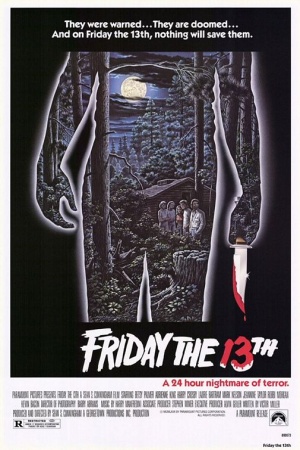
Scenes That I Love: Jason Emerges From The Lake In Friday the 13th


In 1980, when director Sean S. Cunningham offered Ari Lehman a role in his new movie, he asked only one question. “Can you swim?”

At the age of 14, Ari appeared in Friday the 13th.  He didn’t get much screen time but his performance and appearance as the young Jason Voorhees created a moment of fright that lives on today.

4 Shots From 4 Films: Special Friday The 13th Edition


4 Shots From 4 Films is just what it says it is, 4 shots from 4 of our favorite films. As opposed to the reviews and recaps that we usually post, 4 Shots From 4 Films is all about letting the visuals do the talking.

The Friday the 13th films aren’t exactly known for being the most visually impressive horror films ever made.  That’s especially true of the first 8 films, which were all shot on a low budget and in a hurry.  Actually, I think you could argue that’s a part of the enduring charm of the series.  Today is Friday the 13th and there’s no way that I, as a lover of the horror genre, couldn’t use the 4 Shots format to pay a little bit of tribute to one of the most successful and influential horror franchises of all time.

So, with that in mind, here are….

4 Shots From 4 Friday the 13th Films

Friday the 13th (1980, dir by Sean S. Cunningham)

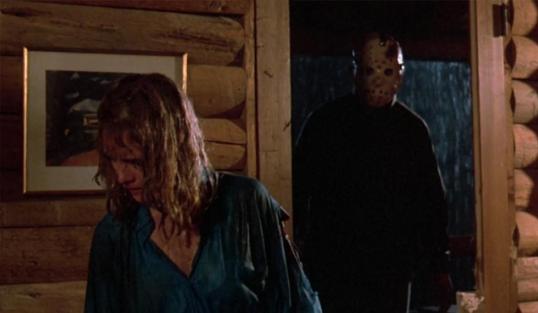
Friday the 13th Part II (1981, dir by Steve Miner)

Friday the 13th: The Final Chapter (1984, dir by Joseph Zito)

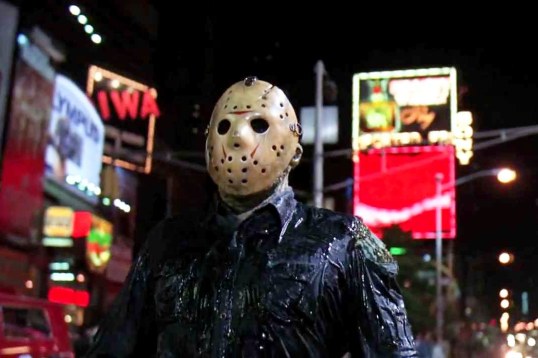
Friday the 13th Part VIII: Jason Takes Manhattan (1989, dir by Rob Hedden)

Back in 2012, I reviewed every single film in the Friday the 13th film franchise!  It was a lot of fun!

My Friday the 13th reviews:

Happy Friday the 13th everyone!

Live Tweet Alert: Join #FridayNightFlix for Sharktopus!


As some of our regular readers undoubtedly know, I am involved in a few weekly watch parties.  On Twitter, I host #FridayNightFlix every Friday and I co-host #ScarySocial on Saturday.  On Mastodon, I am one of the five hosts of #MondayActionMovie!  Every week, we get together.  We watch a movie.  We tweet our way through it.

Tonight, at 10 pm et, I will be hosting #FridayNightFlix!  The movie?  Sharktopus!

If you want to join us this Friday, just hop onto twitter, find Sharktopus on Prime, start the movie at 10 pm et, and use the #FridayNightFlix hashtag!  I’ll be there happily tweeting.  It’s a friendly group and welcoming of newcomers so don’t be shy.

See you there!

Late Night Retro Television Review: Highway to Heaven 5.7 “The Squeaky Wheel”


Welcome to Late Night Retro Television Reviews, a feature where we review some of our favorite and least favorite shows of the past!  On Thursdays, I will be reviewing Highway to Heaven, which aired on NBC from 1984 to 1989.  The entire show is currently streaming on Tubi and several other services!

This week, Jonathan and Mark help out a vet.

Episode 5.7 “The Squeaky Wheel”

(Dir by Michael Landon, originally aired on June 16th, 1989)

Jonathan and Mark attempt to turn Wayne Secret (Robert David Hall) into a disability activist.  Having lost his legs in Vietnam, Wayne wants to live a quiet life with his wife (Deborah Benson) but, while staying at a recently renovated hotel, he is woken up by a fire alarm.  With the the elevators not working and no ramps, Wayne is forced to depend on the kindness of a stranger who carries him down a flight of stairs.  The fire turns out to be a false alarm but the experience leads to Wayne protesting the fact that the hotel is not wheelchair accessible.

The owner of the hotel not only agrees to make changes to the building but he also offers Wayne a job.  Things are looking up for Wayne!  But, when a gang of young men harass him and his wife at a drive-in movie, Wayne snaps.  He buys an Uzi and then heads down to their clubhouse to take them out.  Luckily, Jonathan appears and talks Wayne out of becoming a mass murderer.  Wayne goes on to receive a “man of the year” award while Jonathan beats up the leader of the gang.

This episode felt very familiar.  In the past, this episode would have featured Mark’s brother-in-law, Scotty.  Instead, it features Wayne, who is not a particularly compelling character.  I think that this episode would have worked if it had just focused on Wayne advocating for wheelchair accessible buildings.  I also think it would have worked if it had just focused on Wayne’s anger to the gang and his struggle to let go of his bitterness over his war experiences.  Unfortunately, trying to cram both those storylines into one 45-minute show led to the whole thing feeling half-baked.

There was one poignant scene in this episode.  It opened with Mark and Jonathan visiting the Hollywood Walk of Fame.  Mark got excited when he came across Michael Landon’s star. “Never heard of him,” Jonathan shrugged.  “I forget you’ve been dead for forty years,” Mark replies.  It captured Jonathan and Mark’s friendship, which was always been one of the more underrated aspects of Highway to Heaven.  That said, it was also a bit of a sad scene as the episode itself aired a day after the death of Victor French and Landon himself would pass away nearly two years later.

Retro Television Review: Decoy 1.20 “Across the World”


Welcome to Retro Television Reviews, a feature where we review some of our favorite and least favorite shows of the past!  On Thursdays, I will be reviewing Decoy, which aired in Syndication in 1957 and 1958.  The show can be viewed on Tubi!

This week, Casey gets involved with gun smugglers!

Episode 1.20 “Across the World”

(Dir by Teddy Sills, originally aired on February 24th, 1958)

Andrew Garcia (Frank Silvera), Herbert Carson (Arthur Batanides), and Carl Walton (Nicholas Colasanto) are using an import/export business to smuggle guns to the communists.  (Booo!)  When the owner of the company finds out, they murder her in a hit-and-run.  Because of the suspicious nature of the woman’s death, Casey is sent undercover to investigate.  She shows up at the company, claiming to be the woman’s only heir.  Her cover is blown early, leading to her getting knocked around by the bad guys.  Fortunately, for her, the bad guys end up turning on each other and eventually, the rest of the police force arrives and puts an end to the smuggling once and for all.

This episode didn’t feature much of Beverly Garland.  Instead, the majority of it focused on the three smugglers arguing amongst themselves and then plotting various double crosses.  Unfortunately, the smugglers weren’t particularly interesting.  Sometimes, bad guys can be compelling to watch but these dopes were obviously doomed from the minute that they first appeared.  Though it’s never specifically said to whom they were smuggling the weapons, I’m going to assume that it was probably Castro and his forces.  In 1958, there were a lot of Americans who actually thought that Castro would be more willing to work with America than Batista was.  Needless to say, they turned out to be incorrect.  Casey could have warned them if anyone had bothered to listen!

This was a lesser episode of Decoy but the episode did feature some location shots of New York City.  The actors where shivering so I can only assume it was very cold when they filmed this episode.