The Unnominated #16: The Mortal Storm (dir by Frank Borzage)


Though the Academy of Motion Picture Arts and Sciences claim that the Oscars honor the best of the year, we all know that there are always worthy films and performances that end up getting overlooked.  Sometimes, it’s because the competition too fierce.  Sometimes, it’s because the film itself was too controversial.  Often, it’s just a case of a film’s quality not being fully recognized until years after its initial released.  This series of reviews takes a look at the films and performances that should have been nominated but were, for whatever reason, overlooked.  These are the Unnominated.

Oh, how this movie made me cry!

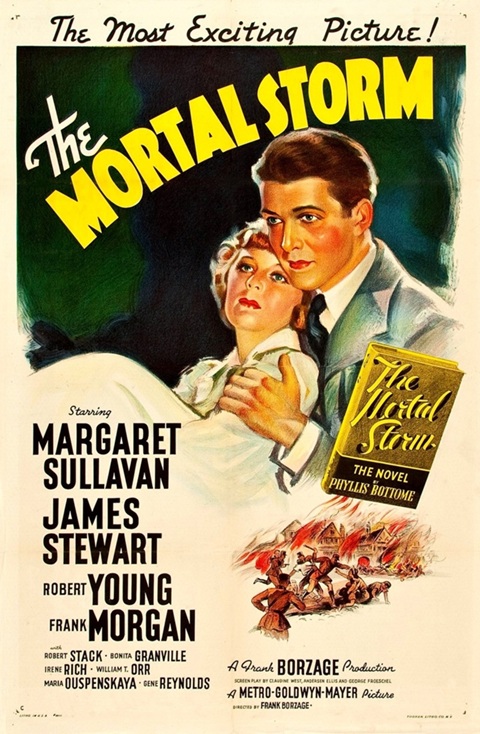
Released in 1940, at a time when war was spreading across Europe, Asia, and Africa but the United States was still officially neutral, The Mortal Storm opens on January 30th, 1933.  In the mountains of Germany, near the Austrian border, Professor Viktor Roth (Frank Morgan) is celebrating his 60th birthday.  He starts the day being applauded by his students at the local college.  In the evening, he returns home for a celebration with his family, including wife (Irene Rich), his daughter Freya (Margaret Sullivan), his son Rudi (Gene Reynolds), and his two stepsons, Otto (Robert Stack) and Erich von Rohn (William T. Orr).  Also present are Freya’s fiancé, Fritz (Robert Young) and one of Roth’s students, a pacifist named Martin Breitner (James Stewart).  It’s a joyous occasion and the film takes its time introducing us to Prof. Roth and his extended family.  At first, everyone seems very kind.  They seem like people who most viewers would want to spend time with or live next to….

But then, the family’s maid excitedly enters the room and announces that it’s just been announced that Adolf Hitler is the new chancellor of Germany.  Otto and Erich are overjoyed and head out to celebrate with the other members of the Nazi Youth Leage.  Martin is less happy and excuses himself to return home.  Roth and his wife worry about what this means for people who do not agree with Hitler’s beliefs.  Freya says that they shouldn’t talk politics.  It is jokingly mentioned that Hitler has taken away Roth’s special day but Roth’s young son Rudi says that he’s learned in school that the needs of the individual will never be more important than the needs of the state.  If Hitler wants to take away your day, it’s your duty to give it up or face the consequences.

Based on a 1937 novel, The Mortal Storm was not the first Hollywood production to take a stand against Hitler and the Nazis but it was one of the best.  I say this despite the fact that the film only hints at the fact that Prof. Roth is Jewish, something that was made very clear in the book.  (In the movie, Roth and his wife worry what will happen to “Non-Aryans” and “freethinkers.”)  That said, the film perfectly captures how quickly and insidiously the authoritarian impulse can spread.  The town, which once seemed so friendly, becomes a very dark place as the students at the university put on their swastika armbands and start to hunt down anyone who dissents from the party line.  When Roth says that, as a scientist, he does not believe one race can be genetically superior to another, his students walk out on him.  A local teacher is beaten when he fails to return to the Nazi salute.  When Martin refuses to join the Party, Otto and Erich turn against him despite being lifelong friends.  When Martina and Freya flee for the border, Fritz pursues them.  And even after Prof. Roth is sent to a concentration camp, Otto and Erich continue to follow the orders of Hull (Dan Dailey), the sinister Youth Party Leader.

It’s a powerful film, one that remains just as relevant today as it was when it was first released.  Hull and Erich’s fanaticism would, today, find a welcome home on social media.  The scenes in which the townspeople eagerly threaten to report their former friends and neighbors for failing to salute or show proper enthusiasm for the government have far too many modern day equivalents for me to even begin to list them all.  This film was also the last the James Stewart made with frequent co-star Margaret Sullivan and they both give great performances.  (All-American Jimmy Stewart might seem a strange choice to play a German farmer but he is never less that convincing as Martin, one of the few people in the town not to surrender his principles and beliefs to the crowd.)  The film’s final moments, with the camera panning around the empty Roth home, brought very real tears to my eyes.

Despite being a powerful film, The Mortal Storm was not nominated for a single Oscar.  (Jimmy Stewart did win his only Oscar that year but it was for The Philadelphia Story.)  It’s temping to assume that, at a time when America was still divided about how to react to the war in Europe and when many Americans still remembered the trauma of the first World War, The Mortal Storm was too explicitly political and anti-Nazi to get a nomination but, the same year, The Great Dictator was nominated for Best Picture.  It seems more likely that, in those days when the studios ruled supreme, MGM decided to puts it weight behind The Philadelphia Story rather than The Mortal Storm.

That said, The Mortal Storm was definitely worthy of being nominated, for Picture, Director, Screenplay, Actress (Margaret Sullivan), Actor (Stewart), Supporting Actor (Frank Morgan and Robert Stack), and Supporting Actress (Irene Rich and, in the role of Stewart’s mother, Maria Ouspenskaya).  The film may not have been nominated but it remains a powerful and important work of art.
Previous entries in The Unnominated:

  1. Auto Focus 
  2. Star 80
  3. Monty Python and The Holy Grail
  4. Johnny Got His Gun
  5. Saint Jack
  6. Office Space
  7. Play Misty For Me
  8. The Long Riders
  9. Mean Streets
  10. The Long Goodbye
  11. The General
  12. Tombstone
  13. Heat
  14. Kansas City Bomber
  15. Touch of Evil

Scenes I Love: James Stewart Explains The Four Ways To Defend Murder In Anatomy of a Murder


In honor of James Stewart’s birthday, our scene that I love comes from one of my favorite Stewart films, 1959’s Anatomy of a Murder.

In today’s scene that I love, James Stewart explains to his client (played by Ben Gazzara) that there are four ways that he can defend a murder charge.  The contrast between Stewart’s classic style and Gazzara’s intense method style makes for an intense scene between two very talented and unique actors.

Retro Television Review: Fantasy Island 6.17 “King of Burlesque/Death Games”


Welcome to Retro Television Reviews, a feature where we review some of our favorite and least favorite shows of the past!  On Tuesdays, I will be reviewing the original Fantasy Island, which ran on ABC from 1977 to 1984.  Unfortunately, the show has been removed from most streaming sites.  Fortunately, I’ve got nearly every episode on my DVR.

“Smiles, everyone, smiles!”  It’s time for another two fantasies.

Episode 6.17 “King of Burlesque/Death Games”

(Dir by Cliff Bole, originally aired on March 12th, 1983)

I’m going to deal with the first of this week’s fantasies very quickly because, quite frankly, it’s not every interesting.  Rich Little is Tom Vail, a wall street accountant who wants to be a burlesque comedian.  He gets his fantasy.  He performs at the Fantasy Island Burlesque Revival.  He wears a hideous suit with a big bowtie.  He falls in love with a dancer.  The always likable Red Buttons appears as a Burlesque veteran.  It’s not a bad fantasy but it’s not terribly interesting.

Meanwhile, Vanessa Walgren (Joanna Pettet) has come to the Island to compete in the “First Annual Fantasy Island Pentathlon.”  However, Mr. Roarke knows that she’s there for another reason.  She wants to kill him!  A year ago, Vanessa’s husband was lost at sea while on his own fantasy.  (He wanted to retrace the route of the Kon Tiki.)  Vanessa blames Roarke and she’s put a bounty on his head.  Roarke sighs and says, “Fine, but if you don’t kill me by the end of the weekend, you have to leave the Island and never bother me again.”  Vanessa agrees….

WHAT!?  What type of vengeance is that!?  Seriously, if you’re obsessed with vengeance, you don’t just shrug and accept an arbitrary rule from the person you’re trying to kill.

Anyway, Roarke is the judge for the Pentathlon so he’s got various athletes trying to kill him over the course of the entire weekend.  He even gets cut during a fencing match!  (“If you can bleed, you can die!” Vanessa declares in a wonderfully over-the-top moment.)  Whenever anyone fails to kill him, Roarke says, “Get off my Island!,” which is rally cool.  Tattoo wonders why Roarke is allowing this to happen.  Why doesn’t Roarke order Vanessa to get off the Island.  Roarke is all like, “I can’t tell you, just trust me.”  The final event is a skydiving competition and I’m not really sure how you compete at that but whatever.  Despite Vanessa’s efforts to sabotage his parachute, Roarke lands safely.

Vanessa then offers him two glasses of wine.  One glass is poisoned!  Can Roarke pick the right glass?  Roarke is like, “Screw this,” and finally reveals that Vanessa’s husband is not dead.  Instead, he’s a secret agent who had to fake his own death but who is now ready to be reunited with Vanessa….

Again, WHAT!?  Seriously, that came out of nowhere.

Reunited with her husband, Vanessa apologizes for trying to murder Roarke.  Roarke says it’s fine because Mr. Roarke is very forgiving.

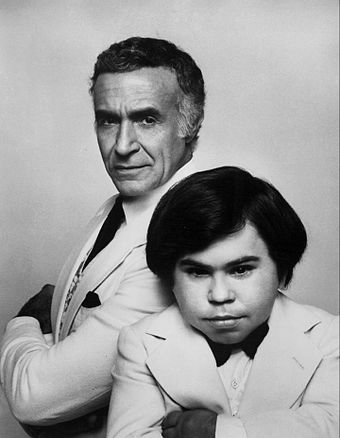
The burlesque fantasy was boring (loved the costumes, though!) but the revenge fantasy made up for it.  I love it when Fantasy Island embraces the melodrama.  Plus, this fantasy actually gave Ricardo Montalban and Herve Villechaize quite a bit to do.  All in all, this was a good trip to the Island!

An Offer You Can’t Refuse: The Last Gangster (dir by Edward Ludwig)


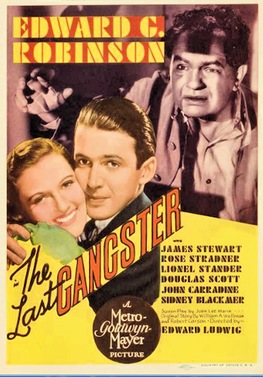
In 1937’s The Last Gangster, Edward G. Robinson plays Al Capone.

Well, actually, that’s not technically true.  The character he’s playing is named Joe Krozac.  However, Joe is a ruthless killer and gangster.  He’s made his fortune through smuggling alcohol during prohibition.  Despite his fearsome reputation, Joe is a family man who loves his wife Tayla (Rose Stradner) and who is overjoyed when he learns that she’s pregnant.  To top it all off, Joe is eventually arrested for and convicted of tax evasion.  He gets sent to Alcatraz, where he finds himself being bullied by another inmate (John Carradine) and waiting for his chance to regain his freedom.

In other words, Edward G. Robinson is playing Al Capone.

Krozac does eventually get out of prison but, by that point, Tayla has moved on.  She’s married Paul North (James Stewart), a former tabloid reporter who was so outraged by how his newspaper exploited Tayla’s grief that he resigned his position.  Joe Krozac’s son has grown up with the name Paul North, Jr. and he has no idea that his father is actually a notorious gangster.

Krozac wants to get his son back but his gang, now led by Curly (Lionel Stander), has other ideas.  They want Krozac to reveal where he hid the money that he made during his gangster days.  As well, an old rival (Alan Bazter) not only wants to get revenge on Krovac but also on Krovac’s son.  Joe Krovac, fresh out of prison, finds himself torn between getting his revenge on his wife and protecting his son.  This being a 30s gangster film, it leads to shoot-outs, car chases, and plenty of hardboiled dialogue.

Edward G. Robinson and Jimmy Stewart in the same movie, how could I n0t watch this!?  I was actually a bit disappointed to discover that, even though both Robinson and Stewart give their customarily fine performances, they don’t spend much time acting opposite each other.  Indeed, it sometimes seem like the two men are appearing in different pictures.

Robinson is appearing in one of the gangster films that made him famous.  (Indeed, the film’s opening credits feature footage that was lifted from some of Robinson’s previous films.)  He gives a tough and snarling performance but also one that suggests that, as bad as he is, he’s nowhere near as bad as the other gangsters that are working against him.  His gangster is ultimately redeemed by his love for his son, though the Production Code still insists that Joe Krozac has to pay for his life of crime.

Stewart, meanwhile, plays his typical romantic part, portraying Paul as being an incurable optimist, a happy go-getter who still has a sense of right-and-wrong and a conscience.  Stewart isn’t in much of the film.  This is definitely Robinson’s movie.  But still, there’s a genuine charm to the scenes in which Paul romances the distrustful Tayla.  Not even being forced to wear a silly mustache (which is the film’s way of letting us know that time has passed) can diminish Stewart’s natural charm.

If you like 30s gangster films, like I do, you should enjoy The Last Gangster.  I would have liked it a bit more if Robinson and Stewart had shared more scenes but regardless, this film features these two men doing what they did best.  This is an offer that you can’t refuse.

Film Review: Speed (dir by Edwin L. Marin)


1936’s Speed takes place in Detroit, at the home of Emery Motors.

When Joan Mitchell (Wendy Barrie) shows up to start her new job in the PR department, one of the first things she sees is a car being driven around a race track at a high speed until eventually it crashes.  Automotive engineer Frank Lawson (Weldon Heybourn) explains that it’s all a part of making sure the car is safe.  At Emery Motors, they crash cars on a daily basis to make sure that both the car and the driver will survive.

Terry Martin (James Stewart), the driver of the crashed car, proceeds to give Joan a tour of the factory.  There’s an obvious attraction between the two of them but Joan also seems to have feelings for Frank.  Terry and Frank are rivals.  Terry may not have Frank’s education but he has instincts and he has common sense.  He and his friend, Gadget Haggerty (Ted Healy), have an instinctive understanding of cars.  They know how to drive them.  They know how to fix them.  They know how to make them go really fast.

In fact, Terry is working on a new carburetor, one that he says will increase the speed of Emery’s cars.  Frank is skeptical but Terry knows that, if he can enter his car into the Indianapolis 500, he’ll be able to prove that he knows what he’s talking about.  Joan comes to believe in Terry and his carburetor.  And, fortunately, Joan has a secret of her own that will be very helpful to Terry’s ambitions.

Speed was not Jimmy Stewart’s first feature role but it was his first starring role.  28 years old when he starred in Speed, Stewart is tall, a little bit gawky, and unbelievably adorable.  From the minute that Terry climbs out of that wrecked car and introduces himself to Joan, Stewart’s a true movie star.  He and Wendy Barrie have a lot of chemistry and are a truly cute couple but Stewart is the one who dominates the film with his straight-forward charisma.  Terry may not be the best educated engineer at Emery Motors but he is determined to prove himself and Stewart does a great job of portraying that determination.

As for the film itself, it’s low-budget and it’s short.  Automotive enthusiasts might enjoy seeing all of the old cars and getting a chance to see what a car race was about in the days when cars themselves were still a relatively new invention.  The film itself starts out as almost a documentary, with Stewart (as Terry) explaining how each car is manufactured on the assembly line.  He points out all the machinery that goes into making the car in an almost-awed tone of voice.  If the information is a bit dry, it doesn’t matter because it’s impossible not to enjoy listening to Jimmy Stewart speak.  In his pre-WWII films, Stewart was the voice of American optimism and that’s certainly the case with Speed.

Speed was not a huge box office success but, in just two years, Stewart would be working with Frank Capra on You Can’t Take It With You, the first Stewart film to be nominated for (and to win) the Oscar for Best Picture of the year.

4 Shots From 4 Films: Special James Stewart Edition


4 Shots From 4 Films is just what it says it is, 4 shots from 4 of our favorite films. As opposed to the reviews and recaps that we usually post, 4 Shots From 4 Films lets the visuals do the talking!

Today, we celebrate the birthday of one of the greatest American actors of all time, the wonderful James Stewart!  It’s time for….

4 Shots From 4 James Stewart Films

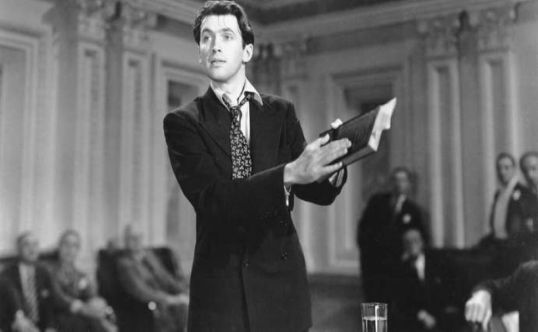
Mr. Smith Goes To Washington (1939, dir by Frank Capra, DP: Joseph Walker)

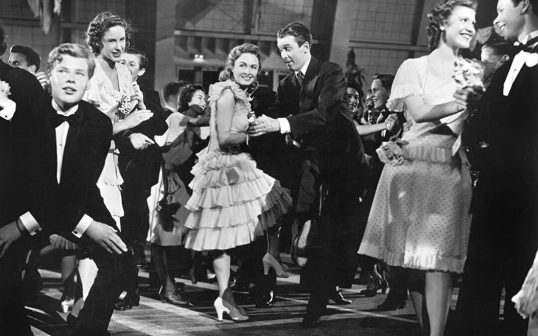
It’s A Wonderful Life (1946, dir by Frank Capra, DP: Joseph Walker and Joseph Biroc)

Rear Window (1954, dir by Alfred Hitchcock, DP: Robert Burks)

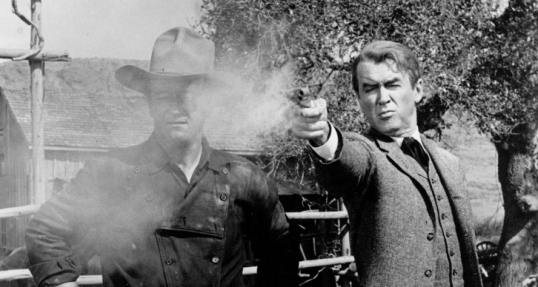
The Man Who Shot Liberty Valance (1962, dir by John Ford. DP: William H. Clothier)

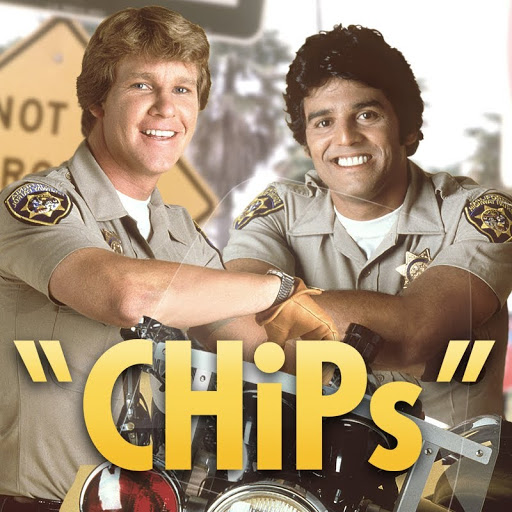
Late Night Retro Television Review: CHiPs 3.21 “The Strippers”


Welcome to Late Night Retro Television Reviews, a feature where we review some of our favorite and least favorite shows of the past!  On Mondays, I will be reviewing CHiPs, which ran on NBC from 1977 to 1983.  The entire show is currently streaming on Prime!

This week, the hills have eyes.

Episode 3.21 “The Strippers”

(Dir by Don Weis, originally aired on February 16th, 1980)

Calm down, boys, we’re not talking those types of strippers!

This episode of CHiPs finds Ponch and Jon searching through the California hill country for two rednecks who are stealing cars and stripping them for the parts.  One of the strippers is a fat guy who likes to sing while he’s working.  The other is a guy played by Evan C. Kim, who later played Clint Eastwood’s partner in The Dead Pool.  Baker’s girlfriend’s car gets stolen so this one is …. wait for it …. PERSONAL!  Of course, this being CHiPs, the episode is still mostly about Ponch even though Baker’s the one with a personal stake in the case.

It turns out that Ponch and Jon aren’t the only ones investigating crimes in the hills of California. The DEA is investigating a drug-running operation and they really don’t want to two motorcycle cops getting in the way.  (Doesn’t the DEA understand that motorcycles are cool?  At least they’re not bike cops like those schmucks on Pacific Blue.)  The head drug smuggler is played by Morgan Woodward, who was a veteran of the western genre.  The old cowboys are smuggling cocaine into Los Angeles.  It’s like an extremely depressing country song.  There’s no more cattle but there’s plenty of the devil’s dandruff to be sold.

If I seem to be rambling, it’s because there’s not really much to say about this episode.  Airing, as it did, late in the season, it’s hard not to feel that show’s writers were probably tired and out-of-ideas when it came to coming up with the plot for this one.  Ponch and Jon catch the car strippers who have information on the drug dealers.  The car strippers turn informant and hope that they’ll get a deal as a result.  Let’s hope so because prison is not a friendly environment to snitches.

This episode did feature one nicely-filmed accident scene, featuring multiple cars flying through the air (in glorious slo mo of doom!) and a bunch of broken glass.  Bonnie and Bear cleaned up the accident site so that Ponch and Baker could get back to searching for the car thieves.  That was nice of them.  It’s all about team work!

Retro Television Review: Miami Vice 4.5 “Child’s Play”


Welcome to Retro Television Reviews, a feature where we review some of our favorite and least favorite shows of the past!  On Mondays, I will be reviewing Miami Vice, which ran on NBC from 1984 to 1989.  The entire show can be purchased on Prime!

This week, Sonny is too quick to fire his gun.

Episode 4.5 “Child’s Play”

(Dir by Vern Gillum, originally aired on October 30th, 1987)

This is a dark, dark episode.

While breaking up what appears to be a case of domestic violence between Annette McAllister (Danitra Vance) and Walker Monroe (Ving Rhames), Sonny thinks that he spots someone holding a gun in the next room.  Sonny fires through the wall, hitting a 13 year-old boy who Annette claims is her son, Jeffrey.  While Jeffrey McCallister lies in a coma, a guilt-ridden Sonny starts to think about his ex-wife and their son, Billy.  They live upstate and it’s been a while since Sonny visited.  When Sonny does visit, he learns that his ex-wife’s fiancé wants to adopt Billy after the wedding.

Meanwhile, back in Miami, it turns out that there is no Jeffrey McAllister and that the boy who Sonny shot was actually a child soldier, recruited into a gang at an early age so that he couldn’t be sent to prison if arrested.  It turns out that Walker and Annette are both involved in a gunrunning operation that is headed up by Holliday (Isaac Hayes).  It all leads to one of those patented Miami Vice-style action sequences where Crockett, more or less, allows Walker to fall to his death.  Sonny is definitely not in a good mood for the majority of this episode.

Child’s Play could have just as easily been titled The Don Johnson Emmy Submission Episode.  This episode revolves entirely around Crockett and his feelings of guilt over shooting a child and also his fear of losing his son.  Johnson does a pretty good job in this episode.  Over the course of season 3 and the first few episodes of season 4, it really has sometimes seemed as if Crockett was losing his edge.  This episode presents us with the return of self-destructive, end-of-his-rope Sonny and not even Johnson’s mullet can distract from the drama.

Thematically, this episode is pretty bleak.  We never really learn much about the kid who was shot by Crockett, other than that he has a pretty sizable criminal record for a 13 year-old.  By the end of the episode, he’s woken up from his coma but, assuming that he is capable of leaving the hospital, he’s still wanted on several murder charges.  The kid basically has no future, even if he does make it to adulthood.  Meanwhile, Sonny’s son is growing up without his father and, when Sonny does visit him, there’s really not much of a connection between the two of them.

In other words, everyone’s doomed.  This was not a happy episode but, then again, Miami Vice was rarely a happy show.