Jedadiah Leland’s Horrific Adventures In The Internet Archive #3: Hugo’s House of Horrors (1990, Gray Designs Associates)


During today’s exploration of the horrific corners of the Internet Archive, I played Hugo’s House of Horrors (1990, Gray Designs Associates.)

In Hugo’s House of Horrors, you control Hugo.  Hugo’s girlfriend went to a haunted house to babysit and never returned.  When the game starts, you have just arrived at the house to try to find her.

First impression: I’m really digging the graphics.  That house sure does look haunted.  The spooky music that playing in the background is also pretty cool.

I guess it’s time for Hugo to enter the house.  This turned out to be more difficult then I was expecting.

Why not?  That’s a great idea!

Locked?  But look at all those eyes watching Hugo.  Maybe someone inside the house can help.

Hello?

Son of a bitch!  Maybe there’s something I’m missing.

I just tried that!

OPEN THIS DOOR!

OPEN UP!

OPEN THE DOOR, I SEE YOU STARING AT ME!

Eventually, I noticed the pumpkin at Hugo’s feet.  The key was hidden in the pumpkin so Hugo was finally able to open the door and enter the house.

Nice house.  I especially like the painting of the bat.  I sent Hugo went upstairs and had him go through that open doorway at the end of the hall.

Get in the box?  Why not?

Maybe this wasn’t such a good idea.

Oh, this is bullsh–

After the professor left, I realized that Hugo was now much smaller.  After the professor left, I decided that Hugo should leave the room too.  I don’t trust Igor.

The lesson here is don’t get into strange boxes.

This is as far as I have gotten on Hugo’s House of Horrors.  Hugo may be in trouble because it doesn’t seem that I’m very good at this game.  Maybe he will have better luck with you controlling his actions than me.
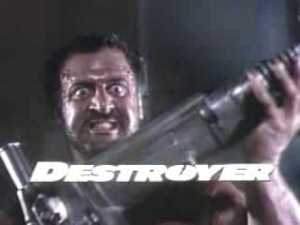
A Movie A Day #268: Destroyer (1988, directed by Robert Kirk)


A year and a half ago, serial killer Ivan Mosser (Lyle Alzado) was sent to the electric chair for murdering 23 people.  On the night that he was electrocuted, the worst prison riot in American history broke out.  The prison was closed and abandoned.  A year and a half later, a film crew has entered the prison to make a women in prison film.  Robert Edwards (Anthony Perkins) is the sleazy director.  David Harris (Clayton Rohner) is the screenwriter who fights to maintain the integrity of his script and who is an expert on the prison’s history.  Susan Malone (Deborah Foreman) is a stuntwoman and David’s girlfriend.  And Ivan is the murderer who is still half-alive and full of electricity.

Watching a forgettable, direct-to-video movie like Destroyer, it is impossible not to feel sorry for Anthony Perkins, who went from getting nominated from Oscars and working with Hitchcock to appearing in films like this.  According to the Perkins biography, Split Image, Perkins was brought in at the last minute to replace Roddy McDowall and was miserable during most of the shoot.  Since Perkins spent a good deal of his later career working with directors like the one he plays in Destroyer, it’s not surprising that he gives one of the two good performances in Destroyer and he also gets the movie’s only memorable death scene.  The other good performance comes from Lyle Alzado, a former football player who had exactly the right look for his role and who plays Ivan like a ghost who is in the throes of roid rage.  Unfortunately, both Alzado and Perkins would die within months of each other in 1992, four years after co-starring in Destroyer.

Jedadiah Leland’s Horrific Adventures In The Internet Archive #2: Knightmare (1992, Konami)


For my second day of exploring the horror section of the Internet Archive, I played Knightmare (1992, Konami). 

Knightmare is basically a top-down shooter.  You are a knight and your girlfriend has been kidnapped by an evil sorcerer.  To rescue her, you must make your way across the grounds of his castle, while avoiding the monsters and guards.

That’s you, in the white armor.  The bat and the gray balloons may look harmless but if they touch you, you explode.  Fortunately, you have an unlimited supply of arrows that you can shoot at them.  You can also use the arrows to destroy obstacles, like those boxes with the question marks.  If you shoot an arrow into a black circle and then retrieve it, you get a weapons upgrade.

You will need that weapons upgrade because eventually, these people show up:

The blue knights are considerably faster than the bats and the balloons.  It takes more than one arrow to kill them and they have arrows of their own.

It took me a while to get the hang of it.

At the end of each level, there is a boss who must be destroyed.  At the end of stage 1, the boss appears to be Medusa.

I have not had much luck against Medusa.

I liked Knightmare.  Like all of the best shooters, it is simple but also challenging and extremely addictive.  It is a game that you can go back and play again and again, which is what I am going to go down right now.

A Movie A Day #267: Satan’s Princess (1990, directed by Bert I. Gordon)


Lou Cherney (Robert Forster) was a top police detective until a perp with a shotgun shattered his leg.  Now, Lou’s a private investigator with a limp, a girlfriend (Caren Kaye), and a learning disabled son named Joey (Philip Glasser).  When Lou is hired to track down a missing girl, he discovers that she is now the lover of Nicole St. James (Lydie Denier), the head of a modeling agency.  Nicole seduces Lou within minutes of meeting him but, when Lou attempts to return the missing girl to her family, Nicole reveals that she is actually an ancient demon and she possesses Joey.  Soon, Joey is carrying an ice pick and throwing people out of windows.

An example of the type of movies that Robert Forster was stuck making before Quentin Tarantino engineered his comeback with Jackie Brown, Satan’s Princess is also noteworthy for having been directed by Bert I. Gordon.  Gordon is best known for making cheesy giant monster movies, like The Amazing Colossal Man, Beginning of the End, and Empire the Ants.  There are not any giant monsters in Satan’s Princess, which instead emphasizes lesbian sex scenes, possessed children, and Robert Forster using a blowtorch to take on a demon.  Satan’s Princess also features the spectacle of a demon fleeing the scene of a crime by stealing a car.  Why a demon who can possess people and do almost anything would need to steal car in order to make escape is a question that Satan’s Princess never answers.

Satan’s Princess is even dumber than it sounds but Robert Forster delivers.  There is no real reason for Lou to be crippled so I like to think that, one day, Forster announced that if he was not allowed to carry a cane in all of his scenes, he wouldn’t do the movie.  Watching Forster give a good performance in even a piece of dreck like Satan’s Princess makes me all the more grateful that Tarantino cast him in Jackie Brown and allowed Forster the chance to once again appear in movie worthy of his talents.

Bert I. Gordon’s career as a filmmaker began in 1954.  Satan’s Princess was his 23rd movie and, for over 20 years, it was also his last.  In 2014, Gordon finally returned to directing with Secrets of a Psychopath.

R.I.P., Tom Petty


Words fail me right now.

Rest in peace, Tom Petty.

Thank you for the music.

Update, 4:39 pm — Now, CBS, which was the first outlet to report that Tom Petty had died, have backtracked their report.  He’s on life support but apparently, he’s still hanging on.  

4:44 pm — The LAPD has apologized for “inadvertently providing false information.”

12:25 am — Sadly, Tom Petty’s passing has now been confirmed.

A Movie A Day #266: Possessed by the Night (1994, directed by Fred Olen Ray)


Howard Hansen (Ted Prior) is a best-selling horror writer who is suffering from writer’s block.  With his agent, Murray (Frank Sivero), pressuring him to get something written, Howard decides to seek inspiration in Chinatown.  When he steps into a curio shop and sees a grotesque, one-eyed blob floating in a jar of formaldehyde, Howard buys it.  He hopes that the blob will give him an idea for a great book but instead, it just causes him to have nightmares and violent sex with his wife, Peggy (Sandahl Bergman).

Meanwhile, Murray is in debt with loan shark Scott Lindsey (Henry Silva) and Scott’s number one debt collector, Gus (Chad McQueen).  Murray needs money and he needs it quickly.  Murray sends his “secretary,” Carol (Shannon Tweed), to live with the Hansens and steal an unpublished romance novel that Howard wrote when he was just starting out as a writer.  However, the one-eyed blob possesses Carol and she is soon climbing onto both Howard’s workout equipment and Howard!  Soon everyone is under the influence of the one-eyed blob, Carol is forcing Howard and Peggy to make love while she holds the gun on them, and both Gus and Murray are sneaking around the house, trying to find the manuscript.

A movie that was once very popular on late night Cinemax, Possessed By The Night is a sometimes awkward but frequently entertaining horror/thriller hybrid from B-auteur Fred Olen Ray.  Along with giving Frank Sivero a rare leading role (Sivero is best known for playing Frankie in Goodfellas and providing the inspiration for the Simpsons character of the same name), Possessed By The Night proves that no movie can be that bad when featuring both Sandahl Bergman and Shannon Tweed.  When you watch a Fred Olen Ray/Shannon Tweed collaboration from 1994, you know what you’re getting and Possessed By The Night delivers.

Jedadiah Leland’s Horrific Adventures In The Internet Archive #1: Richard and Alan’s Escape From Hell (1990, Entertainment Arts)


For October, I have decided to return to the Internet Archive and further explore their collection of old MS-DOS games.   I started things off by playing Richard and Alan’s Escape From Hell (1990, Electronic Arts).

Though the Archive only includes the game (no manual, no instructions of any kind), I was able to find Escape From Hell‘s front and back cover art at the Let’s Play Archive.  Almost everything that needs to be known about this game’s tone and sensibility can be deduced simply by looking at these illustrations:

As for the game itself, it is a role-playing game.  You are Richard.  Largely as a result of your own stupidity, you and your best friend and your girlfriend have all accidentally be sent to Hell.

(Good work on including the Guns and Roses poster in the background.)

Because this is a MS-DOS game from 1990, Hell looks like this:

In the screen shot above, you are standing above a river of flame and there is a skeleton blocking your way.  One thing that I quickly learned is that you should not try to talk to the skeletons.  If you do, this will probably happen:

That did not work out.  One of the problems with trying to play Escape From Hell on the Internet Archive is that, especially early on in the game, it is very easy to die and, without the original disk, it is impossible to save your game.   Death means that you literally have to start over again, from the very beginning.

It is worth restarting, though.  Once you figure out how to avoid running into skeletons, you do get a chance to talk to some of the other inhabitants of Hell.  Like this one:

You also come across clues and other messages:

Eventually, I even found the entrance to Hell’s waiting room.

Unfortunately, once I got in the waiting room, I went down the wrong hallway and this happened:

Escape from Hell is not an easy game but it is worth sticking with.  If you can manage to go long enough without  dying, you will eventually meet some condemned people who are willing to help you out.  Most of them are real-life tyrants, like Joseph Stalin and Genghis Khan.  It turns out that Stalin is a really good shot with a nail gun.  Who would have guessed?

I am still playing my way through Escape From Hell but, from what I have seen, I recommend it for anyone who wants to take a retro trip through the underworld, MS-DOS style.

A Movie A Day #265: Hoodlum (1997, directed by Bill Duke)


1930s.  New York City.  For years, Stephanie St. Clair (Cicely Tyson) has been the benevolent queen of the Harlem underworld, running a successful numbers game and protecting her community from outsiders.  However, psychotic crime boss Dutch Schultz (Tim Roth) is determined to move into Harlem and take over the rackets for himself.  With the weary support of Lucky Luciano (Andy Garcia), Schultz thinks that he is unstoppable but he did not count on the intervention of Bumpy Johnson (Laurence Fishburne).  Just paroled from Sing Sing, Bumpy is determined to do whatever has to be done to keep Schultz out of Harlem.
When I reviewed The Cotton Club yesterday, I knew that I would have to do Hoodlum today.  Hoodlum and The Cotton Club are based on the same historic events and both of them feature Laurence Fishburne in the role of Bumpy Johnson.  Of the two, Hoodlum is the more straightforward film, without any of the operatic flourishes that Coppola brought to The Cotton Club.  Fisburne is surprisingly dull as Bumpy Johnson but Tim Roth goes all in as Dutch Schultz and Andy Garcia is memorably oily as the Machiavellian Luciano.  Hoodlum is about forty minutes too long but the gangster action scenes are staged well.  Bumpy Johnson lived a fascinating life and it is unfortunate that no film has yet to really do him justice, though Clarence Williams III came close with his brief cameo in American Gangster.  (Interestingly enough, Williams is also in Hoodlum, playing one of Shultz’s lieutenants.)

One final note: Hoodlum features William Atherton in the role of District Attorney Thomas E. Dewey.  Atherton plays Dewey as being a corrupt and sleazy politician on Luciano’s payroll.  In real life, Dewey was known for being so honest that Dutch Schultz actually put a contract out on his life after he discovered that Dewey could not be bribed.  I am not sure why Hoodlum decided to slander the subject of one of America’s most famous headlines but it seems unnecessary.

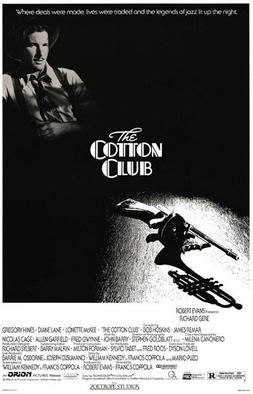
A Movie A Day #264: The Cotton Club (1984, directed by Francis Ford Coppola)


The time is the 1930s and the place is New York City.  Everyone wants to get into the Cotton Club.  Owned by British gangster Owney Madden (Bob Hoskins), the Cotton Club is a place where the stage is exclusively reserved for black performers and the audience is exclusively rich and white.  Everyone from gangsters to film stars comes to the Cotton Club.
It is at the Cotton Club that Dixie Dwyer (Richard Gere) meets everyone from Dutch Shultz (James Remar) to Gloria Swanson (Diane Venora).  Shultz hires Dixie to look after his girlfriend, Vera (Diane Lane).  Swanson arranges for Dixie to become a movie star.  Meanwhile, Dixie’s crazy brother, Vincent (Nicolas Cage), rises up through the New York underworld.  Meanwhile, dancing brothers Sandman and Clay Williams (played by real-life brothers Gregory and Maurice Hines) are stars on stage but face discrimination off, at least until Harlem gangster Bumpy Rhodes (Laurence Fishburne) comes to their aid.

The Cotton Club was a dream project of the legendary producer, Robert Evans, who was looking to make a comeback after being famously charged with cocaine trafficking in 1980.  Having commissioned a screenplay by his former Godfather collaborators, Mario Puzo and Francis Ford Coppola, Evans originally planned to direct the film himself.  At the last minute, Evans changes his mind and asked Coppola to direct the film.  After working with him on The Godfather, Coppola had sworn that he would never work with Evans again. (When he won an Oscar for The Godfather‘s screenplay, Coppola pointedly thanked everyone but Robert Evans.)  However, by 1984, a series of box office flops had damaged Coppola’s standing in Hollywood.  Needing the money, Coppola agreed to direct The Cotton Club.

Evans raised the film’s $58 million budget from a number of investors, including Roy Radin.  Roy Radin was best known for putting together Vaudeville reunions in the 70s and being accused of raping an actress in 1980.  Radin and Evans were introduced to each other by a drug dealer named Lanie Jacobs, who was hoping to remake herself as a film producer.  During the production of The Cotton Club, Radin was murdered by a contract killer who was hired by Jacobs, who apparently felt that Radin was trying to muscle her out of the film production.

While all of this was going on, Coppola fell into his familiar pattern of going overbudget and falling behind schedule.  This led to another investor filing a lawsuit against Orion Pictures and two other investors, claiming fraud and breach of contract.  When the film was finally released, it received mixed reviews, struggled at the box office, and only received two Oscar nominations.

With all of the murder and drama that was occurring offscreen, it is not surprising that the film itself was overshadowed.  The Cotton Club is a disjointed mix of gangster drama and big production numbers.  As always with post-Apocalypse Now Coppola, there are flashes of brilliance in The Cotton Club.  Some of the production numbers are impressive and visually, this movie has got style to burn.   However, among the leads, neither Richard Gere nor Diane Lane seem to be invested in their characters while the talented Hines brothers are underused.  The supporting cast is full of good character actors who are all in a search of a better script.  A few do manage to make an impression: James Remar, Bob Hoskins and Fred Gwynne as veteran gangsters, Nicolas Cage as the film’s stand-in for Mad Dog Coll, and Joe Dallesandro as Lucky Luciano.  The Cotton Club is sometimes boring and sometimes exciting but the onscreen story is never as interesting as what happened behind the scenes.


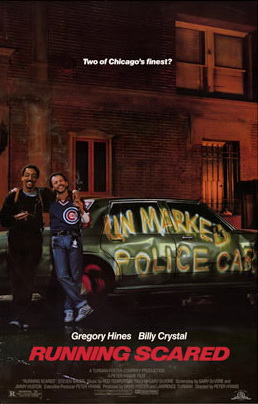
A Movie A Day #263: Running Scared (1986, directed by Peter Hyams)


Running Scared is weird but good.

Ray Hughes (Gregory Hines!) and Danny Costanzo (Billy Crystal!!!) are two tough detectives in Chicago.  All they want to do is three things: retire, open a bar in Florida, and bust Chicago’s most ruthless drug dealer, Julio Gonzalez (Jimmy Smits).  Their captain (Dan Hedaya) wants them to leave for Florida as soon as possible but they are determined to take down Julio first.’

There are two strange things about this otherwise formulaic crime film.  First off, the two tough cops are played by Gregory Hines and Billy Crystal.  According to the film’s Wikipedia page, director Peter Hyams realized that Running Scared‘s plot was nothing special so he decided that the only way to make the movie stand out was by doing it “with two actors you would not normally expect to see in an action movie.”  The other strange thing is that Hyams’s gambit worked.  Gregory Hines may have been best known as a dancer and Billy Crystal as a comedian but both of them were surprisingly believable as Chicago cops.  Running Scared is actually one of Billy Crystal’s best performances.  For once, he’s believable as being someone other than a version of himself.  Even his frequent one liners seem like something that a detective would say instead of Crystal recycling punch lines from his act.  Whether they are chasing down perps and firing their guns at a moving vehicle, Hines and Crystal are never less than credible as action stars.  Lorenzo Lamas has got nothing on the team of Hines and Crystal.

Predictable though it may be, Running Scared is one of the better late 80s cop films.  The action scenes are exciting and Hyams does a good job capturing the grittiness of Chicago.  Jimmy Smits is a good villain and Joe Pantoliano, Steven Bauer, and Jon Gries all shine in supporting roles.  Keep an eye out for the always underrated Darlanne Fluegel, playing Danny’s ex-wife.