Summer Rental (1985, directed by Carl Reiner)


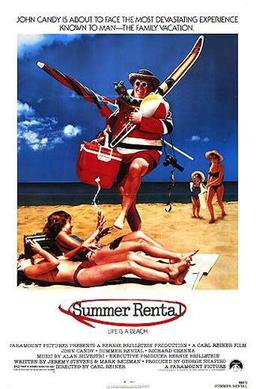
After a blow-up at work, air traffic controller John Chester (John Candy) is given five weeks of paid leave.  He takes his family to Florida, where they rent a beach house and discover that their summer town is controlled by snobbish sailing champion Al Pellett (Richard Crenna).  It’s the snobs vs slobs as Pellett tries to kick John and his family out of their summer rental and John tries to prove himself to his son and daughter (Joey Lawrence and Kerri Green) by winning the local sailing championship.  Luckily, John has Sully (Rip Torn), a modern-day pirate captain, on his side.

John Candy was a remarkable talent.  It’s just a shame that he didn’t appear in more good films.  He will always be remembered for films like Splash, Uncle Buck, Planes, Train, and Automobiles, and Only The Lonely but unfortunately, most of his starring roles were in lightweight, forgettable far like Summer Rental.  Candy is likable as John Chester and sympathetic even when he’s losing his temper over every minor inconvenience.  But the film itself never really does much to distinguish itself from all of the other 80s comedies about middle class outsiders taking on the richest man in town.  Candy is stuck playing a role that really could have been played by any comedic actor in 1985.  It’s just as easy to imagine Dan Aykroyd or even Henry Winkler in the role.  It feels like a waste of Candy.

The best thing about the film is Rip Torn’s performance as Sully.  Torn’s performance here feels like a dry run for his award-winning work as Artie on The Larry Sanders Show.  I would have watched an entire movie about Sully.  As it is, Summer Rental is inoffensive and forgettable.

The History of the World, Part I (1981, directed by Mel Brooks)


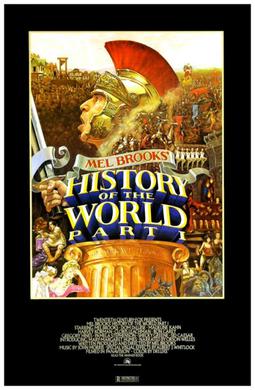
Overlong, wildly uneven, gimmicky too a fault, and often laugh out loud funny with a mix of jokes that range from the crude to the sublimely clever to the surprisingly sentimental, The History of the World, Part I is the ultimate Mel Brooks films.

Narrated by Orson Welles and featuring five historical stories and a collection of coming attractions, The History of the World Part I follows man from his caveman origins to the French Revolution and the thread that ties it all together is that humanity always screws up but still finds a way to survive.  Moses (Mel Brooks) might drop and break one of the three tablets listing the 15 Commandments but he’s still able to present the other ten.  Stand-up philosopher Comicus (Mel Brooks) might make the mistake of poking fun at the weight of Emperor Nero (Dom DeLuise) but he still makes his escape with Josephus (Gregory Hines), Swiftus (Ron Carey), and Miriam the Vestal Virgin (Mary-Margaret Humes) and ends up serving as the waiter at the Last Supper.  (“Jesus!”)  The Spanish Inquisition may have been a catastrophe but it also gave Torquemada (Mel Brooks) a chance to show off his performance skills.  The French Revolution may have been a bloodbath but the future still held promise.  Ask for a miracle and he’ll show up as a white horse named Miracle, no matter what era of history you’re living in.

The humor is very Mel Brooks.  During the Roman Empire sequence, Madeline Kahn plays Empress Nympho.  Jackie Mason, Harvey Korman, Cloris Leachman, Spike Milligan, Jan Murray, Sammy Shores, Shecky Greene, Sid Caesar, Henny Youngman, and Hugh Hefner all make cameo appearances.  Carl Reiner is the voice of God.  John Hurt plays Jesus.  The film ends with the promise of a sequel that will feature “Jews in Space.”  Not every joke lands.  The entire caveman sequence feels forced.  But when the film works — like during The Inquisition production number — it’s hard not get caught up in its anything-goes style.  The entire Roman Empire sequence is probably more historically accurate than the typical Hollywood Roman epic.  That’s especially true of Dom DeLuise’s naughty performance as Emperor Nero.

Mel Brooks is 99 years old today and he says that he has at least one more film to give us, a sequel to Spaceballs.  I’m looking forward to it!  I’m also looking forward to rewatching and enjoying all of the films that he’s already given us.  The History of the World, Part I may not have initially enjoyed the critical acclaim of his earlier films but, in all of its anarchistic glory, it’s still pure Mel Brooks.

A Father’s Revenge (1988, directed by John Herzfeld)


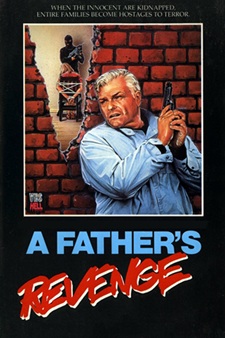
After his flight attendant daughter is taken hostage by a group of German terrorists, basketball coach Paul Hobart (Brian Dennehy) grows frustrated with government red tape and heads to Germany to track her down and save her himself.  Realizing that he doesn’t have the experience necessary to do it all on his own, Paul hires Vickers (Anthony Valentine), a shady and ruthless former SAS man who will do whatever is necessary to get the job done.  Joanna Cassidy plays Paul’s wife.  Ron Silver plays the journalist who sees the opportunity to break a great story as Paul searches for his daughter.

A Father’s Revenge is a slow-moving thriller.  I was surprised to discover that it was actually given a theatrical release because everything about it feels like a made-for-television movie.  It’s a predictable movie.  At first, Paul is reluctant to embrace Vickers’s more extreme methods but then he sees that those methods are the only ones that work when dealing with terrorists.  As usual, Dennehy is ideally cast as a beer-drinking, blue collar American and the underused Joanna Cassidy has a few good emotional scenes as his wife.  The movie is stolen by Anthony Valentine, who brings a note of ambiguity to Vickers’s motivations.  The main problem with the movie is that it spends too much time on scenes of people debating what they should do and not enough time showing them actually doing it.  The finale is exciting but it takes too long to get there.

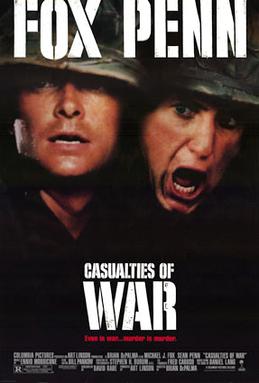
Casualties of War (1989, directed by Brian DePalma)


Private Max Eriksson (Michael J. Fox) is a new arrival in Vietnam, a young infantryman who is called a “cherry” by his fellow soldiers.  No one wants to get close to Eriksson because everyone knows that it’s the new guy who is most likely to make a mistake and get himself killed.  The only person who seems to care whether Eriksson lives or dies is Sgt. Tony Messerve (Sean Penn), a squad leader who is so tough and battle-worn that it is easy to forget that he is only 20 years old.  After a member of Messerve’s squad is killed in a firefight and Messerve’s squad had been denied leave despite all of the stress and pressure that they’ve been under, Messerve decides that, during their next mission, the squad is going to kidnap a woman from a village and take her with them.

Eriksson, who is still naive enough to sincerely say, “We’re supposed to be here to help these people,” is horrified by Messerve’s actions.  At first, only he and Diaz (John Leguizamo) refuse to take part in raping the terrified woman (Thuy Thu Le).  Diaz soon caves to the pressure from the rest of the squad and joins in.  Only Eriksson continues to refuse but his attempt to help the woman escape fails when the members of the squad murder her during a firefight with the Viet Cong.  After the battle, the wounded Eriksson discovers that no one in command wants to hear about what happened.  Messerve’s second-in-command, Clark (Don Patrick Harvey), targets Eriksson, trying to shut him up permanently.

One of the many Vietnam films to come out after the success of Platoon, Brian De Palma’s Casualties of War is an intense and disturbing recreation of a true story.   After years of being accused of making misogynistic and exploitive films, De Palma made an effective and sensitive anti-war film, one that did not exploit the suffering of the kidnapped woman but instead portrays the depravity of war and the courage it takes to do the right thing when everyone around is ordering you not to.  While it always takes a while to get used to Michael J. Fox in a serious role (and, at the start of the film, he really does seem to be miscast), he eventually gives the best performance of his career in Max Eriksson and, by using a framing device of Eriksson back in the United States after completing his tour, both De Palma and Fox show how the Eriksson, like countless other veterans, is still haunted by what he saw in Vietnam even after he returns home.  Sean Penn is equally impressive as Messerve, playing him as someone who sacrificed his soul in order to survive in Vietnam.  Messerve has come to view the entire country with contempt and, in his twisted way, he sees kidnapping the woman as a way to reward his squad for all that they’ve endured.  The rest of the cast is also strong, with John C. Reilly making his acting debut as a member of the squad.

Not surprisingly, the dark and disturbing Casualties of War was a box office disappointment.  It’s still one of most harrowing films made about Vietnam and one of De Palma’s best.

Heaven Is A Playground (1991, directed by Randall Fried)


In the projects of Chicago, Byron Harper (Michael Warren) runs a nonprofit basketball farming system and helps black kids, many of whom would have no other prospects other than a live of poverty or crime, to find a home in college basketball programs.  Byron is passionate about what he does but he’s also a stern taskmaster and not quick to forgive.  When one of his best players, Casey (Nigel Miguel), developed a drinking problem, Byron kicked him off his team.  Byron’s main concern is his stepson, Truth (Victor Love).  Truth is a great basketball player but also has an addiction to cocaine and an attitude problem.

For reasons that are never made clear, white lawyer Zack Telander (D.B. Sweeney) shows up on the court and says he wants to play one-on-one with Byron.  Everyone assumes that Zack is a drug dealer and they tell him to get lost.  But when one of the players is shot, Zack is the only person at the court who has a car.  Zack rushes the player to the hospital and he wins Byron’s trust.  Byron needs Zack to look over a professional contract that is being offered to Truth by sleazy sports agent David Racine (Richard Jordan).

For reasons that are again never made clear, Byron tells Zack to coach some of the more troubled players on the court, including Casey.  At first, Zack isn’t much of a coach but eventually, he gets the players to trust him and start playing like a team.  He also tries to get burned-out Matthew Lockhart (Bo Kimble) to start playing the game again.

Heaven Is A Playground is a mess of a movie that doesn’t really seem to be sure what it wants to say about basketball, the projects, or race relations.  The main problem is that a lot of the decisions made by Byron and Zack don’t make any sort of logical sense.  Moments of broad comedy are mixed with moments of high drama and it makes for an unconvincing and overly melodramatic sports movie.

Heaven Is A Playground had a long pre-production phase.  At one point, a young Michael Jordan agreed to play the role of Matthew Lockhart.  By the time the film actually went into production, Jordan was a superstar and had neither the time (nor, probably, the desire) to co-star in a low-budget sports movie.  After the movie flopped, director Randall Fried sued Jordan for breach-of-contract, claiming that he caused the film’s box office failure by refusing to appear in it and, as a result, Fried’s directorial career stalled.  In the suit, Fried claimed that he was on the verge of being “the next Steven Spielberg” until Jordan refused to do his film.  The jury found Jordan not liable and awarded him $50,000.

(Trying to sue Michael Jordan was a terrible idea in 1998 and it’s probably still a terrible idea today.  People love Jordan!)

Personally, I have to say that Mike made the right decision.

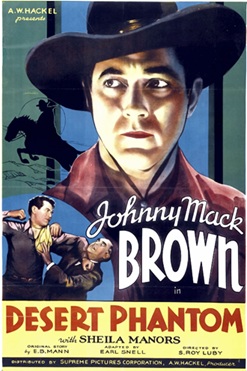
Desert Phantom (1936, directed by S. Roy Luby)


In a frontier town, rancher Jean Halloran (Sheila Bromley) has a big problem.  Someone is shooting and killing all of her ranch hands and sending her notes in which he tells her to give up her ranch and leave town.  When an ammunition salesman and trick shooter named Billy Donavon (Johnny Mack Brown), Jean hires him to serve as a bodyguard and to track down the mysterious Phantom.  Billy, however, has a secret of his own.

Desert Phantom is a remake of an old Harry Carey film.  I don’t know why Poverty Row did remakes since all of their films pretty much had the same plot regardless.  A stranger comes into town and gets involved with a female rancher and a bad guy who is trying to hide his actual identity.  In this one, Nelson McDowell gets to supply the comic relief as a befuddled veterinarian while familiar faces like Ted Adams and Karl Hackett are there to keep us guessing about how the Phantom could actually be.  If you’ve watched enough of these movies, though, you’ll always be able to guess who the bad guy is.

This isn’t the best of Johnny Mack Brown’s movies.  The Phantom’s story seems like it could have been interesting but that would have meant taking more risks than most of the Poverty Row studios were willing to do.  Johnny Mack Brown is as convincing a cowboy as always and is the film’s saving grace.  Brown was a western star precisely because he could make even something like Desert Phantom watchable.

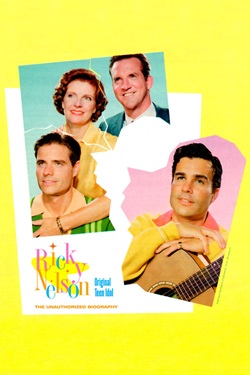
Ricky Nelson: Original Teen Idol (1999, directed by Sturla Gunnarsson)


It’s a story as old as time.

Ricky Nelson (Greogry Calpakis) is a star on his parents’s TV show but what he really wants to be is a rock and roll singer.  Ozzie (Jamey Sheridan) and Harriet Nelson (Sara Botsford) don’t know much about the strange rock and roll music but they do know that girls love it when Ricky plays the guitar and sings.  Ricky becomes a star and a teen idol but chafes at his parents’s attempts to control his music and his image.

This is another one of those behind-the-scenes entertainment biopics that were all the rage of television for a while.  This one was made for VH-1 instead of the any of the major networks and, as a result, it’s a little bit explicit in its depiction of Ricky’s sex life and his later drug use.  Ricky goes from being a teen idol to being a long-haired proto-hippie, getting booed by all the squares who only want to hear the oldies.  Not surprisingly, it’s a pretty shallow movie.  Ricky is played by Gregory Calpakis, who appears to be the same age of Jamey Sheridan, who plays his father.

Movies like this will never go out of style.  It’s inevitable that eventually, there will be biopics of Cobain, Bradley Nowell, Mac Miller, and all the rest.  They’ll be AI-generated which will make them seem even worse.

Again, a story as old as time.

Running Time (1997, directed by Josh Becker)


Carl (Bruce Campbell) is serving a ten-year prison sentence but he gets out in five.  He’s met outside the prison by his old criminal partner. Patrick (Jeremy Roberts).  After Carl makes up for lost time with a prostitute named Janie (Anita Barone), he and Patrick try to rob the prison’s laundry system.  Carl’s spent most of his time in prison carefully plotting out the heist but he didn’t take into account that his old criminal crew is made up of incompetents.

Running Time is only 70 minutes long and the film’s story plays out in real-time.  The movie itself is edited in such a way to create the impression that it was all shot in one continuous take.  It’s gimmicky but, like the film’s noir-style black-and-white cinematography, it works, creating a narrative the feels relentless.  It also makes it clear that Campbell’s Carl is a true career criminal.  He’s not out of prison for more than a handful of minutes before he’s trying to pull his next heist.  Crime is all that Carl really know, which makes his dilemma at the end of the movie (Janie or the money?) very effective.

Running Time is basically a showcase for Bruce Campbell.  Director Josh Becker was a longtime friend and associate of Sam Raimi’s and started his feature career as a production assistant on The Evil Dead.   Running Time feels like it was made with Campbell in mind and Carl is a character who plays to all of Campbell’s strengths.  It’s the perfect film for Campbell’s style of acting and Campbell is just as good when he’s planning the heist as when he’s arguing with Janie about the way that he treated her when they were both in high school together.  (His scenes with the excellent Anita Barone are some of the best in the movie.)  Running Time features Bruce Campbell at his best.

Music Video of the Day: Half the Truth by Royal Court of China (1989, directed by Sam Raimi)


The best rock band to ever come out of Nashville, Tennessee, Royal Court of China was named after a “supergroup” that Jimmy Page tried to put together after the end of Led Zeppelin.  Page may never have formed his band but Joe Blanton used the name for his own group, which started out as a hard country band before moving to heavy metal.

This video was directed by Sam Raimi.  The song was produced by none other than “Groovy” Bruce Campbell, who is celebrating his 67th birthday on this day.

Enjoy!

Bedazzled (2000, directed by Harold Ramis)


Elliot (Brendan Fraser) has a go-nowhere job at a computer company and an unrequited crush on Alison (Frances O’Connor), a co-worker who doesn’t even know who he is.  One night, at a bar afterwork, he’s approached by the Devil (Elizabeth Hurley), who offers Elliot seven wishes in return for his soul.  Elliot agrees but then he discovers that the Devil is tricky and his wishes always have an complication.  Elliot wants to be powerful so the Devil turns him into a Columbian drug lord.  Elliot wants to be sensitive and the Devil turns him into a whiny crybaby.  Elliot wants to be president and suddenly, he’s Abraham Lincoln being told to get ready for the theater.  Whenever things start to get too dangerous, the Devil brings Elliot back to reality so that she can continue to taunt him.

An Americanized remake of a British comedy that starred Dudley Moore and Peter Cook, Bedazzled was unfairly savaged by the critics when it was first released.  While it can’t match the wit and heart of the original and not all of the wishes are equally effective, the remake has its charms.  When Bedazzled first came out, most people talked about Elizabeth Hurley’s sexy performance of the Devil.  When she appears as a school teacher, it’s not a surprise that every student brings her an apple at the start of the day.  Hurley is so sexy that it’s easy to miss that she’s also giving a really good performance.  Hurley’s Devil is a prankster.  She likes to steal souls but mostly, she’s just having fun ruining all of Fraser’s wishes.  Brendan Fraser is likable as Elliot and the way he responds to each wish gives him a chance to show off his comedic skills.  Finally, the movie has a good ending, with Elliot growing up and realizing the truth about his crush on Alison.

Bedazzled may not be up to the level of some of director Harold Ramis’s other films but it’s still better than its reputation.