 The year is 1944 and a group of Germany officials and military officers, all of whom are secretly opposed to the Nazi regime, are plotting to assassinate Adolf Hitler. A group of American and British operatives, led by Captain Evan Blackburn (Sean Patrick Flannery), have been dropped behind enemy lines. Their mission is to protect the man who has been chosen to lead Germany after Hitler’s death but, after the assassination fails, Blackburn and his men find themselves with a new mission. Working with a group of Russian soldiers, Blackburn tries to prevent a group of Nazis from fleeing to Argentina with a cache of stolen good.
The plot of Beyond Valkyrie is rooted in fact. In June of 1944, Hitler was nearly assassinated by a group of high-ranking Germans who hoped to replace him with a more moderate leader. (Historically, it’s questionable whether the majority of the conspirators were truly anti-Nazi or if they just felt that Hitler was mismanaging the war.) At the same time, as it became evident that Germany was going to lose the war, many Nazi war criminals did escape to Argentina, where the government of Juan Peron provided them with sanctuary from prosecution. Some of the most notorious Nazis reinvented themselves as businessmen in both South America and the Middle East. (Others, like Klaus Barbie and Reinhard Gehlen, offered their services to any government that would accept them.)
The true story is so interesting that it’s unfortunate that Beyond Valkyrie is such a bad movie. Basically, consider it to be Inglourious Basterds with none of Tarantino’s style or Christoph Waltz’s smiling menace. Beyond Valkyrie is a war epic on a budget, a very low budget. Neither the weak script nor the cheap-looking CGI does much to add authenticity to the movie. There are a few familiar faces in the cast, though none of them are onscreen for long. Rutger Hauer provides what little dignity Beyond Valkyrie has. Tom Sizemore looks like he’s still recovering from the weekend. Stephen Lang picks up his paycheck. Sean Patrick Flanery does the best he can but he’s stuck with all the worst lines.
One final note: One of the Russian soldiers, played by Andrew Byron, is actually named Tolstoy. I waited for Chekhov, Solzhenitsyn, and Dostoevsky to show up but they never came.
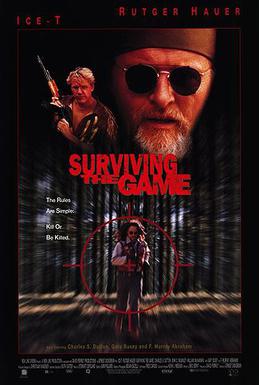 Jack Mason (Ice-T) has been living on the streets of Seattle ever since the death of his wife and daughter. When Cole (Charles S. Dutton), the friendly man at the soup kitchen, tells Mason that he can get him a job, the suicidal Mason accepts. It turns out that a group of wealthy men are going on a hunting trip and they need a guide to lead them through the wilderness. Mason accepts but, upon arriving, he discovers that the men (who are played by Rutger Hauer, F. Murray Abraham, William McNamara, John C. McGinley, and, of course, Gary Busey) are actually planning on playing the most dangerous game and hunting him for the weekend.
 The Soldier is really only remembered for one scene. The Soldier (Ken Wahl) is being chased, on skis, across the Austrian Alps by two KGB agents, who are also on skis. The Soldier is in Austria to track down a KGB agent named Dracha (Klaus Kinski, who only has a few minutes of screen time and who is rumored to have turned down a role in Raiders of the Lost Ark so he could appear in this movie). The Russians want the Soldier dead because they’re evil commies. While being chased, the Soldier goes over a ski slope and, while in the air, executes a perfect 360° turn while firing a machine gun at the men behind him. It’s pretty fucking cool.
 It’s hard out here for a pimp and even worse for a banker.
 The year is 1989 and the Cold War is coming to an end. Colonel Jack Knowles (Roy Scheider) was a hero in Vietnam but now, years later, his eagerness to fight has made him an outsider in the U.S. Army. Most people would rather that Knowles simply retire but, as long as there are wars to be fought, Knowles will be there. His only friend, General Hackworth (Harry Dean Stanton), arranges for Knowles to be assigned to an outpost on the West German-Czechoslovakia border. As soon as he arrives, Knowles starts to annoy his superior officer, Lt. Col. Clark (Tim Reid). When Knowles sees a Czech refugee gunned down by the Soviets while making a run for the border, he unleashes his frustration by throwing a snowball at his Russian counterpart. Like Knowles, Col. Valachev (Jurgen Prochnow) is a decorated veteran who feels lost without a war to fight. Knowles and Valachev are soon fighting their own personal war, even at the risk of starting a full-scale conflict between their two nations.
 The year is 1962. Lights flash over California and the news on the radio is bad. What everyone feared has happened. Atomic war has broken out and the world is about to end. Refugees clog the highways as a mushroom cloud sprouts over Los Angeles. This is year zero, the year that humanity will either cease to exist or try to begin again.
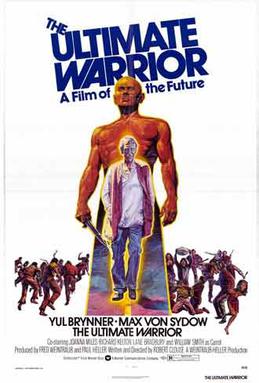 The year is 2012 and New York City, like the rest of the world, has been devastated by energy shortages, wars, and a great plague. The few survivors now live in isolated communes and are easily victimized by roving gangs of marauders. (On the plus side, this version of New York City has been spared Bill de Blasio.) The Baron (Max von Sydow) has managed to keep his people safe by ruling with an iron hand but he knows that it will only be a matter of time until his commune is overrun by the psychotic Carrot (William Smith) and his men. When a mysterious warrior known only as Carson (Yul Brynner) comes to the commune, the Baron tasks him with a very important mission: help his pregnant daughter (Joanna Miles) escape from New York City and transport both her and some genetically modified seeds to an island in North Carolina.
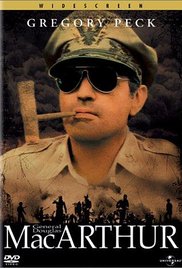 The year is 1962 and Douglas MacArthur (Gregory Peck), the legendary general, visits West Point for one last time. While he meets the graduates and gives his final speech, flashbacks show highlights from MacArthur’s long military career. He leaves and then returns to Philippines. He accepts the Japanese surrender and then helps Japan rebuild and recover from the devastation of the war. He half-heartedly pursues the Presidency and, during the Korean War, gets fired by Harry Truman (Ed Flanders).



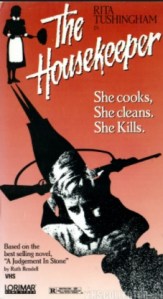 Eunice Parchman (Rita Tushingham) has always had a secret. She is dyslexic. When she was in school, the kids made fun of her for saying, “god” instead of “dog.” When she grew up, her cruel father threatened to send her to a special school so that she could learn how to read. Eunice suffocated him with a pillow and then moved to America, where she was hired as a housekeeper. Eunice is a good housekeeper except she can not read any of the directions that her obnoxious employers leave for her. When she befriends a religious fanatic (Jackie Burroughs) and accidentally overwaters her employer’s prized orchids in the same week, it can only lead to one thing, a shotgun rampage.
 Through the Shattered Lens