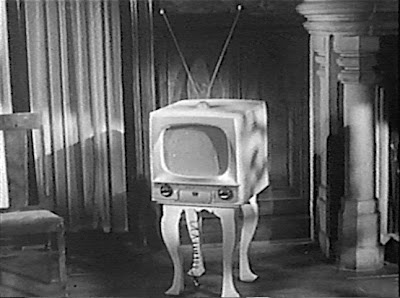
4 Shots From 4 Horror Films: The 1980s Part 3


This October, I’m going to be doing something a little bit different with my contribution to 4 Shots From 4 Films.  I’m going to be taking a little chronological tour of the history of horror cinema, moving from decade to decade.

Today, we complete the 80s!

4 Shots From 4 Horror Films

The Fly (1986, dir by David Cronenberg)

The Fly (1986, dir by David Cronenberg)

Near Dark (1987, dir by Kathryn Bigelow)

Near Dark (1987, dir by Kathryn Bigelow)

Evil Dead 2 (1987, dir by Sam Raimi)

Evil Dead 2 (1987, dir by Sam Raimi)

The Church (1989, dir by Michele Soavi)

The Church (1989, dir by Michele Soavi)

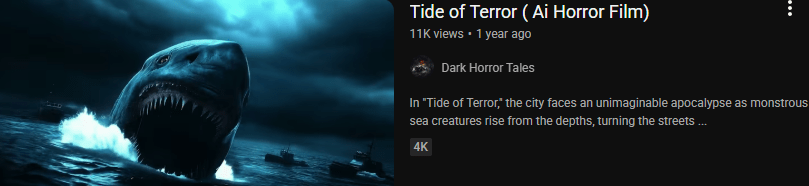
Tide of Terror, AI Short Film Review by Case Wright


Clowns scare me and AI used to scare me, but I just don’t think it’s gonna be all that bad. I wasn’t going to review another AI short because…. well, they are terrible, BUT just as I was about to move on to real people- I saw this:

Lisa knows that I can’t turn down a shark movie or Torchy’s Tacos. A shark movie is like Torchy’s Tacos because even if they made mediocre taco- it’s still EXCELLENT. Furthermore, you are still eating a taco; so, how bad could your life really be?!

The short opens with a terribly flooded New York City. Uh oh, here comes a tidal wave and if that isn’t bad enough…. sharks…wait…no a lot sea creatures appear, which are kinda scary… to someone. I got halfway through and there’s something shark-like.

They cut away from the shark to a large squid; so, I’m like who brought the peanut oil? It’s time for some calamari!!! Finally, there is a shark again sort of… and zombies? Is it good? No, but there is a shark… so, fine. The short was all over the place and really tested the depths of punishing me. Then, Adele showed up because she’s….

If you want to check this short out….

The Pulps Have The Halloween Spirit! Do You?


By Jack Davis

Halloween is right around the corner!  Are you ready?  I’m disappointed because my neighborhood really hasn’t decorated much for Halloween this year.  It’s supposed to rain for the next three days so my neighbors better hurry up and put up some ghosts and some pumpkins and get in the holiday spirit!

Do you need help getting in the holiday spirit?  Here’s some help from the pulps!

Artist Unknown

By Earle Bergey

Artist Unknown


by Doris Stanley

artist unknown

By Frank Frazaetta

by Rudolph Zirn

Artist Unknown

by Rafael De Soto

by Robert Stanley

by Rudolph Belarski

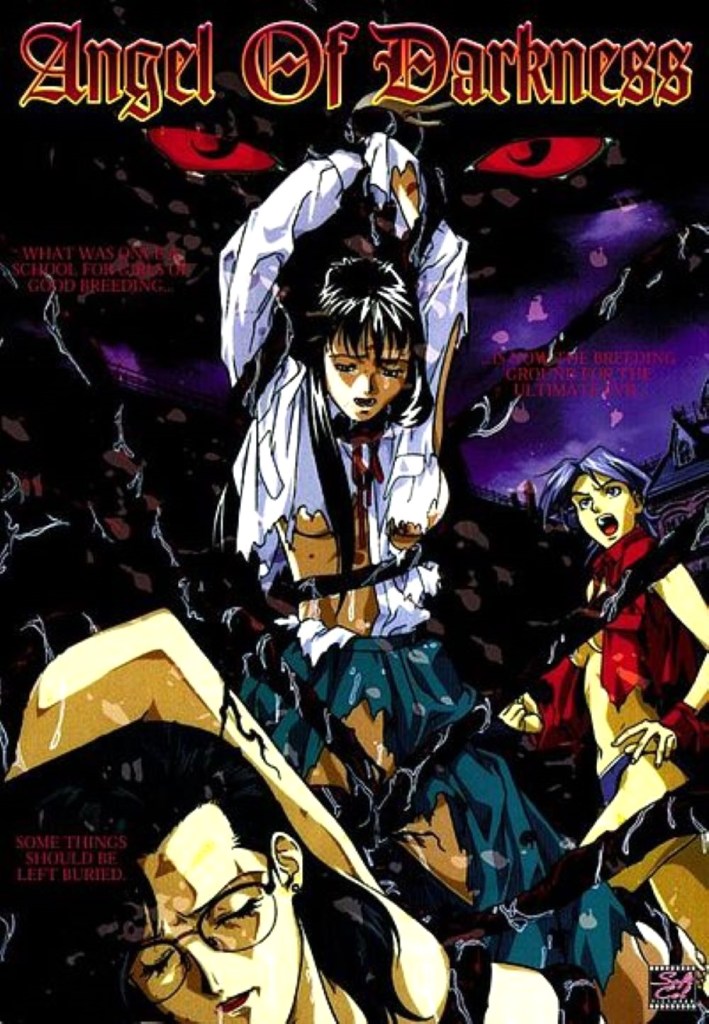
Anime You Should Be Watching (Horror Edition): Angel of Darkness (Injū Kyōshi)


shokushu zeme: “tentacle attack” erotica that explores taboo themes using tentacle-based sexual fantasy as a narrative and visual motif to circumvent Japanese censorship laws.

Angel of Darkness (Injū Kyōshi) holds a notorious place in the lineage of erotic horror anime, bridging the transgressive extremities of Chōjin Densetsu Urotsukidōji and the occult eroticism that would later define Bible Black. This four-episode OVA series from 1994 encapsulates the tentacle horror subgenre with uncompromising explicitness, wrapping its unsettling imagery in a narrative set within the seemingly innocent confines of a girls’ boarding school. The series exemplifies a distinctive moment in adult anime history, when grotesque sexuality and supernatural horror merged to explore themes of control, corruption, and forbidden knowledge.

Like UrotsukidōjiAngel of Darkness does not shy away from cataclysmic violence or graphic sexual transgression. However, rather than sprawling cosmic battles and apocalyptic carnage, it opts for a claustrophobic setting where the boundaries between predation and education collapse. The boarding school, an archetype of sheltered innocence, becomes a crucible for spiritual decay where evil—in the form of demonic possession and twisted rituals—lurks beneath routine façades. This subversion of a sacred educational environment highlights the series’ investment in moral and sexual transgression as intertwined forces.

The plot centers on Professor Goda, whose discovery of a strange stone beneath a campus tree unleashes an ancient, tentacled spirit that begins a viral corruption throughout the school. His transformation into a monstrous sex demon initiates an escalating cycle of ritual abuse and possession among the students and faculty. Against this backdrop, the developing relationship between Sayaka and Atsuko—the relatively innocent lovers trying to find connection amid chaos—provides a tragic human center to the nightmarish events unfolding. The series’ focus on lesbian romance adds emotional depth while diverging from typical harem or fetishistic formulas, instead using sexuality as both refuge and vulnerability under the shadow of demonic influence.

The narrative frequently returns to graphic scenes of domination, bondage, and forced extraction of bodily fluids, imagery that serves symbolic purposes as much as titillation. The recurring S&M rituals, scenes of rape by tentacles, and the desecration of once-hallowed spaces—such as the chapel turned site of torment—communicate a profound collapse of innocence and spirituality. This fusion of sex, violence, and the supernatural positions Angel of Darkness not as mere pornography, but as a stark allegory for power, control, and the corruption of purity.

Visually, the series operates within the constraints of mid-1990s adult OVA budgets, but its simplistic, shadow-heavy animation effectively evokes a mood closer to gothic horror than glossy erotica. The color palette is muted, alternating between the sterile luminescence of the school’s daytime routine and the ominous shadows of ritual scenes. This dichotomy underscores the narrative’s tension between surface normality and subterranean evil. Though the character designs lack the polish of contemporary works like Bible Black, with rougher lines and stilted motion, these limitations amplify the uncanny atmosphere, making the viewer uneasy in a way polished animation rarely achieves.

Sexual content dominates explicitly and persistently, refusing to separate eroticism from horror. This integration exemplifies Angel of Darkness’ commitment to challenging viewer boundaries and expectations. The tentacle horror motifs—ubiquitous in the genre but here rendered with disturbing severity—represent not just physical assault but a symbolic invasion of autonomy and identity by dark forces. The series’ interest in bodily horror situates it firmly within the tradition of Japanese erotic horror, yet its blend of sexuality with a narrative of supernatural possession elevates it beyond titillation toward a meditation on corruption and loss of self.

The series’ narrative and visual style contributed significantly to the evolution of adult anime as a genre willing to explore complex themes within erotic content. It is a clear spiritual predecessor to later occult-erotic works such as Bible Black, which would refine this formula with denser storytelling and atmospheric lighting but owe much to Angel of Darkness’ bold fusion of sex and the supernatural. The taboo-challenging spirit of the series also helped popularize tentacle pornography as a distinctive fetish category internationally, with Angel of Darkness frequently cited as a touchstone in underground anime communities.

Critically, Angel of Darkness remains polarizing. Its extreme explicitness and depiction of violent, non-consensual acts alienate many viewers while fascinating others with its raw thematic ambition. While it is impossible to discuss the anime without acknowledging its deeply problematic content, dismissing it purely as objectionable obscenity overlooks its place as a cultural artifact that pushes the limits of storytelling in adult animation. Indeed, the series critiques institutional complicity and the violation of trust—from teacher to student, from sacred institution to corrupted shrine—embedding its sexual horror within a larger allegory for power abuse.

Despite—or perhaps because of—its intense imagery, Angel of Darkness has maintained a lasting cult status for nearly three decades. Its influence reaches beyond hentai audiences, with many anime historians and scholars referencing it as a foundational work in the erotic horror niche. Its legacy is one of transgression not just for shock, but as a deliberate aesthetic and narrative strategy that challenges the viewer’s comfort zones and probes darker aspects of desire and domination.

Ultimately, Angel of Darkness is a complex and disturbing work that defies simple categorization. It is a horror anime that uses explicit sexuality and supernatural menace to explore themes of corruption, power, and forbidden love. As a historical piece, it represents both the creative ambition and the social taboos of 1990s adult Japanese animation, offering a grim yet compelling experience for those prepared to confront its darkness.

Horror On The Lens: Not Of This Earth (dir by Roger Corman)


Today’s horror on the lens is the 1957 Roger Corman-directed, sci-fi “epic,” Not of this Earth.

Paul Johnson (Paul Birch) may seems like a strange character, with his stilted way of speaking and his sunglasses and his overdramatic reaction to any and all loud noises.  Paul could us be an eccentric.  Or, he could be …. NOT OF THIS EARTH!  Actually, his habit of draining people of their blood and sending weird, umbrella-like creatures out to attack his enemies would seem to suggest that the latter is probably true.

Listen, it’s not easy being a blood-sucking alien.  I mean, sure, there’s always seems to be people stupid enough to show up at your mansion so that you can drain their bodies.  Paul is lucky that he doesn’t exactly seem to be surrounded by brain surgeons.  But sometimes, things happen.  For instance, someone might show up from your home planet and demand an immediate transfusion!  What is an alien to do?

Watch this low-budget but undeniably entertaining film to find out!  And be sure to especially keep an eye out for the great Dick Miller, who reportedly improvised his role as a vacuum cleaner salesman.  (Before going into acting, Miller actually did sell vacuum cleaners door-to-door.)


Music Video of the Day: Mirror People by Love and Rockets (1988, directed by ????)


Mirror People was one of the singles to be released off of Love and Rockets’s third studio album, Earth, Sun, Moon.  The video looks like something that Dr. Caligari would have filmed if he had been a music aficionado.

Enjoy!

October Positivity: Love On The Rock (dir by Matt Shapira)


2021’s Love On The Rock definitely has something going for it.  It was filmed on the island of Malta.

Malta is a beautiful island nation, sitting between Sicily and North Africa.  I spent the summer after I graduated high school in Europe and Malta was one of the many beautiful places that I visited.  Along with its gorgeous architecture and the beaches, Malta is also known for being the island where St. Paul and St. Luke were shipwrecked for three months.  Paul, it’s said, healed every sick person on the island.

Love On The Rock may be a comedic action film with a religious subtext but, far more importantly, it’s a bit of a travelogue as well.  David A.R. White plays Colton Riggs, a former Chicago cop who moved to Malta after the death of his wife.  He has his own boat and he makes his living giving tours.  (He even has a pre-recorded narration that he plays while navigating the boat.)  This allows for several scenes that give us a chance to take in the stunning beauty of the island.  Colton also has a friend named Rev. Yearwood (Jeff Fahey), who oversees a church that overlooks the ocean.  Again, the view is lovely.

As for the plot, it has to do with the search for a serum that can, in theory, cure any and all diseases.  International criminal Claudio Fairbanks (Steven Bauer, who appears to have been dubbed by someone else) wants control of the serum so he sends his associates to raid the Maltese laboratory where it’s being developed.  One technician gets away, carrying a vial of the serum with him.  Wounded during his escape, the dying man secretly hides the vial on Colton’s boat.

Claudio sends his people, led by Halston Hallstrom (Matthew Marsden), to find the serum.  Meanwhile, the head of the CIA (Jon Lovitz …. wait, Jon Lovitz?) sends Josie (Lauriane Gillieron) to Malta to seduce Colton and discover if he knows where the serum is.  Of course, Josie actually does fall in love with Colton and eventually, Colton does find the serum and it all ends with a surprisingly laid back confrontation between the bad guy and the good guys.

The film is also a comedy and it’s got a religious message as well.  (Josie is offended when Colton acts surprised that a spy would also be religious.)  Surprisingly enough, it’s actually pretty adroit when it comes to juggling all of its different genres.  David A.R. White and Laurianne Gillieron make for a cute couple and both of them turn out to have good comedic timing.  For that matter, I also liked the performance of Nathalie Rapti Gomez, who played a trigger-happy mercenary named Plaza and who gave an entertainingly unhinged performance.  In the end, even that stuff that shouldn’t have worked — like casting Jon Lovitz as a spymaster — actually did work.  Maybe Lovitz should be the next James Bond.

Love On The Rock is an entertaining and unpretentious action spoof.  If nothing else, it’s worth seeing for the beauty of Malta.

Late Night Retro Television Review: 1st & Ten 2.2 “The Veterans”


Welcome to Late Night Retro Television Reviews, a feature where we review some of our favorite and least favorite shows of the past! On Wednesdays, I will be reviewing 1st and Ten, which aired in syndication from 1984 to 1991. The entire series is streaming on Tubi.

This week, the Bulls face a dilemma.  What to do with O.J. Simpson?

Episode 2.2 “The Veterans”

(Dir by Bruce Seth Green, originally aired on September 1st, 1986)

This week, veteran running back T.D. Parker (O.J. Simpson) shows up for training camp.  All of the players are excited to see him.  At the bar where all of the Bulls hang out, Dr. Death (Donald Gibb) announces that T.D. Parker has had over one hundred injuries over the past twelve years but he’s still the heart and the soul of the Bulls franchise.  He’s the face of the team!  When people think of the Los Angeles Bulls, they think of T.D. Parker slashing through the other team on his way to an acquittal touchdown.

Speaking as a viewer, it seems kind of strange that this is the first that I’m really hearing about the legendary T.D. Parker.  Where was he last season?  The Bulls went all the way to the Championship Game but I never once heard anyone mention T.D. Parker.  I certainly didn’t see him in the locker room.  The Bulls actually had a totally different running back named Carl Witherspoon.  Oddly, Carl seems to have vanished this season….

As for T.D., his injuries are catching up with him.  Denardo and Diana are forced to confront that fact that T.D. can no longer cut it.  Even in practice, he’s spilling a lot of blood on the field.  Denardo cuts T.D. from the team. When T.D. says that football is all that he knows, Denardo announces that T.D. may not be playing but he’ll still be on the field …. AS A COACH!  T.D. looks confused.  He’ll figure it out eventually, I guess.

Meanwhile, Jeff East briefly returns as quarterback Bryce Smith but just long enough to fall out of a window at training camp and bust his knee.  (He was trying to keep the new kicker — a Bosnian played by future voice of the Crypt Keeper John Kassir — from sneaking out to go into town to get drunk.)  Bryce is done for the season.  Veteran quarterback and all-around druggie sleaze Johnny Valentine (Sam J. Jones) becomes the new starter and Tom Yinessa is brought back to be his backup.  That’ll make Yinessa’s roommate (Jeff Kaake) and Yinessa’s potential girlfriend (Katherine Kelly Lang) happy.

Finally, the NFL owners don’t want to give their players a pension or a raise.  They do, however, want to give them mandatory drug tests.  Diana protests but she’s overruled by the other owners, all of whom are male and in their 60s.  There’s a lot of toupees and cigars at the ownership meeting.

This episode was actually kind of entertaining.  That’s doesn’t mean it was good.  1st & Ten isn’t a really a show that’s ever good.  But this episode did feature Sam J. Jones giving a totally over the top performance as creepy quarterback Johnny Valentine.  Speaking of going over the top, the same can be said of Delta Burke’s performance this season.  It would appear that between seasons one and two, Burke realized there was no need to try to be in any way subtle in her line readings.  That was probably the right decision.

Next week …. who knows?  I’m getting a little bored with training camp so hopefully, we’ll move on!

Horror On TV: The Last Halloween (dir by Savage Steve Holland)


For tonight’s Halloween on television, we have the story of four aliens who came to Earth on Halloween and search for candy for their planet.  After an initial misunderstanding, two kids help the aliens in their search.  It’s sweet!

This was directed by Savage Steve Holland of Better Off Dead fame and it originally aired on October 28th, 1991.