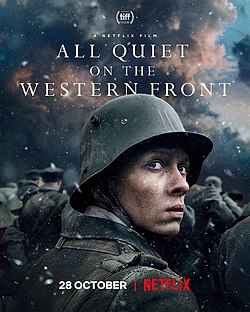
International Film Review: All Quiet On The Western Front (dir by Edward Berger)


From the first scene of Germany’s All Quiet On The Western Front, it’s made clear that there is no glamour or romance to war.

The year is 1917 and the Great War (or World War I as future historians will call it) has been underway for three years.  On the Western Front, soldiers hide in trenches and wait for the inevitable order to try to advance to the next set of trenches.  Most of the soldiers are cut down by machine gun fire and explosions as soon as they go over the top.  Many more are killed as they try to run across the killing field.    We are introduced to one soldier who has been ordered to charge.  Within a few minutes, he is dead and his uniform has been taken, washed, and sewn up so that it can be given to whoever will be the next to enlist.  The whole process plays out with a disturbing efficiency.  That several men have just died in a attack that seems to lack any strategic purpose does not matter.  What matters is that the uniform be ready to be worn by whoever follows.

The uniform is next handed to Paul (Felix Kammerer), a 17 year-old who not only enlists in the Imperial Germany Army but who plays a key role in convincing his friends to enlist as well.  Paul has been moved by the patriotic speeches that he heard from his teachers.  He expects war to be an adventure.  Upon their arrival on the Western Front, Paul and his friends are surrounded by death.  With their uniforms on and their gas masks over their faces, they are nearly unrecognizable as individuals.  Instead, they look like what they are, cogs in the war machine.  Paul spends his first night in the trenches while bombs explode all around him.  His friend, Ludwig (Adrian Grunewald), cries that he wants to return home.  By the next morning, Ludwig is one of the many who is now dead.  Only Kat (Albrecht Schuch) is willing to look after Paul and his friends.  Kat is considered to be a weathered veteran because he has managed to survive for nearly a year on the Western Front.

All Quiet On The Western Front is based on the classic anti-war novel by Erich Maria Remarque.  (A previous adaptation won the Oscar for Best Picture in 1930 and is generally considered to be the first truly “good” Best Picture winner.)  Th film takes some liberties with the book’s plot while still remaining faithful to Remarque’s theme of the futility of war.  One change is that, along with following Paul’s day-to-day life on the Western Front, the film also details the efforts of diplomat Mattias Erzberger (Daniel Bruhl) to negotiate Germany’s surrender.  It’s a fairly big departure from Remarque’s narrative but one that definitely stays true to the spirit of the book.  Despite the fact that Germany knows that it has been defeated and that it will have to surrender, Paul and his friends are still expected to fight and sacrifice their lives for a victory that is no longer attainable.  Indeed, the closer that Erzberger comes to signing a cease fire, the more determined General Friedrichs (Devid Striesow) becomes to launch one final, great offensive before the war ends.  The soldier have no idea what is going on during Erzberger’s negotiations and Erzberger has no idea that Paul has lost the majority of his friends and has been forced to do things that will forever haunt him.  They may not know about each other but Paul’s fate depends on Erzberger’s decisions and the legacy of Erzberger and all the other diplomats and commanders is to be found in what happens to soldiers like Paul.

All Quiet On The Western Front is a brutally effective anti-war film.  Director Edward Berger puts the viewer right in the middle of combat and it is absolutely terrifying.  Paul goes from being an enthusiastic patriot to a hollow-eyed cynic, one who knows that he is considered expendable by both the enemy and his commanders.  The viewer, like Paul, quickly realizes that there is no way to win this war, other than to somehow survive long enough to return home.  But even the soldiers who do survive understand that they won’t have much of a home to return to.  (In a particularly shocking scene, one solder stabs himself in the neck with a fork rather than return home crippled.)  While the the commanders negotiate in luxury, the soldiers live in mud and die almost randomly.  The commanders may talk about strategy but the soldier know that survival comes down to luck.

It’s a harrowing film but it’s also exactly what an anti-war film should be.  There’s a chance that this film could be the second adaptation of All Quiet On The Western Front to receive a nomination for Best Picture and it would certainly be deserved.
Fly Away With Wings Comics and Bob Lubbers!


Come fly with Wings Comics!

Wings Comics was an anthology comic book that ran from 1940 to 1954.  Each 52 to 64-page issues featured several different stories about pilots, airplanes, and the trouble that they got into.  The covers featured below were all done by prominent cartoonist, Bob Lubbers.

July, 1947

August, 1947

February, 1948

March, 1948

April 1948

May, 1948

June, 1948

July, 1948

August, 1948

1948, September

October, 1948

November, 1948

December, 1948

January, 1949

February, 1949

April, 1949

Guilty Pleasure No. 60: The Running Man (dir by Paul Michael Glaser)


“Killian, here’s your Subzero… now plain zero!”

Uhm, excuse me, Mr. Schwarzenegger, but a man just died.  He probably had a family who just watched you kill him on national television….

Oh well, it happens!  In the role of Ben Richards, Arnold Schwarzenegger kills quite a few people over the course of the 1987 film, The Running Man, but they were all bad.  In fact, when we first meet Ben Richards, he’s a cop who is trying to save lives.  His superiors want him to open fire on a bunch of protestors who simply want enough food to eat.  When Richards refuses to do it, he is framed for perpetrating “the Bakersfield Massacre” and is sent to prison.  When he is recaptured after escaping, he is given a chance to compete on America’s number one game show, The Running Man!  Hosted and produced by Damon Killian (Richard Dawson, oozing smarm in a performance that — in a fair world — would have received Oscar consideration), The Running Man is a show in which prisoners are given a chance to win prizes like a trial by jury or maybe even a pardon.  While the audience cheers and puts down bets, the prisoners are stalked by professional killers like Buzzsaw (Gus Rethwisch), Dynamo (Erland Van Lidth), Fireball (Jim Brown), and Sub-Zero (Professor Toru Tanaka).  Along with Killian, Captain Freedom (Jesse Ventura) provides commentary and analysis on how the game is going.  Ben soon finds himself joined by Amber (Maria Conchita Alonso), who proves herself to be just as tough as he is.

Seen today, The Running Man feels more than a bit prophetic.  Due to worldwide economic collapse, the poor are getting poorer while the rich are getting richer.  The American government has become both increasingly corporate and increasingly authoritarian.  The citizens are entertained and manipulated by “reality” programming.  On camera, Killian is a charismatic host who delivers his lines with faux sincerity and who loves to meet and give away prizes to the public.  (There’s something both undeniably creepy and also rather familiar about the way that Killian sniffs the hair, rubs the shoulders and holds the arms of the audience members to whom he’s speaking.  It’s all very calculated and one gets the feeling that Killian washes his hands as soon as the camera are off of him.)  Behind the scenes, he drinks, smokes, curses, and is full of contempt for everyone around him.  He may not be happy when Ben outsmarts and kills the show’s stalkers but he definitely cheers up when he hears how good the ratings are.  The film is set in 2017, which was 30 years in the future when The Running Man was first released.  Seen today, The Running Man’s 2017 feels a lot like our 2017….

That said, The Running Man is also a big, flamboyant, and undeniably entertaining film.  It’s also surprisingly funny, at times.  Living in a dystopia ahs turned everyone into a quip machine.  None of the bad guys die without Schwarzenegger making a joke about it.  (“Buzzsaw?  He had to split.”  Yes, he did.)  The show’s vapid studio audience, who go from cheering the prospect of witnessing a bloody death to crying when their favorite stalker is killed, is both disturbing and humorous.  (Also memorable is the faux somber dance number that is performed while the show memorializes all the dead stalkers.)  For all the costumed heroes and villains, the film is practically stolen by an older woman named Agnes who becomes Ben Richards’s favorite fan.  The gaming “quads” may be dark and dangerous and full of angry people but they’re also full of advertisements for Cadre Cola.  Dey Young of Rock and Roll High School and Strange Behavior fame has a cameo as Amy, who pays six dollars for a can of Cadre.  (That may seem like a lot for a can of anything but Cadre is the official cola of The Running Man!  Damon Killian endorses it!  And, of course, when The Running Man was produced, the studio was owned by Coca-Cola so the jokes about Cadre’s corporate dominance also serve as a “take that” towards the corporation who put up money for the film.  Either that or Cadre is stand-in for Pepsi.)

It’s easy to compare The Running Man to The Hunger Games films but The Running Man is infinitely more fun, if just because it doesn’t make the mistake of taking itself as seriously as The Hunger Games did.  (Add to that, The Running Man manages to wrap up its story in 90 minutes, whereas The Hunger Games needed four movies.)  Like The Hunger Game, The Running Man is based on a book, in this case a very loose adaptation of one of the pulpy novels that Stephen King wrote under the name of Richard Bachman.  While King said that he enjoyed the film, he also asked that his real name not be listed in the credits because the film had little in common with his book, which is fair enough.  The Running Man may have been inspired by a Stephen King novel but it’s an Arnold Schwarzenegger production through-and-through.

Previous Guilty Pleasures

  1. Half-Baked
  2. Save The Last Dance
  3. Every Rose Has Its Thorns
  4. The Jeremy Kyle Show
  5. Invasion USA
  6. The Golden Child
  7. Final Destination 2
  8. Paparazzi
  9. The Principal
  10. The Substitute
  11. Terror In The Family
  12. Pandorum
  13. Lambada
  14. Fear
  15. Cocktail
  16. Keep Off The Grass
  17. Girls, Girls, Girls
  18. Class
  19. Tart
  20. King Kong vs. Godzilla
  21. Hawk the Slayer
  22. Battle Beyond the Stars
  23. Meridian
  24. Walk of Shame
  25. From Justin To Kelly
  26. Project Greenlight
  27. Sex Decoy: Love Stings
  28. Swimfan
  29. On the Line
  30. Wolfen
  31. Hail Caesar!
  32. It’s So Cold In The D
  33. In the Mix
  34. Healed By Grace
  35. Valley of the Dolls
  36. The Legend of Billie Jean
  37. Death Wish
  38. Shipping Wars
  39. Ghost Whisperer
  40. Parking Wars
  41. The Dead Are After Me
  42. Harper’s Island
  43. The Resurrection of Gavin Stone
  44. Paranormal State
  45. Utopia
  46. Bar Rescue
  47. The Powers of Matthew Star
  48. Spiker
  49. Heavenly Bodies
  50. Maid in Manhattan
  51. Rage and Honor
  52. Saved By The Bell 3. 21 “No Hope With Dope”
  53. Happy Gilmore
  54. Solarbabies
  55. The Dawn of Correction
  56. Once You Understand
  57. The Voyeurs 
  58. Robot Jox
  59. Teen Wolf

Live Tweet Alert: Watch Shock Waves with #ScarySocial


Shock Waves (1977, dir by Ken Wiederhorn)


As some of our regular readers undoubtedly know, I am involved in a few weekly live tweets on twitter.  I host #FridayNightFlix every Friday, I co-host #ScarySocial on Saturday, and I am one of the five hosts of #MondayActionMovie!  Every week, we get together.  We watch a movie.  We tweet our way through it.

Tonight, for #ScarySocial, I will be hosting 1977’s Shock Waves!

That’s right!  It’s John Carradine, Peter Cushing, and Brooke Adams in the best underwater zombie film ever made!

If you want to join us on Saturday night, just hop onto twitter, start the film at 9 pm et, and use the #ScarySocial hashtag!  The film is available on Prime, YouTube, and a few other streaming sites.  I’ll be there co-hosting and I imagine some other members of the TSL Crew will be there as well.  It’s a friendly group and welcoming of newcomers so don’t be shy.

Music Video of the Day: The Damned by The Plasmatics (1982, dir by Ron Swenson)


On Friday night, some friends and I were watching an old New Year’s special from 1983.  In between a few stand-up comedians and an interview with an oddly coherent Ozzy Osbourne, this video was broadcast.

Taking a school bus to the desert, singing on top of it, and then blowing it up?  Hell yeah!  All hail the revolution!  It’s interesting to think that, just a few years ago, everyone wanted to be rebellious.  As of late, I kind of feel like society has started to lose its rebellious spirit.  People now seem to prefer complacency and conformity.  That’s a shame but I think that revolutionary spirit is still out there.  It’s just the same people have forgotten how to embrace it.  It’ll return, though.  Like a school bus blowing up in the desert, the temptation of free thought cannot be ignore for too long.

Lead singer Wendy O. Williams did all of her own stunts in the video, including climbing on top of the bus and jumping off right before it exploded.  On top of the danger involved in driving a bus full of explosives, Wendy also did it all with a sprained ankle.  MTV was apparently so worried that the video would inspire other people to try the same thing that they insisted a warning be added to the start of the video.

(My personal opinion on warnings is that they’re counter-productive.  In fact, there’s something really hypocritical about warnings like the ones that MTV used to include before their shows.  If you’re that concerned that a video or television show is going to lead to people doing something stupid and destructive and potentially life-threatening, then don’t broadcast it.  The minute that you decide to air something, you’ve kind of lost the right to say, “Please watch this but don’t try to duplicate it.”  To be honest, whenever I see a warning telling me not to do something, it just makes me want to do it more.  That said, I don’t think I would be able to find the courage necessary to fool around with explosives.  Or, for that matter, drive a school bus.  I’m sure the bus is probably covered with germs and wads of chewing gum.  Bleh!)

This video was directed, over the course of one day, by Ron Swenson.  Of course, since the bus was due to explode during filming, almost every shot had to be completed in just one take.

Enjoy!

Lyrics:

Black visions from the satellite sky
Deaf ears hear not their cries
Fat jackals howl at the moon
Flies buzzing, playing death’s tune

Night ends but the sun it don’t rise
Tombs open and the dead they will rise
Black market buys your soul real cheap
No escaping, what you sow, you will reap

Prisoners of the damned
Find another land
Planet of the lost
Land of fire and frost

Prisoners of the dead
Fear the unknown dread
Tidal waves at sea
Set the serpents free

Coup d’etat on a global scale
Opposition, locked up in jail
Domination, the goons are the boss
Human race nailed to a cross

Prisoners of the damned
Find another land
Planet of the lost
Land of fire and frost

Prisoners of the dead
Fear the unknown dread
Tidal waves at sea
Set the serpents free

Prisoners of the damned
Find another land
Planet of the lost
Land of fire and frost