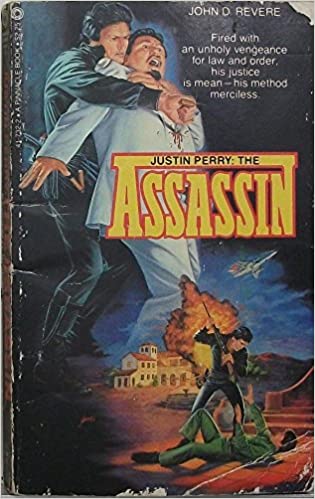
Book Review: Justin Perry: The Assassin by John D. Revere


About a month ago, as I continued to make my way through the paperbacks that I inherited from my aunt, I read five short paperbacks about a character known as Justin Perry, the assassin.

Who is Justin Perry?  As was explained in the first book in the series, 1982’s Justin Perry: The Assassin, Justin’s name used to be Roger Johnson.  He was raised in a world of wealth and privilege, the son of a general and a socialite.  Like his father, Roger enlisted in the army.  He ended up in Vietnam and, when he saw a friend of his get blown up the Viet Cong, Roger discovered that he had it in him to be a very savage and efficient killer.  Back in the States, Roger was hailed as a hero.  He married the beautiful Bambi and they had a son named Roger, Jr.  But then, Bambi was murdered by a commie spy and Roger went mad.  A mysterious figure known as the Old Man recruited Roger to work as an assassin as the CIA.  Now known as Justin Perry, the assassin lives to kill the nation’s enemies and to have sex with every woman he meets.  Seriously, that’s all he does.

The book not only gives us Justin’s origin story but also presents us with a rather sordid adventure in which Justin Perry tracks down a Nazi collaborator in Europe.  It’s while on that assignment that Justin discovers the existence of SADIF, a secret organization that we know is evil because its acronym sounds a lot like SADIST.  His pursuit of SADIF leads to several over-the-top torture sequences and also the discovery of a huge conspiracy, one that involves almost everyone that Justin has ever known.  We also discover that SADIF has infiltrated the Church and that Josef Mengele is now working as a gardener at the Vatican.  (As an Irish-Italian-Spanish Catholic, I would be offended it wasn’t all so stupid.)  None of it makes much sense but, to be honest, I’m not totally convinced that the Justin Perry books weren’t meant to a parody of sex-obsessed pulp fiction.

When I say that Justin Perry is sex-obsessed, that is literally all that he seems to think about.  He gets an erection when he kills a man.  Every woman that he wants automatically wants him (and, apparently, they’re all into S&M to boot).  One sexual encounter is ruined by an attack by an assassin, which leads to not only Justin’s masochistic lover killing herself with a knife (and getting off on the process) but also Justin obsessing over the fact that some of his sperm ended up on a hotel room floor.  Justin, in fact, is so hypersexual and so obsessed with proving himself sexually that it’s hard not to wonder if maybe he’s killing people because he’s trying to kill something about himself that he doesn’t want to accept.  I haven’t even gotten into the weird torture sequence where Justin and his friend, Bob Dante, are threatened with being sexed to death by a group of SADIF nymphomaniacs and a feet-licking chauffeur.

Actually, I have a feeling (or maybe it’s a fear) that I’m making this book sound more interesting than it is.  Despite all of the insane things that happen, the prose itself is actually fairly dull.  If one takes the book seriously, it’s a celebration of a sociopath.  If one takes the book as being satirical, it’s still just one joke repeated over and over again.  What is interesting is that the next four books in the series were even stranger and I’ll be reviewing those over the days to come.  For now, let’s just be happy that Justin Perry: The Assassin never made it to the big screen.
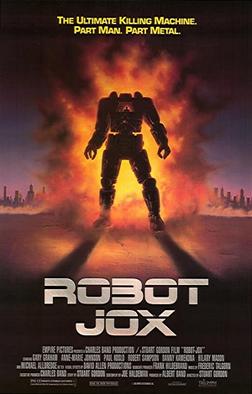
Guilty Pleasure No. 58: Robot Jox (dir by Stuart Gordon)


In the future, the world has been ravaged by a combination of nuclear war and infertility.  The face of diplomacy has changes as well.  Instead of wasting time with negotiations, treaties, or lengthy wars, countries now settle disputes through giant robot combat. 

In fact, robot combat is the most popular sport in the world!  The men who sit inside the head of the giant robots and who push the buttons that make the robots do their thing have all become national heroes.  They’re even more beloved than the robots that they control.  America loves Achilles (Gary Graham).  Russia loves Alexander (Paul Koslo).  Every fight is observed by hundreds of spectators sitting in the stands.

That becomes a problem when Achilles and his robot accidentally fall backwards and land on top of the stands.  Not only does this mean that Russia will claim ownership of Alaska but it also kills a lot of people who were only there because they thought they would get to watch some good old-fashioned giant robot combat.  Achilles is so upset that he announces his retirement.  He leaves robot combat camp and walks around the most depressing, dreariest city imaginable.  It’s hard not to notice that the city is full of signs imploring couples to have as many children as possible.  The humans would seem to be on the way out, regardless of what happens with the giant robots.

Fortunately, Achilles’s retirement only lasts for a day or two.  Once he learns that he’s going to be replaced by Athena (Anne-Marie Johnson), Achilles returns to fight Alexander.  It could be that Achilles is in love with Athena.  It could also just be evidence that it takes a lot more than a nuclear war to wipe out misogyny and Achilles can’t handle a woman controlling his robot.  Who knows?  Achilles is determined to redeem himself but Athena still wants her chance and it turns out that there is a double agent who is giving information to Alexander and the Russians!

Featuring a plot that was apparently made up on the spot, 1990’s Robot Jox is about as silly as a movie can get.  Several scenes are devoted to showing Athena and the other young robot pilots going through their training and it’s hard not to notice that none of it actually has anything to do with sitting inside the head of a giant robot and telling it what to do.  Instead, they do a lot of physical stuff, which makes no sense because piloting a robot would be a mental task, not a physical one.  But it gives the film an excuse to put a bunch of toned 20 year-olds in skin tight outfits and that was probably the main concern.   As for the double agent subplot, there’s only two possible suspects and it’s not difficult to guess which one is guilty.  The actors, for the most part, go through the motions though Michael Alldredge has some good moments as Achilles’s trainer and Paul Koslo is a blast as the maniacally evil Alexander.  In the future, it’s just not enough to destroy a man’s giant robot.  You have to laugh about it, too.

But, to be honest, Robot Jox is one of those movies that is so extremely silly that it’s impossible not to kind of like it.  The special effects may be on the cheap side but the robots themselves are actually fairly impressive and it’s hard not to smile at the sight of them stiffly walking across the combat area.  The film’s finale features not only a giant chainsaw that is stored inside the crotch of one of the robot’s but also a bizarre and impromptu trip into space.  I’m not really sure why the robots flew into space but it really doesn’t matter.  No one is going to watch Robot Jox for a coherent story.  This is a film that people watch because they want to see giant robots fighting.  And, on that front, Robot Jox delivers.

Previous Guilty Pleasures

  1. Half-Baked
  2. Save The Last Dance
  3. Every Rose Has Its Thorns
  4. The Jeremy Kyle Show
  5. Invasion USA
  6. The Golden Child
  7. Final Destination 2
  8. Paparazzi
  9. The Principal
  10. The Substitute
  11. Terror In The Family
  12. Pandorum
  13. Lambada
  14. Fear
  15. Cocktail
  16. Keep Off The Grass
  17. Girls, Girls, Girls
  18. Class
  19. Tart
  20. King Kong vs. Godzilla
  21. Hawk the Slayer
  22. Battle Beyond the Stars
  23. Meridian
  24. Walk of Shame
  25. From Justin To Kelly
  26. Project Greenlight
  27. Sex Decoy: Love Stings
  28. Swimfan
  29. On the Line
  30. Wolfen
  31. Hail Caesar!
  32. It’s So Cold In The D
  33. In the Mix
  34. Healed By Grace
  35. Valley of the Dolls
  36. The Legend of Billie Jean
  37. Death Wish
  38. Shipping Wars
  39. Ghost Whisperer
  40. Parking Wars
  41. The Dead Are After Me
  42. Harper’s Island
  43. The Resurrection of Gavin Stone
  44. Paranormal State
  45. Utopia
  46. Bar Rescue
  47. The Powers of Matthew Star
  48. Spiker
  49. Heavenly Bodies
  50. Maid in Manhattan
  51. Rage and Honor
  52. Saved By The Bell 3. 21 “No Hope With Dope”
  53. Happy Gilmore
  54. Solarbabies
  55. The Dawn of Correction
  56. Once You Understand
  57. The Voyeurs 

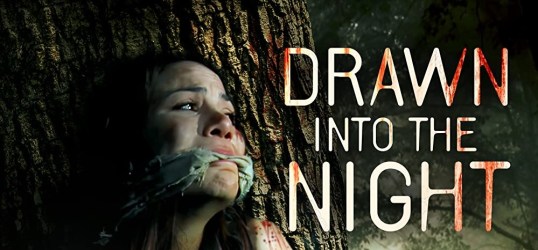
What Lisa Marie Watched Last Night #221: Drawn Into the Night (dir by Bill McAdams, Jr.)


Last night, Erin and I started to watch a film called Drawn Into The Night on Tubi.  Erin abandoned the film after 10 minutes but I stayed for the whole thing!

Why Was I Watching It?

According to the film’s description on Tubi, the film was about a cop who goes undercover in a high school in order to investigate the disappearance of three cheerleaders.  I love film about undercover high school cops and I figured that Erin would enjoy critiquing whether or not the film was an accurate representation of the high school cheerleader experience.  Anyway, Erin stopped watching after 10 minutes but I stuck with the film because I feel guilty whenever I stop watching a movie before the end credits start.

After the film was finished, I did a little research and I discovered that Drawn Into The Night (which Tubi claimed was a 2022 release) was actually a heavily edited version of a 2010 film called A Lure: Teenage Fight Club.   Teenage Fight Club was a little over 90 minutes long.  Drawn Into The Night had a running time of 67 minutes.  Just judging from the reviews that I read of Teenage Fight Club, it would appear that a lot of nudity and excessive violence was edited out of the film that became Drawn Into The Night.  That’s fine by me.  I love a good thriller but I’ve grown a little bored with violence for the sake of violence.

What Was It About?

After three high school cheerleaders mysteriously disappear, a detective named Maggie (Jessica Sonneborn) goes undercover as a high school student.  She joins the school’s field hockey team and makes a quick frenemy out of spoiled Brittany (Augie Duke).  An invitation to a rave turns out to instead be an invitation to be forced to take part in a teenage fight club, where the fights are to the death!

What Worked?

The film was short.  That may sound like a back-handed compliment but, after sitting through countless films that rua over two hours despite not having enough story for 30 minutes, it was kind of nice to see a film that wrapped everything up in 67 minutes.  Of course, some of that is because this was a heavily edited version of a longer film but no matter.  It still worked!

The film had some nicely atmospheric shots of people running through the night, often being pursued by an inbred hillbilly.  Some of those scenes had a dream-like intensity to them.

Augie Duke gave a good performance as the hilariously self-centered Brittany.

What Did Not Work?

Because of the way the film was edited, there were several continuity errors.  One character, in particular, is seen in one location just to be show up in a totally different location one jump cut later.  I’m going to guess the original version of the film included a scene of her arriving at the different location.  In the edited version, she just appears to teleport from place to place.

Maggie going undercover would have been more interesting if not for the fact that all of the high school students already appeared to be in their 20s.  Despite the fact that three cheerleaders had mysteriously vanished just a few days previously, none of the other students at the school seemed to be the concerned about it.  At my high school, if someone popular was kidnapped, people definitely would have been talking about it.

The identity of the main villain seemed to come out of nowhere but I am, once again, going to assume that’s because of how this version of the film were edited down from the original version.

“Oh my God!  Just like me!” Moments

One character has asthma and you better believe that I was cringing when she was trying to catch her breath while running away.

I did sneak out to a few all-night parties when I was in high school and I usually did ruthlessly critique the type of car my older friends drove so I could definitely relate to Brittany.  But I’m happy to say that I was never forced to take part in a teenage fight club.

Lessons Learned

When there’s a kidnapping spree going on, don’t accept invitations to parties in the middle of nowhere.

Film Review: A Day To Die (dir by Wes Miller)


A Day To Die is a low-budget action film with a ludicrously complicated plot.

The film opens with an elite SWAT team reacting to a terrorist incident in a small town.  A group of white supremacists have taken over a hundred hostages in a high school.  An elite SWAT team, led by Brice Mason (Frank Grillo) and Connor Connolly (Kevin Dillon), attempt to rescue the hostages but a mistake leads to the school blowing up and many of the hostages dying.  Corrupt police chief Alston (Bruce Willis) breaks up the SWAT team.  Some of the members become auto mechanics.  Some of them become drug addicts.  Connor becomes a …. parole officer.

A year or so later, Connor is forced to kill one of the henchmen of the local drug lord, Pettis (Leon).  Pettis is upset because, by his estimation, the dead man would have brought in over two million dollars over the course of his career.  Pettis orders Connor to steal two million to pay off his “debt.”  Pettis gives Connor 12 hours to find the money and, just for good measure, he kidnaps Connor’s pregnant wife (Brooke Butler).

Pettis suggests that Connor get the money by robbing a rival’s drug house.  With no other choice, Connor puts in a call to Brice and soon, the old SWAT team has gathered in a garage.  Quicker than you can say Fast and Furious, the team is talking about how they’re family.  If Connor needs them to rob a bunch of drug dealers, that’s what they’re going to do.  However, they’re also going to take down Pettis in the process.  Of course, what they don’t realize is that Pettis has a connection of his own with Chief Alston.

Probably the best thing that can be said about A Day To Die is that Bruce Willis seems to be remarkably steady on his feet.  This was one of the batch of films that Willis made before his family announced that he was retiring from acting.  Knowing what we now know about not only his health but also the allegations that Willis wasn’t always sure what type of films he was being singed up for, it’s always a bit awkward to watch his last few films.  But, in A Day To Die, Willis actually gives a credible performance as the corrupt police chief.  Though there’s not much of evidence of the swaggering wise guy charisma that made Willis a star, Willis still delivers his lines convincingly and he seems to be invested in the character.  While I’m faintly praising the film, I should also mention that Leon appears to be having fun with the role of the sharply-dressed drug dealer and Frank Grillo is his usual rugged self.  They’re all good enough to keep you watching.

Unfortunately, Kevin Dillon uses the same facial expression that he used when he played Johnny Drama on Entourage and, as a result, it’s a bit difficult to take him seriously as an action hero.  (If anything A Day To Die seems like the type of film that everyone would laugh at Johnny for doing while Vince was appearing in Martin Scorsese’s Gatsby.)  Ultimately, the film is done in by an overcomplicated plot that really doesn’t hold up to close scrutiny.  As entertaining as Leon is, Pettis’s actions never really make sense.  In the end, A Day To Die is better than American Siege but nowhere close to Gasoline Alley.

4 Shots From 4 Films: Special John Huston Edition


4 Or More Shots From 4 Or More Films is just what it says it is, 4 shots from 4 of our favorite films. As opposed to the reviews and recaps that we usually post, 4 Shots From 4 Films lets the visuals do the talking!

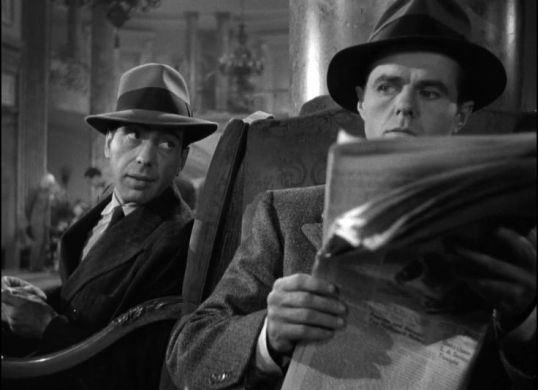
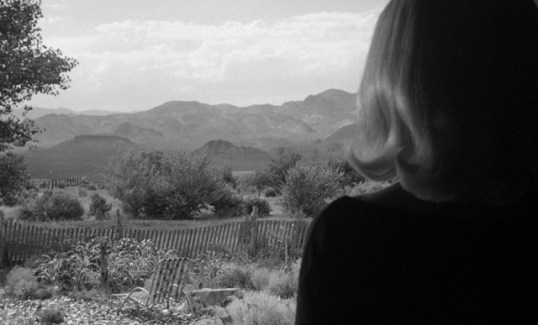
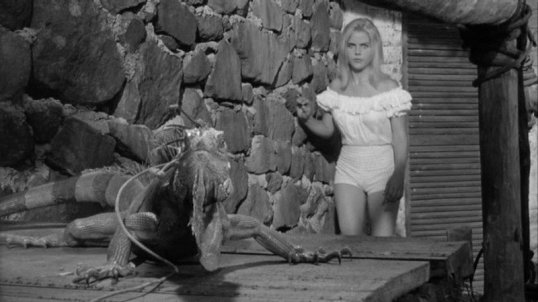
116 years ago today, the writer/director/actor John Huston was born in Nevada, Missouri.  Today, we honor his life and films with….

4 Shots from 4 John Huston Films

The Maltese Falcon (1941, dir by John Huston, DP: Arthur Edeson)


The Misfits (1961, dir by John Huston, DP: Russell Metty)


The Night of the Iguana (1964, dir by John Huston, DP: Gabriel Figueroa)


Under the Volcano (1984, dir by John Huston, DP: Gabriel Figueroa)


Scenes I Love: The Opening of Guardians of the Galaxy


Today, the Shattered Lens wises director James Gunn a happy 56th birthday!

My favorite James Gunn film remains 2014’s Guardians of the Galaxy.  Not coincidentally, that’s also my favorite comic book film.  A good deal of that love has to do with the film’s absolutely brilliant introduction of Chris Pratt’s Star-Lord.  In the scene below, both the film and Gunn announce that this is a comic book movie that actually has a sense of humor.  Let the other franchises specialize in depressed heroes and grim themes.  The Guardians of the Galaxy are all about dancing.

Here’s a scene that I love, directed by James Gunn:

Music Video of the Day: Big Brat by Phantom Planet (2003, directed by Spike Jonze)


Big Brat, which appeared on Phantom Planet’s self-titled third album, has twice gotten a lot of attention.  The first time was when it was released as a single in 2003 and the Spike Jonze-directed music video went into regular rotation on MTV.  (This was when MTV still played videos and had some actual influence.)  The second time was in 2012, when it was included on the soundtrack of The Amazing Spider-Man.

The video features the band performing and shooting a low budget zombie film.  (Remember that 2003 was long before the current zombie boom, showing that both the band and director Spike Jonze were far ahead of the curve.)  This is yet another video in which Spike Jonze displays his love of media and pop culture.  Jonze, of course, has gone on to have a very successful career as a director of idiosyncratic feature films.

Enjoy!

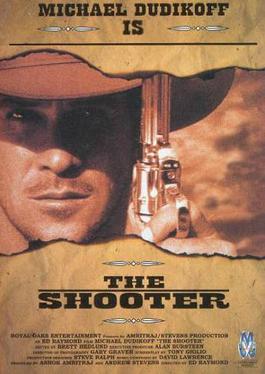
The Shooter (1997, directed by Fred Olen Ray)


While riding his horse through the old, Michael Atherton (Michael Dudikoff) discovers a group of thuggish ranch hands attacking a prostitute named Wendy (Valerie Wildman).  Because Michael is known as being the Shooter, he has no problem coolly gunning the men down and saving Wendy’s life.  Unfortunately, for Michael, one of the dead men is the son of a fearsome rancher named Jerry Krants (William Smith) and Jerry has his own reasons for wanting Wendy dead.  Michael may be the Shooter but Jerry Krants is William Smith so you automatically know that it is not a good idea to mess with him.

In the grand spaghetti western tradition, Krants has his men kidnap Michael, beat him up, and crucify him outside of town.  The men leave Michael for dead but, after they’ve left, Wendy repays Michael’s kindness by untying him from the cross, nursing him back to health, and saving his life.  (The same thing used to happen to Clint Eastwood, except he usually had to nurse himself back to health without anyone else’s help.)  With everyone else believing him to be dead, Michael rides into town to get his violent revenge against Krants and his men.  With all of the townspeople convinced that Michael has returned as a ghost, only the town’s power-hungry sheriff, Kyle Tapert (Randy Travis), understands what has actually happened.  Tapert makes plans to use Michael’s return for his own advantage.  While it wouldn’t look good for Tapert to openly murder all of his opponents, what if he killed them and then framed Michael?  And then what if he made himself a hero by being the one to end Michael’s reign of terror?

Directed by Fred Olen Ray, The Shooter is a low-budget western that turned out to be far better than I was expecting.  Ray is obviously a fan of the western genre and, with The Shooter, he’s made a respectful and, by his standards, restrained homage to the classic spaghetti westerns of old.  He even shows some undeniable skill when it comes to building up the suspense before the climatic showdown.  Ray indulges in every western cliché imaginable but he does so with the respect of a true fan.

With his less than grizzled screen presence, Michael Dudikoff is slightly miscast as a Clint Eastwood-style gunslinger but the rest of the cast is made up of genre veterans who give it their best.  In particular, William Smith shows why he was one of the busiest “bad guys” working in the movies.  To me, the most surprising part of the film was that the casting of Randy Travis as a villain actually worked.  Fred Olen Ray made good use of Travis’s natural amiability, making Kyle into a villain who will give you friendly smile right before he opens fire.  Also be sure to keep an eye out for Andrew Stevens, playing the man who records Michael’s story.  It wouldn’t be a Fed Olen Ray movie without Andrew Stevens playing at least a small role.

Low-budget, undemanding, and made with obvious care, The Shooter is film that will be appreciated by western fans everywhere.

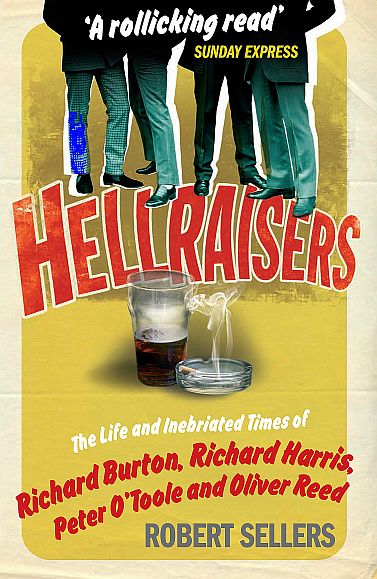
Book Review: Hellraisers: The Life and Inebriated Times of Richard Burton, Richard Harris, Peter O’Toole, and Oliver Reed by Robert Sellers


First published in 2009, Hellraisers is a fast-paced look at the life and times of four men, Richard Burton, Richard Harris, Peter O’Toole, and Oliver Reed, and an examination of what they all had in common.

First off, they were all talented actors who were at the height of their careers in the 60s and the 70s.

They all first came to prominence in the UK.  Peter O’Toole and Oliver Reed were English.  Richard Burton was Welsh.  Richard Harris was born in Ireland.

With the exception of Oliver Reed, all of them were multiple Oscar nominees but none of them actually won the award.

All four of them could boast filmographies that included some of the best and some of the worst films of all time.

And, of course, all four of them were infamous for their drinking.  They were all, if I may borrow the book’s title, famous for raising Hell.

Hellraisers is a frequently entertaining look at their careers and their legendary off-screen exploits.  All four of them come across as being very different drinkers.  Richard Burton was a depressing drunk, one who drank because he was aware that he was wasting his talents in mediocre films.  O’Toole was a drunk who alternated between being charming and being dangerous, someone who was capable of coming across as being a bon vivant even at his lowest moments.  Richard Harris was the angry drunk but he was also the one who seemed to have the both the best understanding of why he drank and why, at a certain age, it was necessary for him to cut back.  And, finally, Oliver Reed was the showman, the one who viewed drinking a beer the way that others viewed having a cup of tea and who would rather damage his career than allow anyone else to tell him how to live.  He knew that he had a reputation and he was determined to live up to it, even at the risk of his own health.

Perhaps not surprisingly, it’s Oliver Reed who dominates the book.  There was very little that Reed wouldn’t do while drunk and he was drunk quite a lot of the time.  He was also perhaps the most unpredictable of all of the actors profiled in the book, a raw mountain of energy who kept audiences off-balance.  Personally, I would not have wanted to have been along in a room with a drunk Oliver Reed.  The book has too many stories of Reed dropping his trousers and asking everyone to look at what he called his “mighty mallet,” for the reader to feel totally safe with Reed.  At the same time, anyone who has seen a good Oliver Reed performance knows that he deserved better roles than he was often given.  (Then again, the book is also honest about the fact that a lot of filmmakers would not work with Reed because they had justifiable reasons to be terrified of him and his erratic nature.)  Over the course of the book, Reed comes across as hyperactive, easily bored, and also far more intelligent than most gave him credit for.  In many ways, he was a prisoner of his own reputation.  He was outrageous because he knew that was what was expected of him.  As shocking as some of his behavior seems today, he felt that he was giving the people what they wanted and Hellraisers suggests that he may have been right.

Personally, I don’t drink and I find most heavy drinkers to be tedious company at best.  That said, Hellraisers is an interesting book.  Burton, Harris, O’Toole, and Reed are all fascinating talents and the book takes a look at how their hellraising reputations both hurt and, in some cases, helped their careers.  However, the book is more than just a biography of four actors who drank a lot.  It’s also an examination of a different era, of a time when performers were expected to raise Hell and when one could get away with being a contrarian just for the fun of it.  One can only imagine what the moral scolds of social media would have to say if Oliver Reed were around today!  As a result, this is a book that can be enjoyed by both film lovers and history nerds, like you and me.