James Bond Film Review: You Only Live Twice (dir. by Lewis Gilbert)


In the days leading up to the American release of Skyfall, the Shattered Lens has been taking a look at the previous films in the James Bond franchise.  Today, we take a look at the 5th official James Bond film, 1967’s You Only Live Twice.

Released two years after the critically derided but financially succesful Thunderball, You Only Live Twice was a step in a new direction for the Bond series.  As Sinclair McKay explains in his brilliant book on the Bond films, The Man With The Golden Touch,  both the world and the movies changed a lot between 1965 and 1967 and You Only Live Twice reflected that change.  Director Lewis Gilbert and screenwriter Roald Dahl were newcomers to the Bond series and the film they created would serve as a prototype for the flamboyant, big budget espionage fantasies that would come to epitomize many of the later entries in the franchise.

You Only Live Twice begins with one the Bond franchise’s more elaborate precredit sequences.  During these first few minutes, the film rather boldly announces that You Only Live Twice is going to be a bit of a departure from the previous Bond films.  The film begins not with Bond but with two anonymous American astronauts orbiting the Earth in a small capsule.  The two astronauts are blandly chatting with mission control on Earth when, suddenly, another spacecraft approaches and literally swallows the American capsule whole.  One of the astronauts is hurled into space as a result and, as his body spins away, it’s obvious that Bond’s not going to be dealing with something bigger than just another guy looking to hold up Fort Knox.

The Americans blame the Russians while the Russians claim that they’re being framed by Americans and the entire world appears to be on the verge of war.  But as always happens in the Bond films, the British are there to keep everyone from overreacting.  A British diplomat is seen calming down the belligerent super powers and assuring them that MI6’s “best man” is already on the case.

(One of the undeniably charming things about the Connery and Roger Moore  Bond films is the way that the United Kingdom is portrayed as being the world’s unofficial third superpower.)

Cut to Hong Kong, where James Bond is lying in bed and asking his latest conquest, “Why do Chinese girls taste different?”  And, at this point, I think it’s fair to say that Bond is really lucky that he looks like a young Sean Connery.  Suddenly, gunmen storm the bedroom and open fire, apparently killing 007.

Oh no!  I guess the world is doomed, right?  We’re left to consider this sad reality as we watch the opening credits and listen to Nancy Sinatra sing the film’s excellent theme song.

Well, of course, James Bond isn’t really dead.  He faked his death so that he can safely go to Tokyo and investigate who was behind the attack on the space craft.  You Only Live Twice was filmed almost entirely on location in Japan and a good deal of the film’s first half is devoted to scenes of Bond simply observing Japanese culture.  It’s a bit like Lost In Translation with an espionage subplot.

After fighting a few random henchmen, Bond meets Tiger Tanaka (Tetsuro Tamba), the head of the Japanese secret service.  Tanaka seems to spend the majority of his time getting massages from the dozen or so young women who wait on him hand-and-foot.  “In Japan,” he tells Bond, “men come first, women come second.”  “I might just retire here,” Bond replies.  Uhmmm…okay.  Thank you, 1967.

In order to continue the ruse that Bond’s dead, Tanaka arranges for Bond to take on an assumed identity.  After being trained on all aspects of Japanese culture and on how to fight like a ninja, Bond is heavily disguised to look like a Japanese fisherman.  Tanaka arranges for Bond to fake marry a local girl named Kissy (Mie Hama).  Kissy is probably one of the least interesting Bond girls in the history of the franchise.  Beyond walking around in a bikini while wearing high heels, Kissy just doesn’t have much of a personality.

Bond and Tanaka’s investigation lead them to a shady industrialist named Osato and his secretary Helga Brandt (Karin Dor).  Helga is about as close as You Only Live Twice comes to featuring a strong female character.  Not only is she an assassin who has no problem with killing a man who she’s just had sex with but she’s also a redhead, just like me!

Anyway, it’s not until very late in the film that we finally meet Helga’s boss.  If for no other reason, You Only Live Twice will always be remembered for featuring one of the great Bond villains.  After being seen in the previous Bond films as just a hand stroking a white cat, Ernest Stavros Blofeld makes his first on-screen appearance here and fortunately, he’s played by Donald Pleasence.

Looking at Pleasence’s performance today, the natural tendency is to compare his Blofeld to the iconic character that he inspired, Mike Myers’ Dr. Evil.  However, one reason that Dr. Evil became such a popular character is because Donald Pleasence’s Blofeld is one of the great film bad guys.  As delivered by Pleasence in his casually off-center way, every line of Blofeld’s dialogue drips with the promise of perversion and hints of the neurosis that fuels his every action.  Blofeld spends most of the movie hiding out in a secret base that’s hidden inside a hollow volcano.  He strokes that ever-present white cat and uses a pool of piranhas to punish failure.  It is a credit to Pleasence’s performance that you never, for a second, doubt that Blofeld could very well be living in a hollow volcano.

I have to admit that You Only Live Twice is not my favorite James Bond film, though there are plenty of things that I do like about it.  Bernard Lee, Lois Maxwell, and Desmond Llewelyn all make welcome appearances and there is a genuinely exciting scene where Bond flies around in a toy helicopter.  Working on his first and only Bond film, Oscar-winning cinematographer Freddie Young captured some beautiful images of Japan and Blofeld’s volcano lair is one of the franchise’s best locations.

That said, You Only Live Twice often moves a bit too slowly for its own good and, with the exception of Blofeld and occasionally Helga Brandt, none of the film’s supporting characters are all that interesting.  Charles Gray, who later took over the role of Blofeld in Diamonds Are Forever, has a nice cameo as a decadent retired intelligence agent but he’s killed off before he can make too much of an impression.  Perhaps worst of all, Connery spends most of this film looking like he’d rather be doing anything other than play James Bond for the fifth time.  By his own account, Connery eventually grew bored with the role and that’s certainly obvious in You Only Live Twice.

Connery’s boredom can perhaps explain why, during the shooting of You Only Live Twice, it was announced that he would not be returning to play the role in the 6th Bond film.  The Bond franchise would continue with On Her Majesty’s Secret Service but it appeared that Connery would no longer be a part of it.

We’ll be taking a look at that film tomorrow.

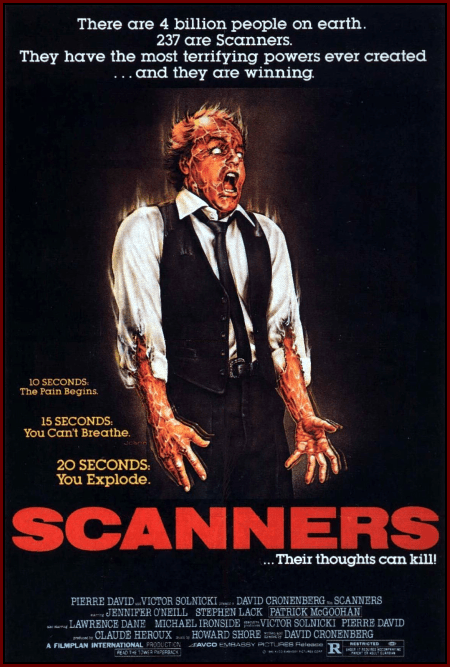
Horror Scenes I Love: Scanners (by David Cronenberg)


[SPOILERS!!!!]

I’ve already shared a favorite scene from David Cronenberg’s landmark scifi/horror film Scanners over a year ago that saw a head explode. For October’s horror-themed month I picked another great scene from this film that always stuck with me long after I’ve finished watching the film each and every time.

The scene I’m talking about is the climactic showdown between Good Scanner Cameron and Evil Scanner Revok. This scene was filmed before the advent of CGI-effects and Cronenberg never had the sort of big-budgets to hire the top FX make-up artists to work on his films. Yet, Cronenberg ended up creating one of the best scenes ever put on film about two people fighting each other using their minds. We never see their mental abilities shooting off psychic blasts at each other but the performance by both Michael Ironside as Revok and Stephen Lack as Cameron was so believable that it made the scene work when it could’ve turned so cheesy and disastrous in the hands of a different filmmaker and other actors.

The battle ends but we’re left to believe the good guy lost and evil triumphs. This feeling pretty much plays out right up to the final scene before fade to black and even then we’re not sure if the final reveal is true or not. Either way there’s no better way to bookend the exploding head intro than with two psychic beings duking it out mentally with blood, spontaneous combustion and creepy white eyes added in for style.

Horror Review: The Walking Dead S3E02 “Sick”


“You think this is sick. You don’t want to know what’s outside.” — Daryl Dixon

[some spoilers]

There’s been an interesting pattern when it comes to The Walking Dead. The series has always had strong season opening (even mid-season returns) but the follow-up episode always seem to come up short. It happened with the second episodes of both first two season and even the episode which came after the mid-season return last season had some big stumbles throughout. It almost as if the writers (who at the time were still working under Frank Darabont’s directioneither as showrunner or the template he set up for the season) put everything they had into making the opening episode really strong and hoping the viewers would forgive them for not doing the follow-up episodes just as strong. Tonight’s season premiere follow-up looks to try and break that pattern. Time and reaction to tonight’s episode, titled “Sick”, will tell if it succeeded or not.

Tonight’s episode begins pretty much exactly where the season premiere left off with Rick and his group trying to save Hershel’s life who had gotten his leg bit during their attempt to clear out an adjoining cellblock. The premiere ended with Hershel minus his bit left ankle courtesy of Rick and his trusty axe and Daryl focusing the aim of his crossbow at the sudden appearance of a group of prisoners who happened to have survived almost a full year on their own in the prison cafeteria. It was this group’s reveal and how the two groups dealt with the knowledge that there were others who have survived just as long.

We learn much abouthow the time Rick and his group spent moving around the backwoods of Georgia between seasons. The episode doesn’t say what exactly happened during those months (a nice change for critics of the series who thought episodes after episodes during the first two season relied too much on exposition scenes to tell rather than show) but we see in the changes to the behavior and attitudes of the group members how those months were. It couldn’t have been a fun time for Rick and his group, but it looks to have made them much more harder and accepting of this new world’s harsh realities. Whether not letting her hopes up when it came to her father’s chances for survival after getting bit and having his bit leg chopped off to Carol becoming even more useful as a member of the group. In the season premiere we find out through a off-chance remark from Rick that she’s gotten quite good with the AK47 and tonight we find out that during their time in the Georgia backwoods Hershel had been teaching her how to perform first-aid and rudimentary battlefield medical work. The scene with Carol patching up Hershel actually gives some clues as to what Hershel’s backstory must be outside of being just a farmer.

Is there a chance that Hershesel could he have been in the military as a medic in his younger and wilder days or was he some sort of civilian emergency medical technician?

Tonight’s episode brought up such questions and without the characters sitting around explaining things that happened. This change in narrative style could be just temporary, but ever since Glen Mazzara took over as showrunner we get less and less exposition and more and more let the character’s actions convey the story. This less is more approach has made for a much more faster pace to the story even when there’s no killing of zombies. It also has made the actors much better in how they’re portraying their characters. Long scenes of quiet diaogue is always good, but in a show that tries to show that survival is a day-to-day or even an hour-to-hour task sometimes such long, extended scenes of just sitting around talking are luxuries that shouldn’t be used like they were a necessity.

There’s a chance that the show could slide back to what plagued the first two season, but for the time being Mazzara and his crew have done a great job with the first two episodes of season 3 to address some of the complaints fans and critics had with the show. We didn’t even have any scenes with Andrea and newcomer Michonne yet the writers avoided the temptation of trying to shoehorn scenes of them in tonight’s episodes which meant sacrificing some time in the prison. Tonight’s episode was all about Rick and Tomas butting heads to see who would end up being the alpha male of the two surviving groups.

We saw how the differences in how the two groups survived has affected them. Tomas and his group of inmate survivors did so almost by luck and having to depend on their prison-honed instincts to get them through. How they’ve managed to survive even with just the zombies in the prison and not knowing the full extent of the crisis would be seen by Rick as a miracle. Our main group on the other hand had to go through almost everything this new post-apocalyptic world could throw at them and they’ve survived. It’s this time out on the road, surviving day-to-day, supplies always on the verge of running out and not knowing if tomorrow might be their last day that has forged this group into hardened battlefield veterans. Make no mistake about it Rick and his group look and behave like war veterans still fighting to survive and having almost having learned an almost preternatural instinct to see danger lurking about.

This doesn’t mean that Rick and his group have come out of their time out in the wilderness surviving fully unscathed. Carl has become more useful and capable of taking care of himself, but at the cost of his innocence and childhood wonder at the world. Even T-Dog has become a very integral part of the group (thank you writers) and has become not just the “red-shirt” waiting to be knocked off for expediency’s sake. The biggest change has been to Rick who seem to have lost whatever optimism he might have had about finding peace and quiet in this new world. He’s now all about keeping his people alive and if that means killing other humans who might pose a danger to him fulfilling that mission statement then he’ll do whatever it takes. We see this change in Rick not through some exposition (something the character loved to do in the first two season) but in how he dealt with Tomas and other prisoners. It will be interesting how Mazzara and his team of writers will deal with Rick and the Governor who, if they’re following the basic outline of the comic book character, had to do almost the same exact things to keep his town of survivors alive through the crisis.

With the episode ending with Rick firmly in control of not just his group, the prison and the rest of the surviving prisoners (not to mention Hershel looking to have survived his encounter with the walker bite and Rick’s axe) it looks like next week’s episode will be focusing on the adventures of Andrea and Michonne and what looks like the introduction of this season’s main villain in David Morrissey’s own brand of despotic ruler in Philip Blake aka The Governor.

NOTES

  • Tonight’s episode was written by show newcomer Nichole Beattie and directed by show veteran Billy Gierhart.
  • Anyone who thought that Tomas and his group of prisoner will get through the episode unscathed can’t be blamed for that assumption. If this was season two there’s a chance they would’ve lasted intact for half the first half of the season. New regime looks to avoid that and keep the number of survivors from spiraling out of control to the show’s detriment.
  • Sarah Wayne Callies has done a very good job in a tough role that only seems to get tougher. I don’t think she’ll ever become a sympathetic character for the fans of the show, but then again not everyone on the show needs to be sympathetic.
  • Then she blows up at Carl for putting himself in danger even though what he did probably saved Hershel’s life for the  moment.
  • Kudos to all Glen Mazzara and his team of writers for actually making a follow-up episode to the season premiere not have such a huge drop in quality. Tonight’s episode was a strong one.
  • The change in how the two Greene sisters acted in tonight’s episode reversed the role Maggie and Beth had while at the Farm. Maggie Green has become hardered by the intervening months between Season 2 and 3 while Beth has become much more optimistic.
  • The prisoners were all very interesting but kudos for the writers for not lingering too much in exploring the group’s dynamic with Rick’s own group.
  • Love how Daryl’s completely in Rick’s corner now and even willing to do the dirty work for him if and when Rick gives him the signal. Show’s that for all his faults in the early goings with the group Daryl understands that it was with Rick and not Shane that the group had the best chance of surviving. Rick may be doing the very same things Shane was advocating in the first two seasons, but Rick does so with a clear head and focus that Shane never really had.
  • The show may never have the Tyrese character from the comic book, but having Daryl Dixon in Rick’s corner more than makes up for it.
  • Killing other survivors still doesn’t sit well with Rick, but he looks to have learned that outside the group itself everyone else is expendable. He may not like murdering other people but he will if it keeps his group alive. This may be an ongoing theme for this season.
  • With the show having deviated from the comic book’s narrative it’s interesting to see how the show’s writers are starting to mine particular scenes from issues and storylines that happens much later in the comics to use in the show.
  • The relationship between Rick and Lori looks to be even more broken in the show than it as in the comic book. The question now is whether the writers will find a balance in keeping their relationship from being too broken. I do like how Rick at the end doesn’t seem ready to break the iceberg between her and Lori or if he ever wants to.
  • It’s good to see Lori admitting it on-screen just how much of a bad wife she has been since Rick returned. Her character has always been the one who was in real denial of her situation especially when it came to Rick and Shane now with the months leading up to this season it looks like Rick’s arctic attitude towards her has finally settled in her mind as to who really put the conflict between Rick and Shane into it’s violent end.
  • The zombie effects tonight wasn’t as extensive as the season premiere but Greg Nicotero and his men at KNB EFX still did a great job as usual.
  • Zombie Kill Count for tonight’s episode: between 20-25.

James Bond Film Review: Casino Royale (dir by Ken Hughes, John Huston, Joseph McGrath, Robert Parrish, Val Guest, and Richard Talmadge)


As you probably already know, we here at the Shattered Lens have been counting down the days until the American release of Skyfall by reviewing every single film in the James Bond franchise.  Today, we take a look at the first non-EON Bond film, the epic, psychedelic 1967 spoof Casino Royale.

Where to begin?

When Ian Fleming’s first James Bond novel, Casino Royale, was published in 1953, veteran Hollywood producer Charles K. Feldman bought the film rights.  However, Feldman didn’t buy the rights to Fleming’s subsequent novels and was forced to sit by and watch as Albert Broccoli and Harry Saltzman had unexpected success with Dr. No and the subsequent EON-produced Bond films.  Much as Kevin McClory did with Thunderball, Feldman first attempted to co-produce a serious adaptation of Casino Royale with Broccoli and Saltzman.  However, when Feldman, Broccoli, and Saltzman couldn’t come to an agreement on how each side would be compensated in the proposed production deal, Feldman decided to make Casino Royale on his own.  He also decided that, instead of trying to compete with EON by making a “straight” James Bond film, his version of Casino Royale would be a satirical extravaganza.

Feldman’s vision of James Bond is apparent from Casino Royale’s opening credits.  While the credits are definitely based on the iconic openings of the EON Bond films, they’re also designed to play up the fact that Casino Royale — in the grand tradition of the Hollywood studios at their most excessive — is meant to be a big budget, all-star extravaganza.

Casino Royale actually starts out with a pretty clever premise.  It seems that the name “James Bond,” is simply a code name that has been assigned to several British spies over the years.  As M (played by John Huston, who also directed the first third of the film), explains it, the name “James Bond” strikes such fear in the hearts of Britain’s enemies that the name must be kept alive.

(Speaking for myself, this is an idea that I kinda wish that the official James Bond series would adopt.  If nothing else, it would certainly explain how Pierce Brosnan and Daniel Craig could possibly be the same person.)

The original James Bond (played by David Niven) has long since retired to his stately country estate, where he spends his time playing the piano and complaining about how the agents who have inherited his name are sullying his reputation with excessive womanizing and violence.  It turns out the Sir James Bond is a man renowned for his “celibate image.”  At the start of the film, Bond is asked to come out of retirement by not only M but the heads of the CIA, KGB, and French secret service as well.  SMERSH, an organization of female assassins that’s led by the mysterious Dr. Noah, has been eliminating agents worldwide and only the original (and very chaste) Bond can defeat them.  Bond, however, refuses and M responds by ordering a mortar attack on Bond’s estate.  The estate is blown up but so is M and Bond soon finds himself returning to London as the new head of MI6.

Interestingly enough, David Niven was one of the actors who was considered for the role of James Bond in Dr. No.  Reportedly, Ian Fleming was quite enthusiastic for Niven to take the role but, by the time that Dr. No went into production, Niven was considered to be too old.  There’s a nice bit of irony here in seeing David Niven playing a retired James Bond who spends a good deal of the film complaining about the men who have subsequently assumed his name.

Once Niven takes over MI6, he orders that, in order to confuse SMERSH, all British agents (including female agents) will be known as James Bond.  The rest of the film is divided into episodes that feature these new James Bonds battling SMERSH and the mysterious Dr. Noah.

Among these agents, there’s the handsome Coop (played by Terrence Cooper) who has been trained to resist all sexual temptations.

There’s Mata Bond (Joanna Pettet), the daughter of Sir James Bond and Mata Hari.

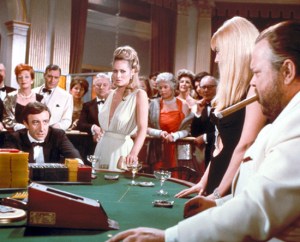
There’s Vesper Lynd (Ursula Andress) who is sent to seduce and recruit the expert gambler Evelyn Tremble (Peter Sellers) so that Tremble can beat SMERSH agent Le Chiffre (Orson Welles) at the Casino Royale.

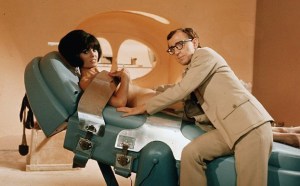
Best of all, there’s Sir James Bond’s nephew, Jimmy Bond.  Jimmy Bond is played by Woody Allen and … well, let’s just take a look at Jimmy’s first scene in the film:

Casino Royale had a notoriously troubled production history and most of those troubles seemed to center on Peter Sellers.  While the film was designed to be a broad, slapstick comedy, Sellers reportedly insisted on trying to play his role straight and even rewrote his lines to make his scenes more dramatic.  Welles eventually grew so disgusted with Sellers that he refused to be in the same room with him.  This caused quite a bit of difficulty since Sellers was in almost every scene that featured Welles.  Eventually, Sellers walked off the film and the film had to be hastily (and awkwardly) rewritten to account for his sudden absence.

When one watches Casino Royale today, it’s hard to escape the conclusion that Sellers was essentially correct.  While most of Casino Royale often feels disjointed and incoherent, the scenes featuring Sellers, Andress, and Welles are some of the strongest in the film.  Sellers’ dramatic approach doesn’t negate the film’s comedy.  If anything, it makes the comedy even stronger because Sellers actually seems to be invested in the reality his character, regardless of how ludicrous a situation that character may find himself in.

When I watched Casino Royale, I was struck by the stark contrast between the parts of the film that worked and the parts that didn’t.  This is a movie that truly swings from one extreme to another.  Either the film’s satire is working  brilliantly (mostly in the scenes featuring Woody Allen and Peter Sellers) or it’s falling completely flat (like in an extended sequence that features Deborah Kerr as a SMERSH assassin).

I found myself laughing more at the little scenes than the big set pieces.  For instance, I loved it when David Niven embraces Miss Moneypenny (Barbara Bouchet) just to be then told that she’s actually the daughter of the original Miss Moneypenny.  I don’t know much about the actor Terrence Cooper (though, according to Wikipedia, he was also a contender to take the role of James Bond in the official series) but I enjoyed the brief sequence where Moneypenny “tests” him to see if he can take on the Bond identity.  Unfortunately, the film doesn’t really have enough of these small, clever moments.

Ultimately, I found that Casino Royale works best when viewed as a time capsule.  Casino Royale was made at a time when the established major Hollywood studios (and veteran producers like Charles K. Feldman) were struggling to remain relevant.  Foreign films (including, it must be said, the James Bond films) were challenging the common assumptions of what could and what couldn’t be shown on-screen and the studio system reacted by trying to make films that would appeal to younger audiences while also reassuring older audiences that the movies hadn’t really changed that much.  The end result were films like Casino Royale that featured the occasional psychedelic sequence along with cameos from old (and safe) Hollywood stars like George Raft, William Holden, and Charles Boyer.  Casino Royale is the type of self-indulgent film that could only have been made in 1967 and, as such, it’s a valuable time capsule for all of us cinematic historians.

I also have to admit that, as excessive as Casino Royale may be, I happen to love excess.  Casino Royale might be overlong and occasionally incoherent but the costumes are simply to die for.  The film is a visual feast, if nothing else.

Casino Royale was released to scathing reviews and terrible box office but, in the years since, it has become something of a cult favorite.  Our own Trash Film Guru has identified Casino Royale as his favorite Bond film.  Myself, I found the film to be extremely flawed and yet oddly fascinating to watch.  Casino Royale is a total mess and that is both its greatest flaw and greatest strength.

Tomorrow, we’ll return to the official James Bond series by taking a look at You Only Live Twice.  

Horror Scenes I Love: Misery


Our next horror-themed “Scenes I Love” entry comes courtesy of Rob Reiner’s film adaptation of the Stephen King novel to celebrity stalkers everywhere.

Misery was one of those novels that was actually much better when adapted to the film screen. Maybe it was the performances of the small cast with Kathy Bates’ star-turning role as Annie Wilkes who happens to be Paul Sheldon’s (James Caan) Number 1 fan. I’m not a huge Rob Reiner fan, but he hits on all cylinders with this adaptation and the scene which cements this film as one of my favorite horror films is the one many have simply called “The Hobbling”.

The scene itself was actually much more graphic in the novel since Annie uses an axe instead of the sledgehammer in the film. Yet, the lack of blood and chopped flesh and bone didn’t keep the scene from being wince-inducing. In fact, the use of the sledgehammer and the wooden block and the slow build-up to the money shot made the entire sequence almost hard to stomach and bear. I think I’m not the only one who ended up having phantom pains as soon the Annie went to town on Paul’s legs.

October Music Series: Alkonost – Sun Shine Our Land


I first ran into Alkonost back in the days of Audiogalaxy, when I barely had a clue what metal beyond Metallica and Pantera consisted of. They are remarkably early for folk/pagan metal, forming in Naberezhnye Chelny, the second largest city of Tatarstan in Russia, in 1995. Their first demos were released in 1997, and “Sun Shine Our Land” appears on their 2000 debut full-length, Songs of the Eternal Oak.

I wasn’t really aware that anything describable as pagan or folk metal existed (and most of the standards by which the genres are judged had yet to be written), so for me it was something of an anomaly. I’d been listening to a lot of Nokturnal Mortum at the time, and I was beginning to develop this idea of “eastern” metal as something far more ah, I guess I’d say spiritual, than the western angst engines I’d been accustomed to. It stood apart, too, from the fantasy stuff I’d been getting into at the time. It was something quite different from Blind Guardian, Iced Earth, Rhapsody… it felt like fantasy (power) metal turned inside out, where the music wasn’t so much describing as becoming the myth. That’s a lot of what folk and pagan metal is, I suppose.

I find it a bit fascinating that, all inheritance from Bathory aside, the genre did emerge largely out of the former Soviet Union. It has a historical framework that goes beyond musical trends. These are bands that, in the new era of free speech that defined the 1990s, rejected the ideals of modernization and looked to idealize the past as a more authentic human experience than anything under pseudo-socialism. I don’t know how much Alkonost actually influenced the pagan and folk scenes that followed, but the fact that I’d heard of them as early as 2000 is a telling sign. “Sun Shine Our Land” was one of my favorite songs back then, and certainly still merits attention.

James Bond Review: Thunderball (dir. by Terence Young)


The Shattered Lens is taking on all of the Bond Films, one a day until the U.S. Release of Skyfall on November 9th. Today, we approach the fourth Bond Picture, Thunderball. Before I start, I should note that this film actually has a bit of controversy behind it. Thunderball had the potential to become one of the first Bond films, but a law suit in 1961 stating that Ian Fleming’s novel for the story was based on the screenplay for the film. Producer Kevin McClory was able to win the lawsuit and hold on to the rights. This would later result in 1983’s Never Say Never Again, with Sean Connery returning to play the same role in the same story as he did in 1965. In the meantime, Dr. No, From Russia With Love and Goldfinger were released with great success.

Before watching the movie, I watched a 1965 documentary from NBC called “The Incredible World of James Bond”, which talked about Ian Fleming, James Bond, and the overall popularity of the character. By the time Goldfinger came out, you’d find lines around theatres all around the world. People were buying colognes and watches – if it had 007 written on it, it was an easy sale. Both the books and the movies were doing extremely well. So with Thunderball being the latest release, it was similar to having perhaps the next Harry Potter or Twilight film on the way. I also learned that Q (Desmond Llewelyn) actually has a name, Major Boothroyd. That was cool to discover.

I wish I could say that I enjoyed Thunderball.  It’s the only Bond film I’ve never seen and the production values for the film were some of the most elaborate around at the time of it’s release. They went out of their way to create submersible machines and other equipment, but the fact that so much of the film took place underwater really caused me to lose interest in what was going on. Granted, it may be fun for many people, but I really wanted to them to give me a few more locales under than the major underwater harpoon fight that occurs near the film’s action climax. Both Tom Jones’ theme song (which describes Bond’s approach to things) and John Barry’s score help to set the mood of the story.

Thunderball continues the SPECTRE story started with Dr. No. Originally, this was supposed to be SMERSH, but that was a real group, much like the KGB or CIA. For movie purposes, SMERSH became SPECTRE to avoid giving any of the Bond stories an anti-nation slant. This would also be done with Quantum of Solace, the organization being something private rather than being any kind of counter intelligence group. This time around, the story opens with Bond attending the funeral of one of the SPECTRE members, and on seeing his wife getting into a car on her own (something I didn’t see as wrong), he follows her to her home to confront her. It’s revealed that the widow is actually the SPECTRE agent (I wasn’t expecting the punch that revealed it), and in the fight Bond ends up killing him. He makes a quick exit and uses a jet pack to get out of the building, where his Aston Martin is waiting for him. It was kind of interesting to see that there was that kind of technology in the 60s.

SPECTRE agent Emilio Largo (Adolfo Celi) is given the task to acquire two Nuclear weapons and decides he’s going to blow up Miami if he doesn’t get his way. Bond is assigned to stop him, and along the way he meets Domino (Claudine Auger), who assists him on this.

At the time of it’s release, Thunderball was a major hit and even won an Academy Award. It managed to come out at the height of Connery’s career as the secret agent. It does suffer from one or two flaws. As most of the story takes place on or near a beach, there are tons of underwater sequences, including a full out battle. Even Finding Nemo took some time to stay on the surface once in a while. This doesn’t make Thunderball a terrible film at all, it simply focuses the story on one element. I would have liked a little more variety.

Q’s gadgets for Bond this time around included a Geiger Counter, a rebreather, an underwater camera, and a personal flare gun, all for the life aquatic.

Overall, Thunderball’s a good film to watch if you’re doing what we’re doing here and are watching the films in a series. You may find yourself a little bothered by the amount of underwater scenes, but the movie still manages to keep some of the spy vibe of the earlier films. Below is Tom Jones’ theme to the film. Tomorrow, the Shattered Lens will take on the David Niven / Peter Sellers version of Casino Royale.

A Horror Quickie: Paranormal Activity 4 (dir by Ariel Schulman and Henry Joost)


Paranormal Activity 4 is the first proper sequel to Paranormal Activity.  Whereas the second Paranormal Activity film showed events that were happening at the same time as the first film and the third film took place several years before the first one, Paranormal Activity 4 actually takes place several years after the conclusion of the first and second films.  It also makes an attempt to further expand the franchise’s mythology but, ultimately, this film just proves that the more things change, the more they remain the same.

In Paranormal Activity 4, Kathryn Newton plays Alex, a teenager who is suspicious of both her odd neighbor Katie (played by a returning Katie Featherston) and Katie’s creepy son, Robbie (Brady Allen).  When Katie is mysteriously taken ill, Alex’s family agrees to take in Robbie while Katie recovers.  As soon as Robbie movies in, all of the usual Paranormal Activity stuff starts happenings.  Doors are mysteriously slammed,  a chandelier falls from the ceiling to the floor and nearly crushes Alex, and Robbie befriends Alex’s adopted little brother, Wyatt (Aiden Lovekamp).  Alex rightly suspects that Robbie is somehow involved with everything that’s happening but she can’t get her constantly bickering parents to listen to her.  So, she does the next best thing and she gets her geeky (but cute) boyfriend (played by the very likable Matt Shively) to set up every computer in the house with a webcam.  Soon, even more strange things are happening and the cameras are there to record all of it…

I saw Paranormal Activity 4 at a midnight screening with my best friend Evelyn and that’s probably the best way to see it, late at night when you’re less concerned about logic and surrounded by a bunch of people who are determined to make the film an interactive experience.  The worst thing you can do, while watching a Paranormal Activity film, is to start thinking about why nobody ever leaves the house or whether or not someone would actually keep filming while being chased by demonic spirits.  Instead, you just have to sit back and enjoy the silly experience for what it is.

When compared to the other films in the series, Paranormal Activity 4 is better than the first two entries but nowhere close to being as good as the third installment.  Kathryn Newton and Matt Shively are likable in the lead roles and there’s an adorable orange house cat who shows up at various points during the film.  (The cat may actually be the smartest character in the entire film because, whenever anything weird starts happening, she does the smart thing and leaves the room.)   Plus, the house in Paranormal Activity 4 is a really nice house.  Seriously, if not for the evil spirits and all that, I would love to live there.

Another year means another Paranormal Activity (or, as Evelyn put it when we saw this film, “Again with this?”).  Since these films all tend to have the same strengths and flaws and since they all tend to tell the same story, they can be difficult to review.  You can either enjoy these films for what they are or you can just throw your hands up in the air in frustration.   If you enjoyed the first three Paranormal Activities, you’ll enjoy the fourth.  If you spent the previous Paranormal Activity films wondering why everyone was so busy setting up video equipment (as opposed to just leaving the house), then Paranormal Activity 4 is not for you.

October Music Series: 下村陽子 – Beware the Forest’s Mushrooms


http://www.youtube.com/watch?v=lbRJ733xiF4

Yoko Shimomura was a rising star when she composed the Super Mario RPG soundtrack in 1996, fresh out of Capcom and ready to embark on a higher profile career with Square. The whole soundtrack was exceptional, but one track in particular was so catchy that it’s been stuck in my head ever since, and it’s most certainly appropriate for a fall theme.

Within the game, the song plays to a forest maze–one of those looping maps that can have you wondering around forever if you don’t pay attention. ‘Forest music’ has always been among the best tracks in RPG scores, but I don’t know that anyone’s pulled one off as effectively as Yoko Shimomura. It’s not quite as dark and haunting as say, Koji Kondo’s “Forest” from A Link to the Past or Yasuaki ‘Bun Bun’ Fujita’s “Deep Forest” from Breath of Fire, nor as calm as Yasunori Mitsuda’s “Secret of the Forest” from Chrono Trigger, to name some contemporaries. It’s far more friendly and inviting, which really makes it all the more dangerous, because at the end of the day you’re still getting lost in a deep forest maze filled with monsters out to kill you. It draws you in, makes you want to keep on wandering, like a good proper evil enchanted forest ought to.

It’s also the theme song to Geno, a doll possessed by the spirit of one of the stars you’re out to rescue, who really creeped me out as a kid because I thought that orange thing on his hat was his nose for some reason.

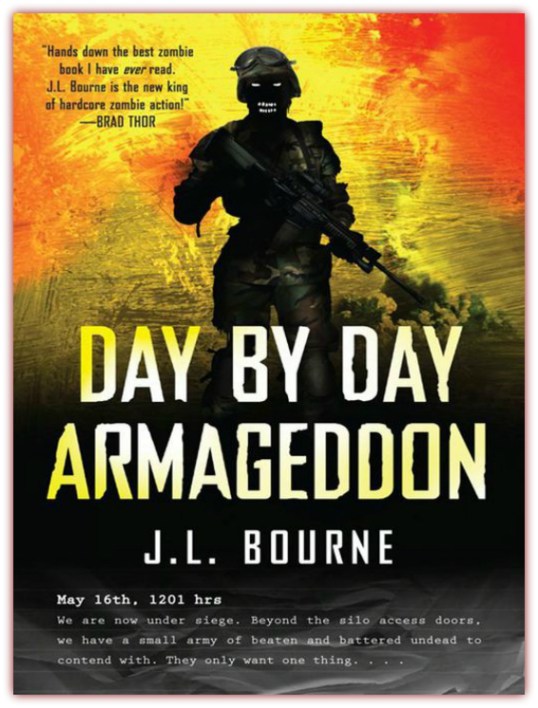
Horror Review: Day by Day Armageddon (by J.L. Bourne)


The last decade or so has been a sort of renaissance for all things zombies. Zombies have become the “monster of the moment” in the entertainment industry. These shambling undead (or Olympic sprinters for some of the more modern take on the genre) have permeated film, video games, comic books and novels. Even tv has been invaded by the recently ambulatory dead. J.L. Bourne debuts with a fast-paced and exciting first novel that takes the well-known conventions of the zombie tale and gives it a nice personal touch to set it apart from the many other zombie novels flooding the market.

Day by Day Armageddon doesn’t go the usual straight narrative of most novels. The novel’s written in the point-of-view of an anonymous narrator, but told through an epistolary-style Ssmilar to Bram Stoker’s Dracula. Bourne’s novel tells the story of this one man’s struggles to survive the gradual collapse of civilization and then the days in a post-apocalyptic undead world around him through journal entries he has taken up to keep himself sane and focused. Bourne’s choice of writing style lends a bit of a personal touch to the proceedings as it imbues the tale with less hyperbole and flowery language. The journal entries gives the reader just the right amount of look into this man’s life instead of bombarding the reader with everything. Not everything’s explained in these journal entries, but enough clues were hinted at to keep the reader interested in reading more. From the beginning of the crisis (which has a timely feel of today’s current events) to the confusion of the situation spiralling out of control with our narrator as confused as the people in charge seem to be.

Day by Day Armageddon doesn’t lack for action and gory detail, but they seem to be more of affectations to the rest of the tale. Bourne concentrates more on the thoughts of his anonymous narrator. From how to plan for a siege to finding a way to distract the growing undead in his first refuge in order to rescue a neighbor who might be the only living person left the area. When the novel does finally have the narrator and the other survivors place themselves in danger in order to find more supplies or a better refuge, Bourne does a great job of keeping the pace of the story fast and tight. There’s not a lot of overly descriptive passages of the environment and its new undead in habitants. This minimalist style also lends itself to keeping the characters real. They behave with a rational and logical mind in trying to cope and deal with the worsening situation outside their refuge. Plans are thought out in advance and every precaution and angles factored in whatever decision they make in regards to their survival. In fact, Bourne’s characters seem to have either read Max Brook’s Zombie Survival Guide or at least something similar since they behaved and acted just how Brook’s guide said people need to if they’re to survive a coming zombie apocalypse.

If there’s a bone to pick with Day by Day Armageddon it would be the ending. To say that it ends in a cliffhanger would be an understatement. The last couple of journal entries became so action-packed that it succeeded in raising the adrenaline and making this reader want more of the same. But just when things really got cooking the book ends suddenly and with no resolution. The novel’s suppose to be just the first book in a larger series. Other than that little complaint, I thoroughly enjoyed this debut zombie novel from a new writer who seems to enjoy the zombie subgenre and knows how to handle it well. No running zombies for Mr. Bourne, though he’s hinted at radioactive zombies with abit more oomph than their less glowing undead brothers. Here’s to hoping Bourne keeps the sprinting undead to a minimum. Now where’s that second volume to this series.