One of the best gaming experiences I’ve had in the past ten years was from a title that was the creation of the man (Sakaguchi Hironobu) who made the wildly-popular Japanese role-playing game franchise, Final Fantasy, before he left to start up his own company. This company would be called Mistwalker and they would release two rpgs for the Xbox 360 between 2008 and 2009. The second of these two titles was Lost Odyssey and this was the title of which I spoke of above.
The title was a nice throwback to the classic Final Fantasy titles Sakaguchi was responsible for while dressed up in nextgen visuals. But what made this game so memorable an experience for me wasn’t just the visuals but the great storytelling and music it also had in great abundance. The music itself was the product of one (if not the greatest) of the greatest video game music composer in the industry, Uematsu Nobuo. It’s from Uematsu’s soundtrack for Lost Odyssey that I pick the latest “Song of the Day”.
“A Return, Indeed…” (“Kaette kuru, kitto…” in Japanese) is part of the game’s soundtrack which makes several appearances throughout the game, but it was during the first found dream sequence (the game’s greatest highlight and reason to play it) which really sold the song and the whole soundtrack as whole as being great. This version is the piano solo one which is really the best version which appears in the game. This piano solo version was arranged by Satoshi Henmi from Uematsu’s original composition and it fully convey’s the song’s sorrow melody in the beginning but gradually transitions into a sound full of hope before finally ending in a simple few notes. Those few notes giving a hint that hope is always a possibility but in the end always fleeting.
What better way to inaugurate 33 days of “A Thousand Years of Dreams” than the song which kicks it off in the game.
I’ve seen this tagged black metal, and I really have to wonder. I’m not familiar with the band’s history. I haven’t heard any of their earlier releases but To the Nameless Dead, and that only twice back in 2007. So maybe they were black metal once, I don’t know. But calling this anything but Celtic metal would fail to properly describe it. It bleeds green.
No Grave Deep Enough
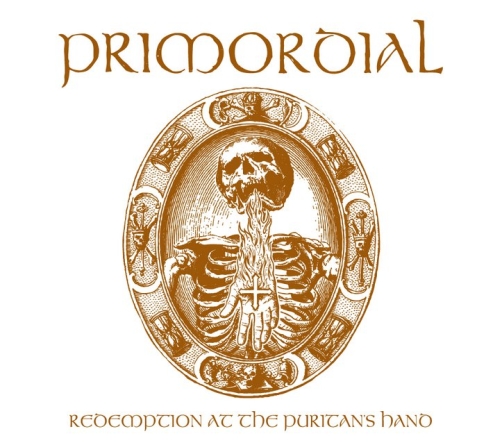
And like many Irish bands, the lyrics are the focal point. Redemption at the Puritan’s Hand is an album about death. The band stated that much pretty bluntly when they released it. But it doesn’t approach the subject through the music (unless metal or Irish melodies can be said to be connected to it by default), nor does it settle for less mature pseudo-poetic lines about chaos and evil and all that nonsense you hear in metal. It’s an in-your-face, unfanciful confrontation. You might not get the bigger picture of each song every time. I’m not going to pretend I do. But line by line it often hits hard and direct, in a powerful vocal style you can understand without having to look up the lyrics.
To the Nameless Dead must not have immediately impressed me too much, because I never did end up giving it an attentive listen. Redemption at the Puritan’s Hand had me hooked by the opening chorus. “Oh death, where are your teeth that gnaw on the bones of fabled men? Oh death, where are your claws that haul me from the grave?” The album is packed full of lyrics you’ll not soon forget.
Bloodied Yet Unbowed
As such, its highs and lows are related. An album like this can be difficult to pull off, because it gives the listener the feeling that every line sung has to matter in some direct, accessible way. Sometimes they simply don’t. For every moment like No Grave Deep Enough’s chorus, you’re going to find an opportunity lost. The song Bloodied Yet Unbowed is a case in point. When the time comes for a powerful stand-alone statement to conclude the opening lines, they really don’t deliver, settling for “You may say I have lost to a better man . . . yet maybe one who did not dare to be wrong or even to be right.” However much meaning might be intended there, and however much you might accurately read into it, there’s a sense of nonsense about it that leaves me unimpressed.
Don’t get me wrong. If I didn’t think Redemption at the Puritan’s Hand had great lyrics I wouldn’t keep going on about them. But they don’t hit home every single time they’re intended to, and that’s at least a minor, petty disappointment.
I haven’t even mentioned the music yet. As you can tell plainly enough from Bloodied Yet Unbowed, there really is a black metal side to them. It just plays no role in driving or defining the album.
The Puritan’s Hand
The penultimate track, The Puritan’s Hand, is my favorite on the album. I about wrecked my car the first time I heard it. Without following a completely direct path of progression, the music evolves from something slow and fairly formless, to something borderline happy that you can really rock out to, to something powerful and intense.
I’m struck by the relative simplicity of the guitar and drumming throughout, and especially in the middle. I’m not sure what direct effect this has, but the track gives off more of an Irish vibe than any other on the album to me. Also the ending is interesting, because it’s the sort of intensity I’d expect in post-rock or pre-commercial success screamo (What’s the acceptable term for that these days? Emo violence?), certainly not from a band with black metal roots. But then, I get the same impression from their fellow countrymen Altar of Plagues, and they’re black metal. Make what you will of that.
Being pretty much new to Primordial, Redemption at the Puritan’s Hand was a delightful surprise–probably the last thing I ever expected from a band generally tagged “folk black metal.” The vocals, the attitude, the unique guitars and drumming that defy thorough classification, an actual regard for the power of words, it all comes together into something pretty unique and refreshing. This one’s definitely worth picking up.
Torchwood: Miracle Day is now into the second-half of it’s 10-episode latest season and something just occurred to me even while I was enjoying this 6th and latest episode. For a new season that’s just 10-episode the writers seem to be doing things as if there’s more than just the 10 episodes. For some people this slow pace has become an annoyance as the mystery of what is “Miracle Day” seem to be doing the glacial unveiling. I’m beginning to lean towards these individuals who thinks this season, as entertaining as it has been, looks to be wasting too much of of the season’s remaining episodes introducing new characters left and right to be nothing more than exposition mouthpieces to help add another clue to the mystery of the season.
While episode 6, perfectly titled as “The Middle Men”, was entertaining as we see Rex, Esther and Gwen deal with their part in exposing the government “Outflow Camps” (aka extermination camps for those deemed braindead but still alive), the episode seemed to spin it’s wheels in place once Jack met with one of PhiCorp’s executive who may or may not know the company’s role in “Miracle Day”. Ernie Hudson plays PhiCorp’s COO, Stuart Owens, who also has begun to investigate on the true nature of the Outflow Camps. One of Owens’ operatives in Shanghai tasked with investigating that country’s Outflow Camps relays an ominous and cryptic message to Owens in the form of jumping off of the roof of the tallest building in the city after what he had uncovered. It looks like the burn units in the Outflow Camps’ module might not be the only way to get around the forced upon “immortality” everyone now has.
The episode actually takes place pretty much where the last one ended and it spends most of it’s time with Rex and Esther finding out who was responsible for Vera Juarez’s “death”. This part of the episode was actually quite frustrating to watch. Some of it was very difficult to watch in a good way as Rex goes through a form of torture that had even me averting my eyes. But it was also a part of the episode where both Rex and Esther make one stupid mistake after the other. Esther I can understand as she’s become almost useless as a Torchwood member outside of her hacking skills. Rex on the other hand I thought would’ve been more wary of his surroundings and those in the Camp he interacted with. The fact that it took a bumbling idiot to save the two put this whole part of the episode into the realm of the absurd.
Gwen’s time in the Cardiff Outflow Camp was a bit more successful though this leads to consequences which puts her in a no-win situation as the episode draws to a cliffhanger close. We did get to see her get into badass mode as she figures out in her own way to put a temporary stop to the burn modules. She does this all the while playfully bantering back and forth with Jack back in LA. This past of the episode was actually the best of the three concurrent story plot threads which has been running for the past couple episodes.
The third part of the episode is more of an exposition dump than anything else. For some reason this season has seen Jack in less of badass role while at the same time the one member of the team who seems to run across people who do nothing but act as exposition dump devices. While Ernie Hudson’s character unloading information on Jack was good and all most of it was something that audiences probably have figured out by now and that PhiCorp is just a link to the those in the shadows pulling the strings on “Miracle Day”. He did give a little tidbit about what might be the endgame for those behind-the-scenes of this worldwide event: The Blessing.
All in all, episode 6 (“The Middle Men”) was a good episode but definitely a step back from some strong ones previous to this one. With only four more episodes remaining in the season I’d be really interested in how Davies and his writers will be able to wrap things up without rushing things. Part of me thinks they may not be able to pull it off and another part of me suspect that there won’t be a true resolution and that a follow-up season may be what’s in store.
I’ve been hyped and itching to get my hands on Battlefield 3 for months now, but still have a little over 2 months to go before I get that chance. Until then EA and DICE (Digital Illusions CE) have come up with another way to tease it’s fans by using Gamescom 2011 over at Germany a new video footage of actual gameplay (using an earlier alpha build of the game). This time around it’s not in-game footage of the single-player campaign. What we get instead is two whole minutes of wargasmic in-game footage showing the game’s multiplayer mode (64-players playing at once over on the PC while the Xbox 360 and the PS3 get 24-player limit for ground fighting).
The footage is of the mulitplayer map simply called “Caspian Border” and it’s a multiplayer game being fought not just between players as foot-soldiers, but also driving armored vehicles, jeeps, tanks and helicopter gunships. But what got me really going is the fact that air-to-air combat with jets. I don’t mean those white-and-green wearing, following the fat, blowhard who has no rings to kiss Jets, but jet fighters performing deadly aerial ballet with their opposing number.
I think if there is ever one reason to pick up Battlefield 3 over Activision’s upcoming title to their juggernaut of a FPS franchise, Call of Duty: Modern Warfare 3, then this gameplay footage with the jets will be one major reason. I may just practice flying those jets for multiplayer and shout “Tally Ho!” over the mike when ambushing another player in their jet.
Battlefield 3 is still set for an October 25, 2011 release date in North America with Europe and the rest of the world getting it the following days.
Don’t ask me why I love this scene from the 1980 grindhouse classic House on the Edge of the Park because I’ll go on and on. I could say that I love dancing in general. I could talk about how I own a red dress just like the one that Lorraine De Selle wears in this scene. I could rave about how pretty Annie Bell and Christian Borromeo were when they made this movie or the time capsule appeal of David Hess’s canary yellow suit.
But, in the end, I love this scene for two reasons:
1) The song playing in the background, composed by Riz Ortolani, is so bad yet so addictive and,
2) Giovanni Lombardo Radice is just so adorable doing his little dance.
If my memory serves me correctly the year of 2010 ended up becoming the year of the Action Team Flicks. Arriving first was the comic book film adaptation, The Losers, which didn’t do so well. Coming out last was the Stallone testosterone action vehicle, The Expendables, which did much better though it lacked somewhat in the grindhouse it was promising. Smack dab in the middle of these two was the film adaptation of the classic 80’s action tv series of the same name, The A-Team, which in the end I thought was the best of the three Action Team Flicks of 2010.
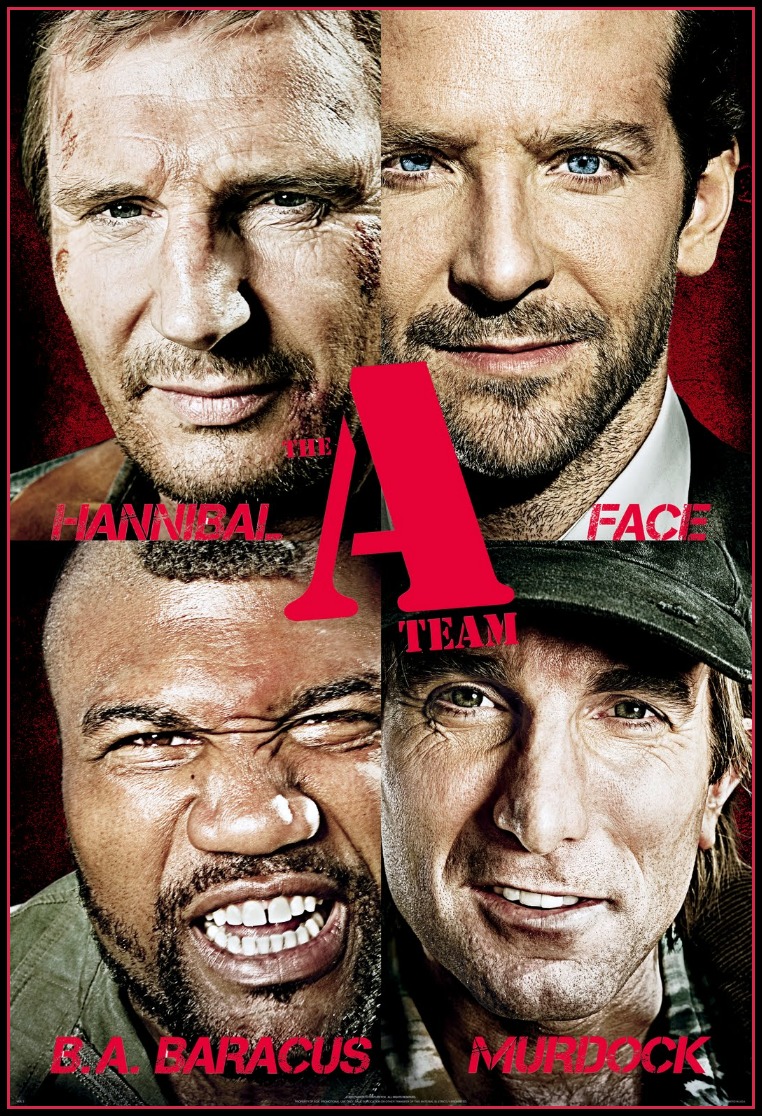
The A-Team was a film project that once had Mel Gibson attached to it right up to Bruce Willis, but delays upon delays pared back what would’ve been a mega-budgeted action blockbuster into something in the bargain basement (for a summer film). It starred Liam Neeson in the iconic role of Col. John “Hannibal” Smith made famous in the 80’s by George Peppard. Surrounding him would be Bradley Cooper as Templeton “Face” Peck, Sharlto Copley as H.M. “Howlin’ Mad” Murdock and veteran MMA fighter Quinton “Rampage” Jackson as B.A. Baracus. Holding court over this A-Team was filmmaker Joe Carnahan working with a script he, Skip Woods and Brian Bloom (who also had a role as the amoral, sociopathic mercenary Pike).
The film took what was great and fun about the original tv series and gives it a 21st-century upgrade. To say that the film’s plot was secondary to watching the cast having fun on the screen would be an understatement. The story dealt with Smith and his team being accused of a crime they didn’t commit and must now escape from a military prison to find out who set them up and clear their name. It’s straight out of the tv series’ basic premise which managed to last a full on four seasons. Fortunately, Carnahan and his writers only had to make this premise last just a little over two hours. While some may think that two hours would be too long for this film it actually moved quite fast for something that went beyond the two hour mark.
Right from the beginning the cast looked to have been having the time of their lives. Neeson was Hannibal through and through while the other actors making up the rest of the team managed to imbue these well-known characters with their own brand of craziness, absurdity and panache. Just like the other two Action Team flicks of 2010 this film also had it’s share of scene-chewing villains in the form of Patrick Wilson as a duplicitous CIA agent and Brian Bloom as the sociopathic leader of a private military company at odds with Smith and his team. It’s these two groups who end up trying to outguess and outmanuever each other to get that final upper hand. Each encounter between these two groups just got more ridiculous with each passing event.
If one ever wondered if one could fly a tank while it was in freefall then this film answers that question. The climactic showdown at the LA shipyard at night has some of the most over-the-top action of the last couple years that wasn’t a scifi-actioner. Laws of physics doesn’t apply in The A-Team and the film revels in that notion as if telling the audience to either get onboard and enjoy the ride or get off and go on the Toad ride instead.
It’s a shame that The A-Team didn’t do as well in the box-office as some would’ve hoped because the film does set things up for further adventures for Neeson and his crew. What Carnahan ended up making won’t be breaking down the doors to the awards committee, but he did deliver on paying homage to the original tv series while adding his own brand of crazy to a film that had just the right amount of fun, ludicrous action to make it the best of 2010’s Action Team Flicks.
A few months ago I placed this album in my top 5 of 2011 so far, but I really didn’t have much to say about it. Despite having listened to ample amounts of this band over the years, I really am still in no position to thoroughly compare it to their past works (though I’ll certainly try). Moonsorrow has always been a band I’ve listened to in passing–something I put on for the mood it sets, not to appreciate its intricacies. In this sense Varjoina Kuljemme Kuolleiden Maassa is no different. But in the span of just, what, six months, I’ve listened to it more than all of their other albums combined since I first heard about them. So it’s got to have something special going for it.
Tähdetön
The first thing that makes Varjoina Kuljemme Kuolleiden Maassa so effective is showcased in the first minute of the opening song. That deep, crushing guitar tone that kicks it off doesn’t lose the spotlight until at least half way through the album, and it’s never abandoned completely. A quick skip through their larger discography tells me this is something fairly new. It’s not their first album to be largely driven by guitar chords, but I’ve found nothing as deep, encompassing, or persistent as this. The result is a fuller sound that keeps me connected as the surrounding styles vary. Tähdetön might move over time from something grim to something sweeping and beautiful, but a thread connects it all. The opening song doesn’t transition in the same sense as their previous works; it follows a steady progression.
Huuto (first 15 minutes)
The folk elements of the album are also worth noting. If a bit less authentic in feel than they used to be, they’re far more in touch with the music that surrounds them. I can’t help but think of Equilibrium’s Sagas throughout Huuto, and to a lesser extent on the other three tracks as well. You’ll find little in the raw here; it’s typically encased in or entirely consistent of dreamy keyboards that feel more fantasy than folk. This isn’t something entirely new for the band. They’ve always been pretty synth-heavy. But I don’t think you’ll find a parallel to Huuto’s intro on their past albums. I think it would have started out with just an acoustic guitar and the keyboards would have entered along with the distortion, or else would have been more of a drone than a dreamy accompaniment. Just like the intro to Tähdetön gives you a distinct example of what has changed on this album metal-wise, the intro to Huuto shows their new approach to folk. The keyboards and traditional sounds are inseparably fused, not two distinct elements of the band.
The third great thing for me is that they’ve returned to writing reasonably short songs. Their last couple releases have been made up predominantly of 30+ minute marathons that are hard to engage from start to finish. The longest song on Varjoina Kuljemme Kuolleiden Maassa is sixteen minutes. I have the option to single out a song once in a while and really get into it from start to finish, making each track a bit easier to appreciate.
Kuolleiden Maa (first 10 minutes)
A lot of what I’ve said about this album doesn’t really apply to the final song, Kuolleiden Maa, which is a fourth of the entire album. It is decidedly darker, and the only track that can really be described as black metal. It’s just as enormous as the rest of Varjoina Kuljemme Kuolleiden Maassa, but the feel is very different. That it’s my least favorite track should be no slight against it; it probably sounds more like what you would have expected on a new Moonsorrow album than any of the others. And it’s well placed to not disrupt the rest of the album. The three generally upbeat tracks come packaged together before the bleak conclusion. It also ends where the first track begins (though this sample doesn’t get that far into it), making the whole album very repeatable. The annoying bit of static you hear on the left in this sample is the product of youtube, by the way, and not something to worry about on the album proper.
In short, everything about Varjoina Kuljemme Kuolleiden Maassa feels bigger, more surreal, and all around more engaging than their past works. It has an incredibly dark ending, but I’d also say it’s all in all more happy and optimistic than their past works–something that certainly appeals to me when I’m in the mood for folk metal. As quintessentially Moonsorrow as it may be, it’s a definite step in a new direction, and the result is my favorite release by them to date. I didn’t actually sample my favorite track here. That would be Muinaiset. But all four feature songs (the rest are short intro/outro/transition tracks) are superb, and you’re definitely missing out if you don’t pick this one up.
During the weekend it looks like several people saw Final Destination 5 to the tune of over $18million dollars. From what has been said about this fifth entry in the on-going series of Death playing with his food this one was actually quite good and enjoyable. I’ll probably end up seeing it this week, but until then I re-watched my favorite in the series to date: Final Destination 2.
It’s from this second entry in the series that I pick the latest “Scenes I Love” and this scene I still consider the best opening disaster-kill sequence in the series. It’s the opening highway car crash and pile-up which sees one of the best car crash sequence ever put on film since the days of George Miller and his Mad Max post-apocalyptic series. This scene had everything.
tree log vaporizes highway cop
motorcycle crushes it’s rider
stoner’s car get rammed and dies in explosion
mother and son crashes headlong into wreck and explodes
fratboy looking guy being burned alive before huge semi finishes him off
SUV full of spring break college kids rolls over before getting the smi truck treatment
This opening disaster-kill sequence beats out the plane crash from the first, the rollercoaster in the third and the NASCAR disaster in the fourth. I may change my mind once I see the bridge sequence in the 5th but it’ll take a lot for that to happen.
While I find my thoughts on how to continue my review on one of my favorite films of all-time I began to listen to it’s soundtrack for inspiration. So, while listening to the Vangelis composed score for Blade Runner I came across what has to be my favorite track from the many different editions of this film’s soundtrack. This track I picked to be my latest “Song of the Day”.
The track I chose is simply the “End Titles” which plays during the film’s end credits sequence. This version of the Vangelis ambient score comes directly from the Esper Edition of the soundtrack which was a bootleg edition that made the rounds in 2002. More specifically, this version of the “End Titles” track is a demo version of what would finally end up in the film.
Vangelis was one of my favorite film composers growing up and it’s saddening that he hasn’t done as much work in the last decade or so. But then his work on Ridley Scott’s Blade Runner was his best and it’s been difficult to top since. Everything about the “End Titles” track was able to convey each and every genre influence the film would mash together to make it into the masterpiece it has become. It’s ambient and electronic synthesizer melody has hints of film noir and, of course, the very science-fiction the film’s foundation has it’s origins in. This was a soundtrack that was one-of-a-kind and as much as others have tried to copy and emulate it they’ve never succeeded.
So, guess what I did earlier today? That’s right — I put on a blindfold, a stumbled over to my ever-growing DVD, Blu-ray. and even VHS collection and I randomly selected 12 films!
Why did I do this?
I did it so you, the beloved readers of Through the Shattered Lens, could once again have a chance to tell me what to do. At the end of this post, you’ll find a poll. Hopefully, between now and next Sunday (that’s August 21st), a few of you will take the time to vote for which of these 12 films I should watch and review. I will then watch the winner on Sunday and post my review on Monday night. In short, I’m putting the power to dominate in your hands. Just remember: with great power comes great … well, you know how it goes.
Here are the 12 films that I randomly selected this afternoon:
Abduction — From 1975, this soft-core grindhouse film is based on the real-life abduction of Patty Hearst and was made while Hearst was still missing. Supposedly, the FBI ended up investigating director Joseph Zito to make sure he wasn’t involved in the actual kidnapping.
Aguirre, The Wrath of God — From director Werner Herzog and star Klaus Kinski comes this story about a Spanish conquistador who fights a losing battle against the Amazon.
Black Caesar — In one of the most succesful of the 70s blaxploitation films, Fred Williamson takes over the Harlem drug trade and battles the mafia.
Don’t Look Now — Donald Sutherland and Julie Christie are a married couple who attempt to deal with the death of their daughter by going to Venice, Italy. Christie quickly falls in with two blind psychics while Sutherland pursues a ghostly figure in a red raincoat through Venice. Directed by Nicolas Roeg.
The Lion In Winter — From 1968, this best picture nominee stars Peter O’Toole and Katharine Hepburn as King Henry II and his wife, Eleanor of Aquitaine. Taking place on Christmas Eve, Henry and Eleanor debate which one of their useless sons will take over a king of England. This film is also the feature debut of both Anthony Hopkins and Timothy Dalton.
Logan’s Run— From 1976, this sci-fi film features Michael York and Jenny Agutter as two future hedonists seeking Sanctuary and instead finding Peter Ustinov and a bunch of cats. Filmed in my hometown of Dallas.
Lost Highway — From director David Lynch comes this 1997 film about … well, who knows for sure what it’s about? Bill Pullman may or may not have killed Patricia Arquette and he may or may not end up changing into Balthazar Getty.
Mystic River— From director Clint Eastwood comes this film about murder, guilt, redemption, and suspicion in working-class Boston. Starring Sean Penn, Kevin Bacon, and Tim Robbins.
Naked Massacre — From 1976, this stark film is something a grindhouse art film. It takes the true life story of Chicago mass murderer Richard Speck and transfers the action to Belfast. Also known as Born for Hell.
Night of the Creeps— From 1986, this film features alien slugs that turn an entire college campus into a breeding ground for frat boy zombies. Tom Atkins gets to deliver the classic line: “Well don’t go out there…”
Petulia — Considered by many to be one of the best American films ever made and one of the definitive films of the 60s, Petulia tells the story of a divorced doctor (George C. Scott) who enters into an odd relationship with Julie Christie. Directed by Richard Lester, this film also stars Joseph Cotten, Richard Chamberlain, and the Grateful Dead.
What Have You Done To Solange? — From 1975, What Have You Done To Solange is a classic giallo that features dream-like murders, disturbing subtext, and one of the best musical scores of all time.
So, there’s your 12 films. Vote once, vote often, have fun, and I await your decision.


 Through the Shattered Lens