Torchwood: Miracle Day has now reached it’s third episode and we’re beginning to see a few more clues as to the truth about the so-called “Miracle Day” event which automatically made everyone on the planet Earth immortal (with the exception of the planet’s previous lone immortal Capt. Jack Harkness who became mortal instead). The series has been a bit slow about the reveals and dropping of clues and with only 10-episodes to this season it’s going to be interesting to see how Davies and his writers will tie things up when the tenth episode rolls around.
“Dead of Night” is the name of this latest episode and it’s actually quite an apropo title. The episode happens mostly at night and it’s during the darkness of night that we get a glimpse at some of the darker sides of some of the characters on the show. First, we see the team on the run after the bungled attempt by CIA deputy director Friedkin (Wayne Knight) to apprehend Matheson and the remaining Torchwood team at Dulles International. It’s interesting to notice how Rex and his fellow agent in Esther Drummond seemed out of sorts realizing that they’ve been betrayed by the very agency they work for (and maybe the very country they serve loyally) while both Jack and Gwen seem to take it all in stride as if they’ve been there and done that. Some have mentioned that the show doesn’t seem to be classic Torchwood and I can see where they’re coming from. The additions of the American characters to the team and the transplanting to US soil has created a different tone to the show which seem to be harder for the veteran fans to accept at the moment.
It’s definitely not the writing or the acting which has given this show an almost dual nature and feel. Tonight’s episode was written by Jane Espenson (who helped write the excellent sixth episode of Game of Thrones, “A Golden Crown”) and the flow of the show seemed to have improved for the previous one. Most of the set-up’s been completed and now the team is up and running once again with a new problem to solve. It’s that very problem which drives this episode as Jack and his new team begin to uncover one of the major clues that goes a long way into explaining the true nature of “Miracle Day”. I do think that finding out a major pharmaceutical conglomerate might have had a hand or knew in advance about “Miracle Day” wasn’t too much of a surprise. The way the episode paints PhiCorp and their plans for their wonder drug seems like the bad dream for everyone trying to overhaul the nation’s health care system for the better.
The show further explores Capt. Jack Harkness’ current situation as he begins to accept the fact that he’s finally dying (aging being the correct term people would use, but not for one so used to being immortal) and he doesn’t do as well as some would want him to. His emotional and drunken late-night call to Gwen after a one-night’s dalliance with a stranger picked up at a club brings back some emotional baggage and the sexual tension between the two. There’s an almost air of desperation in John Barrowman’s performance in this scene which should show new fans to the show that the series won’t be all about action and intrigue. There’s a reason the series has cultivated such a rabid fanbase and it’s been the performance by the actors, first and foremost. Eve Myles performance as Gwen on the receiving end of Harkness’ call were at times empathic, sad and frustrated as if she thought this was something the two were past but now have been brought back to the surface.
The other major performance of the night belongs to Bill Pullman’s pedophile murderer, Oswald Danes. His character still continues to be the show’s cipher. We’re still not sure what to think of Danes. He’s being made out to be a sympathetic character in one moment then a devious manipulator trying to find whatever advantage he could get his hands on to keep himself safe. We finally do get an idea who Danes is during a confrontation between him and Harkness and it spoke volumes at just how banal evil really is and it’s current face happens to be Bill Pullman’s. It’s going to be interesting to see how Danes, PhiCorp and “Miracle Day” will tie together once this season gets deeper into it’s main story.
“Dead of Night” was better than the last episode but still shows some growing pains as the writers are still coping with some of the major changes to the show’s usual tone. While some long-time fans of the show seem to not be as accepting of these changes I think it’s these changes that show’s growth in the series and such things do take time to find their footing. I expect more growing pains in the coming episodes, but I do think that this episode goes a long way into establishing the melding of old Torchwood with the new Torchwood.
It is called the “Marvel Cinematic Universe” and it’s a world-building program that’s been in the making for almost half a decade. It first began when Kevin Feige and the powers-that-be at Marvel Entertainment decided to forgo licensing out the rest of their comic book characters to other studios to play with (Spider-Man, X-Men, Wolverine, Fantastic Four, Daredevil, etc.). Marvel Entertainment was getting rich off of these films without having to help finance any of the films, but the results of these films where hit-or-miss and recently they’ve been really misses (X-Men: Last Stand, X-Men Origins: Wolverine, Fantastic Four: Rise of the Silver Surfer, Ghost Rider to name a few). So, the decision was made for Marvel to open up their own film studio, Marvel Studios, and use money from those licensed films to adapt the remaining characters in the Marvel Universe the Marvel way.
The first film to come out with Marvel Studios as the primary company was 2008’s Iron Man which was followed very closely with a reboot of the Hulk with TheIncredible Hulk later that same summer. Iron Man 2 arrived in 2010 (though it was a mixed bagged depending on who one asks about this sequel) and in 2011 two more Marvel Studio films arrived to continue building this so-called “Marvel Cinematic Universe”. In early May 2011, the first one was Kenneth Branagh’s Thor hitting the big-screen which was widely-acclaimed to be a good and fun entry to this cinematic universe. The final piece and the second Marvel Studio film to arrive in 2011 is the Joe Johnston-helmed film adaptation of one of Marvel Comics’ most iconic characters. The “Marvel Cinematic Universe” finally finds it’s last piece before 2012’s arrival of Marvel Studios’ superhero team film, The Avengers.
Captain America: The First Avenger was being predicted as a film that could fail because of the character itself. Steve Rogers aka Captain America is the All-American G.I. who was straight-laced and never morally ambiguous. This was a character sure of himself and saw the world through a moral prism of black and white. The film that came out of the work by Joe Johnston and his capable film crew was one which surprised most everyone by it’s retro and nostalgic look at action serials of the past but without becoming to beholden to those tropes and losing all the fun in the story. This film played out like a throwback to those very serial action films of the 40’s and 50’s before cynicism and snark took over Hollywood and most of the entertainment industry.
Joe Johnston and his screenwriters, Christopher Markus and Stephen McFeely (and an uncredited Joss Whedon whose strength with dialogue could be seen in this film), were able to make an origin tale which didn’t seem too rushed in laying out just who Captain America was and his early adventures during World War II. It was a great decision to keep most of the film set in World War II since Captain America’s origins would be the hardest to pull off and even harder to convince audiences too used to conflicted and unsure superheroes in their superhero films.
The film begins in current Marvel times as an expedition finds Captain America’s shield in the frozen ice floes of Greenland in what looks to be the wreck of a giant flying wing-type aircraft. Once the shield’s discovery was made the film quickly transitions back in time to 1942 where we get to see first-hand the evil mastermind Johann Schmitt aka the Red Skull (Hugo Weaving) whose obsession and search for ultimate power finally garners him the Tesseract from Odin’s weapon’s vault (the Cosmic Cube last scene in Thor). He would use this cosmic power to power the superweapons being developed by his Nazi-funded splinter group, HYDRA, and it’s lead scientist in Dr. Armin Zola (Toby Jones).
Both Markus and McFeely actually wrote the film to be two storylines running concurrently with Red Skull and HYDRA running in one storyline and the other with Steve Rogers (Chris Evans) as the 90-lbs Brooklyn-native weakling whose attempt to enlist in the Army gets shotdown each and every time he tries. Rogers is just not the type of man the US Army requires no matter how much courage and heart his asthmatic and weak body may hold within. But this very non-physical quality of Rogers is what gets the attention of the US Army’s own research division headed by German scientist and expatriate, Dr. Abraham Erskine, who believes Rogers is the perfect candidate for his super-soldier serum program.
Much of the Roger’s storyline in the early-going brings much comedic dialogue and scenes which made Captain America such a fun film. While Roger’s appearance and situation was never played off for laughs, it was how those around him outside of a few people whose reaction never get past the weakling standing in front of them. Once Rogers does become Captain America the film continued to have fun with the character as he’s drafted by politicians who sees him as the perfect pitchman for the government’s program to sell war bonds. This entire part of the character’s arc even got the full Busby Berkeley musical dance number reminiscent of Steven Spielberg’s musical number to start off Indiana Jones and The Temple of Doom (this won’t be the first time Johnston would pay homage to the Indiana Jones series).
Once Captain America moves past his war bond selling phase the film’s two concurrent running storylines of the Captain and the Red Skull converge to begin the second-half of Captain America. While the comedic dialogue and sequences take a back seat the film still remains very fun as Johnston ramps up the action. He begins with the Rogers disobeying orders and attacking a HYDRA base to rescue not just his boyhood friend Bucky Barnes (Sebastian Stan) from the clutches of HYDRA, but all the prisoners held in the same weapons manufacturing base. The action sequences were filmed in an almost old-school fashion. There’s no tricks of fast editing and quick cuts to make the battles and action chaotic and real, but brought to mind more the action scenes from the Indiana Jones films of the 80’s which Johnston was a part of. All the action sequences in this film were choreographed to be seen and understood, but at the same time with a sense of fun energy that most action films seem to have lost in the last decade.
Captain America was also the first film in the “Marvel Cinematic Universe” which added to the fun by creating a genuine romantic subplot for it’s main lead. The relationship between Steve Rogers and British agent Peggy Carter was written quite beautifully as one between two people who saw each other as equals. This relationship unfolded very organically and not forced onto the two characters and to the audience. There was no manipulation to create a false couple. Steve Rogers gradually grew to not just admire Peggy Carter as a strong-willed, capable, but still feminine woman who saw beyond his initial weakling appearance, but by film’s end as a person who he truly had feelings for. It wouldn’t have worked if the Peggy Carter was just written to be a damsel in distress which she wasn’t and this character’s own journey to admiring Roger’s courage and tenacity in the face of impossible odds to mutual admiration once he became Captain to full-blown love by the end really added the emotional punch to the film. It’s no wonder that the bittersweet ending to the film between these two characters had such an emotional impact. The audience followed these two characters’ in their growing relationship from sweet beginnings to the tragic and bittersweet climactic finish.
It’s that very writing which made Captain America: The First Avenger more than just another superhero film. This was a film that went beyond just superhero action sequences, but a film which brought to mind not just the retro film of such films as Johnston’s own 1991 retro-futurist superhero film, The Rocketeer, but also the fun inherent in the serialized action films of the 40’s and 50’s which Spielberg did paid homage to with Indiana Jones and The Raiders of the Lost Ark. The action, explosions and witty (though without the snark and cynicism) dialogue didn’t dominate the film but became supports for the well-written characters. Characters that were well-played by it’s cast of exceptional actors.
This film, like any other superhero film of the past quarter century, lives and dies by how it’s hero and villain were played. It’s a great thing to have not just Hugo Weaving playing the Red Skull with such relish (with a voice that sounded like a mash-up of Werner herzog and Klaus Kinski), but the surprise was Chris Evans as Captain America himself. Evans had the tougher role since he was the titular character. He was an actor who was more well-known as playing wiseass and jokester roles, but in this film he plays Steve Rogers straight with a sense of unabashed goodness and confidence that he became Captain America without having to be unsure of his abilities, conflicted about his new role as a hero. Evans showed depth and range that was only hinted at in films such as Sunshine.
Another delight in the film would be Hayley Atwell as Peggy Carter. She could’ve been the weak-link in this film and no one would’ve noticed, but she became the moral anchor and strength for the film as she became not just Steve Rogers’ eventual love interest but also his sounding board whenever doubts creeped in. She kept not just him, but the film on course and it helped that she was just as much as kickass as Captain America. Also, to say that Atwell as Peggy Carter was gorgeous to the point of blinding would be an understatement. It’s no wonder Captain America fell for her.
The rest of the supporting cast were up to the challenge no matter the size of the role. Stanley Tucci and Tommy Lee Jones were great as the compassionate mentor and grizzled commanding officer respectively. Jones’ Col. Phillips actually got some of the best one-liners in the film. When Tommy Lee Jones plays such a character as well as he does it’s no wonder he’s the go-to-guy for such roles. He just lives the part and pulls off the lines with such great comedic timing. Dominic Cooper as the young Howard Stark (father of Tony Stark/Iron Man) brought images of the suave and debonair Howard Hughes while Sebastian Stan as Bucky Barnes did a great job in making the character not just a sidekick, but also show hints of why he would become the Winter Soldier later on in the Captain America stories. It’s Stan’s role as Bucky which gives me hope that future Captain America sequels would tap and mine this character’s own journey from sidekick to potential rival as the Winter Soldier.
Captain America: The First Avenger is Marvel Studios’ last puzzle piece in what would transition into 2012’s The Avengers by Joss Whedon and it more than delivers the goods which was a testament to the creative forces led by Joe Johnston, Chris Evans and everyone involved. This was a fun, rollicking good time which brought back the concept that films were ultimately started as a form of mass entertainment. Not every film had to explore the meaning of life and existence. Not every film had to be a journey into the light and dark of existential themes. Films could be a couple hours spent entertaining and allowing it’s audiences to have a fun and good time. Captain America: The First Avenger was able to deliver this type of experience and do so with not a cynical gene in its code. It’s definitely Marvel Studios’ best film to date and one of the best films of the summer.
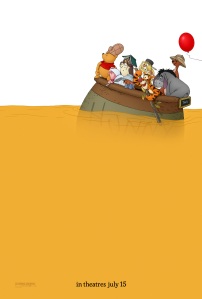
With Harry Potter and the Deathly Hallows Part 2 running at full steam, and Captain America: The First Avenger opening this weekend, Winnie the Pooh still remains an option for younger kids who may not be ready for these two films (at least until The Smurfs is released). There’s really very little in the way of negative comments that I can give to Winnie the Pooh, expect perhaps that running at just 69 minutes, it’s very short. It’s for kids.
Working off the original story by A.A. Milne, Winnie the Pooh re-introduces us to the title character, along with his friends from the Hundred Acre Wood – Tigger, Rabbit, Piglet, Kanga and her son Roo, Owl, and Eeyore. They are the treasured toys of Christopher Robin, who has an active imagination.
One of the cute elements of this story, narrated by John Cleese is how everyone breaks the fourth wall and occasionally has interactions with the paragraphs of the story. Stepping on a few words here, using a few as a ladder, it came across as being quite worthy of a few smiles.
I used to watch “The New Adventures of Winnie the Pooh” on Saturday Mornings, and it was a treat to return to these characters. For the movie, we are given the “Busy Backson” story, where Eeyore has lost his tail and the team come up with ideas on new and interesting ones for him. Each character has their own way of figuring this out. Of course, Pooh has something of a difficult time with his constantly rumbling tummy, but he manages to help in his own way. In their search, Owl misreads a note left behind by Christopher Robin stating that he’ll be busy, but will be back soon. This conjures up the great and terrible “Backson” in everyone’s imagination, responsible for everything from stealing your left socks to making your milk spoil. The team decides to set a trap for the Backson, with wild results. The scenes with the Backson maybe a little frightening to the youngest of viewers, but it’s not that bad. We’re not dealing with Heffalumps or Woozles here.
In the end, as always, everything turns out well. I liked that Friendship was the big factor here. All of Eyeore’s friends tried to help him find his tail, and Pooh even puts his honey chasing ways on hold (as best he can, anyway) to aid his friend. Those familiar with the animated series will instantly recognize Jim Cummings as the voice of both Winnie the Pooh and Tigger. I would have liked to have seen Peter Cullen come back as Eyeore, but he was pretty busy voicing Optimus Prime while the movie was being made. All of the other voice actors are new, including late night tv host Craig Ferguson as Owl. The kids won’t even care.
Musically, there are a few interesting songs. Actress / Singer Zooey Deschanel lends her voice to the title song, along with a few others. Most of the other songs are sung by the cast themselves, and the kids may find themselves singing along (at least I could hear singing in my audience, anyway). The film moves fast, extremely fast. By the time the antsy factor kicks in, the movie’s done, which makes that a treat by itself.
Overall, Winnie the Pooh may not have the magnificence of say a Kung Fu Panda 2 or How to Train Your Dragon, but for very young viewers, it should do just the trick.
One great thing Marvel has done this year for San Diego Comic-Con 2011 was the begin the major media and ad campaign for their 2012 summer tentpole blockbuster in The Avengers. This is a superhero team project which has been 3-4 years in the making. It all began with 2008’s Iron Man and finally concludes with 2011’s Captain America: The First Avenger. In-between these two films we got other members of Marvel Comics’ iconic Avengers team make their introduction through their own films and/or make appearances in all the films like Thor, the Hulk, Nick Fury, Black Widow, Hawkeye and SHIELD.
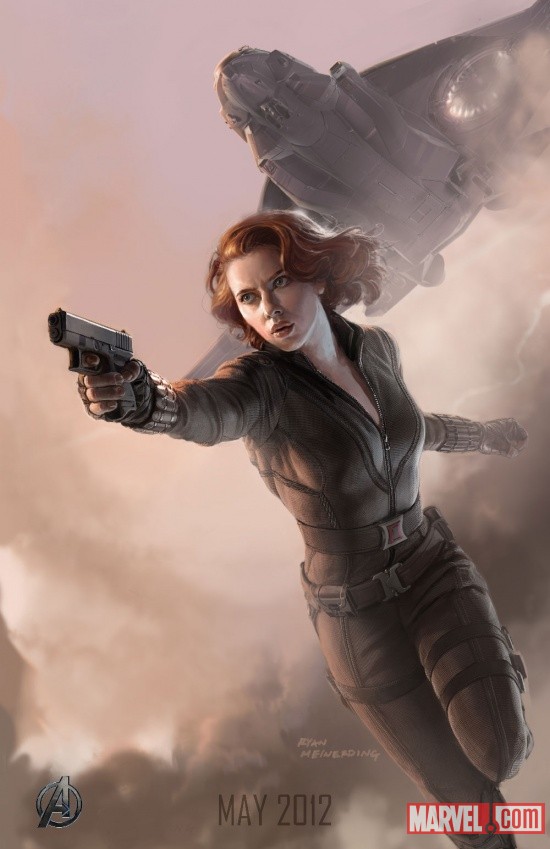
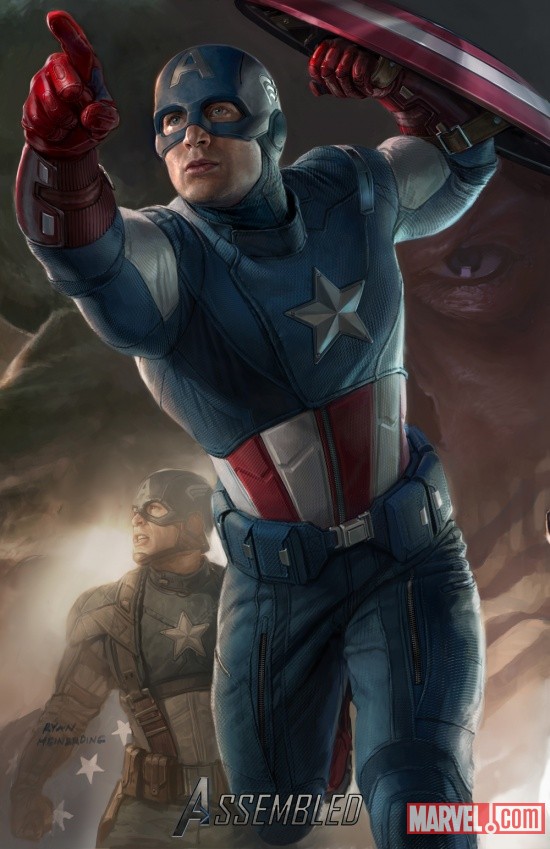
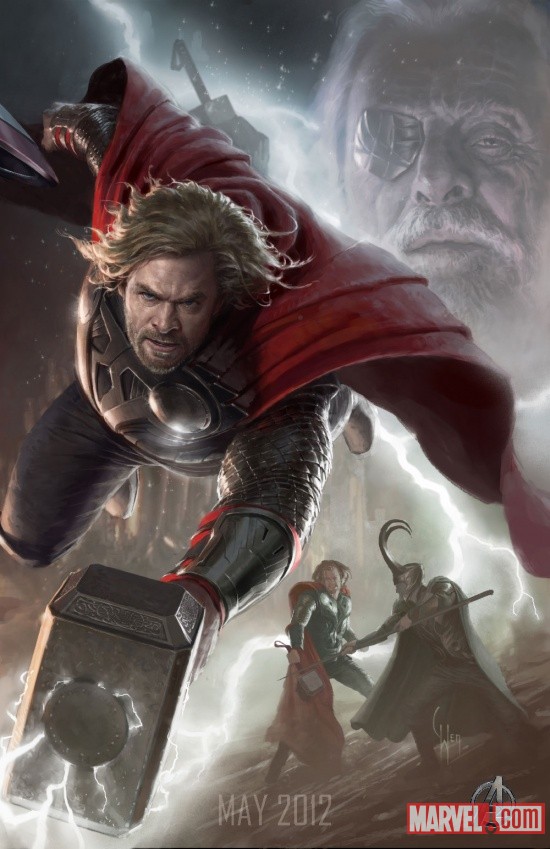
One of the coolest things to come out of the Marvel Studios/Paramount Pictures part of Comic-Con 2011 was the release of the concept art posters for not just The Avengers but for all the characters who make up the team. Each character poster shows each team member (even SHIELD gets their own with Nick Fury leading the agents) in a striking pose with background images showing scenes from past films which comprises what is being called “Marvel’s Cinematic Universe”. That term is just one way of saying that these films do not follow the timelines set down in the primary Marvel Comics universe (Marvel-616).
I’m not exactly sure who was the artist responsible for these concept art, but they’re great and brings to mind such cover artwork as Alex Ross, Drew Struzan and Dave Dorman. I’m sure someone over on Twitter or on Facebook will be able to figure out just who this awesome artist is. Some of the details in the background should make the comic book fans quite happy like the Quinjet in the Black Widow poster and the SHIELD Helicarrier which appear in both the Hawkeye and SHIELD posters.
With Comic-Con winding down the hype machine for The Avengers will definitely be on full swing with New York Comic-Con this October up next. Captain America: The First Avengers is now out in the theaters earning universal acclaim. The Avengers will assemble for a May 4, 2012 release date.
Oh Boris. The next album of their 2011 trilogy (they actually released a fourth one, a noise album with Merzbow that doesn’t deserve much attention) is named Heavy Rocks. It’s not called Heavy Rocks 2011, or anything like that. No, it has the exact identical same name as their April 2002 release. That’s not the most misleading thing about it though. What makes Heavy Rocks the oddest of the three is that in a lot of ways it’s not particularly heavy. The guitar and drums certainly are, to such a wild extent that it’s hard to take the first few seconds of the album seriously. But they’ve brought their more recent styles along for the ride.
Riot Sugar
What Heavy Rocks 2011 certainly is not is a full return to their stoner/doom roots. It’s something way more bizarre. Oh they turn up the distortion to the max and chug out deep dirty chords the whole way through, but somewhere in there it feels like they’re still playing the role of j-rock stars, floating around up in the sky somewhere. If the majority of the album is relatively in keeping with Riot Sugar, some of the songs are still more pop than anything else.
Window Shopping
I mean, if I called something “pop metal” it would normally be an insult–a reference to talentless mass consumer metal bands like Disturbed and Drowning Pool. But Boris take the notion more literally. This is the most unmistakable on Window Shopping and Tu, La La. I don’t think “pop metal” is their ultimate goal though. I wouldn’t say, from listening to it, that the album has anything so specific in mind. It just disregards the past, and unabashedly incorporates what Boris sound like here and now, which is a whole mess of different things really. The only real goal of the album, I’m pretty sure, is to be heavy. And to rock.
Aileron
Thus you get songs like Aileron. It’s unmistakably Boris, and stylistically it has a lot more in common with their early albums than with anything on New Album or Attention Please. But it doesn’t feel like those earlier works much. It’s underpinned by the dreamier qualities that they’ve recently adopted, for better or worse. I mean, this sounds like the breaking point of Flood III in reverse, like the water is all lifting up to the heavens. I really don’t know what I’m listening to on a lot of this album, and it took a while to grow on me. It has nothing of the immediate appeal present on the other two, but it’s good in its own unique way.
Galaxians
Galaxians is my favorite track, and it kicks off with some stoner metal more in keeping with the original Heavy Rocks than probably anything else on the album. But it still feels like it’s floating. The softer vocal style, that sort of laser gun effect they’re using, even the track title suggests something far from the earth. Maybe this song best represents what they’re going for. I think I’d have understood the whole album a lot better if they’d named it Heavy Clouds.
Heavy Rocks 2011 is my least favorite of the three, but don’t get me wrong. I really like it. Besides, Boris have a unique and coveted ability to never sound bad. It’s either really good or just really weird/experimental. Even at their worst (and I’m not calling Heavy Rocks 2011 that) they always reward us with something great somewhere down the line.
In 2011 that something great is called Attention Please, and I’ll be wrapping up this review series by covering it tomorrow.







 Through the Shattered Lens