Miniseries Review: Death by Lightning (dir by Matt Ross)


Death by Lightning, a four-episode miniseries that recently dropped on Netflix, tells the story of two “forgotten men,” as the show itself puts it.

Michael Shannon plays James A. Garfield, the Ohio farmer and former Congressman who, despite attending the 1880 Republican convention solely to give the nominating speech for Secretary of Treasury John Sherman (Alistair Petrie), found himself nominated for President after the convention found itself deadlocked between supporters of Former President Grant (Wayne Brett) and Senator James Blaine (Bradley Whitford).  Garfield did not want to run for President and he certainly did not want to run with Chester A. Arthur (Nick Offerman), an associate of New York political boss, Roscoe Conkling (Shea Whigham).  However, in November of 1880, James Garfield was narrowly elected the 20th President of the United States.

Matthew MacFayden plays Charles J. Guiteau, a failed lawyer and self-proclaimed newspaper publisher who felt that a stump speech he had given at a small rally was responsible for Garfield’s victory.  Guiteau expected to be appointed to a position in the Garfield administration, perhaps as Consul to France.  In those days of no Secret Service protection and an open White House, Guiteau was one of the many random office seekers who managed to get a face-to-face meeting with Garfield.  What Guiteau did not get was a job.  While Guiteau may have deluded himself into thinking that he was an inside player, everyone else viewed him as being a pesky and disreputable character.  On July 2nd, 1881, Guiteau shot Garfield in the back.  After Garfield died in September, Guiteau was convinced that he would be pardoned by the newly sworn-in President Arthur.  Instead, Guiteau was hanged on June 30th, 1882.

(It’s now generally agreed that Guiteau was such a bad shot that Garfield would have survived his wounds if not for the incompetence of his doctors, who probed his wounds with their bare hands in an effort to extract the bullet.  Garfield died as a result of multiple infections caused by his medical treatment.)

Again, Death by Lightning describes Garfield and Guiteau as both being forgotten men.  That’s not quite true.  I knew who both of them were before I watched the miniseries but then again, I’m also a history nerd.  As much as I don’t want to admit it, it is true that the majority of today’s Americans don’t know either Garfield or Guiteau.  And yet, in 1881, America revolved around them and their fate.  Everyone checked every day for news on Garfield’s health and Guiteau’s trial was heavily covered by the press.  That’s something to remember whenever you hear people talking about how “history will remember” whatever may be happening in the news today.  History may remember but people are quick to forget.

As for Death by Lightning, it does a good job of telling not only the stories of Garfield and Guiteau but also Chester Arthur as well.  The miniseries takes place at a time when political machines dominated American politics and also at a time when the Spoils system and the widespread corruption that it engendered were both accepted as immutable political realities.  Guiteau, having spent his life seeing other people receive jobs for supporting the right candidate, felt that he was naturally entitled to whatever position he requested.  Guiteau’s actions actually did lead to reformation of the Spoils system, with President Arthur emerging an unlikely reformer.  Never again would a random office seeker by allowed through the front doors of the White House and never again would a President casually walk around Washington D.C. without some sort of guard.  With a smart script, good performances, and even a few moments of unexpected cringe humor, Death by Lighting recreates that moment in American history and it pays tribute to James A. Garfield, who was universally described by his contemporaries as being a decent man who was struck down before he could reach his full potential.

How historically accurate is Death by Lightning?  That’s a fair question.  Death by Lightning sticks to the established facts about Garfield and Guiteau but a scene in which Garfield’s daughter argues with him about immigration is undoubtedly meant to be more of a commentary on 2025 than 1880.  I think it can be argued that no film or series can be 100% historically accurate because those who actually witnessed the events in question are no longer with us.  Inevitably, the past is always viewed and recreated through the filter of the present.  And indeed, it is tempting to compares Garfield and Guiteau to our modern-day politicians and activists.  Guiteau, with his constant excuses for his own dumb decisions and his ranting and raving about how he speaks for the people, was a particularly familiar character.  As for the modest and honest Garfield, it’s sadly difficult to think of any modern-day politicians from the same mold.

As a final note, my favorite part of this miniseries occurred during the first episode.  The recreation of the 1880 Republican Convention is wonderfully entertaining.  It’s amazing to think that, in the days before television coverage required political conventions to become carefully choreographed and tightly controlled, there actually was legitimate suspense about who would end up being nominated.  Sadly, those days seem to be over.

Retro Television Review: Homicide: Life On The Street 4.12 “The Hat”


Welcome to Retro Television Reviews, a feature where we review some of our favorite and least favorite shows of the past!  On Sundays, I will be reviewing Homicide: Life On The Street, which aired from 1993 to 1999, on NBC!  It  can be viewed on Peacock.
This week, incompetence reigns.

Episode 4.12 “The Hat”

(Dir by Peter Medak, originally aired on January 19th, 1996)

There’s a running theme in this week’s episode and that theme is incompetence.

With Russert having been demoted all the way back to detective, there is now a captain’s vacancy.  The squad room is convinced that Giardello is going to get promoted.  For that matter, Giardello is also convinced that he’s going to be promoted.  Instead, the promotion goes to Roger Gaffney (Walt MacPherson), the racist martinet former homicide detective who nearly got into a fist fight with Pembleton during the white glove murder investigation.

(Giardello, for all of his strengths, has never played the political game as well as those around him.)

Munch thinks that a lawyer who he arrested for murder is going to be convicted.  However, it turns out that the video that Brodie shot at the crime scene shows that a key piece of evidence was mishandled.  Munch tells Brodie to erase the tape.  Brodie refuses to tamper with evidence.  (“It’s illegal,” he says.)  As a result, the murderer walks free.  And while it’s true that Brodie’s refusal to erase the tape did lead to an guilty man walking, it’s also true that it wouldn’t have been a problem if the cops on the scene hadn’t screwed up in the first place.

Finally, Lewis and Kellerman are sent to Pennsylvania to pick up Rose Halligan (Lily Tomlin), a woman suspected of murdering her husband in Baltimore.  Lewis and Kellerman are supposed to go straight to Pennsylvania and then come right back to Maryland, without making any unnecessary stops.  Instead, they screw up.  Kellerman decides to stop off at a run-down amusement park that he remembers from his childhood.  Later, Lewis and Kellerman stop off at a diner so they can get some dinner.  When Rose excuses herself to go to the restroom, they not only remove her handcuffs but they also allow her to go unaccompanied.  Needless to say, Rose escapes, makes her way back to Baltimore, and stabs her husband’s mistress to death before getting Lewis and Kellerman track her down.

Lily Tomlin was this episode’s big guest star, for better or worse.  Sometimes, when a big name appears on a television show, it becomes obvious that there wasn’t anyone around who was willing to tell them that they were overacting just a bit and that would certainly seem to be the case here.  Rose is a music teacher so this episode really tests one’s tolerance for Lily Tomlin singing opera.  That said, Tomlin was quietly effective at the end of the episode, sitting out on a porch while her former friend lay dead in the house.  Rose says she was returning her friend’s hate and, indeed, the dead woman in wearing the hat that Rose wore throughout almost the entire episode.

All said, I enjoyed this episode.  Lewis and Kellerman may be incompetent but they’re still entertaining to watch.  As for the hated Roger Gaffney getting the job that Giardello deserved …. well, isn’t that always the way?

Retro Television Review: Law and Order 6.13 “Charm City” and Homicide 4.11 “For God And Country”


Welcome to Retro Television Reviews, a feature where we review some of our favorite and least favorite shows of the past!  On Sundays, I will be reviewing Homicide: Life On The Street, which aired from 1993 to 1999, on NBC!  It  can be viewed on Peacock.

This week, Homicide crosses over with Law & Order.

Law & Order 6.13 “Charm City”

(Dir by Ed Sherin, originally aired on February 7th, 1996)

Homicide 4.11 “For God and Country”

(Dir by Ed Sherin, originally aired on February 9th, 1996)

This week, we have a two-part cross-over between Law & Order and Homicide.

On Law & Order, things start in New York City.  A chemical attack on a subway train leaves 20 people dead.  Because the train was specifically heading into Harlem and all of the victims were black, it is suspected that the attack was racially motivated.  In Baltimore, Frank Pembleton and Tim Bayliss hear about the attack and are reminded of a similar attack on a black church, which occurred five years prior.  Pembleton was the primary on the church attack.  He and Bayliss head to New York City, where they meet and quickly get on the nerves of Detectives Lennie Briscoe (Jerry Orbach) and Rey Curtis (Benjamin Bratt).

Pembleton’s investigation uncovers that a man from Baltimore, Brian Egan (Kevin Geer), not only had access to the chemicals used in both attacks but also that’s he currently in New York.  When Briscoe and Curtis arrest Egan and fail to get him to confess, Pembleton asks for permission to interrogate him.  Pembleton, being Pembleton, rather easily gets Egan to confess to having committed the church bombing.  However, before getting the confession, Pembleton pretends not to hear Egan say that he no longer wants to continue talking.  In typical Law & Order (if not Homicide) fashion, the confession is tossed out.

Jack McCoy (Sam Waterston) and Claire Kincaid (Jill Hennessy) still get their conviction.  (And Claire gets an admirer in the form of Tim Bayliss.)  However, it’s obvious that Egan was not working alone.  Egan says that he will never name names.

That changes when his wife is murdered and his teenage son goes missing.  Homicide opens with Bayliss investigating the poisoning of Egan’s wife.  He and Pembleton eventually track down Egan’s son and they get him to admit that he saw his uncle, former NSA agent Col. Alexander Rausch (J.K. Simmons), murder his mother.  Because Brian Egan has said that he’ll only reveal the truth of the conspiracy if his son is brought to New York, Briscoe and Curtis show up in Baltimore.

While Curtis, Bayliss, and Pembleton track down Colonel Rausch, Briscoe hangs out with Munch.  Their friendly banter goes south as soon as Briscoe mentions that he once knew a Gwen Munch in New York.  Gwen is John Munch’s ex-wife and John is not happy when he finds out that Briscoe slept with Gwen.  John Munch spends the rest of the episode drinking heavily.  Stanley Bolander would not approve.

As for Col. Rausch, he is captured and he turns out to be a smug snake.  (He’s played by J.K. Simmons, after all.)  Pembleton wants to see Rausch prosecuted for the church bombing and he especially wants to see racist Rausch publicly humiliated.  New York, however, wants to prosecute him for the subway attack.  Claire comes down to Baltimore and gets a judge to agree that Rausch should first be sent to New York.

Rausch doesn’t care.  He has a heart condition so he simply stops taking his heart pills and then drops dead while waiting for the train to take him to the Big Apple.  The episodes ends with Pembleton sobbing as he realizes Rausch will never be humiliated at a trial.  The New York cops shrug and say, “Sorry, Frank.”

I enjoyed this crossover quite a bit.  It was interesting to see two police dramas, each with a very different style, come together to tell one big story.  As Homicide always celebrated the lengths that Pembleton would go to get a confession in the Box, it was amusing to see what would actually happen to one of those confessions if it was brought to court.  Jack McCoy is not at all amused by Pembleton’s tactics.  Meanwhile, Briscoe, Curtis, and Claire was allowed to loosen up a bit when they went to Homicide and I enjoyed watching them shed their “just-the-facts” personas.  If the Law & Order episode was ultimately superior to the the Homicide episode, that’s just because the Law & Order episode featured an actual mystery to be solved whereas the Homicide episode occasionally felt as if it was padded out a bit.  On Homicide, it was obvious that Colonel Rausch was guilty and, from the minute he started to cough during the interrogation, it was easy to guess what his ultimate fate would be.

(I also have to say that it was interesting to compare this episode of Law & Order to watch Law & Order has become today.  How this show went from featuring McCoy confidently doing his job to Nolan Price essentially begging his co-counsel, on a weekly basis, to actually do her job is something that is worth considering.)

Overall, this was a good crossover.  For those who want to watch it, the Law & Order episode is available on Hulu and Disney+ while Homicide can be found on Peacock and Tubi.

Retro Television Review: Homicide: Life On The Street 3.19 “Colors”


Welcome to Retro Television Reviews, a feature where we review some of our favorite and least favorite shows of the past!  On Sundays, I will be reviewing Homicide: Life On The Street, which aired from 1993 to 1999, on NBC!  It  can be viewed on Peacock.

This week …. is the Homicide Unit cursed?

Episode 3.19 “Colors”

(Dir by Peter Medak, originally aired on April 28h, 1995)

A Turkish teenager who is dressed and made up like a member of KISS is lying dead on a front porch.  Jim Bayliss (David Morse) claims that the teenager was banging on his door and acting aggressive.  He says that he grabbed his gun to protect his family and that he ordered the teenager to get off his porch before he shot him.  The teen’s friend, who was standing a few feet away, says that the victim raised his hands before he was shot and that he was only at the house because he was trying to go to a party and got the wrong address.

Pembleton thinks that Jim shot the teenager even though he knew the teen was no longer a threat and because he was angered by the teen’s broken English.  It’s true that Jim did once get into a fight in a bar with someone who was visibly Middle Eastern.  Jim’s wife mentions that Jim gets annoyed with people who can’t speak English.  Pembleton says that Jim is so prejudiced that he doesn’t even think twice about assuming the worse about anyone who isn’t white.

Complicating things is that Jim Bayliss is the cousin of Tim Bayliss.

Tim spends almost the entire episode trying to defend his cousin.  He asks Giardello for permission to be in the Box during the interrogation,  (Giardello refuses, rightly pointing out that Tim has a conflict of interest.)  Later, while watching the interrogation, Tim gets so angry that he breaks a two-way mirror.  Oddly, the one thing that Tim doesn’t do is tell his cousin to ask for a lawyer, which would have ended the interrogation before it could even get started.  Eventually, Ed Danvers, who we haven’t seen much of this season, takes Jim before a Grand Jury and the Grand Jury declines to indict.  Everyone in the courtroom applauds but Tim is left to wonder if Pembleton was correct about his cousin.

At one point, Bolander says that he fears that the Homicide Squad may be cursed and then he lists all of the things that have happened over the course of the third season — Crosetti committed suicide, three detectives were nearly killed in a shooting, Munch opened a bar, and now Bayliss and Pembleton are fighting.  Bolander has a point.  It’s a bit much, particularly when you compare it to the first two seasons.  Homicide took a melodramatic turn during the third season.  That doesn’t mean that the show hasn’t been good.  The acting continues to be amazing.  But it’s still quite a contrast to how the show started.

As for this episode, David Morse kept you guessing as Jim Bayliss.  At first, Jim just seems like a harried home owner who wanted to protect his family.  As the episode progresses, his anger becomes more and more pronounced until the viewer is left feeling that Jim was destined to eventually shoot someone.  That said, this episode was occasionally a bit too much on the nose in its storytelling.  It also left unaddressed something that should have been a bigger issue.  Should Pembleton have been allowed to investigate the case or lead the interrogation, considering that Tim is his partner?  Giardello was rightly concerned about Tim’s conflict of interest but he never addressed the fact that Pembleton potentially had one as well.

Next week, season 3 comes to an end.

Retro Television Review: Homicide: Life On The Street 3.8 “All Through The House”


Welcome to Retro Television Reviews, a feature where we review some of our favorite and least favorite shows of the past!  On Sundays, I will be reviewing Homicide: Life On The Street, which aired from 1993 to 1999, on NBC!  It  can be viewed on Peacock.

It’s time to celebrate the holidays!

Episode 3.8 “All Through The House”

(Dir by Peter Medak, originally aired on December 16th, 1994)

It’s Christmas in Baltimore!  Decorations are up.  A heavy snow is falling.  The Homicide Detectives are starting the night shift on Christmas Eve …. there’s no way this is going to be depressing, right?

  • Russert and Lewis (who no longer has a permanent partner because Crosetti committed suicide) investigate the murder of a woman who was set on fire.  The victim’s mother (Nancy Marchand) is in the midst of throwing a Christmas party and refuses to acknowledge the fact that her daughter is dead.  Instead, she obsesses on the amount of red decorations.  It’s a human moment.  How would you react if you found out a member of your family had been murdered on Christmas Eve?
  • Still, this storyline kind of reinforced the fact that it really doesn’t make much sense for Russert to be a regular on the show.  She’s a shift commander but it’s a totally different shift from the one that the rest of the characters work.  She was originally introduced having an affair with Beau but that appears to be over.  Russert really has nothing to do and her choosing to work Christmas Eve didn’t really make much sense.
  • Scheiner, the crusty old medical examiner, shows up wearing a Santa hat.  Assistant State’s Attorney Ed Danvers also makes an appearance.  He mentions that he’s got someone coming to his apartment to celebrate Christmas Eve with him but Kay is working!  Did they break up!?
  • Meanwhile, Bolander and Much investigate the mystery of a dead man dressed as Santa Claus….
  • SERIOUSLY, HOMICIDE!?
  • Much suggests that Santa was killed by angry elves.
  • Okay, Homicide, that made me laugh.
  • Munch thinks that the man is someone who has been ringing the bell for the Salvation Army for decades.  Bolander says that they need to inform the man’s child….
  • STOP IT, HOMICIDE!
  • While Bolander goes to the morgue to try to get a positive ID on the guy, Munch sits in an apartment with a kid who want stop talking about how his father promised to spend Christmas Eve with him….
  • WHY ARE YOU DOING THIS, HOMICIDE!?
  • Munch takes the kid out.  They go bowling.  They hit some baseballs.  The kid’s antagonistic and Munch is miserable.
  • Oh wait!  The kid’s father is alive!  Yay!  It turns out that someone stole his Santa Claus outfit and that person — that thief of holiday joy — is the one who was brutally murdered while dressed as jolly old St. Nick.
  • Uhmm …. that’s still pretty depressing but at least the kid’s not an orphan.
  • Back at headquarters, a disheveled Bayliss tries to get someone to play Hearts with him because he needs to make some quick money.
  • Seriously, what’s happening with Bayliss?  He went from being clean-cut and idealistic to being a somewhat seedy, convenience store-robbing burnout in record time!

Merry Christmas, everyone!  This was a good episode, actually.  Any episode that involves Munch getting frustrated is usually enjoyable and Russert and Lewis made for a good team.  And, in the end, Santa was not dead.  It’s a Christmas miracle!

Retro Television Review: Homicide: Life On The Street 3.3 “Extreme Unction”


Welcome to Retro Television Reviews, a feature where we review some of our favorite and least favorite shows of the past!  On Sundays, I will be reviewing Homicide: Life On The Street, which aired from 1993 to 1999, on NBC!  It  can be viewed on Peacock.

This week, the White Glove Killer is discovered.

Episode 3.3 “Extreme Unction”

(Dir by Keith Gordon, originally aired on October 28th, 1994)

For all the hours that Pembleton and the other detectives put in and for all the motives that were considered and the suspects were interviewed, the murderer of Katherine Goodrich and two other women is captured not through deductive brilliance but because she herself enters the police station.

When Pamela Wilgis (Lucinda Jenney) first enters the station, she claims to have just witnessed two men dumping the third victim.  Pembleton is dismissive of her until she mentions the white gloves, a detail that has not been released to the public.  While Pembleton talks to her, the other detectives check out Pamela’s apartment and discover 12 sets of white cotton gloves hanging in her bathroom.  Pamela is the murderer.

When Pembleton asks Pamela about the gloves, Pamela suddenly starts speaking in an Irish accent.  Later, she starts speaking like an angry and rebellious child.  Later still, she reverts to being a wide-eyed innocent who says she had no idea how she ended up in the interrogation room.  Pembleton is convinced that she’s faking her alternate personalities but, despite his best efforts, he can never get her to actually confess that she committed the murders.

From the start, Homicide has emphasizes the role of luck in solving murders.  The majority of the show’s murders are solved precisely because someone thought they could outsmart the police or because they made a very obvious error.  For all of Pembleton’s strengths in the Box, his interrogation technique works best when he’s dealing with someone who doesn’t understand how the system works.  Pamela, on the other hand, obviously understands what he’s trying to do.  She knows the system and she knows how to game it.  Pamela does eventually confess but not Pembleton.  Instead, she does an interview with the obnoxious reported played by Tony Todd, blaming her crimes on the abuse she suffered as a child and her dissociative disorder.  Pembleton’s pride is hurt but he also finds himself struggling with his faith.  How can Pamela, after killing three saintly women, now avoid paying for her crimes?  Even with the thrilling interrogation scene between Pembleton and Pamela and the excellent performances of Andre Braugher and Lucinda Jenney, it’s all feels a bit anticlimactic.  But it also feels appropriate for the world in which Homicide takes place.

This episode also wrapped up a few other plotlines.  Munch, Bayliss, and Lewis finally own their bar.  Good for them.  I’m not really a bar person or a drinker but I probably would have enjoyed visiting the Waterfront whenever Munch was working the bar.  Even more importantly, Felton returned to his mentally unstable wife.  And again, that’s a good thing if just because I was getting sick of listening to Felton whine about his marriage.  So was Kay.

This episode was effective enough.  The scenes between Andre Braugher and Lucinda Jenney alone made the episode memorable.  At the same time, as I watched, it occurred to me that, if this episode had aired during the first season, the White Glove Murders probably never would have been solved.  If Adena Watson had died during the third season, one can be sure Bayliss would have gotten a confession out Risley Tucker.

Next week, we find out why Detective Crosetti has yet to return from Atlantic City.

Retro Television Review: Homicide: Life On The Street 2.4 “A Many Splendored Thing”


Welcome to Retro Television Reviews, a feature where we review some of our favorite and least favorite shows of the past!  On Sundays, I will be reviewing Homicide: Life On The Street, which aired from 1993 to 1999, on NBC!  It  can be viewed on Peacock.

This week, season 2 of Homicide comes to a close with an episode directed by John McNaughton, of Henry: Portrait of A Serial Killer fame.

Episode 2.4 “A Many Splendored Thing”

(Dir by John McNaughton, originally aired on January 27th, 1994)

The second season finale of Homicide opens with Bolander in a good mood and Munch feeling that life is pretty much pointless.  It’s a reversal from what we’ve seen over the last few episodes of Homicide and, as annoyed as I got with all the storylines about Bolander’s private life, I was still happy to see Bolander happy in this episode.  As an actor, Ned Beatty’s performance is a lot interesting when Bolander is looking forward to the future.  By that same token, Richard Belzer always seemed to be trying to hard whenever it came to playing Munch’s happiness.  Belzer was born to play a cynic and, in this episode, he delivers his lines with a bitterness that is both funny and authentic.

Bolander is dating Linda and I have to admit that, despite my initial weariness, I really like Ned Beatty and Julianna Margulies as a couple.  Bolander and Linda go on a double date with Kay and Danvers.  Awwww, two couples in love and having dinner together!  How sweet!  Uh-oh, here comes Munch….

While Munch is ruining Bolander’s date, Bayliss is getting in touch with his own dark side.  An investigation into the S&M-related death of a young woman leads to Bayliss and Pembleton arresting a man who killed her during rough (but consensual) sex.  Bayliss and Pembleton spend their investigation in Baltimore’s red light district.  Bayliss claims to be disgusted by the whole scene, leading to Pembleton calling him out for being judgmental.  Pembleton tells Bayliss that he can’t be a good detective unless he’s really in touch with every aspect of his existence.  After the murder is solved, the woman’s co-worker, Tanya, gives Bayliss the gift of a leather jacket.  Tanya is played, in a very good performance, by the actress Adrienne Shelley.  Tragically, Shelley herself would, 12 years later, be murdered in her New York apartment.  And while it’s tempting to write about the irony of Shelley appearing on a show like Homicide, I’d rather recommend that everyone see Waitress instead.  It was the second feature film that Shelley directed and it is very good.

Finally, Lewis investigates a man who committed murder because he felt someone had taken his favorite pen.  Lewis searches for a deeper motive but in the end, it really was all about a pen.  Lewis, I’ve noticed, always seems to get the cases that show just how random life and death can truly be.

The second season of Homicide ends with Lewis giving Felton a pen, Bayliss putting on his new leather jacket and walking the streets of Baltimore, and Munch, Bolander, and Linda watching fireworks explode over the harbor.  It’s a good way to end a season.  As dark as the show was (and as dark as this particular episode was), the season ends on a note of hope.  There is happiness out there for those willing to look for it.


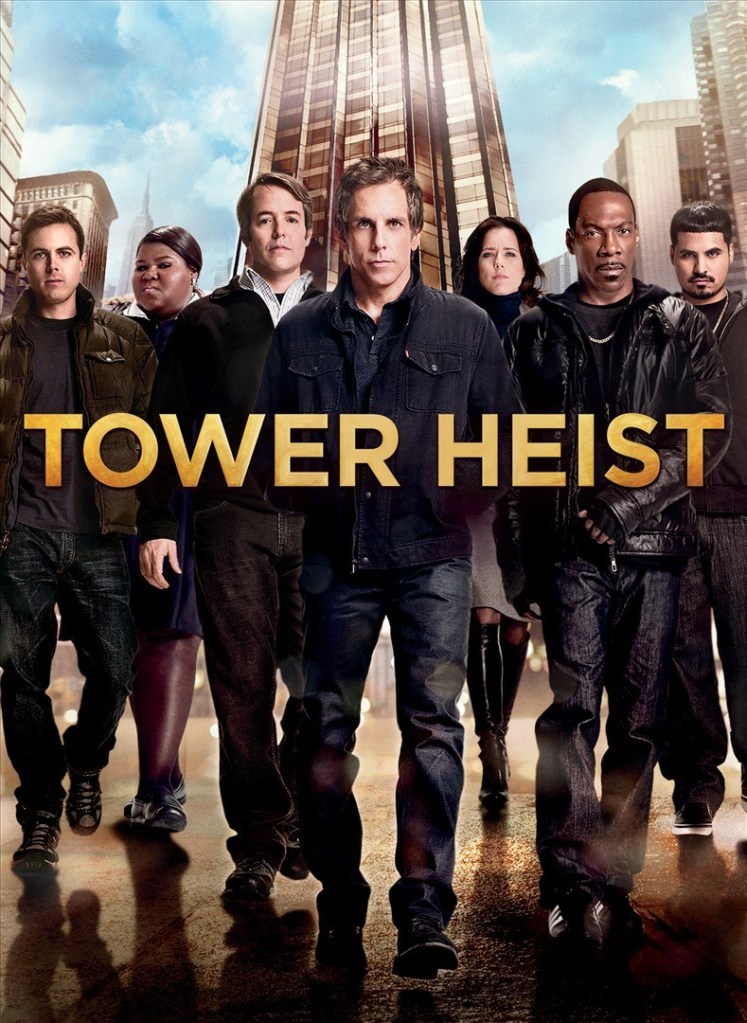
#MondayMuggers – Why TOWER HEIST?


Every Monday night at 9:00 Central Time, my wife Sierra and I host a “Live Movie Tweet” event on X using the hashtag #MondayMuggers. We rotate movie picks each week, and our tastes are quite different. Tonight, Monday November 25th, we’re watching TOWER HEIST starring Ben Stiller, Eddie Murphy, Casey Affleck, Alan Alda, and Matthew Broderick.

So why did Sierra pick TOWER HEIST, you might ask? It’s simple. It’s a Thanksgiving movie. The Macy’s Thanksgiving Day Parade is even used as a key part of the heist strategy! Sierra and I love the holidays and we’re getting in the spirit. We hope watching this movie will enhance your Thanksgiving week!

It’s on Amazon Prime, and we’ll be following along the theatrical edition (NOT the Extended Edition). Join us if you’d like!

Retro Television Review: Homicide: Life On The Street 1.8 “And the Rockets’ Dead Glare”


Welcome to Retro Television Reviews, a feature where we review some of our favorite and least favorite shows of the past!  On Sundays, I will be reviewing Homicide: Life On The Street, which aired from 1993 to 1999, on NBC!  It  can be viewed on Peacock.

This week, Detective Munch takes a stand!

Episode 1.8 “And the Rockets’ Dead Glare”

(Dir by Peter Markle, originally aired on March 17th, 1993)

Is John Munch a stoner?

That’s the question that Stanley Bolander finds himself considering during this week’s episode of Homicide: Life On The Street.  At a crime scene, Munch displays an encyclopedic knowledge of marijuana and later, while talking to a narcotics detective at the station house, both Munch and Bayliss argue that drugs should be legalized.  That night, as they wait to bust a man who earlier killed a drug currier, Bolander flat out asks Munch if he gets high.  Munch refuses to answer.

Of course, those of us watching already know.  Of course, John Munch gets high!  He’s played by Richard Belzer, the thin, middle-aged man who never takes off his sunglasses and who is continually rattling off trivial knowledge in a mellow tone of voice.  Munch not only gets high but he was probably high through this entire episode.  Whenever Munch appeared on another television show, he was probably high then.  And when he eventually ended up on Law & Order: SVU, he was probably so stoned that I’m surprised Stabler didn’t put him in a headlock and start yelling about how he didn’t want Munch serving as a bad example for the youth of New York City.

There’s no surprise that Munch would be in favor of legalizing drugs.  (It’s a bit more surprising that straight-laced Bayliss would agree but whatever.)  What was surprising, to me, was how I reacted to his argument.  There was a time when I was 100% enthusiastically in favor of legalizing all drugs, or at least leaving it up to individual states.  As I’ve gotten older, I’ve come to realize that it’s not that simple.  Legalizing drugs is not the societal cure-all that many of us assumed it would be.  Then again, weed is kind of boring now that it’s socially acceptable so maybe the best way to keep people off of drugs is to broadcast nonstop YouTube commercials featuring middle-aged suburbanites talking about how much they love their edibles.

(To be honest, Munch and Bayliss’s sudden advocacy for drug legalization reminded me of one of the things that always makes me laugh about Law & Order, i.e. the tendency to have blue-collar cops, who are not exactly the most liberal of constituencies, suddenly start talking like MSNBC pundits.)

While Munch argued for drug legalization, Pembleton considered whether or not to accept a promotion, Kay testified in a murder trial and accepted the offer of a dinner date from State’s Attorney Ed Danvers (Zeljko Ivanek), and Corsetti and Lewis drove to Washington D.C. to investigate the murder of a Chinese dissident.  Officially, they went to D.C. so that they could question the people at the Chinese embassy about the victim and the possibility that his murder was related to politics.  However, the real reason they went to D.C. was so that Crosetti could visit some historical sites and expound on his theories about who really killed Abraham Lincoln.  A somewhat sinister secret service agent (played by Ed Lauter) was happy to show them around in return for them not making trouble at the embassy.  Crosetti was excited.  Lewis was considerably less impressed.  I enjoyed the DC storyline, if just because I’m both a history and a conspiracy nerd and, when Jeff and I last went to our nation’s capital, I got excited about seeing some of the same locations that Crosetti got excited about.

This episode was a day-in-the-life episode, with all of the detectives getting their share of attention.  (Even Felton, who accompanied Kay to the courthouse, got a few moments to shine.)  If the episode didn’t have the emotional impact of Night of the Dead Living, it still did a good job of portraying the comradery of a group of people who are linked by their knowledge of what it’s like to see others at their worst.  In the end, Pembleton turns down the promotion and finally, joins his fellow detectives for an after-work drink.  I’m glad he did.  They’re good company.


Retro Television Review: Homicide: Life On The Street 1.5 “A Shot In The Dark”


Welcome to Retro Television Reviews, a feature where we review some of our favorite and least favorite shows of the past!  On Sundays, I will be reviewing Homicide: Life On The Street, which aired from 1993 to 1999, on NBC!  It  can be viewed on Peacock.

This week, the murders continue and two detectives continue to obsess.

Episode 1.5 “A Shot In The Dark”

(Dir by Bruce Paltrow, originally aired on February 24th, 1993)

As I watched this week’s episode of Homicide, it occurred to me that I really don’t care about Stanley Bolander’s relationship with Dr. Carol Blythe.

Seriously, I really did try to give this storyline a chance.  Bolander is played by the great character actor Ned Beatty.  Dr.  Blythe is played by Wendy Hughes.  Both Beatty and Hughes are no longer with us but they were both very good actors and I’m always in favor of giving good actors a plotline.  But, my God — Bolander is so whiny!  I mean, I get it.  He’s newly divorced and he’s unsure of himself and he’s a lot more comfortable investigating death than actually living life.  However, Dr. Blythe obviously likes him and Bolander had a fairly good date with her during the previous episode so why did he spend this episode afraid to talk to her on the phone?  During this episode, Bolander and Munch were investigating the murder of a drug dealer.  The only witness was a high-class prostitute who ended up hitting on Bolander, largely because she wanted him to buy her some food.  It was an interesting-enough case but instead of focusing on that, the whole thing was Munch telling Bolander to call Blythe and Bolander getting mad as a result.  It got old.

While Bolander whined about his relationship issues, Lewis and Crosetti continued to investigate the shooting of Officer Thormann.  Crosetti was convinced that Thormann had been shot by Alfred Smith (Mojo Gentry), largely because a man named Charles Flavin (Larry Hull) fingered Smith as being the shooter.  Lewis thought that Flavin was a more likely suspect, especially after Flavin failed a lie detector.  In the end, it was not superior police work that led to the arrest of Charles Flavin but instead his girlfriend telling Crosetti and Lewis that Flavin shot Thormann because he had a headache.  When confronted, Flavin immediately confessed and then started complaining about his migraine.

(As for Officer Thormann, he survives being shot in the head but he is now blind.)

Everyone is happy that Thormann’s shooter has been arrested but Crosetti finds himself wracked with guilt and self-doubt over the fact that he nearly arrested the wrong man.  In a wonderfully-acted moment, Crosetti tells Lewis that Giardello was right.  Crosetti was too close to Thormann to work the case.

Speaking of getting too involved in a case, Bayliss continues to obsess over the Adena Watson case.  After the incompetent Captain Barnfather (Clayton LeBouef) goes to a community meeting and reveals that a pipe was used to kill Adeena (and, in the process, ruins Bayliss’s plan to interrogate the man who he suspects is the murderer), Bayliss calls Barnfather and calls him a — cover your ears, if you’re young — “butthead.”  Barnfather is so offended that he comes to the station to demand that Bayliss be taken off the case.  Giardello tells Bayliss that he can either apologize or he can find another job.  Giardello also acknowledges that Barnfather’s an idiot and Bayliss has every reason to be upset.  Bayliss, who has a cold and is running a fever, apologizes and then tells Giardello that he’s willing to step down as primary and let Pembleton have the case.  Giardello, who really is the perfect boss, tells Bayliss to go home and get some sleep.

While Bayliss is losing his temper, Felton and Pembleton are investigating a man who lived in the neighborhood where Adeena’s body was found.  Felton’s theory is that the man killed Adeena and then kept her body in the trunk of his car before dumping her in the back yard where she was found.  The man’s car has subsequently been repossessed and Pembleton and Felton spend a night searching for the car on various impound lots.  When they finally find the car, they also find no evidence linking it to the Watson murder.  The focus of these scenes was less on the search for the car and more on listening to Pembleton and Felton bicker.  The two men sincerely dislike each other and Homicide deserves a lot of credit for acknowledging that working with someone is not the same thing as respecting them.  Pembleton views Felton as being a racist.  Felton views Pembleton as being a snob.  As they look for the car, they argue about everything, from the renaming of a street after Martin Luther King to Felton’s belief that Pembleton takes everything too personally.  Their argument is fascinating to listen to, largely because of the obvious disdain that each man has for the other.  Neither man is portrayed as having a monopoly on the truth.  Pembleton may be right about Felton’s prejudices but Felton is equally correct when he suggests that Pembleon is more concerned with showing up Bayliss than with investigating the case.  It’s the type of thing that you would never hear on television today.

In the end, the neighbor and his car prove to be a dead end.  But lab results come in that suggest that Bayliss’s suspicion that Adeena was killed by the local arabber may be correct.  While the rest of the squad celebrates the arrest of Charles Flavin, Pembleton and Bayliss prepare to bring in the arabber.

(According to Wikipedia, an arabber is a street vendor who sells fruits and vegetables from a horse-drawn cart.  Apparently, they’re a Northeastern thing and specifically a Baltimore thing.  Having grown up in the Southwest, I have to admit that I had never even heard the term before watching Homicide.)

All of the Bolander nonsense aside, this was a good episode that took a look at the mental strain involved in being a homicide detective.  Crosetti allowed himself to become so obsessed that he nearly arrested the wrong guy.  Bayliss allowed himself to become so obsessed that he nearly lost his job as a result.  Interestingly enough, Thormann’s shooter is captured because his girlfriend turned him in and not because of any superior policework.  Meanwhile, it’s easy to laugh at Pembleton and Felton spending an entire day chasing down a false lead but, in doing so, they eliminate the neighbor as a viable suspect and help to make the case against the arabber even stronger.  In the end, it’s a thankless job but this episode makes the viewer glad that someone’s doing it.

Next week, we finally meet the arabber!