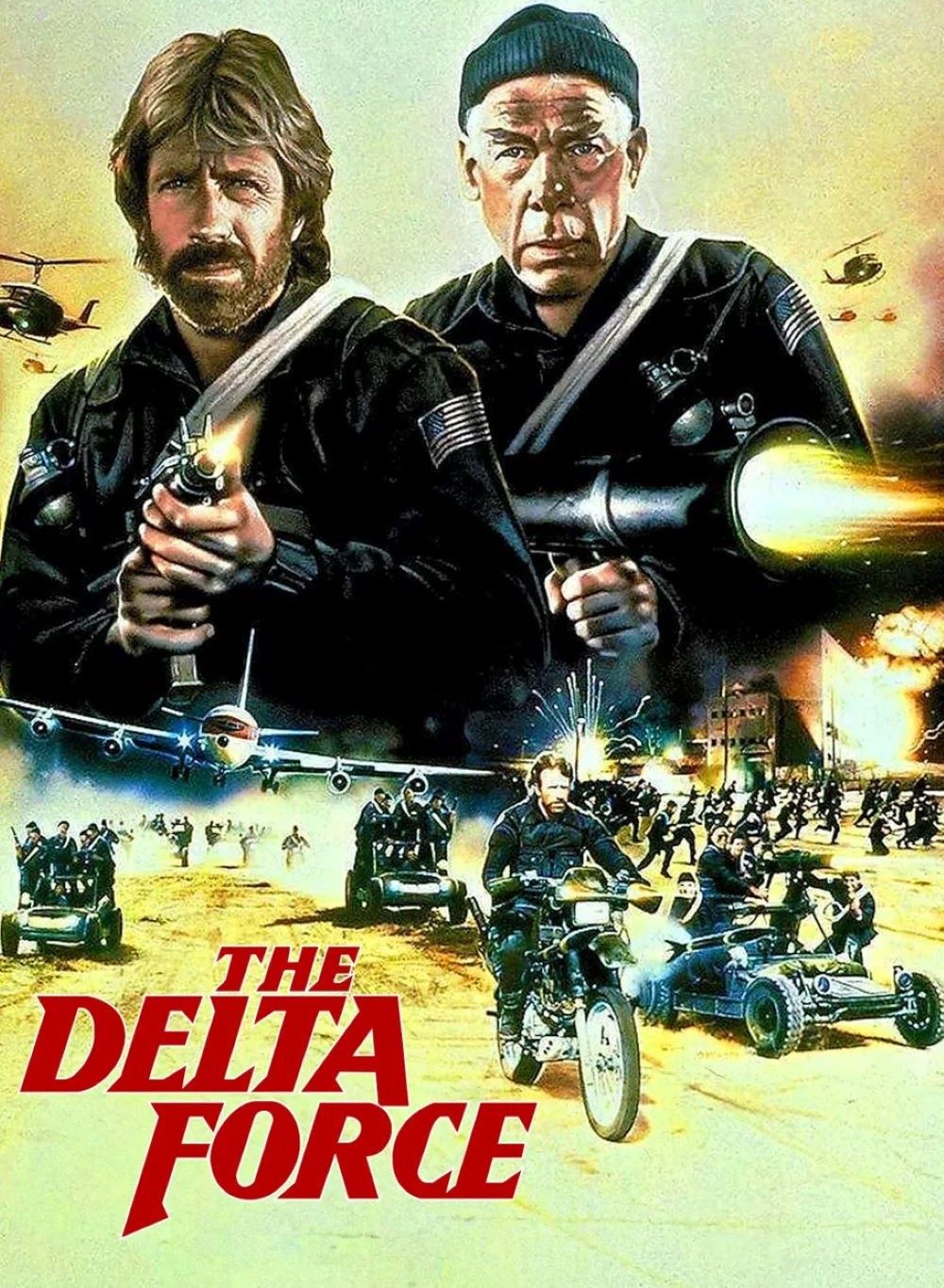
Guilty Pleasure No. 95: The Delta Force (dir. by Menahem Golan)


The Delta Force is the ultimate guilty pleasure from the ’80s, that rocket-bike-riding, Chuck Norris-kicking fantasy you pop on when you need two hours of unapologetic, brain-off escapism. It’s a hijacking thriller crossed with Cannon Films overkill, blending real Middle East tensions with pure action movie wish fulfillment, and yeah, it’s politically charged and dated as hell, but damn if it doesn’t deliver the kind of dumb-fun thrills that make you grin despite yourself.

Right from the jump, the film sets up its hook with a failed Delta Force raid in Iran, nodding to the real-life Eagle Claw disaster that still stung in 1986. Fast-forward, and Lee Marvin’s grizzled Colonel Nick Alexander gets yanked out of retirement when Lebanese militants hijack an Athens-to-New York flight, forcing it to Beirut and beyond. Enter Chuck Norris as Major Scott McCoy, the brooding ex-operator haunted by that botched op, who’s all too ready to strap on his gear when innocents are on the line. The setup drags you through passenger terror and terrorist demands, then explodes into rescue mayhem—it’s like the movie knows you’re here for the payback, and it serves it up hot.

As a plot, it’s pure popcorn simplicity: plane gets taken, hostages split by nationality and faith, planes hopscotch across terror hotspots, and Delta swoops in for the save. Drawing from the TWA 847 ordeal, the onboard stuff feels eerily real at first—sweaty close-ups of scared folks like Shelley Winters’ kvetching grandma or Martin Balsam’s anxious exec, turning the cabin into a pressure cooker. George Kennedy’s priest adds heart, and you almost buy the drama until Norris’ dirt bike starts spitting missiles, flipping the script to glorious absurdity. That’s the guilty pleasure pivot: from newsreel grit to arcade-game heroics, and you can’t help but love the whiplash.

Once the action ramps, The Delta Force leans into its B-movie soul with reckless abandon. McCoy’s team hits beaches, raids compounds, and yeah, that motorcycle sequence where Norris zips through baddies like a one-man apocalypse? Iconic cheese that screams “turn off your brain and enjoy.” It’s less about realism and more about catharsis—after watching hostages suffer, the third act’s bullet ballet feels like the justice porn we all secretly crave in these flicks. No deep strategy, just explosions and one-liners, perfectly tuned for that “hell yeah” rush that keeps you glued.

The cast is a riot of guilty-pleasure gold. Marvin, in his last role, growls through command with that unbeatable world-weary vibe, making every order land like gravitas wrapped in grit. Norris? Stone-faced perfection—says little, does everything, his quiet rage bubbling just enough to humanize the roundhouse legend. The passenger ensemble shines in panic mode: Winters chews scenery, Balsam frets convincingly, Kennedy prays with soul. Villain Robert Forster? Over-the-top terrorist glee, accent thick as plot armor, stealing scenes with gleeful menace that’s so cartoonish, it’s addictive.

Sure, the politics are a time-stamped minefield—terrorists as flat-out monsters, Middle East as villain playground, America as lone savior—but that’s part of the era’s guilty thrill. In a post-9/11 world, the stereotypes jar, yet for ’80s nostalgia buffs, it’s that raw, unfiltered patriotism dialed to eleven, the kind you laugh at now but cheered then. The film doesn’t pretend to balance views; it picks a lane—righteous rage—and floors it, making the righteousness feel perversely fun amid the preachiness.

Technically, it’s rough-around-the-edges charm personified. Menahem Golan directs with propulsive energy, keeping the 126 minutes zipping between dread and dazzle. Action’s shot clean—no shaky cam nonsense—with wide lenses capturing chaos in practical, pre-CGI glory that pops on a big screen. The score? Brass-blasting heroism that’s comically epic, sticking like glue and amping every slow-mo strut. Sets fake Beirut convincingly enough, backlots be damned, all fueling that immersive, low-budget magic.

The Delta Force thrives on its split personality: tense hijack bottle episode crashing into commando wet dream. Plane scenes build real unease, echoing headlines, but then rocket bikes and cheering crowds yank it back to fantasy ad. That clash? Pure guilty pleasure fuel—serious enough to hook you, silly enough to forgive its flaws, never letting tension sag.

Bottom line, embrace The Delta Force as peak time-capsule junk: terrorism tamed by ‘stache and firepower, geopolitics as blockbuster bait. Norris and Cannon diehards will fist-pump through every raid; casual viewers get a hoot from the excess. It’s flawed, fervent, and fantastically rewatchable— the kind of flick where you know it’s ridiculous, but two hours later, you’re humming the theme and plotting your next viewing. Guilty pleasure? Abso-freaking-lutely, and wear that shame badge proud.

Previous Guilty Pleasures

  1. Half-Baked
  2. Save The Last Dance
  3. Every Rose Has Its Thorns
  4. The Jeremy Kyle Show
  5. Invasion USA
  6. The Golden Child
  7. Final Destination 2
  8. Paparazzi
  9. The Principal
  10. The Substitute
  11. Terror In The Family
  12. Pandorum
  13. Lambada
  14. Fear
  15. Cocktail
  16. Keep Off The Grass
  17. Girls, Girls, Girls
  18. Class
  19. Tart
  20. King Kong vs. Godzilla
  21. Hawk the Slayer
  22. Battle Beyond the Stars
  23. Meridian
  24. Walk of Shame
  25. From Justin To Kelly
  26. Project Greenlight
  27. Sex Decoy: Love Stings
  28. Swimfan
  29. On the Line
  30. Wolfen
  31. Hail Caesar!
  32. It’s So Cold In The D
  33. In the Mix
  34. Healed By Grace
  35. Valley of the Dolls
  36. The Legend of Billie Jean
  37. Death Wish
  38. Shipping Wars
  39. Ghost Whisperer
  40. Parking Wars
  41. The Dead Are After Me
  42. Harper’s Island
  43. The Resurrection of Gavin Stone
  44. Paranormal State
  45. Utopia
  46. Bar Rescue
  47. The Powers of Matthew Star
  48. Spiker
  49. Heavenly Bodies
  50. Maid in Manhattan
  51. Rage and Honor
  52. Saved By The Bell 3. 21 “No Hope With Dope”
  53. Happy Gilmore
  54. Solarbabies
  55. The Dawn of Correction
  56. Once You Understand
  57. The Voyeurs 
  58. Robot Jox
  59. Teen Wolf
  60. The Running Man
  61. Double Dragon
  62. Backtrack
  63. Julie and Jack
  64. Karate Warrior
  65. Invaders From Mars
  66. Cloverfield
  67. Aerobicide 
  68. Blood Harvest
  69. Shocking Dark
  70. Face The Truth
  71. Submerged
  72. The Canyons
  73. Days of Thunder
  74. Van Helsing
  75. The Night Comes for Us
  76. Code of Silence
  77. Captain Ron
  78. Armageddon
  79. Kate’s Secret
  80. Point Break
  81. The Replacements
  82. The Shadow
  83. Meteor
  84. Last Action Hero
  85. Attack of the Killer Tomatoes
  86. The Horror at 37,000 Feet
  87. The ‘Burbs
  88. Lifeforce
  89. Highschool of the Dead
  90. Ice Station Zebra
  91. No One Lives
  92. Brewster’s Millions
  93. Porky’s
  94. Revenge of the Nerds

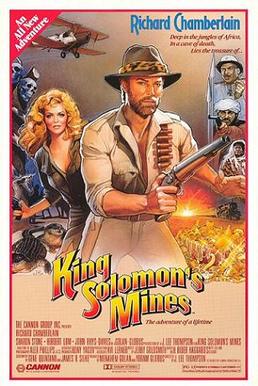
King Solomon’s Mines (1985, directed by J. Lee Thompson)


After her archaeologist father disappears while searching for the fabled mines of King Solomon, Jesse Houston (Sharon Stone) hires famed explorer Allan Quartermain (Richard Chamberlain) to help her find him.  After walking around in the jungle and exploring a nearby village, Allan and Jesse discover that her father has been kidnapped by a German military expedition who want to use King Solomon’s treasure to fund their war effort.  Working with the Germans is Allan’s old enemy, Dogati (John Rhys-Davies).  Allan and Jesse find themselves in a race against time to find the mines before the Germans.  Along the way, they steal an airplane, fight German soldiers on a train, and nearly get cooked alive in a giant cauldron.

Because this is a Cannon film and it was made at the height of Indiana Jones’s popularity and it stars John Rhys-Davies and it has a score that sounds like it was written by someone trying too hard to be John Williams, you might be tempted to think that King Solomon’s Mines is a rip-off of Raiders of the Lost Ark.  However, there are some crucial differences between Raiders and King Solomon’s Mines.  For instance, Raiders of the Lost Ark took place during World War II.  King Solomon’s Mines takes place during World War I.  Raiders of the Lost Ark had angels that melted a man’s face.  King Solomon’s Mines has a lava pit that makes you explode if you fall into it.  Raiders of the Lost Ark has a big fight in an airfield while King Solomon’s Mines has a big fight at an airfield …. well, wait, I guess they do have a few things in common.

Probably the biggest difference between Raiders of the Lost Ark and King Solomon’s Mines is that Raiders had Harrison Ford and Karen Allen while King Solomon’s Mines has to make due with Richard Chamberlain and Sharon Stone.  (If the imdb trivia section is to be believed, Sharon Stone was cast because Menahem Golan mistook her for Kathleen Turner.)  Along with generating zero romantic sparks, neither Chamberlain nor Stone come across as if they’ve ever even seen a jungle, much less explored one.  The only time that the two of them are credible as anything other than actors slumming on Cannon’s dime is when they’re yelling at each other.  There’s also a scene where they’re trying to steal an airplane and Chamberlain tells Stone to “reach between your legs and grab it.”  That was funny, I guess.

Along with trying to be an adventure, King Solomon’s Mines also tries to be a comedy.  As a general rule, Cannon films are great when they’re unintentionally funny but not so much when they actually try to be funny.  The film’s idea of comedy is Richard Chamberlain having to do an impromptu jig while someone shoots at his feet.  Add in a healthy dose of casual racism as Allan and Jesse run into a tribe in Africa who want to cook them in a giant stew pot and you’ve got a film so bad that you’ll hardly believe it could have been produced by the same people who gave us Delta Force, which is, of course, the greatest film ever made.

Golan and Globus had enough confidence in King Solomon’s Mines that they shot a sequel before the first film was even released.  Tomorrow, I will force myself to watch and review Allan Quartermain and The Lost City of Gold.  And, after that, I’ll probably go sit in a corner and think about what I’ve done.

Bronson’s Old: Death Wish 3 (1985, directed by Michael Winner)


To quote Roger Murtaugh, “I’m too old for this shit.”

It has been ten years since Paul Kersey (Charles Bronson) left New York City and the place has gone to Hell.  It’s no longer just muggers that you have look out for.  Now, there are roving street gangs of directionless teenagers, terrorizing the elderly and forcing them to live like prisoners in their own apartment building.

One street corner now looks like a war zone, controlled by spiky-haired, face-painting punks who look like something from a Mad Max movie.  Manny Fraker (Gavan O’Herlihy) rules this street corner, supported by a gang that worships him as if he was some sort of god.  Manny thinks that he is immortal but he’s just targeted the wrong person.  The gang may think that Charley (Francis Drake) is just a defenseless old man but what they don’t know is that, when Charley served in Korea, his best friend was Paul Kersey.

The past few years have been busy for Paul.  He’s killed muggers and rapists in Los Angeles, Chicago, and Kansas City and now he’s returned to New York City, to visit his old friend Charley.  Paul arrives at Charley’s apartment just in time to witness Fraker’s gang murdering him.  The gang flees and when the police arrive, they take Paul into custody.

While public defender Kathryn Davis (Deborah Raffin) tries to figure out why Paul is being held in jail, Paul has a conversation with Lt. Shriker (Ed Lauter).  Shriker remembers Paul as being the New York vigilante and he has a proposition for him.  Paul can kill as many members of Fraker’s gang as he wants, as long as he allows the police to take the credit and reports everything that he discovers to Shriker.  Paul agrees.

In the neighborhood, Paul starts to put Fraker and his gang (one of whom is played by pre-Bill and Ted Alex Winter) in their place.  In a scene borrowed from Brian Garfield’s original Death Wish novel, he uses a used car as bait to gun down two aspiring car thieves.  When Paul gets a new gun, he tests it out on a depraved mugger known as the Giggler.  Though some might call him a serial killer, Paul is soon a hero to the entire neighborhood.  Though Charley may be gone, Paul befriends the other residents of the apartment.  He shows the elderly Kaprovs how to catch anyone trying to climb through their window.  He protects Maria Rodriguez (Marina Sirtis) from the gang.  Best of all, he befriend Bennett Miller (Martin Balsam), a World War II vet who still remembers how to load a machine gun.

(Balsam and Bronson previously co-starred in The Stone Killer, though in that one Bronson was a cop and Balsam was on the other side of the law.)

He also finds time to pursue a relationship with Kathryn Davis.  This is one recurring element in the Death Wish franchise that has never made sense to me.  Paul always has a new girlfriend, despite the fact that almost every woman that he ever gets involved with ends up getting killed.  Paul also only seems to go out with women who would be upset to discover that they were dating a notorious vigilante.  In Death Wish II, he went out with a crusading journalist who was against the death penalty.  In Death Wish 3, he falls for a public defender whose job is to provide legal counsel to the very people that Paul is trying to kill.  After Death Wish 3, Paul would date yet another crusading journalist and, finally, the ex-wife of a notorious mobster.  Maybe Paul should just give up and concentrate on mourning his wife.

Michael Winner returned to direct Death Wish 3 and, this time around, he imagines New York City as being a post-apocalyptic wasteland, full of abandoned buildings and murderous scavengers.  Imagine A Clockwork Orange if Charles Bronson suddenly showed up to shoot Alex and the Droogs.  As played by Gavan O’Herlihy, Manny Fraker is the type of seemingly indestructible bad guy who can actually give Paul Kersey a challenge, something that was missing from the previous films.

The other thing that distinguishes Death Wish 3 is that it was one the only film in the franchise to directly confront an obvious truth.  Charles Bronson was 53 when the first Death Wish was released.  By the time he made Death Wish 3, he was 64 and decades older than the typical action star.  (As way of comparison, Clint Eastwood was 55 when Death Wish 3 was released and was already experimenting with less action-orientated roles.)  By partnering him with Martin Balsam and the other elderly residents of the neighborhood, Death Wish 3 not only acknowledged Bronson’s advanced age but also took advantage of it.  Death Wish 3 is a film where the old folks finally get to teach the young punks a thing or two.  If the other Death Wish films were about one man fighting a lonely war, Death Wish 3 is about a community refusing to be silenced.  The chance to put those kids in their place even seems to perk up Charles Bronson, who gives one of his best performances in Death Wish 3.

Death Wish 3 may have been roundly despised by the critics but it’s the best of the Death Wish sequels.  It made a fortune at the box office so naturally, another sequel would follow.

Tomorrow: Death Wish 4: The Crackdown!

Bronson’s Back!: Death Wish II (1982, directed by Michael Winner)


To quote John McClane, “How can the same shit happen to the same guy twice?”
It has been eight years since Paul Kersey (Charles Bronson) lost his wife and single-handedly cleaned up New York City.  The first Death Wish ended with Paul in Chicago, preparing to gun down a new group of criminals.  I guess Chicago didn’t take because, at the start of Death Wish II, Paul is in Los Angeles and he’s working as an architect again.  He has a new girlfriend, a bleeding heart liberal reporter named Geri (Jill Ireland, Bronson’s real-life wife) who is against the death penalty and who has no idea that Paul used to be New York’s most notorious vigilante.  Having finally been released from the mental institution, Carol (Robin Sherwood) is living with her father but is now mute.

Crime rates are soaring in Los Angeles and why not?  The legal system is more concerned with the rights of the criminals than the victims and Paul has retired from patrolling the streets.  But when a group of cartoonish thugs rape and kill his housekeeper and cause his daughter to fall out of a window while trying to escape them, Paul picks up his gun and sets out for revenge.

Death Wish II was not the first sequel to Death Wish.  Brian Garfield, the author of the novel on which Death Wish was based, never intended for Paul to be seen as a hero and was disgusted by what he saw as being the film’s glorification of violence.  As “penance,” he wrote a sequel called Death Sentence, in which Paul discovered that he had inspired an even more dangerous vigilante.  When Menahem Golan and Yoram Globus bought the rights to produce a second Death Wish film, they decided not to use Garfield’s sequel and instead went with a story that was co-written by Golan.

It’s the same basic story as the first film.  Again, Paul is a mild-mannered architect who is a liberal during the day and a gun-toting reactionary at night.  Again, it’s a home invasion and a death in the family that sets Paul off.  Again, Paul gets help from sympathetic citizens who don’t care that the police commissioner (Anthony Franciosa) wants him off the streets.  Jeff Goldblum played a rapist with a switch blade in the first film.  This time, it’s Laurence Fishburne who fills the role.  (Fishburne also carries a radio, which he eventually learns cannot be used to block bullets.)  Even Detective Ochoa (Vincent Gardenia) returns, coming down to Los Angeles to see if Paul has returned to his old ways.

The main difference between the first two Death Wish films is that Death Wish II is a Cannon film, which means that it is even less concerned with reality than the first film.  In Death Wish II, the criminals are more flamboyant, the violence is more graphic, and Paul is even more of a relentless avenger than in the first film.  In the first Death Wish, Paul threw up after fighting a mugger.  In the second Death Wish, he sees that one of the men who raped his daughter is wearing a cross, leading to the following exchange:

“Do you believe in Jesus?”

“Yes, I do.”

“Well, you’re going to meet him.”

BLAM!

Death Wish II is the best known of the Death Wish sequels.  It made the most money and, when I was a kid, it used to show on TV constantly.  The commercials always featured the “You believe in Jesus?” exchange and, every morning after we saw those commercials, all the kids at school would walk up to each other and say, “You believe in Jesus?  Well, you’re going to meet him.”  It drove the teachers crazy.

Overall, Death Wish II is a lousy film.  Michael Winner, who was always more concerned with getting people into the theaters than anything else, directs in a sledgehammer manner that makes his work on the first film look subtle.  He obscenely lingers over every rape and murder, leaving no doubt that he is more interested in titillating the audience than getting them to share Paul’s outrage.  The script is also weak, with Geri so poorly written that she actually gets more upset about Paul going out at night than she does when she learns that Paul’s daughter has died.  When Paul sets out to track down the gang, his method is to merely wander around Los Angeles until he stumbles across them.  It doesn’t take long for Paul to start taking them out but no one in the gang ever seems to be upset or worried that someone is obviously stalking and killing them.

There are a few good things about the film.  Charles Bronson was always a better actor than he was given credit for and it’s always fun to watch Paul try to balance his normal daily routine with his violent night life.  Whenever Geri demands to know if he’s been shooting people, Paul looks at her like he is personally offended that she could possibly think such a thing.  Also, the criminals themselves are all so cartoonishly evil that there’s never any question that Paul is doing the world a favor by gunning them down.  For many otherwise sensible viewers, a movie like Death Wish II may be bad but it is also cathartic.  It offers up a simple solution to a complex issue.  In real life, a city full of Paul Kerseys would lead to innocent people getting killed for no good reason.  But in the world of Death Wish II, no one out after nightfall is innocent so there’s no need to worry about shooting the wrong person.

Finally, the film’s score was written by the legendary Jimmy Page.  The studio wanted Isaac Hayes to do the score but Winner asked his neighbor, Page.  Page took the film, retreated into his studio, and returned with a bluesy score that would turn out to be the best thing about the movie.  The soundtrack was the only one of Page’s solo projects to be released on Led Zeppelin’s record label, Swan Song Records.

Tomorrow, Bronson returns with Death Wish 3!

A Movie A Day #211: Deja Vu (1985, directed by Anthony B. Richmond)


Damn, son.  I’ve seen some bad movies before but Deja Vu is something else altogether.
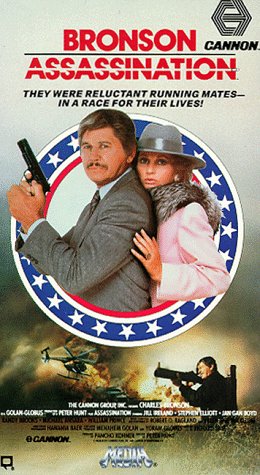
Around the mid-80s, Menahem Golan and Yoram Globus decided to prove that Cannon Films was capable of doing more than making movies about Chuck Norris refighting the war in Vietnam.  Golan and Globus had already made money, now they wanted respect.  Teaming up with respected directors (Robert Altman directed an adaptation of Sam Shepard’s Fool For Love for them) and casting actors who had slightly more range than Chuck Norris or Reb Brown, Cannon tried to go the prestige route.  Some of the Cannon’s quality movies actually were good movies.  The same year that Deja Vu came out, Cannon’s Runaway Train scored several Oscar nominations.  However, Deja Vu is a far more representative example of a Cannon prestige film.  It may have had higher production values than Missing in Action but it was still a Golan/Globus production through and through.

Nigel Terry (best known for playing King Arthur in John Boorman’s Excalibur) plays Michael, a screenwriter who views a documentary about a famous and tragic ballerina and is shocked to discover that she looks just like his actress fiancée.  (Both roles are played by Jaclyn Smith.)  Michael is even more shocked when it turns out that he looks exactly like the ballerina’s husband.  Convinced that his girlfriend is the reincarnation of the ballerina, Michael researches her life and murder.  Meanwhile, his fiancée starts to act strangely.

Deja Vu starts out a merely mediocre, slowly paced and miscast.  (There is no chemistry whatsoever between Nigel Terry and Jaclyn Smith.)  But then Shelley Winters shows up, playing a Russian psychic named Olga Nabokova. As soon as Winters started to deliver her lines in one of the least convincing Russian accents that I have ever heard, Deja Vu made the leap from being merely bad to being a cinematic trainwreck.  While Terry and Smith sleepwalk through their roles, Winters and, later, Claire Bloom (cast as the ballerina’s mother) chew up every piece of scenery that they can get their hands on.  Though the plot may be so predictable that it will cause viewers to have deja vu of their own, it must be said that, eventually, Deja Vu becomes so bad and misjudged that it is impossible to look away.  Golan and Globus may have had Oscars in their eyes when they decided to produce this prestige pic but instead, they won the laughter of anyone who comes across it on TV.


A Movie A Day #209: Assassination (1987, directed by Peter R. Hunt)


Charles Bronson, man.

Long before Clint Eastwood starred in In The Line of Fire, Charles Bronson played an over the hill secret service agent in Assassination.  Having just returned to active service after a six month leave of absence, Jay Killian (Charles Bronson), thinks that he is going to be assigned back to the presidential detail.  Instead, he is given the job that no one wants.  Jay is assigned to protect the first lady, Lara Craig (Jill Ireland, Bronson’s real-life wife).

Lara is a handful.  Every one tells Killian that she is “even worse than Nancy.”  (This running joke probably played better in 1987.  If Assassination had been released ten years later, Lara would have been described as being “even worse than Hillary.”)  Lara does not like being told what she can and cannot do. When she refuses to follow Killian’s orders not to ride in a convertible, she ends up getting a black eye when a motorcycle crashes and Killian instinctively throws her to the floor.  Lara may not like Killian but when, she is targeted by a notorious terrorist (Erik Stern), she will have to learn to trust him.  Her life depends on it, especially when it becomes clear that the order to have her killed is coming from inside the White House.  It turns out that the President has been impotent for years.  That may not have troubled Lara before but now Killian is showing her that a real man looks like Charles Bronson.  A divorced president will never be reelected.  A widowed president, on the other hand…

Assassination was one of the last films that Bronson made for Cannon.  It’s never as wild as Murphy’s Law, Kinjite, or many of Bronson’s other Cannon films but it is always interesting to watch Bronson acting opposite of Ireland.  Bronson famously did not get along with many people but he loved Ireland and that was something that always came through in the 15 movies that they made together.  Whenever Bronson and Ireland acted opposite each other, Bronson actually seemed to be enjoying himself.  And while it may be subdued when compared to his other Cannon films, Assassination provides just enough scenes of Bronson being Bronson.

Who other than Bronson could tell his much younger girlfriend that, because of her, he might “die of terminal orgasm?”

Who other than Bronson could drive around a motorcycle with machine gun turrets and execute a jump that would put his old co-star Steve McQueen to shame?

Who other than Bronson could use a bazooka to kill one man and then smile about it?

Charles Bronson, man.  No offense to Bruce Willis, who will be trying to step into Bronson’s gigantic shoes with the upcoming Death Wish remake, but nobody did it better than Bronson.


A Movie A Day #137: Braddock: Missing in Action III (1988, directed by Aaron Norris)


Chuck Fucking Norris, dude.  Chuck Norris is so cool that continuity bends to his will and thanks him for the opportunity.
Need proof?

Just watch Braddock: Missing in Action III.

The third Missing in Action film starts in 1975, with the fall of Saigon.  The communists are taking over.  The Americans are fleeing Vietnam.  Colonel James Braddock (Chuck FUCKING Norris) is determined to bring his Vietnamese wife to America with him but, when she loses her papers and is not allowed to make her way to the American embassy, Braddock believes that she had been killed. (Keep an eye out for Keith David as the Embassy guard.  Only Chuck Norris could overshadow Keith David in a movie.)  Heartbroken, Braddock returns to the United States.

Every fan of the Missing in Action franchise knows better.  We all know that Chuck was in a POW camp when Saigon fell.  In Missing in Action 2, he and his fellow prisoners did not even know if the war had ended.  Also, Chuck mentioned having a wife waiting for him back in the United States.  What gives?

I can think of only two possible explanations.

Either Chuck Norris and Cannon Films did not care about continuity

or

Chuck Norris is so cool that, in order to prevent his collected coolness from knocking the Earth off of its axis, the U.S. Army split Chuck’s coolness in half by creating a clone.  One clone spent ten years in a POW camp.  The other clone escaped during the Fall of Saigon but had to leave behind his wife.

Thirteen years later and back in the U.S., Chuck is contacted by Reverend Polanski (Yehuda Efroni), who tells him that his wife is still alive in Vietnam and that he has a 12 year-old son.  Chuck’s boss at the CIA tells him that, under no circumstances, is Chuck to go to Vietnam.

Anyone who thinks they can tell Chuck Norris what do is a fool.

Chuck goes to Vietnam and is reunited with his wife and son.  Unfortunately, when Chuck tries to get his new family out of the country, they are captured by sadistic General Quoc (Aki Aleong).  Again, Braddock must escape from a Vietnamese prison camp.

Braddock: Missing in Action III was co-written by Chuck Norris and it was directed by his brother, Aaron.  It’s a Norris production all the way, which means a lot of heroic shots of Chuck and a lot of bad guys wondering why Chuck is so much better than them.

Braddock was released four years after the first Missing in Action but, more importantly, it was released two years after Oliver Stone’s Platoon changed the way that movies dealt with the war in Vietnam.  By the time that Braddock came out, films in which lone American refought and single-handedly won the war were no longer in fashion.  Braddock was a flop at the box office and it ended the franchise.  However, continuity errors aside, Braddock is actually the best of the Missing in Action films.  It features Chuck’s best performance in the series and Chuck searching for his wife and child gives Braddock more emotional weight than the first two Missing in Action films. Maybe Chuck should have co-written and selected the director for all of the films he made for Cannon.

Chuck Norris, dude.

Chuck Fucking Norris.

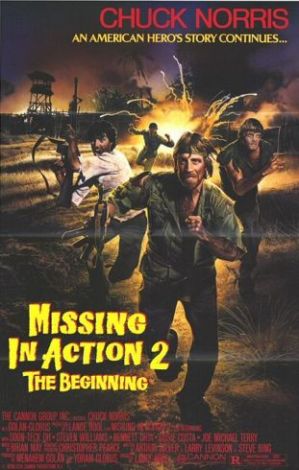
A Movie A Day #136: Missing in Action 2: The Beginning (1985, directed by Lance Hool)


Goddamn, dude.  Chuck Fucking Norris.  Even when the movie is terrible, Chuck is cool.
That is especially relevant when it comes to a movie like Missing In Action 2: The Beginning.  Produced by Cannon Films and shot back-to-back with the first Missing in Action, The Beginning was supposed to come out first.  However, Menahem Golan and Yoram Globus took a look at the two movies and realized that The Beginning would work better as the 2nd film in the series.  They were right though some post-production tinkering did lead to some serious errors in continuity.

(Not that anyone watching a Golan/Globus production would be worrying about continuity.)

Did you ever wonder how James Braddock (Chuck Norris) became a POW in the first place?  No?  Missing In Action 2 is going to show you how it happened anyway.  It turns out that he and his men were captured, in 1972, by the Viet Cong when their helicopter crashed into a lake.  At the start of the movie, Chuck only has a mustache.  If Chuck had been fully bearded, there is no way the VC could have captured him.  After Chuck and his men have spent ten years in a jungle prison, where they are forced to pick poppies for a French heroin drug lord, Chuck has grown a full beard and is finally strong enough to escape from the prison, rescue his men, and defeat the sadistic camp commandant (Soon-Tek Oh) in hand-to-hand combat.  None of it is surprising but there’s enough weird stuff, like the prostitutes that the French drug dealer flies into the camp and the Australian journalist who shows up out of nowhere and is executed ten minutes later, to keep it interesting.  Chuck is as stiff as always but he’s good in the action scenes and gets to show off some sweet karate moves towards the end of the movie.  Supposedly, Chuck viewed the Missing in Action films as a tribute to his brother, Wieland, who was killed in Vietnam.

The continuity error has to do with the amount of time that Braddock and his men spend in the camp.  After Chuck is captured in 1972, the film inserts some footage of Ronald Reagan giving a speech about the men who never returned from Vietnam.  A narrator says that the Americans are still wondering what happened to the thousands of soldiers who were reported as being MIA in Vietnam.  The implication is that Chuck and company spent ten years in the POW Camp, which means that they escaped in 1982.  Since it is said, in Missing in Action, that it has been ten years since Chuck escaped, that means that Missing in Action actually took place in 1992.  But if Chuck and the boys escaped and returned to America in 1982 then why, in 1992, was everyone so convinced that all the POWs were released immediately after the Vietnam War?

Fortunately, Chuck Norris is so cool that it doesn’t matter what year it is.

Chuck Norris, man.

Chuck Fucking Norris.

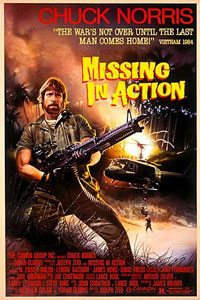
A Movie A Day #135: Missing in Action (1984, directed by Joseph Zito)


Chuck Fucking Norris, man.  Is there anything this man can not do?
In Missing in Action, he plays Colonel James Braddock, an army intelligence officer.  For a career military man, his long hair and his beard are definitely against regulations but who is going to tell Chuck Norris to get a haircut?  Ten years ago, Braddock escaped from a POW camp in North Vietnam.  Haunted by nightmares and still convinced that there are American POWs in Vietnam, Braddock is inspired by an episode of Spider-Man and his Amazing Friends (I am not joking!) to accompany a U.S. Senator on a fact-finding trip to Ho Chi Minh City.  It’s there that Braddock uncovers evidence that American soldiers are being held prisoner by the evil General Trau (James Hong).  With the government refusing to help him, Braddock is forced to go to Thailand, where he hooks up with an old friend, a former soldier turned black marketeer named Tuck (M.  Emmett Walsh).  Braddock and Tuck head into the jungle, to both rescue the POWs and to remind the world that, no matter what a bunch of pointy-headed lefties might say, Americans never lose a war!

A blatant rip-off of the Rambo films, Missing in Action was one of Cannon Films’ most financially successful movies.  Seen today, Missing in Action is borderline xenophobic and it takes forever for the action to really get started.  I was surprised by the number of scenes that were devoted to Braddock looking for evidence that the POWs were still in Vietnam, as if there was ever any real suspense about what Braddock would find.  (No POWs = no movie.)

On the positive side, once it finally starts, the action is exciting.  Joseph Zito was a veteran genre director and he know how to handle a battle scene.  Unfortunately, in this one, Chuck does most of his fighting with a machine gun instead of his hands.  This is also one of the first movies where Chuck Norris has the full beard going.  The beard serves to distract from what a stiff actor Chuck Norris usually was and it does its job in Missing in Action.  When it comes to picking a Chuck Norris film to watch, it’s a good idea to see how much facial hair will be featured.  If Chuck has a beard, definitely watch.  If Chuck only has a mustache, proceed with caution but, if there’s nothing else to watch, give the movie a chance.  If Chuck is clean-shaven and Bruce Lee is nowhere to be seen, throw the movie back and never speak of it again.

Missing in Action was shot back-to-back with what eventually became known as Missing in Action 2: The Beginning.  Originally, The Beginning was meant to be released first and Missing in Action was intended to be a sequel.  However, once the execs at Cannon saw the footage, they deemed The Beginning to be unreleasable and instead sent Missing in Action out to theaters.  (A movie so bad that even Cannon was hesitant to release it?  It boggles the mind.)  Missing in Action was such a box office success and The Beginning was subsequently released as a prequel.  However, when it comes to Norris/Cannon films, Invasion USA is the one to watch.  That one has a bearded Chuck and Richard Lynch!

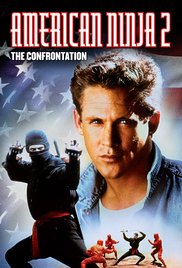
A Movie A Day #133: American Ninja 2: The Confrontation (1987, directed by Sam Firstenberg)


Duuuuuuuuude!  The American Ninja is back!

In this sequel to the first American Ninja, ninja Joe (Michael Dudikoff) and sidekick Jackson (Steve James) are now Army Rangers.  They have been assigned to provide security at an embassy on a small Caribbean island.  At first, it seems like an easy gig but then Joe discovers that a large number of Marines have recently vanished.  According to the only witness, they were abducted by men dressed in black.  Joe and Jackson know what that means!

The Marines are being set up by a traitor in their own ranks, Tommy Taylor (played by Miguel Ferrer look-alike Jonathan Pienaar).  Taylor is being blackmailed by a master criminal known as, I kid you not, Leo the Lion (Gary Conway, who also co-wrote the script).  Leo is brainwashing the Marines, shooting them up with all sorts of drugs and transforming them into zombie-style ninjas.

Doing away with any pretense towards reality, American Ninja 2 is pure comic book action.  A bad guy even says, “It’s the American Ninja!” when he sees Joe.  It’s a strange film.  On the one hand, it is full of goofy humor and it even has a streetwise kid sidekick, all things that would indicate that it was made to appeal to kids.  On the other hand, the first cut was reportedly so violent that it got a dreaded X-rating.  The final version still has enough impalings, decapitations, and throwing stars to the head to earn its R.

With its combination of nonstop action and Steve James one-liners, American Ninja 2 is both a worthy sequel and a worthy addition to the Cannon library.  Still, it bothers me that at least a few of the ninjans that Joe and Jackson killed were probably just brainwashed Marines.  That amounts to a lot of innocent victims being killed by our heroes.

The life of an American ninja is never an easy one.