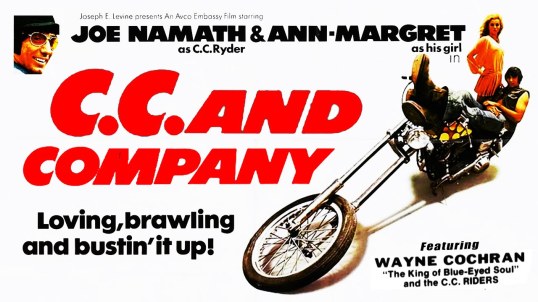
As our long-time readers know, I’ve seen my share of bad movies but it’s been a while since I’ve seen one as bad as 1970’s C.C. and Company.
C.C. and Company is about a drifter named C.C. Ryder (played by Joe Namath, who was a pro football quarterback at the time). Ryder rides through the desert on his dorky motorcycle. He doesn’t have a job. He doesn’t have much money. He does have a lot of hair and he also has a lot of teeth. We know that because it’s rare that there’s ever moment when C.C. isn’t smiling. C.C. is perhaps the most cheerful amateur criminal that I’ve ever seen. Even when C.C. really shouldn’t be smiling, he’s smiling. There are moments when people try to kill C.C. and he responds with a smile. This could be a sign of C.C.’s devil-may-care-attitude but I think it has more to do with Joe Namath being a really bad actor.
C.C. is apparently a member of a motorcycle gang. I say apparently because no one in the gang seems to like him and they’re constantly beating up on him. The leader of the gang is Moon (William Smith) and among the members of the gang is an intimidating figure named Crow (Sid Haig). Smith and Haig were both professional actors and genuine tough guys. They not only knew how to act on camera but they also knew how to throw a punch without faking it. Having them act opposite Namath doesn’t really accomplish much beyond emphasizing just how terrible an actor Namath was. Even though Moon is a Mansonesque creep, you still find yourself rooting for him whenever he and C.C. get into a fight because Smith creates an actual character whereas Namath…. well, he doesn’t. I sat through this entire film and never once did I find myself wondering what C.C.’s initials stood for. That’s how uninterested I was in C.C.’s life.
Anyway, C.C. meets the wealthy and chic Ann McCalley (Ann-Margaret) after Ann’s limo breaks down in the middle of the desert. C.C. not only fixes the limo but he also saves Ann from Crow and Lizard (Greg Mullaney). It’s love at first sight but, unfortunately, Ann has places to go so she drives off and C.C. returns to the biker camp and watches as Moon sends his girlfriend, Pom Pom (Jennifer Billingsley), out to make money on the highway. As I watched all of this, I found myself wondering how everyone else in the gang got stuck with names like Moon, Lizard, Crow, Rabbit, Pom Pom, and Zit-Zit (my favorite) but somehow C.C. was able to keep his innocent initials. The movie never explained the ritual behind receiving motorcycle gang names and I think that was a missed opportunity.
Eventually, C.C. trades in his dorky motorcycle for a Kawasaki, largely because Kawasaki apparently paid the film’s producers a lot of money. C.C. enters a race and wins. Ann sees him win and falls even more in love with him. C.C. gets into a fight with the gang and then he and Ann head to …. well, it looked a lot like Reno but honestly, who knows for sure? Eventually, Moon and the gang track C.C. and Ann down and it all leads to one last fight. We never do find out if the “company” of the title referred to Ann and her rich friends or Moon and the gang. Not even C.C. seems to know for sure.
So, there’s a lot of reasons why C.C. and Company doesn’t really work but mostly it all comes down to the lead non-performance of Joe Namath as C.C. There’s nothing tough or intimidating or rebellious about Namath. C.C. is the biker you can bring home to meet your parents. William Smith and Sid Haig are a lot more fun but they’re playing totally disreputable characters. Namath and Ann-Margaret have zero romantic chemistry and the entire film has the look of a cheap made-for-TV movie. Between C.C. and Company and Altamont, 1970 was not a good year to be a biker groupie.
That said, there is one good scene in C.C. and Company, where C.C. and Ann go out dancing. While Joe Namath awkwardly shakes his shoulders while flashing that ever-present grin, Ann-Margaret dances as if the fate of the world depended upon her. One year after the release of this movie, she would prove herself as dramatic actress and receive her first Oscar nomination for Carnal Knowledge.



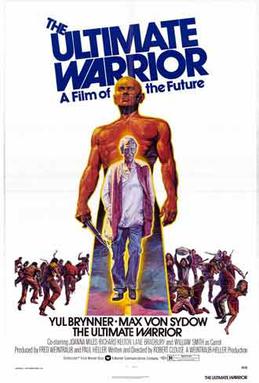 The year is 2012 and New York City, like the rest of the world, has been devastated by energy shortages, wars, and a great plague. The few survivors now live in isolated communes and are easily victimized by roving gangs of marauders. (On the plus side, this version of New York City has been spared Bill de Blasio.) The Baron (Max von Sydow) has managed to keep his people safe by ruling with an iron hand but he knows that it will only be a matter of time until his commune is overrun by the psychotic Carrot (William Smith) and his men. When a mysterious warrior known only as Carson (Yul Brynner) comes to the commune, the Baron tasks him with a very important mission: help his pregnant daughter (Joanna Miles) escape from New York City and transport both her and some genetically modified seeds to an island in North Carolina.
 Having just graduated from West Point, Lt. Jeff Knight (Michael Dudikoff, the American Ninja himself) is sent to Vietnam and takes over a battle-weary platoon. Lt. Knight has got his work cut out for him. The VC is all around, drug use is rampant, and the cynical members of the platoon have no respect for him. When Lt. Knight is injured during one of his first patrols, everyone is so convinced that he’ll go back to the U.S. that they loot his quarters. However, Knight does return, determined to earn the respect of his men and become a true platoon leader!
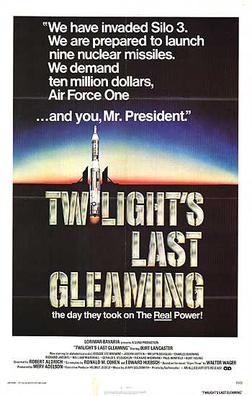 In Montana, four men have infiltrated and taken over a top-secret ICBM complex. Three of the men, Hoxey (William Smith), Garvas (Burt Young), and Powell (Paul Winfield) are considered to be common criminals but their leader is something much different. Until he was court-martialed and sentenced to a military prison, Lawrence Dell (Burt Lancaster) was a respected Air Force general. He even designed the complex that he has now taken over. Dell calls the White House and makes his demands known: he wants ten million dollars and for the President (Charles Durning) to go on television and read the contents of top secret dossier, one that reveals the real reason behind the war in Vietnam. Dell also demands that the President surrender himself so that he can be used as a human shield while Dell and his men make their escape.
 Through the Shattered Lens