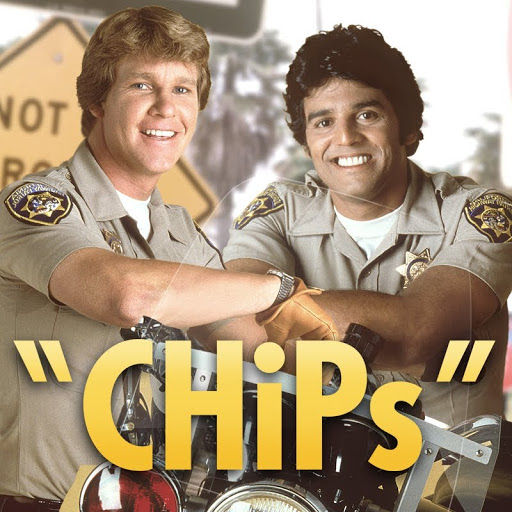
Welcome to Late Night Retro Television Reviews, a feature where we review some of our favorite and least favorite shows of the past! On Mondays, I will be reviewing CHiPs, which ran on NBC from 1977 to 1983. The entire show is currently streaming on Prime!
This week, Bonnie is taken hostage! It’s good thing Ponch exists because you know no one else on this show is going to able to rescue her.
Episode 4.7 “Satan’s Angels”
(Dir by Phil Bondelli, originally aired on December 14th, 1980)
When confronting a group of outlaw bikers who are harrassing a teenager (Heather Locklear, in her screen debut), Bonnie is kidnapped! Reno (John Quade) manages to snap her own handcuffs on her wrists and then drags her to a cabin owned by Stan (William Smith) and his wife (Candice Azzara).
Can the Highway Patrol find the cabin? The cabin is in the mountains it might not be easy to locate. It’s a good thing that Ponch and Jon just happen have those motorized hang gliders! It’s California living to the rescue! Needless to say, Ponch and Jon (but mostly Ponch) are able to swoop in for the rescue.
This episode didn’t do much for me but then again, episodes about hostage situations rarely do. Once a character is taken hostage, it pretty much causes the action to slow down to a crawl. There’s only so many times you can listen to someone being told not to even think about escaping before it gets kind of boring. This episode did feature the great villainous character actor, William Smith. It had that going for it. But, otherwise, the episode itself moved very slowly and it didn’t help that Bonnie herself was required to make a lot of very stupid mistakes so that she could be kidnapped in the first place. When a show’s storyline depends on a previous competent person suddenly being amazing incompetent, it’s an issue.
This episode’s b-plot featured Getraer’s very pregnant wife continually going the hospital, just to discover it was a false alarm. Getraer’s wife was played Gwynne Gilford who was (and is) married to Robert Pine. Their son, Chris Pine, was born a few months before this episode aired.
In this 1980 sequel to EveryWhichWayButLoose, Philo and his orangutan Clyde are still living next door to Orville (Geoffrey Lewis) and his mother (Ruth Gordon). Philo is still working as a truck driver but he’s becoming far better known as a bare-knuckles brawler. In fact, when another famous fighter named Jack Wilson (William Smith), moves to the area, everyone assumes that Jack wants to challenge Philo. It turns out that Jack’s actually a pretty nice guy. He and Philo become jogging buddies.
Remember Lynn Halsey-Taylor (Sondra Locke), the extremely self-centered singer who broke Philo’s heart in the first film? Well, she’s back and she’s changed her ways. When she and Philo meet in a bar, Lynn apologizes to him for her past behavior and soon, she and Philo are a couple again. Booo! Seriously, Eastwood and Locke somehow have even less chemistry here than they did in the first film. (Again, Locke and Eastwood were in a relationship at the time, which makes their total lack of chemistry even more interesting to consider.) Everyone in the film is surprisingly forgiving of Lynn, considering that she was portrayed as being nearly sociopathic in the previous film. Even Clyde seems to be happy to have her back. Of course, Clyde gets to have a romance of his own, with another orangutan. Clyde has sex with his partner while Philo and Lynne fool around in the room next door. It’s …. kind of weird.
Anyway, the Mafia really wants Philo and Jack to fight so they decide to kidnap Lynn in order to force the fight to happen. Instead, Jack and Philo team up to rescue Lynn and to put those gangsters in their place. That might sound dramatic but this film is very much a redneck comedy so these are probably the least intimidating mafia soldier that I’ve ever seen. Just as the previous film’s outlaw bikers (and they also make a return appearance in this film) were too buffoonish to be truly menacing, the same is true of the Mafia in this film.
In the end, Philo and Jack do have a fight but it’s under their own terms and, afterwards, they accompany each other to the hospital. It’s kind of a nice moment, really. Even after beating the hell out of each other and causing more than a few broken bones, Philo and Jack are still friends. It’s a nice touch that Jack was played by William Smith, who was a bit of a low-budget version of Clint Eastwood.
Indeed, with Geoffrey Lewis relegated to a supporting role and Sondra Locke abducted by the mafia, the friendship between Philo and Jack becomes the heart of the film and if there is really anything that makes this film memorable, it’s the scenes that Eastwood shares with William Smith. These two tough guys actors seem to have a natural understanding of each other and their friendship and mutual respect feels real. They may fight but it’s only out respect for each other. It’s a shame that Eastwood and Smith didn’t team up for more films.
AnyWhichWayYouCan is an amiable comedy. It’s not as much fun as EveryWhichWayButLoose. Beverly D’Angelo’s Echo is missed but she was presumably busy filming CoalMiner’sDaughter at the time. The film works best as a buddy movie. Clint Eastwood, William Smith, Geoffrey Lewis, and an orangutan. What a team!
Welcome to Late Night Retro Television Reviews, a feature where we review some of our favorite and least favorite shows of the past! On Mondays, I will be reviewing CHiPs, which ran on NBC from 1977 to 1983. The entire show is currently streaming on Prime!
This week, Ponch and Baker go to school!
Episode 3.17 “E.M.T.”
(Dir by Phil Bondelli, originally aired on January 19th, 1980)
Thinking that it will be an easy class and a chance to meet female college students, Ponch convinces Baker to attend a special EMT course at UCLA. Ponch also thinks that they’ll get paid overtime for taking the class but it turns out that he didn’t read the fine print. No one gets paid for going to the class. Oh well. At least he and Baker will get a chance to relax, right? Nope! The instructor, Michael Adams (played by veteran screen bad guy William Smith), is someone who Ponch and Baker earlier stopped for a minor traffic violation. He takes an immediate dislike to Ponch and Baker and basically spends the entire class accusing them of just wanting to show off. And, considering everything that we know about Ponch, he’s probably right.
Michael Adams is bitter because his son, Warren (Pat Petersen), was in an accident and, due to the cops not knowing how to handle someone with a spinal injury, Warren now has to use crutches to get around. Michael is so bitter that he almost seems to be embarrassed by his son’s disability. Boo, Michael, boo! Seriously, what an unlikable creep. And yet, I get the feeling that we’re supposed to understand and respect Michael, even if he is a jerk. Part of the problem is that William Smith was one of those actors who always came across as being naturally sinister. Smith played a lot of bikers and corrupt cops over the course of his career. He was someone who just looked menacing and perpetually annoyed. In this episode, I kept expecting him to try to kill Baker and Ponch. Don’t get me wrong. William Smith was a good actor but, in this episode, he just seems miscast.
Ponch and Baker do put their training to good use, especially when a makeshift cave collapses on two boys who were using it as a hideout. Ponch and Baker also use their skills to save a man who fell out of a truck. In one of those weird coincidences on which CHiPs thrived, Ponch and Baker just happened to be hang gliding nearby when the accident with the truck happened. Oh, Jon and Ponch! Don’t ever let anyone say that you guys spend way too much time together.
(Seriously, does Baker have no friends outside of the police force? At least Ponch seems to know his neighbors.)
Eventually, Ponch and Baker win Michael over, especially when Michael himself needs to be rescued. Later, they visit Michael in the hospital and everyone has a good laugh as the end credits roll. Good for them! As for this episode, I actually liked getting to see Ponch and Baker doing something other than riding their motorcycles on the highway. To me, this show’s main worth is as a time capsule and this episode allowed us all to see what UCLA was like back in 1980. It was pretty nice!
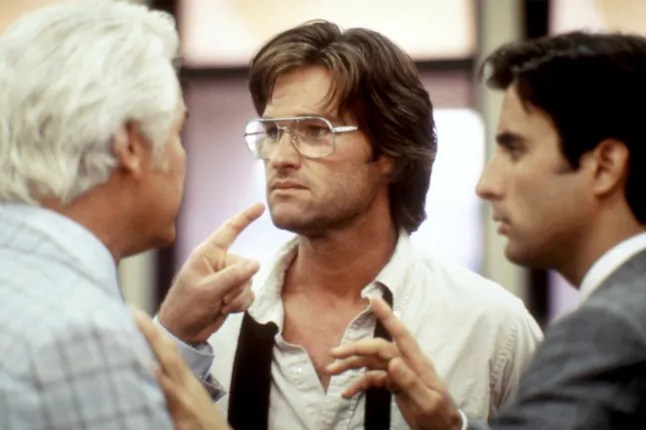
Every Monday night at 9:00 Central Time, my wife Sierra and I host a “Live Movie Tweet” event on X using the hashtag #MondayMuggers. We rotate movie picks each week, and our tastes are quite different. Tonight, Monday March 17th, we celebrate Kurt Russell’s 74th birthday by watching THE MEAN SEASON (1985) co-starring Mariel Hemingway, Richard Jordan, Richard Masur, Richard Bradford, Joe Pantoliano, and Andy Garcia.
Kurt Russell plays Malcolm Anderson, a reporter for a Miami newspaper. He’s had enough of reporting the local murders, so he promises his school teacher girlfriend (Mariel Hemingway) that they’ll move away soon. Before Malcolm can hand in his notice, the murderer (Richard Jordan) from his latest article phones him. The murderer tells Malcolm that he’s going to kill again. The phone calls and murders continue, and soon Malcolm finds that he’s not just reporting the story, he is the story.
We thought it would be fun to join The Shattered Lens and make Kurt Russell our centerpiece for the day. There’s absolutely nothing more enjoyable to me than watching movies with friends. And If you enjoy Russell, Miami, and serial killer thrillers, you should like this one. So, join us tonight for #MondayMuggers and watch THE MEAN SEASON! It’s on Amazon Prime.
The trailer for the THE MEAN SEASON is included below:
Welcome to Retro Television Reviews, a feature where we review some of our favorite and least favorite shows of the past! On Tuesdays, I will be reviewing the original Fantasy Island, which ran on ABC from 1977 to 1984. Almost the entire show is currently streaming on Daily Motion, YouTube, Plex, and a host of other sites.
It’s time for another trip to the Island!
Episode 5.4 “The Last Cowboy/The Lady and the Monster”
(Dir by Don Chaffey, originally aired on October 31st, 1981)
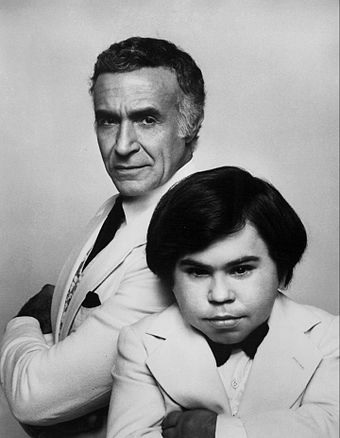
For the second week in a row, Tattoo is notably absent in this episode. He is seen in the stock footage that opens each episode of FantasyIsland. Shortly afterwards, his pre-recorded voice is briefly heard when Mr. Roarke explains to Julie that Tattoo has been turned invisible so that he can help with the fantasy of another guest who is also invisible. Seriously, that’s the excuse that the show goes with. Tattoo is “there” but he can’t be seen. I can only imagine what was going on behind-the-scenes with Herve Villechaize. It’s easy to assume that Villechaize was holding out for more money but, to be honest, it’s almost too easy to assume that. It’s also possible that Villechaize may have just asked for some time off to pursue his career as a singer.
As for the fantasies, the better of the two featured Lynda Day George as scientist Carla Frankenstein, who comes to the island because she wants to clear her ancestor’s reputation for being mad. Fortunately, the castle of Baron Frankenstein just happens to be on the Island! In the castle, Carla finds evidence that, rather than trying to bring the dead back to life, the Baron was instead working on ways to extend the average lifespan. She also discovers that the Baron’s monster (played by veteran character actor William Smith) is still living in the castle!
The Monster is a dignified old soul who has been mistreated every time that he’s left the Castle. Carla befriends him but again, the Monster is forced to confront the pettiness of the outside world when a corporate spy (Ken Swofford) tries to take both Carla and Julie hostage. After Carla and Julia are rescued, the Monster retreats to the Castle but Carla promises that she will not only return to see him but that she will also continue her ancestor’s research. In fact, her company is going to build a lab on the Island and presumably employ the one or two Islanders who aren’t already employed by Mr. Roarke.
This was a Halloween episode so a Frankenstein fantasy feels appropriate. William Smith played the role of the Monster with a wounded dignity that was actually quite touching. His lonely existence was quite sad and I was actually glad when Roarke suggested that he and Julie would, from now on, be joining the Monster for dinner.
As for the other fantasy, Joe Campbell (Stuart Whitman) is yet another city slicker who wants to be a cowboy. Joe thinks that Roarke is going to send him to the old west, as he has done for so many other people with the exact same fantasy. Instead, Roarke gets all technical and says that Joe’s specific fantasy was to be a cowboy and not to travel to the old west. Joe finds himself working as a hired hand on a modern-day ranch. Once Joe stops whining (and it takes a while), he falls in love with widow Margaret Blair (Diane Baker), becomes a surrogate father to Jimmy Blair (Jimmy Baio), and he chasess off an evil biker (Robert Tessier). In the end, Joe asks for permission to remain at the ranch and Fantasy Island. Roarke agrees, probably so Joe can potentially replace Julie if she ever asks for a raise like Tattoo did.
This fantasy felt a bit too familiar. It’s always weird how Roarke will arbitrarily decide to be strict with some guests while letting others do whatever they want.
In New York City, murders are being committed by a hulking man dressed in a policeman’s uniform. The NYPD brass (led by William Smith and Richard Roundtree) want to cover up the fact that the murders are being committed by an apparent maniac cop but Lt. Frank McRae (Tom Atkins) leaks the news to the press. With the citizens taking up arms against cops, the brass is eager to frame adulterous cop Jack Forrest (Bruce Campbell) for not only murdering his wife but also committing all of the murders. Lt. McRae believes that Jack is innocent.
Why is the brass so eager to frame Jack? Maybe it’s because they know that the Maniac Cop is actually Matt Cordell (Robert Z’Dar), a formerly good cop who was sent to Sing Sing on trumped up brutality charges. Cordell was killed in prison but he has now come back to life and is seeking revenge on the police force that he feels betrayed him.
Written by Larry Cohen and directed by William Lustig, Maniac Cop is the first of three Maniac Cop films. While the other two Maniac Cop movies largely work and hold up well, the first Maniac Cop is undoubtedly the worst of the trilogy, with most of the kills occurring offscreen and the action moving very slowly. The film is full of genre vets and Tom Atkins gives another one of this good tough guy performances. Bruce Campbell disappointingly plays his role straight and Robert Z’Dar, as intimidating as he is, is actually underused in this film.
As with most films written by Cohen, Maniac Cop has an interesting political subtext. It focuses on cop brutality and corruption with Cordell becoming a symbol of most people’s mixed feelings about the police. But the Maniac Cop trilogy wouldn’t really come to life until the second film. The first spends a lot of time setting Cordell up as a relentless avenger but there’s not much of pay-off.
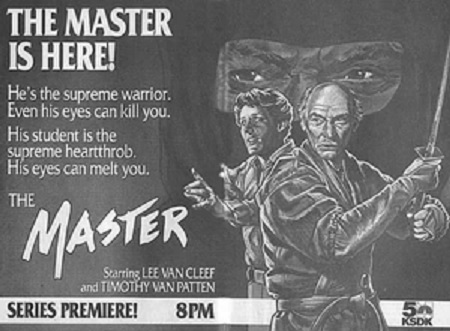
Welcome to Retro Television Reviews, a new feature where we review some of our favorite and least favorite shows of the past! On Fridays, I will be reviewing The Master, which ran on NBC from January to August of 1984. The show can be found on Tubi!
This week, Lee Van Cleef gets a chance to show off what he can do!
Episode 1.7 “Juggernaut”
(Dir by Gordon Hessler, originally aired on March 16th, 1984)
This week’s episode of The Master opens with Max’s totally groovy van driving across what appears to be farmland. Judging from the mountains in the background, it appears that they are back in California. (If they did mention their specific location during this episode, I missed it.) Last week, as you may remember, Max and McAllister were looking for McAllister’s daughter in Louisiana. Now, they’re apparently just hanging out in California again. It’s odd that McAllister left behind his life in Japan so that he could come to America to find his daughter but, now that he’s actually in America, there doesn’t really seem to be any sense of urgency when it comes to actually tracking her down.
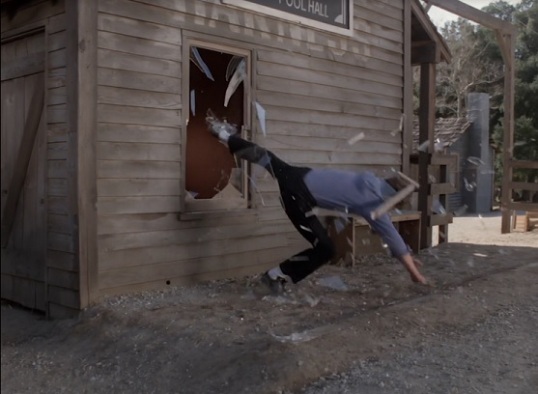
Inside the van, McAllister informs Max that he’s concerned about the way that Max is always losing his temper and starting fights. Max promises that there will be no more unprovoked fights on his part. When they stop in front of a local bar, Max says he’s going to get a beer but he also promises McAllister that he will not be getting tossed through the bar’s window.
Five minutes later:
Now, in all fairness, it isn’t totally Max’s fault that he got thrown through that window. Max went in the bar and saw Alan Kane (veteran TV and movie bad guy William Smith) harassing Cat Sinclair (Tara Buckman). When Max told Alan to back off, Alan challenged Max to a fight. Max was forced to explain that he’s not allowed to fight. Cat rolled her eyes and then Alan tossed Max through the window. Seeing that his protegee is in trouble, McAllister enters the bar, beats up Alan, and saves Max and Cat.
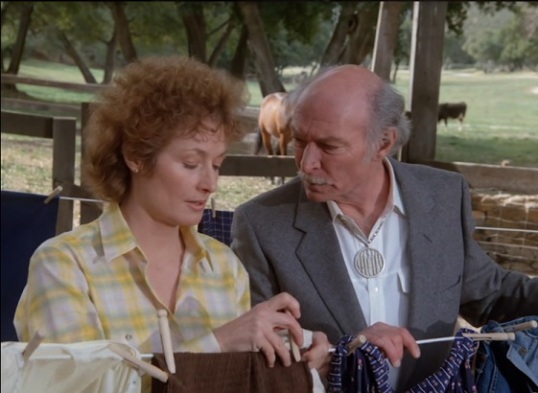
Even though Cat is not impressed with Max’s refusal to fight, she still gets in his van and allows him to give her a ride home. It turns out that Cat and her mother, Maggie (Diana Muldaur), are farmers but an evil land baron named Hellman (Stuart Whitman) is trying to intimidate them off their land. Alan works for Hellman and, because of him and his thugs, none of the farmers have been able to get their crops to market.
Both Cat and Maggie refuse to accept any help from Max and McAllister so our heroes get back in their totally happening van and try to leave town. However, when one of Hellman’s truckers runs the love van off the road, the engine is damaged and the local mechanic informs Max that it will take 48 hours to fix it. Stranded in town, Max searches for proof that Hellman’s trucker was the one who ran them off the road. Meanwhile, McAllister returns to the farm and, turning on some of that Lee Van Cleef charm, proceeds to fall in love with Maggie.
If any of this sounds familiar, it’s because, with the exception of McAllister falling in love, it’s pretty much the same thing that happened in not only the first episode but also the third episode. Max and McAllister have an uncanny talent for randomly wandering into towns that are controlled by evil businessmen. Just as the first and third episodes featured Max giving impassioned speeches about the rights of the workers, this episode features McAllister giving a speech at a meeting in a barn.
While McAllister is giving his speech, Max is getting arrested for snooping around Hellman’s property. Fortunately, McAllister puts on a fake beard and breaks him out of jail. McAllister then directs the farmers to form a convoy and to work together to get their crops to market. Though Alan attempts to set off a bunch of explosives on the way, McAllister uses a cropduster to fool Alan into setting off the explosions early. Then, Lee Van Cleef’s stunt double beats up Hellman. McAllister and Max congratulate each other on a job well done.
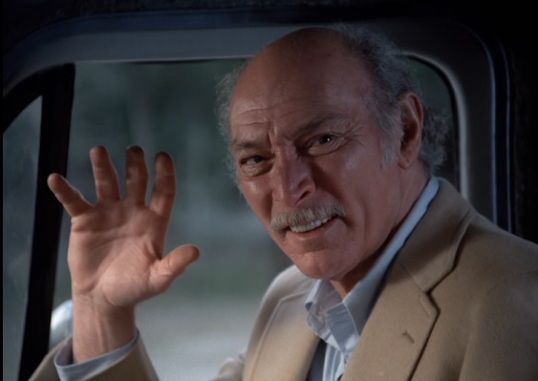
Having saved the farmers and beaten up the bad guys, it’s time for Max and McAllister to once again continue their journey across America. McAllister may love Maggie but he still needs to (eventually) find his daughter so he gets in the Chevy van and waves goodbye.
As I said before, this episode felt very familiar. It’s probably not a good sign that, after just seven episodes, The Master was pretty much repeating itself. That said, the episode did feature the great William Smith playing yet another rural bully and Stuart Whitman always made for a convincing villain. With Max sidelined by McAllister’s demand that he stop fighting, Lee Van Cleef got his moment to shine in this episode. He was obviously frail, making it all the more obvious that his fight scenes involved a stunt man, but Van Cleef still got a chance to show off some of his old school movie star charisma.
Next week: The Master steals the Crown Jewels of the United Kingdom! …. sure, why not?
Welcome to Retro Television Reviews, a feature where we review some of our favorite and least favorite shows of the past! On Tuesdays, I will be reviewing the original Fantasy Island, which ran on ABC from 1977 to 1996. The entire show is currently streaming on Tubi!
“Smiles, everyone, smiles!”
Sorry, Mr. Roarke, there’s not much to smile about when it comes to this episode.
Episode 1.7 “The Funny Girl/Butch and Sundance”
(Dir by Cliff Bole, originally aired on March 18th, 1978)
At the start of this episode, Tattoo is all excited because his birthday is coming up and he remembers that, last year, he partied all night and a bunch of beautiful women celebrated with him. Mr. Roarke promises Tattoo that things will be different this year. This year, Mr. Roarke says, there will be no presents. Tattoo will play a game of chess and drink a glass of sherry and maybe there will be a cello recital. Tattoo, needless to say, is disappointed.
Ignoring Tattoo’s anger, Mr. Roarke introduces him to the latest guests at Fantasy Island and it turns out that their fantasies are almost as disappointing and boring as Mr. Roarke’s plans for Tattoo’s birthday. Kay Penny (Marcia Strassman) is apparently the world’s most successful comedienne even though she never comes across as being particularly funny. Her fantasy is to move to small town where no one knows her. That sounds like a pretty lousy fantasy but whatever.
Bill (Christopher Connelly) and Alex (James MacArthur) are two friends who want to be Butch Cassidy and The Sundance Kid for a weekend. They’re huge fans of the film, though it appears neither one of them ever stuck around for the end. Mr. Roarke takes Bill and Alex to an old west town (perhaps the same one that we saw a few weeks ago) and Bill and Alex get to live out their fantasy while trading quips and robbing banks. The problem, for those of us who are watching then, is that neither Christopher Connelly nor James MacArthur can compare to Robert Redford and Paul Newman. Eventually, though, the great character actor William Smith shows up as a visitor whose fantasy is to be Wyatt Earp. He attempts to arrest Butch and Sundance. They outsmart him and then Bill and Alex go home, satisfied. Good for them but what about the guy who wanted to be Wyatt Earp? Does he get his money back? Seriously, I don’t think being humiliated was a part of his fantasy.
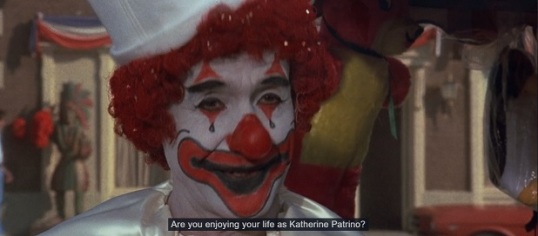
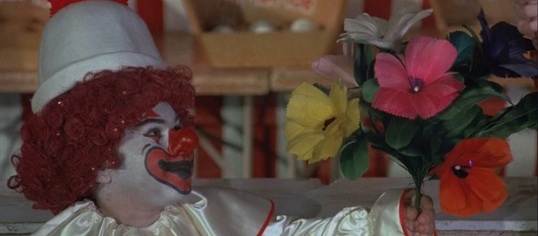
Meanwhile, Kay finds herself living in a small town. Using the name Katherine Patrino, she gets a job as the receptionist for a veterinarian (played by Dennis Cole) and she also helps the vet’s silent son get over the recent loss of his mother. She also tells a lot of jokes, none of which are particularly funny. The best thing about this fantasy is that Mr. Roarke disguised himslef as a clown and showed up at the small town’s Founders Day Festival.
And then Tattoo did the same thing.
Anyway, during the festival, a dog was hit by a truck but Kay helped to bring it back to life and that brought a tear to my mismatched eyes. Otherwise, this was a very forgettable trip to Fantasy Island.
On a positive note, though, it turned out that Mr. Roarke was just joking and Tattoo got to have a wild party after all. Good for him, he earned it!
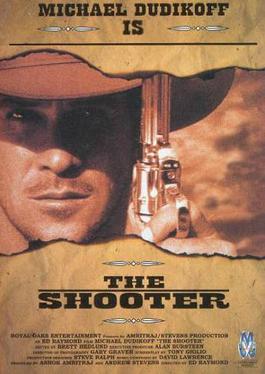
While riding his horse through the old, Michael Atherton (Michael Dudikoff) discovers a group of thuggish ranch hands attacking a prostitute named Wendy (Valerie Wildman). Because Michael is known as being the Shooter, he has no problem coolly gunning the men down and saving Wendy’s life. Unfortunately, for Michael, one of the dead men is the son of a fearsome rancher named Jerry Krants (William Smith) and Jerry has his own reasons for wanting Wendy dead. Michael may be the Shooter but Jerry Krants is William Smith so you automatically know that it is not a good idea to mess with him.
In the grand spaghetti western tradition, Krants has his men kidnap Michael, beat him up, and crucify him outside of town. The men leave Michael for dead but, after they’ve left, Wendy repays Michael’s kindness by untying him from the cross, nursing him back to health, and saving his life. (The same thing used to happen to Clint Eastwood, except he usually had to nurse himself back to health without anyone else’s help.) With everyone else believing him to be dead, Michael rides into town to get his violent revenge against Krants and his men. With all of the townspeople convinced that Michael has returned as a ghost, only the town’s power-hungry sheriff, Kyle Tapert (Randy Travis), understands what has actually happened. Tapert makes plans to use Michael’s return for his own advantage. While it wouldn’t look good for Tapert to openly murder all of his opponents, what if he killed them and then framed Michael? And then what if he made himself a hero by being the one to end Michael’s reign of terror?
Directed by Fred Olen Ray, The Shooter is a low-budget western that turned out to be far better than I was expecting. Ray is obviously a fan of the western genre and, with The Shooter, he’s made a respectful and, by his standards, restrained homage to the classic spaghetti westerns of old. He even shows some undeniable skill when it comes to building up the suspense before the climatic showdown. Ray indulges in every western cliché imaginable but he does so with the respect of a true fan.
With his less than grizzled screen presence, Michael Dudikoff is slightly miscast as a Clint Eastwood-style gunslinger but the rest of the cast is made up of genre veterans who give it their best. In particular, William Smith shows why he was one of the busiest “bad guys” working in the movies. To me, the most surprising part of the film was that the casting of Randy Travis as a villain actually worked. Fred Olen Ray made good use of Travis’s natural amiability, making Kyle into a villain who will give you friendly smile right before he opens fire. Also be sure to keep an eye out for Andrew Stevens, playing the man who records Michael’s story. It wouldn’t be a Fed Olen Ray movie without Andrew Stevens playing at least a small role.
Low-budget, undemanding, and made with obvious care, The Shooter is film that will be appreciated by western fans everywhere.
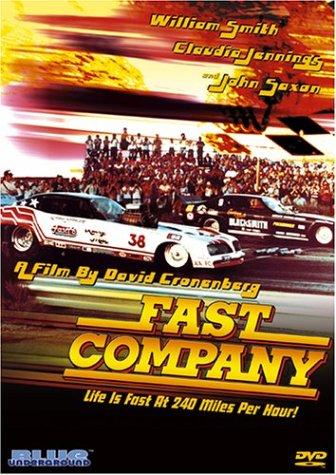
Released in 1979, Fast Company is a Canadian film about fast cars and the fast-living people who drive them. Lonnie Johnson (William Smith) is a veteran drag racer who is so good at his job that his nickname is “Lucky Man.” He rarely loses a race. He’s never without an adoring fan or two, though he always remains loyal to his girlfriend, Sammy (Claudia Jennings). Lonnie is so lucky that, even when one of his cars explodes, he walks away without even a scratch.
Lonnie and his protégé, Billy (Nicholas Campbell), are being sponsored by Fast Company, an international oil consortium. The money is okay but Lonnie is getting old and he would like to step back and spend some more quality time with Sammy. Unfortunately, the team boss is Phil Adamson (John Saxon) and the viewers knows that Phil is a bad guy because he’s played by John Saxon and, instead of driving to the races, he pilots his own private plane. When Lonnie starts to rebel against Phil’s management, Phil schemes to not only replace him and Billy with rival driver Gary Black (Cedric Smith) but he also plots to repossess Lonnie’s prized car!
Okay, so it’s kind of a silly and predictable film. In fact, there’s really only two reasons why Fast Company is remembered today.
One is because it was the last film to feature B-movie star Claudia Jennings before her death in a traffic accident. Jennings was nicknamed the “Queen of the B movies” and, over the course of her brief career, appeared in a lot of films about fast cars. She gives a likable performance as Sammy, even if the film’s script doesn’t really give her much to do.
Secondly, this film was directed by David Cronenberg. This was Cronenberg’s first time to direct a film that he hadn’t written. This was his first job as a “director for hire” but, interestingly enough, it was while directing this film that Cronenberg first worked with some of his most important future collaborators, including cinematographer Mark Irwin and actor Nicholas Campbell. Cronenberg directed Fast Company in between Rabid and The Brood and Fast Company might as well take place in a different universe from either of those films. To be honest, there’s not much about this film that would lead anyone to suspect that it had been directed by Cronenberg if they hadn’t already seen his name in the credits. Cronenberg’s signature style is really only evident when the camera lingers over the scenes of the mechanics working on the cars. In those scenes, there’s a hint of the Cronenberg that everyone knows, the Cronenberg who is fascinated by both the relationship between man and machine and how things work inside the body of both the driver and the car.
For the most part, Fast Company is a typical 70s racing film, one that was made for drive-in audiences and which makes no apologies for that fact. (Nor should it.) There’s a lot of shots of denim-clad Canadians cheering as their favorite driver crosses the finish line. William Smith brings a world-weary dignity to the role of Lonnie Johnson but, while John Saxon is always fun to watch, Phil Adamson is so evil that he threatens to throw the tone of the film out of whack. The light-hearted scenes of Lonnie, Billy, and head mechanic Elder (Don Francks) don’t always seem to belong in the same movie with scenes of John Saxon scheming to cheat and risk the lives of his drivers.
In the end, though, the important thing is that the cars are fast and so is this quickly paced movie. I’m enough of a country girl that I have to admit that I have a weakness for fast cars that leave a cloud of dust behind them. On that level, I enjoyed the film and really, that’s the only level that matters when it comes to a film like Fast Company.


 Through the Shattered Lens