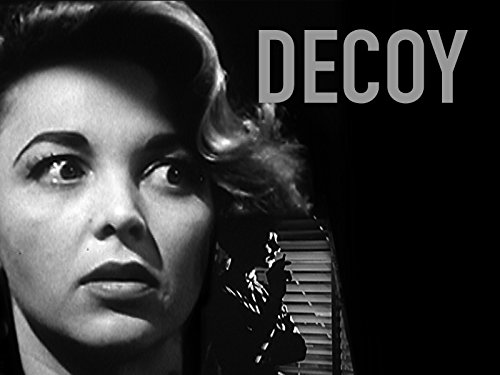
Welcome to Retro Television Reviews, a feature where we review some of our favorite and least favorite shows of the past! On Thursdays, I will be reviewing Decoy, which aired in Syndication in 1957 and 1958. The show can be viewed on Tubi!
This week, Casey learns about the dangers of reefer!
Episode 1.24 “Saturday Lost”
(Dir by Stuart Rosenberg, originally aired on March 24th, 1958)
Casey and her partner-of-the-week (played by Simon Oakland) are investigating the death of Geraldine “Geri” Wilson, a quiet and studious college student who was found dead on the side of the road after attending a college football game with her sister, Beth (Barbara Lord). Beth, who couldn’t even remember her own name when she was first found the morning after, isn’t much of a witness. She can’t remember what happened that night but, as she and Casey sit in one Geri’s old hangouts, she recognizes Ken Davidson (Larry Hagman), a student who was with them at the football game. Beth remembers that Ken and Geri had a fight.
The stunned Ken says that he had no reason to kill Geri.
Casey replies, “Marijuana gave you a reason!”
Casey has figured out, from listening to the way the spacey Beth talks, that Beth and Geri smoked “reefer” the night of the football game. Casey is convinced that, in a marijuana-crazed state, Ken tossed Geri out of the car. To help jog Beth’s memory, she has her partner drive Beth, Ken, and Casey along the same route where Geri’s body was found.
“Where did you get the reefers, sonny!?” Casey demands of Ken.
Beth suddenly remembers that she’s the one who bought the marijuana. Beth says that it only cost a dollar and that Ken himself didn’t indulge. Instead, it was just Beth and Geri who got stoned. Beth was driving when Geri opened the car door and fell out. “Faster! Faster!” Beth says, a line that immediately brings to mind the 30s anti-drug film, Reefer Madness.
(Why wasn’t Ken driving if he was the only one who wasn’t stoned?)
Back at police headquarters, Casey looks at the camera and tell us that the case has been dismissed. However, Beth will never forget that her sister died because Beth bought “reefer.”
Beverly Garland is, as always, excellent and a young Larry Hagman does well as Ken. But Barbara Lord overacts to such an extent that you really find yourself wondering if maybe she actually popped a bunch of amphetamines as opposed to smoking weed. Indeed, Beth and Geri’s story would be plausible with a lot of different drugs but it’s not particularly plausible with marijuana. There’s also a rather bizarre cameo from a young William Hickey (you’ll recognize the voice), playing a hipster who spouts a lot of nonsense. If anything, Hickey’s hipster comes across as if he’d be more likely to know where to get weed on campus than Ken but Casey just lets him wander off. In the end, this episode feels like a version of the urban legend about the girl who walked into an airplane propeller because she took too many pills.
Larry Hagman, I should mention, was a proud member of the Hollywood counter-culture and was very open about his own use of marijuana. (Apparently, he was introduced to it by Jack Nicholson, who felt it would help Hagman cut back on his drinking.) I wonder if anyone ever asked him about this episode.
Welcome to Retro Television Reviews, a feature where we review some of our favorite and least favorite shows of the past! On Mondays, I will be reviewing Miami Vice, which ran on NBC from 1984 to 1989. The entire show can be purchased on Prime!
This week, Crockett goes undercover as a Neo-Nazi.
Episode 5.16 “Victim of Circumstances”
(Dir by Colin Bucksey, originally aired on May 5th, 1989)
When a Miami coffeeshop is the scene of a violent shooting that leaves several dealers and the coffeeshop’s owner dead, Crockett and Tubbs assume that it’s just another part of an ongoing drug war. However, when it’s discovered that the owner of the coffeeshop was a Holocaust survivor who was scheduled to testify against a former guard named Hans Kozak (William Hickey), Crockett comes to suspect that the hit was ordered by a Neo-Nazi group. Crockett and Switek go undercover to infiltrate the group but it turns out that the killer was actually Helen Jackson (Karen Black), a reporter who is the daughter of Hans Kozak and who is trying to kill everyone who can testify against her father. Crockett and Tubbs manage to capture Helen but Helen is subsequently gunned down by Angelo Alvarez (John Leguizamo), the brother of one the dealers who was killed at the coffeeshop.
This was an interesting episode. On the one hand, it was based in reality. In the days following World War II, several concentration camp commandants were put on trial and executed for war crimes but the Allies were so busy going after the people in charge that there were several guards, doctors, and other personnel who were able to escape justice and who immigrated elsewhere. Quite a few went to South America. Several turned up in the Middle East. And there were many who ended up in America. It wasn’t until decades after the war that people started to get serious about tracking down and putting on trial the camp personnel who were often as brutal as the people giving the orders. By the time many of them started going on trial, they were elderly and often frail, like Hans Kozak. And, just as in this episode, there were many Neo-Nazi groups who protested the trials and sometimes tried to help the accused escape justice.
On the other hand, this episode played out in such a surreal manner that it often felt rather dream-like, with Hans Kozak being haunted by nightmares and the Neo-Nazis themselves meeting in ceremonies that felt as if they could have been lifted from one of Fritz Lang’s Dr. Mabuse films. Karen Black plays her role with such wild-eyed intensity that the revelation that she was the killer isn’t really that much of a surprise. As for William Hickey, he doesn’t so much chew the scenery as he treats it like a buffet. This was one of those episodes that felt like it could spin off into space at any given moment. If James Brown had returned as the alien who abducted Trudy, I would not have been surprised.
This episode was definitely watchable and Stefan Gierasch gave a strong performance as the Nazi hunter who was determined to track down Hans Kozak. There was nothing subtle about it but it’s still one of the more memorable episodes of the show’s final season.
Speaking of final season, next week will feature Crockett and Tubbs in their final adventure. And then, we’ll look at the four “lost” episodes, which aired in syndication after the show’s network run ended. And then, we’ll done with Miami …. for now.
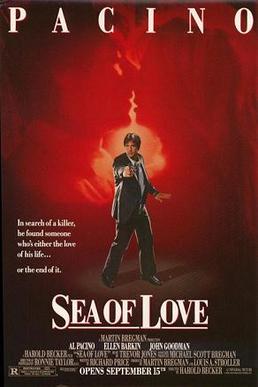
In New York City, someone is ritualistically murdering the men who are placing rhyming personal ads in a tabloid newspaper. Assigned to the case is Frank Keller (Al Pacino), an alcoholic burn-out whose wife just left him for another cop. Keller and his partner (John Goodman) decide to go undercover. Frank places a rhyming personal ad of his own and then goes to a restaurant to see who shows up. When Helen Cruger (Ellen Barkin) answers the ad, it leads to a relationship between Frank and Helen. Frank is falling for Helen but what if she’s the murderer?
Sea of Love is a superior thriller, even though it doesn’t really work as a mystery. As soon as you see a certain person’s name in the cast list, you’re going to guess who the killer is because that person is always the killer. Sea of Love isn’t really about the mystery, though. It’s about people looking something that’s missing from their lives and realizing that the world is passing them by. The movie works because of the performances of Al Pacino and Ellen Barkin, cast as two lonely middle-aged people who are desperately looking for some sort of connection. Helen and Frank are both in their 40s and wondering if their current situation is really as good as it’s going to get. The film uses Frank’s fear that Helen could be the killer as a metaphor for the fear that anyone feels when they are first starting to open up to someone. Both Pacino and Barkin give emotionally raw and poignant performances. I don’t think I’ve ever seen Al Pacino look as miserable as he did for the majority of Sea of Love. This was Pacino’s first film role after the disaster of Revolution and the movie’s box office success was revived Pacino’s career and convinced him to give movies a try again.
Director Harold Becker captures the feel of New York at its grittiest and least welcoming and Richard Price’s script is full of priceless dialogue. This is one of the rare films in which everyone has something intelligent or meaningful to say. Featuring a strong supporting cast and career-best performances from Ellen Barkin and Al Pacino, Sea of Love is much more than just another cop film.
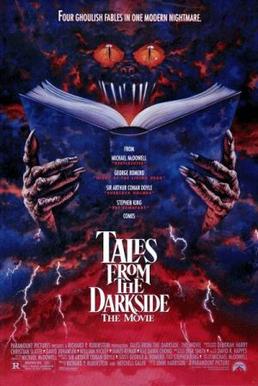
First released in 1990 and based on a horror-themed television series that was created by the one-and-only George Romero, Tales From The Darkside: The Movie is an anthology film. Usually, I can’t stand anthology films because it seems like the viewer only gets one good story and has to sit through two or three mediocre stories to get to the worthwhile stuff. However, I have to say that I really enjoyed all of the stories featured in Tales From The Darkside: The Movie.
The film opens with a wrap-around story, featuring Timmy (Matthew Lawrence), a young boy who is chained up in a pantry and who a local witch named Betty (Debbie Harry) is planning on cooking for a dinner party. Timmy tries to distract Betty from her kitchen duties by telling her three stories.
The first story features Steve Buscemi as a nerdy college student named Edward Bellingham. On the verge of getting a much-needed scholarship, Edward is framed for theft by two of his classmates (one of whom is played by Julianne Moore) and loses the scholarship. Edward responds by doing what anyone would do. He unrolls an ancient parchment and brings to life a mummy who kills his rivals. A very preppy Christian Slater plays Andy, the smug brother of one of the victims who seeks revenge against Bellingham. In a surprise twist, Bellingham is able to get some vengeance of his own.
The second story features William Hickey as Drogan, an annoying old man who is convinced that he is being stalked by an evil black cat. Drogan hires a hitman (David Johansen) to kill the cat but, as we all know, black cats are far more clever than anyone realizes. The story ends on a notably grisly note because cats rule!
Finally, the third story features James Remar as a struggling artist who, one night, discovers that the stone gargoyle that sits atop of his apartment building is actually alive. After witnessing the gargoyle kill someone, the artist promises never to reveal that the gargoyle exists. “Cross your heart?” the gargoyle asks before flying away. Later, the artist meets a mysterious woman (Rae Dawn Chong) who helps him to become a success on the art scene. However, even after he marries the woman and they start a family, Remar is still haunted by his memories of the gargoyle.
As I said at the start of this review, I’m not a huge fan of anthology films but I really liked Tales From The Darkside: The Movie. All three of the stories are equally good and there’s really not a slow spot to be found. This is a horror anthology that manages to balance scares and laughs without becoming too silly or forgetting that the movie is meant to be a horror story. Steve Buscemi, Christian Slater, and James Remar are stand-outs amongst the cast. Even the wrap-around story had a good ending!
If you’re going to watch an anthology film for Halloween, allow me to recommend Tales From The Darkside: The Movie!
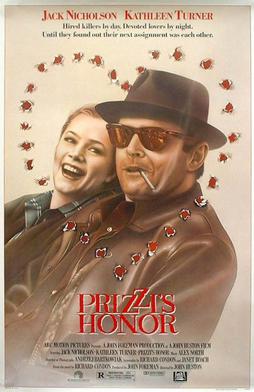
First released in 1985, Prizzi’s Honor tells the story of Charley Partanna (Jack Nicholson), a blue collar guy who lives in Brooklyn and who is a hard-working hit man for the Prizzi crime family. Charley is the son of Angelo (John Randolph), who is the right-hand man to the family’s elderly but still ruthless Don (William Hickey). In the past, Charley came close to marrying the Don’s daughter, Maerose Prizzi (Anjelica Huston), and he is almost as much a member of the family as the Don’s two sons, Eduardo (Robert Loggia) and Dominic (Lee Richardson).
While attending a family wedding, Charley meets and is immediately infatuated with a woman named Irene Walker (Kathleen Turner). Later, when Charley is sent to California to kill a man who robbed one of the family’s Vegas casinos, he is shocked to discover that the man is Irene’s husband. Irene swears that she didn’t have anything to do with the casino theft and, after a whirlwind courtship, Charley and Irene get married in Mexico. What Charley doesn’t know (but eventually discovers) is that Irene is herself a professional killer. While Charley and Irene try to balance work and love, Maerose conspires to turn the family against Irene and win Charley back.
Directed by the legendary John Huston, Prizzi’s Honor is pitch black comedy about two hard-working people who kill for a living. (The film’s big set piece is an extended sequence in which Charley and Irene’s attempt to pull a job together goes wrong in every way and they end up arguing about their relationship while dragging dead bodies from one room to another.) Though Prizzi’s Honor was released long before the series premiered on HBO, the film feels almost like a companion piece to The Sopranos, full of mobsters who are not as clever as they think they are and who struggle to uphold the old ways in an increasingly complicated world. Particularly when compared to the gangster who populate a film like TheGodfather, the Prizzis are defined by their pettiness. If Don Corleone epitomized wisdom and honor, Don Prizzi epitomizes someone who holds onto power solely for power’s sake.
Prizzi’s Honor is one of those films that probably seemed a bit more revolutionary when it was first released than it does today. At this point, we’ve seen so many films about hired killers who have quirky conversations while carrying out their work that the mix of violence and dark humor can feel almost like a cliché. As well, there are certain parts of the film, like the opening wedding sequence, that feel as if they go on for just a few minutes too long, as if John Huston himself was not always comfortable with the balance between the dark drama and the comedy of mob manners. That said, Jack Nicholson, Kathleen Turner (who gives a performance worthy of the great femme fatales of film noir), Anjelica Huston, John Randolph, and especially William Hickey all give strong enough performances to hold the audience’s attention and the film’s finale cuts to the point in such a way that it leaves you reconsidering everything that you’ve previously seen. Prizzi’s Honor has its flaws but Nicholson and Turner have such chemistry that the film’s ending sticks with you.
Prizzi’s Honor was nominated for 8 Oscars, including Best Picture, Best Director, Best Actor, and Best Supporting Actor for William Hickey. (Oddly, Kathleen Turner was not nominated for playing Irene.) In the end, it only won one Oscar that year, for supporting actress Anjelica Huston. The Oscars that year were dominated by a far more convention love story, Out of Africa.
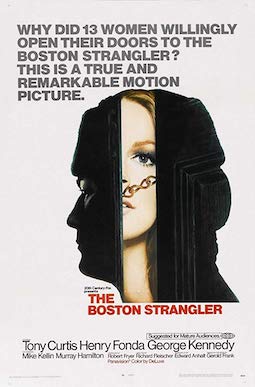
Between June 14, 1962 and January 4, 1964, 13 women between the ages of 19 and 85 were murdered in the Boston area. It was felt that they had all been killed by the same man, a monster known as The Boston Strangler. Though the police investigated many suspects, they never made an arrest. (One should remember that this was before the time of DNA testing or criminal profiling. The term “serial killer” had not even been coined. Today, sad to say, we take the existence of serial killers for granted. In the 60s, it was still an exotic concept.)
In October of 1964, a man named Albert DeSalvo was arrested and charged with being “the Green Man,” a serial rapist who pretended to be a maintenance man in order to gain access to single women’s apartments. After he was charged with rape, detectives were surprised when DeSalvo confessed to being the Boston Strangler. When confessing to the murders, DeSalvo got a few minor details wrong but he also consistently included other details that the police hadn’t released to the general public. Even when put under hypnosis, DeSalvo’s recalled those previously unreleased details. Because DeSalvo was already going to get a life sentence on the rape charges and because there wasn’t any physical evidence that, in those pre-DNA, could have conclusively linked DeSalvo to the crimes, he was never actually charged with any of the murders. Still, with his confessions, the cases were considered to be closed.
In 1966, before DeSalvo was even sentenced for the Green Man rapes, Gerold Frank wrote The Boston Strangler, a book about the murders, the investigations, and DeSalvo’s confessions. It was one of the first true crime books and, in 1968, it was adapted into one of the first true crime films.
Directed by Richard Fleischer (whose filmography somehow includes not only this film but also Dr. Dolittle, Fantastic Voyage, 20,000 Leagues Under the Sea, Conan The Destroyer, and Red Sonja), The Boston Strangler is really two films in one. The first half deals with the crimes and the police (represented by Henry Fonda, George Kennedy, Murray Hamilton, and James Brolin) investigation. This half of the film is pulpy and crudely effective, full of scenes of the cops rounding up every sex offender who they can find. There’s a scene where Henry Fonda talks to a prominent man in a gay bar that’s handled with about as much sensitivity as you could expect from a 1960s studio film. (On the one hand, the man is portrayed with respect and dignity and he’s even allowed to call out the patron saint of 1960s mainstream liberal piety, Henry Fonda, for being close-minded. On the other hand, everyone else in the bar is a stereotype and we’re meant to laugh at the idea that anyone could think that Henry Fonda could be gay.) Director Richard Fleischer makes good use of split screens, creating an effective atmosphere of paranoia. The scene where a woman tries to keep an obscene caller on the phone long enough for the police to trace his location made my skin crawl and served as a reminder that perverts predate social media. Another scene where a flamboyant psychic tries to help the police goes on for a bit too long but, at the same time, you’re happy for a little relief from crime scenes and terrified, elderly women discovering that their neighbors have been murdered.
The second half of the film features Tony Curtis as Albert DeSalvo. Curtis is effective as DeSalvo, playing him as being a self-loathing brute who is incapable of controlling his impulses. (Before committing one of his crimes, DeSalvo watches the funeral of John Kennedy, his face wracked with pain. Is the film suggesting that DeSalvo murdered to deal with the stress of life in America or is it suggesting that the hate that killed Kennedy was a symptom of the same sickness that drove DeSalvo? Or is the film just tossing in a then-recent event to get an easy emotional reaction from the audience?) As one might expect from a mainstream film made in 1968, The Boston Strangler takes something of a wishy washy approach to the question of whether DeSalvo’s crimes were due to sickness or evil. Yes, the film says, DeSalvo was bad but it’s still society’s fault for not realizing that he was bad. It’s the type of approach designed to keep both the law-and-order types and the criminal justice reformers happy but it ultimately feels a bit like a cop out. Still, the shots of DeSalvo isolated in his padding cell have an undeniable power and Curtis is both pathetic and frightening in the role. In its more effective moments, the second half of the film works as a profile of a man imprisoned both physically and mentally.
Watching the film today, it’s hard not to consider how different The Boston Strangler is from the serial killer films that would follow it. DeSalvo is not portrayed as being some sort of charming or interesting Hannibal Lecter or Dexter-type of killer. Instead, he’s a loser, a barely literate idiot who struggled to articulate even the simplest of thoughts. The cops aren’t rule-breakers or renegades. Instead, they’re doing their jobs the best that they can. Though the film ends with a title card saying that it’s important for society to make more of an effort to spot people like DeSalvo before they kill, The Boston Strangler has a surprising amount of faith in both the police and the law and it assumes that you feel the same way. It’s a film that takes it for granted the audience respects and trusts authority. It’s portrayal of the police is quite a contrast to the rebel cops who dominate pop culture today.
After the film came out, DeSalvo recanted his confessions and said that he had never killed anyone. He was subsequently murdered in prison in 1971, not due to his crimes but instead because he was independently selling drugs for prices cheaper than what had been agreed upon by the prison’s syndicate. After his death, many books were written proclaiming that DeSalvo was innocent and that the real Boston Strangler was still on the streets. Others theorized that the actual Strangler was DeSalvo’s cellmate and DeSalvo, knowing he was going to prison for life regardless, confessed in return for money being sent to his family. That said, in 2013, DNA evidence did appear to conclusively link DeSalvo to the murder of 19 year-old Mary Sullivan. Of course, that doesn’t mean that DeSalvo necessarily committed the other 12 murders. In fact, from what we’ve since learned about the pathology of serial killers, it would actually make more sense for the murders to have been committed by multiple killers as opposed to just one man.
Regardless of whether DeSalvo was guilty or not, The Boston Strangler is an uneven but ultimately effective journey into the heart of darkness.
Since there’s been like 200 Puppet Master films made over the past 30 years — goddamn, 30 years of killer puppets! — I figured that maybe I should finally sit down and actually watch one of them. I decided to go with the original film that started the entire franchise, 1989’s Puppet Master!
So, basically, this is a movie about little puppets that kill full-sized people. Obviously, there’s a bit more to the plot but let’s be honest. No one who watches this movie is going to be watching it for the specifics of the plot. They’re going to be watching it because they want to see tiny puppets go on a rampage. I have to say that the puppets themselves are pretty cute. I mean, they’re murderous and a little bit pervy but they’re still really cute. I understand that all of the puppets have their own specific names but, while watching the film, I just made up names of my own.
For instance, there’s Hooky, who has a hook for one hand and a knife for the other and looks like he should be the lead singer of an aging Prog Rock band. And then there’s Drilly, who has a drill on his head. He can be really dangerous, especially if you’re stupid enough to crawl around on the floor and just stay there, on all fours, while he’s running straight at you. I mean, if you just stood up, you probably wouldn’t get that badly injured but …. well, what do I know, right? And then there’s Leechy, who is a female puppet who spits up leeches. What’s interesting is that she never runs out of leeches but I have to wonder, if you have that many leeches, why not just send them out on their own instead of stuffing them all into some poor little puppet? I felt bad for Leechy. She seemed kinda sad. And then there’s Handy, who has big hands and Facey, who can assume several different facial expressions at once. They’re all really adorable, to be honest.
Anyway, Puppet Master is about a bunch of psychics who all spend the night in a California hotel that was once home to the “last alchemist,” Andre Toulon (William Hickey). Toulon had the power to bring inanimate creatures — like puppets! — too life but, when the Nazi spies were closes in on him, Toulon killed himself. Many years later, a psychic named Neil Gallagher (Jimmie F. Skaggs) discovered Toulon’s hiding place in the hotel but then shot himself as well. So now, Neil’s former colleagues are all trying to get Toulon’s power for themselves. Or something. As I said, following the plot is not always easy. The main appeal here is watching the cute puppets do really bad things.
That said, who knew that a group of psychics and witches would prove to be so stupid? I mean, you would think that — when all of you are having constant premonitions of death and destruction — you would be smart enough to take extra precautions or maybe just leave the hotel all together. For instance, Dana (Irene Miracle) casts a protection spell over someone else but not on herself. Meanwhile, Frank (Matt Roe) and Clarissa (Kathryn O’Reilly) make the rookie mistake of having sex in a horror film while our nominal hero, Alex (Paul Le Mat, looking like he’s trying to figure out how he went from American Graffitito this), wanders around in a daze.
And yet, watching the film, I could see why it became so popular. The puppets are memorable and well-designed and the backstory, with Toulon and all the rest, is actually pretty interesting. Puppet Master is one of those films that defines “stupid but fun.” No wonder the puppets came back!
Because her husband’s a dick who spends too much time working and not enough time taking the day off, Cassie (Mia Sara) grabs her five year-old daughter, Samantha (Kayla Buglewicz) and heads off for her sister’s house. When Cassie stops at a gas station to fill up the car, she’s spotted by seedy Roy Scudder (Burt Reynolds!). Roy puts down his cigar long enough to tamper with her car. When it breaks down a few miles down the role, Roy drives up and offers Cassie and Samantha a ride back to his place, where he can fix her car or where she can at least call for hep. Not realizing that she’s in a direct-to-video horror movie, Cassie accepts.
Big mistake! Roy’s wife, Georgina (Angie Dickinson!), has not been the same since the mysterious death of her son and Georgina and Roy’s other child, Jill (Candace Huston, daughter of the film’s director and granddaughter of John Huston), needs a playmate. Roy has decided that Samantha fits the bill. Cassie is locked in a room while Samantha is turned into Jill’s slave and Roy deals with the angry ghost of his abusive father (William Hickey!).
You have to feel bad for Burt Reynolds. He made this film at a time when his career was in decline. His TV show was no longer on the air. Boogie Nights was still two years away. The man had bills to pay. Can you blame Burt for accepting any role that came his way, especially if it meant a chance to co-star with Angie Dickinson and be directed by the son of John Huston? Reynolds was famous for hating even his good films so you can only imagine what he must have thought about The Maddening. Fortunately, since Burt was playing a total psycho in The Maddening, he could at least channel his feeling into the role. Throughout ever minute of The Maddening, Burt is totally and thoroughly unhinged and angry in the way that only the former number one star in America could be upon having to settle for a role in a direct-to-video horror film. He yells at his ghost father. He slits throats. He beats people into unconsciousness. He does everything that a normal movie psycho does but, when he does it, it’s even more memorable because he’s Burt Reynolds. Burt and Angie Dickinson playing the type of role that Bette Davis would have played for Robert Aldrich in the 60s are not just the main reasons to watch this movie. They’re the only reasons.
This was Burt’s only horror film and it’s too bad that it couldn’t have been a better one. But if it helped Burt keep the lights on during the lean years of the early 90s, good.
Here’s the main lesson that I’ve learned from watching the 1977 horror film, The Sentinel:
Even in the 1970s, the life of a model was not an easy one.
Take Alison Parker (Cristina Raines) for instance. She should have everything but instead, she’s a neurotic mess. Haunted by a traumatic childhood, she has attempted to commit suicide twice and everyone is always worried that she’s on the verge of having a breakdown. As a model, she’s forced to deal with a bunch of phonies. One of the phonies is played by Jeff Goldblum. Because he’s Goldblum, you suspect that he has to have something up his sleeve but then it turns out that he doesn’t. I get that Jeff Goldblum probably wasn’t a well-known actor when he appeared in The Sentinel but still, it’s incredibly distracting when he suddenly shows up and then doesn’t really do anything.
Alison has a fiancée. His name is Michael Lerman (Chris Sarandon) and I figured out that he had to be up to no good as soon as he appeared. For one thing, he has a pornstache. For another thing, he’s played by Chris Sarandon, an actor who is best known for playing the vampire in the original Fright Night and Prince Humperdink in The Princess Bride. Not surprisingly, it turns out that Michael’s previous wife died under mysterious circumstances. NYPD Detective Rizzo (Christopher Walken) suspects that Michael may have killed her.
(That’s right. Christopher Walken is in this movie but, much like Jeff Goldblum, he doesn’t get to do anything interesting. How can a movie feature two of the quirkiest actors ever and then refuse to give them a chance to act quirky?)
Maybe Alison’s life will improve now that she has a new apartment. It’s a really nice place and her real estate agent is played by Ava Gardner. Alison wants to live on her own for a while. She loves Michael but she needs to find herself. Plus, it doesn’t help that Michael has a pornstache and may have killed his wife…
Unfortunately, as soon as Alison moves in, she starts having weird dreams and visions and all the usual stuff that always happens in movies like this. She also discovers that she has a lot of eccentric neighbors, all of whom are played by semi-familiar character actors. For instance, eccentric old Charles (Burgess Meredith) is always inviting her to wild parties. Her other two neighbors (played by Sylvia Miles and Beverly D’Angelo) are lesbians, which the film presents as being the height of shocking decadence. At first, Alison likes her neighbors but they make so much noise! Eventually, she complains to Ava Gardner. Ava replies that Alison only has one neighbor and that neighbor is neither Burgess Meredith nor a lesbian.
Instead, he’s a blind priest who spends all day sitting at a window. He’s played by John Carradine, who apparently had a few hours to kill in 1977.
But it doesn’t stop there! This movie is full of actors who will be familiar to anyone who enjoys watching TCM. Along with those already mentioned, we also get cameos from Martin Balsam, Jose Ferrer, Arthur Kennedy, Eli Wallach, Richard Dreyfuss, and Tom Berenger. There are 11 Oscar nominees wasted in this stupid film. (Though, in all fairness, Christopher Walken’s nomination came after The Sentinel.)
Personally, The Sentinel bugged me because it’s yet another horror movie that exploits Catholic iconography while totally misstating church dogma. However, the main problem with The Sentinel is that it’s just so incredibly boring. I own it on DVD because I went through a period where I basically bought every horror film that could I find. I’ve watched The Sentinel a handful of times and somehow, I always manage to forget just how mind-numbingly dull this movie really is. There’s a few scary images but mostly, it’s just Burgess Meredith acting eccentric and Chris Sarandon looking mildly annoyed. If you’ve ever seen Rosemary’s Baby, The Exorcist, or The Omen, you’ll figure out immediately what’s going on but The Sentinel still insists on dragging it all out. Watching this movie is about as exciting as watching an Amish blacksmith shoe a horse.
There’s a lot of good actors in the film but it’s obvious that most of them just needed to pick up a paycheck. I’ve read a lot of criticism of Cristina Raines’s lead performance but I actually think she does a pretty good job. It’s not her acting that’s at fault. It’s the film’s stupid script and lackluster direction.
Tonight’s excursion in televised horror comes the second season of HBO’s Tale From The Crypt. Originally broadcast on April 21st, 1990, The Switch tells the story of an elderly millionaire (William Hickey) who is desperately in love with a younger woman (Kelly Preston). When she tells him that she’s looking for a younger man, he goes to extreme lengths to become that younger man.
The episode was directed by Arnold Schwarzenegger and features good work from both William Hickey and Kelly Preston. And, of course, the whole story ends with a sardonic twist that, once again, reminds the viewers that the universe is just as random and meaningless as Werner Herzog says it is.



 Through the Shattered Lens