Miniseries Review: Death by Lightning (dir by Matt Ross)


Death by Lightning, a four-episode miniseries that recently dropped on Netflix, tells the story of two “forgotten men,” as the show itself puts it.

Michael Shannon plays James A. Garfield, the Ohio farmer and former Congressman who, despite attending the 1880 Republican convention solely to give the nominating speech for Secretary of Treasury John Sherman (Alistair Petrie), found himself nominated for President after the convention found itself deadlocked between supporters of Former President Grant (Wayne Brett) and Senator James Blaine (Bradley Whitford).  Garfield did not want to run for President and he certainly did not want to run with Chester A. Arthur (Nick Offerman), an associate of New York political boss, Roscoe Conkling (Shea Whigham).  However, in November of 1880, James Garfield was narrowly elected the 20th President of the United States.

Matthew MacFayden plays Charles J. Guiteau, a failed lawyer and self-proclaimed newspaper publisher who felt that a stump speech he had given at a small rally was responsible for Garfield’s victory.  Guiteau expected to be appointed to a position in the Garfield administration, perhaps as Consul to France.  In those days of no Secret Service protection and an open White House, Guiteau was one of the many random office seekers who managed to get a face-to-face meeting with Garfield.  What Guiteau did not get was a job.  While Guiteau may have deluded himself into thinking that he was an inside player, everyone else viewed him as being a pesky and disreputable character.  On July 2nd, 1881, Guiteau shot Garfield in the back.  After Garfield died in September, Guiteau was convinced that he would be pardoned by the newly sworn-in President Arthur.  Instead, Guiteau was hanged on June 30th, 1882.

(It’s now generally agreed that Guiteau was such a bad shot that Garfield would have survived his wounds if not for the incompetence of his doctors, who probed his wounds with their bare hands in an effort to extract the bullet.  Garfield died as a result of multiple infections caused by his medical treatment.)

Again, Death by Lightning describes Garfield and Guiteau as both being forgotten men.  That’s not quite true.  I knew who both of them were before I watched the miniseries but then again, I’m also a history nerd.  As much as I don’t want to admit it, it is true that the majority of today’s Americans don’t know either Garfield or Guiteau.  And yet, in 1881, America revolved around them and their fate.  Everyone checked every day for news on Garfield’s health and Guiteau’s trial was heavily covered by the press.  That’s something to remember whenever you hear people talking about how “history will remember” whatever may be happening in the news today.  History may remember but people are quick to forget.

As for Death by Lightning, it does a good job of telling not only the stories of Garfield and Guiteau but also Chester Arthur as well.  The miniseries takes place at a time when political machines dominated American politics and also at a time when the Spoils system and the widespread corruption that it engendered were both accepted as immutable political realities.  Guiteau, having spent his life seeing other people receive jobs for supporting the right candidate, felt that he was naturally entitled to whatever position he requested.  Guiteau’s actions actually did lead to reformation of the Spoils system, with President Arthur emerging an unlikely reformer.  Never again would a random office seeker by allowed through the front doors of the White House and never again would a President casually walk around Washington D.C. without some sort of guard.  With a smart script, good performances, and even a few moments of unexpected cringe humor, Death by Lighting recreates that moment in American history and it pays tribute to James A. Garfield, who was universally described by his contemporaries as being a decent man who was struck down before he could reach his full potential.

How historically accurate is Death by Lightning?  That’s a fair question.  Death by Lightning sticks to the established facts about Garfield and Guiteau but a scene in which Garfield’s daughter argues with him about immigration is undoubtedly meant to be more of a commentary on 2025 than 1880.  I think it can be argued that no film or series can be 100% historically accurate because those who actually witnessed the events in question are no longer with us.  Inevitably, the past is always viewed and recreated through the filter of the present.  And indeed, it is tempting to compares Garfield and Guiteau to our modern-day politicians and activists.  Guiteau, with his constant excuses for his own dumb decisions and his ranting and raving about how he speaks for the people, was a particularly familiar character.  As for the modest and honest Garfield, it’s sadly difficult to think of any modern-day politicians from the same mold.

As a final note, my favorite part of this miniseries occurred during the first episode.  The recreation of the 1880 Republican Convention is wonderfully entertaining.  It’s amazing to think that, in the days before television coverage required political conventions to become carefully choreographed and tightly controlled, there actually was legitimate suspense about who would end up being nominated.  Sadly, those days seem to be over.
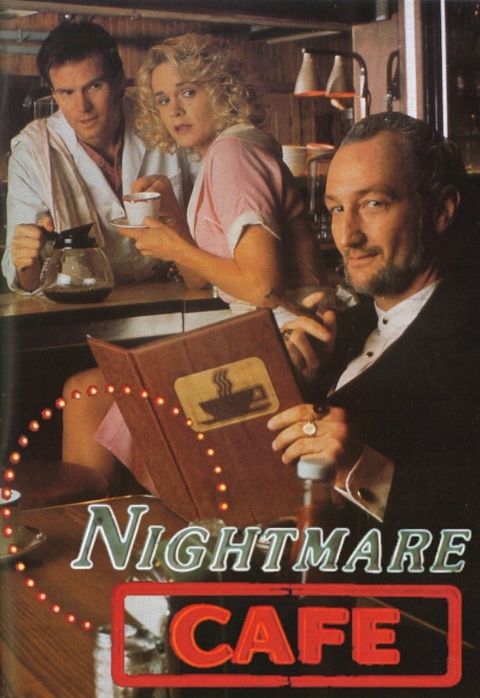
Late Night Retro Television Reviews: Nightmare Café 1.5 “Sanctuary For A Child”


Welcome to Late Night Retro Television Reviews, a feature where we review some of our favorite and least favorite shows of the past!  On Mondays, I will be reviewing Nightmare Café, which ran on NBC from January to April of 1992.  The entire show is currently streaming on YouTube!

This week, the café goes country!

Episode 1.5 “Sanctuary For A Child”

(Dir by Armand Mastroianni, originally aired on March 27th, 1992)

On tonight’s episode of Nightmare Café, we learn a few things about the café.  Apparently, the café is not just located in Los Angeles.  It can materialize anywhere on the planet but it apparently does so on its own.  Though Blackie (played by Robert Englund) claims to be the proprietor of the café, this episode suggests that he actually has no control over it.  While Blackie apparently does know why the Nightmare Café does the things that it does, it would appear that the café still has a mind of its own.  It decides where it is going and it decides when it is time to leave.

This episode, for instance, begins with the Nightmare Café materializing on a street in a small, country town.  Soon after it materializes, both Frank and Fay also materialize inside the café.  I’ve often wondered where Frank and Fay go whenever the café is closed for business.  Frank and Fay, after all, are essentially ghosts.  Do they need to eat or sleep?  This episode suggests that they do, as Fay complains about having to get up early because “the café” has decided to open up the crack of dawn.

Soon enough, a young boy named Luke Wall (Brandon Quintin Adams) comes walking into the café.  He and Frank immediately bond, with Frank realizing that Luke is trying to run away from home.  What Frank discovers upon following Luke out of the café is that Luke’s home is in a hospital.  Luke is in a coma and has been for quite some time.  Frank also discovers that the café has materialized in his home town, the place that he left when he joined the Navy and to which he thought he would never return.  Luke is the son of Frank’s former best friend, Tom (Vondie Curtis-Hall), and his ex-girlfriend, Evelyn (Angela Bassett).  Frank explains to Fay that Evelyn was the love of his life but his racist father demanded that they break up.  That was one of the main reasons why Frank left town and has never returned.

So, the Nightmare Cafe wants two things to happen.  It wants Tom and Evelyn to make peace with Luke’s impending death and also with each other.  And it wants Frank to deal with his past and his feelings towards his late father.

And that’s exactly what happens.  It’s a sweet episode, even if it’s a bit predictable and heavy-handed enough to end with “The Living Years” playing on the soundtrack.  In many ways, this felt more like an episode of Highway to Heaven than an episode of Nightmare Café but, as was so often the case with this show, the strong performances of the cast carried the narrative over any rough spots.  In the end, Frank made his peace with the past, Luke moved on to the afterlife, and the Nightmare Café moved on to a new town.

Next week: the final episode of Nightmare Café!

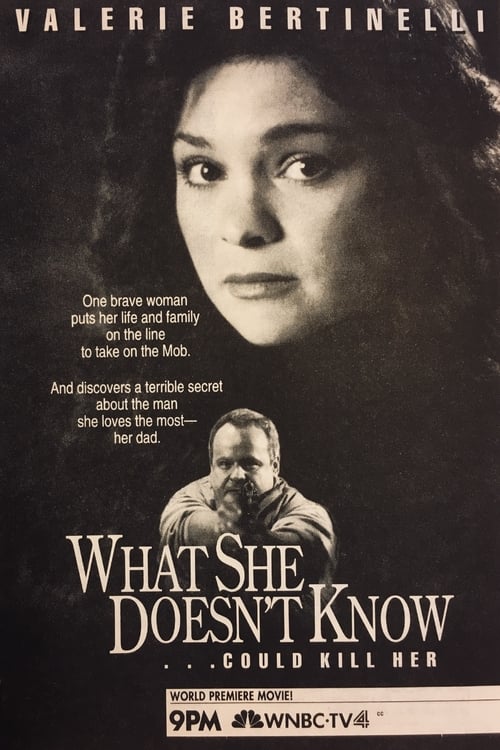
Retro Television Reviews: What She Doesn’t Know (dir by Kevin James Dobson)


Welcome to Retro Television Reviews, a feature where we review some of our favorite and least favorite shows of the past!  On Sundays, I will be reviewing the made-for-television movies that used to be a primetime mainstay.  Today’s film is 1992’s What She Doesn’t Know!  It  can be viewed on YouTube!

Molly Kilcolin (Valerie Bertinelli) has graduated from law school!

In fact, she’s not only graduated from law school but she’s graduated from Harvard Law School, the most prestigious and most expensive law school out there.  And she’s graduated at the top of her class.  She’s the one who gets to give the speech at graduation, where she says that everything she knows about justice she learned from her father.

It’s really quite an accomplishment when you consider that Molly isn’t even from a rich family.  She’s from a family of blue collar, New York City cops.  Her father, Jack Kilcoin (George Dzundza), certainly never had a chance to go to Harvard.  How did Molly even afford to go to Harvard?  Apparently, her tuition was paid out of a trust fund that her aunt set up for her when she was a child.  Seriously, that must have been a helluva trust fund because Harvard is not cheap or easy to get into.

Unfortunately, Molly disappoints her father when she tells him that she will not be accepting a job with a high class law firm but instead, she plans to work for the District Attorney’s office.  Her fellow prosecutors are skeptical of her as well.  Why does she want to go from Harvard to making next to no money in the trenches?  Someone asks her if she has political ambitions but no, Molly just wants to do the right thing.  She grew up in the neighborhood, don’t you know.  She knows the people who are getting caught up in the Mafia’s schemes.

After Molly convinces a young mobster named Joey Mastinelli (Peter Dobson) to testify against his boss, she is shocked to discover that over half of the NYPD is on the Mob’s payroll.  She is even more shocked to discover that her father is one of those dirty cops.  For years, her father has been taking bribes and hiding the money away in Molly’s trust fund.  Molly’s Harvard education was paid for by the Mafia!

As you can probably guess, family dinners are about to get awkward!

I usually enjoy films like What She Doesn’t Know because I’m always interested in the Mafia and there was a time when I briefly thought it might be fun to grow up and go to law school.  I don’t know if I would have wanted to become a prosecutor, of course.  Unlike Molly, I probably would have taken that ritzy law firm offer.  The idea behind What She Doesn’t Know had potential but it was let down by the execution.  Valerie Bertinelli tries hard but she’s just not convincing as a tough-as-nails Harvard grad.  George Dzundza is a bit more believable as an aging New York cop but he’s still a bit on the dull side.  (It would have been nice if this film could have been made a few years later, with Mira and Paul Sorvino in the lead roles.)

The film’s biggest flaw is that it portrays Molly as being so totally clueless about her father’s activities that it makes her seem to be impossibly naïve.  I mean, did she never wonder how she could possibly afford to go to Harvard?

Seriously, Harvard’s expensive!

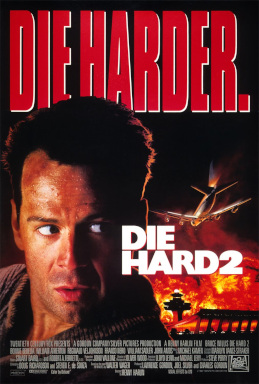
Holiday Film Review: Die Hard 2: Die Harder (dir by Renny Harlin)


During 1990’s Die Hard 2, John McClane (Bruce Willis) asks himself, “How can the same shit happen to the same person twice?” and he does have a point.

I mean, consider the situation.  In 1988, McClane spent his Christmas sneaking around a skyscraper and saving his wife from a group of sadistic mercenaries.  Two years later, John McClane spends his Christmas sneaking around an airport and saving his wife from a group of sadistic mercenaries.

There are a few differences of course.  In 1988, the mercenaries were only interested in stealing as much money as they could and each mercenary had his own properly ghoulish personality.  In 1990, the mercenaries are really more of a cult, led by the fanatical Col. Stuart (William Sadler).  And, along with trying to make some money, they are also trying to free General Ramon Esperanza (Franco Nero), a Central American drug lord and former CIA asset.  Despite the fact that the mercenaries are played by familiar actors (like Robert Patrick, John Leguizamo, Tony Ganois, and Vondie Curtis-Hall), none of them are quite as memorable as the henchmen that Alan Rickman commanded in the first film.  And while Sadler has charisma and makes a big impression during his first scene, his character is nowhere near as interesting or entertaining as Hans Gruber.  Franco Nero, it must be said, is as dashing as ever.  He really seems to be having fun in this movie.

A lot more people die in Die Hard 2 than died in the first Die Hard and the majority of them are innocent bystanders.  This isn’t like the first film, where Harry Ellis died because his coke-addled mind led him to believe that he could outsmart Gruber.  The victims in Die Hard 2 include a friendly church caretaker and over 200 passengers of an airplane that Stuart tricks into crashing on an airport runway.  The scene where the plane crashes remains disturbing no matter how many times that you see it and it truly makes you hate Colonel Stuart.  When the plane crashes, despite McClane’s futile efforts to warn the pilots, McClane sobs and it’s a powerful scene because it’s the first scene in which McClane has not had a quip or a one-liner ready to go.  In this scene, McClane fails to save the day and, for a few minutes, he’s helpless.  I usually end up crying with McClane.  Today, those tears are also a reminder of what a good actor Bruce Willis truly could be whenever he let down his defenses and allowed himself to be vulnerable on screen.

Die Hard 2 is usually dismissed as not being as good as the first movie and …. well, that’s correct.  It’s not as good but then again, few actions films are.  There’s a reason why Die Hard continues to be held in such high regard.  That said, Die Hard 2 is not bad.  The stakes are a bit higher and the action scenes a bit more elaborate, as you would expect from a film directed by Renny Harlin.  Bruce Willis plays McClane with the blue collar swagger that made his such an awesome hero in the first film.  Bonnie Bedelia and William Atherton also return from the first film and Atherton once again gets his comeuppance in a crowd-pleasing moment.  The cast is full of character actors, all of whom get a chance to make an impression.  Dennis Franz is the profane head of security who eventually turns out to be not such a bad guy.  John Amos is the major who eventually turns out to be not such a good guy.  Colm Meaney has a few heart-breaking moments as the pilot of the doomed airplane.  My favorite supporting performance is given by Fred Thompson, bringing his quiet authority to the role of tough but fair-minded Air Traffic Control director.  Watching Die Hard 2, it does feel as if the viewer has been dropped in the middle of these people’s lives.  Everyone seems real.  No one seems like a mere plot device.

Is Die Hard a Christmas movie?  You bet it is!  But so is Die Hard 2 and it’s not a bad one.

New Orleans Film Review: Bad Lieutenant: Port Of Call New Orleans (dir by Werner Herzog)


“Do you think fish dream?”

— Terrence McDonagh (Nicolas Cage) in Bad Lieutenant: Port of Call New Orleans (2009)

Happy Mardi Gras!

Since today is not only Fat Tuesday but also rapidly coming to a close, I think it’s time for me to share one final New Orleans film review.  Admittedly, though this film takes place and was filmed in New Orleans, it doesn’t feature any Mardi Gras scenes.  However, it does feature a lead performance that is perhaps as bizarre as anything that you’re likely to see in the French Quarter tonight.  Of course, I’m talking about Werner Herzog’s 2009 film, Bad Lieutenant: Port Of Call New Orleans.

Whenever I mention this movie to anyone, it only takes a few minutes before they get around to saying, “What was the deal with the iguanas?”  Everyone remembers the two iguanas who would randomly show up throughout the movie.  At one point, they were sitting in a coffee table while Lt. Terrence McDonagh (Nicholas Cage) and Sgt. Stevie Pruit (Val Kilmer) were watching a house across the street.  When McDonagh demanded to know why the iguanas were on his coffee table, Pruit replied, “There ain’t no iguanas.”  McDonagh looked down at them and grinned.  This was followed by several hand-held close-ups of the iguanas, looking around inquisitively while McDonagh kept giving them the side eye.

The iguanas show up a second time, after McDonagh has tricked one gangster into killing another gangster.  “Shoot him again,” McDonagh demands, “his soul’s still dancing!”  Herzog pans over to show us that, indeed, the man’s soul is still dancing next to his corpse.  After the soul gets shot down, an iguana wanders across the floor.

What do the iguanas represent?  Some people think that they actually are meant to be hallucinations.  As the result of a back injury that he received saving a prisoner during Hurricane Katrina, McDonagh has permanent back problems and this has led to him getting hooked on drugs.  The perpetually high McDonagh sees and does a lot of bizarre things over the course of this movie.  Perhaps the iguanas are just a part of his addiction.

Myself, I think the iguanas represent the fact that, no matter what McDonagh and anyone else in New Orleans does over the course of the film, the randomness of nature is going win out in the end.  After all, Bad Lieutenant: Port of Call New Orleans opens with Katrina, which is perhaps the ultimate example of how helpless modern society is in the face of nature’s whims.  The film takes places in neighborhoods that have yet to recover from the flooding.  Every corner of the film is full of physical, emotional, and mental debris.  McDonagh pops pills and snorts cocaine in an attempt to maintain some semblance of control but ultimately, the iguanas are going to show up regardless of how much control he thinks he has.  Just as how Klaus Kinski, at the end of Aguirre, The Wrath Of God, couldn’t keep the monkeys off of his raft, Terrence McDonagh can’t keep the iguanas off of his coffee table.

Bad Lieutenant: Port of Call New Orleans apparently started life as a reboot of Abel Ferrara’s 1992 film, Bad Lieutenant.  The script (which was credited to William M. Finkelstein) is full of moments that mirror scenes from Ferrara’s film.  Once again, the protagonist is a corrupt police lieutenant who spends almost the entire film fucked up on drugs and whose only friend is a prostitute.  Again, there’s a disturbing scene in which the lieutenant harasses a young woman in a parking lot.  Again, the lieutenant has gambling debts and again, the lieutenant has to solve a horrifying crime.

While promoting his film, Herzog always said that 1) he had never seen Bad Lieutenant and 2) he didn’t even know who Abel Ferrara was.  Judging from the way Herzog directs the film, which is the complete opposite of the approach that Ferrara took to similar material, I’m inclined to believe Herzog.  Whereas Ferrara’s film was a grim and humorless plunge into the depths of Hell, Herzog takes an almost satirical approach to the story.  The running joke throughout Herzog’s film is that the bad lieutenant gets results precisely because he is so thoroughly messed up and incompetent.  The final part of Herzog’s film features so many sudden twists and turns that it’s hard not to conclude that Herzog is poking fun at how American crime films always have to wrap everything up within the final fifteen minutes, regardless of how messy or convoluted their plots may be.  Whereas Ferrara’s film featured Harvey Keitel naked and bellowing in soul-searing pain, Herzog gives us Nicolas Cage grinning, laughing, and apparently having a ball.

This has got to be one of Nicolas Cage’s wildest performances.  He yells.  He bulges his eyes.  He grins maniacally at the strangest moments.  He interrogates a suspect while taking hits off a joint.  Because his character has a bad back, Cage moves stiffly, carrying himself almost as if he were a living Golem.  McDonagh may have his demons but, at the same time, he also seems to be having a blast every time we see him.  Wisely, Herzog also allows the character some quieter moments.  When the lieutenant talks about how he used to imagine there was pirate treasure buried in his back yard or when he and an ex-con sit in front of a gigantic fish tank, Cage gets a chance to show that there actually is something going on underneath all of McDonagh’s bluster.  This not only one of Cage’s most over the top performances but also one of his best.

Herzog not only gets the best out of Cage but also the best out of New Orleans.  He may not make New Orleans look beautiful but he still captures the atmosphere that has made New Orleans one of the most legendary cities in the world.  Cage, Herzog, and New Orleans make for a great combination.

Cleaning Out The DVR #36: Toni Braxton: Unbreak My Heart (dir by Vondie Curtis-Hall)


(For those following at home, Lisa is attempting to clean out her DVR by watching and reviewing 38 films by the end of today!!!!!  Will she make it?  Keep following the site to find out!)

tb

It’s becoming a new annual tradition.  Every January, Lifetime airs a biopic about a singer.  As I watched Toni Braxton: Unbreak My Heart, I found myself thinking about what makes a good biopic.  Unfortunately, good lives rarely make good biopics.  After all, we watch biopics for the drama behind-the-scenes.  When someone has lived a successful life and has basically lived her life with intelligence and integrity, it makes them a role model.  But it doesn’t necessarily make them into a fascinating subject for a movie.

Now, I have to admit that, before watching this movie, I didn’t know much about Toni Braxton.  My musical taste tends to run from EDM to more EDM.  I had heard the name Toni Braxton, of course.  I knew that there was a reality show called Braxton Family Values, though I’ve never seen an episode.  But I didn’t know much about her or her life.

So, as I watched, I kept waiting for the inevitable moment when Toni Braxton would first be pressured into trying cocaine or when she would end up in an abusive marriage or when she would eventually end up going through a Hellish rehab experience.  But none of that happened, largely because Toni Braxton appears to have been pretty intelligent when it came to making her life decisions.

Oh, there’s certainly some drama.  She had some financial difficulties early on her career.  Some members of her family get jealous of her success but not so jealous that they can’t be totally supportive.  She gets married but the marriage ends — not because of infidelity or abuse but just because sometimes marriages end.  And really, Lifetime should be commended for the way it handled the end of Braxton’s marriage because sometimes, marriages just don’t work out and it’s not anyone’s fault.  Finally, Toni discovers the she has Lupus.  Lupus is a serious disease and both Toni and the movie deserve full credit for educating the public.

In the end, Toni Braxton: Unbreak My Heart is a well-made and perfectly pleasant film but it’s not particularly memorable  Lex Scott Davis does a good as Toni and the film provides good roles for a lot of talented African-American performers.  But, as a movie, Toni Braxton: Unbreak My Heart never quite reaches the memorable heights of last year’s Whitney.

Daredevil Has No Need For Iron Suits or Magic Hammers


daredevil

“I accept your conviction. The lone man who thinks he can make a difference.” — Wilson Fisk

Today we saw the release of the official trailer for Netflix and Marvel Television’s first of five series based on characters from the Marvel Universe. Daredevil will be the first out of the gate and it looks to darken things a bit in the Marvel Cinematic Universe by bringing to the small screen one of it’s street-level heroes.

Daredevil (aka Matt Murdock) will soon be joined by Jessica Jones, Luke Cage and Iron Fist in their own web series on Netflix before teaming up for the Defenders series.

Under the guiding hands of showrunner (and Whedon alum) Stephen S. DeKnight, Daredevil will soon be available for bingewatchers everywhere on April 10, 2015.

Trailer: Daredevil


daredevil“Bless me father for I have sinned.” — Matt Murdock

Marvel has pretty much been dominating the big-screen with it’s yearly event offerings. 2015 will not be an exception with Avengers: Age of Ultron set for a summer release expected to rake in the box-office by the money bins. Now, Marvel has set it’s site on the small-screen with it’s first Netflix Original Series that will be the first link in a five series set that will culminate in a team-up series called the Defenders.

This first link will be a new, and hopefully better take, on the street-level superhero Daredevil aka the Man With No Fear. The blind lawyer by day and vigilante by night whose blindness since childhood has helped him developed the rest of his senses beyond human levels. We shall not speak of the film adaptation starring Ben Affleck over ten years ago.

Marvel’s Daredevil will release all 10-episodes on Netflix this April 10, 2015.