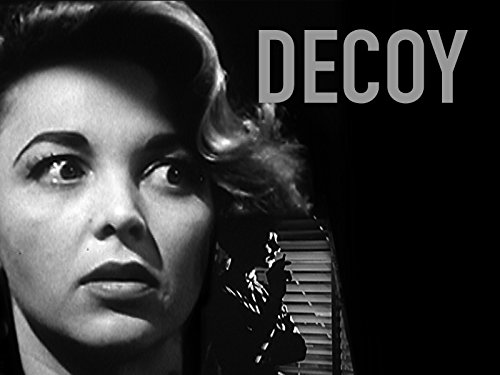
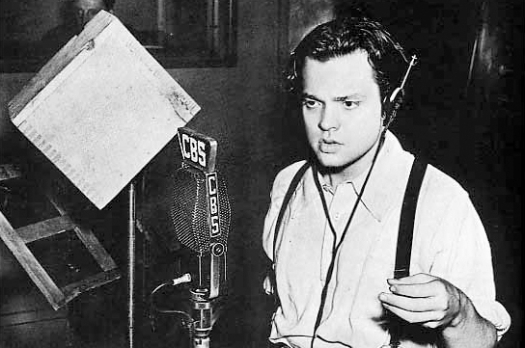
Filmed in 1957 for a television program called Westinghouse Studio One, The Night America Trembled is a dramatization of the night that Orson Welles terrified America with his radio adaptation of War of The Worlds.
For legal reasons, Orson Welles is not portrayed nor is his name mentioned. Instead, the focus is mostly on the people listening to the broadcast and getting the wrong idea. That may sound like a comedy but The Night America Trembled takes itself fairly seriously. Even pompous old Edward R. Murrow shows up to narrate the film, in between taking drags off a cigarette.
Clocking in at a brisk 60 minutes, The Night America Trembled is an interesting recreation of that October 30th. Among the people panicking: a group of people in a bar who, before hearing the broadcast, were debating whether or not Hitler was as crazy as people said he was, a babysitter who goes absolutely crazy with fear, and a group of poker-playing college students. If, like me, you’re a frequent viewer of TCM, you may recognize some of the faces in the large cast: Ed Asner, James Coburn, John Astin, Warren Oates, and Warren Beatty all make early appearances.
It’s an interesting little historical document and you can watch it below!
You’ve just won a Best Supporting Actor Oscar for playing a psychotic gangster and you’re worried that it’s going to lead to you getting typecast as a villain. What do you do?
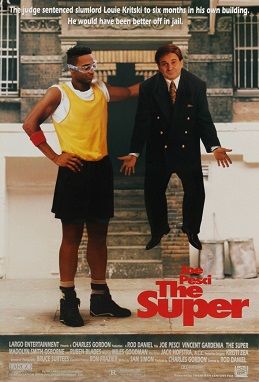
If you’re Joe Pesci, you follow-up playing Tommy DeVito in Goodfellas by agreeing to play Louie Kritski, Jr. in The Super. Louie is the son of a slumlord (Vincent Gardenia) and he’s eager to follow his old man into the family business. But when Louie is arrested for failing to keep his buildings up to code, he’s sentenced to actually live in one of them. Louie has to stay in a rat-infested apartment. He has to repair the rest of the building and will not be allowed to do any work on his apartment until everyone else’s apartment is up to code. Louie thinks that his father will use his influence to get his son out of this mess. It turns out that Big Lou just wants to set the building on fire and be done with it. Louie isn’t down with that. He may be a loud-mouthed slumlord but he has his standards.
Louie becomes a better person as a result of living in a slum. All of the tenants, from Marlon (Ruben Blades) to Tito (Kenny Blank), come to respect him. He even plays basketball with them. Louie finds a new girlfriend (Madolyn Smith) in the court officer who is sent to check on his progress. Louie is still Joe Pesci, though. He’s still a loud mouth who is quick to lose his temper and there’s always a feeling that Louie is about to snap and blow the entire building away. Joe Pesci was always a good actor and skilled at comedy but The Super doesn’t make good use of his talents in the way that My Cousin Vinny did. My Cousin Vinny worked because it put Joe Pesci in a place where you wouldn’t expect to find Joe Pesci, the genteel South. The Super is a New York movie and Pesci’s wiseguy intensity means that his sudden redemption doesn’t feel true.
The Super was a box office flop and briefly derailed Pesci’s attempts to show his range. Luckily, My Cousin Vinny was right around the corner.
Nominated for Best Picture of 1987, Moonstruck is a film about love, romance, New York City, and being Italian.
Loretta Castorini (Cher) is a widow and a bookkeeper who lives with her parents, Cosmo (Vincent Gardenia) and Rose (Olympia Dukakis) in Brooklyn. When her boyfriend, Johnny (Danny Aiello), asks Loretta to marry him, Loretta says yes even though she knows that, while she likes him, she’s not really in love with him. After he proposes, Johnny reveals that he has to go to Sicily to see his “dying” mother. He asks Loretta to pay a visit to his estranged brother, Ronny (Nicolas Cage), and invite him to the wedding. Loretta, a strong believer in family and the importance of following tradition, agrees.
Loretta finds Ronny working in the bakery that he owns. Ronny is not thrilled to learn that his brother has gotten engaged. Ronny reveals that he has a wooden hand. He lost his real hand when he accidentally placed it in a bread slicer while having a conversation with Johnny. After he lost his hand, Ronny’s then-fiancée left him. Ronny has never forgiven Johnny for the loss of his hand. “I lost my hand! I lost my bride!” Ronny yells to the heavens. Loretta, however, immediately understands that Johnny actually hurt his hand to get his fiancée to break up with him. A conversation at Ronny’s apartment leads to the two of them impulsively sleeping with each other. The next day, Ronny promises to never bother Loretta again if she agrees to go the opera with him.
What the guilt-stricken Loretta doesn’t know is that her father is having an affair himself and it turns out that Cosmo and Mona (Rose Gilette) enjoy the opera as well. Meanwhile, Rose finds herself tempted by a lecherous college professor named Perry (John Mahoney).
There’s a lot of stereotypes to be found in Moonstruck. Of course, passionate Ronny loves the opera. Of course, the simple but well-intentioned Johnny abandons his fiancée so that he can rush to Sicily to be with his “dying” mother who, it turns out, isn’t dying at all. Of course, Loretta slaps Ronny and tells him to snap out of it. (I should note that I’m a fourth Italian myself so I could definitely relate to some of this film. I’ve never liked opera, though.) Fortunately, the film’s cast is so perfectly chosen and John Patrick Shanley’s script so adroitly maintains the balance between the broad comedy and the small dramatic moments that it doesn’t matter that all of the characters are a bit stereotypical. The film comes to a wonderful life. It’s impossible not love these characters, flaws and all. Cher and Olympia Dukakis deserved the Oscars that they both won for this film. Vincent Gardenia deserved the nomination that he received. Nicolas Cage, Danny Aiello, and John Mahoney were not nominated but they should have been. In particular, John Mahoney is heart-breaking in his small role, playing the type of lecherous character that most films would have just portrayed as being a cardboard buffoon. As for Nicolas Cage, Moonstruck is a film that features both his trademark eccentricity and his ability to show the real and vulnerable human being underneath all of the bluster. Moonstruck is a film about the search for love and the glory of finding it. It’s a wonderfully romantic film, even if almost all of that love seems to involve infidelity. As directed by Norman Jewison, Moonstruck not only celebrates falling in love but also celebrates being lucky enough to do so in New York City. It’s a love letter not just to its characters but to the city as well.
Moonstruck was nominated for Best Picture but it lost to a far more epic production, The Last Emperor.
I’m on Day 2 of my discussion of Charles Bronson’s DEATH WISH series in chronological order. This series has brought me countless hours of entertainment over the last 40 years, so enjoy and let me know your thoughts!
Charles Bronson returns as vigilante Paul Kersey in DEATH WISH II. In this installment, Kersey is trying to get his life back on track in Los Angeles with his daughter Carol, who’s still traumatized from the events of the first film, and with his new lady friend Geri Nichols (Jill Ireland). One day when he takes these two out for a fun day of shopping and ice cream, Kersey runs afoul of a group of young thugs who take his wallet. They use the wallet to find Kersey’s address, stand outside his house and make a plan like they’re diagramming a back yard football play, and then break in and rape his housekeeper. They set up shop to wait on Kersey to come home. When Kersey and his daughter finally arrive, the thugs knock out Kersey and kidnap his daughter. They take her back to their warehouse / hideout, where they rape her and she then falls to her death trying to escape. After this series of horrific events, Paul Kersey again turns vigilante to hunt down and kill every person responsible.
DEATH WISH II (1982) came along at a time in Charles Bronson’s career when he needed a box office hit. His prior three movies, DEATH HUNT, BORDERLINE & CABOBLANCO, had barely made a dent at the box office. Around the same time that Bronson needed a hit, the infamous Cannon Films, recently purchased by cousins Menahem Golan & Yoram Globus, was also looking to make a big splash in the American movie market. Cannon decided that a sequel to DEATH WISH was just what they needed, and with a big paycheck, they were able to convince Bronson to come along for the ride. Director Michael Winner was also hired to direct. The resulting film was a big success, earning back eight times its production budget at the box office alone. Its success also started a relationship between Bronson & Cannon Films that lasted for a total of eight films all the way to the end of the 1980’s.
Now that we’ve discussed how important DEATH WISH II was to extending Charles Bronson’s leading man career and providing Cannon Films a needed hit, let’s talk about the movie itself. I’m just going to say upfront that it’s my least favorite of the DEATH WISH series. Even though it presents itself as a serious film, it’s more of an exploitative retread of the 70’s classic than a realistic continuation of the Kersey character. And the first thirty minutes is hard to watch. Not content with just allowing Kersey to lose a beloved family member, Winner has crafted two graphic rape and murder sequences. These scenes are rough. While they do make sure we want to see Paul Kersey get his revenge, they leave a bad taste in our mouth that doesn’t go away as the creeps are being dispatched one by one. Vincent Gardenia returns as Frank Ochoa, the New York detective who investigated the original vigilante killings in DEATH WISH. Gardenia was so good in the original, but he’s not given much to do here. Jill Ireland doesn’t really add much either as his new lady friend.
This is a Charles Bronson film though, so there are definitely some things about DEATH WISH II that I really do like. First, I think Bronson looks like a total badass in his beanie that he wears when he’s hunting down the creeps on the mean streets of LA. It’s a classic 80’s Bronson look. Second, Kersey has some cool sayings as he dispatches the bad guys. The “Do you believe in Jesus” exchange is the best example. Third, it’s fun seeing a young Laurence Fishburne show up as one of the creeps, extending the franchise’s ability to cast future big stars as horrific rapists. Jeff Goldblum had that distinction in DEATH WISH. And finally, Led Zeppelin guitarist Jimmy Page composed the music for DEATH WISH II. It’s a memorable soundtrack that’s different than just about anything I’ve ever heard. It’s the most unique thing about the entire movie!
The bottom line is that I would watch Charles Bronson read a phone book, so I will always find something to enjoy about his films. Well, maybe every one but LOLA. DEATH WISH II isn’t as fun as most Bronson movies, even if it does have some good moments. I’m glad DEATH WISH 3 went a completely different direction with Kersey’s character.
BONUS: Robert “Bobby” Lyons had a part in DEATH WISH II. On our THIS WEEK IN CHARLES BRONSON PODCAST, my partner Eric Todd and I interviewed Bobby about his time on DEATH WISH II and a whole bunch of other topics. He has some interesting stories to tell about working with Charles Bronson, as well as clashing on the DEATH WISH II set with Michael Winner. Give it a listen if you get a chance!
Over the next 5 days, I will discuss Charles Bronson’s DEATH WISH series in chronological order. This series has brought me countless hours of entertainment over the last 40 years, so enjoy and let me know your thoughts!
“Don’t ever make a death wish, because a death wish always comes true!” – I’ve always thought this was kind of a corny saying on the original DEATH WISH trailer, but as one of the world’s biggest Charles Bronson fans, I still hold the original DEATH WISH (1974) in extremely high regard. This is the 70’s revenge classic that made Bronson a box office superstar in his home country, while simultaneously influencing the way vengeance was depicted on screen for decades to come. DEATH WISH is one of the most underrated and influential films from a decade that was full of great films.
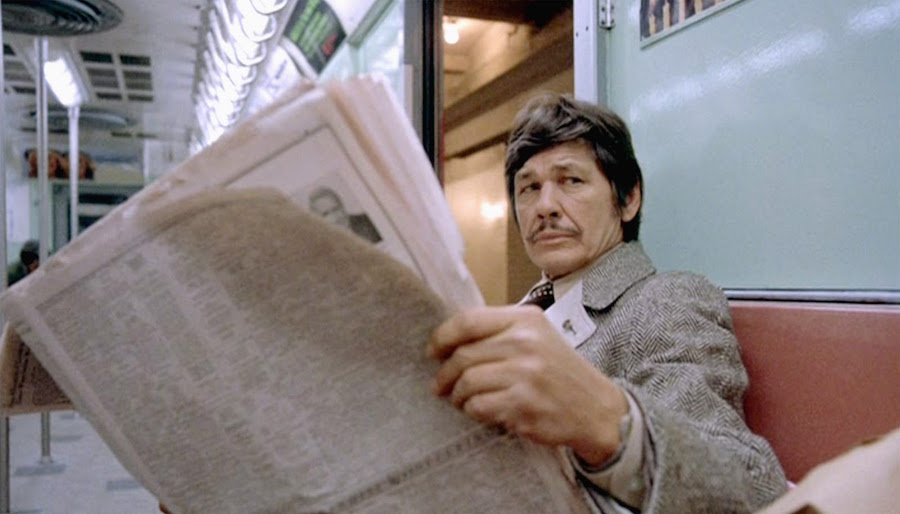
If you’re reading this review, I’d be about 99% positive that you know the basic story of the film. Charles Bronson plays Paul Kersey, a conscientious objector whose wife is killed and whose daughter is raped by a group of criminal thugs in New York City. When the police are incapable of providing justice, Kersey turns into a sidewalk vigilante and stalks the streets and subways of New York, luring thugs to mug him so he can shoot them with his 32-caliber Colt Police Positive pistol. Vincent Gardenia plays detective Frank Ochoa, who’s put in charge of finding the vigilante and putting an end to his one-man mission of justice.
It’s been 50 years since DEATH WISH was released into theaters and it’s hard to fathom just how controversial the film was in its time, especially since I wasn’t even 1 year old when it was released. The graphic rape scene that kicks off the events of the film, combined with the vigilante subject matter, turned off so many big stars, including Jack Lemmon, Henry Fonda and George C. Scott. This opened up the door for Charles Bronson who didn’t have any such misgivings. They just didn’t understand what a nerve the film would touch with the filmgoing public, who were tired of their cities being overrun by violent criminals. The movie became an audience participation movie unlike any others of the time with cheering in the seats every time Kersey offed another criminal. The controversial film became one of the top box office hits of the year and the biggest of Bronson’s career.
DEATH WISH was the fourth of six films directed by Michael Winner and starring Charles Bronson. In typical Winner fashion, the film has some strange touches, but the director is extremely effective in building the motivation for vigilante justice that was required for the film to thrive. He handles the action sequences well, and his cast is outstanding. Bronson & Gardenia are perfect in the lead roles, and the lovely Hope Lange has the brief, infamous role as Kersey’s brutalized wife. Stuart Margolin is especially memorable as the Arizona businessman who gives Kersey his gun. There are also a number of actors in small roles who were not well known when the movie was made who would go on to successful film careers. The biggest is Jeff Goldblum who has the most memorable role of the three muggers who attack Kersey’s wife and daughter at the beginning of the film. It’s a brief, but no holds barred performance for sure. Oscar winning actress Olympia Dukakis has a small role as a cop who expresses her frustration about the amount of leg work expected of her by Detective Ochoa. And finally, Christopher Guest has one scene as a young cop who finds the wounded vigilante and recovers his gun.
On a personal note, this film holds a special place in my heart as the first Charles Bronson film I ever saw. It was probably in 1984 or ‘85, and I stayed up with my dad to watch the late movie on our local TV station. The movie happened to be DEATH WISH. As bad things were happening to Kersey’s family at the beginning of the film, my dad told me not to worry, that “Charles would get them.” That intrigued me and let me know that Bronson had a reputation that preceded him. From that point forward, I wanted to rent a Charles Bronson film every time we went to the video store. And the rest, as they say, is history!
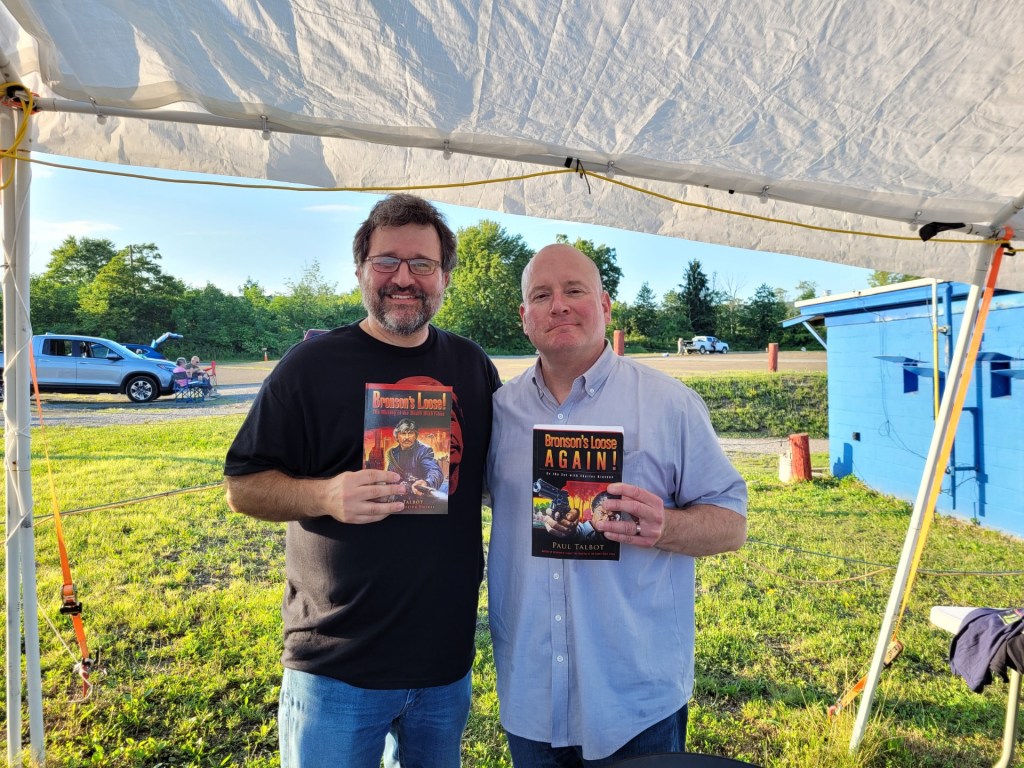
BONUS: The definitive book about the DEATH WISH film series was written by my friend, author and film historian Paul Talbot. The name of the book is BRONSON’S LOOSE: THE MAKING OF THE DEATH WISH FILMS. If you have any interest in Charles Bronson, the DEATH WISH series or Cannon Films, I can’t recommend Paul’s books more highly.
Filmed in 1957 for a television program called Westinghouse Studio One, The Night America Trembled is a dramatization of the night that Orson Welles terrified America with his radio adaptation of War of The Worlds.
For legal reasons, Orson Welles is not portrayed nor is his name mentioned. Instead, the focus is mostly on the people listening to the broadcast and getting the wrong idea. That may sound like a comedy but The Night America Trembled takes itself fairly seriously. Even pompous old Edward R. Murrow shows up to narrate the film, in between taking drags off a cigarette.
Clocking in at a brisk 60 minutes, The Night America Trembled is an interesting recreation of that October 30th. Among the people panicking: a group of people in a bar who, before hearing the broadcast, were debating whether or not Hitler was as crazy as people said he was, a babysitter who goes absolutely crazy with fear, and a group of poker-playing college students. If, like me, you’re a frequent viewer of TCM, you may recognize some of the faces in the large cast: Ed Asner, James Coburn, John Astin, Warren Oates, and Warren Beatty all make early appearances.
It’s an interesting little historical document and you can watch it below!
Filmed in 1957 for a television program called Westinghouse Studio One, The Night America Trembled is a dramatization of the night in 1938 when Orson Welles’s adaptation of H.G. Wells’s The War of the Worlds reportedly caused a panic amongst listeners.
For legal reasons, Orson Welles is not portrayed nor is his name mentioned. Instead, the focus is mostly on the people listening to the broadcast and getting the wrong idea. That may sound like a comedy but The Night America Trembled takes itself fairly seriously, complete with Edward R. Murrow narrating and taking drags off of a cigarette.
Clocking in at a brisk 60 minutes, The Night America Trembled is an interesting recreation of that October 30th. Among the people panicking are a large collection of future stars and character actors. Ed Asner, James Coburn, John Astin, Warren Oates, and Warren Beatty all make early appearances.
It’s an interesting historical document and you can watch it below!
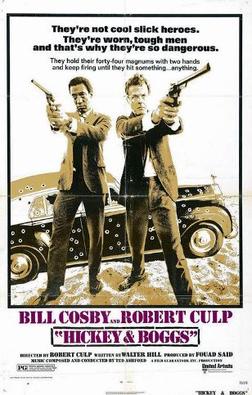
Frank Boggs (Robert Culp) and Al Hickey (Bill Cosby) are two private investigators who are constantly in danger of losing their licenses and going out of business. Hickey is the responsible one. Boggs is the seedy alcoholic. When Hickey and Boggs are hired to track down a missing woman, their investigation lands them in the middle of a war between the mob and a group of political activists who are fighting over who is going to get the loot from a recent robbery. Hickey and Boggs are targeted by the mob and soon, everyone is dying around them.
With its cynical themes and downbeat ending, Hickey & Boggs is very much a 70s film. The script was written by future director Walter Hill and when it was eventually offered to Bill Cosby, Cosby agreed to star on the condition that his I Spy co-star, Robert Culp, be hired to direct. Producer John Calley hired Culp but after Calley refused to provide the budget that Culp requested, Culp bought the script and raised the money himself.
There are a few problems with Hickey & Boggs, the main one being that the plot is next to impossible to follow. As a director, Robert Culp apparently didn’t believe in either filming coverage or providing establishment shots so, especially early on, it is often impossible to tell how one scene is connected to another or even how much time has passed between scenes. I don’t know if this was an intentional aesthetic decision or if the production just ran out of money before everything could be shot but it makes it difficult to get into the film’s already complicated story. On a positive note, Culp did have a flair for staging action scenes. The film ends with a shoot out on the beach that’s is handled with such skill that it almost makes up for what came before it. Also, like many actors-turned-director, Culp proved himself capable of spotting talent. Along with giving early roles to Vincent Gardenia, James Woods and Michael Moriarty, Culp also took the chance of casting sitcom mainstay Robert Mandan as a villain. It was a risk but it worked as Mandan convincingly portrays the banality of evil.
Of course, the biggest problem with Hickey & Boggs is that it stars Bill Cosby as a straight-laced hero and that’s no longer a role that anyone’s willing to believe him in. Cosby actually does give a convincing dramatic performance in Hickey & Boggs. Just look at the final scene on the beach where Hickey has his “what have we done” moment and shows the type of regret that Cosby has never shown in real life. The problem is that to really appreciate Cosby’s performance, you have to find a way to overlook the fact that he’s Bill Cosby and that something that I found impossible to do while watching Hickey & Boggs. When you should be getting into the movie, you’re thinking about how many decades Bill Cosby was able to get away with drugging and assaulting women. If not for a comment from Hannibal Buress that led to a social media uproar, Cosby would probably still be getting away with it. If Buress’s anti-Cosby comments hadn’t been recorded and hadn’t gone viral, Bill Cosby would still be free and the media would probably still be holding him up as some sort of role model.
At the time Hickey & Boggs was made, both Bill Cosby and Robert Culp were at a career crossroads. Cosby was hoping to transform himself into a film star. Culp was hoping to become a director. Hickey & Boggs, however, was disliked by critics and flopped at the box office. Culp never directed another film and we all know what happened with Bill Cosby. (Of course, it wasn’t just the box office failure of Hickey & Boggs that kept Cosby from becoming a movie star. Say what you will about Robert Culp as a director, he had nothing to do with Leonard Part 6.) Hickey & Boggs is too disjointed to really work but Robert Culp and Bill Cosby were convincing action stars and the film’s downbeat style and cynical worldview is sometimes interesting.
We all know the famous line from The Godfather. “I’m going to make him an offer he can’t refuse.” Of course, everyone also knows that “It’s not personal. It’s strictly business.” There’s another line that’s almost as famous: “One lawyer with his briefcase can steal more than a hundred men with guns.” That line comes from Mario Puzo’s novel. It’s never actually used in the film though it’s certainly present as a theme.
The idea of organized crime essentially being a huge corporation is hardly a new one. In fact, it’s become a bit of a cliche. Nearly every gangster film ever made has featured at least one scene where someone specifically compares their illegal activities to the day-to-day business of politicians and CEOs. However, just because it’s a familiar analogy, that doesn’t make it any less important. It’s hard not to think of organized crime as being big business when you consider that, in the 30s and the 40s, the mafia’s assassination squad was actually known as Murder, Inc.
Murder, Inc. was formed in Brooklyn, in the 30s. It was founded and initially led by a man named Lepke Buchalter. Lepke was a gangster but, because he was Jewish, he couldn’t actually become a made man. However, he used that to his advantage when he created Murder, Inc. The organization was largely made up of non-Italians who couldn’t actually become official members of the Mob. The major mafia families would hire Murder, Inc. to carry out hits because they knew that, since none of the members were made men, they wouldn’t be able to implicate any of the families if they were caught by the police.
It was a good idea and Lepke and his band of killers made a lot of money. Of course, eventually, the police did catch on. A member of the organization by the name Abe Reles was eventually arrested and agreed to be a rat. Lepke went to the electric chair. Reles ended up falling out of a window. Did he jump or was he thrown? It depends on who you ask.
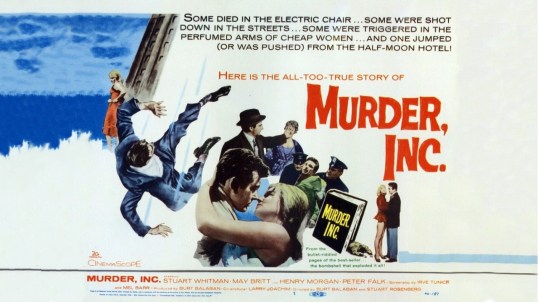
19 years after Reles plunged from that window and 16 years after Lepke was executed, their story was told in the 1960 film, Murder, Inc. Lepke was played by David J. Stewart while Reles was played by Peter Falk. The film is told in a documentary style, complete with a narrator who delivers his lines in a rat-a-tat-tat style. We follow Reles as he goes to work with Lepke and as he harasses a singer (Stuart Whitman) and his wife (May Britt), forcing them help him carry out a murder and then allowing them to live in a luxury apartment on the condition that they also let Lepke hide out there. (It’s probably not a surprise that a professional killer wouldn’t turn out to be the best houseguest.) Eventually, a crusading DA (Henry Morgan) and an honest cop (Simon Oakland) take it upon themselves to take down Murder, Inc.
To be honest, there’s not a whole lot that’s surprising about this film but it’s still an entertaining B-movie. The black-and-white cinematography and the on-location filming give the film an authentically gritty feel. The action moves quickly and there’s enough tough talk and violent deaths to keep most gangster aficionados happy. The best thing about the film is, without a doubt, Peter Falk’s portrayal of Abe Reles. Falk is magnetically evil in the role, playing Reles as a man without a soul. Even when Reles finally cooperates with the police, the film leaves no doubt that he’s only doing it to try to save himself. Falk plays Reles like a tough guy who secretly knows that his days are numbered but who has convinced himself that, as long as he keeps sneering and threatening people, the rest of the world will never figure out that he’s been doomed all the time. The more people he kills, the higher Reles moves up in the corporation and the more he tries to take on the look of a respectable member of society. But, no mater how hard he tries, Reles always remains just another violent thug. Falk was deservedly Oscar-nominated for his performance in this film, though he ultimately lost the award to Spartacus‘s Peter Ustinov.
Murder, Inc. may be a low-budget, B-movie but it’s also a classic of gangster cinema. It’s an offer you can’t refuse.
The 1971 satire, Cold Turkey, is the film that boldly explores just how much into the ground one joke can driven.
It’s a film that imagines what would happen if a big tobacco company decided to try to improve its image by giving people an incentive to quit smoking. In the real world, of course, they ended up funding Truth.org and coming up with anti-smoking commercials that were so lame that they would make viewers want to go out and buy a pack of cigarettes just to spite the self-righteous people lecturing them during the commercial breaks. In the film, however, Marwen Wren (Bob Newhart) comes up with the idea of offering to pay 25 million dollars to any community that can completely stop smoking for 30 days.
Wren figures that no large group of people will be able to just give up smoking for a month. Not in 1971! However, Wren didn’t count on the single-minded determination of the Rev. Clayton Hughes (Dick Van Dyke). Hughes is the stern and self-righteous minister of Eagle Rock Community Church in Eagle Rock, Iowa. He knows that Eagle Rock could really use that money so he sets off on a crusade to convince all 4,006 of the citizens of Eagle Rock to take the pledge to quit smoking.
As I said at the start of this review, Cold Turkey is pretty much a one-joke film. The joke is that everyone in the movie — from the tobacco company execs to the citizens of Eagle Rock to Rev. Hughes — is an asshole. They start the film as a bunch of assholes and, once they try to quit smoking, they become even bigger assholes. Soon, everyone in town is irritable and angry. The only people happy are the people who never smoked in the first place, largely because they’ve been set up as a sort of paramilitary border patrol. Even though his anti-smoking crusade lands him on the cover of Time, Rev. Hughes is also upset because he started smoking right before it was time to quit smoking. He deals with his withdraw pains through sex and frequent glowering.
Wren is concerned that the town of Eagle Rock might actually go for a full 30 days without smoking so he attempts to smuggle a bunch of cigarettes into the town and then runs around with a gigantic lighter that looks like a gun. It’s a storyline that doesn’t really go anywhere but then again, you could say that about almost all of the subplots in Cold Turkey. There’s a lot of characters and there’s a lot of frantic overacting but it doesn’t really add up too much. Storylines begin and are then quickly abandoned. Characters are introduced but then never do anything. For a while, It seems like the film is at least going to examine the Rev. Hughes’s totalitarian impulses but no. Those impulses are clearly there but they’re not really explored.
If I seem somewhat annoyed by this film, it’s because it really did have a lot of potential. This could have been a very sharp and timeless satire but instead, it gets bogged down in its own frantic storytelling and the film’s comedy becomes progressively more and more cartoonish. By the end of the movie, the President shows up in town and so does the military and it all tries to achieve some Dr. Strangelove-style lunacy but the film doesn’t seem to know what it really wants to say. It seems to be setting itself up for some sort of grandly cynical conclusion but instead, it just sort of ends. One gets the feeling that, at the last minute, the filmmakers decided that they couldn’t risk alienating their audience by taking the story to its natural conclusion.
Admittedly, while watching the film, I did find myself comparing Hughes and his bullying mob to the same people who are currently snapping at anyone who suggests that maybe the Coronavirus lockdowns were a bit excessive. It’s easy to think of some modern politicians and media figures who probably would have had a great time in Eagle Rock, ordering people around and shaming anyone who wants a cigarette. But otherwise, Cold Turkey was just too cartoonish and one-note to really work.