Horror On The Lens: Baffled! (dir by Philip Leacock)


This is a film that I share every year for Horrorthon and can you blame me?  Check out this pitch: Leonard Nimoy is a race car driver who can see into the future and who uses his powers to solve crimes!

Seriously, if that’s not enough to get you to watch the 1973 made-for-TV movie Baffled!, then I don’t know what is.  In the film, Nimoy takes a break from racing so that he and a parapsychologist (played by Susan Hampshire) can solve the mystery of the visions that Nimoy is having of a woman in a mansion.  This movie was meant to serve as a pilot and I guess if the series had been picked up, Nimoy would have had weekly visions.  Of course, the movie didn’t lead to a series but Baffled! is still fun in a 70s television sort of way.  Thanks to use of what I like to call “slo mo of doom,” a few of Nimoy’s visions are creepy and the whole thing ends with the promise of future adventures that were sadly never to be.  And it’s a shame because I’ve always wondered what was going on with that couple at the airport!

Enjoy Baffled!  Can you solve the mystery before Leonard?


Horror On The Lens: Mazes and Monsters (dir by Steven Hilliard Stern)


Hi there and welcome to October!  This is our favorite time of the year here at the Shattered Lens because October is our annual horrorthon!  For the past several years (seriously, we’ve been doing this for a while), we have celebrated every October by reviewing and showing some of our favorite horror movies, shows, books, and music.  That’s a tradition that I’m looking forward to helping to continue this year!

Let’s get things started with 1982’s Mazes and Monsters!

Based on a best-seller by Rona Jaffe, Mazes and Monsters tell the story of some college students who enjoy playing a game called Mazes and Monsters.  Now, I realize that Mazes and Monsters may sound a lot like Dungeons and Dragons but they are actually two separate games.  One game takes place in a dungeon.  The other takes place in maze, got it?

When the players decide to play the game in some nearby caves, it causes the newest member of the group (Tom Hanks — yes, Tom Hanks) to snap and become his character.  Convinced that he’s living in a world full of monsters and wizard, Hanks runs away to New York.  How does that go?  During a moment of clarity, Hanks calls his friends and wails, “There’s blood on my knife!”

It’s all fairly silly.  There was a moral panic going on about role playing games when this film was made and this film definitely leans into the panic.  But, in its own over-the-top way, it works.  If you’ve ever wanted to see Tom Hanks battle a big green lizard, this is the film for you.  And I defy anyone not to tear up a little during the final scene!

From 1982, here is Mazes and Monsters!  Happy Horrorthon!

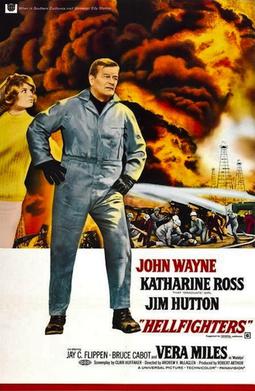
Hellfighters (1968, directed by Andrew McLaglen)


Chance Buckman (John Wayne) is the best there is when it comes to fighting oil fires.  Along with Greg Parker (Jim Hutton), Joe Horn (Bruce Cabot), and George Harris (Edward Faulkner), Chance travels the world and puts out fires that the regular authorities can’t handle.  Chance loves his job but he also loves his ex-wife, Madelyn (Vera Miles).  When Madelyn indicates that she wants to remarry Chance but only if he pursues a less dangerous line of work, Chance retires from firefighting and becomes an oil executive.  He leaves his firefighting company to his new son-in-law, Greg.  When Greg and Chance’s daughter (Katharine Ross) head down to Venezuela to battle a fire and find themselves not only having to deal with the flames but also with a band of revolutionaries, Chance is the only one who can help them.

When I was growing up, Hellfighters was one of those movies that seemed to turn up on the local stations a lot.  The commercials always emphasized the idea of John Wayne almost single-handedly fighting fires and made it seem as if the entire movie was just the Duke staring into the flames with that, “Don’t even try it, you SOB” look on his face.  As a result, the sight of John Wayne surrounded by a wall of fire is one of the defining images of my childhood, even though I didn’t actually watch all the way through until recently.  When I did watch it, I discovered that Hellfighters was actually a domestic drama, with an aging Wayne passing the torch to youngster Jim Hutton but then taking it back.

The fire scenes are the best part of Hellfighters and I wish there had been more of them.  The movie gets bogged down with all of Chance’s family dramas but it comes alive again as soon as John Wayne and his crew are in the middle of a raging inferno, putting their lives at risk to try to tame the fire.  Wayne was always at his best when he was playing strong, no-nonsense men who were the best at what they did.  Hellfighters is slow in spots but the fire scenes hold up well.  There’s no one I’d rather follow into an inferno than Chance Buckman.

Film Review: The FBI Story (dir by Mervyn LeRoy)


In 1959’s The FBI Story, veteran FBI agent Chip Hardesty (James Stewart) delivers a lecture to a group of new FBI recruits.  He tells them the story of both the FBI and his time as a member of the agency.  Somewhat implausibly, it turns out that Chip was involved with nearly every major FBI operation, as we discover while watching this flashback-filled, episodic film.

Battling the Ku Klux Klan in the Deep South?  Chip was there.

Investigating the Oklahoma Indian murders?  Chip was not only there but he was also the one who solved them through handwriting analysis!  (Decades later, the crimes and the investigation would serve as the basis of Martin Scorsese’s Killers of the Flower Moon.)

During the public enemy era, Chip was there.  He was there when Baby Face Nelson killed several unarmed FBI agents, including Chip’s best friend (Murray Hamilton).  He was there when John Dillinger was gunned down in Chicago.  He was there when my distant ancestor “Pretty Boy” Floyd was killed in Ohio.  He wasn’t there when J. Edgar Hoover personally arrested Alvin Karpis or when “Machine Gun” Kelly said, “Don’t shoot, G-Man!” but Chip still makes sure to tell the recruits about it.  He also talks about the gunfight that killed Ma Barker, presented her as being a machine gun-toting madwoman.

Chip investigates subversives during World War II and helped to round up Americans of German and Japanese descent during the internment era.  (Chip insists that they weren’t rounded up because of their ancestry but because the FBI had gotten reports that they might be disloyal.)   When the war wraps up, Chip turns his attention to fighting the international communist conspiracy and good for him.  (Communism sucks!)

Strangely enough, it appears that Chip also tells the recruits a good deal about his personal life because we certainly do see a lot of it.  Chip marries a librarian named Lucy (Vera Miles), who struggles with the demands of being an FBI agent’s wife but who ultimately accepts that Chip has to do his duty.  Sometimes, Lucy wants Chip to quit and sometimes, Chip is tempted to get out.  But they always remember that Chip and the FBI have a job to do.  They raise a family.  They lose a son at Iwo Jima.  Their faith in God and country remains undiminished.

The FBI Story was made with the full cooperation of the FBI, with J. Edgar Hoover personally approving the script and making suggestions.  Hoover even appeared as himself in the film, accepting a report about an airplane bombing with a grim look on his face.  At one point, Chip is prepared to quit the FBI until he hears a speech from Hoover and he’s so inspired that he keeps his resignation letter tucked away in his suit pocket.  Since this film came out in 1959, there’s no details of the FBI tapping the phones of Martin Luther King or Hoover collecting dirt on his political opponents.  Instead, The FBI Story is pure propaganda, your reminder that law enforcement never makes mistakes and civil liberties can be always be sacrificed for the greater good.

It’s simplistic propaganda and it’s overlong and it promotes a few falsehoods as facts.  (Despite what the film says, Pretty Boy Floyd had nothing to do with the Kansas City Massacre and most historians agree that Ma Barker was not the criminal mastermind that Hoover made her out to be after she was caught in the crossfire between her sons and law enforcement.)  The film rather casually dismisses the concern over the World War II internments of American citizens.  To me, something like that is a big deal but the film insists to us that it was all blown out of proportion.  That’s the one moment when not even the film itself seems to be totally sold on what it’s selling.

Fortunately, the film stars the ever-reliable James Stewart, who brings his natural mix of charm and gravity to the role of Chip Hardesty.  Stewart was a bit too old to play Chip as a bumbling young man in the early part of the film but, as the character grows up, so does Stewart’s performance.  The scene where he and Vera Miles learn that his son has been killed in combat feels like it’s from a different and far better movie.  I guess my point here is that James Stewart was one of those actors who could make even questionable material watchable and that’s certainly what he does with The FBI Story.  The FBI, at a time when Hoover was aging and the excesses of the McCarthy era had left many Americans uneasy about the government, decides to borrow James Stewart’s credibility to boost their own.  You may not like the FBI but how can you not love Jimmy Stewart?

The FBI Story came out the same year as one of Stewart’s best films, Anatomy of a Murder, a film that was a complicated as The FBI Story was simplistic.  Stewart gives one of his best performances in Anatomy of a Murder, playing the type of character that Chip Hardesty probably wouldn’t want to have much to do with.  With these two films, Stewart showed us both sides of the American justice system, the men who are tasked with enforcing the law and, even more importantly, the men who are tasked with making sure that law was enforced fairly.  Whichever side your on, you have to be happy to have Jimmy Stewart there.

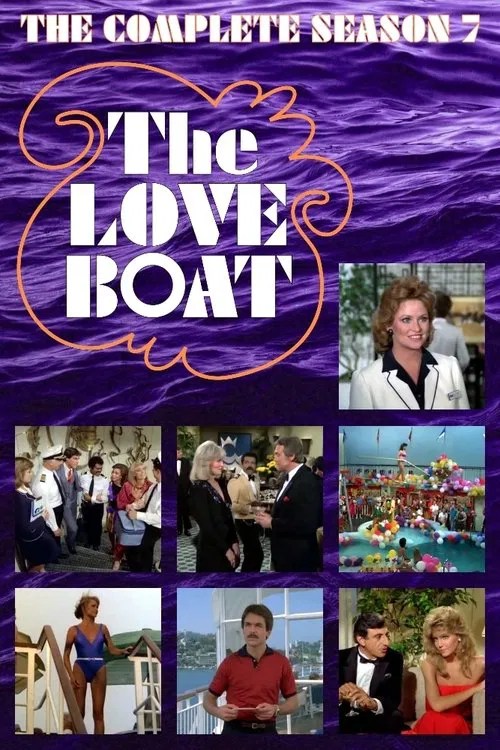
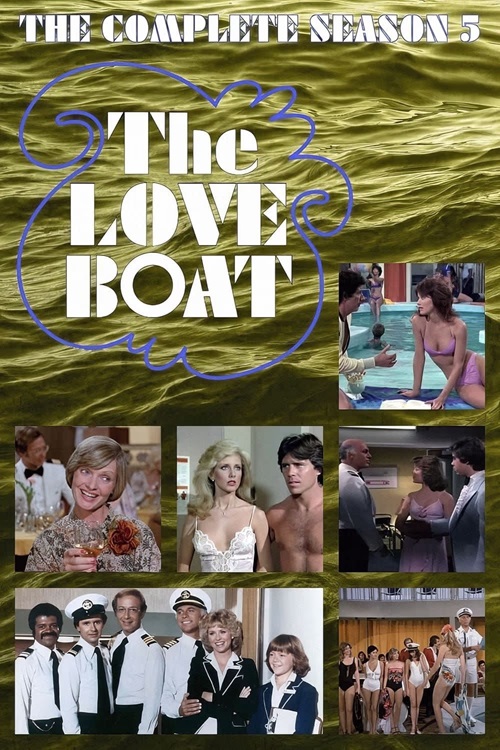
Retro Television Review: The Love Boat 5.18 “His Girls Friday/A Wife for Wilfred/The Girl Who Stood Still”


Welcome to Retro Television Reviews, a feature where we review some of our favorite and least favorite shows of the past!  On Wednesdays, I will be reviewing the original Love Boat, which aired on ABC from 1977 to 1986!  The series can be streamed on Paramount Plus!

Love, exciting and new …. come aboard, they’re expecting you….

Episode 5.18 “His Girls Friday/A Wife for Wilfred/The Girl Who Stood Still”

(Dir by Robert Scheerer, originally aired on February 13th, 1982)

Wilfred (Tom Smothers) is a single guy who tells the crew that he’ll pay $10,000 to whoever helps him find a wife on the cruise.  The members of the crew each introduce Wilfred to a different woman and soon, Wilfred has five women following him all over the boat.  However, when Isaac hears Wilfred bragging about how he conned the crew into doing all the work for him and how he was lying about the $10,000, the crew hires Marilyn (Connie Stevens), who runs the ship’s flower shop, to pretend to Wilfred’s wife.

Ha!  Joke’s on Wilfred!  No wait, the joke’s on the crew.  Marilyn and Wilfred fall in love.  Meanwhile, Julie remains single.

Meanwhile, Howard Ethan (Dick Van Patten) boards the ship with his loyal and superefficient secretary, Doris (Rue McClanahan).  Doris is a great secretary but when Howard finds out that Cindy Nevins (Judy Landers) is looking for a secretarial job, he tries to figure out how to get Doris to quit so that he can hire Cindy.  Maybe he and Doris could just fall in love.  Myself, I wonder why people were always doing work while on The Love Boat.  Isn’t a cruise supposed to be a vacation?  And yet, every episode seemed to feature someone determined to spend the cruise in their cabin and getting some work done.  I appreciate the spirit, I guess.  I mean, I write film reviews while I’m on vacation so I guess I can relate.  But still, if you’re going to pay for a luxury cruise, wouldn’t you at least want to use it as an excuse to forget about your responsibilities on the mainland?

Finally, Bess Hensinger (Vera Miles) boards the boat with her daughter, Abigail (Denise Miller).  Abigail is stunned to learn that Bess invited a boy that Abigail likes to join them on the cruise.  How will Jim (James Osmond) react if he discovers that Abigail has …. scoliosis!?  This storyline was actually the best of the episode, if just because it was the only one where the male half of the romantic pairing didn’t come across as being totally sleazy.  Jim was a genuinely nice guy and, needless to say, he didn’t care that Abigail has scoliosis.  Denise Miller give an excellent performance as the insecure Abigail.  As an asthmatic teenager, I always dreaded the thought of using my inhaler in front of other people so I could relate to what Abigail was going through.  I may not have cared about the other two stories but I was happy things worked out for Jim and Abigail.

One good story out of three is usually not something brag about but Abigail and Jim were such a winning couple that they really did make this episode worth the trouble.  Despite Wilfred and Howard, this was a good cruise.

Song of the Day: The Man Who Shot Liberty Valance, performed by Gene Pitney


Since I already shared a scene from my favorite John Ford film, it seems only right that today’s song of the day should pay some respect to Mr. Ford as well.  Here is the theme song from 1962’s The Man Who Shot Liberty Valance, performed by Gene Pitney.

When Liberty Valance rode to town
The womenfolk would hide, they’d hide
When Liberty Valance walked around
The men would step aside

‘Cause the point of a gun was the only law
That Liberty understood
When it came to shooting straight and fast
He was mighty good

From out of the East a stranger came
A law book in his hand, a man
The kind of a man the West would need
To tame a troubled land

‘Cause the point of a gun was the only law
That Liberty understood
When it came to shooting straight and fast
He was mighty good

Many a man would face his gun
And many a man would fall
The man who shot Liberty Valance
He shot Liberty Valance
He was the bravest of them all

The love of a girl can make a man stay on
When he should go, stay on
Just trying to build a peaceful life
Where love is free to grow

But the point of a gun was the only law
That Liberty understood
When the final showdown came at last
A law book was no good

Alone and afraid, she prayed that he’d
Return that fateful night, oh that night
When nothing she said could keep her man
From going out to fight

From the moment a girl gets to be full grown
The very first thing she learns
When two men go out to face each other
Only one returns

Everyone heard two shots ring out
One shot made Liberty fall
The man who shot Liberty Valence
He shot Liberty Valance
He was the bravest of them all

The man who shot Liberty Valance
He shot Liberty Valance
He was the bravest of them all

Songwriters: Burt F. Bacharach / Hal David

Horror on the Lens: Baffled! (dir by Philip Leacock)


Leonard Nimoy is a race car driver who can see into the future and who uses his powers to solve crimes!

Seriously, if that’s not enough to get you to watch the 1973 made-for-TV movie Baffled!, then I don’t know what is.  In the film, Nimoy takes a break from racing so that he and a parapsychologist (played by Susan Hampshire) can solve the mystery of the visions that Nimoy is having of a woman in a mansion.  This movie was meant to serve as a pilot and I guess if the series had been picked up, Nimoy would have had weekly visions.  Of course, the movie didn’t lead to a series but Baffled! is still fun in a 70s television sort of way.  Thanks to use of what I like to call “slow mo of doom,” a few of Nimoy’s visions are creepy and the whole thing ends with the promise of future adventures that were sadly never to be.  And it’s a shame because I’ve always wondered what was going on with that couple at the airport!

(I should mention that this is a personal favorite of mine and, as our longtime readers have probably noticed, I share it every Horrorthon.  I’m sharing it earlier than usual this month because, today, I’m having to take my car in to get the driver’s side window repaired.  I have no idea how long I’ll be at the shop but I look forward to watching Baffled when I get back!)

Enjoy Baffled!  Can you solve the mystery before Leonard?

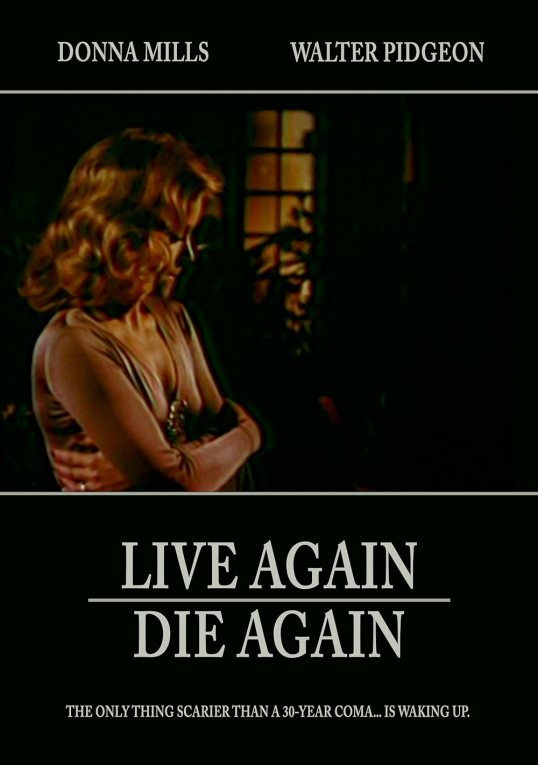
Retro Television Reviews: Live Again, Die Again (dir by Richard A. Colla)


Welcome to Retro Television Reviews, a feature where we review some of our favorite and least favorite shows of the past!  On Sundays, I will be reviewing the made-for-television movies that used to be a primetime mainstay.  Today’s film is 1974’s Live Again, Die Again!  It  can be viewed on YouTube.

30 years ago, Caroline Carmichael (Donna Mills) died.

Except, she really didn’t.  Instead, when on the verge of death, she was put into cryogenic suspension.  She has spent the last three decades in suspended animation and, as a result, she has not aged in all that time.  In fact, her hair still looks perfect.  (I have some doubts about the scientific validity of any of this but let’s just go with it.)  As this movie begins, Caroline Carmichael finally wakes up.

Caroline has an entirely new world to discover.  At a party to celebrate her awakening, Caroline is shocked to discover that, while she still appears to be young, all of her friends are now in their 60s. Her husband, Thomas (Walter Pidgeon), is now old and sickly.  Her beautiful home is now looked after by a strict and suspicious housekeeper (Geraldine Page).    Her two children (played by Mike Farrell and Vera Miles) both appear to be older than her.  In fact, her daughter was so traumatized by Caroline’s “death,” that she is now terrified of being left alone with her mother.

You might expect that this film would be dedicated to Caroline adjusting to the world of the 70s and that it might feature some thoughts on whether it’s ethical to keep someone in suspended animation for 30 years.  And there are elements of that.  Caroline is amazed by all the tall buildings.  Her daughter’s reaction to Caroline’s return is hardly heart-warming and even Caroline’s whiny son doesn’t seem to be quite as happy about it as one might expect.  Her husband has spent the last 30 years of his life waiting for Caroline to wake up and it’s hard not to consider how many opportunities for happiness or success that he missed as a result.

That said, the film itself quickly becomes more of a gothic murder mystery, as Caroline comes to realize that someone is trying to kill her.  That’s kind of a shame because I actually found all of the cryogenic stuff to be much more interesting and the idea that one could basically just stop aging for 30 years was an intriguing one.  It’s an interesting question.  If it could save your life at some undetermined point in the future, would you be frozen?  Myself, I think I would be reluctant to do so because you never know what type of world you might wake up in.  Caroline is lucky enough to wake up wealthy in the 70s but what if you woke up and discovered that your entire family had died while you were in your coma?  What if you woke up and discovered that your country had become some sort of socialist Hellhole?  Imagine if someone went into hibernation in 1994 and then woke up in 2024?  They would probably want to go back to sleep.

The film was written Joseph Stefano, who also did the script for Psycho and was one of the producers behind The Outer Limits.  Not surprisingly, the script is full of snappy dialogue and the cast features two Psycho cast members, Vera Miles and Lurene Tuttle.  Director Richard Colla keeps the action moving and, early on in the film, he does a good job of depicting Caroline’s disorientation with finding herself in an entirely new world.  The film is well-acted by the entire cast, with Donna Mills especially doing a good job as Caroline.  This was an intelligent, well-made, and — most importantly — short made-for-TV movie.  At a time when almost all movies and TV shows seem to be too long for their own good, it’s hard not appreciate Live Again, Die Again‘s 73-minute runtime.

Horror on the Lens: Baffled! (dir by Philip Leacock)


Leonard Nimoy is a race car driver who can see into the future and who uses his powers to solve crimes!

Seriously, if that’s not enough to get you to watch the 1973 made-for-TV movie Baffled!, then I don’t know what is.  In the film, Nimoy takes a break from racing so that he and a parapsychologist (played by Susan Hampshire) can solve the mystery of the visions that Nimoy is having of a woman in a mansion.  This movie was meant to serve as a pilot and I guess if the series had been picked up, Nimoy would have had weekly visions.  Of course, the movie didn’t lead to a series but Baffled! is still fun in a 70s television sort of way.  Thanks to use of what I like to call “slow mo of doom,” a few of Nimoy’s visions are creepy and the whole thing ends with the promise of future adventures that were sadly never to be.

Enjoy Baffled!  Can you solve the mystery before Leonard?

Retro Television Reviews: A Great American Tragedy (dir by J. Lee Thompson)


Welcome to Retro Television Reviews, a feature where we review some of our favorite and least favorite shows of the past!  On Sundays, I will be reviewing the made-for-television movies that used to be a primetime mainstay.  Today’s film is 1972’s A Great American Tragedy!  It  can be viewed on YouTube!

Brad Wilkes (George Kennedy) had a good career, working as an aerospace engineer.  He was able to buy a nice house.  With his wife, Gloria (Vera Miles), he was able to raise a good family.  He was even able to buy a sailboat, one that is the pride of the entire marina.  But then, one day, he’s told that the company is letting him go.

Returning to his home, Brad tells Gloria that he’s lost his job but that everything’s going to be okay because not only does he have a $10,000 pension but he’s sure he can find a new job.  “Of course, I might not be making $35,000 a year….” he says.

(Watching at home, I said, “Pfffft!  I make more than that!”  But, of course, Brad is talking about $35,000 in 1972 money, which would be the equivalent of a quarter of a million today.)

However, Brad soon discovers that getting a new job will not be as easy as he assumed.  It turns out that there are a lot of people out there looking for work and most of them are younger, cheaper, and better educated than Brad.  The bills start to pile up.  His former boss (Robert Mandan) informs Brad that his pension is going to be $7,000 less than he thought.  Brad forces himself to go down to the unemployment office so that he can collect $25 a week and then suffers the humiliation of being offered a loan by his well-meaning son-in-law (played by a youngish James Woods).  Gloria gets a job at the same clothing store where she used to shop and her lecherous boss (Kevin McCarthy) starts to hit on her.

For Brad, the final humiliation comes when he has to sell the boat.  A younger boat owner (Tony Dow, with a huge mustache) puts Brad in contact with a woman named Paula (Natalie Trundy).  Paula wants to buy the boat and, after they take it out on the water, Brad finds himself tempted to cheat on his wife.  It all gets to be too much for Brad and soon, he’s on a plane to Nevada where hopefully one good night at the craps table will be enough to pay his bills….

Watching this film, I found myself feeling very sorry for Brad while, at the same time, becoming very frustrated with him.  On the one hand, his company tossed him out after years of loyal service and then tried to screw him out of his pension.  On the other hand, Brad spent almost the entire movie in denial about how bad things actually were.  It’s one thing to be proud and it’s another to just be stubborn.  Knowing that he has next to no money, Brad still insists on throwing his annual 4th of July party and he even invites his former boss to come over and celebrate.  Brad simply cannot bring himself to admit that his old life is over but really, who can blame him?  He’s not the one who chose to be fired.

A Great American Tragedy was directed by J. Lee Thompson, who also did Cape Fear, The Guns of Navarone, the Planet of the Apes sequels, and several Charles Bronson films.  There are no fight scenes to be found in A Great American Tragedy but Thompson does get good performances from his cast and the film makes great use of George Kennedy’s likability.  The viewer remains sympathetic to Brad, even when he makes mistake after mistake.  A film about a formerly secure family suddenly discovering just how much the economy sucks, A Great American Tragedy remains just as a relevant today as when it was first made.