So, some may have noticed a lack of retro television reviews this week. I wish I had a better excuse than me being sick to give you but seriously, I’ve just been under the weather big time this week. I went from 9 degree temperatures at Lake Texoma to 67 degree temperatures back home in Dallas and my asthma has basically just been kicking my ass for a week and a half now. Plus …. well, I won’t go into the gory details but let’s just say this is not my week when it comes to feeling well.
I was going to try to get caught up on my television reviews today but then I realized that would essentially mean writing and posting 9 television reviews in one day and it would also mean that I would inevitably have to rush to get them all completed. That, along with me being tired and ill, would probably lead to some badly written reviews on my part. Add to that, the Oscars are approaching this weekend and Oscar Sunday is a big tradition around these parts. It’s a tradition that also requires a bit of focus from me.
Long story short: I’m bowing to reality. I’m sick and the world’s not going to end if there’s a week’s delay in reviewing the next episode of Malibu, CA. I’m accepting that what Erin always tells me about taking care myself is true and that I need to perhaps get a little rest so I can get back to being 100% healthy and alert. Retro Television Reviews will return on March 3rd with Miami Vice! Thank you for your understanding and patience!
6 Shots From 6 Films is just what it says it is, 6 shots from 6 of our favorite films. As opposed to the reviews and recaps that we usually post, 6 Shots From 6 Films lets the visuals do the talking!
Welcome to Retro Television Reviews, a feature where we review some of our favorite and least favorite shows of the past! On Sundays, I will be reviewing Homicide: Life On The Street, which aired from 1993 to 1999, on NBC! It can be viewed on Peacock.
This week, we discover why Steve Crosetti has not come back to work.
Episode 3.4 “Crosetti”
(Dir by Whitney Ransick, originally aired on December 2nd, 1994)
Detective Steve Crosetti has yet to return from a week-long vacation in Atlantic City. When Giardello asks Lewis where Crosetti is, Lewis lies and says that he has the flu. In truth, Lewis hasn’t heard from Crosetti but he remains convinced that his partner will soon return and will once again be annoying him with all of his theories about Abraham Lincoln.
Meanwhile, Bolander and Munch are called to the harbor. A body has been fished out of the water. The body has been in the water for a while and, from what we see, its bloated and the skin has turned the purplish color of decay. Bolander and Munch have no idea who the man is but they see that he’s wearing a lapel pin that identifies him as a member of the Fraternal Order of Policeman. They check the body for ID….
Lewis is called in Giardello’s office. Giardello tells Lewis that Steve Crosetti is dead. His body was found in the harbor. Bolander is investigating but all signs seem to indicate that Crosetti’s death was a suicide. Lewis refuses to believe it. He is convinced that Crosetti was murdered, perhaps by someone he investigated. Lewis takes out his anger on Bolander and Munch, feeling that they’re attempting to besmirch Crosett’s reputation by even considering the possibility of suicide.
It’s more than just Lewis’s feelings at stake. If Bolander determines that Crosetti committed suicide, it will make him the fourth Baltimore cop to have committed suicide that year. The brass says that Crosetti won’t get an honor guard if it’s determined that he committed suicide. Giardello subtly suggests that Bolander should rule the death of homicide. Bolander suggests that committing suicide was Crosetti’s final statement. Who are they to ignore a man’s final statement?
In the end, the toxicology results reveal that Crosetti was drunk when he fell in the harbor, leading to Lewis saying the death was an accident. Munch then reveals that Crosetti was also taking several anti-depressants at the time of his death and Lewis is finally forced to admit that Crosetti was not murdered. Crosetti does not get his honor guard, though Pembleton, after spending the whole episode acting as if he didn’t care, puts on his full dress uniform and salutes as Crosetti’s casket passes.
This was an incredibly powerful episode, all the more so because no explanation is given as to what specifically led to Crosetti taking his own life. The genesis behind the episode was not a happy one. One of NBC’s conditions for renewing Homicide for a third season was that Jon Polito, who was not considered photogenic enough for television, be written out. Showrunner Tom Fontana told Polito it would only be a temporary thing and that Crosetti would return once the show had been renewed for a fourth season. Polito didn’t believe Fontana and went to the press, complaining about how the show was being run. As a result, Crosetti ended his life. (Polito and Fontana later ended their feud, allowing Polito to return as a ghost at the end of Homicide: The Movie.) The show uses Crosetti’s suicide as a way to explore the psychological impact of being a cop as well as the impossibility of truly knowing what’s going on inside anyone’s head. Only after Crosetti’s suicide has been confirmed can Lewis look back and see certain signs that Crosetti was unhappy.
Wonderfully acted and wonderfully written, this episode is a dark one but, as so often happens with life’s darker moments, there are moments of humor. Pembleton brags about his parallel parking skills, just to discover that he can’t actually pull out afterwards. An attempt to buy cookies for Crosetti’s reception leads to a fierce argument between Bayliss and Pembleton, regarding both the price of cookies and whether or not the baker was actually Italian. We meet Munch’s younger brother, a rather bitter mortician. When Lewis cleans out Crosetti’s desk, the first thing he pulls out is a slinky. These are small moments but they affirm the humanity of the show’s characters and reminds us that the show and this episode in general is as much about living as it is about dying.
Yeah, I’m running late with this. That seems to be the theme of my life this weekend but no matter! Here it is, my week in television.
American Murder: Gabby Petito (Netflix)
Netflix’s Gabby Petito documentary didn’t necessarily tell me anything that I didn’t already know about that tragic and awful case. Indeed, I kind of found myself getting angry at the documentary as I watched the endless footage of Gabby because it reminded me that Gabby Petito — and every other crime victim — deserved more than to be the latest subject of America’s fascinating with the morbid and the sordid. (Of course, it’s hypocritical of me to judge as I was the one watching the documentary.) But, in the end, I did feel that the documentary made an important point. There were so many red flags about Brian Laundrie but no one wanted to admit it, not the cops and not Gabby’s friends. Gabby was failed by so many people.
Up until I saw this documentary, I was not convinced that Brian’s family really knew the full extent of his crimes. Now, I’m convinced that they not only knew but tried to help him cover them up. It’s infuriating.
Check it Out! (Tubi)
I reviewed Check It Out! here. I’ll soon be finished with this show and I have to admit that I’m kind of proud of being the only person to have actually sat down and reviewed every single episode.
Case and I have now started the third and final season of this creepy German show. It’s all about time travel, black holes, and people having nonstop sex without any emotional connection. The architecture is brutalist, the cinematography is dark, and everyone seems to be fairly depressed. It’s very German and very intriguing.
Chef Ramsay was back in New Orleans, helping out another surprisingly ugly restaurant. Seriously, how can a restaurant succeed when it looks like a trailer? Again, a former football player was brought in to provide emotional encouragement. I will undoubtedly find myself in New Orleans in the future but I’ll probably never eat there.
I finished up Scamanda this week, watching the final two episodes. For all the build-up, the finale was a bit disappointing. Amanda was arrested and convicted and then, for 30 minutes, we listened to a bunch of podcast hosts talk about how they came across the story and went viral with it. I love true crime documentaries but true crime podcast hosts are always so annoying and self-important.
Welcome to Late Night Retro Television Reviews, a feature where we review some of our favorite and least favorite shows of the past! On Saturdays, I will be reviewingthe Canadian sitcom, Check it Out, which ran in syndication from 1985 to 1988. The entire show is currently streaming on Tubi and Peacock!
This week, Howard leaves the store once again. Chaos follows.
Episode 3.8 “Mutiny on Mr. Christian”
(Dir by Alan Erlich, originally aired on November 7th, 1987)
Howard goes on another one of the 100 vacations that he seems to take during the year, leaving Christian in charge of the store. To no one’s surprise, Christian turns out to be a total martinet who times Marlene’s check-out speed, bothers Leslie at the deli, and refuses to give out the paychecks early. “The book says 4:00,” Christian explains, “and I’m doing things by the book.”
When Howard returns early, Marlene rats on Christian and reveals, amongst other things, that Christian attempted to strip search a female shop lifter. (Agck! As someone who was a compulsive makeup stealer in her teen years, I’m glad Target didn’t have the same policy.) Howard probably could fire Christian for the strip search stunt but instead, he …. well, he does nothing.
Christian, however, gets back at Marlene by disguising his voice, calling her, and telling her that she has won two tickets to Atlantic City as a part of a newspaper sweepstakes that she was taking part in. Marlene is super-excited and can’t wait to take her grandmother on a real vacation. Christian suffers a pang of guilt. When he later calls to tell Marlene that she didn’t win the tickets, Howard overhears him. Christian is forced to tell Marlene what he did. Instead of yelling at Christian, Marlene says she’ll just win the tickets for real.
Marlene does not win the contest. But Howard, Leslie, and even Christian all buy her tickets to Atlantic City. Awwwww!
Plotwise, this episode felt like a season two episode. Howard is once again going on vacation whenever he wants. Christian is once again acting like a jackass. Leslie and Marlene are once again allied against the world. Edna is not in the episode and neither is Viker. Even the ending feels like a season two ending. Marlene takes the tickets from Christian while Marlene returns the other tickets to Leslie and Howard so that they can get refunds. They laugh about getting one over on Christian though they might want to consider that Christian, for once, tried to do the right thing without being ordered to do so.
That said, this episode works like a season 3 episode because it focuses on the show’s three most consistently funny performers, Jeff Pustil, Aaron Schwartz, and Kathleen Laskey. Schwartz has fun with Leslie’s snarky insults. Laskey brings an edge to Marlene’s sarcasm. Jeff Pustil is always at his best when he’s portraying Christian’s attempts to weasel out of being held responsible for his actions. The three of them more than make up for the fact that Don Adams himself feels a bit off in this episode.
All in all, this wasn’t the best episode of the show or even the third season. But it still made me smile.
Welcome to Late Night Retro Television Reviews, a feature where we review some of our favorite and least favorite shows of the past! On Fridays, I will be reviewing Friday the 13th: The Series, a show which ran in syndication from 1987 to 1990. The entire series can be found on YouTube!
This week, it’s all up to Johnny Ventura!
By the way, it is true that these reviews usually run on Friday. This week, however, all the cold weather caught up to me and I spent most of yesterday in bed. As a result, this week’s review got preempted to tonight. Now, let’s find out what’s been going on in the world of cursed antiques!
Episode 3.4 “Crippled Inside”
(Dir by Timothy Bond, originally aired on October 21st, 1989)
This week’s episode opens with teenager Rachel Horn (Stephanie Morgenstern) nearly getting gang-raped by a group of jocks. Rachel manages to escape from them but, as she runs away, she’s hit by a car and left a quadriplegic. Feeling that her life is over, things start to look up for Rachel when an old man (John Gilbert) gives her his antique wheelchair, which he suggests will help her regain the ability to move. When Rachel sits in the antique wheelchair, she can send out her astral form. Each time she uses the wheelchair, her body heals just a little bit more. The only catch is that the wheelchair only works if Rachel kills people while in her astral form. Hey, I can think of at least four guys that Rachel might want to kill….
With Jack and Micki in London, it falls to Johnny Ventura to try to get the wheelchair back. I have to admit that I was a bit skeptical when I saw this episode was going to be a solo effort on Johnny’s part. I was like, “Johnny’s only been a regular for two episodes and he’s already working alone?” (I have to admit that my feelings towards the Johnny Ventura character are very much influenced by how much I liked Ryan.) But I have to say that this was a good episode and a lot of that was because Johnny was working alone. Not understanding the true danger of the cursed antiques, Johnny was torn about whether or not to take the wheelchair away from Rachel. Rachel was a very sympathetic character and the people she was targeting truly were terrible. Johnny, not understanding that Rachel was losing her soul to the devil, actually gave the wheelchair back at one point. By the end of the episode, he realized he had made a mistake. Steve Monarque did a wonderful job portraying Johnny’s growing realization that there are no good curses.
This was a good episode. I still miss Ryan but Johnny held his own. The story was emotionally effective and the ending left me feeling genuinely unsettled. Johnny learned the truth about curses and I learned that, even during its final season, Friday the 13th: The Series was capable of producing intelligent and memorable horror.
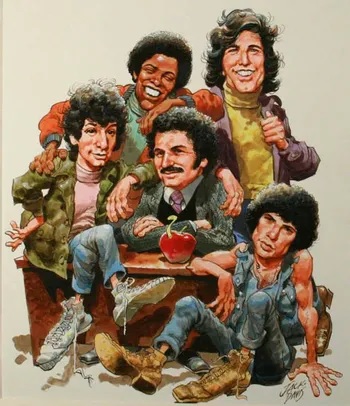
Welcome to Retro Television Reviews, a feature where we review some of our favorite and least favorite shows of the past! On Saturdays, I will be reviewing Welcome Back Kotter, which ran on ABC from 1975 to 1979. The entire show can be purchased on Prime.
Buchanan High is in chaos! Only one man can save the day but he’s not around anymore.
Episode 4.18 “The Sweat Smell of Success”
(Dir by Norman Abbott, originally aired on March 3rd, 1979)
Where is Mr. Kotter!?
I mean, don’t get me wrong. I know why Gabe Kaplan was hardly ever on the show during the fourth season. He was annoyed that the network refused to allow the Sweathogs to graduate from Buchanan High, despite the fact that the actors playing the Sweathogs were all in their late 20s and early 30s. He was not happy about working with Marcia Strassman. And he was shooting a movie for a good deal of the fourth season. Kaplan felt that he moved on from the series and as such, he allowed his character to become vice principal and kept his appearances on the show to a minimum,
But, in the narrative of the show, where is Mr. Kotter? Usually, someone will mention that he’s out of town or busy with school business. In this episode, he isn’t even mentioned. It’s kind of disturbing how he’s vanished and no one seems to care. The Sweathogs need his guidance and this episode, as dumb as it was, features a plot that feels like it would have been perfect for Mr. Kotter’s corny jokes and gentle mentoring. Even more importantly …. who is the song welcoming back? Kotter’s gone! He’s not around to be welcomed back!
As for this week’s episodes, it appears that the show’s writers finally remembered that, at the start of the season, each of the Sweathogs was assigned a job around the school. Freddie and Horshack run the school store. Meanwhile, Epstein is in charge of the audio visual department. But he sucks at his job so Woodman reassigns him to the school paper. Horshack’s girlfriend, Mary Johnson, edits and writes the paper and is very earnest in her efforts to make the paper something worth reading. That’s quite a chance from the Mary who tried to kill herself just a few episodes ago.
Anyway, Epstein turns the paper into a tabloid. He suggests that Julie is having an affair with Woodman. (“She’s not my type!” Woodman declares, “Too tall!”) He writes about Freddie Washington wore diapers until he was six months old. Epstein describes Horshack as being a diva. Epstein says that Beau is a member of the Ku Klux Klan. He says….
WAIT! WHAT!?
Okay, one of these stories is far worse than the others. Washington did wear diapers when he was a baby and Horshack is a diva and Julie probably is cheating on Gabe. But Beau is a member of the Klan? Where did this come from? “I’m going to need a police escort to go home tonight,” Beau says while the audience laughs.
Seriously, don’t just toss around Klan accusations, folks. It’s just common sense.
Anyway, Epstein’s friends get mad at him so Epstein quits the paper after publishing an expose of himself on the front page. He returns to the audio visual department. He still sucks at his job and I guess Mary is back to having to write, edit, and publish the entire newspaper by herself. Is this a happy ending?
Well, at least Beau didn’t get killed.
Next week, it’s time for the school talent show! Wow, Mr. Kotter would have loved that. RIP.
Welcome to Retro Television Reviews, a feature where we review some of our favorite and least favorite shows of the past! On Fridays, I will be reviewing St. Elsewhere, a medical show which ran on NBC from 1982 to 1988. The show can be found on Hulu and, for purchase, on Prime!
Usually, I review this show on Friday but, yesterday, my week of visiting Lake Texoma in freezing weather finally caught up with me and I spent most of the day congested and curled up in bed. As a result, St. Elsewhere got preempted until today. Now, let’s see what’s happening at St. Eligius….
Episode 1.13 “Family History”
(Dir by Kevin Hooks, originally aired on February 8th, 1983)
After being a background character for the past few episodes, Dr. Wendy Armstrong (Kim Miyori) finally gets her time in the spotlight with this episode. When Charlie Heller (Keenan Wynn) comes into the ER with a chronic nosebleed, Dr. Armstrong is too quick to assume that it’s nothing serious. Dr. Westphall, who is in an especially crappy mood this episode, reprimands her for not getting a family history before making her diagnosis. A chastened Armstrong gets Charlie’s family history and comes to suspect that he has a rare blood condition that only seems to effect Jewish men. A very expensive test confirms Armstrong’s diagnosis. Armstrong is excited. “I was right!” she says. Westphall again reprimands her, telling her that she now needs to tell Charlie that he has a chronic condition and will have to take medicine for the rest of his life.
Seriously, Westphall was not in a good mood during this episode! But I don’t blame him. From her first appearance on the show, Dr. Armstrong has been complaining nonstop. No matter what happens in the hospital, she seems to take it as a personal affront. Now, after several episodes of complaining about the other doctors, Armstrong fails to do a simple thing like get a family history. No wonder Westphall was all like, What are you bragging about?
That said, even if his mood was understandable, I would not want to get on Westphall’s bad side. Even after Armstrong makes the correct diagnosis, Westphall takes the time to say, “Next time, do what I told you to do.” Agck!
While Westphall was dealing with whatever was eating away at him, Dr. Chandler was getting annoyed by John Doe’s refusal to try to remember anything about his past. Even when John Doe’s real father showed up and explained that Doe was his son, Dave Stewart, he refused to try to remember anything. Eventually, Chandler snapped at Dave for refusing to even try. Chandler, of course, is played by a young Denzel Washington so, when he gets mad, it’s like having the voice of God call you out. After Chandler’s reprimand, Dave finally makes an effort to remember his past. He realizes that, when he was shot, he had a vision of his deceased mother welcoming him to heaven. Awwww!
Dr. Craig’s friend has his gender affirmation surgery. Crag met his friend’s lover, a trans man. Needless to say, this episode featured a lot of scenes of Craig rolling his eyes as he struggled to come to terms with everything he was learning about his old friend. It was all pretty predictable but William Daniels did a great job playing up Craig’s confusion and single-mindedness.
And finally, Peter was happy because his wife wanted to get back together. I get the feeling any happiness Peter feels is destined to always be temporary.
This episode was a bit uneven. Armstrong’s story would have been compelling if Armstrong herself was a more interesting character. The highlight of the episode were the scenes between Denzel Washington’s doctor and Tom Hulce’s amnesiac. It’s always enjoyable to watch two good actors perform opposite of each other.
Next week, the great Norman Lloyd takes center stage as Auschlander’s cancer returns.
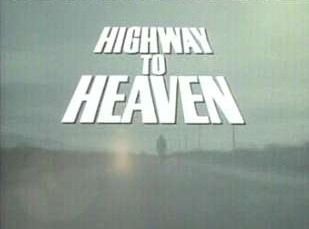
Welcome to Late Night Retro Television Reviews, a feature where we review some of our favorite and least favorite shows of the past! On Thursdays, I will be reviewing Highway to Heaven, which aired on NBC from 1984 to 1989. The entire show is currently streaming on Tubi and several other services!
This week, a conman seeks refuge in a church.
Episode 3.14 “All that Glitters”
(Dir by Michael Landon, originally aired on January 7th, 1987)
There’s a fire raging in the city and elderly homeowners are being forced to evacuate. “Father” Jonathan and “Father” Mark open up an abandoned church so that the people have some place to stay while the fires are burning. Good for them and also good for this show for finally acknowledging Catholicism.
Also hiding out in the church and disguised as a priest is Charley Trapola (John Pleshette), a con artist who, despite his criminal profession, actually has a good heart. Charley has a briefcase with him, one that is full of money. A group of criminals want the briefcase back but, at least initially, they know better than to try anything in the church. Instead, they decide to wait for Charley to come out. Inside the church, Charley gets to know Wanda (Didi Conn), a shy but kind-hearted woman who goes to Confession every day.
This episode was okay. Usually, when Jonathan and Mark go undercover as clergyman, they’re portrayed as being wishy-washy Episcopalians or vaguely liberal Methodists so I was happy that they were Catholic for this episode. John Pleshette and Didi Conn were both well-cast as this episode’s guest stars. They eventually made for a very sweet and likable couple. My main issue with this episode is that it tried to do a bit too much. Not only did we have Charley being chased by the gangsters but we also had Wanda dealing with her shyness and Mark and Jonathan dealing with the people were seeking shelter and looking for their loved ones. This episode — and not that weird marriage counseling episode — would have benefitted from an extra hour. As it was, it just felt a bit overstuffed. As well, this is another episode in which Jonathan reveals early on that he’s angel and, oddly enough, Charley has no hesitation about believing him. I always prefer the episodes where Jonathan doesn’t reveal who he really is. When Jonathan reveals that he’s an angel, it almost seems like cheating. The show is always more effective when people decide to open up their hearts on their own as opposed to doing so because they feel they’ve been ordered to.
There’s an odd scene where the three thugs break into the church and pull a gun on Jonathan. After Jonathan gives them fair warning about “the boss,” the main thug attempts to shoot Jonathan. Needless to say, the bullets don’t have any effect on an angel. However, a sudden blue lights fills the church and suddenly, the three men are apparently zapped out of existence. Jonathan later jokes that he’s not sure where the three men are but that they probably aren’t happy. So, did the three men go straight to Hell? Are they dead? I understand the logic behind the scene but it’s not really something you expect from a show where the main theme is usually that everyone has a chance for redemption.
Next week, Dick Van Dyke plays a homeless puppeteer …. uh oh. This sounds like it could a little bit cringey …. well, we’ll see.
Welcome to Retro Television Reviews, a feature where we review some of our favorite and least favorite shows of the past! On Thursdays, I will be reviewing Malibu CA, which aired in Syndication in 1998 and 1999. The entire show is currently streaming on YouTube!
Yes, this is from the first season. I don’t care. I refuse to waste my time looking for a second season advertisement.
Even by Malibu CA standards, this week’s episode is incredibly stupid.
Episode 2.3 “Aloha”
(Dir by Gary Shimokawa, originally aired on October 23rd, 1999)
Peter can’t figure out why no one is coming to his restaurant.
Gee, Peter, maybe it’s because your idiot sons work there and are constantly screwing everything up. Maybe it’s because your only waitress is constantly complaining about everything in the most overdramatic way possible. (Seriously, after only three episodes, Lisa — the Malibu CA character, not me! — is perhaps the most annoying human being ever.) Maybe that all has something to do with it….
No, actually, it’s because there’s a new restaurant called Aloha, which features the Cocoanuts, a group of girls who wear bikinis and dance while the patrons are eating. I can’t imagine anyone going to this restaurant on a date but apparently, all of the single men on the beach love it. Murray has eaten at the restaurant 21 times in a row! Jason and Scott go down to Aloha with their father and Jason immediately starts dancing with the girls. Peter accuses both Jason and Murray of betraying him.
It’s easy to laugh at Peter’s misfortune, especially since it’s his own damn fault for being a terrible business owner. But when he announces that he might lose the restaurant because he stupidly took out a loan, Jason and Scott bully Murray into using his trust fund to invest in The Lighthouse. Co-owner Murray wants to have a pirate night. “Arggh!” Peter says.
Anyway, Jason and Scott eventually bully Murray into applying to be one of the Cocoanuts and after Murray is hired, everyone stops going to Aloha and they return to the Lighthouse because there are only two restaurants in Malibu. Myself, I’m wondering how exactly Murray got hired. On the show, it’s suggested that Murray was hired because, otherwise, he would have sued the owner of Aloha for sex discrimination. That’s not exactly how that law works, though. Even if the owner did hire Murray to work at Aloha, he wouldn’t be required to make Murray one of the dancers. He could have just used Murray as a waiter or dishwasher or …. WAIT ON MINUTE! Murray already has a job! Just two episodes ago, he was working at The Lighthouse! What the Hell!?
There’s an equally stupid B-plot. Traycee wants to date the guy who changes out the coke machine on the beach. He’s not into flashy celebrities who Traycee works a dark wig and glasses and pretends to be a librarian. It all seems to be working until he sees Traycee in a bikini and realizes that she’s not actually a librarian …. WHAT!? Why would Traycee, whose entire life is about being famous, like this guy in the first place? And why are Lisa (the character, not me!) and Stads still on the show when its obvious that the show really doesn’t have anything for either of them to do? It would perhaps help if Lisa and Stads didn’t both have exactly the same killjoy personality. Anyway, Traycee ends up single again but she lands on the cover of Soap Opera Digest.