
The 12th season of Doctor Who got off to a shaky start with Robot, a serial that was ultimately distinguished only by the introduction of Tom Baker as the Fourth Doctor. The best thing about Robot is that it ended with The Fourth Doctor peeking out of the TARDIS and inviting Sarah Jane Smith (Elisabeth Sladen) and Harry Sullivan (Ian Marter) to join him on his further adventures. By inviting them, he was inviting the audience as well.
The remaining episodes of the 12th season not only established Tom Baker as the Doctor but it also reestablished Doctor Who as being a show about an alien who could travel through time and space. After several seasons of The Third Doctor largely staying on Earth and in the present, the 12th Season reminded everyone that the Doctor could turn up anywhere.

The Ark In Space (1975, directed by Rodney Bennett)
The first place that the Doctor takes Sarah and Harry is to Nerva, a space station that floating above the Earth. The time is 10,000 years into the future. Forced to flee the Earth due to solar flares, the crew of the space station has spent a millennia in suspended animation. During that time, the space station has been invaded by the Wirm, a space insect that has laid its eggs in some of the crewmen. When everyone is revived, the infected crewmen are transformed into creatures that are half-human and half-insect.
The Ark in Space is a classic space opera. When I was a kid and our PBS station first started to broadcast Doctor Who, they started with a four-hour bloc, which included Robot, The Ark In Space, and The Sontaran Experiment. After Robot, with its basic plot and bad special effects, it was a relief to then see The Ark In Space, a serial that lived up to all of the Doctor Who hype. Not only did Tom Baker fully step into the role of the eccentric Fourth Doctor but this serial also featured Elisabeth Sladen and Ian Marter in active roles as well. This serial said that the days of the passive companion were (temporarily) over.
The plot of The Ark in Space does have some similarities to Alien, which came out for years later. I think that’s probably just a coincidence.

The Sontaran Experiment (1975, directed by Rodney Bennett)
Having defeated the Wirm and saved the remaining colonists on the Ark, The Doctor, Harry, and Sarah transport down to Earth to repair a receiver terminal. They discover that the Earth is not as deserted as they assumed. A group of human astronauts returned to the planet earlier but they were captured by Styre (Kevin Lindsay), a Sontaran who has been sent to Earth to prepare it for an invasion so that the Sontarans can use the planet as an outpost in their never ending war with the Rutans.
This serial was only two episodes long but The Sontarans were always good villains. They’re relentless, destructive, and very, very stupid. This story featured one of Tom Baker’s best moments, when he convinced Styre to throw away his weapon because it made him look weak. Styre fell for it because Sontarans will fall for anything.

Genesis of the Daleks (1975, directed by David Maloney)
This is it. This is the first true classic of the Tom Baker era and also the best of the classic Dalek stories. Terry Nation was invited back to Doctor Who to write about his most famous creations and he created one of the show’s most enduring villains in the process.
A Time Lord appears to the Doctor and his companions and tells them that they need The Doctor to change history. (This goes against all Time Lord law, which is why they gave the job to a known renegade like The Doctor.) The Daleks have been determined to be too much of a threat. The Doctor is to go back to the time of their creation and “interfere.”
The Doctor, Harry, and Sarah Jane find themselves on Skaro, where the war between the Thals and the Kaleds have left the planet ravaged and inhospitable. The Thals and the Kaleds each live in a domed city and spend their days shooting missiles at each other. Terry Nation often said that the Daleks were meant to be a stand-in for the Nazis and he makes that clear in this episode with the Kaleds wearing SS-style uniforms and spouting theories about racial superiority.
In this episode, Nation introduces Davros (Michael Wisher), the horribly scarred and crippled scientist who will ultimately be responsible for transforming the Kaleds into the Daleks. (The Kaleds who don’t want to be Daleks are wiped out by those who do.) Davros would appear in every subsequent Dalek episode of classic era Doctor Who and his effectiveness would be diluted by repetition. In his first appearance, though, he immediately establishes himself as a frightening and truly evil Doctor Who villain. If their first appearance suggested that the Daleks retreated into the shells for survival in their nuclear-ravaged world, this episode shows that it more about Davros wanting to play God.
A six-episode serial, Genesis of the Daleks more than justifies its epic length. The heart of the serial is a moment when the Doctor, on the verge of wiping out the Daleks forever, stops to wonder if he has the right to do so. This was a key moment in the development of The Fourth Doctor. The Fourth Doctor may have been an eccentric but he was an eccentric with a conscience who realized that even the worst creatures deserved a chance at redemption. In the end, The Doctor does not destroy the Daleks, though he does set back their evolution by an undetermined number of years. As the Doctor explains it, good will always rise up to counter the evil of the Daleks.
This episode features the apparent destruction of Davros but you can never keep a good villain down. Both Davros and his creations would return.

Revenge of the Cybermen (1975, directed by Michael Briant)
After a classic Dalek story, I guess it was inevitable that Doctor Who would feature a Cyberman episode.
Following the events of Genesis of the Daleks, the Time Lords return The Doctor, Sarah Jane, and Harry to the Nerva space station. They arrive several centuries before the events in The Ark In Space. Without the TARDIS (it’s traveling back through time to meet them), The Doctor and his companions discover that the majority of Nerva’s crew is dead and that the remaining members are using the station as a space beacon to warn people about a drifting planetoid. The planetoid is made of gold and the Cybermen show up at Nerva because, being uniquely vulnerable to gold dust, they want to destroy it.
If Genesis of the Daleks re-imagined the Daleks, Attack of the Cybermen proves to be just a typical Cybermen story and a disappointing one. The best thing about this episode is that it gave Tom Baker a chance to once again prove his Doctor bonafides by defeating a classic Doctor Who villain.

Terror of the Zygons (1975, directed by Douglas Camfield)
Terror of the Zygons was the first seral of the thirteenth season but, since it’s also Harry Sullivan’s final appearance as a regular member of the TARDIS crew (though he would return in a later episode for a one-off appearance), it still feels like a twelfth season episode.
Having been reunited with the TARDIS, the Doctor, Sarah Jane, and Harry return to present-day Earth. The Brigadier (Nicholas Courtney) and UNIT are investigating attacks on oil rigs by a giant sea creature. Sea Devils, again? No, this time it’s the Zygons, who are far less sympathetic.
This was a typical UNIT story, the type of thing that Jon Pertwee did regularly. Tom Baker’s more mischievous version of the Doctor feels slightly out-of-place with UNIT but it is still a pleasure to see Nicholas Courtney and John Levene again and this episode finally explains what everyone has been seeing in Loch Ness over the years. This episode ends with Harry returning to UNIT while Sarah Jane and the Doctor returned the TARDIS. Harry Sullivan was a strong character and producer Philip Hinchcliffe later said it was a mistake to write him out of the series.
Ian Marter, who played Harry Sullivan, continued to be associated with Doctor Who as one of the better writers of the Doctor Who novelizations. He also wrote two stand-alone novels featuring Harry’s adventures without the Doctor. Ian Marter died of a heart attack when he was just 42 but Harry Sullivan lived on, frequently being mentioned in both the classic series and the revival.

That’s it for the 12th season, the season that truly made Tom Baker the Doctor and which was one of the best of the classic series. As these were the first episodes of Doctor Who that I ever saw, I have a lot of nostalgia for them. The Ark In Space, The Sonatarn Experiment, Genesis of the Daleks, and even Terror of the Zygons still hold up well to this day.
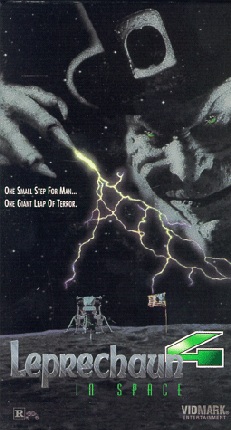 In the far future, the Leprechaun (Warwick Davis) is living on another planet where he’s trying to marry a space princess and he’s interfering with Earth’s mining operations. A bunch of Space Marines show up and take the Leprechaun out. One of the Marines decides to take a leak on the Leprechaun’s remains. The reborn Leprechaun later springs out of the Marine’s penis, which I guess is one of those leprechaun powers that usually goes unmentioned. The Space Marines are in trouble and so is the franchise. A sudden trip into space is usually a pretty good sign that you’ve run out of ideas.

