LAST OF THE DOGMEN – One of my favorites!


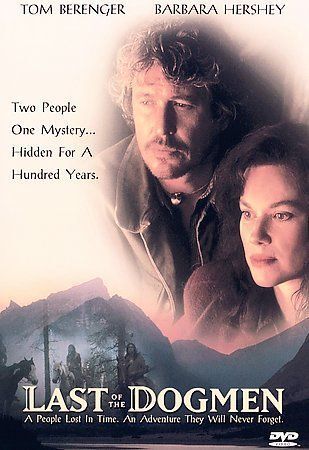
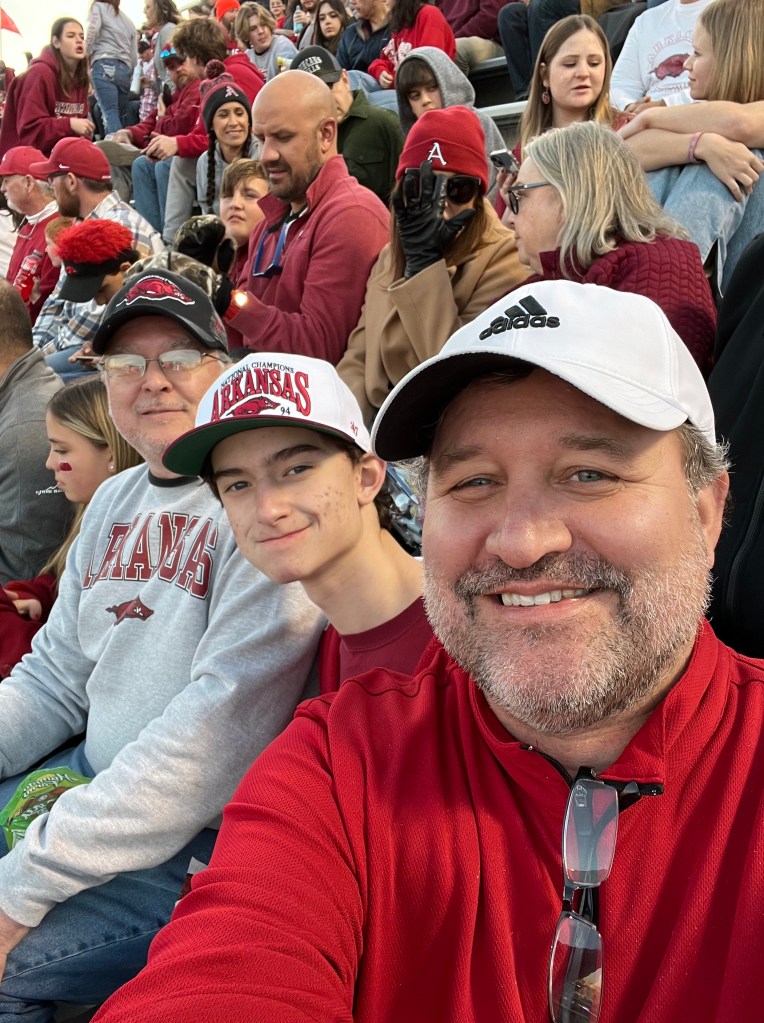
I don’t hear a lot about LAST OF THE DOGMEN, the 1995 modern day western starring Tom Berenger, Barbara Hershey and Kurtwood Smith. I love the movie, and I have for years. My buddy Chuck, his son Carter, and I recently drove up the hill to Fayetteville to watch the Arkansas Razorbacks play football. We had a great day! We ate at the Catfish Hole for lunch and then watched the Razorbacks beat Louisiana Tech 35-14. It was fun (See picture below for the happy crew). We had about a 3-hour drive home so we were talking about things we both love, like the Andy Griffith Show. Out of nowhere, Chuck said, “Do you want to know a movie I love? It’s called the LAST OF THE DOGMEN.” It was the last thing I was expecting to hear. I also love the movie. We talked about it and had a good time, but I made a mental note to watch it again soon. So here we are. 

LAST OF THE DOGMEN opens with Sheriff Deegan (Kurtwood Smith) trying to find three escaped convicts in Northwest Montana. Deegan calls in the best tracker he knows, Lewis Gates (Tom Berenger), to go into the mountains to find the convicts. The two men have a history as Gates was married to the sheriff’s daughter, and the daughter died. The sheriff clearly doesn’t like Gates and blames him for his daughter’s death, but he knows he’s the man for the job. With Gates and his genius dog Zip right on their tails, the convicts are mysteriously killed by a group of men on horses who shoot them with arrows. Gates see the men riding off through a fog and is convinced they are Indians. He ends up seeking out the help of Native American historian Lillian Sloan (Barbara Hershey) to help him understand what he may have seen. He’s able to convince Lillian to ride into the mountains with him because he needs a translator if he actually finds anyone, and the two head off into the Oxbow. After a week of roughing it, they’re about to give up when they suddenly find themselves surrounded by the Indian dog soldiers. They’re taken as prisoners to the Indian camp, where the leader of the dog soldiers, Yellow Wolf, has a sick son. It seems he was shot by one of the escaped prisoners. Gates heads back to town to get penicillin for the son, which ultimately saves his life. Gates and Lillian spend some time getting to know and respect this isolated Cheyenne tribe. Meanwhile, Sheriff Deegan, unable to forgive Gates for the death of his daughter, gathers a group of men and they head into the Oxbow to find Gates. Will the Indians be able to have peace and live their lives like they did in the 19th century, or will they be discovered and forced to live out the fates of their ancestors? Well, if you haven’t seen it, just watch and enjoy!

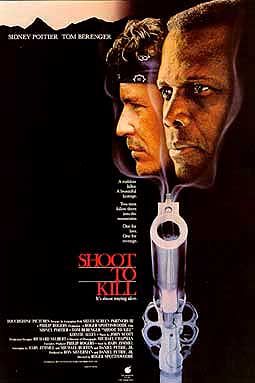
As I said earlier, I’m a big fan of LAST OF THE DOGMEN. I was initially interested in the movie because I like Tom Berenger as a leading man. His SHOOT TO KILL with Sidney Poitier is a big time personal favorite. I also like him in PLATOON, SOMEONE TO WATCH OVER ME, BETRAYED, MAJOR LEAGUE, SHATTERED, SNIPER and THE SUBSTITUTE. He had been a big sex symbol earlier in his career. By the time of this film, he’s getting a little too old and heavy to be a sex symbol. In THE LAST OF THE DOGMEN, he’s actually very funny, and I really enjoy watching him have fun on screen. I’ll also go ahead and say that I’ve never been a huge fan of the actress Barbara Hershey, but she keeps showing up in movies I love. Outside of this, she’s also in HOOSIERS, and it’s one of my favorites. While there’s something about her I don’t really like, she is pretty good, and I do like her chemistry with Berenger. When they finally share a big smooch towards the end of the film, I liked it. And what can I say about Gates’ Australian cattle dog Zip? He’s an integral part of the story and saves Gates & Lillian’s asses on multiple occasions. At one point in the story, Lillian says “it’s disconcerting to know that the smartest member in our expedition is a dog!” It’s true!

I think the thing I like the most about the LAST OF THE DOGMEN is the idea that a group of Cheyenne Indians could be living out their lives the way they did a century ago. Something about that is romantic and magical to me, and it gave me an emotional interest in the film. Isn’t that why we really love movies? The best ones can reach into our souls and find something that’s valuable to us. I love the idea of Cheyenne Indians living out their heritage and protecting it at all costs. There’s something simple and meaningful about that. Director Tab Hunter really leans into this emotional truth. It’s the only film he would direct, and it seems to share the one message that meant the most to him. Most of us would give anything to have an opportunity to share with the world who we really are. Hunter got that opportunity and shared this movie. That’s pretty cool to me.

The Films of 2024: One More Shot (dir by James Nunn)


It’s the night of the President’s State of the Union address and it appears that someone is planning to blow up the capital and spare everyone from having to sit through it.  (Personally, I’ve always found the pomp and circumstance surrounding the State of the Union address to be the opposite of what the Founding Fathers probably envisioned.  Presidents should go back to just sending Congress a note at the start of the year.)  Unfortunately, the bomb itself is radioactive so, though Americans will be spared the speech, Washington D.C. will still be reduced to an atomic wasteland.  Canceling the speech and the special Congressional session seems like an obvious solution but the President’s approval ratings are tanking and he’s hoping a good State of the Union will energize his reelection campaign.

Navy SEAL Jake Harris (Scott Adkins) has been tasked with escorting terrorist suspect Amin Mansur  (Waleed Elgadi) from Poland to Washington so that CIA director Mike Marshall (Tom Berenger, looking generally annoyed) can interrogate Mansur about the location of the bomb.  A Baltimore airport has been cleared out so that Mansur can be transferred to FBI custody with as little attention as possible.  Marshall takes a few minutes to yell at Jake, because this is an action film and action heroes always get yelled at by their superiors.  No sooner has Jake been yelled at then a bunch of mercenaries attack the airport.  It turns out that they also want Mansur and they’re willing to kill everyone in the airport to both get him and to make sure that the bomb is properly delivered.

Jake finds himself fighting for his life and also in the position of having to protect the terrorist that he brought to America.  However, as the night progresses, Jake discovers that Mansur is not the terrorist mastermind that he assumed and that the mercenaries are working for an enemy who is very close to home.

One More Shot is a sequel to 2021’s One Shot and, like that film, it’s shot and edited to make it appear as if the action is playing out in one continuous take.  The camera never seems to stop roaming through the airport, occasionally catching a mercenary or sometimes even Jake hiding in the shadows and waiting for a chance to attack.  It’s a gimmick but it’s an undeniably effective gimmick, one that is especially well-used in the film’s many battle scenes and which keeps the audience on its toes.  One More Shot has some of the most effective gunfights that I’ve recently seen and a lengthy sequence where Jake, Mansur, and a few others attempts to drive their way through a gauntlet of mercenaries is as genuinely exciting as anything you’d expect to find in an action film with bigger budget.

In the end, One More Shot feels like a video game come to life, with everything that implies.  One More Shot is an unapologetic action film, which is to say that this is not the film to watch if you’re looking for extensive character development or a nuanced debate about terrorism and American foreign policy.  We don’t really find out much about Jake Harris, other than the fact that he’s a good shot and he’s not easily intimidated.  Of course, that’s all we really need to know.  It’s an exiting 100 minutes and that’s all that it really needs to be.

Sliver (1993, directed by Phillip Noyce)


Who here remembers Sliver?

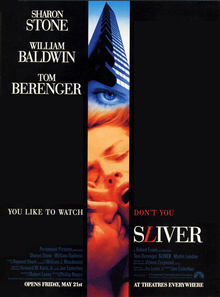
It may be hard to believe it but Sliver was a big deal back in the day.  It was one of Robert Evans’s first producing gigs after getting out of rehab.  It was Sharon Stone’s first film after Basic Instinct.  The script was written by Basic Instinct‘s Joe Eszterhas, back when that was still something that people bragged about.  It featured Tom Berenger, back before he found himself relegated to character roles, and William Baldwin.  Remember William Baldwin?  He was Alec Baldwin’s younger brother.  He looked just like Alec but he never managed to project much of a personality whenever he was onscreen.  Even Stephen Baldwin was a more interesting actor than William.  Still, back in the day, William Baldwin was close to being a star.

William Baldwin’s lack of personality actually works for the role he plays in Sliver.  He’s Zeke, who owns an exclusive high-rise apartment building.  Zeke makes his money designing video games and he’s filled the building with secret video cameras so he can spend all day sitting in front of a wall of monitors and watching his tenants and experiencing their lives without having to get close to them.  Zeke’s a voyeur.  Back in the 90s, the surveillance thing was a big twist.  Today, we take it for granted.  We even applauded Batman for doing the same thing to all of the citizens of Gotham.

Sharon Stone plays Carly, the newest resident of the Sliver.  Carly is a recently divorced book editor snd is lonely and repressed despite being played by Sharon Stone.  She draws the attention of both Zeke and her neighbor, Jack (Tom Berenger).  Both are interested when they discover that Carly has a telescope on her balcony.  “She’s a voyeur!” Jack says.  When Carly gets involved with Zeke, Jack is obsessively jealous.  He insinuates that Zeke had something to do with the death of the previous tenant of Carly’s apartment.

After Basic Instinct, Sharon Stone made a series of films that were designed to show that she actually could act by casting her as characters who were meant to be sexually repressed.  The films never seemed to work because, at the height of Sharon Stone’s 90s stardom, there was nothing about her that suggested that she was repressed in any way.  What made her a star in the first place was that she was so uninhibited and not afraid to be as blunt about sex as any of her male co-stars.  In Sliver, she gives a performance that is somewhere between her vampish work in Basic Instinct and her terrible ice queen performance in Intersection.  At the start of the film, she feels miscast as a straight-laced book editor but her performance gets better once she starts hooking up with Zeke.  Sharon Stone tries, even if she doesn’t succeed.  That’s more than can be said for most of her co-stars.

“Get a life,” Sharon Stone says at the end of the movie and, as far as final lines go, it’s a bad one because it comes out of nowhere and her actions in the final scene don’t fit in with anything that she’s previously said or done in the film.  That’s because the ending was hastily reshot after test audiences disliked the original ending.  Test audiences often have the worst instincts.

Like many things, Sliver was big in the 90s but forgotten today.  It was a popular Blockbuster rental for a while.  VCRs were set for whenever it appeared on Cinemax.  When it first came out, it was all about Sharon Stone.  Today, it’s all about nostalgia.

Faster (2010, directed by George Tilllman, Jr.)


A man known as the Driver (played by Dwayne Johnson) is released from prison, having served time for taking part in a bank robbery.  As soon as he gets his freedom, the Driver is jumping in a fast car, driving across Nevada and California, and killing everyone who he believes set him up and murdered his half-brother.  The Driver has even made out list of the people on whom he needs to get revenge.  Among those on the Driver’s list are a nightclub bouncer, a snuff film producer, an traveling evangelist, and one name that the Driver has not bothered to write down.

As the Driver conducts his killing spree, he is pursued by two other men who each have their own reason for wanting to find him.  The Cop (Billy Bob Thornton) is close to retirement and has a heroin addiction.  The Killer (Oliver Jackson-Cohen) is a hit man who views murder as a personal challenge and who plans to marry his girlfriend (Maggie Grace) as soon as he takes care of the Driver.

Today, we take Dwayne Johnson’s superstardom for granted so it’s interesting to go back and watch a movie like Faster, which was made when Johnson was still best known as a wrestler and there were still doubts about whether or not he had the screen presence to carry an entire film on his own.  Though Johnson’s character is the main character and it’s his single-minded quest for revenge that propels the plot, the film spends as much time with the Cop and the Killer as it does with the Driver.  The Driver doesn’t get much dialogue.  Instead, the majority of the Driver’s scenes emphasize Johnson’s physical presence, casting him as the unstoppable hand of fate.  Johnson doesn’t really get to show what he can do as an actor until nearly halfway through the film, when the Driver has an emotional meeting with his mother.  Johnson acquits himself well in the scene but it’s still obvious that the film was made before people realized that Dwayne Johnson really could act.

Seen today, Faster is a relentless and exciting B-movie.  It’s fast-paced and, even if it doesn’t give Johnson a chance to say much, it’s smart enough to surround him with memorable character actors like Billy Bob Thornton, Tom Berenger, Adewale Akinnuoye-Agbaje, and Carla Gugino.  Even without a lot of dialogue, Dwayne Johnson is such an imposing figure and has so much screen presence that he dominates the film in a way that it’s hard to believe that there were ever any doubts about whether or not he could be a film star.  Faster holds up well, as both an action movie and star-making vehicle for Dwayne Johnson.

Major League (1989, dir. by David S. Ward) and Major League II (1994, dir. by David S. Ward)


I’m so excited that baseball’s back!

The 2020 regular season of Major League Baseball is going to start on July 22nd and it’s going to last until September 27th.  The teams will play 60 games and the World Series will be held in October.  It’s an abbreviated season but there was no way to avoid that.  I’m just happy that there will at least be some games played this year.

Of course, as excited and happy as I am, I can’t deny that baseball almost always breaks my heart.  Just a few years ago, I was so excited when a Texas team finally won the World Series.  Later, we all found out that the Astros won because they cheated, which will forever taint both the legacy of the team and the MLB.  It breaks my heart to say it but, as far as I’m concerned, no Texas team has yet to legitimately win the World Series.

And then there’s the Rangers.  I’m a Rangers fan.  I love the Rangers.  I was so excited the two times that they made it to the World Series and I’ve never gotten over their loss to the Cardinals.  (Their loss to the Giants I can accept because the Giants were a great team and they earned their wins.  The Cardinals, on the other hand…)  Ever since 2012, though, the Rangers have always broken my heart.  It’s been a while since we’ve had a great Rangers season.  At the start of every season, though, I say, “This is our season!”  And no matter how badly things end, I always say, “Next season, we’re going all the way!”

I guess that’s why I love Major League.

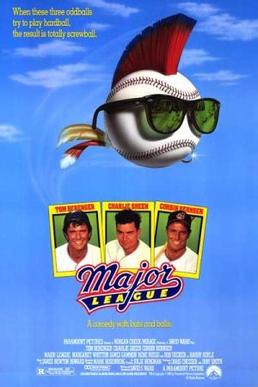
Major League is the ultimate underdog baseball movie.  It’s a film about a fictional version of the Cleveland Indians.  Rachel Phelps (Margaret Whitton), the new owner of the Indians, wants to move the team to Miami but to do that, she’s going to need to have the worst season ever, one where the team plays so badly and breaks so many hearts that even the most loyal fans stop coming to the games.  It shouldn’t be too hard since the Indians have’t even won a pennant in over 30 years.  But to make sure that it happens and that the team only wins 15 games over the entire season, Phelps recruits the worst players she can find.

The team that she puts together is made up of has-beens and never-weres.  Some of them have raw talent but none of them know how to play as a team.  Ex-con Ricky Vaughn (Charlie Sheen) has a killer fastball but is so near-sighted that he’s a danger whenever he steps on the mound.  Catcher Jake Taylor (Tom Berenger) is a veteran team leader but his knees are so bad that he can barely walk.  Willie Mays Hayes (Wesley Snipes) is fast but can’t hit worth a damn.  Pedro Cerrano (Dennis Haysbert) can hit home runs but only if the pitcher throws him a fastball.  Just as Rachel expected, the team struggles at first.  Even when they start to show signs of improvement, she cut back on their budget and sells their equipment, all to try to make winning impossible.  It’s only when their manager, ex-drywall salesman Lou Brown (James Gammon), tells them that Rachel wants them to lose that the team comes together and starts to win.

Everything that’s great about baseball can be found in Major League.  I love all the scenes with the fans slowly coming around to believing that maybe the Indians actually could win it all.  I’ve been through that so many times with the Rangers that I know exactly how they all felt.  I love the interactions between all the players on the team, from the new players eager to win to the veterans who just want to survive another season.  I love the scenes with the play-by-play announcer (Bob Uecker) trying to put a good spin on the way the team plays.  (All together: “Just a bit outside!”)  And mostly, I love that the film treats the game and its players with the respect that they deserve.  So many other films would have turned a character like born-again pitcher Eddie Harris (Chelcie Ross) into a punchline.  Instead, in Major League, he gets a standing ovation after he pitches his last game.  The best thing about Major League is that it loves baseball, both the games and the players.

Since Major League was a success at the box office, it was eventually followed by a sequel, Major League II.

Major League II picks up the season after the first movie ended and it tells the exact same story as the first film, just not as well.  Almost everyone from the first film is back (though Omar Epps takes over the role of Willie Mays Hayes from Wesley Snipes) but the charm and the chemistry from the first movie just aren’t there.  The players have to set aside their egos and learn how to play like a team all over again.  The main difference between the two movies is that it takes a lot longer for the Indians to start winning in the sequel than in the first film.  Plus, the sequel just isn’t as funny.

Even if the sequel is a let down, the first Major League is still one of the best baseball movies ever made.  If the Indians could win the pennant in Major League, maybe there’s hope for my Rangers yet!

18 Days of Paranoia #11: Betrayed (dir by Costa-Gavras)


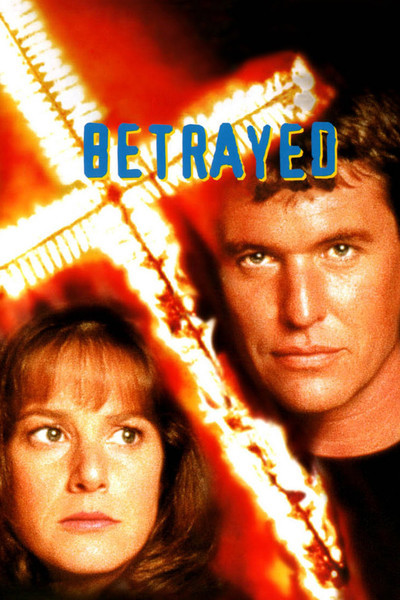
The 1988 film, Betrayed, starts out on a strong note but then quickly becomes annoying as Hell.

It opens with shots of a radio talk show host, an outspoken liberal named Sam Kraus (Richard Libertini).  Kraus berates his callers.  Kraus ridicules anyone who is to the left of Bernie Sanders.  When a man with a rural-accent calls in and attacks Karus for being Jewish, Kraus calls the man an idiot.  After he gets off the air, Kraus walks through a parking garage and stops in front of his car.  Another car pulls up beside Kraus and suddenly, a masked man with a gun opens fire on Kraus, killing him.  The gunman gets out of the car and spray paints, “ZOG” on Kraus’s car before then fleeing the garage.

(ZOG stands for Zionist Occupational Government.  It’s a term used by the type of anti-Semitic dipshits who thinks that the Protocols of Elder Zion are real.)

From this shockingly brutal opening, we cut to panoramic shots of beautiful farmland and crops being harvested in the American midwest, the heartland.  Gary Simmons (Tom Berenger) owns a farm.  He’s a Vietnam vet who nearly received the medal of honor.  He lives with his mother and he has two children.  (He’s divorced and his ex-wife died as the result of a mysterious hit-and-run in California.)  Almost everyone in his small hometown seems to worship Gary.  They’re certainly curious about his new girlfriend, Katie Phillips (Debra Winger).

And really, they probably should be.  Katie Phillips isn’t Katie Phillips at all.  She’s actually an FBI agent named Cathy Weaver and she’s been sent undercover to investigate whether or not Gary was involved in the murder of Kraus.  Cathy, who comes from a broken family and who we’re told has always been seeking some sort of deeper meaning in her life, is charmed by both Gary and his family.  In fact, she falls in love with Gary.  She tells her superior, Mike Carnes (John Heard), that there’s no way Gary is dangerous.  Mike doesn’t believe her but, of course, Mike has a personal stake in this because he and Cathy used to be romantically involved.

(That’s right, everyone.  Betrayed is so narratively lazy that it resorts to making Mike a scorned lover, even though the film’s plot would have worked just as well if he wasn’t.)

As I said, the first part of the movie works.  Debra Wingers gives a strong performance and Tom Berenger is a charming roughneck.  For the first half-hour or so, the film does a good job of showing why men like Gary and his friends are susceptible to conspiracy theories and why they feel that the entire world is stacked against them.  You can understand why Cathy is so troubled by her assignment because Gary’s friends are hardly master criminals.  For the most part, they’re farmers who feel like their entire way of life has been taken away from them.

Unfortunately, almost immediately after Mike refuses to allow her to end her investigation, Cathy returns to the farm and sleeps with Gary.  Not only is this a plot development a disservice to everything that has previously been established about Cathy as a character but it also marks the point where the movie entirely falls apart.  Immediately after sleeping with Cathy, Gary suddenly goes from being a complex but troubled character to being a cartoonish super villain.  And listen — we’ve all been there.  You meet a guy.  He’s handsome.  He says all the right things.  He seems like he’s sensitive.  He makes you feel safe.  You let down your defenses for one night and the next morning, he’s yelling at you for wearing a short skirt in public.  It happens.  Of course, in Gary’s case, it means that he’s not only criticizing the way that Cathy dresses but he’s also taking her on a hunt where the prey is terrified person of color who Gary and his friends have kidnapped.  It also means that Gary drags Cathy along on a bank robbery and then expects her to join him when he wants to assassinate a presidential candidate.  Even after all that, Cathy remains conflicted about what to do with Gary.  The problem is that it’s not like Gary’s a guy who needs sensitivity training or who spends too much time watching ESPN.  Gary is a guy who is carting around weapons and talking about how he wants to kill “mud people.”  That Cathy still has mixed emotions after all of that goes against everything that the film previously asked us to believe about her.  Gary becomes too cartoonish to be plausible and, as a result, he drags down Cathy’s character as well.

Unfortunately, as the film’s narrative falls apart, so do the majority of the performances.  While Debra Winger struggles to make her character’s motivations plausible, Tom Berenger is reduced to doing a lot of glaring.  (Poor John Heard spends most of the movie shouting and bugging his eyes.)  About the only actor who comes out Betrayed unscathed is John Mahoney, who plays Shorty.  Shorty is one of Gary’s friends.  He’s a friendly and personable guy who seems to sincerely care about everyone and who has a charmingly gentle smile.  He’s also a total racist and the contrast between Shorty’s amiable nature and his hateful thoughts provide the latter half of Betrayed with its only powerful moments.  Mahoney gets one big scene, where he talks to Cathy about how much he hates violence but, at the same time, he feels that the world has left him no other choice.  Mahoney does a great job with his small role.  It’s unfortunate that the rest of Betrayed couldn’t live up to his performance.

Other Entries In The 18 Days Of Paranoia:

  1. The Flight That Disappeared
  2. The Humanity Bureau
  3. The Private Files of J. Edgar Hoover
  4. The Falcon and the Snowman
  5. New World Order
  6. Scandal Sheet
  7. Cuban Rebel Girls
  8. The French Connection II
  9. Blunt: The Fourth Man 
  10. The Quiller Memorandum

Rockin’ in the Film World #20: EDDIE AND THE CRUISERS (Embassy 1983)


gary loggins's avatarcracked rear viewer

You couldn’t go anywhere in 1984 without hearing “On the Dark Side” blaring from a car radio or your neighborhood bar’s jukebox. That’s thanks in large part to audiences rediscovering 1983’s EDDIE AND THE CRUISERS via repeated showings on HBO, turning the film into an instant cult classic and veteran Providence-based rockers John Cafferty & The Beaver Brown Band into FM-radio favorites. The film hadn’t done well when first released to theaters, but exposure on the fairly-new medium of Cable TV garnered new fans of both it and Cafferty’s soundtrack album.

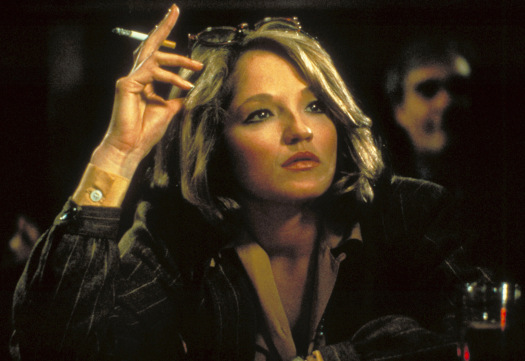
Investigative reporter Ellen Barkin looks into the mysterious death of Eddie Wilson (played by Michael Pare’), lead singer of The Cruisers, whose death in a car accident is shrouded in secret, as the body was never found. Was it suicide? murder? or is Eddie still alive? She digs deep to uncover the facts about what happened that fateful night…

View original post 435 more words

Horror Film Review: The Sentinel (dir by Michael Winner)


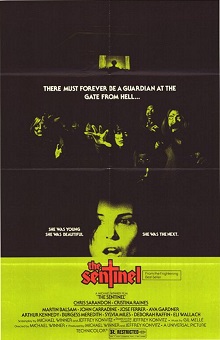
Here’s the main lesson that I’ve learned from watching the 1977 horror film, The Sentinel:

Even in the 1970s, the life of a model was not an easy one.

Take Alison Parker (Cristina Raines) for instance.  She should have everything but instead, she’s a neurotic mess.  Haunted by a traumatic childhood, she has attempted to commit suicide twice and everyone is always worried that she’s on the verge of having a breakdown.  As a model, she’s forced to deal with a bunch of phonies.  One of the phonies is played by Jeff Goldblum.  Because he’s Goldblum, you suspect that he has to have something up his sleeve but then it turns out that he doesn’t.  I get that Jeff Goldblum probably wasn’t a well-known actor when he appeared in The Sentinel but still, it’s incredibly distracting when he suddenly shows up and then doesn’t really do anything.

Alison has a fiancée.  His name is Michael Lerman (Chris Sarandon) and I figured out that he had to be up to no good as soon as he appeared.  For one thing, he has a pornstache.  For another thing, he’s played by Chris Sarandon, an actor who is best known for playing the vampire in the original Fright Night and Prince Humperdink in The Princess Bride.  Not surprisingly, it turns out that Michael’s previous wife died under mysterious circumstances.  NYPD Detective Rizzo (Christopher Walken) suspects that Michael may have killed her.

(That’s right.  Christopher Walken is in this movie but, much like Jeff Goldblum, he doesn’t get to do anything interesting.  How can a movie feature two of the quirkiest actors ever and then refuse to give them a chance to act quirky?)

Maybe Alison’s life will improve now that she has a new apartment.  It’s a really nice place and her real estate agent is played by Ava Gardner.  Alison wants to live on her own for a while.  She loves Michael but she needs to find herself.  Plus, it doesn’t help that Michael has a pornstache and may have killed his wife…

Unfortunately, as soon as Alison moves in, she starts having weird dreams and visions and all the usual stuff that always happens in movies like this.  She also discovers that she has a lot of eccentric neighbors, all of whom are played by semi-familiar character actors.  For instance, eccentric old Charles (Burgess Meredith) is always inviting her to wild parties.  Her other two neighbors (played by Sylvia Miles and Beverly D’Angelo) are lesbians, which the film presents as being the height of shocking decadence.  At first, Alison likes her neighbors but they make so much noise!  Eventually, she complains to Ava Gardner.  Ava replies that Alison only has one neighbor and that neighbor is neither Burgess Meredith nor a lesbian.

Instead, he’s a blind priest who spends all day sitting at a window.  He’s played by John Carradine, who apparently had a few hours to kill in 1977.

But it doesn’t stop there!  This movie is full of actors who will be familiar to anyone who enjoys watching TCM.  Along with those already mentioned, we also get cameos from Martin Balsam, Jose Ferrer, Arthur Kennedy, Eli Wallach, Richard Dreyfuss, and Tom Berenger.  There are 11 Oscar nominees wasted in this stupid film.  (Though, in all fairness, Christopher Walken’s nomination came after The Sentinel.)

Personally, The Sentinel bugged me because it’s yet another horror movie that exploits Catholic iconography while totally misstating church dogma.  However, the main problem with The Sentinel is that it’s just so incredibly boring.  I own it on DVD because I went through a period where I basically bought every horror film that could I find.  I’ve watched The Sentinel a handful of times and somehow, I always manage to forget just how mind-numbingly dull this movie really is.  There’s a few scary images but mostly, it’s just Burgess Meredith acting eccentric and Chris Sarandon looking mildly annoyed.  If you’ve ever seen Rosemary’s Baby, The Exorcist, or The Omen, you’ll figure out immediately what’s going on but The Sentinel still insists on dragging it all out.  Watching this movie is about as exciting as watching an Amish blacksmith shoe a horse.

There’s a lot of good actors in the film but it’s obvious that most of them just needed to pick up a paycheck.  I’ve read a lot of criticism of Cristina Raines’s lead performance but I actually think she does a pretty good job.  It’s not her acting that’s at fault.  It’s the film’s stupid script and lackluster direction.

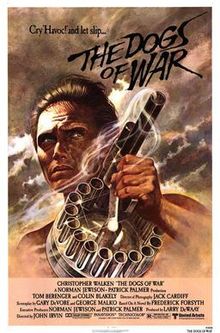
A Movie A Day #146: The Dogs of War (1981, directed by John Irvin)


Jamie Shannon (Christopher Walken) is a professional mercenary who is hired, by a British businessman, to overthrow the government of Zangaro.  Though Zangaro is currently ruled by a ruthless dictator, Shannon’s employers want to replace him with someone even worse, all so they can get their hands on the country’s platinum mines.  After Shannon is captured and tortured by the government, he wants nothing else to do with Zangaro.  Instead, he wants to return to New York and propose to his ex-wife (JoBeth Williams).  But, when she turns down his proposal, Shannon and his mercenary army return to Zangaro.

Before winning an Oscar for The Deer Hunter and becoming one of our most popular character actors, Christopher Walken was a finalist for the role of Han Solo in Star Wars.  If not for George Lucas’s decision to hire Harrison Ford to read lines for the actors at the auditions, Christopher Walken’s career could have developed far differently.  The Dogs of War, which was Walken’s first big film after the high of The Deer Hunter and the low of Heaven’s Gate, features Walken playing a character who has much in common with George Lucas’s original conception of Han Solo, an amoral mercenary who will work for anyone who pays him.  Walken is almost too good as Jamie, playing the part as being so aloof and ruthless that it is sometimes hard to feel any sympathy for him at all.  If he had taken that approach to playing Han Solo, audiences would have really been shocked when Han returned to attack the Death Star.  They would probably be worried that he had returned because the Empire offered him a thousand credits to kill Luke.

The Dogs of War has an intriguing premise but it’s a very slow movie that gets caught up in all the minutia that goes into staging a coup.  It’s exciting when Walken and his mercenaries finally attack the dictator’s compound but it takes forever to get there.  The book, by Frederick Forsyth, is a well-written page turner but the film adaptation largely falls flat.

Lisa Reviews An Oscar Nominee: The Big Chill (dir by Lawrence Kasdan)


Big_chill_ver1

There are certain films that truly are “You just had to be there” films.  These are the movies that were apparently loved by contemporary audiences but, when viewed today, it’s difficult to see just what exactly everyone was getting so excited about.  Sometimes, this is because the film itself was so influential and has been copied by so many other films that the original has had its power diluted.  And then, sometimes, it’s just a case that the film was never that good to begin with.

I’m guessing that The Big Chill must be one of those “you just had to be there” type of films.  First released in 1983, The Big Chill was nominated for best picture.  If you look the film up over at the imdb, you’ll find lots of comments from people who absolutely adore this film.  However, when I watched the film as a part of TCM’s 31 Days of Oscar, I have to admit that my reaction can be best summed in one word.

Meh.

Now, don’t get me wrong.  I’m not saying that The Big Chill was a bad film.  To be honest, it was neither memorably bad nor remarkably good.  Instead, it just was.  Overall, the performances were good, the direction was shallow, and the screenplay was occasionally good and occasionally shallow but mostly, it was the epitome of serviceable.

At the start of The Big Chill, Alex is dead.  With the exception of a scene where his corpse is being prepared for burial, Alex never actually appears on screen.  (Originally, Kevin Costner was cast to play the role in a flashback but director Lawrence Kasdan cut the scene.)  What little we learn about Alex, we learn from listening to the other characters in the film talk about him.  For instance, Alex was apparently brilliant but troubled.  He attended the University of Michigan in the 1960s and was close to 7 other politically radical students.  While everyone else was busy selling out their ideals, Alex stayed true to his and, as a result, he ended up spending his life depressed and poor.  Alex ultimately ended up committing suicide, an act that leads to his 7 friends reuniting for his funeral.

Opening with Alex’s funeral and taking place over one long weekend, The Big Chill follows Alex’s friends as they try to figure out why Alex committed suicide and debate whether or not they’ve sold out their college ideals.  They also spend a lot of time listening to the music of the youth, getting high, watching a football game, and washing dishes.

(Interestingly enough, they spend the weekend in the exact same house where Alex committed suicide.  Which, to be honest, I would think would be kind of creepy.)

There’s Harold (Kevin Kline) and Sarah (Glenn Close), who are the unofficial grown ups of the group.  It was at their vacation home that Alex committed suicide and, over the course of the film, we find out that Alex and Sarah had a brief affair.  Harold owns a company that makes running shoes and, to at least one friend’s horror, is now good friends with the local police.  Sarah, meanwhile, splits her time between crying in the shower and smiling beatifically at her friends.

(Incidentally, throughout the film, Kevin Kline speaks in one of the least convincing southern accents that I’ve ever heard…)

Meg (Mary Kay Place) is a former public defender who, after deciding that all of her poverty-stricken clients really were scum, has now become a real estate attorney.  Meg wants a baby and is hoping that one of the men at the funeral might be willing to impregnate her.  Meg is a chain smoker so good luck, unborn child.  Before Alex killed himself, she had an argument with him.  (“That’s probably why he killed himself,” someone suggests.)

I liked Karen (JoBeth Williams) because she’s prettier than Meg and less condescending than Sarah.  She’s unhappily married to an advertising executive named Richard (Dan Galloway).  As they drive to the cemetery, Richard tells Karen that he can’t believe her famous friends all turned out to be so boring.  Karen is unhappy in her marriage and, after Richard returns home and leaves her in South Carolina for the weekend, decides that she wants a divorce.

That’s good news for Sam (Tom Berenger), an actor who is best known for playing private detective J.T. Lancer on television.  Sam is upset that nobody takes him or his career seriously.  Meg was hoping that Sam would be the father of her baby but, instead, Sam is more interested in Karen.

And then there’s Nick (William Hurt), who is a former radio psychologist-turned-drug dealer.  Nick was wounded in Vietnam and is impotent as a result.  In case you somehow forget that fact, don’t worry.  Nick brings it up every few minutes.

Michael (Jeff Goldblum) was my favorite among the men because he’s at least willing to admit that he’s a self-centered jerk.  Michael is a former underground journalist who now works for People Magazine.  Nobody seems to like Michael and yet, he’s still invited to stay over the weekend.  Personally, I like to think that he does so just to get on everyone’s nerves.  Good for him.

And finally, there’s Chloe (Meg Tillis), who was Alex’s much younger girlfriend and who doesn’t seem to be impressed with any of Alex’s friends (with the exception, of course, of impotent old Nick).

I have to admit that I probably would have responded more to The Big Chill if it was actually about my generation, as opposed to being about my grandparents. Someday, someone my age will make a movie about a bunch of college friends reunited for a funeral and it will be filled with my music and my cultural references and I’ll think it’s brilliant.  And then, a 30 years later, some snotty little film reviewer will watch and probably say, “Meh.  Old people.”

Such is life.