Quickie Review: Running Scared (dir. by Wayne Kramer)


Director Wayne Kramer’s follow-up to his directorial debut (The Cooler) shows that he has a flair for drama and suspense that borders the line between reality and surrealism. Running Scared has such a gritty, washed out look right from the get-go that one starts to think it’s a film lifted right out of the 70’s. But that is only part of what Kramer does in creating a look and feel for Running Scared. Kramer actually uses every kind of trick in a director’s book to give his film such an over-the-top sense that the audience really doesn’t know what to expect just around the next dark corner.

Running Scared‘s first ten minutes sets up what the rest of the next two hours are going to be like. Kramer direct’s this ten minutes like a man possessed. The direction and editing is frantic and frenetic. Some have said that it’s all been done before by Tarantino, Woo and a dozen other action-stylists out of Hong Kong, but I disagree. Kramer’s style owes alot more to the grandfather of excessive film violence and that’s Sam Peckinpah. I’m not comparing Running Scared to Peckinpah’s seminal classic The Wild Bunch, but the pace and look of the chaotic shoot-out in the tiny apartment to start the film brings to mind the opening and closing shoot-outs of Peckinpah’s film.

Kramer knows he’s not making a social statement or even an intellectually relevant film. What he does know is that he wants to tell a fairy tale of one man’s hectic day and all the craziness he has to go through during that day. And this is what Running Scared really has turned out to be. A fairy tale set in an modern, dank, urban landscape where our hero (though anti-hero is more like it) and the two kids in his life must travel a surreal place filled with mack-daddy pimps, hooker with a heart of gold, corrupt cops and even a pair of child pedophiles who also turn out to be husband and wife. Running Scared is a like Grimms fairy tale as seen and told in a modern setting.

The cast of actors Kramer has assembled all do a good job in populating this violent, profane modern fairy tale. I’d be the last to think that Paul Walker was an actor who had any talent, but his performance in this film has given me pause to think that maybe its not him, but the projects he’s been doing that’s given him a bad reputation as an actor (which continues to this day as he continues to put himself in bad projects). Gone is the California surfer dude persona he seems to saddle himself with in most of his roles. He actually inhabits the low-level mobster soldier he plays as Joey Gazelle. This film may not be his breakout performance but it will open up some eyes. The boy’s got some skill he’s never been able to show before. The other actor who makes a standout performance is one Cameron Bright who plays Oleg. The neighbor kid whose theft of a mob gun Joey is suppose to make disappear turns Joey’s life upside down. Cameron’s almost like Pinocchio in that its through him that we see all the crazy characters he runs across. It’s a testament to Kramer’s direction that he’s able to get such good performances from Walker, Bright and the rest of the cast in a film that’s as confusing, complicated and surreal as this film turned out to be.

Running Scared was a wonderful surprise of a film for 2006. It’s an unabashed fun, thrilling urban fairy tale that goes for broke in everything it does. Wayne Kramer’s direction shows that his very good work in filming The Cooler wasn’t a fluke and one-time deal. He’s no Tarantino and surely not in the same league as Sam Peckinpah whose films this one owes alot to in style and feel, but he’s slowly making a name for himself as one who can do good work. Oh, Paul Walker does a good job in it as well.

6 Trailers For The End of 2010


I’ve been under the weather since the day after Christmas (and you probably don’t want the details though they can be found on twitter because my twitter account is my place to be all TMI) so I fear that I’ve been running behind when it comes to posting on this site.  Not only have I not written my review of True Grit and Rabbit Hole, but I haven’t written anything about that video of the beaver opening up the box of tampons yet. 

So, wyle ah work on gittin mah purty lil self all caught up here (and attempt to phonetically recreate my natural country girl accent), here’s the final 2010 edition of Lisa Marie’s Grindhouse and Exploitation Trailers

1) Made in Sweden

I love how all the imported, soft-core films of the early 70s were always advertised as being sensitive, coming-of-age stories.  Christina Lindberg later starred as the iconic One-Eye in Thriller, A Cruel Picture (a.k.a. They Call Her One-Eye.)

2) Blindman

Yes, the trailer’s in German and no, I don’t speak German.  I speak French which I guess means I’d have to surrender if this trailer ever tried to enter me.  BUT ANYWAY, this is actually an Italian film.  Tony Anthony plays a blind gunslinger who is hired by a bunch of mail order brides to free them from a sadistic bandit played by Ringo Starr.  Yes, that Ringo Starr.

3) Tattoo

If, like my friend Elly, you live in Australia, you can watch this movie on DVD.  Unfortunately, outside of “region 4,” this movie is unavailable.  I’ve never seen it though I read about it in Bruce Dern’s quite frankly weird autobiography.  (I say weird with affection because, seriously — how can you not love Bruce Dern?)  Anyway, Dern says that in the sex scenes in this movie, he and Adams were actually doing it.  Apparently, the film itself is a take-off on The Collector — Dern kidnaps Adams, covers her body in tattoos, and then has sex with her.  It actually sounds like kind of a disgusting movie, to be honest and the prospect I might see it is making me reconsider my plans to eventually relocate to Australia (sorry, Elly).  

As for the trailer,  I just think it’s really nicely atmospheric, especially in the slow-motion sequence at the beginning.

4) Hell Night

This is the old school slasher film that I always wish I had been around to be cast in.  Why?  Because of all the costumes, of course!  If you’re going to be a victim in one of these movies, you might as well get to play dress up beforehand.

5) Invasion of the Bee Girls

There are two trailers for this movie.  This is the mainstream version and it is a heavily cut — and I mean HEAVILY CUT — version of the one that played in the grindhouses.  You can find the uncut version on Stephen Romano’s Shock Festival.  Anyway, this is one of those wonderfully satirical 70s films that was marketed as a standard grindhouse film.  William Smith plays an FBI agent who is sent to Peckham, California to discover why the town’s men are being fucked to death.  Actually, just looking at the men of Peckham, California — they should probably be happy with what they can get.

6) Deep Red

What better way to end 2010 than with the one and only Dario Argento?  This is the trailer for his first worldwide hit, the classic giallo Deep Red.  This is also the film where he first met and romanced Daria Nicolodi.  Plus, this movie probably features the best performance ever from the late and underrated David Hemmings (who would end his career playing a small role in Gangs of New York, a film which also features Giovanni Lombardo Radice.)

As a sidenote, I’ve really enjoyed sharing these trailers through 2010 and I look forward to sharing more in 2011.  Je te donne tout mon amour, mon lecteur.

Review: Taken (dir. by Pierre Morel)


In 2009 a little film coming out of France gained a buzz from on-line film bloggers. The film wasn’t the latest arthouse attempt to relive the glory days of French New Wave. It wasn’t a film that’s become part of the extreme French horror that’s becme all the rage in the horror circles in the past decade or so. This film was an action-thriller starring Irish actor Liam Neeson with an ensemble cast of actors from the US, UK, France and Albania. The film I am talking about is Taken by French filmmaker Pierre Morel (his previous film, District 13 with it’s parkour action scenes would make it a cult hit) and produced by his mentor Luc Besson.

Taken at its most basic core is a film about a father’s love for his daughter who has gotten herself kidnapped by Albanian sex-traffickers while on vacation in Paris, France. Liam Neeson’s character gets introduced as a retired government worker and divorcee whose attempt to reconnect with Kim his teenage daughter (played by Maggie Grace of Lost). His attempts to impress his daughter and make her happy gets upstaged by his ex-wife’s richer husband and stepfather to his daughter. It doesn’t help that Neeson’s character Bryan Mills has skillsets not easily translated to the civilian sector. He’d take an offer of a bodyguard gig from one of his former co-workers and it’s during this security job that we get a clue as to what sort of government employee Bryan Mills was before his decision to retire.

Moving forward we finally get past the introductions of the characters (Famke Janssen as Mills’ ex-wife really comes across as a major harridan who seems intent on punishing Mills for selfish reasons). Mills learns of a trip Kim will be taking with her friend Amanda (Katie Cassidy) to follow U2’s European concert tour. Mills, the clearheaded parent, doesn’t like this plan to have his daughter galavanting across Europe without adult supervision, but his guilt for having neglected Kim while he was working for the government plus his ex-wife’s insistence that Kim take the trip makes him relent, but not without giving her some advice to stay safe.

To say that Kim and Amanda get into a heap of trouble right as soon as they arrive in Paris would be an understatement. The two get kidnapped while staying at the luxury apartment of Amanda’s cousin. Before Kim is taken by the masked intruders (who’ve already taken Amanda) she’s able to make a desperate phone call to her father. Calm, collected and knowing that her daughter’s abduction was an inevitability, Mills instructs his daughter to relay to him as much information as possible about those abducting her. With that information in hand Mills heads to Paris to find his daughter (and to punish those who dare kidnap her).

From then on Taken becomes an action-thriller which barely gives the audience a chance to take a breather. Mills knows his time frame when it comes to finding his daughter gets shorter and shorter thus goes about his job searching for her in a deadly efficient manner. Mills becomes Jack Bauer and Jason Bourne rolled into one. There’s no witty, debonair Bond in this character. Mills goes about his business of interrogating, killing and gathering information with cold, calculating efficiency which leaves no room for Bondesque dialogue. The story moving forward once Mills arrive in Paris becomes almost an extension of Mills’ character. Writers Besson and fellow collaborator Robert Mark Kamen keep the dialogue to the barest minimum. We learn more about Neeson’s character through his actions more than we do during character interactions with other players in the film.

The film hinges on the audience buying Liam Neeson as a deadly, ex-CIA operative who manages to survive every violent encounter throughout the film (some by his own doing and others just trying to survive through it). From how people have reacted to this film and Neeson’s character I would say that it’s a big definitive yes that we buy Neeson as someone akin to Bauer and Bourne. In fact, I would say that Neeson’s Bryan Mills would be the more dangerous of the three. He has no compunction about using torture to gather information and barely breaks a sweat when killing those involved in some way in his daughter’s abduction. He has no bouts of guilt about what he has done in the past (probably killing as a secret agent) , what he’s doing in the present (killing to find his daughter) and what he’ll be doing in the future (probably thinking killing thoughts about anyone who will look at his daughter funny). Neeson’s Bryan Mills is a cold, efficient killing machine who doesn’t use fancy moves to take out his opponents and willing to shoot them in the back if it ends the fight in his favor.

The action sequences in Taken has some parkour influences, but not enough to make it distracting. There were no Michael Bay-style skewed camera angles, slo-mo shots and ADHD-style editing. Morel actually keeps the frenetic editing that made the Jason Bourne fight scenes so dynamic to a minimum. There’s just enough of it to make the fight scenes look brutal and painful, but not enough to make people nauseous. The climactic action sequence on the yacht of a rich buyer of sex-slaves goes by so quickly yet was more entertaining than half the prolonged action scenes from Bay’s Transformers sequel.

The rest of the cast barely keep up with Neeson in the film. They become tertiary characters whose job were to give Neeson’s character the motivations he needs to get the job done. I will say that Maggie Grace as Kim was believable as a teenager even down to the spoiled teen she starts off in the beginning. But again her character was just there to motivate Neeson’s character to go back to doing what he did well and that’s kick ass (he’d probably do it just as well while chewing bubble gum).

In the end, Taken was an action-thriller which more than surprised many people. It cemented Liam Neeson as one badass dude in the same league as Kiefer Sutherland’s Bauer and Matt Damon’s Jason Bourne. The film became a showcase for people to witness Neeson kickass and do it believably while Morel does just enough to keep the film from becoming too ridiculous. While Taken won’t herald the coming of another era of French New Wave, it does succeed in doing what it set out to do and that’s entertain, thrill and just give the audience some kickass escapist fare that some big-budgeted Hollywood studio titles never seem to do.

Scenes I Love: Southern Comfort


This rather lengthy sequence comes towards the end of Walter Hill’s 1981 action film, Southern Comfort.  Two national guardsmen (played by Keith Carradine and Powers Boothe), after spending the majority of the movie being chased through the Louisiana bayou by “bad” Cajuns, find a few moments of fleeting peace with “good” Cajuns.  While I love the way Hill builds up the tension in the scene, it’s the authentic atmosphere that makes this sequence memorable.  Hill filmed this sequence with nonprofessional extras who pretty much just did their thing. 

(As a sidenote: I’m fluent in French but less so in Cajun.)

Be warned: two hogs are gunned down and gutted about halfway through this scene.  Since this film was made by Walter Hill and not Umberto Lenzi, I doubt the hogs were specifically murdered just for the movie.  To be honest, as a former farm girl who has spent more than a little time down around the bayous, I find it diffilcult to cry too hard over a hog.  Trust me, they’re nothing at all like Babe.

The music here, by the way, was performed by the legendary Dewey Balfa.

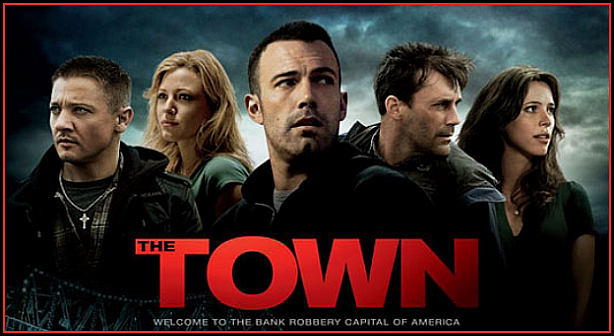
Quickie Review: The Town (dir. by Ben Affleck)


If someone just five years ago told me that Ben Affleck would turn out to be a director whose work has been some of the better crime drama/thrillers of the past decade then I would declare shenanigans on that individual. Ben Affleck might have won an Oscar for helping write the screenplay for Good Will Hunting, but his career since could be labeled as being one of a joke (Gigli) interspersed with huge paycheck projects (Armageddon) that showed his range as an actor.

This is not to say that Affleck has no talent in front of the camera. I just believe that early in his career after winning his Oscar he got fooled into thinking that everything else since would be Easy Street paved in gold (financially and critically). To say that it hasn’t turned out to be that way (though he did make a ton of money) would be an understatement. But one thing happened while Affleck’s acting career was heading nowhere but down. He got behind the camera as a director and his very first time directing a feature-length film he would make one of 2007’s best films. I speak of his film adaptation of the Dennis Lehane crime drama, Gone Baby Gone. He didn’t just direct the life out of that film, but he also the screenplay with the help of Aaron Stockard.

The two of the them would collaborate once again on Affleck’s latest Boston-based crime drama, The Town. He wrote the screenplay and directed the film and pulled in some wonderful performances from an ensemble cast which included Jeremy Renner, Jon Hamm, Rebecca Hall, Blake Lively, Titus Welliver and Pete Postlethwaite. Fellow site writer Lisa Marie already reviewed the film in detail and her review pretty much put down into words exactly what I thought of the film. I will say that I would swerve slightly away from what she considered some of the flaws in the film.

The Town was adapted from Chuck Hogan’s novel, Prince of Thieves. I would consider the screenplay and dialogue as a major strength of the film. While at times it did seemed to follow the step-by-step and by-the-numbers heist thriller story the screenplay itself didn’t ring false. I liken this film to another heist film which shared some themes and similarities. Michael Mann’s Heat also dealt with the cops-and-robbers foundation. Where Mann’s film had a much larger and epic scope to its storytelling it still boiled down to two groups of determined men playing a dangerous game of cat-and-mouse. The women in both film were written just enough that they had distinct personalities, but in the end they were motivations for the men in the film.

Affleck shows that he doesn’t just know how to direct, but continues is reputation as being one very good screenwriter. One just has to be reminded that he is now 3-for-3 when it comes to screenplays he has written which have turned out to be great ones. While he doesn’t have the same flair for words as Tarantino or Mamet when it comes to the screenplay. What he does well was to create an efficient script which flowed from scene to scene. Tarantino’s screenplays are great, but at times he does allow himself to overindulge his inner-film geek and create dialogue that might be Sorkin-like in execution. What I mean is that as great as the dialogue sound there’s no way people really spoke like this to each other. Affleck’s screenplay for The Town felt very natural and even with Jon Hamm’s less than great performance the film had a natural and genuine sound to it’s dialogue.

That’s one flaw pointed out by Lisa Marie that I would disagree with her on. The other two I can see her point, but it bothered me none. Though if I ever took on a life of crime I would hope I find someone just like Rebecca Hall’s Claire. Now there’s a woman who stands by her man no matter what.

I think in the long run this film might just be seen as one of the best of 2010 and some critics have already dubbed it so. While it’s prospects come awards season time is still up in the air I wouldn’t be surprised if it ends up nabbing one of the ten Best Picture nominations when the Oscar nominations get announced. It would be well-deserved and would just prove that Affleck’s career in the film industry might just be hitting its stride. Who would’ve thought it would be as a writer-director and not as an actor.

Film Review: The Town (dir. by Ben Affleck)


Before I get to my review, you should understand that I nearly didn’t see The Town last night.  Earlier, on Friday morning, I had to leave work early because I was so sick and nauseous that I was on the verge of passing out.  Once I got home, I had to 1) convince my aunt that I wasn’t pregnant (“Are you sure?” she said after I reassured her) and 2) had to convince myself that my appendix wasn’t about to burst (and it’s not so don’t worry).  After all that, there was a part of me that said, “The Town can wait.  I’ll go on Saturday or maybe even later in the week.”

But I ignored that part of me and I went and saw the movie anyway.  Why?  Well, I wanted to review it for this site.  (That’s dedication for you!)  Plus, I knew my friend Jeff wanted to see it with me and I wanted to see it with him and since when has a little thing like a ruptured appendix ever been an excuse not to have a good time?  Last but not least, The Town is Ben Affleck’s second movie as a director.  His first was 2007’s Gone, Baby, Gone.  Personally, I think Gone, Baby, Gone is one of the best crime films ever made.  It’s certainly one of my favorite.  I was curious to see if The Town would be a worthy follow-up or would it just prove Gone, Baby, Gone to have been a fluke.

The Town takes place in the Charlestown section of Boston.  At the opening of the film, we’re told that Charlestown apparently produces more professional armed robbers than any other place in the entire world.  It’s a practice that is handed down from father-to-son.  (Or, in the case of this movie, from Chris Cooper to Ben Affleck.)

Affleck plays Doug, a former hockey player who is now the head of a gang of Charlestown bank robbers.  His second-in-command is Jem (played by Jeremy Renner).  Over the course of the film, we learn Doug’s father (Chris Cooper) is a career criminal who is currently serving a life sentence in prison.  When his father went to prison, Doug was taken in by Jem’s family.  Doug even ended up dating Jem’s sister (Blake Lively) and might be the father of Lively’s daughter.  For this reason, Doug and Jem are fiercely loyal to each other despite the fact that Doug is essentially a nice guy and Jem is not.

(As a sidenote, why is it in the crime films that people are always shocked when the psychotic supporting character ends up doing psychotic?  I mean, have these people never gone to the movies before?  Have they never checked out Goodfellas from Netflix?  Did they miss the whole Joe Pesci “How am I funny?” thing?)

At the start of the film, Doug, Jem, and the gang rob a bank.  Doug is a model of professionalism.  Jem goes a little bit crazy and beats one bank employee nearly to death.  This gives the bank manager, Clare (Rebecca Hall), just enough time to set off a silent alarm.  Realizing that the police are on the way, Jem responds by taking Clare hostage as the gang flees.  Clare is later released on a desolate beach.

However, there’s a problem.  Before releasing her, Jem stole Clare’s ID.  Looking at it after the robbery, he discovers that Clare lives in Charlestown and, as a result, there’s now a risk that she might simply see one of the gang on the street and identify him.  Jem wants to kill her but Doug says that he’ll take care of her himself.

By “taking care of,” Doug means that he’ll follow her around town, eventually strike up a conversation with her, and then end up pursuing a romance with her (while declining, of course, to mention that he already knows her).  Jem, however, was under the impression that “taking care of” meant to kill.  So, needless to say, he’s a little bit miffed when he stumbles across Doug and Clare having a lunch date.

Soon, Doug finds himself trapped in the life he’s created for himself.  In love with Clare but torn by his loyalty to the increasingly unstable Jem, Doug agrees to one more big job.  All the while, he is pursued by two relentless FBI agents (Jon Hamm and Titus Welliver) and he has to deal with an Irish mob boss (Pete Postlewaite) who has an agenda of his own.

The Town works largely because Ben Affleck has, unexpectedly, turned out to be an intelligent, no-nonsense director.  The movie features three robbery scenes and, in each one of them, Affleck creates genuine tension and excitement without ever once resorting to outlandish stunts or random slow motion.  Unlike a lot of (bad) actors turned director, Affleck never seems to feel the need to toss in any showy (but ultimately empty) tricks to try to convince us that he’s a director.  This is a confident movie that shows that Gone, Baby, Gone wasn’t a fluke.  (That said, Gone, Baby, Gone remains the superior film for reasons that I’m getting to.)

Also, as with Gone, Baby, Gone, The Town benefits from Affleck’s obvious love for the city and people of Boston.  Shot on location and featuring a number of local actors, The Town has a wonderful sense of place to it.  By the end of it, you feel as if you know Charlestown even if, like me, you’re just a country girl from Texas.

Ben Affleck the director also manages to do something truly surprising — he gets a good performance out of Ben Affleck the actor.  In the past, I’ve always enjoyed looking at Ben Affleck on-screen but I never really wanted to hear him talk.  Because as soon as he would open his mouth, whatever appeal that Affleck possessed would immediately dissolve.  In the past, as an actor, Affleck often epitomized that whole concept of “there’s no there there.”  However, in this film, he gives a low-key, subtle performance that really helps to hold the entire film together.  I still wouldn’t call Affleck a good actor.  Instead, he’s one of those rare directors who (like fellow bad actor Quentin Tarantino) knows how to get good performances even from the most unlikely of performers.

Affleck is well-supported by Hall, Lively, and Renner.  Hall has a difficult job because she’s not so much playing an actual human being as much as she’s playing an idealized concept.  Her character really doesn’t have any purpose beyond offering Doug a chance at redemption and (this is obvious more in retrospect than during the actual film) really doesn’t have much of an identity beyond how her life touches Doug’s.  Hall, however, is so vulnerable in the role that, while you’re watching the film, that none of this really becomes obvious until a few hours after the movie ends.  Lively (better known for her role on Gossip Girl) is only in a few scenes and, in many ways, her character is even less developed than Hall’s.  If Hall has to represent the Madonna part of the Whore/Madonna complex, guess what Lively represents.  Still, Lively brings some much needed humor to the role and to the film.  She’s having fun playing her drunken, drug-addled character and she steals almost every scene that she’s in.

However, the film is ultimately dominated by Jeremy Renner.  With his angelic voice and deceptively soft voice, Renner is the psychopath that you can’t help but love.  Movie psychos are a dime-a-dozen so when an actor comes along and actually finds something new to do with the role, it’s impossible not to be impressed.

So much works in The Town that I almost feel guilty talking about what doesn’t.  For all its strengths, it also has three rather glaring flaws.  As with all things, the final verdict on this film depends on just how willing the viewer is to overlook these flaws.

First off, Ben Affleck proves himself to be a better director than writer.  The Town’s story is well told but the majority of it will still be awfully familiar to anyone who has ever seen a heist film.  Unlike Quentin Tarantino, Martin Scorsese, or Michael Mann, Affleck doesn’t embrace the conventions in order to deconstruct them.  Instead, he uses the conventional storyline as an excuse to explore the Charlestown culture.  As a result, this flaw arguably works to the film’s advantage.  Still, those viewers who are expecting to be surprised by the film’s plot should consider themselves warned.

As well acted as the movie is, there is one big exception in the cast and that is Mad Men’s Jon Hamm.  Hamm plays the FBI agent who is determined to capture Affleck.  He’s the Javert to Affleck’s Valjean.  Unfortunately, as played by Jon Hamm, he’s also a cinematic black hole.  Hamm may be an excellent television actor but, playing a key supporting role and surrounded by actual film actors, it’s obvious that Hamm has no idea how to act for the big screen.  As a result, he never comes across as a worthy or even dangerous adversary and his pursuit of Affleck never becomes compelling nor do we ever worry that Affleck might not be able to outsmart him.  There’s a scene, towards the end of the film, where Hamm yells something like, “Drop your weapon, asshole!”  I have to admit that I stunned just about everyone in the theater when I burst into laughter at the sound of Hamm shouting “asshole” and sounding, more or less, like an overgrown kid on a playground.

(Hamm’s sidekick, by the way, is played by another tv actor, Titus Welliver.  Welliver is probably best known for playing the Man In Black on the final season of Lost.  Though he gets next to nothing to do, Welliver dominates every scene that he’s in.  Unlike Hamm, he knows how to act on a big screen.)

The most glaring flaw with The Town, however, is that the entire plot pretty much depends on the viewer accepting that Hall’s character, just days after being traumatized by being held hostage and seeing one of her co-workers nearly beaten to death because he attempted to protect her, would so easily trust and open up her life to a stranger (even if that stranger is Ben Affleck).  Never mind the fact that we are then expected to believe that she would stay loyal to Affleck even after learning the truth.  Realistically, this would seem to indicate that the character’s something of a sadomasochist but the film really doesn’t explore that (or really anything else that might make Hall’s character anything more than just an idealized Madonna figure).

I mean, I’m always open to experimentation in a relationship.  Different people enjoy different things and I’ve never been one to judge anyone else’s particular fetish.  However, just speaking for myself, the day that you stick a gun in my face, put a blindfold over my eyes, and then abandon me out on the beach is the same day that I decide that there’s probably not going to be a long-term relationship there.

So, once again, it’s all a question of whether or not you can accept these flaws.  I have to admit that, as I watched the film, I occasionally had a hard time doing so.  If you can agree to overlook the flaws, however, then The Town is an entertaining, well-acted crime thriller with an authentic sense of place.  And if you can’t overlook those flaws, than The Town is a good but imperfect movie that still indicates that Ben Affleck has got quite a future as a director.

Review: Ronin (dir. by John Frankenheimer)


The definition of the Japanese word ronin describes it as a samurai who has lost his master from the ruin of or the fall of his master. John Frankenheimer (with some final draft help with the script from David Mamet) takes this notion of a masterless samurai and brings to it a post-Cold War setting and sensibility that more than pay homage to the great stories and film of the ronin. One particular story about ronin that Frankenheimer references in detail is the classic story of the 47 Ronin. Ronin shows that in the latter-stages of his career, Frankenheimer was still the master of the political/spy-thriller genre. He infuses the film with a real hard-edge and was able to mix together both intelligence and energy in both the quieter and action-packed sequences in the film.

The film begins quietly with the introduction of the characters involved. We meet each individual in this quiet 10-minute scene that shows Frankenheimer’s skill as a director would always be heads and shoulders above those of the bombastic and ADD-addled filmmakers of the MTV generation (Michael Bay being the poster boy). Robert De Niro plays the role of one of the two American mercenaries (or contractors) who instantly becomes the focal point for everyone in the scene. His casual, but attentive reconnoitering of the Paris bar where the first meet occurs helps build tension without being being heavy-handed in its execution. It’s with the introduction of Jean Reno as the Frenchman in the group that we get the buddy-film dynamic as De Niro and Reno quickly create a believable camaraderie born of the times for such men during and after the Cold War.

The rest of the cast was rounded out by an excellent and high-energy turn from Sean Bean as an English contractor who might not be all that he claims and brags to be. The other American in the group was played by Skipp Sudduth who in his own understated way more than kept up with the high-caliber of actors around him. Finishing off and adding the darker and seedier aspects of the cast were Stellan Skarsgard as a former Eastern Bloc (maybe ex-KGB) operative and Jonathan Pryce as an IRA commander whose agendas for bringing this team of masterless ex-spies and operatives together might not be all as he claims. The only break in all the testosterone in the film was ably played by the beautiful, yet tough Natasha McElhone. Like Sudduth, McElhone more than keeps up and matches acting skills with the likes of De Niro, Reno and Skarsgard.

The film moves from the meeting of the group to the actual operation which brought all these disparate characters together. Taking a page from Hitchcock, Frankenheimer and Mamet introduces what would become the film’s MacGuffin. A “MacGuffin” being a plot device which helps motivates each character of its importance and yet we’re left to believe that the item is important without ever finding out why. The MacGuffin in Ronin ends up being a silver case which the IRA terrorists, the Russian Mob and seemingly every intelligence agency in Europe wants to get their hands on.

It’s up to De Niro and his group to steal the case from another party and this was where Frankenheimer’s skill in seemlessly blending spy-thriller and action film shows. From the set-up of the team and their plans, to a near double-cross during an arms deal to the actual operation to take the case, Ronin begins to move at a clipped and tension-filled pace. There’s no overly extraneous dialogue. Mamet’s script fleshes out the story and adds a sense and feel of intelligent professionalism to the characters.

The action sequences mostly involved car chases through the narrow streets of Nice, France to the metropolitan thoroughfares and tunnels of Paris. Frankenheimer shines in creating and directing these sequences. Sequences which he’d decided against the use of CGI. Using what he’d learned and perfected from his own past as a former amateur race car driver and from his own classic film Grand Prix, Frankenheimer used real life cars and drove them through real (albeit choreographed) traffic to give the sequences that sense of reality and speed that one couldn’t get with CGI. The car chase scene within the Paris thoroughfare tunnel against traffic has to go down as one of the best car chase put on film.  With just abit of help from second unit directors Luc Etienne and Michel Cheyko, Frankenheimer pretty much did most of the filming of the car chases.

The story itself, after all the characterizations and high-energy, tense action sequences, was really bare bones and in itself its own MacGuffin. The story just becomes a prop device to help show the mercenaries’ special sense of honor in regards to working with people who might’ve been enemies in the past. The murky world they now live in after the collapse of the black and white sensibility that was the Cold War has become nothing but shades of gray. One little bit of trivia that I found interesting was the fact that Ronin included quite a bit of actors who portrayed past James Bond villains: Sean Bean (Janus), Jonathan Pryce (Carver) and Michael Lonsdale (Drax).

In the end, Ronin became the last great film from a great director. I don’t count Reindeer Games as anything but Frankenheimer picking up a check and the studio dabbling overmuch in the final look and feel of that film. Frankenheimer’s Ronin is a blend of smart dialogue, hard-edged characters, and tense-filled action that he manages to blend together to make a fine and intelligent film. The story’s myseries concerning the MacGuffin might not have been answered in the end, but the journey the audience takes with DeNiro, Reno and McElhone’s character in getting there more than made up for any flaws in the plot.

Black Swan: Aronofsky, Portman and Kunis this December


On July 22, 2010 USA Today score the first exclusive pictures from the set of Darren Aronofsky’s follow-up to his critically-acclaimed 208 film, The Wrestler. This time around Aronofsky takes on Tchaikovsky’s Swan Lake and weaves a psychological thriller around the classic ballet.

Black Swan will have in the titular lead one Ms. Natalie Portman. She’s taking on a role which continues her attempts to expand her repoertoire of character beyond the helpless child-like young women she’s been portraying since she first burst onto the scene. Playing opposite Ms. Portman is Mila Kunis. There’s already been talk going as far back as late 2009 that the two co-sta’ characters will be getting real close.

Synopsis:  The dark tale with psychological twists stars Natalie Portman as Nina, a technically brilliant ballerina whose life takes some strange turns after being picked as the lead in a New York City production of Swan Lake. Pressures mount as her overbearing mother (Barbara Hershey) pushes her to succeed and her manipulative dance master (Vincent Cassel) commands her to be more seductive and loose in her performance.

Complicating matters is the arrival of Lily (Mila Kunis), a sultry dancer who exhibits all the innate ease and sexuality that Nina lacks. Nina begins to fixate on the newcomer as the two forge an unusual relationship.

The film will premiere at the Venice Film Festival this September and also appear in the 35th Toronto Internation Film Festival. Black Swan will be shown in limited release this coming December 1, 2010 to qualify it for the awards season and from the buzz surrounding this film don’t be surprised if it does well with awards and critics prizes. Pictures from the set can be seen in the USA Today link below.

Source: USA Today

6 Exploitation Film Trailers That I Love


The only thing I love more than a good exploitation film is a good exploitation film trailer.  I’ve been known to buy Anchor Bay DVDs of films that I hate just to see what trailers will be included in the extras.  Often times, when I find myself suffering from writer’s block, I cure it by watching 42nd Street Forever.

Below are 6 exploitation film trailers.  They are six of my personal favorites though I could easily list 666. 

Enjoy!

1) Teenage Mother (1967)This trailer (if not the actual film, which is pretty dull) is pure exploitation perfection.

2) They Call Her One Eye (1974)They Call Her One Eye is the American title for a Sweedish film called Thriller, A Cruel Picture.  It’s an appropriate title but its also one of the best movies ever made in the history of cinema.

3) Ms. 45 (1981)I love this movie.  Whenever I break up with a boyfriend or just find myself annoyed with men in general, this is the movie that I end up popping into my DVD player.  Consider yourself warned. 🙂

4) The House With The Laughing Windows (1976) This giallo, directed by Pupi Avati, is probably one of the best films ever to come out of Italy period.  The trailer only begins to hint just how girm, dark, depressing, disturbing, and downright odd this little gem really is.

5) Starcrash (1979) — Starcrash was Luigi Cozzi’s attempt to cash in on Star Wars.  For what its worth, Starcrash is actually a lot more fun and, as played by Caroline Munro, intergalactic priate Stella Starr is actually one of the few truly strong women to appear in Italian exploitation cinema.  (The next Halloween party I’m invited to, I’m going to go as Caroline Munro in Starcrash.)  The special effects pretty much define the whole concept of “That’s a great movie when you’re stoned.”

6) Spasmo (1974) Our final trailer is for that rarest of things, a good movie directed by Umberto Lenzi. 

Review: Hostage (dir. by Florent Siri)


The five years or so has seen the rise of several new directors from France who’ve made quite a splash with their Hollywood debuts. There’s Alejandro Aja with Haute Tension (or Switchblade Romance/High Tension) who brought back the late 70’s early 80’s sensibilities of what constitutes a good slasher, exploitation film. Then there’s Jean-Francois Richet whose 2005 remake of John Carpenter’s early classic, Assault on Precinct 13 surprised quite a bit in the industry. Neither film made too much in terms of box-office, but they did show that a new wave of genre directors may not be coming out of the US but from France of all places. Another name to add to this list is Florent Siri and his first major Hollywood project Hostage shows that he has the style and skills to make it in Hollywood.

Hostage
is another Bruce Willis vehicle that was adapted by Doug Richardson (wrote the screenplay for Die Hard 2) from Robert Crais’ novel. Hostage is a very good thriller with a unique twist to the hostage-theme. Willis’ character is a burn-out ex-L.A. SWAT prime hostage negotiator whose last major case quickly ended up in the death of suspect and hostages. We next see him as chief of police of a small, Northern California community where low-crime is the norm. We soon find out that his peace of mind and guilt from his last case may have eased since taking this new job, but his family life has suffered as a consequence. All of the peace and tranquility is quickly shattered as a trio of local teen hoodlums break into the opulent home of one Walter Smith (played by Kevin Pollak). What is originally an attempt to steal one of the Smith’s expensive rides turn into a hostage situation as mistakes after mistakes are made by the teens.

From this moment on Hostage would’ve turned into a by-the-numbers hostage thriller, but Richardson’s screenplay ratchets things up by forcing Willis’ character back into the negotiator’s role as shadowy character who remain hooded and faceless throughout the film kidnap his wife and daughter. It would seem that these individuals want something from the Smith’s home and would kill Willis’ character’s family to achieve their goals. The situation does get a bit convoluted at times and the final reel of the film ends just too nicely after what everyone goes through the first two-third’s of the film.

The character development in the film were done well enough to give each individual a specific motivation and enough backstory to explain why they ended up in the situation they’ve gotten themselves into. Willis’ performance in Hostage was actually one of better ones in the last couple years. The weariness he gives off during the film was more due to his character’s state of mind rather than Willis phoning in his performance. I would dare say that his role as Chief of Police Jeff Talley was his best in the last five years or so. The other performance that stands out has to be Ben Foster as the teen sociopath Mars. Foster’s performance straddles the line between being comedic and over-the-top and could’ve landed on either side. What we get instead is one creepy individual who almost becomes the boogeyman of the film. In fact, the last twenty minutes of Hostage makes Mars into a slasher-film type character who can’t seem to die.

The real star of the film has to be Florent Siri’s direction and sense of style. From the very first frame all the way to the last, Siri gives Hostage the classic 70’s and 80’s Italian giallo look and feel. Siri’s use of bright primary colors in conjuction with the earthy, desaturated look of the film reminds me of some of the best work of Argento, Bava and Fulci. In particular, Siri’s film owes alot of its look to films such as Tenebrae, The Bird with the Crystal Plumage, and The Psychic. Certain scenes, especially the penultimate climax in the Smith home, take on an almost dreamlike quality. Siri’s homage to the classic gialli even gives Hostage some sequences that would comfortably fit in a 70’s slasher film.

Florent Siri’s Hostage is not a perfect film and at times its increasing tension without any form of release can be unbearable to some people, but it succeeds well enough as a thriller. It also shows that Siri knows his craft well and instead of mimicking and cloning scenes from the gialli he’s fond of, he emulates and adds his own brushstrokes. The film is not for everyone and some people may find the story convoluted if not dull at times, but for me the film works well overall. Siri is one director that people should keep an eye on.