A Town Called Bastard is a British-produced Western that was shot in Spain and which was obviously designed to capitalize on the popularity of the Spaghetti westerns of the two Sergios, Leone and Corbucci. When the movie was released in the United States, the title was changed to A Town Called Hell because it was felt that Americans would find the word “bastard” to be too offensive. I’m not sure how naming your town Hell is somehow an improvement on naming a town Bastard but apparently, that was the thinking. Actually, the town is called Bastardo is both versions of the film so the American title makes less and less sense the more you think about it.
Of course, how you can expect a film to make sense when the opening scenes feature Martin Landau and the very British Robert Shaw as two Mexican revolutionaries who, in the year 1895, ride into the town town of Bastardo and murder almost everyone that they see. Ten years later, Robert Shaw is still living in the town but he’s now a priest and he’s renounced his formerly evil ways. The town itself is ruled by a ruthless outlaw played by Telly Savalas, who doesn’t bother to hide his New York accent despite playing a Mexican outlaw.
One day, a black carriage arrives in town. Inside the carriage is a glass coffin and inside the coffin in Stella Stevens, who is very much alive. Stevens’s husband was among those killed by Shaw and Landau back in the day and she offers gold to anyone who can avenge his death. Savalas is interested in the gold but then his character literally disappears from the film. Instead, Martin Landau rides back into town. He’s now a colonel in the Mexican army and is searching for a fugitive.
A Town Called Bastard has potential but it’s done in by poor casting and Robert Parrish’s inconsistent direction. The story is told so messily and the editing is so sloppy that it often feels like major scenes were left on the cutting room floor. (Just try to figure out what’s going on with Telly Savalas’s character, for example.) Stella Stevens has one or two good moments as the vengeful widow and her entrance into the town is one of the few interesting moments in the movie but both Savalas and Shaw overact in an attempt to hide just how miscast they are while Martin Landau’s main concern seems to be to get his paycheck and move on to the next movie.
In the end, A Town Called Bastard goes straight to Hell.
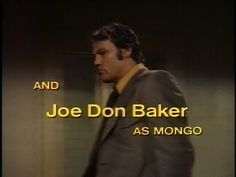
During the Christmas season, Mongo (Joe Don Baker) returns home. However, Mongo hasn’t just come back for the holidays. Mongo is professional killer, one of the best in the business. His older brother, mob boss Mike Nash (Charles Cioffi), has a job for him. He wants Mongo to wipe out a rival gangster. Mongo’s willing to do it but he expects to be properly compensated for his trouble. Family is family but Mongo’s a professional and a professional has to get paid. Lt. Pete Tolsted (Telly Savalas) and his partner, Gordon (Martin Sheen), are the two cops who know that Mongo is bad news and who are determined to discover why Mongo is back in town. Meanwhile, Mongo is falling in love with the naive Vicki (a very young Sally Field), a young woman who has fled West Virginia and is looking to restart her life in the big city.
This made-for-TV movie may not contain any huge surprises but it’s worth tracking down just for the cast. Joe Don Baker, Telly Savalas, Martin Sheen, and Sally Field, all in the same movie and all at the top of their considerable game? That’s more than worth the effort. Joe Don Baker, in particular, is good. Unfortunately, Baker doesn’t always get the respect that he deserves an actor. It’s true that he’s appeared in his share of bad films and his range is limited. But whenever he was cast in the right role — like in this movie or the first Walking Tall — he was a force of nature. What’s most interesting about Mongo is that he doesn’t really like his work and he resents that it’s something that he’s been trapped into doing but, at the same time, he’s so good at it that it’s hard not to wonder what other career he could have possibly found as much success in.
Mongo’s Back In Town was released theatrically overseas under the title Steel Wreath. (Maybe someone realized that Mongo’s Back In Town makes the movie sound like a screwball comedy.) It can be viewed, under its original title, on YouTube.
The 1965 biblical epic, The Greatest Story Ever Told, tells the story of the life of Jesus, from the Nativity to the Ascension. It’s probably the most complete telling of the story that you’ll ever find. It’s hard to think of a single details that’s left out and, as a result, the film has a four hour running time. Whether you’re a believer or not, that’s a really long time to watch a reverent film that doesn’t even feature the campy excesses of something like The Ten Commandments.
(There’s actually several different version of The Greatest Story Ever Told floating around. There’s a version that’s a little over two hours. There’s a version that’s close to four hours. Reportedly, the uncut version of the film ran for four hour and 20 minutes.)
Max von Sydow plays Jesus. On the one hand, that seems like that should work because Max von Sydow was a great actor who gave off an otherworldly air. On the other hand, it totally doesn’t work because von Sydow gives an oddly detached performance. The Greatest Story Ever Told was von Sydow’s first American film and, at no point, does he seem particularly happy about being involved with it. von Sydow is a very cerebral and rather reserved Jesus, one who makes his points without a hint of passion or charisma. When he’s being friendly, he offers up a half-smile. When he has to rebuke his disciples for their doubt, he sounds more annoyed than anything else. He’s Jesus if Jesus was a community college philosophy professor.
The rest of the huge cast is populated with familiar faces. The Greatest Story Ever Told takes the all-star approach to heart and, as a result, even the minor roles are played by actors who will be familiar to anyone who has spent more than a few hours watching TCM. Many of them are on screen for only a few seconds, which makes their presence all the more distracting. Sidney Poitier shows up as Simon of Cyrene. Pat Boone is an angel. Roddy McDowall is Matthew and Sal Mineo is Uriah and John Wayne shows up as a centurion and delivers his one line in his trademark drawl.
A few of the actors do manage to stand out and make a good impression. Telly Savalas is a credible Pilate, playing him as being neither smug nor overly sympathetic but instead as a bureaucrat who can’t understand why he’s being forced to deal with all of this. Charlton Heston has just the right intensity for the role of John the Baptist while Jose Ferrer is properly sleazy as Herod. In the role Judas, David McCallum looks at the world through suspicious eyes and does little to disguise his irritation with the rest of the world. The Greatest Story Ever Told does not sentimentalize Judas or his role in Jesus’s arrest. For the most part, he’s just a jerk. Finally, it’s not exactly surprising when Donald Pleasence shows up as Satan but Pleasence still gives a properly evil performance, giving all of his lines a mocking and often sarcastic bite.
The Greatest Story Ever Told was directed by George Stevens, a legitimately great director who struggles to maintain any sort of narrative momentum in this film. Watching The Greatest Story Ever Told, it occurred to me that the best biblical films are the ones like Ben-Hur and The Robe, which both largely keep Jesus off-screen and instead focus on how his life and teachings and the reports of his resurrection effected other people. Stevens approaches the film’s subject with such reverence that the film becomes boring and that’s something that should never happen when you’re making a film set in Judea during the Roman era.
I do have to admit that, despite all of my criticism of the film, I do actually kind of like The Greatest Story Ever Told. It’s just such a big production that it’s hard not to be a little awed by it all. That huge cast may be distracting but it’s still a little bit fun to sit there and go, “There’s Shelley Winters! There’s John Wayne! There’s Robert Blake and Martin Landau!” That said, as far as biblical films are concerned, you’re still better off sticking with Jesus Christ Superstar.
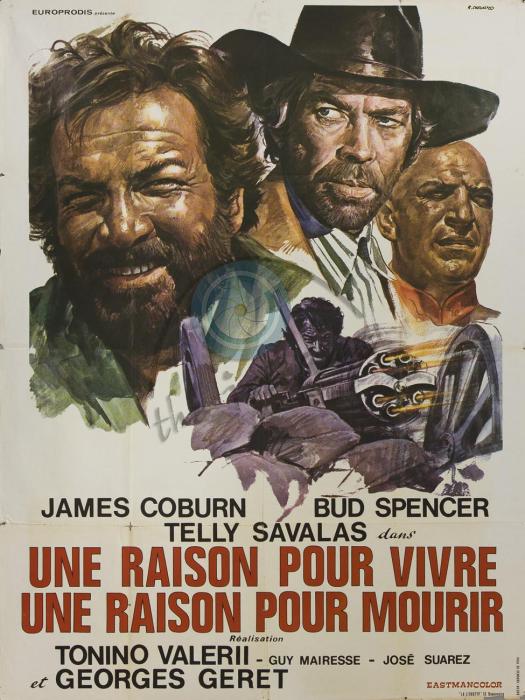
James Coburn, at the height of his career, moved from American movies to international productions with his trademark elegance and ease. He worked for the Maestro of Spaghetti Westerns Sergio Leone in 1972’s DUCK, YOU SUCKER , then appeared for Leone’s former Assistant Director Tonino Valerii in A REASON TO LIVE, A REASON TO DIE, a revenge tale disguised as a caper film that costars Telly Savalas and Spaghetti icon Bud Spencer. The version I viewed was the truncated American cut, missing about a half hour of footage and released stateside in 1974. If the complete version is as good as this one, I need to hunt it down and see it!
The Civil War-set drama finds Coburn as Col. Pembroke, recently escaped from a Confederate prison after surrendering Fort Holman without a fight to Rebel Major Ward (Savalas) and his forces. Fort Holman is a crucial piece of real…
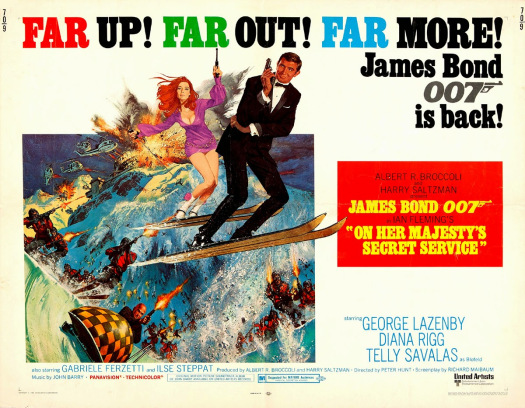
(Okay, so technically ON HER MAJESTY’S SECRET SERVICE isn’t a Christmas Movie. But neither is DIE HARD, though many consider it to be because it’s set during the holiday season. Well, so is this film, and it’s as close as you’ll get to a James Bond Christmas Movie, so I’m gonna go with that!)
ON HER MAJESTY’S SECRET SERVICE was the first Bond film to not star Sean Connery . Instead, newcomer George Lazenby was given the plum role of 007. Lazenby was a model whose claim to fame was a British TV commercial for a chocolate bar; despite having virtually zero acting experience, producer Albert “Cubby” Broccoli offered him an audition and gave him the part. Critics of the time derided Lazenby’s performance, more due to the fact that he wasn’t Sean Connery than anything else. Looking back on the film, he isn’t bad at all; he handles the…
The one that most people seem to know and which regularly shows up on cable is the 1991 version. This version was directed by Martin Scorsese and features Oscar-nominated performances from Robert De Niro and Juliette Lewis. This is the version that has De Niro speaking in a broad Southern accent and attacking people while speaking in tongues. If you’ve ever watched a rerun of an old sitcom and wondered why the laugh track was going wild at the sight of a tattooed prisoner lifting weights in a cell while portentous music boomed in the background, it’s because you were watching a parody of Scorsese’s Cape Fear.
That, however, is not the first version of Cape Fear.
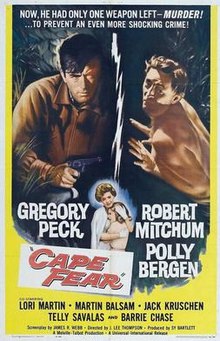
The first version of Cape Fear came out in 1962. It was a black-and-white film that was directed by J. Lee Thompson. In this version, the recently released rapist, Max Cady, is played by Robert Mitchum. Sam Bowden, the attorney that Cady blames for his incarceration, is played by Gregory Peck. Whereas the Scorsese version was highly stylized, the original Cape Fear is brutally straight forward. (While Scorsese’s Cape Fear goes on for over two hours, the original Cape Fear tells its story in a brisk 100 minutes.) While I think that Scorsese’s Cape Fear has its strong points, the original Cape Fear is superior in almost every way.
The original is certainly far more frightening than the remake. What the original may lack in stylization, it makes up for in plausibility. It’s scary because you can imagine everything in the film actually happening. Robert Mitchum and Gregory Peck may both be iconic film stars but they’re also believable as human beings.
For modern audiences, it’s easy to smirk at Peck with his upright image and his sonorous voice but what made Peck a great actor was his ability to make it all seem natural. Peck never seemed like he was acting like an honest man who always tried to do the right thing. Instead, he simply was that man. It’s perhaps significant that Peck played Sam Bowden the same year that he played another honest lawyer, Atticus Finch, in To Kill A Mockingbird. The only real difference between them is that, whereas Atticus was always confident and sure of himself, Sam is frequently helpless. He knows that Max is stalking him and his family and he’s just as aware that there’s nothing he can do about it. When Max rapes a woman (Barrie Chase) that he meets at a bar, she refuses to testify against him. When Sam’s dog turns up dead, everyone knows that Max killed him but there’s no way to prove it. When Sam hires three men to intimidate Max, Max beats them up and promptly tries to get Sam disbarred. When Sam finally resorts to plotting Max’s murder, we’re seeing Atticus Finch pushed beyond his limit.
As for Robert Mitchum, his animalistic performance is frightening precisely because it feels very real. Everyone has known a Max Cady, even if they didn’t realize it at the time. Max gives a fiercely physical performance, often appearing shirtless and strutting through his scenes with a sexual arrogance that’s both frightening and, at times, far more tempting than anyone would want to admit. The scenes in which Max attacks Barrie Chase and Polly Bergen (who plays Peck’s wife) are absolutely terrifying but, for me, the most disturbing moments in Cape Fear are the moments when Max is silent. Even when he’s not speaking, Mitchum allows you to see every depraved thought going through is head.
What’s the scariest moment for me? When the camera catches Max watching Sam’s teenage daughter (Lori Martin). It’s not just that I know what’s going on in Mitchum’s mind as he stares at her. It’s because I know what it’s like to be watched. It’s a scene that’s unsettling because it makes me consider just how many Max Cadys are out there right now.
The battle between Max and Sam is a fascinating one. In prison, Max studied enough law to become as knowledgeable about how to manipulate it as Sam. Under pressure, Sam grows more violent and more willing to circumvent his oath to uphold the same law that Max is now using against him. It makes for a frightening film, one that will stick with you long after you watch it.
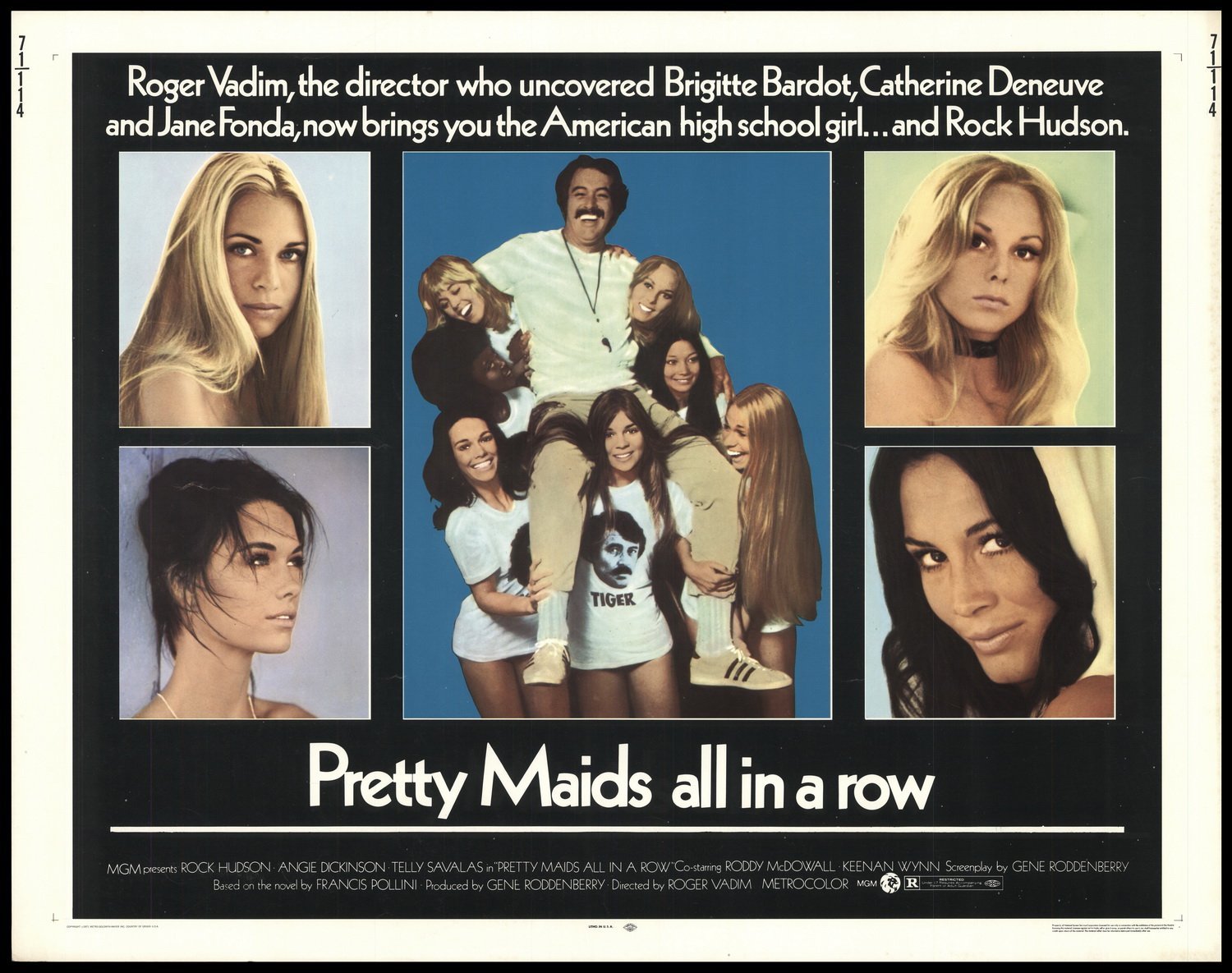
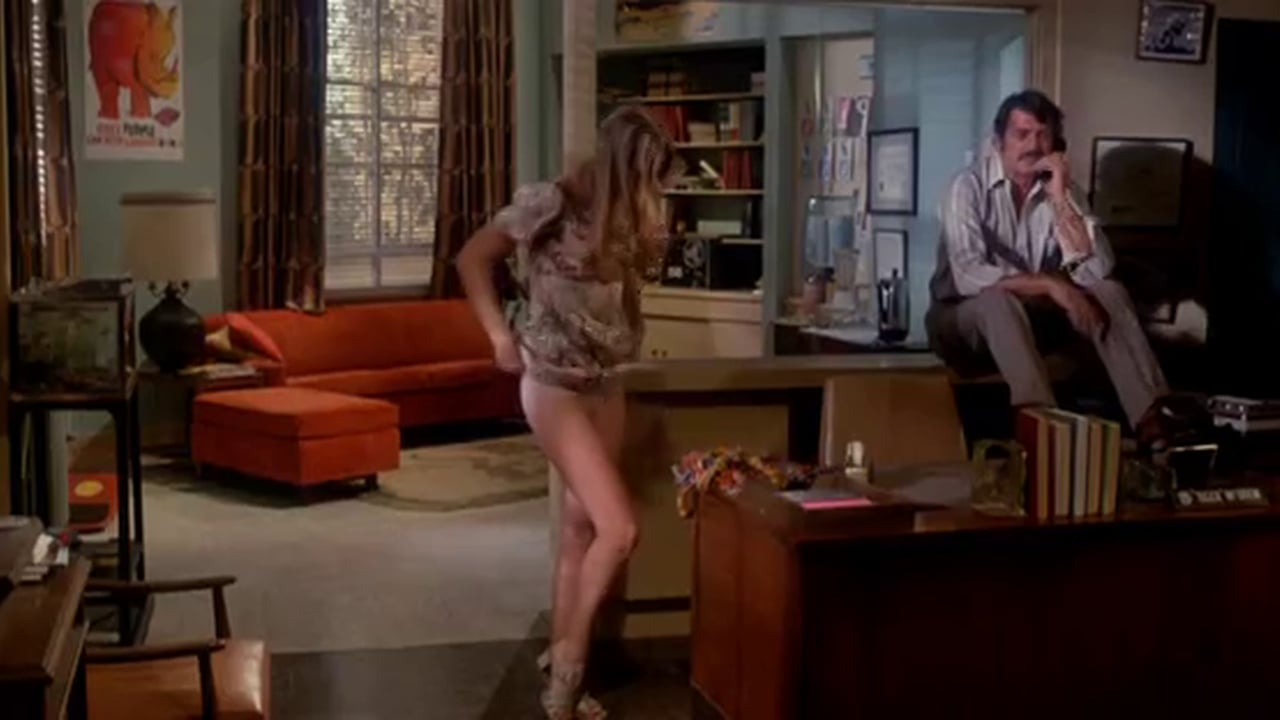
Gene Roddenberry’s post-STAR TREK career had pretty much gone down the tubes. The sci-fi series had been a money loser, and Roddenberry wasn’t getting many offers. Not wanting to be pigeonholed in the science fiction ghetto, he produced and wrote the screenplay for PRETTY MAIDS ALL IN A ROW, a black comedy skewering the sexual revolution, with French New Wave director Roger Vadim making his first American movie. The result was an uneven yet entertaining film that would never get the green light today with its theme of horny teachers having sex with horny high school students!
All-American hunk Rock Hudson was in the middle of a career crisis himself. After spending years as Doris Day’s paramour in a series of fluffy comedies, his box office clout was at an all-time low. Taking the role of Tiger McGrew, the guidance counselor/football coach whose dalliances with the cheerleading squad leads to murder…
After taking off the month of October, I am now back on my Warren Oates kick. The latest Oates film that I watched was Crooks and Coronets, a heist comedy that stars Oates and Telly Savalas as two career criminals plotting a robbery in England.
Crooks and Coronets starts with Herbie Haseler (Telly Savalas) getting released from prison. Waiting for him is his partner-in-crime, Marty Miller (Warren Oates). Because Herbie wants to go straight and doesn’t want to do any more time, he is not happy to learn that Marty stole a car just so he could pick Herbie up from prison. Leaving the car behind, Herbie and Marty walk to a meeting with their old boss, New York gangster Nick Marco (Cesar Romero). Nick reminds Herbie and Marty that they owe him money and tells them that they can not go straight until they pay him back. Nick sends them to England to rob the estate of Lady Sophie Fitzmore (Edith Evans).
After arriving in the UK and meeting with Nick’s English counterpart, Frank Finley (Harry H. Corbett), Herbie and Marty infiltrate the Fitzmore estate. Marty pretends to be a security expect while Herbie says that he is a librarian who is interested in cataloguing the Fitzmore library. However, once they meet the kindly and eccentric Lady Sophie, neither one of them can bring themselves to rob her. Instead, Marty helps Sophie fly an old World War I airplane while Herbie turns Fitzmore mansion into a tourist attraction. When Nick and Frank show up and demand to know what the hold up is, Herbie and Marty have to find a way to stop the robbery.
Crooks and Coronets is never exactly memorable but it is amusing throughout. The main reason to watch it is for the performances of Edith Evans, Telly Savalas and Warren Oates. Though this is not one of Warren’s better-known films, it was a personally significant one for him. It was while filming Crooks and Coronets that Oates met British actress Vickery Turner. Turner played the role of Annie, a tour guide who helps to protect the mansion from Nick and Harry. She did not have a big role but she did look great in a miniskirt. She and Warren Oates were married in 1969 and, after they were divorced in 1974, she went on to have a very successful career as a novelist.
Whenever it comes time to review a film like 1988’s Faceless, movie bloggers like me are faced with a very important question. Which name should we use for this film’s prolific director? The director was born Jesus Franco Manera and, for a very small handful of his 200+ film, he’s actually credited by his full name. However, for the majority of his films, he dropped the Manera. Sometimes, he is credited as Jesus Franco and then other times, the director’s credit reads Jesse Franco or just simply Jess Franco.
Myself, I usually prefer to go with “Jess Franco,” because it just seems to go with his “never give up” style of filmmaking. At the same time, it seems rather appropriate that Franco is known by more than one name because he was a director with a many different personas, occasionally a serious artist, occasionally a subversive prankster, and sometimes a director-for-hire. Franco was a lover of jazz and his films often had a similarly improvised feel. Sometimes, the results were, to put it lightly, not very memorable. But, for every Oasis of the Zombies, there was always a chance that Franco would give the world a film like Female Vampire. The imdb credits Franco with directing 203 films before his death in 2013 but it’s generally agreed that he probably directed a lot more. A lot of his films may not have worked but the ones that did are memorable enough to justify searching for them.
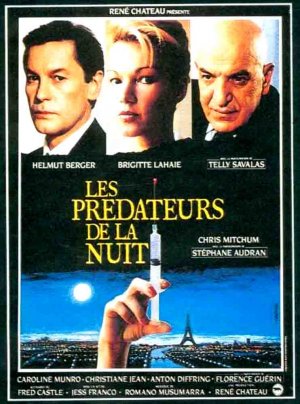
Faceless is Franco’s take on Eyes Without A Face, as well as being something of a descendant of his first film, The Awful Dr. Orloff. All three of these films deal with a doctor trying to repair a loved one’s disfigured face. In Faceless, the doctor is Dr. Flammad (Helmut Berger), a wealthy and decadent Paris-based plastic surgeon. One night, while out with his sister Ingird (Christiane Jean) and his nurse and lover Nathalie (Brigitte Lahaie, the former pornographic actress who appeared in several of Jean Rollin’s best films, including the brilliant Night of the Hunted), Dr. Flammad is confronted by a former patient. Flammad botched her operation so the patient tries to get back at him by tossing acid in his face. However, Ingrid shoves Flammad out of the way and ends up getting splashed by the acid instead.
Now disfigured, Ingrid spends her time hidden away in Flammad’s clinic and wearing a mask. Flammad and Nathalie start to kidnap models and actresses, searching for a perfect face. Flammad’s plan is to perform a face transplant, giving Ingrid a new and beautiful face.
Needless to say, a face transplant is not a simple thing to do. In order to get some advice, they go to the mysterious Dr. Orloff (Howard Vernon) and Orloff directs them to a Nazi war criminal named Dr. Moser (Anton Diffring). Now, if you’re not familiar with Franco’s work, the scene with Dr. Orloff will probably seem like pointless filler. However, if you are a Francophile, you will feel incredibly relieved to see Howard Vernon suddenly pop up. When it comes Franco’s films, a Howard Vernon cameo is usually a good sign.
Flammad’s search for the perfect face is complicated by the fact that his assistant, the moronic Gordon (Gerard Zalcberg), keeps accidentally killing and otherwise damaging all of the prospects. As the bodies continue to pile up, Nathalie even points out that there’s “too many dead bodies” in the clinic.
(Of course, Nathalie isn’t doing much to solve that problem. When the film got to the moment where Nathalie plunged a syringe into one troublesome patient’s eye, I ended up watching the movie between my fingers.)
Eventually, Nathalie kidnaps a coke-addicted model named Barbara (Caroline Munro). Flammad thinks that Barbara might finally be the perfect face that they’ve been looking for but there’s a problem. (Actually, two problems if you count Gordon…) Barbara’s father (Telly Savalas) is a wealthy industrialist and he wants his daughter back. He hires an American private investigator, Sam Morgan (Chris Mitchum, looking a lot like his father Robert), to track her down.
Actually, it’s not that much of a problem. It quickly turns out that Sam is kind of an idiot. Plus, since he’s American, nobody in Paris wants to help him. A Paris police inspector orders him to go home, yells at him for always chewing gum, and then adds, “You are not Bogart!”
And things only get stranger from there…
Faceless is one of Franco’s better films, a mix of over-the-top glamour (Faceless was filmed in Paris, after all) and grindhouse sleaze. Though there is a definite storyline, the film still feels like an extended improvisation, with characters and plot points coming out of nowhere and then disappearing just as quickly. If we’re going to be totally honest, the film is kind of a mess but it’s a glorious and stylish mess, one that is never less than watchable.
One of the great tragedies of American politics is that Chris Mitchum has twice been defeated when he ran for a seat in the U.S. House of Representatives (though he did come close to winning in 2014). Not only would it be great to have Robert Mitchum’s son as a member of Congress but it would be even better to know that our laws were being written, in part, by the star of Faceless. Unfortunately, Chris is sitting out the 2016 election. Hopefully, he’ll reconsider and file for at least one office.
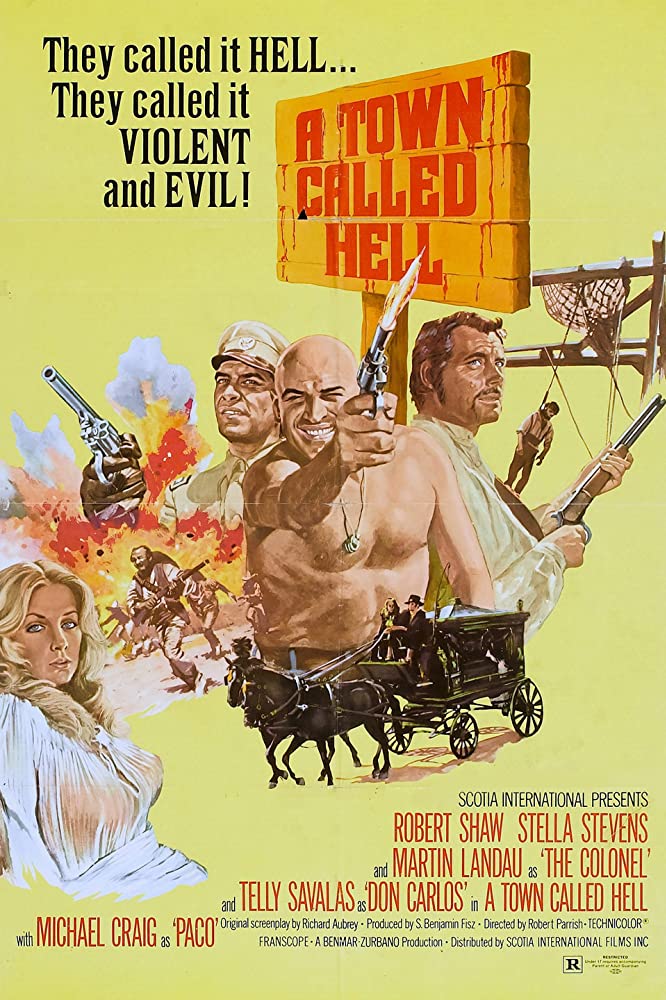 A Town Called Bastard is a British-produced Western that was shot in Spain and which was obviously designed to capitalize on the popularity of the Spaghetti westerns of the two Sergios, Leone and Corbucci. When the movie was released in the United States, the title was changed to A Town Called Hell because it was felt that Americans would find the word “bastard” to be too offensive. I’m not sure how naming your town Hell is somehow an improvement on naming a town Bastard but apparently, that was the thinking. Actually, the town is called Bastardo is both versions of the film so the American title makes less and less sense the more you think about it.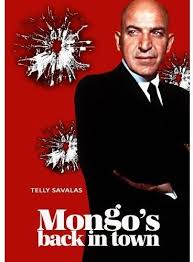



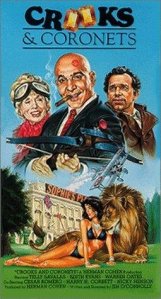 After taking off the month of October, I am now back on my Warren Oates kick. The latest Oates film that I watched was Crooks and Coronets, a heist comedy that stars Oates and Telly Savalas as two career criminals plotting a robbery in England.
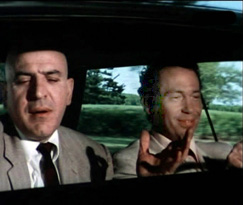 After arriving in the UK and meeting with Nick’s English counterpart, Frank Finley (Harry H. Corbett), Herbie and Marty infiltrate the Fitzmore estate. Marty pretends to be a security expect while Herbie says that he is a librarian who is interested in cataloguing the Fitzmore library. However, once they meet the kindly and eccentric Lady Sophie, neither one of them can bring themselves to rob her. Instead, Marty helps Sophie fly an old World War I airplane while Herbie turns Fitzmore mansion into a tourist attraction. When Nick and Frank show up and demand to know what the hold up is, Herbie and Marty have to find a way to stop the robbery.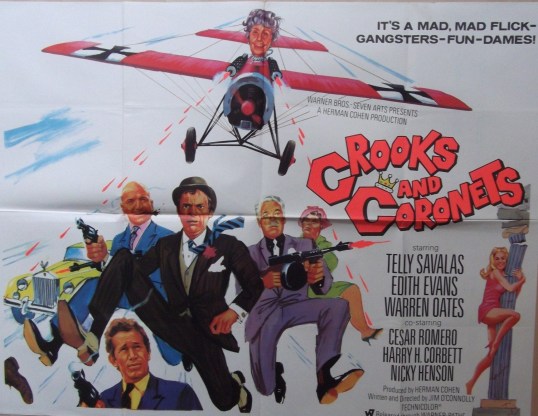
 Through the Shattered Lens