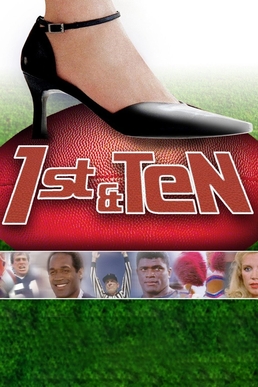
Late Night Retro Television Review: 1st & Ten 2.3 “A Second Chance”


Welcome to Late Night Retro Television Reviews, a feature where we review some of our favorite and least favorite shows of the past! On Wednesdays, I will be reviewing 1st and Ten, which aired in syndication from 1984 to 1991. The entire series is streaming on Tubi.
Things are getting crazy at training camp!

Episode 2.3 “A Second Chance”

(Dir by Bruce Seth Green, originally aired on September 8th, 1986)

This week’s episode featured the unforgettable sight of O.J. Simpson tackling a knife-wielding Don Swayze and saving the life of Delta Burke.

Swayze was playing Clay Daniels, a tight end who was drafted by Coach Denardo, even though he apparently pulled a knife on a professor in college.  After Clay threatened Johnny Valentine after he felt Valentine wasn’t throwing him the ball enough, Denardo explained that he drafted Clay because Clay can play football.  Okay, Ernie, I guess that justifies having a knife-wielding maniac in the locker room….

After Denardo finally cut Clay from the team, Clay showed up at Diana’s house with a knife.  Fortunately, Diana was able to call Denardo and T.D. Parker for help.  Denardo showed up and promised he would give Clay a second chance.  And then T.D. tackled Clay and grabbed that knife like a pro!

Meanwhile, Yinessa returned to training camp but he was not happy that his friend and roommate, wide receiver Jamie Waldren (Jeff Kaake), had a drug problem.  This episode ended with Yinessa getting into a fight with someone who broke into their room in search of Waldren’s cocaine.  An angry Yinessa flushed all of Waldren’s cocaine.  Considering that this episode also featured Diana being named Chairperson of the League’s Anti-Drug Committee, I’m sure this won’t lead to any sort of awkwardness with the team.

Much like last week’s episode, this episode was so melodramatic and over-the-top that I couldn’t help but enjoy it.  Drugs, training camp, and knives!  Will the Bulls make it to the Championship Game a second year in a row?  It’s not looking good but, considering that they have O.J. Simpson’s razor-sharp instincts at their disposal, I wouldn’t count them out yet!

Late Night Retro Television Review: 1st & Ten 2.2 “The Veterans”


Welcome to Late Night Retro Television Reviews, a feature where we review some of our favorite and least favorite shows of the past! On Wednesdays, I will be reviewing 1st and Ten, which aired in syndication from 1984 to 1991. The entire series is streaming on Tubi.

This week, the Bulls face a dilemma.  What to do with O.J. Simpson?

Episode 2.2 “The Veterans”

(Dir by Bruce Seth Green, originally aired on September 1st, 1986)

This week, veteran running back T.D. Parker (O.J. Simpson) shows up for training camp.  All of the players are excited to see him.  At the bar where all of the Bulls hang out, Dr. Death (Donald Gibb) announces that T.D. Parker has had over one hundred injuries over the past twelve years but he’s still the heart and the soul of the Bulls franchise.  He’s the face of the team!  When people think of the Los Angeles Bulls, they think of T.D. Parker slashing through the other team on his way to an acquittal touchdown.

Speaking as a viewer, it seems kind of strange that this is the first that I’m really hearing about the legendary T.D. Parker.  Where was he last season?  The Bulls went all the way to the Championship Game but I never once heard anyone mention T.D. Parker.  I certainly didn’t see him in the locker room.  The Bulls actually had a totally different running back named Carl Witherspoon.  Oddly, Carl seems to have vanished this season….

As for T.D., his injuries are catching up with him.  Denardo and Diana are forced to confront that fact that T.D. can no longer cut it.  Even in practice, he’s spilling a lot of blood on the field.  Denardo cuts T.D. from the team. When T.D. says that football is all that he knows, Denardo announces that T.D. may not be playing but he’ll still be on the field …. AS A COACH!  T.D. looks confused.  He’ll figure it out eventually, I guess.

Meanwhile, Jeff East briefly returns as quarterback Bryce Smith but just long enough to fall out of a window at training camp and bust his knee.  (He was trying to keep the new kicker — a Bosnian played by future voice of the Crypt Keeper John Kassir — from sneaking out to go into town to get drunk.)  Bryce is done for the season.  Veteran quarterback and all-around druggie sleaze Johnny Valentine (Sam J. Jones) becomes the new starter and Tom Yinessa is brought back to be his backup.  That’ll make Yinessa’s roommate (Jeff Kaake) and Yinessa’s potential girlfriend (Katherine Kelly Lang) happy.

Finally, the NFL owners don’t want to give their players a pension or a raise.  They do, however, want to give them mandatory drug tests.  Diana protests but she’s overruled by the other owners, all of whom are male and in their 60s.  There’s a lot of toupees and cigars at the ownership meeting.

This episode was actually kind of entertaining.  That’s doesn’t mean it was good.  1st & Ten isn’t a really a show that’s ever good.  But this episode did feature Sam J. Jones giving a totally over the top performance as creepy quarterback Johnny Valentine.  Speaking of going over the top, the same can be said of Delta Burke’s performance this season.  It would appear that between seasons one and two, Burke realized there was no need to try to be in any way subtle in her line readings.  That was probably the right decision.

Next week …. who knows?  I’m getting a little bored with training camp so hopefully, we’ll move on!

Retro Television Review: Fantasy Island 7.8 “Random Choices/My Mommy, The Swinger”


Welcome to Retro Television Reviews, a feature where we review some of our favorite and least favorite shows of the past!  On Tuesdays, I will be reviewing the original Fantasy Island, which ran on ABC from 1977 to 1984.  Unfortunately, the show has been removed from most streaming sites.  Fortunately, I’ve got nearly every episode on my DVR.

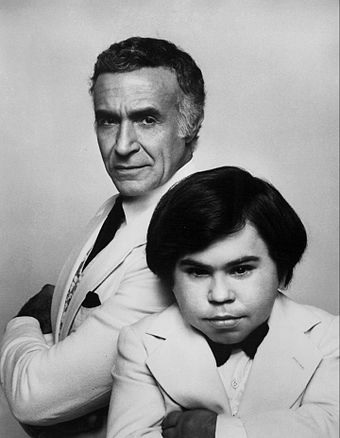
This week, we have two more fantasies that do not feature Tattoo.  What even is the point?

Episode 7.8 “Random Choices/My Mommy, The Swinger”

(Dir by Bob Sweeney, originally aired on December 3rd, 1983)

Elaine Ashley (Florence Henderson) is divorced and raising two kids on her own.  Her fantasy is to be a swinger for the weekend!  Mr. Roarke arranges for Lawrence to watch the kids and then he sets Elaine up with tennis player Martin Avery (Robert Goulet).  While Lawrence attempts to explain to the kids why their mother doesn’t want them around for the weekend, Martin offers Elaine a job.  It’s a good job with a nice salary but it would require her to put her children in a boarding school.  On the plus side, I guess Elaine would finally get laid again since that seems to be her main concern.  On the negative side, no more kids.

Elaine is tempted.  In fact, Elaine is so tempted that it actually make her into a really unsympathetic character.  At first, Elaine takes the job but then, when she sees how upset her children are about no longer living with her, she changes her mind.  Hey, Elaine — how did you think the children would react!?

This fantasy irked me.  Of course, to be absolutely honest about things, Florence Henderson irks me in general.  Maybe I’m still holding the last episode of The Brady Bunch Variety Hour against her but, whenever Florence Henderson appeared on this show or on The Love Boat, the characters she played always came across as being judgmental and self-absorbed.  That’s certainly the case here.  You take your children to a tropical paradise and then you abandon them with the butler?  Really?

As for the other fantasy, it featured Jose Ferrer as a dying billionaire who needed to find someone who he could trust to give away his money to people who deserved it.  Roarke determined that person was Eddie Random (James Read), an angry young man who felt his father had been cheated by Ferrer’s tycoon.  The entire fantasy came down to Eddie proving himself by taking supplies to an Island and helping a crotchety old man come to terms with the death of his wife.

This second fantasy felt like a backdoor pilot.  It literally ended with Eddie and the billionaire leaving to have many more adventures.  As such, the fantasy itself felt rather incomplete and …. well, silly.  Why would the tycoon need Fantasy Island to help him find the right person to give away his money?  Why does he even need a person to do that?  He should have just arranged for a big scavenger hunt and whoever found the most items would get the money.  That would have been a lot more fun.

You know who always enjoyed fantasies dealing with money?  Tattoo.  I miss him.

Wild Rovers (1971, directed by Blake Edwards)


In Montana, Walter Buckman (Karl Malden) runs his ranch with an iron hand, warning his neighbor, Hansen (Sam Gilman) not to even think of allowing his sheep to graze on his land.  Walter has two sons, hot-headed John (Tom Skerritt) and the laid back and good-natured Paul (Joe Don Baker).  When Walter learns that two of his ranch hands — aging Ross Bodine (William Holden) and young Frank Post (Ryan O’Neal) — have robbed a bank and are heading down to Mexico, he sends John and Paul to bring them back.  Walter is a big believer in the law and he’s not going to allow any of his people to get away with breaking it.

Ross is a veteran cowboy, who only robbed the bank after Walter withheld his pay to cover the damage of a saloon fight between Ross and Hansen’s men.  Frank is the wilder of the two.  He looks up to Ross and Ross is protective of Frank, even if he has a hard time admitting it.  Ross and Frank are heading down to Mexico so Ross can retire in peace.  Instead of going straight to Mexico, though, they make the mistake of stopping by a small town so Frank can play a little poker and visit the town’s brothel.

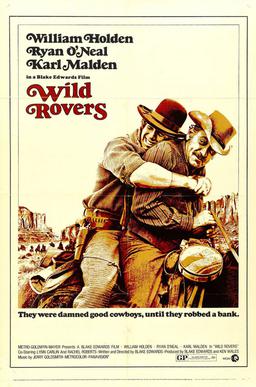
Wild Rovers was Blake Edwards’s attempt to make an epic, revisionist western and he includes plenty of shots of the sun setting over the mountains as well as several violent shoot-outs that are shot in Peckinpah-style slow motion.  Unfortunately, the story itself isn’t really strong enough to support Edwards’s ambitions and all of the shots of the countryside, while nice to look at, don’t really add up too much.  Wild Rovers was also a troubled production, with MGM slashing Edwards’s original three-hour film down to 106 minutes and advertising it with a poster featuring O’Neal hugging Edwards from behind, making the film look like a buddy comedy in the style of Butch Cassidy and the Sundance Kid (or an early version of Brokeback Mountain) as opposed to a violent and elegiac western.  (In 1986, a director’s cut was released, which ran for 136 minutes.)  If you only know Blake Edwards from his Pink Panther movies, the grim and tragedy-filled Wild Rovers will come as a surprise.

One thing that Wild Rovers does have going for it is a good cast.  William Holden and an energetic Ryan O’Neal are a solid team and Karl Malden, Tom Skerritt, Rachel Roberts, James Olson, and Moses Gunn all give good performances too.  This movie also provides Joe Don Baker with a sympathetic role and he’s very likable as the laid back Paul Buckman.  It’s not the type of role that Baker often got to play and it’s obvious that a lot of scenes between John and Paul were cut from the film but, in the truncated version, Joe Don Baker’s Paul Buckman becomes the moral center of the film’s story.

Wild Rovers was a disappointment at the box office, one of many that Edwards suffered in the 70s before he and Peter Sellers brought back Inspector Clouseau.

Late Night Retro Television Reviews: Highway to Heaven 1.2 “Pilot: Part Two”


Welcome to Late Night Retro Television Reviews, a feature where we review some of our favorite and least favorite shows of the past!  On Thursdays, I will be reviewing Highway to Heaven, which aired on NBC from 1984 to 1989.  The entire show is currently streaming on Tubi and several other services!


This week, we finish up the pilot for Highway to Heaven, with Jonathan revealing the true nature of his job to Mark and the old people heading to the horse races!

Episode 1.1 “Highway to Heaven: Part Two”

(Dir by Michael Landon, originally aired on September 19th, 1984)

The second half of the pilot for Highway to Heaven opens with things looking up at the retirement community.  Everyone is enjoying the new garden.  There’s a new sense of community amongst the residents.  Even Estelle (Helen Hayes) has finally come out of her room and is now taking care of the dog that Jonathan previously gave her.  Sidney Gould (John Bleifer) is especially happy to see Estelle out and about, especially after Estelle agrees to have dinner with him.

The only person who is not happy with the changes that Jonathan has brought to everyone’s lives is Mark Gordon.  Mark is still suspicious of Jonathan’s motives and he’s not happy that his sister, Leslie (Mary McCusker), is falling for a man who she really knows nothing about.  When Jonathan is having dinner at Leslie’s apartment, Mark breaks into Jonathan’s apartment and discovers that Jonathan owns nothing.  There’s not even a toothbrush in the bathroom.

Jonathan catches Mark in his apartment and, after Mark demands to know just who exactly Jonathan is, Jonathan explains that he works for “the Boss.”  He travels from location to location, helping people who need help.  When Mark demands to know who the Boss is, Jonathan can only look heaven-ward.

Needless to say, Mark is not at all convinced that Jonathan is an angel.  But there’s an even bigger problem to deal with!  Mr. Sinclair (Joe Dorsey), the owner of retirement home, has sold the land to a developer!  Everyone who worked there is now out of a job and everyone who lived there has been given just a few days to move out and find somewhere else to live.

When Jonathan pays Mr. Sinclair a visit, he discovers that Sinclair has spent his life making money in order to get over the shame of being rejected by his high school love.  Unfortunately, she’s now dead and Sinclair no longer cares about anyone.  Still, Jonathan is able to convince Mr. Sinclair to give him a chance to raise enough money to buy the retirement home.

Mark’s suggestion is that they take the money that they already have and bet it at the tracks.  Jonathan is not sure if the Boss would like him gambling but, in the end, he agrees to Mark’s plan.  At the tracks, it first appears that the horse that the old people put their money on has lost.  But then then Sidney discovers that the person at the betting window accidentally gave him the wrong ticket and — it’s a miracle!  They win the money!

The old people are able to buy their retirement home and Mark is now convinced that Jonathan is angel.  In fact, Mark is so convinced that he insists on driving Jonathan around the country and helping him out.

(Don’t worry about Leslie.  Though she’s upset when Jonathan leaves, a handsome and single man immediately moves in next door to her.)

This episode ends with Jonathan getting into Mark’s car and the two of them driving off, down the highway.

Wow, this was an earnest show.  Seriously, there’s not a hint of sarcasm or snarkiness to be found in this episode, which I imagine explains why this show is still airing on the retro stations and streaming on a hundred different sites.  To an extent, it’s easy to be dismissive of a show where a bunch of quirky old people got to the race track to win enough money to be able to stay together in their retirement home.  There’s nothing subtle not particularly surprising about any of it.  I mean, we know there’s no way Helen Hayes and that adorable dog are going to lose their home!  But this episode was so achingly sincere in its approach that it worked.

We’ll see if it continues to work next week!

Late Night Retro Television Reviews: Highway to Heaven 1.1 “Pilot: Part One”


Welcome to Late Night Retro Television Reviews, a feature where we review some of our favorite and least favorite shows of the past!  On Thursdays, I will be reviewing Highway to Heaven, which aired on NBC from 1984 to 1989.  The entire show is currently streaming on Tubi and several other services!

Highway to Heaven is one of those old shows that, decades after its final episode, still always seems to either be airing or streaming somewhere.  The show’s premise was a simple one.  Jonathan Smith (Michael Landon) was an angel who had been sent to Earth to help people.  Working with him was a retired cop named Mark Gordon (Victor French).  Together, they drove across the country and met a different guest star every week.

Though the show aired its final episode over 30 years ago and both of the stars have since passed on, Highway to Heaven remains popular in both syndication and streaming.  From the few episodes that I’ve seen, it appears that the show’s main appeal was just how unabashedly sentimental it was.  For people living in a cynical age, the show is a throwback to a simpler time.  Of course, I imagine that some people also find it to be a fairly campy show.  There’s nothing subtle about the messaging of Highway to Heaven. 

Anyway, it seems like a good show to review for Retro Television Reviews, so here we are.  Let’s head down that highway!

Episode 1.1 “Highway to Heaven: Part One”

(Dir by Michael Landon, originally aired on September 19th, 1984)

In a small town in Arizona, there’s a retirement community that is full of people who are in need.

For instance, Estelle Wicks (Helen Hayes) hasn’t left her room in years.  She’s convinced that her daughter is going to come to get her at any minute, even though everyone else at the community tries to get her to understand that her daughter hasn’t been by to see her in years.  That said, at least Estelle still has some hope.  Everyone else in the community appears to be resigned to spending all of their time indoors, watching television and waiting for the end.

Mr. Haskins (John O’Leary), the owner of the community, is struggling to pay the bills and is thinking of selling the retirement home to a group of land developers.  Mr. Haskins rarely smiles and hardly ever interacts with the people living at the community.  He doesn’t want them going outside or doing any special activities because he’s worried about potential lawsuits.  He’s not willing to spend the money necessary to even make the community look like an inviting place to live.

Mr. Haskins’s assistant, Leslie Gordon (Mary McCusker), is a lonely woman who lives in an apartment with her brother, Mark (Victor French).  Mark is a former cop who refuses to trust anyone and who can’t hold down a job.  He’s developing quite a drinking problem and spends most of his time either watching television and having a beer or going down to the local bar and having even more beer.

No one, and I mean no one, in this town appears to be happy.  But then a mysterious drifter named Jonathan Smith (Michael Landon) hitchhikes into town and applies for a job as a maintenance worker at the retirement community.  As he explains to Mr. Haskins, he doesn’t have any references but he’s willing to work without a salary for a month in order to prove that he can handle the job.  Mr. Haskins hires Jonathan, who immediately plants a flower garden and gets to know the residents at the retirement community.  He even gets Estelle to agree to take care of a puppy.

With Jonathan’s gentle encouragement, even Leslie starts to enjoy life a little bit more.  When Jonathan shows up one morning with a bicycle, Leslie rides it to work.  When Leslie asks Jonathan how he could afford the bike, he says that a friend gave it to him.  When she asks how Jonathan could afford to plant all of the flowers for the retirement home, he says that a friend helped out.  For a drifter who just came to town, Jonathan certainly seems to have a lot of friends!

This raises the concern of Mark, who thinks that Jonathan must be a conman of some sort.  He sets out to investigate just exactly who Jonathan is.  He first stop is the local bicycle shop, where the owner says that he’s never met a Jonathan Smith.  And then — the episode ends!  “TO BE CONTINUED” reads the title card.

It’s a rather abrupt ending, undoubtedly the result of the pilot originally being aired as a two-hour movie.  As often happens, the pilot was split into two parts for syndication.  Of course, the viewer already knows that Jonathan is an angel who has been sent to Earth to help people but the first episode of the series ends with Mark still convinced that Jonathan is just a con man.  I assume he’ll find out the truth next week.

As far as first episodes go, this one is hard to judge because it’s obviously incomplete.  That said, the pilot’s unapologetic earnestness is definitely its strongest trait.  Early on, Jonathan says, “Kindness doesn’t cost a thing,” and Michael Landon delivers the line with such sincerity that he makes it work despite the fact that it’s also a cliché.

Anyway, next week, we’ll finish up the pilot and see if Mr. Haskins will ever learn how to run a retirement community.  Hopefully, Estelle will finally come out of her room as well.  And, most importantly, we’ll see how Mark went from thinking Jonathan was a con artist to traveling around the country with him.

Until then, be kind.

Hanging By A Thread (1979, directed by Georg Fenady)


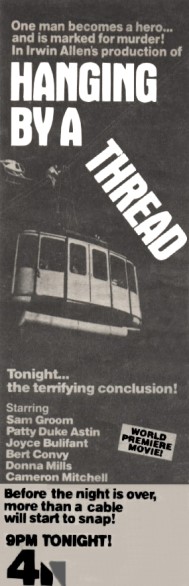
A group of old friend who call themselves the Uptowners’ Club (yes, really) want to go on a picnic on top of a remote mountain.  The only problem is that they have to ride a cable car up to the mountain and there are reports of potentially bad weather.  It’s not safe to ride in a cable car during a thunderstorm.  Drunken ne’er-do-well Alan (Bert Convy) doesn’t care and, since his family owns both the mountain and the tramway, his demands that he and his friends be allowed to ride the cable car are met.  One lightning strike later and the members of the Uptowners’ Club are stranded in a cable car that is perilously suspended, by only a frayed wire, over treacherous mountain valley.

With no place to go, there’s not much left for the members of the Uptowners’ Club to do but bicker amongst themselves and have lengthy flashbacks that reveal every detail of their own sordid history.  Paul (Sam Groom) is angry with Alan because Alan is now engaged to his ex-wife (Donna Mills).  Sue Grainger (Patty Duke) is angry with everyone else because they don’t want to admit how their old friend Bobby Graham (Doug Llewellyn) actually died.  The other members of the Uptowners’ Club are angry because there’s not much for them to do other than watch Duke and Convy chew on the scenery.  Because of the supposedly fierce winds, someone is going to have to climb out on top of the cable car and repair it themselves.  Will it be Paul or will it be cowardly drunk Alan?  On top of everything else, Paul is set to enter the witness protection program and has got hitmen who want to kill him.

This made-for-TV disaster movie was produced by Irwin Allen.  Are you surprised?  It’s also three hours long and amazingly, Leslie Nielsen is not in it.  It’s hard to understand how anyone could have produced a cable car disaster film and not given a role to Leslie Nielsen.  Cameron Mitchell’s in the film but he’s not actually in the cable car so it’s a missed opportunity.  Any film that features Patty Duke detailing how her friends got so drunk that they ended up killing the future host of The People’s Court is going to at least have some curiosity value but, for the most part, Hanging By A Thread gets bogged down by its own excessive runtime and lack of convincing effects.  Hanging By A Thread came out at the tail end of the 70s disaster boom and it shows why the boom didn’t continue into the 80s.

A Movie A Day #152: Bad Company (1972, directed by Robert Benton)


Missouri during the Civil War.  All young men are being forcibly constricted into the Union army, leaving those who want to avoid service with only two options: they can either disguise themselves as a woman and hope that the soldiers are fooled or they can head out west.  Drew Dixon (Barry Brown) opts for the latter solution but his plans hit a snag when he’s robbed and pistol-whipped by Jake Rumsey (Jeff Bridges).  When Drew coincidentally meets Jake for a second time, he immediately attacks him.  Jake is so impressed that he insists that Drew join his gang of thieves.

Jake’s gang, which include two brothers (one of whom is played by John Savage) and a ten year-old boy, is hardly the wild bunch.  They spend most of their time robbing children and are, themselves, regularly robbed by other gangs, including the one run by Big Joe (David Huddleston).  Their attempt to rob a stagecoach goes hilariously wrong.  Less hilarious is what happens when they try to steal a pie from a window sill.

Bad Company was the directorial debut of Robert Benton and it has the same combination of comedy and fatalism that distinguished both his script for Bonnie and Clyde and several of the other revisionist westerns of the 1970s.  While the interplay between Drew and Jake may remind some of Butch Cassidy and the Sundance Kid, the film’s sudden bursts of violence feel like pure Peckinpah.  Fortunately, the combination of Robert Benton’s low-key direction and the excellent performances of Jeff Bridges and Barry Brown allows Bad Company to stand on its own.  Brown and Bridges make for an excellent team, with Bridges giving a charismatic, devil-may-care performance and the late Barry Brown holding his own as the more grounded Drew.  (Sadly, Brown, who appears to have had the talent to be a huge star, committed suicide six years after the release of Bad Company.)  This unjustly forgotten western is one of the best films of the 1970s.

Shattered Politics #34: The Parallax View (dir by Alan J. Pakula)


Parallax_View_movie_poster

Judging from the films that the decade produced, the 1970s were truly a paranoid time.  (Of course, 2015 is a paranoid time as well, which is probably why so many of the classic films of the 70s still feel incredibly relevant.)  Some weekend, you should watch a marathon of 1970s films and I guarantee that, by the time Monday rolls around, you will be looking for lurkers in every shadow and automatically distrusting any and all authority figures.  The 1970s were a good time to be paranoid.

And it’s really not surprising at all.  The previous decade was a time of turmoil and upheavel, a time when some people feared protestors and some people feared the establishment but, ultimately, everyone was afraid of someone.  When you think of the 1960s, you think about all the leaders who were violently assassinated — John F. Kennedy, Malcolm X, Martin Luther King, Robert F. Kennedy, and more.  (And that’s just in America!)  And then the 70s came along, with Watergate and the revelations about the CIA partnering up with the Mafia to try to kill Fidel Castro.

The 70s were a good time to be paranoid and the films of the 70s reflected that fact.

Take for instance, 1974’s The Parallax View.  The Parallax View opens and ends with assassination.  In both cases, the victims are U.S. politicians who are running for President and whose ambitions have caused concern for the shadowy and rarely seen leaders of the established order.  In both cases, the official story is that the assassin was a lone gunman, a nut with a gun and absolutely no political or religious motivations.  Of course, both accused assassins were apparently involved with the shadowy Parallax Corporation and, over the course of the film, anyone who knows anything about Parallax ends up dying.  Reporter Joe Frady (Warren Beatty) goes undercover to investigate the group but, as he does so, he grows increasingly paranoid and unstable, until finally  it’s easy to mistake him for any other paranoid madman, ranting in the street and, in many ways, indistinguishable from the accused assassins that he’s been investigating.  In many ways, Joe becomes like a character in a H.P. Lovecraft short story who, upon laying eyes on Cthulhu, is driven mad as punishment.

It’s a good film, one that’s enhanced by Gordon Willis’s trademark shadowy cinematography and the convincing desperation of Warren Beatty’s performance.  In the film’s best scene, Frady applies for a job with the Parallax Corporation.  As a part of his job interview, he’s taken a dark room and he’s told to watch a short film.  His reactions will help to determine what role he could possibly play at Parallax.

Needless to say, The Parallax View feels just as relevant today as it did when it was first released.  We still live in paranoid times and hints of conspiracy are still everywhere to be seen.  Perhaps the only thing that has changed is that, back in 1974, conspiracies could still take people be surprise.

Now, we just take them for granted.