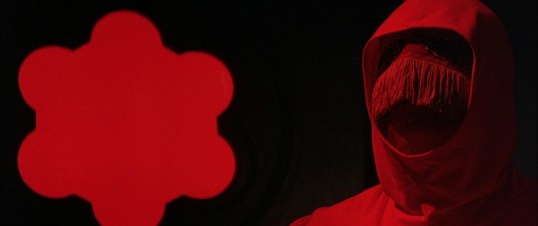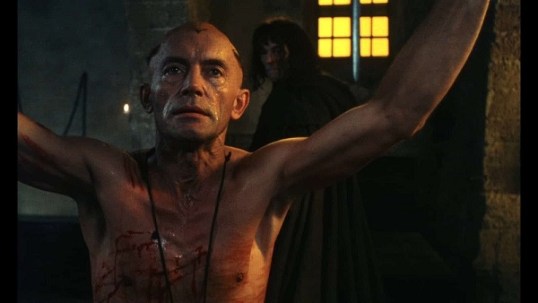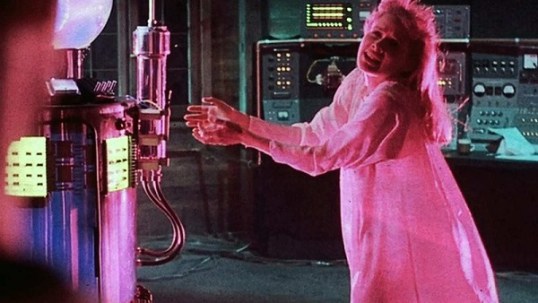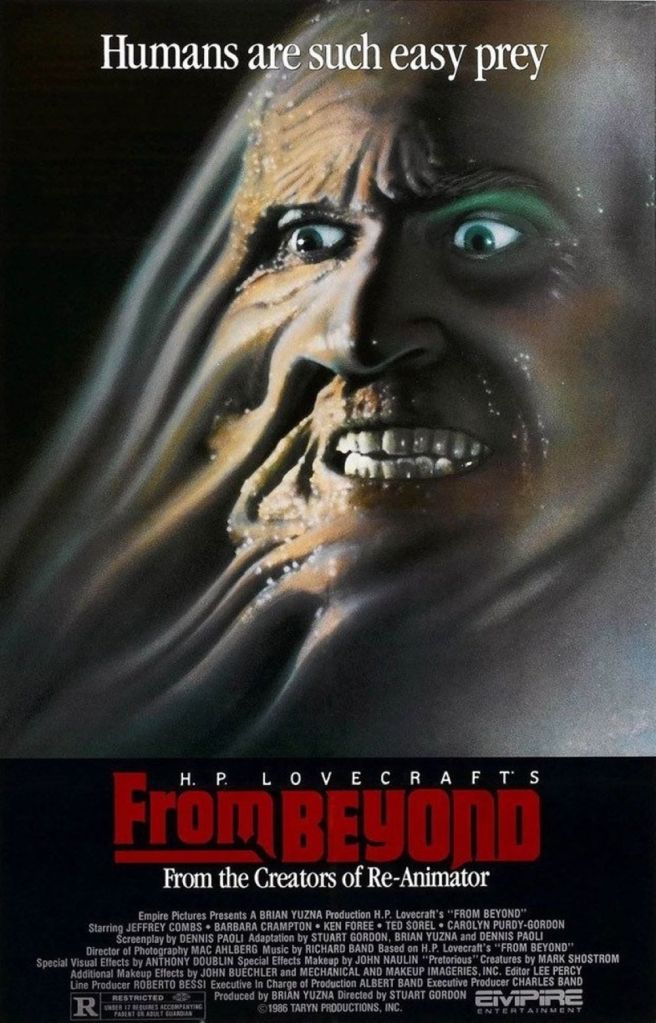
Horror Review: From Beyond (dir. by Stuart Gordon)


“You’re diving deeper than any sane man ever should.” — Dr. Katherine McMichaels

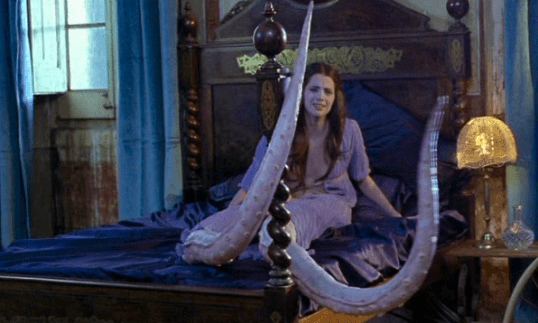
Stuart Gordon’s From Beyond (1986) stands as a darker, moodier follow-up to his breakout Lovecraft adaptation, Re-Animator (1985). At its core is the Resonator, a bizarre scientific contraption designed to stimulate the pineal gland—allowing its users to glimpse eerie creatures and dimensions normally invisible to the naked eye. When Dr. Crawford Tillinghast (Jeffrey Combs) activates the device, it unleashes horrors not just upon the world but also within the minds and bodies of those involved, blurring the line between reality and nightmare in a way both terrifying and hypnotic.

Just like with Re-Animator, Gordon used H.P. Lovecraft’s short story From Beyond as a foundation but expanded the narrative significantly by injecting his own creative vision and filling in what Lovecraft left unexplored. Lovecraft’s original story is a brief, eerie vignette about stimulating the pineal gland to perceive alternate dimensions and terrifying alien creatures—minimalistic and atmospheric, leaving much to the imagination. Gordon reimagines this premise into a fully fleshed-out narrative, adding complex characters like the obsessive Dr. Edward Pretorius and the rational yet vulnerable Dr. Katherine McMichaels. He enriches the story with body horror, psychological torment, and a deeper thematic exploration of sexuality, obsession, and the fragility of the mind. This creative expansion transforms the story into something far more personal and tangible, blending cosmic horror with primal human fears and desires.

This tonal shift stands in stark contrast to Re-Animator, which thrives on anarchic gore, slapstick comedy, and a playful mad-scientist energy. From Beyond trades much of the humor for a somber, unsettling atmosphere drenched in slime, grotesque transformations, and claustrophobic dread. The characters are more grounded in psychological trauma, and the film’s pacing emphasizes creeping unease rather than chaotic spectacle. Gordon’s use of stark, hallucinatory lighting and saturated colors enhances this otherworldly feeling, while practical effects bring a tactile horror to life that heightens the visceral and emotional impact. The horror isn’t just external—it’s internal, a fracture of reality and self.

One of the most notable ways From Beyond separates itself from Gordon’s earlier work is in its overt intertwining of sexuality and horror. The Resonator doesn’t just expose alien creatures; it unlocks primal lust and repressed desires in its users. Scenes imbued with uneasy erotic tension, especially involving Barbara Crampton’s character, make sexuality a core source of vulnerability and terror. This blend of eroticism and nightmare adds depth and psychological complexity, exploring how intimate human experiences can be distorted into something terrifying. It’s a thematic boldness that would become highly influential beyond Western cinema.

Indeed, the film’s fusion of sexual subtext, body horror, and psychological unease foreshadowed themes embraced by late 1980s and early 1990s Japanese horror hentai anime. Works such as Angel of Darkness (Injū Kyōshi) combined explicit eroticism, grotesque body transformations, and supernatural horror in ways reminiscent of From Beyond’s style and tone. This synergy helped define a subgenre of adult horror anime where the boundaries between pleasure and terror, desire and monstrosity, are constantly blurred—cementing From Beyond not only as a cult classic in horror but also as an inspirational bridge to pioneering adult animation in Japan.

Visually and atmospherically, the film is a masterpiece of practical effects and immersive storytelling. The slime-drenched creatures, anatomically warped bodies, and constant visual flow between nightmare and distorted reality create a hallucinatory experience. The climax offers a frenetic, visceral battle that embodies the film’s core themes of madness, transformation, and cosmic terror, leaving viewers with a lingering sense of unease and wonder.

Stuart Gordon’s direction also employs incredibly effective subjective perspectives, with many scenes shot from the characters’ points of view. This technique immerses viewers in the unfolding madness and heightens the sensory overload that defines the film’s experience. There is a famously unsettling point-of-view shot from the mutated Crawford as he perceives a brain inside a doctor’s head and gruesomely attacks. Such moments amplify the film’s exploration of altered perception and the treacherous expansion of human senses.

Despite these strengths, the film is not without flaws. Ken Foree’s character, Bubba Brownlee, while providing moments of grounded streetwise humor, sometimes comes off as a caricature that leans into stereotypical portrayals of Black men as taboo or outlier figures in horror cinema. This portrayal feels somewhat jarring against the film’s otherwise nuanced tone and may evoke discomfort.

Additionally, From Beyond can feel comparatively stiff and sluggish next to Re-Animator, lacking some of the earlier film’s darkly comic energy. The story often relies on a series of increasingly grotesque set pieces that feel more like shock showcases than a cohesive narrative arc. Some performances, including Jeffrey Combs’ lead, occasionally seem overly intense without sufficient emotional variation, and the film sometimes slips into melodrama that undercuts its impact. Furthermore, although ambitious in visualizing Lovecraftian horrors, budgetary constraints are occasionally evident, diminishing some of the awe those moments seek to inspire.

Ultimately, Gordon’s From Beyond is a significant Lovecraft adaptation that showcases the power of expanding upon source material with bold creativity. Moving beyond Lovecraft’s sparse prose, Gordon infuses the story with rich characters, psychological depth, explicit body horror, and mature explorations of sexuality. This results in a haunting, distinctly unsettling film that not only stands as a high point in Gordon’s career but also resonates far beyond its American horror roots, shaping international horror aesthetics and inspiring future genres. It is a disturbing, thrilling journey to the dark spaces just beyond human perception—a cinematic experience that lingers in the mind long after the screen fades to black.
4 Shots From 4 Films: Special H.P. Lovecraft Edition


4 Shots From 4 Films is just what it says it is, 4 shots from 4 of our favorite films.  As opposed to the reviews and recaps that we usually post, 4 Shots From 4 Films is all about letting the visuals do the talking.

This edition of 4 Shots From 4 Films is dedicated to H.P. Lovecraft, on the occasion of his 135th birthday.

4 Shots From 4 Films

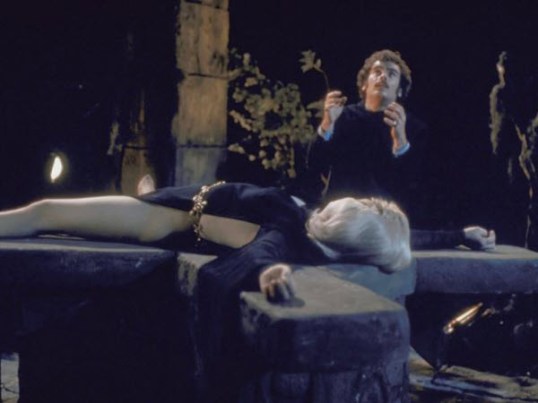
The Dunwich Horror (1970, directed by Daniel Haller)

The Dunwich Horror (1970, directed by Daniel Haller)

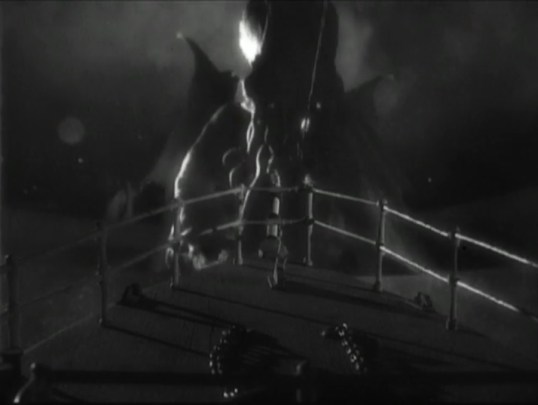
Dagon (2001, directed by Stuart Gordon)

Dagon (2001, directed by Stuart Gordon)

The Call of Cthulhu (2005, directed by Andrew Leman)

The Call of Cthulhu (2005, directed by Andrew Leman)

The Whisperer in Darkness (2011, directed by Sean Branney)

The Whisperer in Darkness (2011, directed by Sean Branney)

4 Shots From 4 Films: Special Stuart Gordon Edition


4 Or More Shots From 4 Or More Films is just what it says it is, 4 shots from 4 of our favorite films. As opposed to the reviews and recaps that we usually post, 4 Shots From 4 Films lets the visuals do the talking!

78 years ago on this date, director Stuart Gordon was born in Chicago, Illinois.  Gordon went from experimental theater to feature films and was responsible for some of the most visually memorable horror films of the past century.  Perhaps no other American director was a strong interpreter of the work of H.P. Lovecraft than Stuart Gordon.

Today, we honor Stuart Gordon with….

4 Shots From 4 Stuart Gordon Films

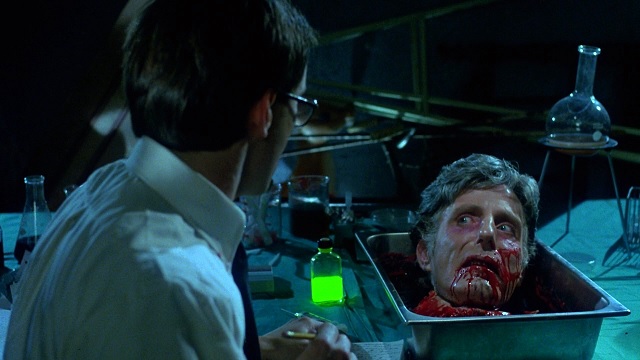
Re-Animator (1985, dir by Stuart Gordon, DP: Marc Ahlberg)

Dolls (1987, dir by Stuart Gordon, DP: Marc Ahlberg)

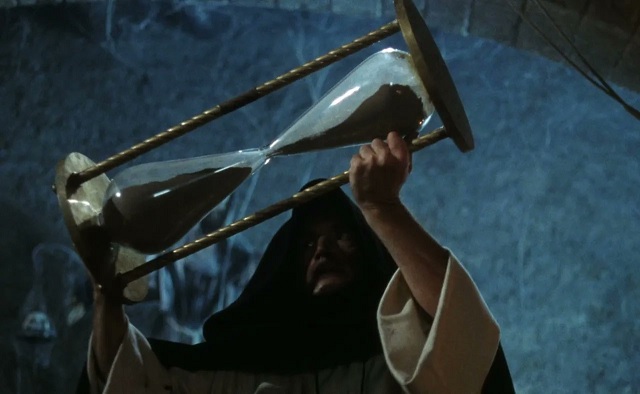
The Pit and the Pendulum (1991, dir by Stuart Gordon. DP: Adolfo Bartoli)

Castle Freak (1994, dir by Stuart Gordon, DP: Mario Vulpiani)

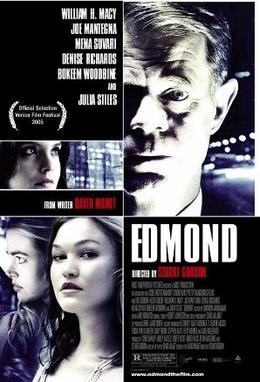
Days of Paranoia: Edmond (dir by Stuart Gordon)


Based on a one-act play by David Mamet, 2005’s Edmond tells the story of Edmond Burke (William H. Macy).

Edmond shares his name (if not the actual spelling) with the philosopher Edmund Burke.  Edmund Burke was a strong believer that society had to put value in good manners to survive and that religious and moral institutions played an important role in promoting the idea of people treating each other with respect and decency.  Edmund Burke knew what he believes and his writings continue to influence thinks to this day.  Edmond Burke, on the other hand, doesn’t know what he believes.  He doesn’t know who he wants to be.  All he knows is that he doesn’t feel like he’s accomplished anything with his life.  “I don’t feel like a man,” he says at one point to a racist bar patron (played by Joe Mantegna) who replies that Edmond needs to get laid.

On a whim, Edmond steps into the shop of a fortune teller (Frances Bay), who flips a few Tarot cards and then tells Edmond that “You’re not where you’re supposed to be.”  Edmond takes her words to heart.  He starts the night by telling his wife (played by Mamet’s wife, Rebecca Pidgeon) that he’s leaving their apartment and he won’t be coming back.  He goes to the bar, where he discusses his marriage with Mantegna.  He goes to a strip club where he’s kicked out after he refuses to pay $100 for a drink.  He goes to a peep show where he’s frustrated by the glass between him and the stripper and the stripper’s constant demand that he expose himself.  He gets beaten in an alley by three men who were running a three-card monte scam.  Edmond’s problem is that he left home without much cash and each encounter leads to him having less and less money.  If he can’t pay, no one wants to help him, regardless of how much Edmond argues for a little kindness.  He pawns his wedding ring for $120 but apparently, he just turns around and uses that money to buy a knife.  An alley-way fight with a pimp leads to Edmond committing his first murder.  A one-night stand with a waitress (a heart-breaking Julia Stiles) leads to a second murder after a conversation about whether or not the waitress is actually an actress leads to a sudden burst of violence.  Edmond ends up eventually in prison, getting raped by his cellmate (Bookem Woodbine) and being told, “It happens.”  Unable to accept that his actions have, in one night, led him from being a businessman to a prisoner, Edmond says, “I’m ready to go home now.”  By the end of the film, Edmond realizes that perhaps he is now where he was meant to be.

It’s a disturbing film, all the more so because Edmond is played by the likable William H. Macy and watching Macy go from being a somewhat frustrated but mild-mannered businessman to becoming a blood-drenched, racial slur-shouting murderer is not a pleasant experience.  Both the play and the film have generated a lot of controversy due to just how far Edmond goes.  I don’t see either production as being an endorsement of Edmond or his actions.  Instead, I see Edmond as a portrait of someone who, after a lifetime of being willfully blind to the world around him, ends up embracing all of the ugliness that he suddenly discovers around him.  He’s driven mad by discovering, over the course of one night, that the world that is not as kind and well-mannered as he assumed that it was and it all hits him so suddenly that he can’t handle it.  He discovers that he’s not special and that the world is largely indifferent to his feelings.  He gets overwhelmed and, until he gets his hands on that knife, he feels powerless and emasculated.  (The knife is an obvious phallic symbol.)  It’s not until the film’s final scene that Edmond truly understands what he’s done and who he has become.

Edmond is not always an easy film to watch.  The second murder scene is truly nightmarish, all the more so because the camera remains on Edmond as he’s drenched in blood.  This is one of William H. Macy’s best performances and also one of his most disturbing characters.  That said, it’s a play and a film that continues to be relevant today.  There’s undoubtedly a lot of Edmonds out there.

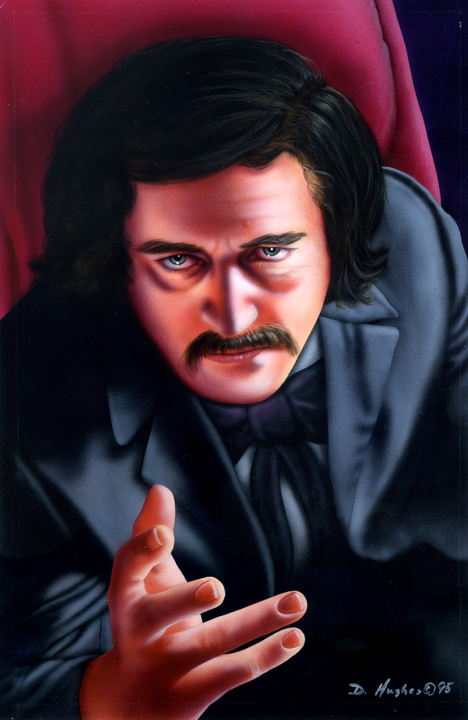
4 Shots From 4 Films: Special Edgar Allan Poe Edition


by Debbie Hughes

4 (or more) Shots From 4 (or more) Films is just what it says it is, 4 (or more) shots from 4 (or more) of our favorite films. As opposed to the reviews and recaps that we usually post, 4 (or more) Shots From 4 (or more) Films lets the visuals do the talking.

216 years ago today, Edgar Allan Poe was born in Boston, Massachusetts.  From his humble beginnings as the son of two struggling actors, Poe would go on to become one of the first great American writers.  (It’s been said that, when Charles Dickens first traveled to the United States in 1842, he specifically wanted to meet Edgar Allan Poe.  Unfortunately, it appears that popular story my not be true but it’s still a good story.)  Poe was controversial in life and even his death generated more questions than answers but no one can deny his strength as a poet and as a prose writer.  Both the detective and the horror genres owe a huge debt to Edgar Allan Poe.

Today, in honor of Edgar Allan Poe’s legacy, TSL presents 4 shots from 4 films that were inspired by the work of Edgar Allan Poe!

4 Shots From 4 Films

The Fall of the House of Usher (1960, dir by Roger Corman, DP: Floyd Crosby)

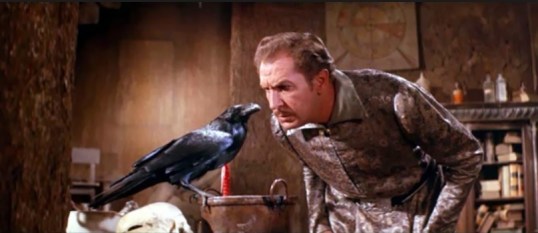
The Raven (1963, dir by Roger Corman, DP: Floyd Crosby)

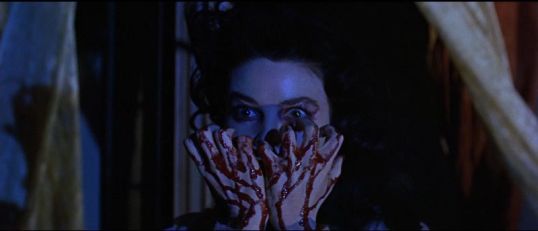
The Masque of the Red Death (1964, dir by Roger Corman, DP: Nicolas Roeg)

The Pit and the Pendulum (1990, dir by Stuart Gordon, DP: Adolfo Bartoli)

4 Shots From 4 Horror Films: Special Stuart Gordon Edition


4 Shots From 4 Films is just what it says it is, 4 shots from 4 of our favorite films. As opposed to the reviews and recaps that we usually post, 4 Shots From 4 Films is all about letting the visuals do the talking.

This October, I am going to be using our 4 Shots From 4 Films feature to pay tribute to some of my favorite horror directors, in alphabetical order!  That’s right, we’re going from Argento to Zombie in one month!

Today’s director: Stuart Gordon!

4 Shots From 4 Stuart Gordon Films

Re-animator (1985, dir by Stuart Gordon, DP: Marc Ahlberg)

From Beyond (1981, dir by Stuart Gordon, DP: Marc Ahlberg)

The Pit and the Pendulum (1990, dir by Stuart Gordon, DP: Adolfo Bartoli)

Castle Freak (1995, dir by Stuart Gordon, DP: Mario Vulpiani)

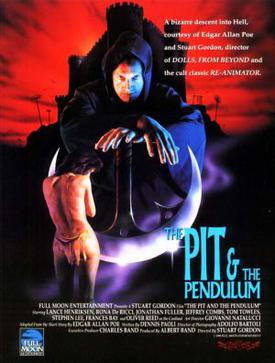
Horror Film Review: The Pit and the Pendulum (dir by Stuart Gordon)


AGCK!

That was my reaction when I watched the 1991 film, The Pit and the Pendulum.  Based very narrowly on several Edgar Allan Poe short stories, The Pit and the Pendulum takes place at the height of the Spanish inquisition.  Despite the objections of the Pope, Grand Inquisitor Torquemada (Lance Henriksen) is leading a reign of terror though 15th Century Spain.  In his torture chambers, Torquemada forces confessions from accused witches and other criminals.  The dirty prison cells are full of starving and beaten partners.  Witches are burned at the stake and explode while the crazed citizenry calls for blood and Torquemada tests out new torture devices.

Torquemada presents himself as being a grim and emotionless man, someone who is above all sin and who is allowed to sit in judgment of the people who are brought before him.  However, Torquemada is hardly the sinless figure that he portrays himself as being.  His actions are fueled by his repressed lust and his anger.  Maria (Rona De Ricci) has been brought before him, accused of being a witch and Torquemada is determined to get her to confess.  Maria’s refusal to be broken by Torquemada only increases Toquemada’s anger but, at the same time, Torquemada has also decided that he’s in love with Maria.  While Maria waits in the prison and takes advice from the witch Esmerelda (Frances Bay), Maria’s husband, Antonio (Jonathan Fuller), attempts to break Maria out of prison.  When Antonio is captured, Torquemada decides to try out his latest device, a swinging and sharpened pendulum that hangs in a pit….

The Pit and the Pendulum is not always an easy movie to watch.  I have to admit that I spent the majority of the movie with my hands over my eyes, not wanting to watch the extremely graphic torture scenes.  Like many of director Stuart Gordon’s film, The Pit and the Pendulum is gripped by an atmosphere of pervasive corruption and the movie captures the feeling of not being able to escape from the worst place on Earth.  Poor Maria spends a good deal of the movie naked and chained to various devices but Rona De Ricci gives such a strong and such a committed performance as Maria that, instead of being offended by the obvious exploitation element of the scenes, you instead find yourself admiring Maria and her strength.

It’s probably not a coincidence that Oliver Reed shows up in the film as a Cardinal because The Pit and the Pendulum, with its portrayal of blood frenzy and hypocrisy, is definitely influenced by Ken Russell’s The Devils.  The imagery is graphic and often disturbing but the most memorable thing about the film is Lance Henriksen’s intense performance as the evil Torquemada.  Henriksen plays Torquemada as being a hateful and self-loathing figure, a man who deals with his own demons by bringing his fury down on the innocent.  It’s a truly frightening villainous performance, one that carries shades of Vincent Price’s excellent performance in The Witchfinder General.

The Pit and the Pendulum is not an easy film to watch and I doubt I’ll watch it a second time.  In the end, it’s a disturbing film but one that definitely leaves an impression.

4 Shots From 4 Films: Special Stuart Gordon Edition


4 Or More Shots From 4 Or More Films is just what it says it is, 4 shots from 4 of our favorite films. As opposed to the reviews and recaps that we usually post, 4 Shots From 4 Films lets the visuals do the talking!

76 years ago on this date, director Stuart Gordon was born in Chicago, Illinois.  Gordon went from experimental theater to feature films and was responsible for some of the most visually memorable horror films of the past century.  Perhaps no other American director was a strong interpreter of the work of H.P. Lovecraft than Stuart Gordon.

Today, we honor Stuart Gordon with….

4 Shots From 4 Stuart Gordon Films

Re-Animator (1985, dir by Stuart Gordon, DP: Marc Ahlberg)

Dolls (1987, dir by Stuart Gordon, DP: Marc Ahlberg)

The Pit and the Pendulum (1991, dir by Stuart Gordon. DP: Adolfo Bartoli)

Castle Freak (1994, dir by Stuart Gordon, DP: Mario Vulpiani)

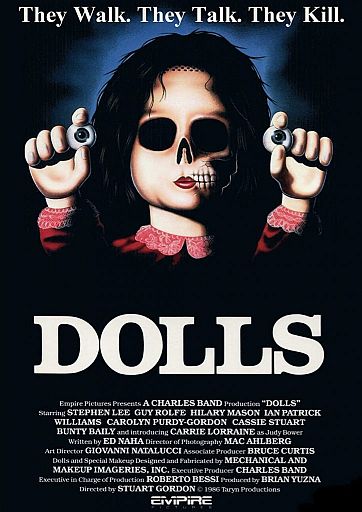
The TSL’s Horror Grindhouse: Dolls (dir by Stuart Gordon)


Sitting out of the middle of nowhere, there’s a house. And in this house, there lives an old man and an old woman. They appear to be very friendly, the type who will happily open up their home to anyone needing a place to stay and have a cup of coffee. They make dolls for a living. They make the type of dolls that smirk at you whenever you trip and that glare at you whenever you say that you don’t care about toys. They’re living dolls and they’re actually kind of vicious. Don’t get on their bad side.

That is exactly the mistake that a few people make when they arrive at the house on one stormy night. Two punk rock girls with exaggerated British accents make the mistake of trying to find something to steal. Uh-oh, here come the dolls! A self-centered man and his wife make the mistake of not caring about their daughter. The dolls aren’t going to stand for that!  Seriously, the dolls may be cute but if they don’t like you, you are doomed!

The dolls, however, do like the daughter. And they appear to be willing to tolerate Ralph, the goofy traveling salesman who made the mistake of picking up the two punk rock girls while they were hitchhiking. Will the dolls continue to like the daughter and Ralph or will they eventually turn on everyone in the house? They may be small but again, you seriously do not want to get these dolls mad.

First released in 1986, Dolls is a seriously strange movie from director Stuart Gordon and producer Charles Band. There’s a lot of good things to be said for Dolls. The house is atmospheric. The dolls are truly creepy. The acting really isn’t that bad, though I do think most viewers won’t necessarily miss the two punks girls.  The movie does take the characters and the dolls in some unexpected directions. But the movie’s tone is all over the place. It starts out as a broad comedy before then turning into a surprisingly violent and bloody horror film and then it turns into this strangely macabre family drama. The movie can’t seem to decide whether it wants you touch your heart or scar your soul. Imagine Home Alone if the movie kept all the heart-warming stuff but then had the kid brutally kill the burglars and laugh while stuffing their corpses in a furnace and you have some idea of what the tone of Dolls is like.

It’s an odd film but it’s hard not to like. Stuart Gordon’s direction is energetic and, since the movie only has a running time of 77 minutes, the whole thing feels like an extra weird episode of Tales From The Crypt or The Twilight Zone. Even the film’s mix of humor and disturbing violence feels strangely appropriate, as if the film itself is an adaptation of a particularly grisly fairy tale.

Watch Dolls and you’ll never look at a toy the same way again!

Guilty Pleasure No. 58: Robot Jox (dir by Stuart Gordon)


In the future, the world has been ravaged by a combination of nuclear war and infertility.  The face of diplomacy has changes as well.  Instead of wasting time with negotiations, treaties, or lengthy wars, countries now settle disputes through giant robot combat. 

In fact, robot combat is the most popular sport in the world!  The men who sit inside the head of the giant robots and who push the buttons that make the robots do their thing have all become national heroes.  They’re even more beloved than the robots that they control.  America loves Achilles (Gary Graham).  Russia loves Alexander (Paul Koslo).  Every fight is observed by hundreds of spectators sitting in the stands.

That becomes a problem when Achilles and his robot accidentally fall backwards and land on top of the stands.  Not only does this mean that Russia will claim ownership of Alaska but it also kills a lot of people who were only there because they thought they would get to watch some good old-fashioned giant robot combat.  Achilles is so upset that he announces his retirement.  He leaves robot combat camp and walks around the most depressing, dreariest city imaginable.  It’s hard not to notice that the city is full of signs imploring couples to have as many children as possible.  The humans would seem to be on the way out, regardless of what happens with the giant robots.

Fortunately, Achilles’s retirement only lasts for a day or two.  Once he learns that he’s going to be replaced by Athena (Anne-Marie Johnson), Achilles returns to fight Alexander.  It could be that Achilles is in love with Athena.  It could also just be evidence that it takes a lot more than a nuclear war to wipe out misogyny and Achilles can’t handle a woman controlling his robot.  Who knows?  Achilles is determined to redeem himself but Athena still wants her chance and it turns out that there is a double agent who is giving information to Alexander and the Russians!

Featuring a plot that was apparently made up on the spot, 1990’s Robot Jox is about as silly as a movie can get.  Several scenes are devoted to showing Athena and the other young robot pilots going through their training and it’s hard not to notice that none of it actually has anything to do with sitting inside the head of a giant robot and telling it what to do.  Instead, they do a lot of physical stuff, which makes no sense because piloting a robot would be a mental task, not a physical one.  But it gives the film an excuse to put a bunch of toned 20 year-olds in skin tight outfits and that was probably the main concern.   As for the double agent subplot, there’s only two possible suspects and it’s not difficult to guess which one is guilty.  The actors, for the most part, go through the motions though Michael Alldredge has some good moments as Achilles’s trainer and Paul Koslo is a blast as the maniacally evil Alexander.  In the future, it’s just not enough to destroy a man’s giant robot.  You have to laugh about it, too.

But, to be honest, Robot Jox is one of those movies that is so extremely silly that it’s impossible not to kind of like it.  The special effects may be on the cheap side but the robots themselves are actually fairly impressive and it’s hard not to smile at the sight of them stiffly walking across the combat area.  The film’s finale features not only a giant chainsaw that is stored inside the crotch of one of the robot’s but also a bizarre and impromptu trip into space.  I’m not really sure why the robots flew into space but it really doesn’t matter.  No one is going to watch Robot Jox for a coherent story.  This is a film that people watch because they want to see giant robots fighting.  And, on that front, Robot Jox delivers.

Previous Guilty Pleasures

  1. Half-Baked
  2. Save The Last Dance
  3. Every Rose Has Its Thorns
  4. The Jeremy Kyle Show
  5. Invasion USA
  6. The Golden Child
  7. Final Destination 2
  8. Paparazzi
  9. The Principal
  10. The Substitute
  11. Terror In The Family
  12. Pandorum
  13. Lambada
  14. Fear
  15. Cocktail
  16. Keep Off The Grass
  17. Girls, Girls, Girls
  18. Class
  19. Tart
  20. King Kong vs. Godzilla
  21. Hawk the Slayer
  22. Battle Beyond the Stars
  23. Meridian
  24. Walk of Shame
  25. From Justin To Kelly
  26. Project Greenlight
  27. Sex Decoy: Love Stings
  28. Swimfan
  29. On the Line
  30. Wolfen
  31. Hail Caesar!
  32. It’s So Cold In The D
  33. In the Mix
  34. Healed By Grace
  35. Valley of the Dolls
  36. The Legend of Billie Jean
  37. Death Wish
  38. Shipping Wars
  39. Ghost Whisperer
  40. Parking Wars
  41. The Dead Are After Me
  42. Harper’s Island
  43. The Resurrection of Gavin Stone
  44. Paranormal State
  45. Utopia
  46. Bar Rescue
  47. The Powers of Matthew Star
  48. Spiker
  49. Heavenly Bodies
  50. Maid in Manhattan
  51. Rage and Honor
  52. Saved By The Bell 3. 21 “No Hope With Dope”
  53. Happy Gilmore
  54. Solarbabies
  55. The Dawn of Correction
  56. Once You Understand
  57. The Voyeurs