Lisa Marie Reviews An Oscar Winner: The Crying Game (dir by Neil Jordan)


Directed by Neil Jordan and first released in 1992, The Crying Game opens at a fair in Northern Ireland.  A black British soldier named Jody (Forest Whitaker) meets a flirtatious woman named Jude (Miranda Richardson).  Jude leads Jody away from the fairground.  Jody thinks that they’re going to have sex but instead, he ends up getting kidnapped by Fergus (Stephen Rea) and Peter Maguire (Adrian Dunbar).  As Peter explains it after Jody is taken to an abandoned cottage, the soldier is now a prisoner of the Irish Republican Army.

Jody is left in a dark room, tied to a chair and with a canvas bad over his head.  Fergus is often left to guard him.  Despite Peter’s explicit orders, Fergus talks to Jody and the two men strike up an uneasy friendship.  Fergus removes the bag from Jody’s head.  He even reveals his name.  Jody and Fergus talk about their lives.  Jody says he joined the Army and was immediately sent to the most racist part of the UK.  Fergus replies that his only issue with Jody is that “you shouldn’t be over here.”  Jody talks about his love of cricket.  Fergus talks about his love of hurling.  Fergus sees a picture of Jody with his lover, Dil (Jaye Davidson).  Fergus comments that Dil is attractive.  “She’s not your type,” Jody replies.

Peter warns Fergus not to become friends with Jody because there’s a good chance that they’re going to have to execute him.  And when the British refuse to exchange prisoners, the order does come down to carry out the execution.  Fergus demands that he be allowed to carry out the shooting.  However, as he leads Jody out of the cottage, Jody breaks free.  Fergus chases him but, as they reach a nearby road, Fergus realizes that he can’t bring himself to kill Jody.  Unfortunately, Jody is still killed when he’s run over by a British army truck.

Fergus flees to London and, after getting a job as a construction worker, he tries to lay low and track down Dil.  Dil, however, turns out to be not quite was Fergus was expecting.  It turns out that Jody didn’t reveal every aspect of his life while he was trapped in that cottage.  Meanwhile, Jude and Peter both show up in London and demand that Fergus help them execute “some judge.”

The Crying Game is a twisty and engaging thriller, one that is best known for the twist involving Dil’s identity but which is also a thought-provoking look at the assumptions we make about each other and the roles that people feel forced to play.  Fergus doesn’t really have it in him to be a terrorist or an assassin but it’s the role that he feels he’s been forced into by his desire to see the British leave Northern Ireland.  Jody turns out to have a few secrets of his own and, once their revealed, his eagerness to go off with Jude is seen in an entirely new light.  Jude and Peter present themselves as being honorable freedom fighters but their actions often seem to suggest the opposite.  In the end, the only character who is truly comfortable with their nature is Dil.  Both Stephen Rea and Jaye Davidson more than deserved their Oscar nominations.  Their chemistry goes a long way towards making this a thriller that sticks with you.

The Crying Game was nominated for several Oscars but lost the majority of them to Unforgiven.  (Both Stephen Rea and Clint Eastwood lost Best Actor to Al Pacino for Scent of a Woman.)  However, Neil Jordan did win an Oscar for his clever screenplay.  Rea has continued to act.  Davidson, who reportedly hated the fame that came with appearing in The Crying Game, appeared in one more film before retiring.
Film Review: Michael Collins (dir by Neil Jordan)


Released in 1996, Michael Collins tells the story of the early 20th century struggle of Ireland to gain independence from Britain.

Liam Neeson stars as Michael “Mick” Collins, the revolutionary leader who perfected the use of guerilla warfare against the British and then, in the greatest of ironies, found himself fighting some of his former allies during the Irish Civil War.  Aidan Quinn plays Mick’s friend and fellow revolutionary, Harry Boland.  Both Harry and Mick fall in love with Kitty Kiernan (Julia Roberts).  Stephen Rea shows up as Ned Broy, a member of the Dublin police department who is inspired by Mick’s words to become a double agent.  Charles Dance has a cameo as the fearsome Soames, a British intelligence agent who is sent to Ireland to violently put down the Irish insurgency.  Finally, Alan Rickman plays Eamon de Valera, who goes from being one of Mick’s strongest allies to being one of his fiercest rivals.  The film follows Collins from the Easter Rising of 1916 to his eventual assassination in 1922, providing a look at the history of Ireland that is as much directed towards those outside of Ireland as those on the inside.

When watching Michael Collins, it helps to have a working knowledge of Irish history.  Otherwise, it can occasionally be a bit difficult to keep track of who is angry with who at any particular point in time.  Of course, it should be noted that the movie itself is not exactly historically accurate.  In the film, the gentle and likable Ned Broy becomes a victim of British bloodlust.  In real life, Ned Broy outlived Michael Collins by several decades and died peacefully at the age of 84.  For that matter, the film presents Eamon de Valera as being coldly Machiavellian and it suggests that de Valera was jealous of Mick’s popularity.  Though both Rickman and director Neil Jordan later said it wasn’t intentional, the film also seems to suggest that de Valera played a role in Collins’s assassination.  While Eamon de Valera remains a controversial figure for many reasons (including his neutrality during World War II), Jordan has said that he feels de Valera was not necessarily treated fairly in Michael Collins and indeed, de Valera — who plays as big a role in the founding of the Irish republic as anyone — is portrayed as often being ineffectual and unwilling to truly put himself at risk to fight the British.  De Valera’s relationship with Collins was undoubtedly more complex than portrayed in this film but, when one makes a movie for an international audience, nuance is often the first thing that’s abandoned.

Seen today, 29 years after it was released, Michael Collins is an impressively made film that has a few inescapable flaws.  It’s gorgeous to look at, full of moody shots of dark Dublin streets.  The violence is often shocking and Jordan doesn’t shy away from considering the moral implications of Collins’s guerilla warfare.  Michael Collins doesn’t make the mistake of blindly celebrating violence, which would be a valuable lesson for the world’s current crop of self-styled revolutionaries if they were only willing to hear it.  Having gotten used to seeing Liam Neeson cast in one generic action film after another, it was interesting to watch Michael Collins and see what a good actor he truly could be.  Even in 1996, He was perhaps a few years too old to playing a man who was only 31 when he died but Neeson still plays the role with a ferocious charisma that makes him believable as a leader.  His scenes with Aidan Quinn have a joie de vivre that brings out the both in best actors.  Alan Rickman is memorably sinister as Eamon de Valera and Stephen Rea’s gentle style makes Ned Broy into a truly tragic figure.  That said, the very American Julia Roberts feels miscast as Kitty Kiernan.  One gets the feeling that she was cast solely for her box office appeal.  Every film, the feeling goes, needs  a love story and those love stories need to be between people with familiar faces and Roberts is such a familiar face that her every appearance in the film feels like a distraction from the story being told.  That said, the film captures the excitement and danger of being in the middle of history-making events.  It’s a historical epic that’s never boring and manages to hold the viewer’s interest.

Michael Collins is ultimately a flawed but entertaining look at the early days of the Irish republic.

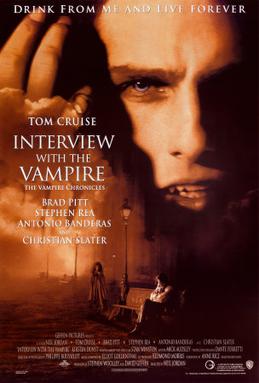
Horror Film Review: Interview With The Vampire (dir by Neil Jordan)


Oh, poor Claudia.

There are a lot of vampires and other cursed beings wandering through the 1994 film adaptation of Interview With A Vampire but Claudia (Kisten Dunst) is the only one for whom I have any sympathy.

Louis (Brad Pitt) may be the main character and the vampire giving the interview but it’s hard to have much sympathy for him.  He’s just such a whiny little bitch.  The Louisiana aristocrat is transformed into a vampire in 1791 and basically spends the next 200 years complaining about it.  You want to have sympathy for him but sometimes, you just have to accept stuff and move on.  It doesn’t help that Brad Pitt, who has always given his best performances when cast as men of action, is somewhat miscast as the effete and self-loathing Louis.

Lestat (Tom Cruise) may be the most charismatic of the vampires but he’s never exactly sympathetic.  He turns Louis into a vampire and then spends years following him across Louisiana and Europe.  Lestat is decadence personified and he never whines and, as a result, he’s far more enjoyable to spend time with than Louis.  Cruise is as perfectly cast as Lestat as Pitt was miscat as Louis.  Lestat is a star and Tom Cruise has always been one of the few true movie stars around.  That said, Lestat is still far too self-indulgent and thoughtlessly self-destructive to really be a sympathetic character.  Instead, he’s like Lord Byron, destroying happy families but at least writing a poem about it afterwards.

Armand (Antonio Banderas) runs the Théâtre des Vampires in Paris and he becomes Louis’s companion for a time.  Louis is charismatic because he’s played by Antonio Banderas but, ultimately, he proves to be a rather ineffectual leader.  Armand puts on a good show but, in the end, that’s all he has to offer.  He’s a bit shallow, despite all of the theatrics.

Santiago (Stephen Rea) isn’t sympathetic at all but at least he really seems to get into being evil.  Good for him!

And then there’s Daniel Malloy (Christian Slater), the journalist who conducts the interview with Louis.  In the film, Malloy starts out as a cynic, the type of writer who theatrically pours himself a glass of whiskey before dramatically turning to his typewriter.  All he needs is a fedora with a press pass tucked into the headband.  It’s difficult to take him seriously.

But then there’s Claudia.  Poor Claudia.  In the book, Claudia was only five years old when she was turned into a vampire.  In the movie, she’s played by 12 year-old Kirsten Dunst and it’s left ambiguous as to how young Claudia actually was when Lestat turned her into a vampire, though it’s still made clear that was too young to be cursed without her consent.  Claudia becomes Lestat and Louis’s companion.  Louis treats her like the daughter that he will never have.  Lestart treats her like an apprentice, teaching her how to kill.  Claudia grows up but is forever trapped in the body of a child.  It’s impossible not to feel sorry for Claudia, who never asked to become a vampire, who indeed was just turned so that Lestat could use her as a pawn to keep control of Louis.  Claudia spends a good deal of the movie in a rage and who can blame her?

Interview With A Vampire is a messy and uneven film.  Brad Pitt is miscast and the whole film is oddly paced, with the New Orleans scenes taking too long and the Paris scenes going by almost too quickly.  At the same time, Tom Cruise brings the proper joie de mort to the role of Lestat and Claudia and her fate will simply break your heart.  Interview With The Vampire is not the best vampire movie that I’ve ever seen but it definitely has its pleasures.

Film Review: Greta (dir by Neil Jordan)


http://www.youtube.com/watch?v=hMVgcxf5h_A

I always worry a little bit about Chloe Grace Moretz.

Seriously, it seems as if every film in which she appears features her either losing her entire family or getting stalked by some psycho or both.  It’s rare that she ever gets to play someone who is happy with their life.  Even when she was cast against type as a spoiled, vacuous brat in Clouds of Sils Maria, she still came across as being the saddest spoiled, vacuous brat imaginable.  Obviously, Mortez has the dramatic talent necessary to play these type of roles and, out of all the young actresses working today, she seems the most likely to still have an interesting career 30 years from now.  Still, it’s hard not to wish that she could just do a nice, romantic comedy at some point in the future, if just to give her a break from constantly being menaced on screen.

This year’s Chloe Moretz Gets Stalked film was Greta.  In this one, Moretz plays Frances McMullen, a waitress living in New York City.  Frances lives in a nice loft, has a fantastic roommate and best friend named Erica (Maika Monroe), and a strained relationship with her wealthy father (Colm Feore). As is typical of any character played by Chloe Moretz, Frances is still struggling to come to terms with the recent death of her mother.

After Frances finds an expensive handbag on the subway, she returns it to its owner, a piano teacher named Greta Hibeg (Isabelle Huppert).  Greta claims to be French and says that she’s been lonely ever since her daughter left home to study music in France.  Frances needs a substitute mother.  Greta needs a substitute daughter.

Can you tell where this is going?

If you said, “Together, they solve crimes!,” — well, you’re wrong but you’re still my hero.  Instead, what all this leads to is Greta becoming rather obsessed with Frances.  When Frances discovers that Greta has a whole closet full of handbags and that she’s not even French, Frances decides to end their friendship.  However, Greta will not take no for an answer.  Soon, Greta is following both Frances and Erica all around New York City.  Greta even goes to Frances’s place of employment and makes a scene that leads to Frances losing her job.  (Considering the amazingly ugly waitress uniform that Frances was required to wear, I’d say that Greta was doing her a favor.)  Eventually, it all leads to a kidnapping, a drugging, and an unexpected visual gag involving the Eiffel Tower.

About 30 minutes into Greta, there’s a scene in which Isabelle Huppert spits a piece of chewing gum into Chloe Moretz’s hair and it was at that moment that I knew that I was going to absolutely love this film.  I mean, there have been a lot of films made about people being stalked but it takes a certain amount of demented genius to have one of the world’s most acclaimed actresses actually spit a piece of gum into someone’s hair.  Brilliantly, the film follows this up with a scene of Frances and Erica trying to press assault charges against Greta, all because of the gum incident.  The cop is so cynical and unimpressed by their story that you just know that Frances is probably like the hundredth person to get attacked by chewing gum in just that day.

My point here is that there’s absolutely nothing subtle about Greta and we’re all the better for it.  As directed by Neil Jordan, Greta is a thoroughly excessive and deliberately campy little film and definitely not one to be taken too seriously.  Everything, from the lush cinematography to Greta’s sudden rages, is wonderfully over-the-top.  While Moretz wisely underplays her role (because, after all, someone has to keep things at least vaguely grounded in reality), Maika Monroe and especially Isabelle Huppert dive head first into the film’s melodramatic atmosphere.  Huppert, especially, deserves a lot of credit for her ferocious performance as Greta.  Whether she’s cheerfully celebrating a murder by doing an impromptu dance or suddenly screaming in Hungarian, Huppert is never less than entertaining while, at the same time, remaining credible as a very threatening individual.  One of the great joys of Greta is watching this masterful French actress play a Hungarian who is obsessed with Paris.  (It’s also probably not a coincidence that Greta is obsessed with someone named Frances.)

There’s an interesting subtext to the Greta and Frances relationship, one that goes beyond a girl who needs a mother and a woman who needs a daughter.  In many of the scenes where Greta stalks Frances, Huppert plays her as if she’s a spurned lover, crying out, “I love you!” and demanding that Frances return her phone calls.  As for Frances, she’s portrayed as being an almost absurdly repressed single girl who spends all of her personal time with two very different women, the accepting and fun-loving Erica and the predatory and destructive Greta.  (When Erica tells Frances that a guy who is interested in her is throwing a party, Frances says that she already has plans with Greta.)  Watching Greta, it occurred to me that the film was really about Frances coming to terms with her own sexuality, with Greta representing her fears and Erica representing the peace of accepting who you are.  The film may be about Greta stalking Frances but it’s also about Frances struggling to decide whether to give in to her fears or to accept her own identity.

Then again, it’s also totally possible that there’s no intentional subtext at all to this film.  It might just be an entertaining film about Isabelle Huppert stalking Chloe Moretz.  And that’s fine, too!  Either way, it’s a fun movie.

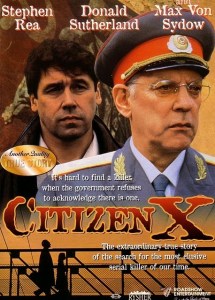
A Movie A Day #226: Citizen X (1995, directed by Chris Gerolmo)


How do you solve a crime in a society that refuses to admit that crime exists?

That is the dilemma faced by Viktor Burakov (Stephen Rea) in the fact-based film, Citizen X.  Burakov is a forensic expert in the Soviet Union.  In 1982, when a dead body is found on a collective farm, Burakov is assigned to investigate.  When seven more bodies are discovered, Burakov is convinced that he is dealing with a serial killer.  The problem is that the official Soviet position is that crime and, especially, serial murder are a product of western decadence.  With his superiors refusing to accept that a serial killer could be active in the USSR, Burakov is driven to the point of insanity as he both tries to stop the murders and keep his job.  Fortunately, he has the Machiavellian Col. Fetisov (Donald Sutherland) on his side but, even with Fetisov’s protection, Burakov is no closer to tracking down the murderer.

Citizen X is based on the crimes of Andrei Chikatilo.  From 1978 to 1990, Chikatilo committed at least 57 murders, with several of his victims being young children.  Though many were suspicious of him, Chikatilo was protected by both his membership in the Communist party and the government’s refusal to allow most of his crimes to be publicly reported.  It was only during the reforms of Perestroika that authorities were allowed to thoroughly investigate Chikatilo’s crimes.  Chikatilo was arrested in 1992 and executed, via a gunshot to the back of his head, in 1994.  In Citizen X, Chikatilo is played by Jeffrey DeMunn, who gives a very good and disturbingly plausible performance as the monstrous killer.

Made for HBO, Citizen X is a low-key but thought-provoking recreations of not just Chikatilo’s crimes but the atmosphere that allowed him to go undetected,  Along with DeMunn, both Rea and Sutherland give great performances.  (Sutherland won an Emmy.)  Max Von Sydow also appears, playing a psychologist who is given the unenviable task of trying to enter Chikatilo’s mind.

Review: V for Vendetta (dir. by James McTeigue)


“Remember, remember the fifth of November, the gunpowder treason and plot. I know of no reason why the gunpowder treason should ever be forgot.”

Alan Moore’s decision to want his name off the final credits for the film adaptation of V for Vendetta now makes sense. Moore has had a hate/hate relationship with Hollywood and the film industry in general. They’ve taken two of his other works in The League of Extraordinary Gentlemen and From Hell. and bollocks’d them up (to borrow a term used quite a bit in V for Vendetta). Outside of Watchmen, Alan Moore sees V for Vendetta as one of his more personal works and after reading the screenplay adaptation of the graphic novel by The Wachowski Brothers his decision afterwards was to demand his name be removed from the film if it was ever made. Part of this was his hatred of the film industry for their past mistakes and another being his wish for a perfect adaptation or none at all. Well, V for Vendettaby James McTeigue and The Wachowski Brothers is not a perfect film adaptation. What it turns out to be is a film that stays true to the spirit of Moore’s graphic novel and given a modern, up-to-the-current news retelling of the world’s state of affairs.

V for Vendetta starts off with abit of a prologue to explain the relevance of the Guy Fawkes mask worn by V throughout the film and the significance of the date of the 5th of November. I think this change in the story from the source material may be for the benefit of audiences who didn’t grow up in the UK and have no idea of who Guy Fawkes was and what his Gunpowder Plot was all about. The sequence is short but informative. From then on we move on to the start of the main story and here the film adheres close enough to the source material with a few changes to the Evey character (played by Natalie Portman) but not enough to ruin the character. Caught after curfew and accosted by the ruling government’s secret police called Fingermen, Evey soon encounters V who saves her not just from imprisonment but rape from these so-called Fingermen.

Right from the start the one thing McTeigue and The Wachowski Brothers got dead-on was casting Hugo Weaving as the title character. Voice silky, velvety and sonorous, Weaving infuses V with an otherworldly, theatrical personality. Whether V was speaking phrases from Shakespeare, philosophers or pop culture icons, the voice gave a character who doesn’t show his face from behind the enternally-smiling Guy Fawkes mask real life. I’d forgiven the makers of this films for some of the changes they made to the story and some of the characters for keeping V as close to how Moore wrote him. Once V and Evey are thrown in together by the happenstance of that nightly encounter their fates became intertwined. Portman plays the reluctant witness to V’s acts of terrorism, murders and destruction in the beginning, but a poignant and emotionally powerful sequence to start the second half of the film soon brings Evey’s character not much towards V’s way of doing things, but to understanding just why he’s doing them. This sequence became the emotional punch of the whole film and is literally lifted word for word from the graphic novel. This is the sequence in the film which should resonate the loudest for most people whether they buy into the rest of the film or not.

The rest of the cast seemed like a who’s who of the British acting community. From Stephen Rea’s stubborn and dogged Chief Inspector Finch whose quest to find V leads him to finding clues about his government’s past actions that he’d rather not have found. Then there’s Stephen Fry’s flamboyant TV show host who becomes Evey’s only other ally whose secret longings have been forbidden by the government, but who’s awakened by V’s actions to go through with his own form of rebellion. Then there’s John Hurt as High Chancellor Adam Sutler who’s seen chewing up the scenery with his Hitler-like performance through Big Brother video conferences (an ironic bit of casting since John Hurt also played Winston Smith in the film adaptation of the Orwell classic 1984). I really couldn’t find any of the supporting players as having done a bad job in their performances. Even Hurt’s Sutler might have seemed over-the-top to some but his performance just showed how much of a hatemonger Sutler and, in the end, his Norsefire party really were in order to stay in power.

The story itself, as I mentioned earlier, had had some changes made to it. Some of these changes angered Moore and probably continues to anger his more die-hard fans. I count myself as one of these die-hards, but I know how film adaptations of classic literary works must and need to trim some of the fat from the main body and theme of the story to fully translate onto the silver screen. The Wachowski Brother’s screenplay did just that. They trimmed some of the side stories and tertiary characters from the story and concentrated on V, Evey and Inspector Finch’s pursuit of both the truth of V and his own journey in finding that truth. This adaptation wa much closer to how Peter Jackson adapted The Lord of the Rings. As a fan of Moore I understood why he was unhappy with the changes, but then Moore was and still is an avowed perfectionist and only a perfect adaptation would do.

Critics on both sides of the aisle have called V for Vendetta revolutionary, subversive, daring to irresponsible and propagandist. All because the film dares to ask serious questions about the nature and role of violence as a form of dissent. But the granddaddy question the film brings up that has people talking is the question: terrorist or freedom fighter? Is V one or the other or is he both? Make no mistake about it, V for all intents and purposes is a terrorist if one was to use the definition of what a terrorist is. The makers of this film goes to great lenghts to describe throughout the film just how Sutler and his Norsefire (with its iconic Nazi-like imagery and extreme fundamentalist Christian idealogy) party rose to power in the UK. Partly due to what seemed like the failed US foreign policy and its subsequent and destructive decline as a superpower and the worldwide panic and fear it caused as a result. V for Vendetta also ask just who was to blame for allowing such individuals to rule over them. V has his reasons for killing these powers-that-be, but he also points out that people really should just look in the mirror if they need to know who really was to blame. For it was the population — whose desire to remain safe and have a semblance of peace — gave up more and more of their basic liberties and rights for a return to order. If one was to look at the past 100 years they would see that it’s happened before. There was the regime of Pol Pot in Cambodia, Milosevic’s Greater Serbia, and the king of the hill of them all being Adolf Hitler and his Nazi Inner Circle.

Another thing about V for Vendetta that will surely talked about alot will be the images used in the film. Not just images and symbols looking so much like Nazi icons, but images from the events of the past decade which have become symbols of oppression and censorship. The film shows people bound and hooded like prisoners from Abu Ghraib. The reason of the war on terror used time and time again by Sutler to justify why England and its people need him and his group to protect them by any means necessary. V for Vendetta seems like a timely film for our current times. Even with the conclusion of the film finally accomplishing what Guy Fawkes failed to do that night of November 5th some 400 plus years ago, V for Vendetta doesn’t give all the answers to all the questions it raises. I’m sure this would be something that’ll frustrate them some audiences. So much of people who go to watch thought-provoking films want their questions answered as clearly as possible and all of them. V for Vendetta doesn’t answer them but gives the audience enough information to try and work it out themselves.

In final analysis, V for Vendetta accomplishes in bringing the main themes of Alan Moore’s graphic novel to life and even does it well despite some of the changes made. It is a film that is sure to polarize the extreme left and right of the political pundits and commentators. But as a piece of thought-provoking and even as a politically subversive film, V for Vendetta does it job well. It is not a perfect film by any respect, but the story and message it tries to convey in addition to its value as a piece of entertainment mor than makes up for its flaws. Alan Moore and his followers might not love and approve of this film, but it doesn’t mean the film in and of itself wasn’t a good one. Sometimes calls for literal adaptations of beloved works or no adaptation at all also becomes a form of creative oppression and censorship.