The Films of 2025: Jay Kelly (dir by Noah Baumbach)


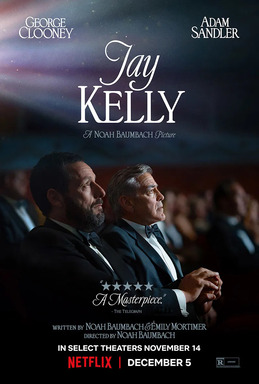
Jay Kelly features George Clooney at both his best and his worst.

Clooney plays the film’s title character, an actor who has just hit 60 and who is having an existential crisis as he realizes everything that he’s lost as a result of being rich and famous.  Clooney’s best moments are when he plays Jay as being essentially a prick, a guy who might be well-meaning but who lacks the self-awareness necessary to understand just how condescending and fake he tends to come across to the people who know him.  This is the Jay who insists on having a drink with Tim (Billy Crudup), a former actor who lost a key role to Jay and who has never forgiven him for it.  (It starts out as a friendly drink but it eventually becomes a fight after Tim reveals that he hates Jay and Jay responds by being smug.)  This is the Jay who has alienated both of his daughters (Riley Keough and Grace Edwards) and who doesn’t seem to understand that the rest of the world doesn’t travel with an entourage.

Jay is gloriously unaware in those scenes and they give Clooney a chance to show that he’s still capable of giving a sharp comedic performance.  Watching him in those scenes, I was reminded of the gloriously dumb characters that he played for the Coen Brothers, in both Burn After Reading and Hail, Caesar.  For that matter, I was also reminded of his burned-out hatchet man from Up In the Air, who was not a dumb character but still was someone who, like Jay Kelly, always seemed to be performing.

Unfortunately, as the film progresses, Jay himself starts to wander into flashbacks of himself as a young actor and, even worse, he starts to talk to himself about everything that he’s lost due to his fame and suddenly, he transforms into the insufferably smug Clooney who spent the earlier part of this year in greasepaint, lecturing us all about Edward R. Murrow.  The flashbacks to Jay Kelly’s past often feel like stand-ins for flashbacks to George Clooney’s past (and it’s probably not a coincidence that both Kelly and Clooney are from Kentucky) but they don’t really add up to much.  Jay Kelly is a character who becomes less compelling the more that one learns about him.

The characters around Jay Kelly are far more interesting than Jay himself, though I have my doubts whether that was intentional on the part of director Noah Baumbach.  (An overly long and indulgent sequence on a train would seem to suggest that Jay Kelly was envisioned as being a more fascinating character than he turned out to be.)  Just as he did in Baumbach’s The Meyerowitz Stories, Adam Sandler gives the film its heart, playing the role of Jay’s loyal but unappreciated manager.  Sandler and Laura Dern have a few showy scenes together but Sandler’s best moments come opposite Patrick Wilson as a client who feels that he’s being neglected in favor of Jay Kelly.  (For that matter, Wilson is so good in those scenes that I almost wish he had switched roles with Clooney.)  One might not expect the star of Jack and Jill and That’s My Boy to emerge as one of Hollywood’s best sad-eyed character actors but that’s what has happened in the case of Adam Sandler.

With all that in mind, I have to admit that I enjoyed Jay Kelly more than I thought I would.  Some of that has to do with expectations.  Jay Kelly is currently getting so roasted on social media that I was expecting the film to be a self-indulgent disaster.  While the film is definitely self-indulgent and about 30 minutes too long, it’s not a disaster.  When Clooney’s performance works, it really works.  (Unfortunately, the inverse is also true.)  Adam Sandler, Billy Crudup, Riley Keough, and Stacy Keach all give performances that elevate the occasionally shallow script.  Cinematographer Linus Sandgren captures some beautiful shots, especially towards the end of the film.  Visually, Jay Kelly is a marked improvement on the bland imagery of Marriage Story.  Like its title character, Jay Kelly is imperfect and occasionally annoying but it does hold your attention.

As for the film’s Oscar chances, the reviews are mixed but it’s a film about how tough it is to be an actor and one should not forget that the Actor’s Branch is the biggest branch of the Academy and the majority of the voters are people who are probably going to watch Jay Kelly and say, at the very least, “Hey, I know that guy!”  (Few will admit, “I am that guy,” but that will still definitely be a factor in how they react to the film.)  Regardless of how social media feels about the film, I imagine Jay Kelly will be remembered when the nominations are announced.

October Positivity: Jerusalem Countdown (dir by Harold Cronk)


2011’s Jerusalem Countdown opens with the world on the verge of destruction.  Israel and a nuclear-armed Iran are negotiating in Washington and not everyone wants the two countries to be at peace.

In Chicago, Daniel (Carey Scott) watches the news of the summit and then looks out his window as his unfriendly and glowering neighbor comes and goes from his house.  Daniel worries that his neighbor is up to something.  He could be a member of a terrorist cell!  Daniel’s wife (Jaci Velasquez) tells him to stop worrying about things that he can’t control but that’s easier said than done.

FBI agent Eve (Anna Zielinski) is approached by her father (Stacy Keach), a former intelligence agent who warns her that the end times are approaching.

Another intelligence agent, Shane Daughtery (David A.R. White) is contacted by a burned-out arms dealer (Lee Majors), who informs him that a group of terrorists are planning on setting off a series of bombs and plunging the world into war.  The arms dealer is assassinated by a man who keeps reciting passages from the Book of Revelations.  Meanwhile, CIA bigwig Jack Thompson (a seriously miscast Randy Travis) continually tells Shane that he can’t share too much information with him because it’s all classified….

Jerusalem Countdown is a faith-based film that also tries to be an action film.  In fact, I would say that far more emphasis is put on action than on faith.  Until the final few minutes of the film, there’s really not much focus put on religion, other than Daniel briefly praying when he finds himself trapped in the neighbor’s house and a scene where a librarian scolds Shane and Eve for not knowing about the Ten Commandments.  One major commandments, by the way, is Thou Shalt Not Kill but Shane and Eve manage to kill quite a few people in this film.  Of course, they were all bad people and Shane and Eve are trying to keep the world from being plunged into a world war so I’m willing to cut them some slack.

The cast, as you may have noticed, has a number of familiar faces in it.  It’s largely a nostalgia cast, the type that’s designed to make people over the age of 60 say, “Lee Majors is in this!”  With the exception of Randy Travis, none of the “stars” have a particularly large role.  One gets the feeling that Stacy Keach filmed his scenes in a handful of hours, collected his paycheck, and then got out of there.  It’s amazing to me that Eric Roberts is somehow not in this film.

As for the film itself, it’s competently made and David A.R. White is one of the better actors amongst the Pureflix regulars.  (White has even managed to maintain a semblance of dignity through five God’s Not Dead films.)  That said, the film itself moves a bit slowly and the low-budget keeps the action from being as memorable as it could be.  There’s a cool helicopter crash but otherwise, it’s never as exciting as it obviously wants to be and there’s a lot — and I do mean A LOT — of filler-type scenes of people talking on their phones while driving from one location to another.  The plot itself feels a bit muddled and there’s a lot of loose ends left dangling, as if the film was meant to be a set up for a sequel that never came.

The Unnominated #20: The Ninth Configuration (dir by William Peter Blatty)


Though the Academy of Motion Picture Arts and Sciences claim that the Oscars honor the best of the year, we all know that there are always worthy films and performances that end up getting overlooked.  Sometimes, it’s because the competition too fierce.  Sometimes, it’s because the film itself was too controversial.  Often, it’s just a case of a film’s quality not being fully recognized until years after its initial released.  This series of reviews takes a look at the films and performances that should have been nominated but were, for whatever reason, overlooked.  These are the Unnominated.

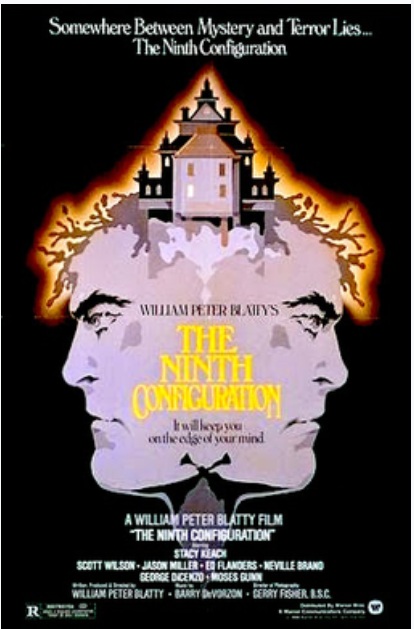
Some films defy easy description and that’s certainly the case with 1980’s The Ninth Configuration.

The film opens with a shot of a castle sitting atop of a fog-shrouded mountain.  A voice over tells us that, in the early 70s, the castle was used by the U.S. government to house military personnel who were suffering from mental illness.  Inside the castle, the patients appear to be left to their own devices.  Lt. Reno (Jason Miller) is trying to teach dog how to perform Shakespeare.  Astronaut Billy Cutshaw (Scott Wilson) is haunted by the thought of being alone in space and refuses to reveal why he, at the last minute, refused to go to the moon.  The men are watched over by weary and somewhat sinister-look guards, who are played by actors like Joe Spinell and Neville Brand.

Colonel Kane (Stacy Keach) shows up as the new commandant of the the castle.  From the first minute that we see Kane, we get the feeling that there might be something off about him.  Though he says that his main concern is to help the patients, the man himself seems to be holding back secrets of his own.  With the help of Colonel Fell (Ed Flanders, giving an excellent performance), Kane gets to know the patients and the guards.  (Despite the objections of the guards, Kane says that his office must always be unlocked and open to anyone who want to see him.)  He takes a special interest in Cutsaw and the two frequently debate the existence of God.  The formerly religious Cutshaw believes the universe is empty and that leaving Earth means being alone.  Kane disagrees and promises that, should he die, he will send proof of the afterlife.  At night, though, Kane is haunted by dreams of a soldier who went on a murderous rampage in Vietnam.

The film start out as a broad comedy, with Keach’s smoldering intensity being matched with things like Jason Miller trying to get the dogs to perform Hamlet.  As things progress, the film becomes a seriously and thoughtful meditation on belief and faith, with characters like Kane, Billy, and Colonel Fell revealing themselves to be quite different from who the viewer originally assumed them to be.  By the time Kane and Cutshaw meet a group of villainous bikers (including Richard Lynch), the film becomes a horror film as we learn what one character is truly capable of doing.  The film then ends with a simple and emotional scene, one that is so well-done that it’ll bring tears to the eyes of those who are willing to stick with the entire movie.

Considering all of the tonal shifts, it’s not surprising that the Hollywood studios didn’t know what to make of The Ninth Configuration.  The film was written and directed by William Peter Blatty, the man who wrote the novel and the script for The Exorcist.  (The Ninth Configuration was itself based on a novel that Blatty wrote before The Exorcist.)  By most reports, the studio execs to whom Blatty pitched the project were hoping for another work of shocking horror.  Instead, what they got was an enigmatic meditation on belief and redemption.  The Ninth Configuration had the same themes as The Exorcist but it dealt with them far differently.  (Because he wrote genre fiction, it’s often overlooked that Blatty was one of the best Catholic writers of his time.)  In the end, Blatty ended up funding and producing the film himself.  That allowed him complete creative control and it also allowed him to make a truly unique and thought-provoking film.

The Ninth Configuration was probably too weird for the Academy.  Though it received some Golden Globe nomination, The Ninth Configuration was ignored by the Oscars.  Admittedly, 1980 was a strong year and it’s hard to really look at the films that were nominated for Best Picture and say, “That one should be dropped.”  Still, one can very much argue that both Blatty’s script and the atmospheric cinematography were unfairly snubbed.  As well, it’s a shame that there was no room for either Stacy Keach or Scott Wilson amongst the acting nominee.  Keach, to date, has never received an Oscar nomination.  Scott Wilson died in 2018, beloved from film lovers but never nominated by the Academy.  Both of them give career-best performances in The Ninth Configuration and it’s a shame that there apparently wasn’t any room to honor either one of them.

The Ninth Configuration is not a film for everyone but, if you have the patience, it’s an unforgettable viewing experience.

Previous Entries In The Unnominated:

  1. Auto Focus 
  2. Star 80
  3. Monty Python and The Holy Grail
  4. Johnny Got His Gun
  5. Saint Jack
  6. Office Space
  7. Play Misty For Me
  8. The Long Riders
  9. Mean Streets
  10. The Long Goodbye
  11. The General
  12. Tombstone
  13. Heat
  14. Kansas City Bomber
  15. Touch of Evil
  16. The Mortal Storm
  17. Honky Tonk Man
  18. Two-Lane Blacktop
  19. The Terminator

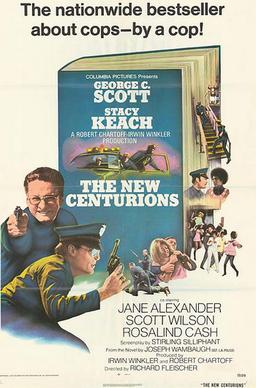
The New Centurions (1972, directed by Richard Fleischer)


Fresh from the police academy, three rookie cops are assigned to a precinct in East L.A.  Gus (Scott Wilson) is a father of three who just wants to do a good job and support his family.  Sergio (Erik Estrada) is a former gang member who saw the police academy as a way to get out of his old neighborhood, and Roy (Stacy Keach) is a new father who is going to law school at night.  Most of the movie centers on Roy, who goes from being an idealistic rookie to being a hardened veteran and who comes to love the job so much that he abandons law school and eventually loses his family.  Roy’s wife (Jane Alexander) comes to realize that Roy will never be able to relate to anyone other than his fellow cops.  Roy’s mentor is Andy Kilvinski (George C. Scott), a tough but warm-hearted survivor who has never been shot once and whose mandatory retirement is approaching.

Based on an autobiographical novel by real-life policeman Joseph Wambaugh, The New Centurion’s episodic structure allows the film to touch on all the issues, good and bad, that come with police work.  Gus is shaken after he accidentally shoots a civilian.  Sergio feels the burden of patrolling the streets on which he grew up.  Roy becomes a good cop but at the cost of everything else in his life and he deals with the stress by drinking.  There are moments of humor and moments of seriousness and then a tragic ending.  Just as Wambaugh’s book was acclaimed for its insight and its realistic portrayal of the pressures of being a policeman, the movie could have been one of the definitive portraits of being a street cop, except that it was directed in a workmanlike fashion by Richard Fleischer.  Instead of being the ultimate cop movie, The New Centurions feels more like an especially good episode of Police Story or Hill Street Blues.  (The New Centurions and Hill Street Blues both feature James B. Sikking as a pipe-smoking, martinet commander.)

George C. Scott, though.  What a great actor!  Scott only has a supporting role but he’s so good as Kilvinski that you miss him when he’s not around and, when he leaves, the movie gets a lot less interesting.  Scott makes Kilvinski the ultimate beat cop and he delivers the closest thing that The New Centurions has to a cohesive message.  A cop can leave the beat but the beat is never going to leave him.

Lisa Marie Reviews An Oscar Nominee: Nebraska (dir by Alexander Payne)


As Brad mentioned earlier, today is Bruce Dern’s birthday!

Bruce Dern is a favorite actor of mine.  He’s one of those performers who, over the course of his very long career, has appeared in all sorts of different and occasionally odd films, sometimes as a lead but most often as a character actor.  He appeared in biker films, westerns, literary adaptations, and Oscar-winners.  He killed John Wayne in The Cowboys.  He introduced Peter Fonda to acid in The Trip (Dern, for his part, has said that he the only person on the set of that film who has never done acid.)  He captured the trauma of Vietnam in Coming Home.  He played one of the great hyperactive cops in The Driver.  He came close to playing Tom Hagen in The Godfather and was the original choice for the attorney who was eventually played by Jack Nicholson in Easy Rider.

In 2013’s Nebraska, he broke my heart.

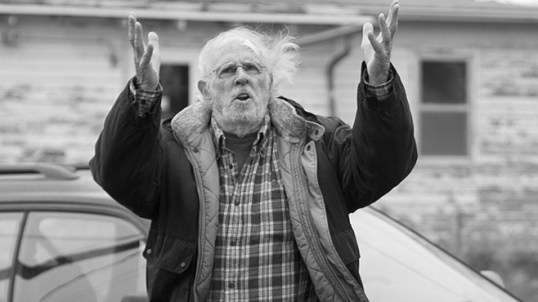
In Nebraska, Dern plays Woody Grant, an elderly man who is convinced that he’s won a million-dollar sweepstakes.  Everyone around him, including his wife (June Squibb) and his oldest son (Bob Odenkirk), realizes that the sweepstakes is a scam and that Woody has actually won nothing.  But Woody is convinced that a million dollars is waiting for him.  All he has to do is somehow make it from Montana to Nebraska.  At first, Woody attempts to walk along the interstate.  When that doesn’t work and the police end up arresting him and sending him home, his youngest son, David (Will Forte), agrees to drive Woody down to Lincoln, Nebraska.  David knows that there’s not any money waiting for Woody but, unlike his mother and his older brother, David hasn’t given up on the idea of connecting with his father.

Nebraska is a road movie, with the majority of the film following David and Woody as the drive through rural and smalltown America.  They stop off in Woody’s former hometown, where they meet Woody’s brother (Rance Howard) and also Woody’s former business partner, a bully named Ed (Stacy Keach).  Ed is convinced that Woody stole money from him.  Woody blames Ed for the loss of his air compressor.  Their anger has simmered for years and, at first, it’s tempting to assume that it’s simply one of those grudge matches that old men seem to have a weakness for.  But Ed turns out to truly be a rotten human being and Woody …. well, Woody his own problems but at least he’s not as bad as Ed.

Before I say anything else, I want to praise the entire cast.  June Squibb, Bob Odernkirk, Stacy Keach, Rance Howard, Melinda Simonsen (who has a small role as a receptionist in Lincoln), they all bring their characters to memorable life.  Will Forte is the heart of the film, trying to keep his family together and standing up for his father when it matters.  If you only know Will Forte as MacGruber, you need to see Nebraska.  That said, this film is dominated by Bruce Dern’s poignant, sad, and often very funny performance as Woody Grant.  Woody is a flawed character and Dern wisely doesn’t try to sentimentalize or downplay any of those flaws.  He drinks too much, he neglected his family when he was younger, he holds a grudge, and he’s incredibly stubborn.  But, as played by Dern, you just can’t help but like Woody and hope that he finds some sort of happiness.  Even though the viewer, like everyone else in Woody’s life, knows that the sweepstakes is a scam, it’s still hard not to spend the film hoping that Woody will prove everyone wrong when he makes it to Nebraska.

Nebraska was nominated for Best Picture while both Bruce Dern and June Squibb picked up acting nominations.  That year, the Best Picture race was dominated by 12 Years A Slave.  Matthew McConaughey won Best Actor for Dallas Buyers Club while Lupita Nyong’o won Best Supporting Actress for 12 Years A Slave.  Alexander Payne lost Best Director to Gravity’s Alfonso Cuaron.  Gravity also won the Oscar for Best Cinematography, defeating Nebraska’s gorgeous black-and-white imagery.

Oscars or not, Nebraska is a wonderful, late career showcase for the great Bruce Dern.

The Killer Inside Me (1976, directed by Burt Kennedy)


Today is Stacy Keach’s 84th birthday.

Stacy Keach has always been an underappreciated actor.  Despite his obvious talent and his ability to play both heroes and villains, he’s never really gotten the film roles that he’s deserved and he’s mostly made his mark on stage and on television.  There have been a few good films that made use of Keach’s talents.  I’ve always appreciated his performance as Frank James in Walter Hill’s The Long Riders.  He was a morally ambiguous Doc Holliday in Doc.  He played a boxer in John Huston’s Fat City.  Horror fans will always remember him for Road Games. The Ninth Configuration featured a rare starring role for Keach but it was treated poorly by its studio.  He was chilling as a white supremacist in American History X.  For the most part, though, Keach’s film career has been made up of stuff like Class of 1999.  For all of his talent, he seems destined to be remembered mostly for playing Mike Hammer in a television series and a few made-for-TV movies.  It’s too bad because Keach had the talent to bring certain character to life in a way that few other actors can.

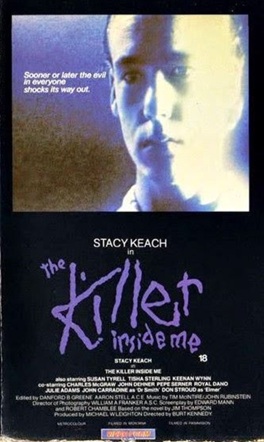
The Killer Inside Me features one of Keach’s best performances.  Based on a pulp novel by Jim Thompson, The Killer Inside Me stars Stacy Keach as Lou Ford.  Lou is a small town deputy.  Everyone thinks that he’s a good, decent man.  He’s dating the local school teacher (Tisha Sterling).  The sheriff (John Dehner) trusts him.  Lou seems to be an expert at settling conflicts between neighbors.  What everyone doesn’t know is that Lou is actually a psycho killer who is having a sado-masochistic affair with a local prostitute (Susan Tyrrell) and who has zero qualms about punching the life out of someone.  When Lou finds out that Tyrrell is also involved with the son of a local businessman, it sets Lou on a crime and killing spree.  Lou thinks he’s a genius but his main strength is that no one can imagine Lou Ford doing the terrible things that he does.

Burt Kennedy was an outstanding director of westerns and straight-forward action movies but he appears to have struggled with The Killer Inside Me’s morally ambiguous tone.  The end result is not a great film but it does feature a great performance from Stacy Keach.  In both his performance and his narration, Keach captures both the arrogance and the detachment from normal society that defines Lou Ford’s character.  He also shows how Ford coolly manipulates the people around him.  Keach is believable and compelling whether he’s playing the fool or if he’s committing cold-blooded murder and he also subtly shows that Lou is not as smart as he thinks he is.  Though Keach dominates the film, The Killer Inside Me also features good performances from a gallery of 70s character actors, including John Carradine, Keenan Wynn, Don Stroud, Charles McGraw, and Royal Dano.

This version of The Killer Inside Me didn’t do much at the box office.  The movie was remade in 2010, with Casey Affleck miscast as Lou Ford.  That version didn’t do much at the box office either.  The secret to recreating the book’s mix of social satire and pulp action has proven elusive to filmmakers but at least we’ve got Stacy Keach’s performance as Lou Ford to appreciate.

Raw Justice (1994, directed by David Prior)


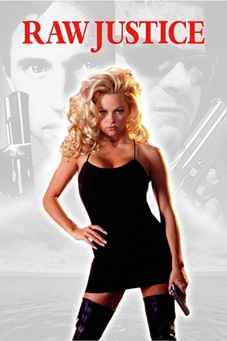
When his daughter is strangled, New Orleans Mayor David Stiles (Charles Napier) hires ex-cop-turned-bounty-hunter Mace (David Keith) to keep an eye on the main suspect, Mitch McCullum (Robert Hays).  What the mayor doesn’t know is that his daughter’s murder was ordered by Deputy Mayor Jenkins (Stacy Keach) and now, both Mace and Mitch are being stalked by a crooked cop named Atkins (Leo Rossi).  Also getting involved in this mess is a hooker with a heart of gold named Sarah (Pamela Anderson), who is angry because Mace earlier stole his clothes while trying to get the jump on a bail jumper.  Sarah and Mitch soon fall in love.  Mace is good with a gun and Mitch turns out to know karate (because he watched a lot of Bruce Lee movies growing up) but the film’s high point is when one of the bad guys is taken out with a giant novelty dart.

The plot is dumb and David Keith comes across as being a discount version of Patrick Swayze but this film does give the always likable Robert Hays a good role and fans of Pamela Anderson (and you know who you are) will definitely appreciate at least two scenes in the movie.  Actually, Pamela Anderson isn’t bad in Raw Justice.  She’s mostly there for her looks but she still has a likable and energetic screen presence.  Otherwise, this is a typical low-rent David Prior production, complete with action scenes featuring guns that never run out of bullets (unless it’s convenient for the plot) and a score that is pretty much the same guitar riff over and over again.  It’s not exactly good but it is entertaining if you’re in the right mood.

This film was also released under the title Good Cop Bad Cop, which doesn’t make much sense because neither Keith nor Hays is playing  a cop.

A Blast From The Past: Wait Until Dark (dir by Barry Davis)


Malibu, CA will not be reviewed tonight so that we might bring you this special presentation….

My retro television reviews will return next week but, for now, why not enjoy something even better than me discussing my hatred of Malibu, CA?  1982’s Wait Until Dark is a videotaped record of a stage production of Frederick Knott’s classic play about a blind woman who is menaced by three criminals.  (I assume it was filmed for PBS.  According to Lettrboxd, this aired on television on June 20th, 1982.)  This play was famously adapted into an Audrey Hepburn film in 1967.  The production below gives us a chance to see how the suspense plays out in a theatrical setting.  The cast, including Katharine Ross and Stacy Keach, is excellent!

And now, here is Wait Until Dark….


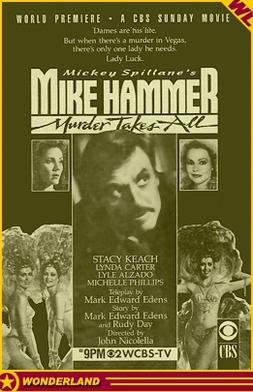
Mike Hammer: Murder Takes All (1989, directed by John Nicollela)


Entertainer Johnny Roman (Ed Winter, best-known as the crazed Colonel Flagg on M*A*S*H) sends an invitation to New York P.I. Mike Hammer (Stacy Keach), asking him to come to Vegas for a job.  Hammer refuses.  Vegas is not for him.  He’s pure New York.  So, someone has Hammer abducted and thrown out of an airplane over Vegas.  Luckily, they gave Hammer a parachute.  Unluckily, for them, Hammer is now in Las Vegas and he’s pissed off.

Johnny, who says he had nothing to do with the kidnapping and just wants Hammer to help him deal with a singer who has been stealing from him, is killed by an explosive device while hosting a telethon.  Everyone suspects Hammer.  When the singer that Hammer was supposed to investigate also turns up dead, Hammer is again suspected.  Hammer has to clear his name while dealing with guest stars ranging from Lynda Carter to Michelle Phillips to Jim Carrey.

Stacy Keach was Mike Hammer for most of the 80s, playing Mickey Spillane’s notorious detective in a television series and in several made-for-TV movies, like this one.  Television was an awkward fit for Mike Hammer, or at least Hammer the way he was imagined in the books.  Mike Hammer was written to be a killer with his own brand of justice.  He was not written to be a nice person.  Instead, he was the brutal but intelligent warrior that you hoped would be on your side.  The television version of Mike Hammer was considered to be violent for the era but the show still toned down Hammer’s signature brutality.  Keach’s Hammer still killed people but he no longer gloated about it.  Stacy Keach, with his trademark intensity, was a good pick for Mike Hammer, even if the show’s scripts often let him down.

This movie is hamstrung by the fact that it was made-for-TV.  Hammer is not happy about being in Las Vegas but he can’t go off on the city in the same way that he would have in one of Mickey Spillane’s novels.  Keach still gives a good and tough performance as Hammer, getting as close to the character as anyone could under the restrictions of 80s network television.  The mystery is interesting, though Hammer doesn’t really solve it as much as he just waits until all the other suspects have been killed.  The main attraction of this one is the amount of guest stars who show up.  Lynda Carter is a great femme fatale and it’s always good to see Michelle Phillips, even in a small role.  Jim Carrey, in his pre-In Living Color days, plays an accountant and does okay with a serious role.

Who could play Mike Hammer today?  It’s hard to say.  There aren’t many believably tough actors around anymore and even those who do seem like they could hold their own in a fight don’t have the gritty world-weariness that the character requires.  (Just try to imagine Dwayne Johnson reenacting the end of I, the Jury.)  A few years ago, I would have said Frank Grillo.  In the 90s, Bruce Willis would have been the perfect Hammer.  Today, though, Mike Hammer’s time may finally have passed.

Icarus File No. 18: Brewster McCloud (dir by Robert Altman)


First released in 1970, Brewster McCloud takes place in Houston.

A series of murders have occurred in the city.  The victims have all been older authority figures, like decrepit landlord Abraham Wright (Stacy Keach, under a ton of old age makeup) or demanding society matron Daphne Heap (Margaret Hamilton, who decades earlier had played The Wicked Witch in The Wizard Of Oz).  The victims all appear to have been killed by strangulation and all of them are covered in bird droppings.  Perplexed, the Houston authorities call in Detective Frank Shaft (Michael Murphy) from San Francisco.  Shaft only wears turtlenecks and he has piercing blue eyes.  He looks like the type of guy you would call to solve a mystery like this one.  It’s only later in the film that we discover his blue eyes are due to the contact lenses that he’s wearing.  Frank Shaft is someone who very much understands the importance of appearance.  As one detective puts it, when it comes to Shaft’s reputation, “The Santa Barbara Strangler turned himself in to him.  He must have really trusted him.”

Perhaps the murders are connected to Brewster McCloud (Bud Cort), who lives in a bunker underneath the Astrodome and who seems to be fascinated with birds.  Brewster dreams of being able to fly just like a bird and he’s spent quite some time building himself a set of artificial wings.  A mysterious woman (Sally Kellerman) who wears only a trenchcoat and who has scars on her shoulder blades that would seem to indicate that she once had wings continually visits Brewster and encourages him to pursue his dream.  However, she warns him that he will only be able to fly as long as he remains a virgin.  If he ever has sex, he will crash to the ground.

Brewster thinks that he can handle that.  Then he meets a tour guide named Suzanne Davis (Shelley Duvall, in her film debut) and things start to change….

Brewster McCloud is a curious film.  The story is regularly interrupted by a disheveled lecturer (Rene Auberjonois) who is very much into birds and who, over the course of the film, starts to more and more resemble a bird himself.  The film is full of bird-related puns and there are moments when the characters seem to understand that they’re in a movie.  Frank Shaft dresses like Steve McQueen in Bullitt and his blue contact lenses feel like his attempt to conform to the typical image of a movie hero.  (A lengthy car chase also feels like a parody of Bullitt’s famous chase scene.)  When the old woman played by Margaret Hamilton dies, the camera reveals that she’s wearing ruby slippers and a snippet of Somewhere Over The Rainbow is heard.  As played by Bud Cort, Brewster is the perfect stand-in for the lost youth of middle class America.  He knows that he’s rebelling against something but he doesn’t seem to be quite sure what.  Brewster, like many idealists, is eventually distracted by his own desires and his once earnest plans come cashing down.  Brewster becomes an Icarus figure in perhaps the most literal way possible, even if he doesn’t come anywhere close to reaching the sun.  As with many of Altman’s films, Brewster McCloud is occasionally a bit too esoteric for its own good but it’s always watchable and it always engages with the mind of the viewer.  One gets the feeling that many of the film’s mysteries are not necessarily meant to be solved.  (Altman often said his best films were based on dreams and, as such, used dream logic.)  With its mix of plain-spoken establishmentarians and quirky misfits, Brewster McCloud is not only a classic counterculture film but it’s also a portrait of Texas on the crossroads between the cultures of the past and the future.

Though it baffled critics when it was released, Brewster McCloud has gone on to become a cult film.  It’s a bit of a like-it-or-hate-it type of film.  I like it, even if I find it to be a bit too self-indulgent to truly love.  Quentin Tarantino, for his part, hates it.  Brewster McCloud was released in 1970, the same year as Altman’s Oscar-nominated M*A*S*H.  (Both films have quite a few cast members in common.)  Needless to say, the cheerfully and almost defiantly odd Brewster McCloud was pretty much ignored by the Academy.

Previous Icarus Files:

  1. Cloud Atlas
  2. Maximum Overdrive
  3. Glass
  4. Captive State
  5. Mother!
  6. The Man Who Killed Don Quixote
  7. Last Days
  8. Plan 9 From Outer Space
  9. The Last Movie
  10. 88
  11. The Bonfire of the Vanities
  12. Birdemic
  13. Birdemic 2: The Resurrection 
  14. Last Exit To Brooklyn
  15. Glen or Glenda
  16. The Assassination of Trotsky
  17. Che!