Review: Thanksgiving (dir. by Eli Roth)


“This year, there will be no leftovers.” — Sheriff Eric Newlon

Thanksgiving (2023) is Eli Roth’s ambitious take on the slasher genre, blending elements of gory horror, dark comedy, and social commentary rooted in the holiday’s American origins. The film follows a masked killer, inspired by the historical Plymouth Colony governor John Carver, who stalks the small town of Plymouth, Massachusetts, weaving a path of violence around the Thanksgiving festivities. The movie opens strongly with a tense, chaotic Black Friday mob scene that effectively captures the frenzy of consumerism and sets a sharp tone of societal critique through horror. However, as the film progresses, it drifts more into a conventional slasher revenge plot that lacks the depth expected from its promising premise.

Visually, Thanksgiving is sharp and well-crafted, abandoning the low-budget aesthetic of Roth’s original 2007 fake trailer and adopting a slick, modern horror style reminiscent of recent elevated slashers. The kills are signature Roth—extremely graphic and creatively brutal—offering plenty of gore that will satisfy fans of extreme slasher violence. The cast delivers solid performances, portraying a range of characters that touch on themes from corporate greed to family tension. While some characters feel underdeveloped, the film does maintain a whodunit element that keeps the mystery alive until the later stages, engaging the audience in the killer’s identity.

The film attempts a tricky balance between paying homage to nostalgic slasher films and delivering dark social satire. This tonal uncertainty emerges as its main weakness; the mix of campy horror and dramatic narrative sometimes feels disconnected and uneven. Although the premise hints at a sharp critique of consumerism and the problematic legacy of Thanksgiving, these themes remain superficially explored. The clashing tones—between over-the-top murder scenes and serious town investigations—can disengage viewers, leading to a jarring experience that affects overall cohesion.

The film leans heavily on extreme violence and a parade of signature kills, but it lacks the sharp wit or cohesive satire needed to maintain sustained interest. It tries to balance being both artful and absurd, yet ends up feeling off-balance and somewhat numbing, stretching a brief satirical concept into a 106-minute feature without clear follow-through or a unified purpose. While it delivers plenty of gore and horror moments, Thanksgiving ultimately falls short of being a polished homage or a compelling modern reinvention of the slasher genre. The result is entertaining mainly for fans who appreciate relentless slasher violence but may leave others feeling the film is uneven and overstuffed without fully satisfying either as a tribute or as a fresh take on the genre.

In terms of entertainment value, Thanksgiving offers a chaotic mix of gore, dark humor, and missed opportunities that make it an uneven but occasionally thrilling watch. It delivers a fresh avalanche of horror and inventive kill sequences packed with kitschy Thanksgiving references and humorous touches, especially in its opening Black Friday massacre. Fans of Eli Roth’s style will recognize his penchant for mixing intense violence with comedic timing, and the film does a respectable job reviving the feel of classic ’80s slashers with a modern twist. However, it’s a film best suited for devotees of graphic slashers rather than casual horror viewers seeking strong narrative or thematic depth.

Ultimately, Thanksgiving stands as a gutsy effort buoyed by bold kills and nostalgic flair, but one that struggles to find a fully satisfying balance between homage, horror, and social commentary. Its impact is intense but uneven, making it a film that may carve out a cult following among gore enthusiasts while leaving others wishing for a sharper, more cohesive final product.

Review: Kraven the Hunter (dir. by J. C. Chandor)


Kraven is Sony’s latest attempt to mine its Spider-Man-adjacent characters for cinematic gold, this time taking a stab at Sergei Kravinoff, better known as Kraven the Hunter. Even if you’re going in with rock-bottom expectations set by Morbius or the patchy Venom films, you might find yourself torn between mild intrigue and full-on indifference. The movie doesn’t bomb, but it certainly doesn’t soar either—it lands squarely in the “it’s fine, I guess” territory, buoyed by a handful of positive elements but weighed down by a laundry list of issues.

The film tries to position itself as a darker, grittier entry in Sony’s Spider-Man Universe but ultimately falls flat in several key areas. The movie follows Sergei Kravinoff (Aaron Taylor-Johnson), a man battling his toxic past and violent instincts, trying to define himself apart from his ruthless father, Nikolai (Russell Crowe). While Taylor-Johnson puts in a committed, physical performance and the action sequences deliver some visceral excitement—with brutal fight scenes and a snowy prison breakout standing out—the film struggles to transcend its predictable, shallow narrative.

One of the strongest aspects of Kraven is its commitment to visceral, intense action. The movie doesn’t shy away from bloody, fierce fights, embracing Kraven’s nature as a hunter rather than a hero. Physicality is a highlight here with Taylor-Johnson convincingly portraying the character’s power and agility. Some of the choreography—such as a snow-covered prison escape and a jungle chase—inject adrenaline into the movie, complemented by Russell Crowe’s imposing presence as the domineering father. Ariana DeBose’s Calypso and Alessandro Nivola’s Rhino provide interesting, if underdeveloped, counterparts that add flavor to the otherwise monochrome supporting cast.

However, the film is weighed down by a paint-by-numbers storyline that treads the well-worn path of antihero origin stories without adding fresh insight or emotional texture. The plot feels cliched and forgettable, with many moments so awkward and stilted that the dialogue and narrative flow could easily be accused of being AI-generated—and that accusation wouldn’t be out of place. This mechanical, artificial quality in the script creates a disconnect that makes characters seem like hollow archetypes rather than fully realized people. It’s as if the story was stitched together by a formula rather than human creativity, robbing the film of natural humor, depth, or emotional impact.

The biggest glaring example of this artificiality comes in the odd use of CGI for some of the characters’ facial movements. In particular, a scene with DeBose’s Calypso involved digital manipulation of her mouth and eyes to sync dialogue after filming, creating an uncanny, often distracting effect. This technique, reminiscent of the awkward, jarring movement of digitally animated mouths on still images, recalls the uncomfortable “Annoying Orange” vibe and highlights a troubling overreliance on technology rather than retakes or better production planning. It is a standout low point that further reinforces the impression of a rushed or overly engineered project.

The emotional core of Kraven revolves around the toxic father-son dynamic, which Crowe and Taylor-Johnson approach with convincing intensity, though the writing undermines their efforts with repetitive, obvious lines. The other characters, including Calypso, Rhino, and the Foreigner, suffer from limited screen time and one-dimensional arcs, often serving only to advance the plot mechanically rather than enrich the story. The film’s isolation from the broader Spider-Man universe also makes the stakes feel lower, leaving Kraven’s violent vendetta somewhat directionless and detached from broader consequences.

Visually, the film is inconsistent. While it nails gritty, physical action sequences, the CGI and digital alterations break immersion. The attempt at a darker, more grounded tone battles against these technical missteps and a narrative stuck in early-2000s superhero tropes.

Kraven offers some genuinely brutal action and committed performances but is hamstrung by a formulaic, AI-esque script and distracting technical glitches like the digital mouth-sync. It feels like a film caught between creative ambition and lazy execution, where flashes of potential are overwhelmed by awkward dialogue and uninspired plotting. For fans craving raw action or eager to see a Spider-Man villain on screen, it may be a mildly watchable diversion; for anyone seeking a fully fleshed-out, emotionally engaging story, Kraven is likely to disappoint.

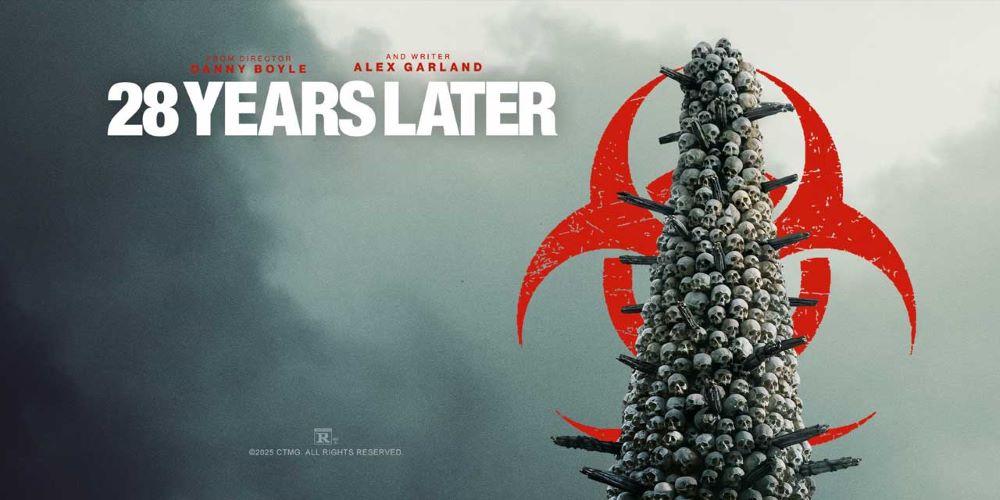
Horror Review: 28 Years Later (dir. by Danny Boyle)


Danny Boyle waited nearly two decades to return to the world he helped redefine with his groundbreaking 2002 film 28 Days Later, which reshaped the zombie subgenre by replacing the traditional, slow-moving undead with fast, feral infected that embody contagion, panic, and societal collapse. While purists continue to debate whether the creatures are technically zombies or infected, Boyle’s vision fundamentally changed how audiences engage with themes of epidemic, survival, and the breakdown of order on screen. The 2007 follow-up, 28 Weeks Later, directed by Juan Carlos Fresnadillo, expanded the Rage virus mythology and landscape but lacked the original’s haunting intimacy and innovation, leaving the franchise in a state of uncertainty until Boyle and writer Alex Garland reunited for 28 Years Later, a film that feels less like a conventional sequel and more like an elegy for a deeply changed world.

The film opens with a short, brutal prologue: young Jimmy Crystal’s family is consumed by the Rage virus while watching Teletubbies, and the boy flees to find safety only to discover his minister father welcoming the infected as a sign of apocalyptic judgment. This early scene deftly establishes the film’s unease, blending visceral horror with spiritual inquiry and foreshadowing a narrative caught between faith, grief, and chaos. Boyle reasserts his command of visceral set pieces while signaling that this film is more concerned with memory and ritual than with relentless terror.

Decades later, the British Isles have been sealed off; NATO forces enforce a quarantine and blockade, isolating the mainland as a toxic exclusion zone. On the tidal island of Lindisfarne, a small community clings to a fragile existence, protected by a causeway that floods at high tide—a detail that metaphorically underscores themes of isolation and dangerous connection. It is here that the emotional core emerges in Jamie and his son Spike, played by Aaron Taylor-Johnson and the remarkable newcomer Alfie Williams. Their spare, heartfelt relationship grounds what otherwise wanders into meditative and often surreal territory.

Alfie Williams emerges as one of the year’s most impressive new talents. His portrayal of Spike avoids the usual survivor archetype; instead, he presents a boy deeply shaped by inherited trauma and cautious curiosity. Boyle’s camera lingers on Williams’ face, capturing silent shifts of fear, wonder, and resilience, making his quiet moments as powerful as the film’s larger set pieces. Williams shines particularly in a sequence where Spike and his mother, portrayed with subtle grace by Jodie Comer, navigate a moss-covered village reclaimed by nature; Williams embodies awe and terror with a single glance. His encounters with the evolved infected—some sedentary and tree-like, others organized into predator packs—are charged with terrifying authenticity and emotional depth. Early reviews label Williams a breakout star, praising his ability to hold the screen alongside veteran actors.

Visually, Boyle and cinematographer Anthony Dod Mantle experiment with a striking mix of techniques, blending the use of iPhone 15 Pro Max cameras and drones with traditional film methods to create a language that oscillates between intimate human moments and sweeping, documentary-style landscapes. The Britain depicted is no longer a lifeless wasteland but an ecologically regrown terrain—lush, eerie, and indifferent. This verdant backdrop reflects the Rage virus’s own evolution. The infected have adapted in ways both terrifying and fascinating: some feed off the earth and fungus, becoming near-plantlike and sedentary, while others form packs ruled by alpha mutants, suggesting emergent social structures even after humanity’s collapse. This biological and ecological evolution amplifies the film’s central theme: survival transcending humanity.

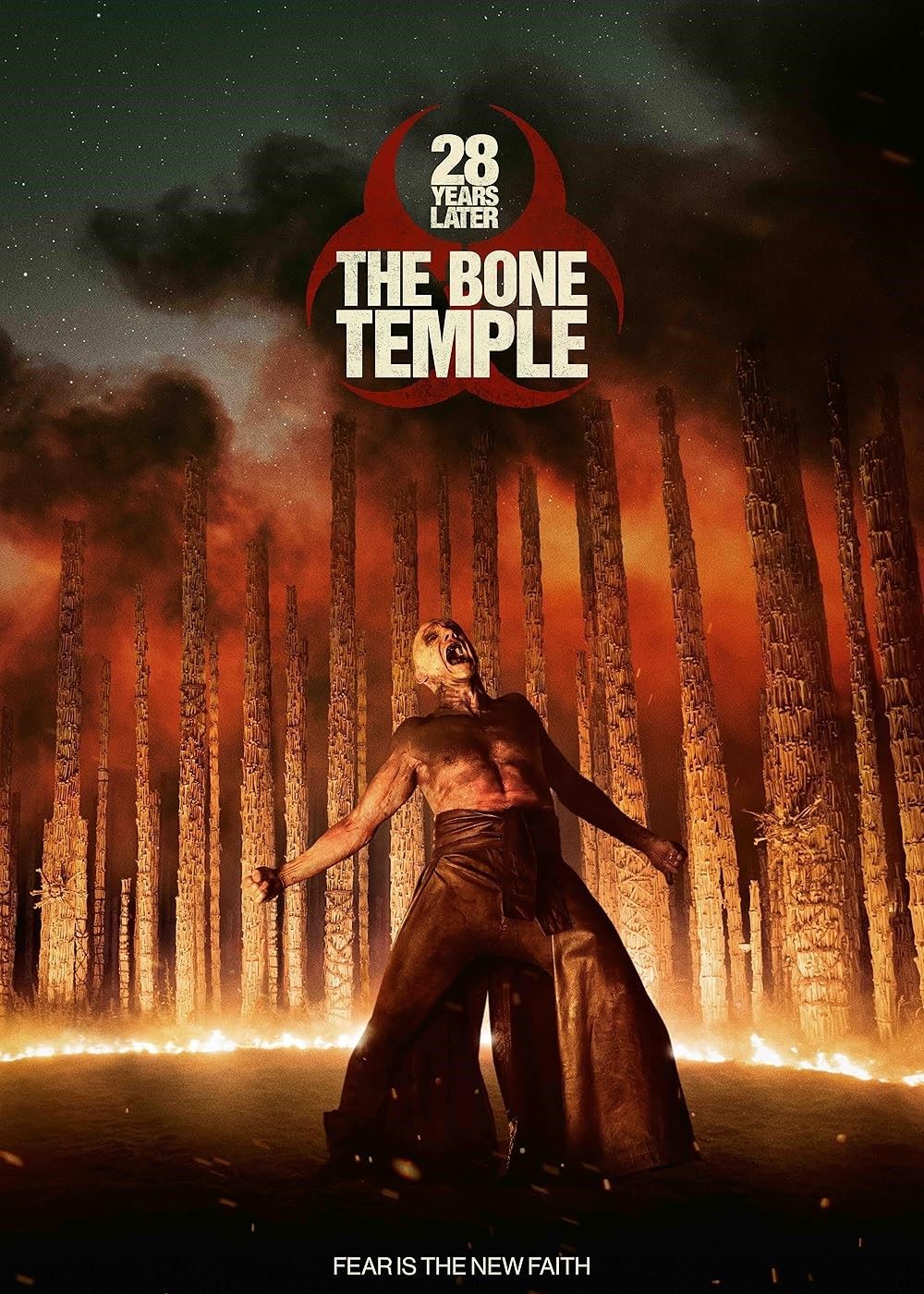
Anchoring the film’s philosophical inquiry is Ralph Fiennes’s performance as Dr. Ian Kelson, a former general practitioner who has exiled himself to live among the infected. Fiennes crafts Kelson with haunting solemnity and layered ambiguity—part caregiver, part fanatic, part recluse—who has created the eponymous “Bone Temple,” a shrine assembled from bones and memories to honor the dead and the changed world they inhabit. The role requires quiet intensity, and Fiennes delivers; his interactions with Spike are charged with both menace and melancholy. Kelson’s reverence for the infected and his willingness to coexist with them challenge traditional survivalist narratives, injecting the film with a solemn meditation on loss, acceptance, and the possibility of new forms of life.

28 Years Later opts for a deliberately slower, more contemplative pace than its predecessors. Boyle and Garland invest their energy in exploring grief, adaptation, and collective memory. The infected become symbolic forces of transformation rather than mere antagonists, while survivors seek meaning through ritual and remembrance as a bulwark against despair. This approach has divided fans: some lament the absence of the unrelenting terror and pace that characterized the earlier films, while others welcome the franchise’s intellectual maturity and thematic depth.

Certain scenes—such as the stranded NATO patrol subplot and glimpses of emerging cult-like human factions—hint at a larger, more complex world but never overshadow the film’s intimate father‑son narrative. Jodie Comer complements Williams with a nuanced portrayal of Spike’s mother, and Taylor‑Johnson brings grounded emotional weight to Jamie, embodying a parent wrestling with how to protect the next generation in a broken world and dealing with his own inner demons.

The interplay between Williams and Fiennes forms the film’s core dynamic, uniting youthful vulnerability with somber reflection. Kelson’s philosophical acceptance of the apocalypse contrasts with Spike’s struggle for identity and belonging, producing compelling, often unsettling exchanges that elevate the narrative’s moral complexity.

Toward the film’s conclusion, a jarring tonal shift occurs with the sudden arrival of a grown-up Jimmy Crystal, whose unsettling presence and cult leadership drastically change the mood. The moment is so discordant that viewers are left questioning whether it is literal or a fevered hallucination—an ambiguity that effectively sets the stage for the sequel.

The upcoming follow-up, 28 Years Later: The Bone Temple, is set for release in January 2026 and will be directed by Nia DaCosta, with Alex Garland returning as screenwriter. This sequel is expected to explore the role of Kelson’s Bone Temple more deeply and develop the cult gathering led by Jack O’Connell’s Jimmy Crystal, expanding on the fractured post-apocalyptic world and the characters introduced in the current film.

Ultimately, 28 Years Later is a film about evolution—of species, storytelling, and filmmaking itself. It balances raw dread with haunting visuals and somber themes, anchored by Alfie Williams’s quietly compelling Spike and Ralph Fiennes’s enigmatic Dr. Ian Kelson. Boyle has not merely revived the franchise; he has transformed it into an unsettling, elegiac meditation on rage, loss, and the fragile hope that survives beyond apocalypse.

Spider-Man: Far From Home Teaser and International Trailers


spider-man far from home

Spider-Man: Homecoming was the Spider-Man that fans have been waiting for. It was able to balance the character of Peter Parker and his alter-ego of Spider-Man. Where the Sam Raimi version was able to make the former stand-out at the cost of the Spider-Man alter, the Marc Webb version swapped the two dynamics. Webb’s version had a great Spider-Man but had a Peter Parker whose moral compass was a bit skewed.

Jon Watt’s Spider-Man and Peter Parker were a nice balance. It helped that the character was now free (to a degree) to play in the huge cinematic sandbox that is the Marvel Cinematic Universe.

Last we saw Spider-Man and Peter Parker, he was dusted just like half the living things in the universe following the Thanos Snap. The question that gets brought up whenever Spider-man: Far From Home, the sequel to Spider-Man: Homecoming, gets talked about is does this film take away from the emotional sucker punch that was Avengers: Infinity War and it’s upcoming sequel, Avengers: Endgame.

From this teaser trailer and it’s international version has shown, the question still remains as both teasers mention nothing about the Avengers and keeps the timeline of the film vague enough to make one wonder if this sequel happens before Avengers: Infinity War.

I guess fans will find out on July 5, 2019 when the film is released worldwide.

….and here’s the International Teaser trailer