1985’s Revolution opens on July 4th, 1776. The Declaration of Independence has just been published. The streets are full of people celebrating. A statue of King George is pulled down. In her carriage, the wealthy Mrs. McConnahay (Joan Plowright) turns up her nose to the enthusiastic rebels, including the fanatical Liberty Woman (Annie Lennox). Mrs. McConnahay’s daughter, Daisy (Nastassja Kinski) is intrigued by this idea of freedom and equality.
Fur trader Tom Dobbs sails his boat into Hudson Harbor. Tom is Scottish, illiterate, and very much a man of the 18th Century. However, he’s played by Al Pacino, who was none of those things. After Revolution was released to desultory reviews, Pacino took four years off from the movies and watching this film, one can see why. Pacino is miscast as Dobbs and, as a result, he gives the type of truly bad performance that can only be given by a great actor. Unable to disguise the fact that he had the accent of a modern-day New Yorker, Pacino resorts to mumbling the majority of his lines. Tasked with playing a character who has no idea how to deal with the history-making events in which he finds himself, Pacino alternates between a blank look and with bulging his eyes like a madman, proving that it’s far more difficult to play an uneducated character than an educated one. Why cast Pacino, who can be one of our most exciting actors, as a character who can barely speak and who has neither the intensity of Michael Corleone or the subversive wit of Tony Montana? Due to Pacino and Kinski having zero chemistry, the scenes where Tom falls in love with Daisy are almost painful to watch.
The film follows Tom as he and his son, Ned (Simon Owen when the film begins, Dexter Fletcher by the time the action moves to Valley Forge), as they find themselves conscripted into the Revolutionary Army. Eventually, Ned is abducted into the British army and serves as a drummer boy under the sadistic watch of Sgt. Major Peasy (Donald Sutherland). The idea behind the film isn’t a bad one. It attempts to portray the American Revolution through the eyes of the average citizen. Instead of focusing on the Founding Fathers, Revolution tries to tell the story of the everyday people who found themselves in the middle of the war. Tom loses his boat and (temporarily) he loses his son. Fortunately, this is one of those films where people are constantly running into each other by chance, regardless of whether it makes any sense or not. Daisy goes from seeing Tom in New York to randomly coming across him in a field to eventually finding him in Valley Forge. It’s not because she’s specifically looking for him. Instead, he just happens to be there.
Why does Revolution fail? A lot of it comes down to Pacino’s performance, though Pacino certainly isn’t the only talented actor to give a not-quite good performance in Revolution. (Donald Sutherland has never been more wasted in a film.) The script is full of dialogue like, “My mouth belongs where I place it.” (Pacino gets stuck with that one.) Hugh Hudson directs in a leaden manner. Towards the end of the film, there is one brilliant sequence where Tom wanders through the streets of New York and, for a few minutes, the film comes to like with a spontaneity that was previously lacking. Unfortunately, it’s just one sequence in a very long movie,
To be honest, we could use some good films about the American Revolution and I’m not talking about elitist nonsense like Hamilton. No taxation without representation. It’s still a good message for us all.
That’s a question that people have been asking for 129 years. Arguably the world’s first famous serial killer, Jack the Ripper killed at least five prostitutes in the Whitechapel section of London. Some claim that he killed as many as twenty. He may have also written several taunting letters to the police. Again, some say that the letters are authentic and some say that they were hoaxes. Hell, there’s even some people who say that Jack the Ripper himself is a myth and the five murders attributed to him were actually five unconnected crimes. It was speculated that Jack the Ripper was a butcher, a surgeon, or maybe a midwife. Just as suddenly as the murders began, they ended. The London police claimed that he had committed suicide by jumping into the Thames. Few people believed them then and even less now.
The reason that there is so much uncertainty is because Jack the Ripper was never caught. He was never identified. There were stories of confessions, though many of them came from the mentally infirm or they were heard by someone who was a friend of someone who claimed to be the Butcher of Whitechapel. At one point, there was even a claim that Jack’s diary had been found.
As a horror fan, a true crime fanatic, and a lover of history, I’ve read quite a few theories about who Jack the Ripper was. Nearly every prominent (or, at the very least, remembered) Victorian has been accused of having been Jack the Ripper. Oscar Wilde has been accused of hiding a confession in The Picture of Dorian Gray. Various members of the Royal Family have been fingered as the culprit. Even Lewis Carroll could not escape accusation. The true crime author Patricia Cornwell wrote an entire book where she (wrongly) accused the painter Walter Sickert. Cornwell’s case could basically be summed up as follows: “Walter Sicket’s paintings were weird. Walter Sickert must be Jack the Ripper.” Apparently, she managed to destroy one of Sickert’s paintings while looking for clues.
The truth of the matter is that Jack the Ripper was probably some guy who no one has ever heard of, most probably one of the unknown men who lived and worked in the shadows of Whitechapel. For all the talk of Jack being a doctor, it can be argued that the surgical precision of his murders has been overstated. He didn’t get away with murder because he was particularly clever. Instead, he got away with it because, in 1888, even fingerprinting was considered to be a radical science.
But, honestly, that’s not very intriguing. For those of us who have researched the case, it’s far more interesting to speculate that Jack the Ripper was either a famous person or that the murders were all the result of a huge conspiracy.
That’s certainly the appeal of From Hell, the 2001 film from The Hughes Brothers. Making the same basic case as Bob Clark’s Murder By Decree, From Hell argues that the Jack the Ripper murders were the result of a royal conspiracy. In reality, that theory has been discredited but it certainly is the most cinematic of all the possibilities.
And, speaking of cinematic, it must be said that From Hell is very stylish movie. Though the title comes from one of Jack the Ripper’s letters, From Hell also could just as easily be used to describe the film’s vision of Whitechapel. Whitechapel is full of shadows and secrets and the blood flows freely. If Mary Kelly (Heather Graham) isn’t killed by Jack the Ripper, it’s just as likely she’ll be killed by one of her clients. Even as the murders are committed, life and business in Whitechapel goes on. What other choice is there? It’s either risk being killed or starve.
It falls to Frederick Abberline (Johnny Depp) to solve the murders. The real-life Abberline was an almost legendary detective who lived for decades after the final Jack the Ripper murder. The movie’s Abberline is an opium addict who always seems to be on the verge of a breakdown. When he and Mary Kelly fall in love, you’re not really sure if it’s something to be happy about. Abberline seems just as likely to go crazy as everyone else.
From Hell is an uneven and somewhat overlong movie but I like it. Heather Graham and Johnny Depp give somewhat odd performances but the oddness fits right in with the Hughes Brothers’s vision of a world that’s been turned permanently upside down. It’s a movie that’s full of atmosphere and the story is intriguing even if it’s never exactly convincing. For obvious reasons, I can’t reveal who plays Jack the Ripper but I will say that he gives a very good performance. When he says that, “One day, men will look back and say that I gave birth to the 20th century,” you believe him.
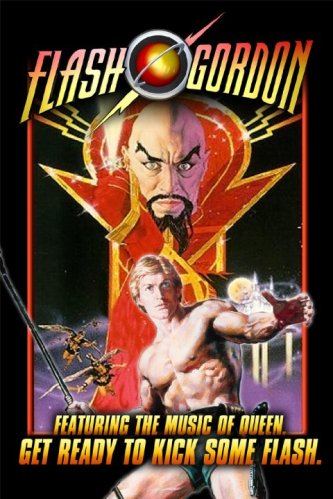
Life on the planet Mongo is not easy. Aided by Darth Vader wannabe Klytus (Peter Wyngarde) and the sadistic General Kala (Mariangela Melato), the evil Emperor Ming (Max Von Sydow) rules with an iron fist. All of the citizens are heavily taxed and kept in a state of perpetual war in order to keep them from joining together and rebelling. Those who attempt to defy Ming are executed.
There are many different races living on both Mongo and its moons. The Arborians, also known as the tree people, live in a jungle and are ruled by Prince Barin (Timothy Dalton). Until Ming overthrew his father, Barin was the rightful heir to the throne of Mongo. Barin is also one of the many lovers of Aura (Ornella Muti), Ming’s rebellious daughter.
Barin distrusts the Hawkmen, a group of winged barbarians. Led by the boisterous Prince Vultan (the one and only Brian Blessed), the Hawkmen live in a palace that floats above Mongo. Both Vultan and Barin share a desire to overthrow Ming but neither one of them can set aside their own dislike and distrust of each other.
Ming grows bored easily but Klytus has found him a new play thing, an obscure planet in the S-K system. “The inhabitants,” Klytus says, “refer to it as the planet Earth.”
It all leads to this:
You may have been too busy listening to Queen’s theme song to notice (and I don’t blame you if you were) but I have always found it strange that, even though Ming had never heard of Earth before Klytus brought it to his attention, he still had a button labeled “Earthquake.” Whenever I watch Flash Gordon, I wonder if I am the only one who has noticed this.
With Ming plaguing Earth with tornadoes, hurriances, and “hot hail,” it is up to three Earthlings to travel to Mongo and defeat him. Dr. Zarkov (Topol) is an eccentric scientist who was forced out of NASA because of his belief in Mongo. Dale Arden (Melody Anderson) is a reporter. And, finally, Flash Gordon (Sam J. Jones) is a professional athlete. Because this movie is a fantasy, Flash Gordon is a superstar quarterback for the New York Jets.
The character of Flash Gordon was first introduced in a 1934 comic strip and was played by Buster Crabbe in several classic serials. Among Flash’s many young fans was a future filmmaker named George Lucas, who would later cite Flash’s adventures as being a major inspiration for the Star Wars saga. After the unprecedented success of Star Wars:A New Hope, it only made sense that someone would try to make a Flash Gordon film.
That someone was producer Dino De Laurentiis. (Before writing the script for Star Wars, Lucas attempted to buy the rights for Flash Gordon from De Laurentiis.) To write the script that would bring Flash into the 80s, De Laurentiis hired Lorenzo Semple, Jr. Semple was best known for helping to create the 1960s version of Batman and he brought a similarly campy perspective to the character and story of Flash Gordon. As a result, the film ended up with scenes like this one, where Flash interrupts one of Ming’s ceremonies with an impromptu football scrimmage:
It also led to Brian Blessed’s entire performance as Prince Vultan, which is especially famous for the way that Blessed delivered one line:
(That also makes for a great ringtone.)
Sam J. Jones and Melody Anderson often seem to be stranded by Semple’s script but Max Von Sydow, Topol, Brian Blessed, Peter Wyngarde, and Ornella Muti all get into the swing of things. Seen today, Flash Gordon is entertaining but too intentionally campy for its own good. On the positive side, the images still pop off the screen and the soundtrack sounds as great as ever. When you listen to Queen’s theme song, you have no doubt that “he’ll save every one of us.”
As Flash Gordon himself put it after he saved the universe: “YEAAAAH!”
What’s an Insomnia File? You know how some times you just can’t get any sleep and, at about three in the morning, you’ll find yourself watching whatever you can find on cable? This feature is all about those insomnia-inspired discoveries!
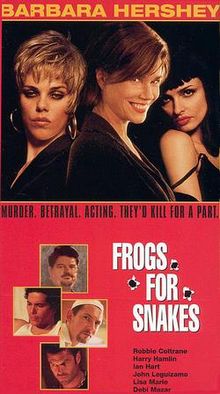
If you were suffering from insomnia last night, at around two a.m., you could have turned over to Flix and watched the 1998 film Frogs For Snakes.
And if you were suffering from insomnia, watching Frogs For Snakes would probably have been a good idea because this film is amazingly dull. In fact, I am not sure that I have the words to express to you just how tedious Frogs For Snakes truly was. It may be necessary for me to go back to school and learn how to speak in a dead language in order for me to express the boredom that I felt while watching Frogs For Snakes.
And yes, I realize that I’m talking about an obscure film that was released nearly 20 years ago and it might seem kind of petty to, at this late date, make a big deal about how terrible this film was.
But seriously, Frogs For Snakes was really, really bad. In fact, it was disturbing to think that a film this bad could have actually been made. It was even more disturbing to consider that this film was apparently given a theatrical release and, all these years later, still pops up on cable so that it can proudly display its overwhelming mediocrity.
Now, I’m going to tell you what Frogs For Snakes is about and you’re going to think, “That actually sounds like it might be kind of interesting.” Don’t be fooled! The film may sound interesting but it’s not.
Frogs for Snakes takes place in a stylized, neo-noir version of New York City. Eva Santana (Barbara Hershey) is an aging actress who claims to have quit the business, though it’s clear that it’s more a case of the business quitting her. She talks about leaving New York and raising her son in a better environment. However, until she gets around to leaving, she’s making ends meet by working as a waitress at a diner owned by the kind-hearted Quint (Ian Hart). And, of course, when she’s not waitressing, she’s working as a debt collector for her ex-husband, a loan shark named Al Santana (Robbie Coltrane).
That’s right, this actress has a gun and she uses it frequently. However, because Eva is good at heart, she rarely kills anyone. Instead, she just shoots them in the foot and tells them to pay back their loans while they lay on the floor and scream in agony. (All that agonized screaming got pretty old after a while.)
As for Al, he’s not just a loan shark. He’s a theatrical impressario. He’s planning on putting on a production of David Mamet’s American Buffalo. He promises his driver a role in American Buffalo on the condition that the driver assassinate Eva’s new boyfriend (John Leguizamo, of course).
Soon, actors all over New York are literally killing to get a role in Al’s play. Meanwhile, Eva just wants to retire and get out of New York but first, she has to do one last job for Al…
In between all the killing, the characters frequently launch into monologues that have been lifted from other films. John Leguizamo does a Brando imitation. Lisa Marie (Tim Burton’s ex, not yours truly) delivers the cuckoo clock speech from The Third Man. A suggestion for aspiring filmmakers: if you’re going to make a bad film, don’t remind your audience that they could be watching The Third Man instead.
Anyway, the plot sounds interesting but none of the potentially intriguing ideas are explored. I imagine that the film was meant to be a satire of Off-Broadway ruthlessness but ultimately, the film is just another tediously violent indie film from the 90s. This is one of those movies where nobody can do anything without spending an excessive amount of time talking about it beforehand and, when things do turn violent, it’s the worst type of quirky, sadistic, drawn-out, “look how crazy we are” violence.
There’s a scene towards the end of the film where Al shoots a group of people in a bar. This is intercut with clips from the Odessa Steps sequence from Battleship Potemkin. As Al leave, he shoots the TV showing Battleship Potemkin and, I have to say, that really annoyed me. Seriously, just as a bad filmmaker should not remind people that they could be watching The Third Man, he shouldn’t invite them to compare his film to Battleship Potemkin unless he’s willing to back up the comparison. When Al shot the TV, I found myself hoping that Sergei Eisenstein would pop up and shoot him.
Frogs for Snakes is one of the worst films that I’ve ever seen. It may, in fact, be the worst but I would need to rewatch Ted 2 before I said that for sure. But, if you have insomnia, Frogs For Snakes will at least put you to sleep.
Well, we all knew it would have to end someday and now, it’s over. The Harry Potter film series, which began way back in 2001, is concluding right now in a theater near you. On Friday night, me, Jeff, my sister Erin, and our friend Evelyn went down to the AMC Valley View and we saw Harry Potter and the Deathly Hallows, Part 2.
The cinematic story of Harry Potter is over and yes, I did cry as I watched it end. I didn’t just cry because of the movie, though the movie itself is one of the best of the year and it has one of those wonderful endings that just makes it impossible to remain dry-eyed. No, I cried because — with this film — an era of my life is truly over.
When the first Harry Potter film came out, I was only 16 and still trying to deal with the fact that I had been diagnosed as being bipolar just a few weeks earlier. I felt alone and broken and destined to spend the rest of my life on the outside looking in. The three hours that I spent watching Harry Potter and the Sorcerer’s Stone were three hours when I didn’t have to worry about suddenly bursting into tears and having everyone around me worrying about whether or not I was actually taking my hated medication. For three hours, I could escape to another world where those who were different were celebrated precisely because they were different. For three hours, I could imagine that just maybe I had a special purpose for existing too and maybe I had benevolent wizards and witches looking out for me too. And I’m sorry if all that sounds trite in retrospect but, when you’re 16 and you think you’re too damaged to love, anything that gives you hope and pleasure in the present is a precious treasure.
Over the years, I eventually came to realize that being bipolar was hardly a curse and, as I matured and grew up and discovered new things, there was always a Harry Potter film either playing or about to come out. Whether I was escaping high school, graduating college, or dealing with just every good or bad thing that makes up life, Harry Potter — this character who I first met (in book form) when I was 13 — was always there. So, at the risk of sounding overdramatic, the end of Harry Potter is the end of a chapter of my life.
One final personal note: As I watched Harry Potter and the Deathly Hallows, Part Two, I had three dolls (or action figures, as boys insist on calling them) in my purse. These dolls — Harry, Hermione, and Ron — came out around the same time as the second Harry Potter film and my mom (who collected dolls) ordered them off of Ebay three years ago, shortly before she entered the hospital for the final time. Now, my mom was not a huge fan of the Harry Potter series but she knew that I loved it and that’s why she made those dolls her final gift to me.
And those are some of the reasons why I found myself crying as I watched the finale of Harry Potter. However, there’s another reason why I cried and that’s that this is just a great film and the perfect conclusion to the series.
Essentially, Harry Potter and the Deathly Hallows, Part Two starts up immediately after the conclusion of Part One. Dobby is dead, Lord Voldemort (a wonderfully neurotic Ralph Fiennes) and the Death Eaters are intent on destroying everything, and Severus Snape (Alan Rickman, wonderful as always) is in charge of Hogwarts. After spending the first part of Deathly Hallows as fugitives, Harry Potter, Ron Weasley, and Hermione Granger (Daniel Radcliffe, Rupert Grint, and Emma Watson) return to Hogwarts to take a final stand against Voldemort. Things end in a surprisingly bloody battle (this film is not for children) that leaves several characters dead and ultimately reveals that one wizard wasn’t the saint we always assumed he was while another is revealed to be the secret hero of the entire series.
Let’s get one question out of the way right now: will non-Harry Potter fans be able to follow this film? Uhmmm…no. Sorry. Then again, why would a non-Harry Potter fan be at a film called Harry Potter and The Deathly Hallows Part Two anyway? I mean, seriously, if you’re just going to film because everyone else is doing it than who are you to bitch anyway? This is what you non-Harry Potter fans need to do. Stop reading this review. Go watch the previous Harry Potter films. Watch them in order. Take your time because Deathly Hallows is going to be in theaters for a while. And then, once you’ve become immersed in the story, go see how it all concludes. And then come back here and read rest of this review.
Okay, so is everybody up to date?
Cool.
One of the more interesting features of the Harry Potter series is that so many different directors (each with his own definite, individual style) have been involved in bringing these films to the screen. Among Harry Potter fans, hours can literally be spent debating the merits (and weaknesses) of Chris Columbus, Alfonso Cuaron, Mike Newell, and David Yates. My own theory is that each director was perfectly suited for each film he directed. The audience-friendly vision of Chris Columbus was what the first two films needed, just as Prisoner of Azkaban needed Cuaron’s far darker vision and Mike Newell’s attention to character made Goblet of Fire one of the best of the Harry Potter films. And while David Yates may not be as well-known (or critically acclaimed) as Newell or Cuaron, he brings exactly the right tone to Harry Potter and the Deathly Hallows, a perfect combination of spectacle and humanity. It is to Yates’ credit that the scenes in which the characters simply talk to each other are just as compelling as the dramatic sequences where Voldemort and the Death Eaters attack Hogwarts. Yates understands that this material could easily come across as silly or childish and to his credit, he never allows the audience to simply dismiss this film as a lot of blathering about wands and CGI magic. As opposed to other directors who have given us summer blockbusters, Yates takes his film seriously.
And, fortunately, so does his cast.
One of the great pleasures of the Harry Potter series is that it’s given American audiences the chance to discover (and rediscover) some of the great British character actors and a lot of them show up (some for only a matter of minutes) here in the finale. Maggie Smith, Jim Broadbent, Julie Walters, Robbie Coltrane, Gary Oldman, John Hurt, David Thewlis, Emma Thompson, and Jason Isaacs all put in appearances. Kelly MacDonald has a great scene playing a ghost, Helena Bonham Carter is perfect as the evil Bellatrix Lestrange, and Alan Rickman is brilliantly ambiguous as Severus Snape. (And yes, Snape’s actions are explained in this film and yes, I did cry.)
Ralph Fiennes plays so many villains that I now find myself expecting him to show up killing people in every movie I see. He’s like a British Christopher Walken. Still, it’s easy to take an actor like Fiennes for granted. For the entire Harry Potter series to work, Lord Voldemort can’t just be an ordinary villain. He’s got to be the sum total of all things evil and deadly. You’ve got to believe that people would be scared to speak his name. Great heroes need a great villain and Fiennes’ Voldermort is a great villain.
Ultimately, however, the true credit for the success of the Harry Potter series belongs to three actors who have literally grown up on the movie screen — Daniel Radcliffe, Rupert Grint, and Emma Watson. The producers are fortunate indeed that the cute kids that they cast over a decade ago have all grown up to be talented, attractive, and likable actors. If the first part of Harry Potter and the Deathly Hallows seemed to showcase both Grint and Watson (almost to Radcliffe’s expense), part 2 is most definitely centered on Harry Potter. That doesn’t mean that Watson and Grint aren’t good in this film. They are and they get to share one of the best movie kisses of 2011. (As well, for those who keep count, Grint says “Bloody Hell,” three times in the film.) But, for obvious reasons, this film is all about Harry and Radcliffe’s performance as Harry. It’s a challenge for Radcliffe and it’s a challenge that he more than succeeds at conquering. As the film ended, I realized that I was sad to know that the adventures of Harry Potter were done but I was excited to see what the future will hold for Radcliffe, Grint, and Watson.
Incidentally, Harry Potter and the Deathly Hallows Part 2 has been released in both 3-D and 2-D. We saw the 3-D version and if you have any knowledge of how I feel about 3-D (and how motion sick I tend to get while watching 3-D films) then that should show you just much I love the Harry Potter series. I loved it so much that I was even willing to overlook my hatred of 3-D. The 3-D here (which was added after the film has already been filmed) doesn’t really add much to the movie. There were a few cool moments where I was all like, “Look, I can reach out and grab a piece of Voldemort,” but otherwise, the 3-D was a negligible factor as far as the overall film was concerned.
Still, there was one interesting thing about the 3-D. The theater we saw the movie in was half-way empty. At the same time, the neighboring theater — in which the 2-D version was playing — had a line of people waiting to get in. They were not only waiting to see the 2-D version, they were waiting to see a showing that wouldn’t even begin until a full 90 minutes after the 3-D version started. I mention this because, in the wake of Avatar, so many people have taken it for granted that 3-D is the future of movies and soon, as long as a film is in 3-D, we won’t have to worry about the difficult stuff like an interesting plot or compelling characters. However, 3-D has become an overexposed gimmick. For every film like Cave of Dreams that uses 3-D to craft an actual artistic statement, there’s a 1,000 films like Priest which use 3-D just because it’s an easy way to trick sucks into spending an extra dollars to see a crappy film.
What so many filmmakers seem to forget is that the majority of film goers are not looking for 3-D. We’re just looking for a good film. And sometimes — like with Harry Potter and the Deathly Hallows — we get lucky and we find a great film.
(Oh, and one last thing: I know everyone always expects me to claim to be just like Hermione but actually, I’ve always related more to Ginny Weasley. Like her, I’m the youngest of four siblings, I’ve got red hair, and I always get my man, in the end.)

 Life on the planet Mongo is not easy. Aided by Darth Vader wannabe Klytus (Peter Wyngarde) and the sadistic General Kala (Mariangela Melato), the evil Emperor Ming (Max Von Sydow) rules with an iron fist. All of the citizens are heavily taxed and kept in a state of perpetual war in order to keep them from joining together and rebelling. Those who attempt to defy Ming are executed.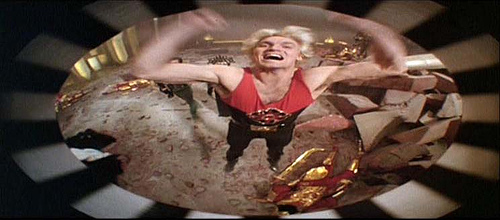




 Through the Shattered Lens