
In the year 1979, a young Steven Spielberg attempted to conquer comedy in the same way that he previously conquered horror with Jaws and science fiction with Close Encounters of The Third Kind. Working from a script written by Robert Zemeckis and Bob Gale, Spielberg made a film about the days immediately following Japan’s attack on Pearl Harbor. The name of the film was 1941 and it remains Steven Spielberg’s only attempt to direct a full-out comedy. There’s a reason for that.
The film follows a large group of characters over the course of one day and night in 1941. It’s been six days since Pearl Harbor was attacked and the streets of Los Angeles are full of young men who are preparing to ship out and older man who are paranoid about when the next attack is going to come. However, Major General Joseph Stilwell (Robert Stack) just wants to see Dumbo at the local theater. Meanwhile, his womanizing aide (Tim Matheson, giving the same performance here that he did in National Lampoon’s Animal House) just wants to get Stillwell’s aviation-lusting secretary (Nancy Allen) into an airplane.
Elsewhere, Ward Douglas (Ned Beatty) is happy to allow Sgt. Tree (Dan Aykroyd) and his men (including John Candy) to set up on an anti-aircraft gun in his front yard. Ward’s daughter, Betty (Dianne Kay), is only concerned about entering a dance contest with her friend, Maxine (Wendie Jo Sperber). Cpl. Sitarski (Treat Williams) and dishwasher Wally Stephens (Bobby D iCicco) both hope to be Betty’s partner and their rivalry leads to a massive (and seemingly never-ending) brawl.
While Ward deals with the gun in his front yard, another concerned citizen — Claude Crumm (Murray Hamilton) — keeps watch from atop of Ferris wheel, along with amateur ventriloquist Herbie Kazlminsky (Eddie Deezen).
But that’s not all! Susan Backilinie recreates her role from a previous Spielberg film, skinny dipping while the Jaws theme plays in the background and running straight into a submarine that is commanded by Commander Akiro Mitamura (Toshiro Mifune, trying to maintain his dignity). Mifune decides to attack Hollywood but no one on the submarine is sure where that is. Christopher Lee appears as an arrogant German who is along for the ride. Slim Pickens shows up as a lumberjack who is temporarily captured by the Japanese. John Belushi plays Wild Bill Kelso, who flies his airplane through Los Angeles. Warren Oates yells and laughs. Dick Miller, Elijah Cook Jr. and Lionel Stander show up in small roles.
“Since when is Steven funny?” According to Peter Biskind’s Easy Riders, Raging Bulls, this was the reaction that most of Spielberg’s friends had when he announced that his next film would be a screwball comedy set during World War II. Watching the film, one gets their point. The majority of the film’s humor comes from people looking at the camera and screaming. There’s a lot physical comedy, which would undoubtedly work in small amounts but which grows rather tiring when it’s dragged out to the extent that Spielberg’s drags it out. (A brawl at a USO show seems like it should be funny but Spielberg allows it to go on for too long and the careful choreography takes away any element of spontaneity.) The film attempts to duplicate the style of Animal House (and it’s probably not a coincidence that Matheson, Belushi, and director John Landis all have roles in the film) but Spielberg often seems as if he’s trying too hard. There’s nothing subversive about the humor. It’s more antic than funny.
A huge problem is that there really isn’t much of a story here. Spielberg, who is normally one of Hollywood’s best storytellers, attempts to do a loose, Altman-style ensemble film and the result is that none of the characters feel alive and there’s never any sense of narrative momentum. There are a few performers who manage to make an impression amongst all the explosions and the yelling. John Belushi has the advantage of not having to share the majority of his scenes with anyone else. Warren Oates’s manic energy is more than welcome. Wendie Jo Sperber deserved more screentime. Murray Hamilton and Eddie Deezen frequently made me laugh. There’s a wonderful moment where Robert Stack’s intense general cries while watching Dumbo. But, for the most part, the film never comes together.
That said, 1941 is definitely a Steven Spielberg film. It received three Academy Award nominations, for Cinematography, Sound, and Visual Effects. (All three of those categories, not surprisingly, are more associated with spectacle than with comedy.) The film looks great! Spielberg’s attention to detail is there in the production design and the costumes. Watching 1941, you can see Spielberg’s talent while also seeing why he never directed another comedy.
Previous Icarus Files:
- Cloud Atlas
- Maximum Overdrive
- Glass
- Captive State
- Mother!
- The Man Who Killed Don Quixote
- Last Days
- Plan 9 From Outer Space
- The Last Movie
- 88
- The Bonfire of the Vanities
- Birdemic
- Birdemic 2: The Resurrection
- Last Exit To Brooklyn
- Glen or Glenda
- The Assassination of Trotsky
- Che!
- Brewster McCloud
- American Traitor: The Trial of Axis Sally
- Tough Guys Don’t Dance
- Reach Me
- Revolution
- The Last Tycoon
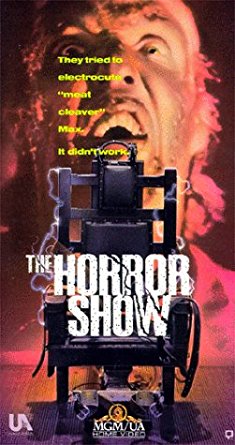 For the crime of having murdered over a 100 people, “Meat Cleaver Max” Jenke (Brion James) is sentenced to death and sent to the electric chair. Even though everyone thinks that Max was electrocuted, his electricity-fueled spirit is still alive and pissed off. If this sounds familiar, that is because it is the exact same premise that was used in
  Through the Shattered Lens