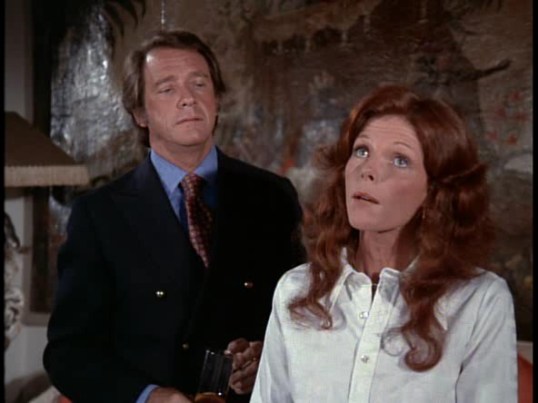
A Movie A Day #141: Breakheart Pass (1975, directed by Tom Gries)


California.  The 1870s.  Sheriff Pearce (Ben Johnson) boards a train with his prisoner, an alleged outlaw named John Deakin (Charles Bronson).  The train is mostly full of soldiers, under the command of Major Claremont (Ed Lauter), who are on their way to Fort Humboldt.  The fort has suffered a diphtheria epidemic and the soldiers are supposedly transporting medical supplies.

However, it’s not just soldiers on the train.  There’s also Gov. Fairchild (Richard Crenna) of Nevada, his fiancée (Jill Ireland), the Reverend Peabody (Bill McKinney), and a conductor named O’Brien (Charles Durning).  As the train continues on its journey, it becomes obvious that all is not as it seems.  People start to disappear.  A man is thrown from the train.  Two cars full of soldiers are separated from the train and plunge over a cliff.  There is also more to Deakin than anyone first realized and soon, he is the only person who can bring the murderers to justice.

In both real life and the movies, Charles Bronson was the epitome of a tough guy, so it’s always interesting to see him playing a more cerebral character than usual.  There are some exciting and surprisingly brutal action scenes, including a scene where Bronson fights a cook (played by former professional boxer Archie Moore) on top of the speeding train, but Breakheart Pass is more of a murder mystery than a typical action film.  If Louis L’Amour and Agatha Christie had collaborated on a story, the end result would be much like Breakheart Pass.  Bronson spends as much time investigating as he does swinging his fists or shooting a gun.  It’s not a typical Bronson role but he does a good job, showing that he could think as convincingly as he could kill.  Acting opposite some of the best character actors around in the 70s, Bronson more than holds his own.

Apparently, back in 1975, audiences were not interesting in watching Bronson think so Breakheart Pass was a disappointment at the box office and it is still not as well known as Bronson’s other films.  However, even if you’re not already a fan of the great Bronson, Breakheart Pass is worth discovering.

Horror on the Lens: House of Evil (dir by Gus Trikonis)


Today’s horror on the lens in 1978’s House of Evil!

When Richard Crenna buys a new house, he recruits a few friends to help him fix it up.  Unfortunately, it turns out that the house is haunted by the devil himself.  House of Evil — which is also known as The Evil — is an entertaining little time waster.  If the idea of being in a house with the devil doesn’t scare you, just check out some of those the 1970s fashion choices!

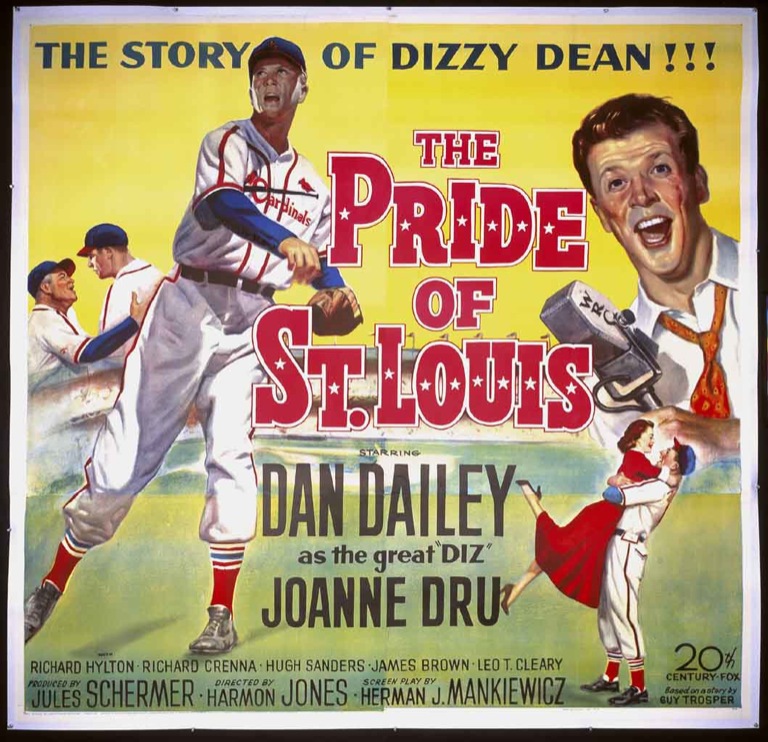
Wild Pitch: THE PRIDE OF ST. LOUIS (20th Century-Fox 1952)


gary loggins's avatarcracked rear viewer

diz1

Jerome Herman “Dizzy” Dean, ace pitcher of the St. Louis Cardinals’ famed “Gashouse Gang” in the 1930’s, gets the Hollywood biopic treatment in this pleasant little film. The malaprop prone Dizzy was one of the game’s greats before an unfortunate injury, leading to him becoming a well-loved broadcaster. The film sticks fairly close to the facts, as Dean was a colorful enough character to need little embellishment.

diz4

THE PRIDE OF ST. LOUIS follows Dean’s career as he’s discovered pitching in his Arkansas hometown, through the minors, and finally to big league success with the Cardinals. Along the way he woos and wins the love of his life, Patricia. Soon his brother Paul joins the team, and the pair become as well-known for their off-field antics as for their pitching prowess.

The movie takes a turn when Dizzy is injured during an All Star Game and tries to come back too soon. His arm is ruined, but Dizzy can’t…

View original post 516 more words

Horror on the Lens: Death Ship (dir by Alvin Rakoff)


Today’s Horror on the Lens comes to use from 1980.  In Death Ship, a cruise ship collides with a mysterious black freighter.  When the survivors board the freighter, they discover that it appears to be deserted.  But is it really?  As the survivors explore, they start to suspect that they might not be alone.  Even worse, the already unstable captain (George Kennedy) starts to hear a mysterious German voice, encouraging him to kill everyone else and stay on the freighter forever.

It’s kinda like The Shining, except it takes place on a boat and it’s not as good.

But then again, very few horror films are as good as The Shining!  Death Ship is an enjoyably pulpy exercise in ghostly horror and it can actually be quite scary, especially if you have an obsessive fear of drowning, like I do!

Plus, George Kennedy really puts his heart and soul into being possessed.

Watch Death Ship below!


Embracing the Melodrama Part II #45: Double Indemnity (dir by Jack Smight)


di3vh6

Nothing can make you appreciate a classic film more than by watching a really bad remake.  As proof, I would offer up the 1973 made-for-television version of the classic 1944 film Double Indemnity.  The original Double Indemnity is a classic example of film noir, one that remains intriguing and powerful over 70 years since it was first released.  The remake features the exact same plot as Double Indemnity and a few of the original’s scenes are recreated shot-by-shot but it just does not work.

Part of the problem is that the remake is in color.  In fact, since it was made in 1973 and for television, it’s in very bright and somewhat tacky color.  Bright and vibrant doesn’t work for film noir.  You need the shadows and the visual ambiguities that are unique to black-and-white.  If the original Double Indemnity was full of secrets and mysteries, the remake is all on the surface.  There are no secrets to be found in this remake.

That goes for the cast as well.  In the original, Fred MacMurray made Walter Neff into the epitome of the bored, post-war American male.  You watched him with a certain sick fascination, trying to figure out what was going on behind the blandly friendly facade.  In the remake, you know that Richard Crenna is a serpent from the minute he first appears.  If MacMurray’s Walter was motivated by ennui, Crenna’s Walter is just bad and therefore, far less interesting.  Meanwhile, in the role of Phyllis, Samantha Eggar has none of Barbara Stanwyck’s ferocious determination.  Instead, Eggar’s performance is curiously refined (which is another way to say boring).

Probably the most interesting thing about the remake of Double Indemnity is that the role of Keyes is played by Lee J. Cobb.  Cobb actually gives a pretty good performance and, unlike Crenna and Eggar, he’s actually entertaining to watch.  In the original film, Keyes was played by Edward G. Robinson and was roughly around the same age as Walter.  They were contemporaries and friends and that made the original’s ending all the more poignant.  In the remake, Cobb is quite a bit older than Crenna and, as a result, their relationship feels more paternalistic.  It’s almost as if Crenna is the prodigal son who has betrayed his father and who tells his story as a way of begging for forgiveness.

But that’s probably reading too much into the remake!  For the most part, the remake of Double Indemnity is bland and boring.  The best thing about it is that it’ll make you love the original even more.

As for how I ended up watching the remake of Double Indemnity, it was included as an extra on my DVD of the original.  Watching them back-to-back, as I did, really serves to make you appreciate Billy Wilder as a filmmaker.

Lisa Watches An Oscar Nominee: The Sand Pebbles (dir by Robert Wise)


The_Sand_Pebbles_film_posterAfter watching Witness For The Prosecution, I continued TCM’s 31 Days of Oscar by watching the 1966 Best Picture nominee, The Sand Pebbles.

Considering that The Sand Pebbles is close to four hours long, it’s interesting how little there is to really say about it.  Taking place in 1926, The Sand Pebbles follows the crew of the USS San Pablo, a gunboat that patrols the Yangtze River in China.  The San Pablo is there to protect American business interests, which are in particular danger because China is caught up in a communist revolution.  For the most part, the crew of the San Pablo are portrayed as being lazy and racist.  They have little interest in understanding the culture of the people around them and they use Chinese laborer to do the work on the boat.

When Jake Holman (Steve McQueen) is transferred to the San Pablo, he upsets his fellow crewmen by insisting on working in the ship’s engine room himself, the fear being that if Holman is willing to work then the rest of them will be expected to work as well.  The ship’s commander, Lt. Collins (Richard Crenna), views Holman as being a threat to morale and starts to make plans to get Holman off of his boat.  But, first, the boat is going to have to get out of China…

The Sand Pebbles is an episodic film and some of those episodes are more interesting than others.  Typically, an episode will start out positively and then end with some sudden tragedy.  For instance, Holman trains one laborer (Mako) to be a boxer and then watches as he beats the most racist crewman on the ship.  However, just a few minutes later, the laborer is captured and savagely tortured by the communists and Holman is forced to perform a mercy killing.

In another subplot, Holman’s only friend, Frenchy (Richard Attenborough), marries a local prostitute (Emmanuelle Arsan, who would later write an autobiography that would serve as the basis for a very different type of film).  However, in order to see his wife, Frenchy has to continually swim to shore in the middle of the night.  Frenchy soon develops pneumonia and dies while his wife is dragged off and apparently executed.

And finally, Holman strikes up a romance with Shirley Eckert (Candice Bergen), an innocent missionary.  However, when her arrogant and naive boss, Jameson (Larry Gates), refuses to leave the country despite the revolution, the San Pablo is ordered to rescue them.  This, of course, leads to a final battle with the communists which leaves a good deal of the cast dead.

As I watched The Sand Pebbles, my main impression was that it was an extremely long movie.  The film’s climatic battle was exciting and Steve McQueen (not to be confused with the director of 12 Years A Slave and Shame) gave a good performance but otherwise, the film often seemed to drag.  While the movie’s theme of Americans struggling (and failing) to understand another country’s culture had a definite resonance, The Sand Pebbles did not seem to be quite sure what it truly wanted to say about it.

Let’s face it — over 500 films have been nominated for best picture.  And, while a good deal of them hold up surprisingly well and are still entertaining to watch, there’s also a handful like The Sand Pebbles, ambitious films that never quite reached their potential but were probably nominated because they seemed like the type of epic film that should be nominated.  Many of these films were nominated and a few even won.

However, in the case of The Sand Pebbles, a nomination would have to be enough.  That year, the Oscar for Best Picture was won by A Man For All Seasons.