Embracing the Melodrama Part III #1: No Down Payment (dir by Martin Ritt)


Back in 2014 and 2015, I did a series of reviews that I called Embracing the Melodrama, in which I reviewed some of the best (and worst) melodramas ever made.  All together, I reviewed 186 films as a part of Embracing the Melodrama, everything from Sunrise to Reefer Madness to The Towering Inferno to Cocaine: One Man’s Seduction.  I had so much fun doing it that I’ve decided to do it again.

No, don’t worry.  I’m not going to attempt to review 186 films this time.  Instead, for Embracing The Melodrama Part III, I am going to limit myself to reviewing 8 films.  I’ll be posting one Embracing the Melodrama review a day, from now until next Sunday.

Let’s kick things off with 1957’s No Down Payment, a film about life in … THE SUBURBS!

(cue dramatic music)

The suburbs!

Is there any place in America that’s more dramatic?  Is it any wonder that, since the early 50s, films have regularly been using the suburbs as an example of everything that’s apparently wrong with America?  Every year sees at least one major film about how terrible life is in the suburbs.  Last year, for instance, George Clooney directed a film called Suburbicon, which was regularly cited as a possible Oscar contender before it was released and everyone was reminded of the fact that George Clooney is a terrible director.  That said, I can understand why filmmakers continue to be drawn to the suburbs.  Secret affairs.  Dangerous drugs.  Duplicitous children.  Fractured families.  Barbecuing alcoholics.  Undercover occultists.  You can find them all in the suburbs!

No Down Payment opens with David (Jeffrey Hunter) and Jean Martin (Patricia Owens) driving down a California highway and looking at the billboards that dot the landscape.  Every billboard advertises a new community, inviting people to make a new and better life away from the crowded city.  David and Jean smile, amused by how blatant all of the ads are.  That’s when they see the billboard that’s advertising their new home:

Sunrise Hill Estates

A Better Place For Better Living

Soon, David and Jean are moving into their new home and meeting their new neighbors.  It turns out that most of the houses in Sunrise Hill Estates are available for “no down payment” and the majority of the residents are struggling financially.  Though David may look at all of his neighbors and say, “Looks like everybody here is living a wonderful life,” the truth is something far different.

(If David’s line sound a bit too on the nose and obvious, that’s because almost all of the dialogue in No Down Payment was too on the nose and obvious.  As a side note, “on the nose” is an extremely strange expression.)

David’s neighbors include:

Herm Kreitzer (Pat Hingle) and his wife, Betty (Barbara Rush).  Herm owns an appliance store and sits on the town council.  Herm is gruff but likable.  He’s the leader of his neighborhood and he welcomes the Martins with a backyard party.  Herm’s employee, Iko (Aki Aleong), wants to move to Sunrise Hill but no one is willing to give him a reference because he’s not white.

Troy Boone (Cameron Mitchell) and his wife, Leola (Joanne Woodward).  We know that Troy is going to be trouble because he’s played by Cameron Mitchell.  We know that we’re going to like Leola because she’s played by Joanne Woodward.  Troy’s an auto mechanic and a veteran.  He wants to be appointed the chief of police but the town is reluctant to hire him because he doesn’t have a college education.  Leola wants to have a child but Troy says that they can’t even think about that until he has a good job.

And then there’s Jerry Flagg (Tony Randall) and his wife, Isabelle (Sheree North).  Jerry is a used car salesman and he’s also a drunk.  Jerry spends most of the movie hitting on other women and embarrassing Isabelle.  Jerry has no impulse control and, as a result, he’s heavily in debt.  His only hope is that he can convince a family to buy an expensive car that they really don’t need.  When last I checked, that’s what a used car salesman is supposed to do.

The film deals with a lot of issues — prejudice, sexism, economic insecurity — that are still relevant today.  Unfortunately, the film itself is a bit slow and what was shocking in the 50s seems rather jejune today.  Watching the film, you get the feeling that, as with many films of the 50s, all of the interesting stuff is happening off-screen.  That said, the film has an interesting cast.  Jeffrey Hunter and Patricia Owens are a bit dull as the Martins but then you’ve got their neighbors!  Any film that features Cameron Mitchell glowering can’t be all bad but the best performance comes from Tony Randall, who is memorably sleazy and desperate as Jerry Flagg.  For a fun experiment, watch this film right before watching Will Success Spoil Rock Hunter?

Tomorrow, we’ll continue to embrace the melodrama with 1961’s Common Law Wife!

Film Review: Hard Hunted (dir by Andy Sidaris)


Uh-oh!  A master criminal is trying to sell a nuclear device to terrorists and it’s up to the most secret law enforcement agency in the world to stop him!  How secret is this agency?  It’s so secret that it’s based in Dallas but most of its agents live in Hawaii.  It’s so secret that there’s an entire Hawaiian radio station that exists for the sole purpose of broadcasting heavily coded messages.  It’s the type of agency that continues to employ an agent who can’t shoot a gun and where the completion of successful mission is celebrated with a hot tub party.

As you probably guessed, 1992’s Hard Hunted is an Andy Sidaris film.

Hard Hunted picks up where Do Or Die left off.  Master criminal Kane is still at large and planning to do various evil things.  It’s up to Donna (Dona Speir) and Nicole (Roberta Vasquez) to catch him but their search for him mostly seems to mostly amount to spending a lot of time sunbathing in Arizona.  Fortunately, there are two other agents, currently working undercover as members of Kane’s operation.  Considering how dangerous and evil Kane apparently is, you have to wonder why the agency never just takes out Kane.  I guess that wouldn’t be ethical or something.

In Do Or Die, Kane was an elderly Japanese man who made a big deal about fair play and his code of honor.  In Hard Hunted, Kane is suddenly a young and handsome British man.  He’s played by RJ Moore, who was the son of Roger Moore.  Kane is now charming and sexy and that’s good.  If you’re the type who continually threatens to destroy the world, you should definitely be hot because otherwise, people are going to get sick of you.

Anyway, Kane has a nuclear trigger device that he wants to sell to terrorists.  He keeps the device hidden in a jade Buddha.  One of the undercover agents manages to run off with the trigger so Kane sends his number one henchman, Raven (Al Leong), to retrieve it before it gets into the hands of Donna and Nicole.

There are two things to notice about Raven.

First off, as you can tell from the picture above, Raven wears a jacket with a lion’s hand emblem on it.  Kane is apparently big into branding because all of his henchmen wear clothing with the lion’s head emblem.  It would seem to me that, when you’re a global supper villain, it might be a mistake to advertise yourself but Kane apparently feels differently.

The other good thing about Raven is that he’s played by Al Leong.  Leong, who got his start as a stuntman, is a character actor who has been playing evil henchman since the 1980s.  Leong always brings a lot style to these roles and he does so again in Hard Hunted.  In fact, he’s the second best thing about this largely misbegotten movie, right behind his helicopter.

Anyway, as for the film itself, it’s stupid even by the standards of Andy Sidaris.  This time, most of the action takes place in Arizona.  The biggest plot development is that Donna strikes her head on a rock and spend the latter half of the film suffering from amnesia and being held hostage by Pico (Roberto Obregon).  While Donna’s out-of-commission, it’s up to Bruce (Bruce Penhall), Shane (Michael Shane), and Nicole to step up and take care of the situation.  It’s all typical Sidaris mayhem, with stuff blowing up and final justice being meted out with yet another rocket launcher.

It may not make any sense, but at least it has Al Leong and a helicopter!

Book Review: Goldfinger by Ian Fleming


(SPOILERS)

In 1959, Ian Fleming introduced a character who would go on to become the quintessential James Bond villain.  His name? Auric Goldfinger.

When I reread Goldfinger, Fleming’s seventh Bond novel, I was surprised to discover just how faithful the 1964 film adaptation really was.  True, there were a few differences.  While Jill Masterson was still killed via gold paint, it happened off-stage in the book and long after Bond had already left Miami.  Meanwhile, Jill’s sister, Tilly, survived far longer in the book than she did in the movie.  Pussy Galore, on the other hand, doesn’t appear until the very last few chapters of the book.  There’s no scene with Bond being threatened by a laser.  Goldfinger never laughs and says, “I expect you to die.”

And yet, while reading Fleming’s novel, it was impossible for me not to visualize Gert Frobe and Harold Sakata as Goldfinger and Oddjob.  Outside of the actors who have played Bond, the casting of Frobe and Sakata in the film version of Goldfinger may have been the two best casting decisions in the history of the Bond franchise.  And while that giant laser never made an appearance, Oddjob’s killer hat was present in the novel and loving described by Fleming.

Goldfinger’s lunatic plot to rob Fort Knox is present in both the novel and the book, though it’s somehow even more implausible in the book than in the movie.  What’s interesting is that, from the minute Bond hears about Goldfinger’s plot, Bond continually says that it’s a crazy plan that can’t possibly succeed.  Fleming never makes much of an effort to convince us that Bond could possibly be wrong about Goldfinger’s plan, either.  For once, the threat isn’t that the villain will succeed.  The threat is that Goldfinger will cause even more damage while failing.  Bond’s mission is less to thwart Goldfinger than to contain him.

With a personality that is somewhat reminiscent of Moonraker‘s Hugo Drax, Goldfinger is one of Fleming’s best bad guys.  Though there’s nothing subtle about Goldfinger, his flamboyant and cocky villainy serves as a nice contrast to James Bond’s more serious-minded personality.  Like many Bond villains, Goldfinger is so defined by his single obsession (in this case, with gold) that he doesn’t show any interest in any of the activities — drinking, smoking, having sex — that tend to define Bond as a character.  That’s one of the reoccurring themes to found in Fleming’s work.  Men who do not indulge in “gentlemanly vices” are almost always evil.

It’s a good and entertaining book, marred only by some foolishness towards the end in which Bond is upset to realize that 1) Tilly Masterson is a lesbian and 2) she’s more attracted to Pussy Galore than to him.  In fact, during Goldfinger’s assault on Fort Knox, Tilly ignores Bond’s orders and goes looking for Pussy instead.  (I know, I know.  Stop it.)  Tilly is promptly killed by Oddjob and Bond mournfully considers that she would still be alive if only she had been attracted to men instead of women.

(As I mentioned in my review of Live and Let Die, Fleming may have been a “man of the world” but he was also a product of his time and all the prejudices that went along with it.)

Fleming would follow Goldfinger with a collection of short stories.  The next James Bond novel, Thunderball, would not appear until 1961.  We’ll take a look at it tomorrow.

Music Video of the Day: Happy by Robert DeLong (2013, dir by ????)


It’s a happy song but kind of a disturbing video.

What exactly is happening in this video?  I’ll leave that for you to interpret.  All I’ll say is that it reminds me of my favorite movie about cults, Ticket to Heaven.

Then again, if you can remain happy after slipping in a pool of blood then you’ve obviously achieved something.

Enjoy!

Film Review: Do or Die (dir by Andy Sidaris)


So, imagine this.

You and your BFF are at a luau in Hawaii.  Fires are being spun.  People are dancing.  Drums are being beaten.  It’s almost time to eat the pig and suddenly, you discover that a mysterious old man wants to speak to you.  The man is surrounded by armed guards but you’re used to that.  Both you and your BFF work for the government.  You blow things up and save the world for a living!

Anyway, the old man informs you that he is a master criminal named Kane.  He’s one of those “I’m going to take over the world” types but apparently, you keep thwarting his plans.  He’s a little bit upset about that and why not?  It’s hard enough trying to conquer the world without having somebody continually blowing up all of your friends.  He says that he’s going to have you killed.

Uh-oh!

But fear not!  Kane isn’t going to kill you right there and then.  It turns out that Kane has a code of honor that he lives by.  He may be evil but he believes in fair play.  So, Kane says that he’s going to kill you later.  Apparently, he’s hired six different teams of assassins.  Over the next couple of days, they’re going to try to kill you.  Fortunately, the team’s aren’t going to work together or anything intelligent like that.  That wouldn’t be fair.  Instead, they’re going to come at you one at a time.  Once one teams fails to kill you, they’re out of the hunt.

How would you react?  What would be the first thing that you and your BFF would do?

Would you make sure your guns were loaded, lock the doors, and then wait for the first team to make their move?

Would you try to make the first move, maybe trying to take out Kane right then and there?

Or maybe you would leave the country and try to start a whole new life under a new identity?

I’d probably go with the third option but that’s not what Donna (Dona Speir) and Nicole (Roberta Vasquez) do when Kane (Pat Morita) tells them that they’ve been targeted.  Instead, they get topless and relax in the hut tub while discussing how much it sucks that someone wants to kill them.

Honestly, this shouldn’t come as a surprise.  The 1991 film, Do or Die, was directed by Andy Sidaris.  In a Sidaris film, a topless hot tub party plays much the same role as the family get togethers that often end the Fast and the Furious movies.  Still, it’s hard not to be a little bit disappointed by their sudden passivity.  After all, Donna is the same agent who previously used a rocket launcher to blow up Erik Estrada at the end of Guns.

Speaking of Erik Estrada, he’s back.  However, he’s playing a different character than he played in Guns.  Now, he’s a heroic agent named Rico.  When Donna and Nicole finally get around to letting their boss, Lucas (William Bumiller), know what’s going on, Lucas recruits Rico to help protect them.  Bruce Christian (Bruce Penhall) and Shane Abilene (Michael Shane) are also brought in as well.  Shane still has terrible aim.  I know that’s a running joke in all of the Sidaris films but you really do have to wonder why the government continues to employ someone who sucks at a huge part of his job.

Anyway, Donna and Nicole eventually head for the mainland but that doesn’t do much good because Kane put a tracking device on her watch and Donna apparently lost several IQ points between the end of Guns and the start of this movie.  At first, they go to Vegas but eventually, they end up in Louisiana.  This leads to the usual remote-controlled boats and helicopters, the same ones that appear in nearly every Sidaris film.  Needless to say, a lot of stuff gets blown up.

And it’s all pretty boring, to be honest.  It sounds like it should be fun, what with all the different assassins showing up and Kane getting more and more frustrated as Donna and Nicole continue to survive.  But, unfortunately, none of the assassins are that interesting.  Most of the film takes place in Caddo Parish.  My family lived in Shreveport for a year and a half.  I like Caddo Parish.  But it really can’t compare to Hawaii as far as photogenic locations are concerned.

Do or Die had potential but it got lost in the hot tub.

Book Review: Dr. No by Ian Fleming


Having survived his creator’s attempt to kill him off at the end of From Russia With Love, British secret agent James Bond returned in the 1958 novel Dr. No.

When Dr. No begins, M is concerned that his top agent might no longer have what it takes.  After all, James Bond barely survived his previous mission.  The doctors say that he’s recovered,  Bond has spent months in rehab.  Bond is desperate for a new mission but M still has his doubts.  So, he gives Bond what should be an easy assignment.  He sends 007 to Jamaica, to investigate the strange disappearance of John Strangeways and his secretary.  (Strangeways previously appeared in Live and Let Die.)

It turns out to be anything but simple.  As soon as Bond arrives, it becomes obvious that the mysterious Dr. No was somehow involved in whatever happened to Strangeways.  Dr. No lives on a remote island and has made a fortune through the cultivation of bat guano.  (Eck!)  With the help of the loyal Quarrel and the beautiful Honeychile Ryder, Bond sets out to find out what Dr. No is actually up to.  Of course, the natives say that Dr. No is protected by a dragon.  Bond says that’s foolish but then the dragon shows up…

But it’s not just the dragon that Bond has to look out for!  There’s Dr. No himself.  When we finally meet Dr. No, we discover that he’s basically a cyborg.  Oh, he’s never called that, of course.  I don’t even know if “cyborg” was a word in 1958.  But Fleming delights in telling us about Dr. No’s metal hands and the way that he glides across the floor.  Fleming also delights in telling us all about the ins and outs of bat guano.  Fleming came up with many creative deaths for his Bond novels but Dr. No is the first to feature suffocation by bat shit.

Dr. No is a departure from Fleming’s previous books, all of which may have featured villains with odd names but, at the same time, remained somewhat realistic.  Dr. No, on the other hand, is so fanciful that it almost reads as being satire.  Everything from Dr. No’s megalomania to Honeychile Ryder’s first appearance on the beach suggests that Dr. No is intentionally written to take place in a bigger-than-life fantasy world.  That doesn’t mean that it’s a bad book.  In fact, it’s one of Fleming’s more entertaining novels.  But it’s almost as if, having brought Bond back to life, Fleming was determined to take a break from the real world with his next novel.

Interestingly, Dr. No started life as a non-Bond related screenplay.  Though Fleming ultimately abandoned the script, he used it as the inspiration for his next book.  It’s appropriate that, from such beginnings, Dr. No went on to serve as the basis of the first Bond film.

Music Video of the Day: Do or Die (remix) by Afrojack featuring 30 Seconds To Mars (2014, dir by ????)


Afrojack vs. Thirty Seconds to Mars?

Well, Thirty Seconds To Mars has Jared Leto.  But Afrojack is Afrojack.  My money has to be on the guy who didn’t appear in the worst movie to come out of the DCEU so far.

Anyway, enjoy!

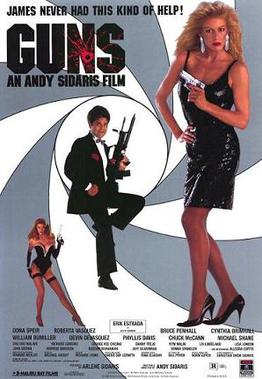
Film Review: Guns (dir by Andy Sidaris)


As you can probably tell by looking at the poster at the top of this review, the 1990 film Guns was Andy Sidaris’s attempt to make a Bond film.  Not only does the poster feature a man in a tuxedo and two gun-wielding women but the tag line even reads, “James Never Had This Kind of Help!”

(Of course, that’s not really true, as anyone who has seen Dr. No, Goldfinger, The Spy Who Loved Me, or For Your Eyes Only can tell you.)

Much like a Bond film, Guns features a secret agent fighting to defeat an international conspiracy.  The agent’s efforts lead her and her allies to several different cities in several different … well, really only one country.  Being a Sidaris film, it’s doubtful the Guns really had the budget to film anyplace other than the United States but still, the action does move from Lake Huvasa, Arizona to Hawaii to Las Vegas.  That’s about as close as a Sidaris film ever gets to featuring exotic locations.

(If Lake Havusa sounds familiar, that’s because Jimmy Kimmel gave away at trip to Lake Havusa during the Oscars.)

And like any good Bond film, Guns has a flamboyant and almost comically evil villain.  Juan “Jack of Diamonds” Degas (telenovela star and future reality tv mainstay Erik Estrada) is an international gun dealer and an all-around sociopath.  He’s the type who shoots someone and then smirks about it.  He’s so evil that he’s even got Danny Tejo working as his main henchman!  That’s really evil!  Estrada gives a surprisingly good performance in the role.  Especially when compared to the forgettable villains who appeared in Sidaris’s previous films, Juan Degas feels like a worthy opponent.  It’s not just that he’s evil.  It’s that he’s so damn smug about it.  You can’t wait to see him get taken down.

Degas is planning on smuggling a bunch of Chinese weapons into America through a base on Hawaii.  The only problem is that Donna (Dona Speir) and her new partner, Nicole Justin (Roberta Vasquez), are based in Hawaii!  Degas knows that he has to get rid of them if he’s going to have any hope of succeeding.  (For whatever reason, it never occurs to Degas to smuggle the weapons through Guam or American Samoa. I mean, there are other islands out there.)  When Degas sends two cross-dressing assassins to kill Nicole, they end up not only shooting the wrong woman but also killing a friend of Dona’s as well.

Now, it’s personal!

Except, it was already personal.  In a typical example of Sidaris’s make-it-up-as-you-go-along style of  plotting, it turns out that Degas previously killed Donna’s father.  And now, it appears that it might get even more personal because Degas has kidnapped the Attorney General of Nevada, who happens to be Donna’s mother!

Obviously, this means that it’s time to gather together another group of misfit agents and take down the bad guys.  That means that Savage Beach‘s Shane Abilene (Michael J. Shane) and Bruce Christian (Bruce Penhall) both show up again.  It also means that a lovable magician named Abe (Chuck McCann) gets to help out as well.  Unfortunately, one member of the team is eventually blown up by a remote control boat.

That’s right!  A remote control boat!  For some reason, remote control vehicles were a Sidaris obsession and it’s not a Sidaris film without someone getting blown by either a remote control boat or helicopter.

Anyway, there’s a lot of explosions to be found in Guns but the good thing is that it’s women blowing stuff up and it’s women who are in charge of the entire operation.  That’s the thing with a Sidaris film like this one.  For all of the nudity and the double entendre-filled dialogue, Guns was an action film where women got to shoot the guns, beat up the bad guys, and ultimately save the world from a smirking misogynist.  When Donna picked up that rocket launcher, it was both ludicrous and empowering at the same time.

Guns is one of Sidaris’s better films.  For once, despite all of the usual Sidaris red herrings, the plot can actually be followed and Estrada is an appropriately hissable villain.  While the film may not be able to compete with the best of the Bond films, it’s still more fun that SPECTRE.

Book Review: From Russia With Love by Ian Fleming


(MAJOR SPOILERS)

First published in 1957, the fifth James Bond novel was nearly the last.  Despite the success of the previous books, Ian Fleming was growing tired of the yearly obligation of coming up with a new adventure for James Bond.  His health failing and his marriage strained, Fleming wrote to his friend Raymond Chandler, “My muse is in a very bad way … I am getting fed up with Bond and it has been very difficult to make him go through his tawdry tricks.”

Perhaps that’s why From Russia With Love could have easily been retitled “The Death of James Bond.”

In fact, the promise of death hangs over every paragraph of From Russia With Love.  Bond doesn’t even make a personal appearance until halfway through the book.  Up until that point, we spend our time with the men and the women who are plotting his death.  The Russians not only want to kill Bond but they want to do so in a way that will embarrass the British secret service.  What better scheme than to use the naive Tatiana Romanova to entice Bond and get Bond to lower his guard long enough to be killed by their top assassin, the sociopathic Red Grant?

Indeed, From Russia With Love is unique among the Bond books in that the reader spends almost the entire book a few steps ahead of Bond.  While Bond thinks that he is helping Tatiana defect to the West, we’re aware that Red Grant is waiting just around the corner.  And while Bond is often unsure about whether Tatiana is really in love with him, we know that she is but we also know that the Russians consider her to be expendable.

Up until the final few chapters, Bond is almost as passive a character in From Russia With Love as he was in Casino Royale.  When he arrives in Turkey to investigate Tatiana, he spends most of his time being led around by the older Darko Kerim.  Much as in Casino Royale, Bond is a bit of a student, one who is briefly disturbed when Kerim ruthlessly assassinates an enemy agent.  Kerim is one of Fleming’s best creations, an outspoken spymaster who is so full of life that he often overshadows Bond.  It’s only when Kerim is dead that Bond can step up into his usual heroic role.

Throughout the book, Fleming appears to be fascinated by everyone but James Bond.  However, the change-of-pace actually works out surprisingly well.  Grant, Tatiana, Kerim, and the dangerous Major Rosa Klebb are such memorably drawn characters that it doesn’t matter that Bond spends most of the book in the background.  More than being a good Bond novel, it’s a genuinely exciting thriller.

And then there’s that ending.  After originally ending with Bond and Tatiana going off on a typical Bondian jaunt, Fleming revised the book’s conclusion.  Now, the book ended rather abruptly with Bond, having been poisoned by Major Klebb, crashing to the floor.  If you ignore the fact that you’re reading a James Bond novel then it’s obvious that the Russians have succeeded in assassinating MI6’s best agent.  That may have been Fleming’s intention but, of course, that’s not the way things turned out.  Instead, Bond would return a year later in Dr. No.

And why not?  From Russia With Love was the best Bond novel up to that point.  (I consider it to be the second best of Fleming’s Bond novels, behind On Her Majesty’s Secret Service.)    Fleming may have been growing bored with Bond but readers?  They loved him.

Up next: Bond gets strange with Dr. No!

Music Video of the Day: Think of England by Bear’s Den (2015, dir by Gareth Phillips)


Apparently, “think of England” is the advice that was once given to British wives who no longer enjoyed having sex with their husband, that one should simply lie back and “think of England.”  Apparently, thinking of France would lead to divorce.

Yeah, this isn’t a particularly happy song.  But it sounds nice and I enjoy the bleakness of the video’s black-and-white cinematography.

Enjoy!